
… over the past few years the term has been appropriated and sloganised by the cult of social justice. “Woke” is no longer simply a matter of standing up to racism, but is irrevocably connected to the authoritarian mindset of the identitarian left. Rather than confront bad ideas through discussion, debate, ridicule and protest, those who self-identify as “woke” would sooner intimidate their detractors into silence through what has become known as “cancel culture”. More insidiously, they have sought to empower the state and strengthen hate-speech laws, which curb individual freedom. They do all this in the belief that theirs is a righteous cause, but their illiberal actions ultimately bolster the very ideas they purport to despise.
Moreover, this monomaniacal need to expose an ever-expanding set of “phobias” in society means that they end up detecting prejudice even where it does not exist. In the absence of evidence of racism the woke have a habit of simply concocting it; hence the continual emphasis on “unconscious bias”, “white privilege” and “institutional power structures”. Such ideas have germinated over many years in academia – particularly in the postmodern branches of critical theory – and have since seeped into the mainstream.
This is why the public is routinely confronted with absurd articles in the media grounded in an extreme form of intersectionality. One, for instance, claims that white women are “evil”, another that white DNA is an “abomination”. Barely a day goes by without some frenzied denunciation of a movie or a television series for its lack of diversity and positive representation, as though the function of the arts is to send a message that accords with identitarian values.
Few members of the public are entirely familiar with the jargon (“cisgender”, “mansplaining”, “toxic masculinity”), but are assured nonetheless that the premises are indisputable. There’s a very good reason why the Catholic Church resisted translating the Bible into the vernacular for so long. Those in power are always threatened when the plebeians start thinking for themselves and asking difficult questions.
Some commentators have recently raised concerns that “woke” has been weaponised by the far right as a slur against anti-racist campaigners. Afua Hirsch, for instance, has claimed in the Guardian that anyone using the word is “likely to be a right-wing culture warrior angry at a phenomenon that lives mainly in their imagination”. This strikes me as particularly odd, given the Guardian‘s own frequent use of the word, including in headlines such as “Can a woke makeover win Barbie and Monopoly new fans?” and “My search for Mr Woke: a dating diary”. Perhaps Hirsch’s colleagues are further to the right than is generally supposed.
Andrew Doyle, “Why I’m anti-woke”, Spiked, 2020-02-04.
April 26, 2025
QotD: “Woke”
April 11, 2025
Critical Trade Theory
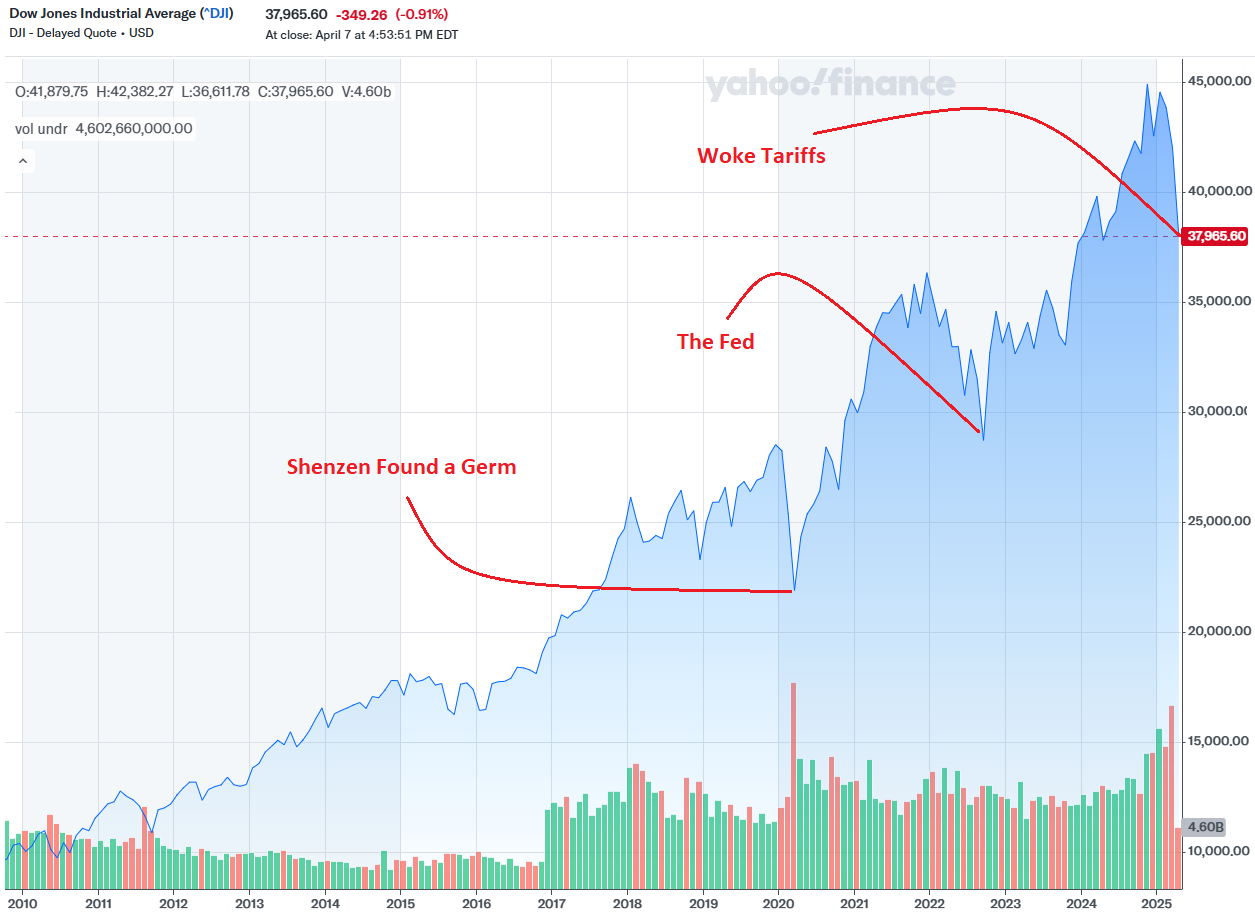
A discussion at the amusingly named Handwaving Freakoutery on the ongoing wave of tariff activity under the Trump II administration, characterizing them as “woke” tariffs:

The great argument playing out in the media right now about the relative value and ethical implications of reciprocal tariffs is not relevant. It is not relevant because these tariffs are not reciprocal tariffs in any measurable way. They aren’t reciprocal, they aren’t sensible, and the justification for them is Woke in every sense of the word. Let’s take a close look at what we might call Critical Trade Theory, back our way into an understanding of what a woke tariff is and how this is definitely that, and close with a quick word about how political realignments portend doom for the left even though the right is really screwing this up. Then we’ll all buy mop handle futures.
Awokening
The Great Awokening of the prior decade was founded in part on the False Cause Fallacy. Our major institutions for the better part of the last ten years were operated by wokerists, who used an Intersectional Matrix of Culturally Encouraged Race and Gender Prejudice to counteract what they viewed as hidden unmeasurable forces such as “systemic racism”. They couldn’t point to the systemic racism, but they knew it must be there because of the imbalance in socioeconomic metrics, and they denied any other possible explanation for the imbalance. Once the False Cause was in place, the devout wokerist was forced to fight the hidden prejudice with overt reverse prejudice, because they couldn’t conceive any other cause.
For example, if black folks have a hard time getting into Harvard or UNC, it must be because society is systemically racist against black people, and no other reason, therefore we should redirect admission slots from Asians who earned them to blacks who didn’t, for race balancing.
Harvard did exactly that, for exactly that reason, and admitted it, and it was sent to the Supreme Court, and the Supreme Court banned it, and then Harvard kept doing it and is still doing it using different words.
Some of our other institutions are still running this wokery program, although the Trump Administration purged much of it from the halls of federal power this year under their DEI ban, and many other institutions used Trump as cover to independently purge it from theirs. But this same smooth-brained thinking wiggled its way right into Trump’s tariff plan last week, through an equation that looks fancy but is something my middle school son could figure out.
[…]
The media thinks these woke tariffs are going to bomb the economy back to the stone age, but when I make the abhorrent choice to read the graphs myself it looks more like January 2024. A 20% tariff on Chinese goods is rough. Adding 34% more to it is rougher. But a 54% tariff on Chinese goods is nothing compared to Shenzhen closing its entire manufacturing sector down because they found a germ, and probably not significantly worse than the Fed turning off the free money spigot in 2022.
These tariffs are going to do goofy shit to the economy. I don’t like the goofy shit they’re likely to do. I think that trade balancing through tariffs is an idea so stupid that only Rust Belt union workers could come up with it, which is why they probably did come up with it, and also probably why Trump won the election by flipping the Rust Belt.
April 9, 2025
“South Africa is what happens when a country becomes ungovernable”
Niccolo Soldo’s weekend roundup includes some quotes from Lawrence Thomas on what he terms a “racketeer party state“, what the “Rainbow Nation” of South Africa has degenerated into since the end of Apartheid:
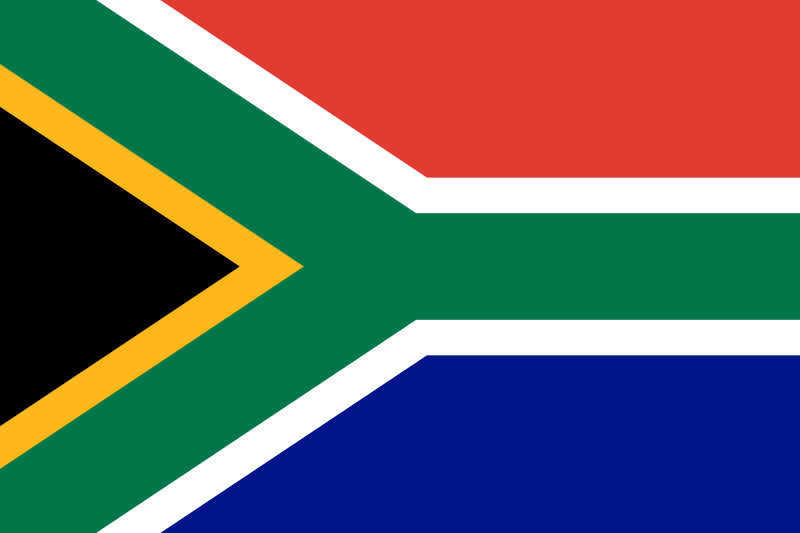
South Africa is what happens when a country becomes ungovernable. From endemic sexual crime to farm murders, rolling blackouts, and expropriation, the rest is just the details. What has come to be termed “South Africanization” is not the failed development of a Third-World nation such as Afghanistan or Somalia, but the structural de-development of a once fully modern state that had its own nuclear weapons program. President Trump’s support of Afrikaner farmers has brought global attention to the decaying state of the country and is perhaps the most high-level recognition yet that the 1990s “Rainbow Nation” dream is dead. What’s strange about it all is how much of it happened on purpose.
What may be worse is that the very system of law and government itself has become an instrument to be captured and used to further the mass looting of the country. South Africans of all races inherit a Western political culture and economy. The average South African experiences a strong civic identity, highly active political parties, popular national media networks, a market economy, and a parliamentary constitutional order. The last thirty years saw a coalition of political actors, patronage networks, and organized criminal gangs seize control of and use all the infrastructure of modern government for their own ends.
[…]
While songs like “Kill the Boer” at rallies tend to grab headlines, the most consequential development of late is the passing of expropriation without compensation into law by the supposedly moderate President Cyril Ramaphosa. In addition to further eroding property rights, it emboldens a widespread movement that sees land redistribution as the sole resolution to the country’s racial conflict and views the presence of any white population as fundamentally illegitimate. The radicalization of race politics is the means through which political fights are won, since it plays on the country’s major divides and wins over those who feel left out of the spoils.
On the ground, reports tell of ANC officials tacitly allowing invasions of private and public land by squatters. Occupations of this sort have sometimes preceded the farm murders which have gained media attention internationally, and squatters have now begun to invoke the Expropriation Act. Such groups become the shock troops of political pressure: they can harass and pressure the occupants of the lands they occupy, or worse, while becoming a media story about the “landless oppressed” used to justify broader government action. The broad facilitation of ground-level conflict and crime by those with political power is the defining feature of South Africanization.
[…]
In other words, decay is a burden without benefit. There is no “rock bottom”. Business, political organization, social fabric, and all other forms of Western cultural life just face increasing costs. Some are direct, while others are opportunity costs: how much doesn’t happen because almost no one can guarantee electricity? In a relatively developed country, there’s still much more to break down and expropriate.
The combination of social progressivism with an economic model of managed decline has become orthodoxy in many establishment parties across the developed world. South Africa is a study of the political phenomenon in its advanced stage and a demonstration of what is at stake in defeating it in the rest of the Western world. Flip Buys, leader of the Afrikaner trade union Solidariteit, was likely prophetic when he foresaw that South Africa would become home to the “first large grouping of Westerners living in a post-Western country”.
Emphasis from Niccolo’s excerpts.
March 22, 2025
“Humiliate yourself before us,” I was being told, “And we still won’t hire you, lol”
The accelerating downfall of the academic-political complex is the subject of John Carter’s most recent post at Postcards from Barsoom:

University College, University of Toronto, 31 July, 2008.
Photo by “SurlyDuff” via Wikimedia Commons.
Look. In any given case, for any given scientist working inside the university system, there are exactly two possibilities.
One: they embraced all of this with cheerful, delirious, evangelical enthusiasm. Religious devotees of the unholy cause of converting every institution to the One False Faith of Decay, Envy, and Incompetence, they have spent the last decade or more enforcing campus speech codes, demanding inclusive changes to hiring policies, watering down curricular requirements to improve retention of underrepresented (because underperforming) equity-seeking demographics, forcing their research collaborations to adopt codes of conduct, and mobbing any of their colleagues who voiced the mildest protest against any of this intellectual and organizational vandalism.
Two: they had reservations, but went along with it all anyhow because what were they to do? They needed jobs; they needed funding; and anyhow they didn’t go into STEM to fight culture wars. As the article says, “They’d prefer to just get back to the science,” and the easiest way to get back to the science was to just go along with whatever the crazies were demanding. Even if the crazies were demanding that they abandon any pretense of doing actual science.
The first group are enemies.
The second are cowards.
Both deserve everything they get.
And I am going to enjoy every moment of them getting it.
Look, I am going to vent here a bit, okay? Because the mewling in this article succeeded in getting under my skin.
Not long ago I was considered a promising early career scientist, with an excellent publication record for my field, a decent enough teaching record, and all the rest of it. After several years as a semi-nomadic postdoc – which had followed several years as a semi-nomadic graduate student – it was time to start looking for faculty positions. My bad luck: Fentanyl Floyd couldn’t breathe, and the networked hive consciousness of eggless harpies infesting the institutions was driven into paroxysms of preening performative para-empathy.
What this meant was two things. First, more or less every single university started demanding ‘diversity statements’ be included in faculty application packages, alongside the standard research statements, teaching statements, curriculum vitae, and publication list. The purpose of the diversity statement was to enable the zampolit in HR and the faculty hiring committee to evaluate the candidate’s level of understanding of critical race theory, gender theory, intersectionality, and all the rest of the cultural Marxist anti-knowledge; to identify candidates who had already made contributions to advancing diversity; and to identify candidates who had well-thought-out ten-point plans to help advance the department’s new core principle and overriding purpose, that being: diversity.
The second thing it meant was that hiring policies now implicitly – in the United States – and explictly (in Canada) mandated diversity as an overriding concern in hiring. As everyone knows, this means that if you’re a heterosexual cisgendered fucking white male, you are not getting hired.
In other words, I was now expected to write paeans praising the very ideology that had erected itself as an essentially impermeable barrier to my own employment, pledging to uphold this ideology myself and enforce it against others who look like me. “Humiliate yourself before us,” I was being told, “And we still won’t hire you, lol.”
Having some modicum of self-respect, I refused to go along with this. This meant that I simply could not apply for something like 90% of the available positions. And when I did apply to positions that didn’t require a diversity statement, and successfully got an interview, guess what? One of the first questions out of the mouth of one of hiring committee members would be “what will you do for diversity”, or “I see you didn’t mention diversity in your teaching statement …” See, even if it isn’t mandated by the administration, that doesn’t stop the imposter-syndrome-having activist ladyprofs from insinuating the diversity test on their own initiative. I once had a dean, a middle-aged Hispanic woman, tell me “women in science are very important to me” right at the beginning of the interview; I very nearly got that job, because everyone on the committee wanted me, but later – after they inexplicably ghosted – found out that she’d nixed it. They just didn’t hire anyone.
Right around the same time, of course, we were in the thick of the COVID-19 scamdemic. You remember, the one that was just the flu, bro, until it became the new Black Death that definitely did not come from a laboratory shut up you conspiracy theorist; which couldn’t be stopped by masks so don’t be silly until suddenly masks were the only thing that could save you; which led to us all being locked in our houses for a year because some idiot wrote a Medium article called “the dance of the hammer with your soft skull” or whatever which then went viral inside the hysterosphere; which motivated the accelerated development of a novel mRNA treatment that no one was going to get because you couldn’t trust the Evil Orange Man’s bad sloppy science until suddenly it was safe and effective and then overnight absolutely mandatory and anyone who refused to take it should be sent to a camp.
Yeah, remember that?
I guarantee you that every single credentialed scientist in that article was on board for all of it.
How do I know this?
Because they all were.
March 19, 2025
The Trumpocalypse – “The outlook for universities has become dire”
John Carter suggests that American higher education needs to find a new funding model that doesn’t depend on governments to shower their administrative organizations with unearned loot:
Shortly after taking power, the Trump administration announced a freeze on academic grants at the National Science Foundation and the National Institute for Health. New grant proposal reviews were halted, locking up billions in research funding. Naturally, the courts pushed back, with progressive judges issuing injunctions demanding the funding be reinstated. Judicial activism has so far met with only mixed success: the NSF has resumed the flow of money to existing grants, but the NIH has continued to resist. While the grant review process has been restarted at the NSF, the pause created a huge backlog, resulting in considerable uncertainty for applicants.
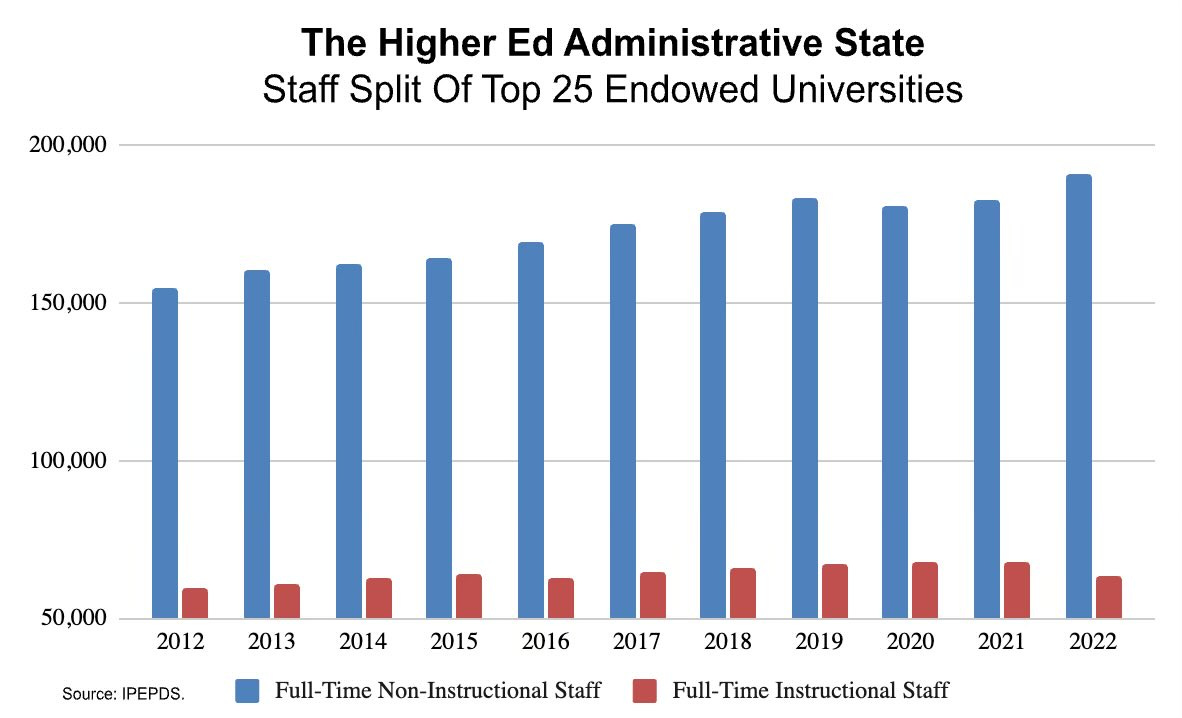
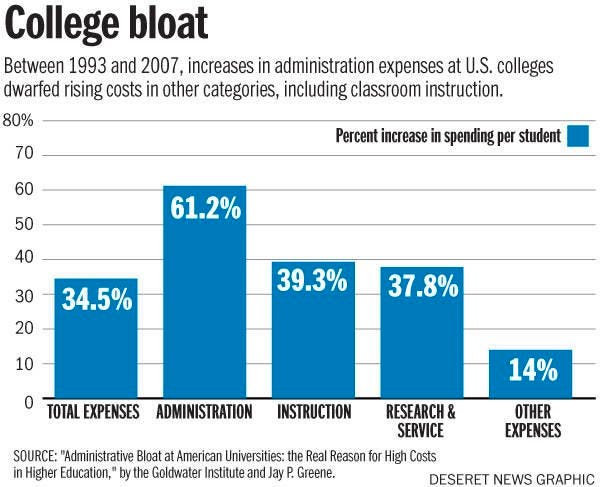
The NIH has instituted a 15% cap to indirect costs, commonly referred to as overheads. This has universities squealing. Overheads are meant to offset the budgetary strain research groups place on universities, covering the costs of the facilities they work in – maintenance, power and heating, paper for the departmental printer, that kind of thing. Universities have been sticking a blood funnel into this superficially reasonable line item for decades, gulping down additional surcharges up to 50% of the value of research grants, a bounty which largely goes towards inflating the salaries of the little armies of self-aggrandizing political commissars with titles like Associate Vice Assistant Deanlet of Advancing Excellence who infest the flesh of the modern campus like deer ticks swarming on the neck of a sick dog. Easily startled readers may wish to close their eyes and scroll past the next few images btw, but I really want to make this point here. When you look at this:
A 15% overhead cap, if applied across the board, has an effect on the parasitic university administration class similar to a diversity truck finding parking at a German Christmas market. Thoughts and prayers, everyone.
Meanwhile at the NSF, massive layoffs are ongoing, and there are apparently plans to slash the research budget by up to 50%. While specific overhead caps haven’t been announced at the NSF yet, there’s every reason to expect that these will be imposed as well, compounding the effect of budget cuts.
There is no attempt to hide the motivation behind the funding freeze, which is obvious to both the appalled and the cuts’ cheerleaders. Just as overheads serve as a blood meal for the administrative caste, scientific research funding has been getting brazenly appropriated by political activists at obscene scales. A recent Senate Commerce Committee report found that $2 billion in NSF funding had been diverted towards DEI promotion under the Biden administration. In reaction to this travesty, as this recent Nature article notes, there are apparently plans to outright cancel ongoing grants funding “research” into gay race communism. DEI programs, formerly ubiquitous across Federal agencies, have already been scrubbed both from departmental budgets and web pages. Indeed, killing those programs was one of the first actions of the MAGA administration.
The outlook for universities has become dire, and academics have been sweating bullets all over social media. Postdocs aren’t being hired, faculty offers are being rescinded, careers are on hold, research programs are in limbo. This comes at the same time that budgets are being hit by declining enrolment due to the demographic impact of an extended period of below-replacement fertility along with rapidly declining confidence in the value of university degrees, with young men in particular checking out at increasing rates as universities become tacitly understood as hostile feminine environments. They’re hitting a financial cliff at the same point that they’ve burned through the sympathy of the general public.
The entire sector is in grave danger.
Politically, going after research funding is astute. Academia is well known to be a Blue America power centre, used to indoctrinate the young with the antivalues of race Marxism, provide a halo of scholarly legitimacy to the left’s ideological pronouncements, and hand out comfortable sinecures to left-wing activists. The overwhelming left-wing bias of university faculties is proverbial. The Trump administration is using the budgetary crisis as a handy excuse to sic its attack DOGE on the unclean beast – starting with cutting off funding to the most ideological research projects, but apparently also intending to ruin the financial viability of the progressives’ academic spoils system as a whole.
Cutting the NSF budget by half may seem at first glance like punitive overkill, and no doubt the left is screeching that Orange Hitler is throwing a destructive tantrum like a vindictive child and thereby endangering American leadership in scientific research. After all, for all the attention that NASA diversity programs have received, the bulk of research funding still goes to legitimate scientific inquiry, surely? However, the problems in academic research go much deeper than its relentless production of partisan activist slop. Strip out all of the DEI funding, fire every equitied commissar and inclusioned diversity hire, and you’re still left with a sclerotic academic research landscape that has spent decades doing little of use – or interest – to anyone, and doing this great nothing at great expense.
March 15, 2025
Eliminating “environmental justice” from the EPA
J.D. Tuccille suggests that you not take the New York Times coverage too literally as they wail about the Trump administration’s plans for the Environmental Protection Agency:

If you were to believe reporting from The New York Times — which is an increasingly unwise idea — the Trump administration is diverting the attention of the Environmental Protection Agency (EPA) from poor and minority communities that face “disproportionately high levels of pollution”. But if you scratch the surface even a bit, you find that what’s really being eliminated are “environmental justice” offices that infuse identitarian ideology into EPA enforcement efforts. Americans should welcome efforts to strip racial obsessions from the armory of regulators who already wield too much power.
Competing Takes on “Environmental Justice”
“The Trump administration intends to eliminate Environmental Protection Agency offices responsible for addressing the disproportionately high levels of pollution facing poor communities, according to a memo from Lee Zeldin, the agency administrator,” Lisa Friedman wrote for the Times. She added that the memo directed the reorganization and elimination of “offices of environmental justice at all 10 E.P.A. regional offices as well as the one in Washington”.
Contrast that with a press release from the EPA, which states “that EPA will immediately revise National Enforcement and Compliance Initiatives to ensure that enforcement does not discriminate based on race and socioeconomic status (as it has under environmental justice initiatives) or shut down energy production and that it focuses on the most pressing health and safety issues”.
Whatever you think of the Trump administration in general, EPA Administrator Zeldin is on the right side of this debate. As I wrote in 2022 when the Biden administration formally introduced “environmental justice” concerns to the EPA, the term refers to “a decades-old school of thought that seeks to graft identitarian politics onto environmental concerns. That allows practitioners to wield civil rights law in addition to traditional environmental laws against perceived malefactors. It also makes it possible to slam offenders as ‘bigots’ if their actions affect one community more than another.”
There’s no need to read between the lines to figure out what is meant by “environmental justice” — its advocates are quite clear about their meaning. In 2021, the Northeastern University School of Public Policy and Urban Affairs published A User’s Guide to Environmental Justice: Theory, Policy, & Practice by Ken Kimmell, Alaina Boyle, Yutong Si, and Marisa Sotolongo.
The Ideology’s History of Racial Obsessions
“The demand for ‘environmental justice’ (EJ) has gained substantial traction in the last few years, as well it should,” the authors wrote in their introduction. “A key pillar in EJ will be widespread, community-designed and community-supported investment in neighborhoods that have been economically and environmentally burdened by a long history of racist government and industry decisions.”
“The environmental justice movement has evolved in parallel with and in response to traditional environmentalism to focus on the unequal distribution of environmental harms among different people and communities,” the authors add in summarizing the history of the movement. “Research revealing the whiteness of the environmental community elevated concerns that social justice and racial justice were not prioritized in mainstream environmentalism.”
“Applying the Civil Rights Act of 1964, which prohibits discrimination based on race, color, or national origin … frontline communities and others began to use the term ‘environmental racism’ to focus on the unequal (social and spatial) distribution of environmental burdens,” they continue.
March 12, 2025
Free speech in Canada takes yet another hit, as Palestinian activists granted special protections
In the National Post, Tristin Hopper outlines the jaw-dropping contents of the Guide to Understanding and Combatting Islamophobia published by the federal government recently:

The federal government has dropped a new guide that, according to critics, deems it “racist” to criticize Palestinian advocacy or extremism.
The guide also defines both “sharia” and “jihad” as benign terms that are misrepresented by Westerners, with sharia defined as a means “to establish justice and peace in society”.
It’s contained in “The Canadian Guide to Understanding and Combatting Islamophobia“, a document published last week by the Department of Canadian Heritage.
The report endorses the idea of “anti-Palestinian racism”, an activist term with such a broad definition that it technically deems any criticism of Palestinians or “their narratives” to be racist.
“Public discourse often unfairly associates Palestinian and Muslim identities with terrorism,” reads the guide.
The new guide specifically links to a definition of the term circulated by the Arab Canadian Lawyers Association. Their 99-word definition says that it’s racist to link the Palestinian cause to terrorism, to describe it as “inherently antisemitic” or to say that Palestinians are not “an Indigenous people”.
The term is broad enough that merely acknowledging the existence of Israel could fall under its rubric. The definition describes the Jewish state as “occupied and historic Palestine”, and its creation as “the Nakba” (catastrophe). “Denying the Nakba” is specifically cited as one of the markers of “anti-Palestinian racism”.
In a March 4 statement criticizing the new federal report, the Centre for Israel and Jewish Affairs (CIJA) said that the term is so vague that “denouncing Hamas – the terrorists behind the October 7 massacre – could be portrayed as an act of racism”.
The new report was praised, meanwhile, by the vocally anti-Israel Centre for Justice and Peace in the Middle East, which called Ottawa’s embrace of the term anti-Palestinian racism “groundbreaking.”
“We are extremely pleased that Canada, through this guide, finally recognizes the unique racism that Palestinians experience daily,” said the group’s acting president Michael Bueckert.
The federal government’s new guide writes that Canada’s “understanding of anti-Palestinian racism” is growing, and directs readers to a 2022 report on the phenomenon by the Arab Canadian Lawyers Association.
February 25, 2025
QotD: Identity politics as a secular religion
But the problem with identity politics as a secular religion is precisely its failure to allow for absolution. The faith that Saad espouses is utterly bleak, even cloaked as it is in words of love. It utterly fails to allow for redemption, and its most direct religious antecedent is found in Calvinist predestination.
Under this doctrine, God has predetermined whether you are damned or elect. From the second that the right sperm hit it lucky with the most fecund egg, your place in the woke hierarchy was decided. In the modern progressive world, informed by intersectional feminists, it does not matter what you say or do, the only defining factor in your state of grace is your skin, gender and sexuality.
This is a profoundly depressing outlook for three main reasons. The first is the essential nihilism in the creed. Your intent? Irrelevant. Your deeds? Likewise. The sum of your experience, desires, longings, beliefs? Your humanity itself? Nah, not relevant.
The second dispiriting message is that the problems its aims to address are insoluble. White people are racist by their nature, and inherently incapable of seeing their own racism or addressing it. Men are misogynists, by default, witting or unwitting bulwarks of the patriarchy. If they don’t believe they are individually at fault they are in denial. And if they try to say, actually, I’m not sure the patriarchy exists, they are mansplaining misogynist bastards. This is the politics of perpetual antagonism, of a kind of bleak acceptance that all relationships between different categories of human are necessarily fractious.
[…]
The third problem with Puritan wokeness is that it [has] sinister echoes in the history of predestination. When the creed reached its zenith in the seventeenth century, the logical hole at its centre became insanely obvious. If it does not matter to God how you behave, because your salvation was pre-determined at birth, why not behave however the hell you want to?
Antonia Senior, “Identity politics is Christianity without the redemption”, UnHerd, 2020-01-20.
February 13, 2025
Australia’s most toxic export (so far) – “Settler-colonial ideology”
Helen Dale explains how a lunatic fringe Australian notion has grown to be a major ideology in most of the Anglosphere and even as far afield as Israel:

Despite a great efflorescence of literature and especially film about the mafia, it’s a truism to say that it isn’t very good for Sicily. It also hasn’t been very good when exported to other countries, either, spreading violence, corruption, and lawlessness. Well, Australia is to settler-colonial ideology as Sicily is to mafia, and our poisonous gift to the world is, like Sicily’s mafia, one of those things about us that really isn’t for export.
“Settler-colonial ideology” seems a mouthful, but if I describe bits of it to you, you’ll recognise it. Heard Australia Day called “Invasion Day”? You’ve encountered settler-colonial ideology. Been called racist for voting NO in the 2023 Voice Referendum? You’ve encountered settler-colonial ideology. Noticed Aboriginal academics get hired with obviously inadequate qualifications? You’ve encountered settler-colonial ideology.
Many Australians — including me — first encountered settler-colonial ideology at university. Back then, it was a theoretical and foreign concern, and largely in languages other than English (mainly French and Arabic). I do remember one of the “post-colonial literatures” (note the s, the s is important) obsessives trying to convince me that Alan Paton’s Cry the Beloved Country wasn’t a “legitimate book” because its author was white, but back then, this was still a niche view.
Like other Australians confronted with daft academic ideas, I blamed the US or France and ignored my own country’s contribution. Australians aren’t noted for their theoretical acumen, which made this easier. Critical race theory and affirmative action are all-American, while US academics have often executed hostile takeovers of French nonsense like postmodernism or queer theory early on in proceedings. It gets easy to blame America and France.
Easy, but unfair.
I realised how mistaken I’d been when, in October last year, I returned to Australia for a stint. While I was there, I read Adam Kirsch’s On Settler Colonialism: Ideology, Violence and Justice. I did so in part because October 2024 was the one-year anniversary of two important events. Both concerned what Kirsch calls “the ideology of settler-colonialism”.
Kirsch documents a process whereby the French- and Arabic-speaking theorists of post WWII decolonial conflicts — particularly Frantz Fanon — had their ideas grafted (very, very awkwardly) onto dissimilar Australian history and conditions by Australian intellectuals. These were then exported throughout the English-speaking world, likely through academic conferences. This explains how cringeworthy Australian nonsense like land acknowledgments managed to spread first to Canada and then the US in a reversal of the usual process whereby America sneezes and so gives its Hat a cold.
Fanon was a Marxist and a Freudian. His writing seethes with angry bloodthirstiness and pseudoscientific psychodrama, but he was responding to a vicious war of independence and incipient civil conflict. Kirsch notices a pattern where Australian scholars borrow bits of Fanon to give a sanguinary rhetorical garnish to their writing. “Fanon’s praise of violence is a large part of his appeal for Western intellectuals,” he notes. “Many of the sentiments expressed in The Wretched of the Earth, coming from a European or American writer, would immediately be identified as fascistic.”
Australia’s intervention changed the ideology, in some ways making it more destructive. Fanon is shorn of most of his Marxism, for example (can’t have that, won’t be able to recruit rich minorities to the boss class otherwise). The key Australian shift coalesces around an oft-quoted aphorism from historian Patrick Wolfe: “invasion is a structure, not an event”. That is, colonisation trauma is constantly renewed because “settler” is a heritable identity. “Every inhabitant of a settler colonial society who is not descended from the original indigenous population,” Kirsch points out, “is, and always will be, a settler”.
“Settler” here includes people transported to both America and Australia in chains — slaves and convicts. Once it became acceptable to construe one group of people conveyed against their will across thousands of miles of ocean in dreadful conditions as providentially lucky (and genocidal) settlers, it became possible to extend the reasoning to other, similar groups. After all, the only difference between a convict and a slave is the presence or absence of a criminal conviction.
Kirsch’s attempt to explain how Australia was analogised with Fanon’s Algeria and then how Israel was analogised with Wolfe’s Australia is heroic, in part because the casuistry he seeks to unpick is so convoluted. Filtering Fanon through Australian academia and its claim that “settler” is a heritable identity did have the effect of making Jewish Israelis look more like non-indigenous Australians or Americans, however, especially when attention was focussed on European Jewish immigrants to Israel.

QotD: Social Darwinism
Social Darwinism fails in practice for the most obvious reason: You can’t practice it with the necessary consistency without massive State intervention, and what kind of fool would give a State, any State, that power? It has been tried, 1933-45 being the most prominent example, and it didn’t go well.
Severian, “The Experiment”, Founding Questions, 2021-09-25.
February 11, 2025
Many young white men are choosing to “own the insult” when accused of being a fascist
Lorenzo Warby points out that some — even many — young white men are reacting to repeatedly being called “Nazi” or “fascist” by embracing the slur:

Still from Pink Floyd: The Wall
For the fuel of the contemporary networked authoritarians are angry young men. Angry young men who have a great deal to be angry about.
In so many modern schools, universities, and much of social media, if you are a low melanin count, heterosexual male you are absolutely at the bottom of the “woke” oppression-bingo hierarchy. You will be implicitly, or explicitly, held to be somehow tarred with every bad thing any person “like” you has done in history, no matter how long — even how many generations — before you were born that it happened, nor how dubious an historical characterisation it might be. There is no identity open to you that you can celebrate, or feel positively attached to, without potential or actual denigration.
If you do any reading, you can quickly work out that this is a ludicrously one-sided — and deeply unfair — way to look at history. Even in its own terms, it is nonsense, as “folk like you” — i.e., low melanin count heterosexual males — voted for every single legal advance any of the celebrated-as-oppressed groups made. “Folk like you” built the Scientific Revolution, Parliamentary Government, mass prosperity.
Of course, this was a matter of culture, institutions, the happenstance of history, not melanin content. The trouble with the racialisation of history and identity is that it is, indeed, the racialisation of history and identity. As Jews are currently (re)discovering.
Nor can many of these angry young men take much refuge in the good life, work or entertainment. Online dating has turned into a hypergamous nightmare that excludes most guys, in-person connections are fraying and migration-plus-restrictive-land-regulation has shot rents up and made home-owning unattainable.
In entertainment, masculine heroes are being replaced and degraded. Online games are being systematically “wokified”. There are systematic attacks on their heritage. Sport and advertising is also being wokified, is “bending the knee”. Where to go?
If folk systematically tar or denigrate someone’s identity, a natural response is to say “no, my identity is great, it is wonderful”. There will be certainly a market for such a response. The natural response to systematic denigration is some form of “fuck you!” and the politics of “fuck you!“.
In the contemporary world, what is the most dramatic way of saying “fuck you!“? To take the racist!, fascist! abuse and go “right on!“. Even more so if you take the ideas they invoke and turn them back against them.
Of course, if you just reverse what left-progressivism — in its “woke” iteration — stands for, you are still dancing to their tune. But rage can easily work like that.
So, these angry young men look at the folk who treat them with such continual, institutionalised, contempt — who stack everything they can against them — and decide “we hate you”. If you are going to abuse us anyway no matter what we do — the seductive logic goes — then why not simply embrace the identity you impose on us if we put our heads up? There is, after all, no more in-your-face way to shriek their anger and rejection back at those who are abusing, denigrating and excluding them than to embrace racism and fascism.
They look at ordinary conservatives, at ordinary liberals, they look at Boomers, and think “you did not stop it, you did nothing to protect people like me”, so they — and their politics — get no respect.
Instead, they go to the politics of using the operational tactics used against them — the operational politics of “wokery” — in support of politics that most completely expresses their rage. This is the updated version of what happened with 1920s Fascism in Italy and 1930s Nazism in Germany. Like the original versions, they are using — and so helping to legitimate — the operational methods of the left-progressivism.
Not that left-progressives, the “woke”, will see it. They are way too full of the stupidity of arrogance, of the blindness of moral narcissism, to pick what is happening, still less take any responsibility for it. They utterly fail to see themselves; to understand how much they come across as smug, arrogant, condescending, self-righteous, shits whose politics again and again ends up favouring people like them and whose recurrent response to disagreement is to de-legitimise, denounce and censor. Their entire view of themselves is they are the oh-so-clever, oh-so-moral people. Nothing they do is ever seriously counter-productive or fundamentally mistaken.
Faced with the rise of actual racism and actual fascism, they will shriek racist! and fascist! even harder. But they are in the situation of the boy who cried wolf! Except worse, as the boy in the story neither created, nor trained, the wolf.
They have so debased that currency, so debased historical analogy, that fascism has lost its rhetorical, or even its warning, power.
Besides, how many people will say: these folk against whom you are shrieking the same terms of abuse you have shrieked at people for decades. Are they making excuses for the mass sexual predation on young girls by migrants we did not want? Are they supporting the hormonal and surgical mutilation and sterilisation of minors? Are they teaching folk to despise their own countries and heritage? Are they pushing the narrative lies of the moment? Have they proved to be incompetent at elementary things, such as fighting crime and managing fire risk?
No? Then they sound good to me.
Left-progressives: so good at finding new ways to make the same mistakes. It is almost as if they have a pathological relationship with information. Oh, wait, they do.
January 26, 2025
Andrew Sullivan reluctantly welcomes Trump’s actions to undo Biden’s radical agenda
I have to admit that I didn’t expect to see Andrew Sullivan saying nice things about Donald Trump, and I’m sure it caused him much personal distress to have to write this:

A quick image search turns up plenty of examples of Presidents proudly showing off freshly signed documents. Usually these will be laws passed by the legislators but sometimes (especially in January 2025) it’s rule-by-decree on steroids.
To say I have conflicted feelings after a week or so of Trump’s return to power would be an understatement. Some of his early decisions remind me why I couldn’t vote for him. His decision to pardon even those among the J6 mob who assaulted cops jibes with his own instinctual love of vigilante justice against anyone in his way. That’s why his egregious withdrawal of security detail from John Bolton and Mike Pompeo is so instructive. Trump is no longer fond of these men, so he has all but invited a foreign hostile government to murder them. His embrace of anti-police vigilanteism at home is matched by his removal of sanctions on the violent settlers in the West Bank this week. He’s a thug who loves thugs.
But for all this, a large part of me is exhilarated by this first week. Yes, exhilarated. Liberated even. I wasn’t quite expecting this, but I can’t deny it. I suddenly feel more oxygen in the air as the woke authoritarianism of the last four years begins finally to lift. And let me put the core reason for this exhilaration as simply as I can. On the central questions of immigration and identity politics, what Trump is proposing is simply a return to common sense — a reflection of the sane views of the vast majority of Americans, who support secure borders and oppose unfairness in sports and medical experiments on children. My conservative soul is glad.
Joe Biden brazenly lied when he promised moderation in 2020. Check out my column on his initial flurry of executive orders four years ago this week:
[Biden] is doubling down on the very policies that made a Trump presidency possible. In every major democracy, mass immigration has empowered the far right. Instead of easing white panic about changing demographics, Biden just intensified it.
All Trump had to do was wait. But Biden’s EOs on “equity” were even more extreme, effectively ending any pretense of color-blindness in American law and society. Biden, I wrote four years ago, was:
enforcing the Ibram X. Kendi view that “the only remedy to past discrimination is present discrimination”. And he’s enforcing it across the entire federal government and any institution the federal government funds.
It was a direct and proud embrace of systemic race and sex discrimination by the federal government. It was accompanied by a massive shift in the private sector toward illegal race and sex discrimination in hiring, firing, and promotion. This was buttressed by actual mandatory workplace indoctrination in critical race, gender, and queer theory. This was authoritarian brainwashing, accompanied by blatant race discrimination.
Biden also decreed by executive order that the postmodern notion of “gender” would henceforth replace biological sex in determining who is a man or a woman. He mandated that any school or university getting federal funds should remove distinctions between boys and girls — even in sports and intimate spaces. His administration fully backed the medically irreversible transing of children with gender dysphoria, lied about the science, and secretly urged removing all age restrictions on transition — subjecting countless gay and autistic children to the permanent destruction of their future ability to have kids or even an orgasm.
Biden was, in these respects, an unremitting extremist; and almost all Trump is doing this week is unraveling this insanity. The one actually radical act from Trump is rescinding LBJ’s “affirmative action” directive of 1965. Reagan wanted to do this, but he faced bipartisan opposition. One justification of the feds moving from anti-discrimination to being pro-discrimination was because, in LBJ’s words, African-Americans “don’t have their 12 percent” in federal employment, i.e. their proportion in the country at large. Today, African-Americans are almost 19 percent of federal employees — much higher than their population share. The MSM won’t frame it this way. But that’s the truth. And Trump’s EO language suggests he now has a staff shrewd and determined enough to push back. This week was more regime change than shit-show.
It is, however, far too soon to declare the war on left authoritarianism over. It is far from dead; it has replaced Christianity entirely for many, as we saw with Bishop Budde at the National Cathedral this week, or the Oscars giving an unpopular film 13 nominations just so they can give a Best Actress award to a biological man. The Ivy League will do everything it can to keep discriminating against members of “oppressor classes.” The MSM is too far gone to reform itself. If you want proof of that, notice that the NYT has two emphatically “queer” columnists pushing gender woo-woo, and it just fired the only writer in that publication, Pamela Paul, who helped expose the medically baseless transing of children.
Not only will the Trump EOs end the systemic racism in the federal government and its contractors, his people are also aware of attempts to foil color-blindness by their own woke bureaucrats, and will be vigilant. More importantly, the new administration will deploy the DOJ to restore equality of opportunity in the private sector. After so many major corporations have been openly bragging about their race and sex discrimination these past few years, they sure have been asking for it.
January 25, 2025
“How can an active program of ending censorship; of lauding colour blind appointment on merit; … be Fascism redux?”
As discussed yesterday, one of the many “hitting the ground running” acts of Donald Trump at the beginning of his second term in office has been to issue executive orders to dismantle a lot of progressives’ favourite policies, and many of them are calling it “fascism”:

Trump-the-Presidency 2.0 has already proved to be rather different from the 1.0 version. It is not merely that this time around he won the US popular vote. It is that he has “hit the ground running” with a whole stack of executive orders.
Watching the reaction to this has become — to put it mildly — a somewhat bifurcated experience. Lots of people, who were relieved at his victory, applaud what they see as a return to common sense; a rejection of censorship; a rejection of a politics intrusive into any and all aspects of life.
Conversely, there are also lots of — typically very online — people who see it as Fascism redux, as the equivalent of the end of Weimar Germany being live-streamed. How can an active program of ending censorship; of lauding colour blind appointment on merit; of removing DEI commissars from the US Federal Government; that includes appointment of women and persons of colour to senior positions; be Fascism redux?
The short answer is: it isn’t. The question then becomes, how can it be seen as such? This is where the long-run consequences of anti-discrimination law kicks in.
Anti-discrimination law creates a legal-bureaucratic structure that operates on the basis that the general citizenry is continually hovering on the edge of wrong think (racism) and wrong act (discrimination). The presumption becomes — without all this active effort — racism and discrimination will be unleashed.
This is nonsense. Anglosphere countries have low levels of racism and anti-discrimination norms have become widely accepted. Where there are discrimination issues, they are mostly problems of cultural distance that have a significant element of practicality from differing expectations between groups.
Nevertheless, it is very much in the interests of the legal-bureaucratic structure that anti-discrimination law sets up that propensities to wrong act and wrong think be seen as real, and endemic. Even better, is if the problem is seen as even larger than originally conceived.
So, we get a double expansion. The first expansion is in the range of protected groups. This provides a broadening of the social ambit of the potential wrong thinking (racism, misogyny, homophobia, Islamophobia, transphobia …) and of the potential wrong acting (who might be discriminated against).
As this moral dimension becomes so elevated—not least because there are so much employment involved, but also as considerable social leverage is created by for those who can set what is, or is not, legitimate action and speech—there is expansion of what constitutes wrong think and wrong act. There is large, indeed expanding, ambit for intellectual and other entrepreneurs to identify new sins of discrimination, new sins of unequal consideration, new ways wrong think propagates, and new ways of signalling one’s rejection of such sins.
It is better still if uttering true things becomes a wrong act, expressing wrong think, for people are prone to do that, to notice things. Of course, if you start trying to shun, shame and punish folk for expressing true things, for noticing things, you are likely to generate quite a lot of resentment. This is useful, for such pushback just further “establishes” the propensity to wrong think and wrong act. Hence Transphobia and Islamophobia becoming such markers of wrong think—there are so many true things to not notice.
There is even a term for someone who notices inconvenient patterns — far right. A term that has become the classic thought-terminating cliché in the service of not noticing.
January 24, 2025
The end of “affirmative action” in US government hiring
In The Free Press, Coleman Hughes outlines how the US federal government got into the formal habit of hiring and promoting staff based on things other than ability and merit during the Nixon administration:
Trump’s Executive Order 14171 is titled Ending Illegal Discrimination and Restoring Merit-Based Opportunity. It describes how vast swaths of society, including the “Federal Government, major corporations, financial institutions, the medical industry, large commercial airlines, law enforcement agencies, and institutions of higher education have adopted and actively use dangerous, demeaning, and immoral race- and sex-based preferences under the guise of so-called ‘diversity, equity, and inclusion’ (DEI)”.
In response, Trump has ordered the executive branch and its agencies “to terminate all discriminatory and illegal preferences, mandates, policies, programs, activities, guidance, regulations, enforcement actions, consent orders, and requirements”.
That is a lot of preferences and mandates. Trump’s executive order accurately describes the enormousness of the DEI bureaucracy that has arisen in government and private industry to infuse race in hiring, promotion, and training. Take, for example, the virtue-signaling announcements made by big corporations in recent years — such as CBS’s promise that the writers of its television shows would meet a quota of being 40 percent non-white.
And so, we will now see what federal enforcement of a color-blind society looks like. We’ll certainly see how many federal employees were assigned to monitor and enforce DEI — Trump has just demanded they all be laid off.
The most controversial part of this executive order is that it repeals the storied, 60-year-old Executive Order 11246, signed by President Lyndon Johnson in 1965. Johnson’s original order mandated that government contractors take “affirmative action” to ensure that employees are hired “without regard to their race, color, religion, or national origin”.
The phrase affirmative action, however, has come to have a profoundly different meaning for us than it did during the 1960s civil rights era. Back then, it simply meant that companies had to make an active effort to stop discriminating against blacks, since antiblack discrimination was, in many places, the norm. Only later did the phrase come to be associated with the requirement to actively discriminate in favor of blacks and other minorities.
One of the great ironies of affirmative action is that it was not a Democrat but a Republican president, Richard Nixon, who did more than anyone to enshrine reverse racism at the federal level by establishing racial quotas. According to the Richard Nixon Foundation, “The Nixon administration ended discrimination in companies and labor unions that received federal contracts, and set guidelines and goals for affirmative action hiring for African Americans”. It was called the “Philadelphia Plan” — the city of its origin.
For the first time in American history, private companies had to meet strict numerical targets in order to do business with the federal government. Philadelphia iron trades had to be at least 22 percent non-white by 1973; plumbing trades had to be at least 20 percent non-white by the same year; electrical trades had to be 19 percent non-white, and so forth.
In the intervening decades, this racial spoils system has not only caused grief for countless members of the unfavored races — it has also created incentives for business owners to commit racial fraud, or else to legally restructure so as to be technically “minority-owned”. As far back as 1992, The New York Times reported that such fraud was “a problem everywhere” — for instance, with companies falsely claiming to be 51 percent minority-owned in order to secure government contracts. In a more recent case, a Seattle man sued both the state and federal government, claiming to run a minority-owned business on account of being 4 percent African.
When the law schools went woke
In the New English Review, Bruce Bawer reviews Ilya Shapiro’s book Lawless: The Miseducation of America’s Elites:

As Donald Trump begins his second term as president with a mandate to undo the damage done to the country by leftist ideology, incompetence, and corruption, one of the many stables that most need cleaning up is academia – which is, of course, the source of virtually all of the most misbegotten ideas that have sent America astray.
To be sure, some parts of academia are more desperately in need of reform than others. As a rule, the elite universities, especially those in the Ivy League, are more poisoned by the new progressivism than most state schools, especially those in the heartland. Humanities and social science departments are worse off than STEM departments. And as Ilya Shapiro points out in his important new book, Lawless: The Miseducation of America’s Elite, the introduction of woke thinking into law schools is singularly damaging.
Yes, writes Shapiro, it’s unfortunate enough if, say, a sociology faculty is selling ideology rather than fact, for it represents “a loss to the richness of life and the accumulation of human knowledge”. But for a law school to head down the same road is far more perilous. For these schools turn out the lawyers, politicians, and judges who will serve as “the gatekeepers of our institutions and of the rules of the game on which American prosperity, liberty, and equality sit”.
And the sad fact, alas, is that in too many American law schools today, a preponderance of students are the products of classrooms in which, as Shapiro puts it, “the classical pedagogical model of legal education” has been abandoned in favor of “the postmodern activist one” – a process that has been underway for decades but that was greatly accelerated during the Covid pandemic and in the wake of the irrational nationwide hysteria over the killing of George Floyd. Hence those students swallow such dangerous notions as critical race theory and its corollary, critical legal theory, and therefore believe that colorblind justice, due process, and freedom of speech aren’t desiderata but tools of white supremacy.
Lawless has its roots in Shapiro’s own hellish encounter with this ideological leviathan. It happened like this: on January 26, 2022, the day that Supreme Court Justice Stephen Breyer announced his retirement, Shapiro tweeted that the “best pick” for a replacement was Sri Srinivasan, who, if appointed by President Biden, would be the “first Asian (Indian) American” on the Court. Yet because Biden had promised to name a black woman, lamented Shapiro, “we’ll get [a] lesser black woman”. After sending off the tweet, Shapiro went to bed – and awoke in the morning to discover that his comment had caused pandemonium in the legal community, where he was being viciously attacked as a racist and a sexist. Shapiro immediately deleted the tweet and issued an apology for expressing his opinion in such an “inartful” manner.
But that wasn’t the end of it. As it happened, Shapiro, who had just left the Cato Institute, was scheduled to take up a new position at Georgetown University’s school of law in five days. And unluckily for him, the dean of the law school, William M. Treanor, was a wimp of the first order, the kind of craven academic administrator who’s quick to cave to the noisiest and most radical elements. On January 27, Treanor issued a statement in which he represented Shapiro as believing that “the best Supreme Court nominee could not be a Black woman”.
This was the height of disingenuity: it was clear that Shapiro simply meant that Biden shouldn’t limit the pool of possible nominees on the basis of sex or race – a view shared by three-quarters of the American public. But as Shapiro would soon discover, under the current dispensation at woke law schools “what matters is not the objective meaning of a given statement or even its intent but its effect – not the facts but the feelings”.
So it was that Treanor ordered an elaborate and expensive “investigation” by a top-dollar law firm into Shapiro’s tweet – yes, an investigation into a tweet. Ludicrously, it took more than four months – during which Shapiro’s new job was put on hold. In the end, the “investigators” concluded that Shapiro had indeed expressed an offensive opinion but permitted him to start work at Georgetown. Wisely, Shapiro decided that, given everything that had happened, Georgetown would not be a comfortable fit for him – at least not with Treanor at the helm – and chose instead to accept a job offer from the Manhattan Institute, where he works today.


