Quotulatiousness

November 15, 2025

There’s not much room for men and boys in the “Female Future”

Filed under: Media, Politics, USA — Tags: , , , , — Nicholas @ 04:00

Janice Fiamengo responds to a recent discussion between former Fox News host Tucker Carlson and happiness coach Chris Williamson which was intended to be about men’s lives but “quickly becomes a conversation about what women want”:

Chris Williamson: “It’s very hard to try and put forward something that doesn’t sound like putting the brakes on women. And I don’t think that’s what either of us …”

Here is the problem in a nutshell. We must never say No to a woman, no matter the social atrophy and misery she and her sisters are causing. Carlson, in turn, gives the only permissible response: “Are women happier than they were?”

A conversation about men’s lives quickly becomes a conversation about what women want.

**

Men’s issues have long been the purview of a tiny group of outliers who gained traction in the early days of the internet and were popularized in Cassie Jaye’s The Red Pill.

Following in the footsteps of iconoclasts like Ernest Belfort Bax (The Legal Subjection of Men, 1896), Esther Vilar (The Manipulated Man, 1971), and Warren Farrell (The Myth of Male Power, 1993), they questioned standard feminist wisdom, focusing on male disposability (see also here) and the empathy gap. For years, they were voices crying in the wilderness.

Now, decades into our Female Future, it’s becoming harder to ignore the suffering and plummeting fortunes of men and boys — and their knock-on social effects. But what happens when the red pill begins to go mainstream?

As the recent discussion between former Fox News host Tucker Carlson and happiness coach Chris Williamson makes clear, most hard truths get leached away, and we’re left with half-hearted calls for a compassion that the influencers themselves seem unable to maintain.

Spoiler Alert: “Chris Williamson’s Guide to Being Happy, and Debunking the Feminist Lies Sabotaging You” doesn’t debunk any feminist lies. Even the MeToo movement, which harmed or destroyed thousands of men’s lives through unproven accusations (some of them almost inconceivably ridiculous and trivial), is accepted as an attempt to “sanitize the toxic elements of male behavior”. Accusers’ falsehoods, ‘Poor-me-I’m-so-desirable’ showboating, manipulations, and blithe indifference to evidence are all passed over in feminist-compliant silence.

Sadly, the discussion is full of feminist lies.

**

Near the beginning of the discussion, Williamson expresses frustration that in order to acknowledge any of the troubles of men and boys in the modern world, it has become obligatory first to rehearse women and girls’ (always at least equal, if not greater) suffering. Unfortunately, Williamson is a prime example of such gynocentric genuflecting, visibly uncomfortable every time the conversation seems to be moving into non-feminist territory.

In order to talk about the drastic decline in men’s higher education attainment, for example, Williamson seems to think it necessary to point out that women were at some point in the past discouraged from getting university degrees. Both Williamson and Carlson refer to men’s diminishing earning power, but pivot immediately to stressing how hard this is on professional women looking for marriageable men.

The sexual revolution is alleged to have mainly benefited men who can now, with impunity, “use and abuse women”; nothing is said about women’s rampant OnlyFans activity or their exploitation of men in divorce.

It goes on and on like this: for every male suicide, divorce-raped father, falsely accused or incarcerated man, there must be at least one woman somewhere who felt at some point that she wasn’t encouraged to do something.

There is a small amount of criticism directed at women, but only when women act badly towards other women, as is the case, according to Carlson, with female bosses. But about female cruelty to men or children (over half of child maltreatment, for example, is female-perpetrated), we do not hear anything.

There is a good deal said about women as a civilizing force, how much women bring to family life, how women are better with social cues, how they are “unbullshittable.” Carlson even gushes about how kind women are to their hubbies: “They wash your underwear. They listen to you snore,” he rhapsodizes. For the considerable number of men who have rarely had a kind word from any woman or who have gone through a hellish marriage and/or divorce with a vindictive shrew, the adulation seems quite unhelpful.

November 10, 2025

QotD: “Is it a boy or a girl?”

Filed under: Books, Health, History, Quotations — Tags: , , , , — Nicholas @ 01:00

Even in our supposedly enlightened times, “Is it a boy or a girl?” is still the first question asked of nearly every newborn — and the answer continues to shape how the child is raised. Research shows that from infancy, boys and girls are touched, comforted, spoken to, and treated differently by parents and caregivers. These early experiences may reinforce sex-typical patterns of behavior that often persist into adulthood.

People are intrinsically fascinated by psychological sex differences — the average differences between men and women in personality, behavior, and preferences. Psychologists have studied this topic systematically for decades, beginning with landmark works like The Psychology of Sex Differences (1974) by Eleanor Maccoby and Carol Jacklin. That book helped spark a wave of research that continues to this day. Since then, increasingly sophisticated methods have enabled researchers to detect subtle but consistent differences in how men and women think, feel, and act.

Men and women use language and think about the world in broadly similar ways. They experience the same basic emotions. Both seek kind, intelligent, and attractive romantic partners, enjoy sex, get jealous, make sacrifices for their children, compete for status, and sometimes resort to aggression in pursuit of their interests. In the end, women and men are more alike than different. But they are not identical.

To be sure, sociocultural influences play a role in creating those differences. But environmental factors don’t act on blank slates. To understand young men and young women, we must consider not only cultural context but also evolved sex differences. We are, after all, biological creatures. Like other mammals, we share similar physiology and emotional systems, so it’s not surprising that meaningful differences exist between human males and females.

To understand why psychological and behavioral sex differences evolved, the key concept is parental investment theory, developed by evolutionary biologist Robert Trivers in 1972. The basic idea is straightforward: the sex that invests more in offspring tends to be more selective when choosing a mate. This selectivity follows basic evolutionary logic: those with more to lose are more cautious and risk-averse. To put the stakes in perspective: raising a child from birth to independence in a traditional, preindustrial society requires an estimated 10 million to 13 million calories — the equivalent of about 20,000 Big Macs. For women, reproduction is enormously expensive.

Men also incur reproductive costs, though of a different kind. On average, they have about 20 percent more active metabolic tissue — such as muscle — that fuels their efforts in competition, courtship, and provisioning. While pregnancy requires a large, immediate investment from women, men’s reproductive effort is more gradual, spread out over a lifetime. In evolutionary terms, both sexes pay a price for reproduction, but in different currencies — women through gestation and caregiving, men through physical competition and resource acquisition.

Yet while nature can inform our understanding of human behavior, it does not dictate how we ought to live. A clearer grasp of sex differences can help guide our decisions. It cannot define our values.

Rob Henderson, “Sex Differences Don’t Go Away Just Because You Want Them To”, Rob Henderson’s Newsletter, 2025-08-03.

November 7, 2025

“BookTok on its own sounds innocent enough”

Filed under: Books, Health, Media — Tags: , , , , , , — Nicholas @ 04:00

I’ve seen occasional references to BookTok on other platforms but as it seemed to be as female-coded as an online community can be, I’d never bothered to pay close attention to it. If Zoomertea is to be believed, it’s a weird and disturbing space for the unprepared to visit:

Image from “The Female Gooner Epidemic” at Zoomertea

If you’re smart enough to have never downloaded TikTok, then you’ve probably never heard of BookTok and the resulting epidemic of female gooners (a term borrowed from porn culture to describe obsessive arousal and fixation). BookTok on its own sounds innocent enough, women rediscovering the joys of reading, romanticising cozy nights in, or even joining a book club. In theory, what could be more wholesome? However, the reality is more concerning. It turns out the bookish girls have traded the likes of Pride and Prejudice for highly pornographic dark fantasy erotica, stories that make Fifty Shades of Grey seem tame.

Women have always enjoyed a flair for romance. Once it was the slow burn longing of Romeo & Juliet or Wuthering Heights – the stories weren’t explicit, yet still roused deep, passionate feelings. By the 2000s, romance had evolved into “chick lit” – breezy novels about friendship, love and self-discovery. Books like Bridget Jones and the Devil Wears Prada swapped tragic love for witty realism, capturing the struggles of modern women navigating careers, dating, and independence. It seems like in all aspects of modern culture, people have been pushing for the “reliability factor” – they wanted to see themselves in the characters and storylines. But somewhere along the way, the realism and reliability factor lost its appeal.

During the pandemic, while the virus spread and the world stayed home, TikTok spread too, surpassing 2 billion downloads by mid-2020. With endless free time, people picked up new hobbies: some tried Chloe Ting’s “Get Abs in 2 Weeks” workouts, others turned to BookTok and rediscovered their love for literature. Booktok isn’t just for explicit romantasy novels, however it’s become synonymous with women who obsessively consume dark romance. On BookTok, desire isn’t intimate anymore; it’s performed.

While Fifty Shades of Grey, a book very explicitly about sex, came almost ten years before BookTok, it wasn’t exposed to the algorithmic amplification loop we see today. Although its release did shock readers and spark feminist critiques about patriarchal relationships and sexual themes, it still felt more like a dirty secret. Its eroticism was discussed privately, even sheepishly. It was a book club secret, not a TikTok performance. Now, even the most unassuming women are flocking to BookTok and demanding books with a maximum “spice rating”, without an ounce of shame. But how did this happen?

Somewhere between the isolation and scrolling, the lines between fantasy and reality began to blur. The algorithm on TikTok can be very dangerous for enforcing unhealthy habits on its users. When a woman watches or likes just one “spicy book” video, even just out of curiosity, TikTok interprets it as interest in similar content. Without the user’s knowledge, suddenly their ForYou page is filled with similar videos, “books with a max spice rating”, “extreme taboo book recommendations” or “Top five dark romance recs”. The more they see, the more they engage, the more the algo pushes darker more extreme content. Essentially, the algorithm learns: You like desire, here’s more. Louder. Darker

November 1, 2025

QotD: Bullies

Filed under: Quotations — Tags: , , — Nicholas @ 01:00

I suppose that people who feel little control over their own lives or destinies can obtain a slight sense of agency by interfering in the lives of others, in tiny ways. I have noticed that many of the men who are violently dictatorial at home often count for little once they pass their own threshold. They are the Stalins of their own home.

Theodore Dalrymple, interviewed by James Glazov in “Our Culture, What’s Left Of It”, FrontPage, 2005-08-31.

October 30, 2025

Cowardice & Courage – Fear, Flying & Combat Stress

Filed under: Britain, Health, History, Military, USA, WW2 — Tags: , , , — Nicholas @ 04:00

HardThrasher
Published 24 Oct 2025

Just getting into a bomber took guts. To do it twice required balls of steel. What happened when men wouldn’t or couldn’t continue to fly? We’ll look at the dangers they faced, what the RAF and the USAAF did to tackle the problem and talk about the infamous “LMF” cases in the RAF

00:00 – Come with Me
03:51 – Intro
04:16 – Shell Shock
06:00 – Inter War vs Early War
09:17 – Night Terrors
10:31 – Death in the Daylight
11:00 – Common Fears
13:22 – Raw Numbers
14:55 – The Mew Who Flew
16:35 – In The Hands of the CO
18:53 – LMF
21:01 – Combat Stress in the USAAF
22:03 – Attempts at treatment
24:47 – Wrap up and Closing Message
(more…)

QotD: When species’ mating rituals are disturbed, they don’t mate … and Humans are a species

Filed under: Health, Media, Quotations — Tags: , , — Nicholas @ 01:00

    Rob Henderson @robkhenderson

    The actual truth is a lot of guys are naturally timid and are secretly grateful that approaching women was stigmatized because it gave them a righteous-sounding excuse for their own cowardice.

Is thirty seconds’ thought before posting too much to ask?

If cold approaching strange women was part of the natural human reproductive cycle, no men would [be] afraid to do it, because those who were would not have had descendants.

Every species has mating rituals. If those rituals are not disrupted, they will mate. If they are disrupted, they will not mate.

This is why a cattery run by a middle aged housewife in her own home can breed Occicats, Russian Blues, or Bengals, but the best zoos in the world can’t make two pandas into three pandas.

The basic mating ritual of human beings does not begin with a man cold approaching a strange woman.

It begins with a woman covertly signalling a willingness to be approached, either to a specific man, or in general. Only then is the man supposed to respond with an overt approach.

Women raised under the heel of feminism not only don’t know how to signal, they don’t even know that they should.

Men raised under the heel of feminism not only don’t know how to spot a signal, they don’t know they should be looking for one. And even if they did, it wouldn’t do them any good, because the women are not signalling.

This is why women’s twitter histories are an endless litany of “don’t approach me at the park, don’t approach me in the dark, don’t approach me here or there, don’t approach me anywhere”, alternating with “why don’t I get any attention? *sob*”.

They instinctively know that an approach from a man they do not favor is an affront, so they are affronted, and demand not be approached, when it happens.

Then everyone stops approaching, and they cry.

They want only men they like to approach them, but they have no idea that it’s their responsibility to make this happen.

If you attempt to make them understand this, most of them think you are telling them to overtly cold approach men, and they hate this idea, because it’s not natural to them, either.

Blank slatists, who don’t think humans have mating rituals, or at least don’t want them to, will insist that men “man up” and do all the work of solving this problem by cold approaching a steady stream of women until something clicks.

Or they will try to get women to do the approaching by building a dating website where only women can make first contact.

Doesn’t work.

Because mating rituals aren’t just “things you’re afraid to stop doing”, they are “things that make you feel attracted at all”.

When I was in my 20s, I would certainly cold approach women. But only for sex. If a woman didn’t make some sort of “come-hither” signal to me, sex was all I was in it for, and sex was the highest level of commitment she could expect from me.

Because it was firmly fixed in my mind, on an instinctive level, that she wasn’t actually that enthusiastic about me. And if she wasn’t enthusiastic about me, how could I be about her?

No thanks. I wanted to be appreciated, and so do most men.

Walking around with your breasts on display may attract the male gaze, but it’s not a substitute for contributing some energy and enthusiasm to the process.

This is what men really mean when they say “you told us not to approach you”.

It doesn’t mean “I am afraid of being called a creepy pervert or even arrested”.

It means “I can’t drum up much enthusiasm if you don’t show any”.

It means “You told everyone not to approach you, and you never shot me that eye contact and smile to say ‘I didn’t mean you'”.

It means “You project an air of defensiveness, and I’m not interested in rowing upstream. I want to be appreciated.”

No one wants to dance with a mannequin.

Devon Eriksen The social media site formerly known as Twitter, 2025-07-26.

October 20, 2025

QotD: Wanting to be a pet, not an adult human

Filed under: Education, Health, Media, Politics, Quotations — Tags: , , , , — Nicholas @ 01:00

    Sagu @Sagutxis
    Seeing so many men happy to replace us with robots is very blackpilling ngl

I didn’t go to college until I was 30. This gave me a chance to see it with the perspective of an adult.

One lecture in Industrial Psychology, in particular, I will never forget.

The professor spoke about how an effective job description focused on concretely measurable tasks, not vague instructions, or characteristics.

For example, “maintain an 85% or greater average on customer feedback surveys”, instead of “be cheerful and upbeat”, or even “interact positively with customers”.

This means that goals are clear, and performance is measurable. A job is to do something, not be something.

Once some of the students had wrapped their minds around this concept, the professor decided to do a class exercise.

He asked the female students to come up with a job description for “husband”. At first, this went fine. The girls noodled around a bit with things they wanted their husbands to be (tall, etc), but he was able to gradually steer them towards describing what they wanted in terms of actions.

But then he asked the male students to define a wife in the same way.

And all the girls became upset. Some of them had full-on meltdowns.

Every single thing that a male student wanted, or expected, from his hypothetical future wife was sexist, oppressive, old-fashioned, misogynistic, patriarchal, etc.

They were literally screaming. Some of them in tears.

And I realized something pretty quickly. It wasn’t the actual, concrete responsibilities of the female role that they objected to.

It was the idea of there being a female role at all, with any attached responsibilities.

These women didn’t want to be wives. They wanted to be pets.

What’s a pet? Well a pet is not a wife, or a friend. A pet is a creature of instinct, which you bring into your home because you like how it naturally behaves.

You get a cat because you want [it] to behave like a cat, and do things a cat naturally does, like play with string, and purr when you pet him. If he’s smart, he’ll adapt [to] you somewhat, but he doesn’t have responsibilities other than “be a cat”.

If you get a wife, you get a wife so she will do things for you, specific things that are the responsibilities of wife, like care for your home, bear and raise your children, cook nutritious meals so you don’t have to eat processed slop, look after your emotional well-being, and so on.

These girls didn’t want to be held responsible for those things. As married women, they might have anticipated doing some of them, but some of the time. When they felt like it.

The cat chases the string if and when it wants to, not because chasing the string is its job.

These young millennial women didn’t realize it, but they wanted to be pets. And that’s what they were in their college relationships. They hung out with guys when they wanted to, had sex with them when they wanted to, broke up with them for someone new when they wanted to.

Their relationships had no element of reciprocal responsibilities. They were perfectly at home with the idea of men having responsibilities to them, but they would repay those men if they chose, and how they chose, not how the men actually wanted.

And as I’ve said twice already, someone you have responsibilities to, but who has none to you, is a pet, or a child.

The reason that a significant portion of men want to invent sentient feminine robots so that they can marry them is because they want wives, and they have given up on the possibility of young women re-embracing the concept of sex roles and actually having to do something for someone else.

Women didn’t spontaneously became more selfish than previous generations, of course. They were the targets of a concerted psyop whose purpose was to convince them that female responsibilities were demeaning. It was tailored to their unique psychological vulnerabilities, and they swallowed it hook, line, and sinker.

Who mounted that psyop, and why, is a conversation most of us aren’t ready for yet.

But our point for today is don’t worry, young ladies.

The robots aren’t being brought in to replace you.

Just to do the jobs you won’t do.

Devon Eriksen, The social media site formerly known as Twitter, 2025-07-18.

October 17, 2025

Civilizational collapse is … female

On her Substack, Janice Fiamengo addresses the unpalatable contention that female power leads to civilizational disaster:

Liberty Leading the People by Eugene Delacroix

Multiple surveys (see, for example, with thanks to James Nuzzo, here, here, here, here, here and here) suggest that when women hold power, they pursue typically feminine preferences and policies. Female-led institutions become more oriented to social justice than objective truth. Feelings matter above facts, context above law, and victimhood above expertise.

Protecting and promoting the allegedly vulnerable — through censorship, shaming, coercion, or lawbreaking/lawfare — becomes a greater priority than excellence or impartiality. Truth-tellers find themselves cancelled, Nobel prize winners reduced to tears, laws and policies applied unequally, white men accused and vilified, criminals cossetted, mental illnesses affirmed, and destructive policies embraced. No one who has paid attention over the past 20 years can be surprised by the findings.

Moreover, our ability to discuss this feminine revolution in values is hampered by the very logic of the revolution, as I will show. Both women and men, deeply disinclined to “harm” women, fail to confront the problem adequately.

Two discussions of the subject — an essay by two social psychologists at Quillette and, more recently, a conference speech by a feisty conservative woman — draw a line under the seeming inevitability of the west’s collapse. Even faced with that alarming prospect, most pundits cannot bear to imagine an alternative to the female-led assault on our core institutions.


Cheering on Women’s Empowerment

A 2022 article in Quillette, “Sex and the Academy“, provides a stark illustration of my thesis. The subtitle rules out the very conclusion the data supports, with the authors emphasizing that “The inclusion of women in higher education is a great achievement for Western liberal societies. How is this changing academic culture?”

The “great achievement”, as it turns out, will almost certainly be a lethal one.

The article was written by two academics, Cory Clark and Bo Winegard, both PhDs in social psychology. Winegard, a male scholar, had an unfortunate run-in with academic orthodoxy that led to his loss of employment; Clark, a female scholar, has a secure academic position. Both authors express enthusiasm for the takeover of academia by women even as they point out its damaging consequences. Neither one advocates any form of resistance, no matter how mild, to feminine academia’s assault on truth.

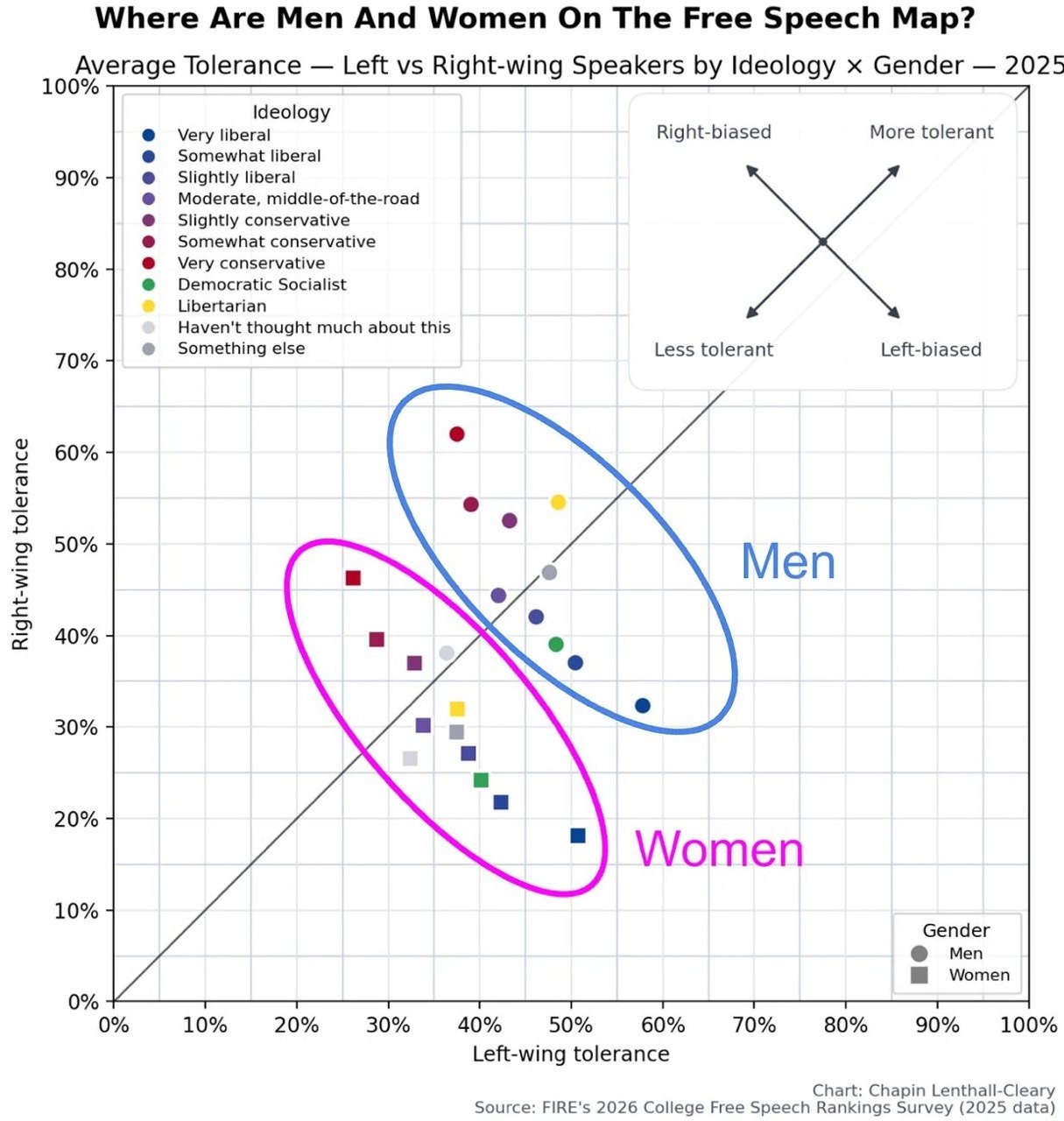
Summarizing the results of many surveys, Clark and Winegard demonstrate that while a majority of men favor free speech and the advancement of knowledge over emotional comfort, a majority of women prefer conformity, safety, and the protection of victim groups’ feelings. Not all women are indifferent to the traditional underpinnings of western civilization (and not all men support those underpinnings), but the general trends are clear.

Women are significantly more likely than men to support the cancellation of controversial speakers or the suppression of controversial research.

Women also tend to favor the existence of snitch lines to report people who cause offence. Women are more supportive than men of diversity quotas that exclude white men from consideration for prizes, positions, and promotions. (It would be interesting to know how many white women support diversity quotas that exclude white women from consideration for prizes, positions, and promotions.)

[…]

Asserting that both sides are pursuing worthy goals, the authors downplay the shock value of the findings, which show that women are, overall, less interested in truth and accuracy than men are. Imagine assessing such a finding as anything but catastrophic. Imagine calling the disregard for truth moral.

In place of truth, women value a utopian ideology that they perceive — usually without any consistency or adherence to fact, but nonetheless granted by Clark and Winegard — as “morally desirable”. But morally desirable for whom, and to what end? The use of the phrase, a misnomer, demonstrates how thoroughly the authors themselves are in thrall to the corrosive feminine culture they examine.

There is nothing moral (or generally desirable) about the suppression of truth-seeking research when it conflicts — or is perceived to conflict — with an allegedly emancipatory social goal. There is nothing morally desirable or indeed “protective” about shouting down an academic speaker because of the alleged harm of the speech. Naturally, social justice proponents would be outraged if their speeches were shouted down or their research blocked and censored.

I saw a link to this Helen Andrews article which seems to go well with Janice Fiamengo’s article linked above describing the “Great Feminization”:

… Cancel culture is simply what women do whenever there are enough of them in a given organization or field. That is the Great Feminization thesis, which the same author later elaborated upon at book length: Everything you think of as “wokeness” is simply an epiphenomenon of demographic feminization.

The explanatory power of this simple thesis was incredible. It really did unlock the secrets of the era we are living in. Wokeness is not a new ideology, an outgrowth of Marxism, or a result of post-Obama disillusionment. It is simply feminine patterns of behavior applied to institutions where women were few in number until recently. How did I not see it before?

[…]

The substance fits, too. Everything you think of as wokeness involves prioritizing the feminine over the masculine: empathy over rationality, safety over risk, cohesion over competition. Other writers who have proposed their own versions of the Great Feminization thesis, such as Noah Carl or Bo Winegard and Cory Clark, who looked at feminization’s effects on academia, offer survey data showing sex differences in political values. One survey, for example, found that 71 percent of men said protecting free speech was more important than preserving a cohesive society, and 59 percent of women said the opposite.

The most relevant differences are not about individuals but about groups. In my experience, individuals are unique and you come across outliers who defy stereotypes every day, but groups of men and women display consistent differences. Which makes sense, if you think about it statistically. A random woman might be taller than a random man, but a group of ten random women is very unlikely to have an average height greater than that of a group of ten men. The larger the group of people, the more likely it is to conform to statistical averages.

Female group dynamics favor consensus and cooperation. Men order each other around, but women can only suggest and persuade. Any criticism or negative sentiment, if it absolutely must be expressed, needs to be buried in layers of compliments. The outcome of a discussion is less important than the fact that a discussion was held and everyone participated in it. The most important sex difference in group dynamics is attitude to conflict. In short, men wage conflict openly while women covertly undermine or ostracize their enemies.

Bari Weiss, in her letter of resignation from The New York Times, described how colleagues referred to her in internal Slack messages as a racist, a Nazi, and a bigot and—this is the most feminine part—”colleagues perceived to be friendly with me were badgered by coworkers.” Weiss once asked a colleague at the Times opinion desk to get coffee with her. This journalist, a biracial woman who wrote frequently about race, refused to meet. This was a failure to meet the standards of basic professionalism, obviously. It was also very feminine.

Men tend to be better at compartmentalizing than women, and wokeness was in many ways a society-wide failure to compartmentalize. Traditionally, an individual doctor might have opinions on the political issues of the day but he would regard it as his professional duty to keep those opinions out of the examination room. Now that medicine has become more feminized, doctors wear pins and lanyards expressing views on controversial issues from gay rights to Gaza. They even bring the credibility of their profession to bear on political fads, as when doctors said Black Lives Matter protests could continue in violation of Covid lockdowns because racism was a public health emergency.

[…]

The Great Feminization is truly unprecedented. Other civilizations have given women the vote, granted them property rights, or let them inherit the thrones of empires. No civilization in human history has ever experimented with letting women control so many vital institutions of our society, from political parties to universities to our largest businesses. Even where women do not hold the top spots, women set the tone in these organizations, such that a male CEO must operate within the limits set by his human resources VP. We assume that these institutions will continue to function under these completely novel circumstances. But what are our grounds for that assumption?

The problem is not that women are less talented than men or even that female modes of interaction are inferior in any objective sense. The problem is that female modes of interaction are not well suited to accomplishing the goals of many major institutions. You can have an academia that is majority female, but it will be (as majority-female departments in today’s universities already are) oriented toward other goals than open debate and the unfettered pursuit of truth. And if your academia doesn’t pursue truth, what good is it? If your journalists aren’t prickly individualists who don’t mind alienating people, what good are they? If a business loses its swashbuckling spirit and becomes a feminized, inward-focused bureaucracy, will it not stagnate?

If the Great Feminization poses a threat to civilization, the question becomes whether there is anything we can do about it. The answer depends on why you think it occurred in the first place. There are many people who think the Great Feminization is a naturally occurring phenomenon. Women were finally given a chance to compete with men, and it turned out they were just better. That is why there are so many women in our newsrooms, running our political parties, and managing our corporations.

On the social media site formerly known as Twitter, John Carter comments on Helen Andrews’ article:

One thing Helen misses in this otherwise excellent analysis is the role played by prestige. Cancel culture was enabled by the unique circumstance of women weaponizing the prestige of freshly feminized legacy institutions. So long as those institutions retained their prestige, what the people who ran them said really mattered.

Unfortunately for the ladies (but luckily for civilization), this is self-limiting, because prestige is fundamentally an emergent property of masculine competence hierarchies. We see this demonstrated whenever a profession becomes coded as women’s work: its prestige immediately crashes. Feminists have complained about this for years, though of course they misunderstand the mechanism (prestige is a component of male sexual attractiveness, but not of female, and this is biologically hard-wired).

This prestige collapse is now affecting essentially every coopted, feminized institution — universities, news media, publishing houses, movie studios, large corporations, various government agencies, hospitals, courts, churches, all of them wield far less cultural power than they did even a few years ago. The only people who really care what these legacy institutions say are the women who took them over. To everyone else, the angry sounds they make are nothing more than background noise.

This is probably the main reason for the vibe shift. Once the prestige of feminized institutions declined below a certain threshold, their ability to enforce social consensus began to evaporate.

It’s also probably no accident that the Trump administration seems to care a lot more about what the anons of the Online Right say than it does about the opinion of the universities or the news media. All the intelligent young men got pushed out of the institutions, and those ionized particles of free male energy then began to self-assemble online into an ad hoc competence hierarchy where prestige is measured by clout rather than professional degrees, job titles, or institutional affiliations. The anon swarm is entirely informal, meaning that its outcomes are not amenable to antidiscrimination legislation or to procedural manipulation; you can screw with the algo all you want but you can’t actually force people to care what women say just because they’re women (thereby placing women into the position of openly trading in thirst, which gets them attention but certainly doesn’t mean that anyone has to pretend to take them seriously).

All that’s happened so far is that people’s attention has been redirected away from crazy woke females and towards the influencers of the online right. The fever has broken but society is a long way from recovered. The institutions are still under the control of crazy woke females, and this is extremely bad, especially because they are – for biological reasons related to childlessness — only going to get crazier as time goes on. Fortunately no one really cares what they say anymore, so as they throw tantrums as the institutions are reclaimed over the next decade or so, their protests won’t register as anything but irrelevant toddler noise.

October 15, 2025

QotD: Taxes in a zero elasticity world

Filed under: Economics, Government, Quotations — Tags: , , , — Nicholas @ 01:00

The problem with most politicians is when they enact a law, they seldom ask, “Then what?” They assume a world of what economists call zero elasticity wherein people behave after a tax is imposed just as they behaved before the tax was imposed and the only difference is that more money comes into the government’s tax coffers. The long-term effect of a wealth tax is that people will try to avoid it by not accumulating as much wealth or concealing the wealth they accumulate.

Walter E. Williams, “Let’s Not Waste a Crisis”, Townhall.com, 2020-05-12.

October 14, 2025

QotD: The trade in fake doctor’s notes

Filed under: Britain, Bureaucracy, Business, Health, Quotations — Tags: , , , , — Nicholas @ 01:00

A suspended doctor in England is running a company that sells people sick notes to excuse them on medical grounds from their work. “When you’re ill,” said an advertisement for the company, “our prices will make you feel better”.

A reporter for the Daily Telegraph newspaper managed to obtain a certificate from the company to excuse him from work for five months, because he claimed (falsely) to be suffering from the long-term effects of COVID. He obtained the note without providing any medical evidence whatsoever.

The only thing that surprised me about this was that anyone thought that it was necessary in Britain to buy or pay for such a certificate. I thought of the famous lines of Humbert Wolfe, the otherwise all-but-forgotten England man of letters:

    You cannot hope
    to bribe or twist,
    thank God! the
    British journalist.
    But, seeing what
    the man will do
    unbribed, there’s
    no occasion to.

The same might almost be said of British doctors, many of whom, I suspect, issue such certificates incontinently, for one of two reasons: fear of their patients, and sentimentality.

Not surprisingly, doctors do not like unpleasant scenes in their consulting rooms, and refusal of requests for time off sick can easily lead to such scenes, and occasionally to threatened or actual violence.

Naturally, no doctor likes to think of himself as a coward, the kind of person who caves in to such threats. The best way to avoid so humiliating a thought is never to risk having to think it, that is to say by granting the patients’ wishes in this matter immediately.

But in order to do this without feeling self-contempt, it is necessary to rationalize, that is to say to find supposed reasons for why everyone who wants a certificate should be given one. The English philosopher F.H. Bradley once said that metaphysics is the finding of bad reasons for what we believe on instinct, adding however that it was a human propensity to do so. In like fashion, we could say that doctors find bad reasons for giving sick certificates when they suspect that not to do so might lead to a confrontation with a patient.

Thus they convince themselves that if a person tells them that they are unfit for work, for whatever reason, it would be wrong to question it. No one would make a claim to be unable to work unless he were in some way discontented, unhappy, depressed, anxious, stressed, in a word suffering, and it is the object of doctors to reduce human suffering.

The doctor is aided in this train of thought by the looseness of psychiatric diagnosis, so that practically all forms of distress can be fitted into the procrustean bed of diagnosis. Even outright faking can now be construed as an illness or disorder, provided only that it goes on for long enough or is deceptive enough.

Does this mean that the patients seeking sick notes are all faking it? The matter is more complex than this would suggest. There is, of course, conscious, outright fraud, but this is comparatively rare. Just as doctors don’t like to think of themselves as cowards in the face of their patients, so patients don’t like to think of themselves as frauds.

Distress can be conjured out of almost anything and is not necessarily proportional to whatever causes it. Dwelling on the ill treatment one has suffered — and who has not suffered ill treatment at some time in his life? — can magnify something minor into something major, to the point at which it seems almost to have ruined one’s life. And it is certainly capable of rendering a person unfit for work in his own estimation — though in fact continuing at work would be a remedy for, rather than an exacerbation of, the problem.

However, where economic loss is not too severe when stopping work on medical grounds is possible, medical grounds will be both sought and found. In the days of the Soviet Union, the workers had a saying: “We pretend to work, and they pretend to pay us.” In our kinder and more enlightened societies, we pretend to be ill, and they pretend to treat us — except that the word “pretend” does not quite capture the subtlety of the transactions between doctor and patients.

Theodore Dalrymple, “Make Me Sick”, New English Review, 2025-07-04.

October 12, 2025

QotD: Male privilege revealed

Filed under: Books, Health, Media, Quotations — Tags: , , , , , — Nicholas @ 01:00

Self-Made Man by Norah Vincent documents the author’s 18-month experiment living as a man named Ned. She decided to embark on this experiment to explore gender dynamics from “the other side”, so to speak. Vincent, a liberal journalist with a strong feminist background, decided she wanted to understand men’s lives and social roles from within. She recognized, accurately, that men change their behavior when a woman is present, and she was curious to see how they were when no women were around.

Vincent described herself as a “bull dyke” and held strong feminist views. She expected, throughout the course of the experiment to uncover the secrets of male privilege and the societal advantages that, she was sure, are afforded to men. She anticipated that living life as a man would validate her beliefs that men lead easier lives and wield unchecked power. She figured that, at the very least, she could enjoy a couple of years as a powerful male.

Vincent disguised herself as a man by getting a new hair style and giving herself a fake five o’clock shadow, among other things. She had always been considered rather masculine in her usual feminist and lesbian circles, so she figured she could pass rather easily as a man, if perhaps a slightly effeminate one. She was right.

Her initial assumptions changed when Vincent discovered that men, contrary to her expectations of power and privilege, face their own unique set of pressures and struggles. Men, she discovered, were expected to suppress any signs of vulnerability. This quickly led to feelings of extreme isolation that she did not expect. Nobody “had her back” because, as far as they knew, she was just a man, and should “man up”. She quickly realized that men do not have inherently easier lives. Her preconceived notions of in-born male advantage evaporated. She was getting worried.

She realized that women do not have empathy for the struggles of men.

Norah, as Ned, experienced the behavior of women toward men firsthand. At one point, she tried dating women as a man. She figured this would be incredibly easy for her. Not only was she a woman herself and knew how women think, but she was also a lesbian and already liked women. She worried at first that she’d be too good at it and would have to tell interested women that she was a woman to stop them from pursuing her.

The reality was sharply different from her expectations. Her apparent femininity came across as her simply being an effeminate man. This caused women to be disinterested in her and their rejections were dismissive, cold, and often extremely brutal. Women would sometimes treat her with suspicion or outright hostility as they assumed her intent was negative.

These interactions eventually led Vincent to start developing misogynistic thoughts. That’s right: women treated her so poorly when they believed her to be a man that she started to develop misogynistic thoughts.

Interestingly, many of the supposedly straight women she had attempted to date, even those who had been brutal and cold toward her, immediately expressed interest in a lesbian “hook-up” when she told them she was a woman who had been disguised as a man for the sake of journalism.

Perhaps there’s no such thing as a “straight woman”. Is there even a such thing as a lesbian?

CTCG, “UNDERCOVER: A Feminist’s Year Living as a Man”, Codex Trivium Cosmic Genesis, 2025-06-16.

October 7, 2025

An unexpected Gen Z “influencer” – Shakespeare

Filed under: Books, Health, History, Media — Tags: , , , , , — Nicholas @ 03:00

Ted Gioia describes the plight of a young man who had to move home after college and falls into a state of depression thanks to his hopeless situation and his dysfunctional home and social life. His name is Hamlet:

This was long thought to be the only portrait of William Shakespeare that had any claim to have been painted from life, until another possible life portrait, the Cobbe portrait, was revealed in 2009. The portrait is known as the “Chandos portrait” after a previous owner, James Brydges, 1st Duke of Chandos. It was the first portrait to be acquired by the National Portrait Gallery in 1856. The artist may be by a painter called John Taylor who was an important member of the Painter-Stainers’ Company.
National Portrait Gallery image via Wikimedia Commons.

It’s almost uncanny how relevant it feels right now.

So if I were directing Hamlet in the current moment, I’d give the title character an iPhone and game console. I’d have the characters onstage share photos on Instagram — and put up a big screen so the audience could see them posted in real time.

Hamlet could add pithy captions to his social media images. What a piece of work is a man! or maybe The lady doth protest too much!

Yes, Hamlet is many things, but one of them is, perhaps, a failed influencer.

Along the way, we may have answered the classic question about this play. For generations, critics have wondered why Hamlet wastes so much time, and can’t be bothered to take action.

Maybe he’s just too busy gaming and scrolling.

Okay, it sounds ridiculous. But is it really? Shakespeare possessed tremendous insight into the human condition — perhaps more than any author in history. So maybe he really did grasp the dominant personality types of our own time.

The Prince of Denmark still walks in our midst. And maybe — just maybe — careful attention to this play might help us, in some small degree, to heal the Hamlets all around us. Their number is legion.

Of course, the larger reality is that Shakespeare has proven himself relevant to every time and place. We can see that easily be examining how other generations viewed this same play.

Hamlet‘s original audience, four hundred years ago, clearly enjoyed the spectacle of violence and adultery. Nine key characters die during the course of the play — most of them murdered. Audiences loved these kinds of dramas back then, and Shakespeare always knew how to please the crowd.

But more sophisticated viewers, circa 1600, would have seen Hamlet as a political commentary — a reflection of all the tensions and rivalries of Elizabethan England. Nobody knew better than Shakespeare that monarchy is a dangerous game, and he always looked for opportunities to refer to current events in roundabout ways.

But two hundred years later, the Romanticists were in ascendancy, and they saw Hamlet as a very different kind of play. They ditched the politics, and embraced the Prince of Denmark for his pathos and personality. They tapped into the intense emotional currents of Shakespeare’s heroes — and the plays seemed perfectly suited for this kind of interpretation.

It’s no exaggeration to say that Hamlet continued to change for each new generation. He always feels timely and relevant.

A hundred years ago, critics began grappling with psychology and the unconscious — and Hamlet was a perfect character for these kinds of interests. In his 1900 book The Interpretation of Dreams, Freud focused on Hamlet as a case study in repression.

And who could disagree?

But fifty years later, Hamlet changed again. It now was the perfect play for those who had survived World War II. Jan Kott insists, in his book Shakespeare, Our Contemporary, that these old plays were more relevant than ever during the Cold War — just as timely as Beckett or Sartre or Brecht or Ionesco.

October 4, 2025

Rapid onset gender dysphoria (ROGD)

Filed under: Cancon, Health, Media, Politics — Tags: , , , , , , — Nicholas @ 05:00

At Woke Watch Canada, Igor Stravinsky tells the story of “Jane and John”, a distressing tale of rapid onset gender dysphoria:

Image via the Boston Medical Center

In Ontario elementary schools, students are taught that whether you’re a boy or a girl is not determined by your physical body. Kids are encouraged to “explore their identity”. You may have a girl’s body. But how do you feel about it?

These kinds of discussions are going on because schools have accepted what rational people call “gender ideology”, but I prefer the term “gender mythology” because an ideology usually has to do with political systems. In my view the idea that a person’s sex is unrelated to their physical body, that they have a kind of soul sex, if you will, is clearly a myth.

[…]

Jane and John

This is a true story. The names have been changed to protect the privacy of this person.

Jane was a happy, clever, talented, and expressive girl who always wanted to help others. She displayed precocious empathy and enjoyed teaching younger kids various skills. Jane became socially conscious at an early age and was bothered by the fact that she enjoyed a middle-class, Western quality of life while so many others were clearly struggling. As an elementary student, she canvassed her neighbourhood collecting donations for disadvantaged kids. She came to identify with groups she saw as persecuted or oppressed.

Her school was very racially diverse, but she did not observe much racial discrimination. What she did notice was a fair bit of homophobia. She quickly took every opportunity to be an ally to the LGBT cause. In her middle school, there was an LGBT club, which she joined. Jane would often arrive home from school in an angry state because another student had said something that upset her, like, “being gay is a sin”, for example.

Jane’s parents were progressives who made it clear that she would be loved and accepted if she were a lesbian. Jane laughed at that and replied that she “dreamed about boys”.

Jane was a high achiever who was active in athletics and music. At 16, she became a vegan. She was in most ways a typical high school student, but her allyship with LGBT people gradually moved towards activism.

At university she quickly gravitated towards Indigenous and Gender Studies. Her close friends were all LGBT people. Her best friend was a transwoman (a man who identified as a woman). Jane came out as “bisexual” but her main romantic relationship was with a man.

Then, abruptly at the age of 20, she announced to her parents that she was to be called “John” and that she was going to transition to male.

By her own admission, Jane had been perfectly happy as a girl/woman for 20 years- “until I wasn’t”. This does not fit the Gender Mythology narrative. There is simply no way you can reasonably argue that she had, at this late age, suddenly realized what she truly was. She herself did not even claim that. So, what happened?

[…]

It was pretty obvious to me that Jane’s “transition”, like [trans-race activist Rachel] Dolezal, was the result of a combination of personal qualities and social influences. All the stars aligned to point her in that direction. She desperately wanted to be part of the community she had connected with and was tired of just being an ally. Claiming to be bisexual did not really cement her position as an insider. But becoming trans was her ticket.

Due to the extreme nature of taking on that identity — lifelong drug regimens and a number of surgeries, all of which presented serious health risks, going down that road reflected a true commitment and not only made her a part of the LGBT tribe but catapulted her to the top of the hierarchy.

What Jane experienced is known as Rapid Onset Gender Dysphoria (ROGD) and was first identified by the physician/researcher Lisa Littman. Learn more about it here. If you want to get a 2SLGBTQ++ (plus whatever other letters and numbers they’re using now — I can’t keep up) activist spitting mad mention ROGD. The phenomenon proves beyond a reasonable doubt that gender dysphoria can be induced in vulnerable people by social circumstances and aligns well with the research and clinical practice of Dr. Kenneth Zucker from the Centre for Addiction and Mental Health (CAMH) in Toronto.

Zucker ran the clinic for some 20 years and was pushed out due to his refusal to accept “affirmative care” as the only acceptable treatment for gender dysphoria. Zucker found that about 80% of kids would eventually grow out of their dysphoria and thus did not believe in affirming kids’ identities but rather focused on helping them cope with their condition.

Since affirmative care (an oxymoron!) has been adopted, we thus know that 80% of the kids who have been put on the road to gender transitions (and most carry through to the end) would have seen their gender dysphoria dissipate naturally over time. But once the first step — puberty blocking drugs, is taken, kids almost always go on to cross sex hormones and many continue with various surgeries.

Gender clinics do not do follow up nor do they support de-transitioning, but it is clear that the number of young people out there who have seriously harmed themselves through “affirmation” treatments is significant, and more harm is being done day by day as long as affirmative care remains the standard treatment for gender dysphoria.

September 29, 2025

Screen addiction – “No drug cartel makes as much money as the screen-and-app companies”

Filed under: Health, Media, Technology — Tags: , , , , , , — Nicholas @ 03:00

Ted Gioia on the eight things about screen addiction that David Foster Wallace tried to warn us about before he took his own life in 2008:

Those same youngsters are now showing up on college campuses, and we can begin to gauge the societal impact of a screen-driven life. It ain’t pretty.

So this is a good time to revisit what Wallace tried to warn us about thirty years ago. He was ahead of his time in the worst possible way, experiencing firsthand all the debilitating symptoms that now plague millions.

That’s why his writings feel so eerily contemporary. They read like commentaries on what’s happening right now.

Of course, Wallace knew very little about the Internet — he deliberately avoided it. He also refused to own a television. He understood how susceptible he was to screen addiction, and took drastic steps to reduce his exposure to all screens.

But he wrote about it — most tellingly in his huge novel Infinite Jest. The title refers to a film that is so addictive that people who watch it can’t stop. They literally watch it to death. It’s an infinite diversion, much like the endless scrolls on today’s social media apps.

He returned to the topic in his final book The Pale King, and also discussed it in interviews and essays. I’ve read through all of these including more than thirty interviews with the author. These allow me to put together a point-by-point summary of what Wallace tried to tell us.

We ignore his warnings at great risk.

(1) Screen technology will cause a crisis of loneliness, especially among young people.
In almost every interview, Wallace eventually talks about loneliness. It was a looming crisis, he insisted. But he was one of the first to link this to the ways we divert ourselves via screens. […]

(2) This will lead to widespread depression.
Wallace also knew this firsthand. He suffered intensely from depression. His inability to find a suitable treatment led to his suicide in 2008. […]

(3) This will also happen at a larger scale. Society will grow more fragmented and disconnected.
As each person falls into an isolated relationship with a screen, larger communities begin to fray. Wallace anticipated a “new vision of the U.S.A. as an atomized mass of watchers and appearers”. […]

(4) Screen technology promises to liberate us, but the reality is that it controls us for the benefit of others.
The most dangerous part of the screen entertainment is the illusion that it serves us. But the reality is that we actually serve tech platforms and their advertisers. […]

(5) The people who control the technology work to hide their purposes and goals.
“They’re trying to lock us tighter into certain conventions, in this case habits of consumption,” Wallace told Larry McCaffery in 1993. “This is McLuhan right? ‘The medium is the message’ and all that? But notice that TV’s mediated message is never that the medium is the message.” […]

(6) Our survival will depend on our ability to remain independent of these forces.
If we abandon ourselves completely to the tech (as many now do), we become pawns in the corporate agenda to monetize us — at a tremendous cost in loneliness, depression, and social disconnection. […]

(7) We don’t have many tools, but kindness and compassion will be the starting point.
We need to replace irony, sarcasm, and cynicism — which have contributed to our self-debasement — with softer, gentler attitudes. Cynicism is useful in criticizing, but is impotent when we need to build something better. Irony only destroys, never builds. […]

(8) Art can help us heal.
He wrote his big books with the hope that they would help us find a way back to a more caring and connected world — but connected via people, not screens. […]

September 26, 2025

QotD: Men and women

Filed under: Humour, Quotations — Tags: , , , , — Nicholas @ 01:00

A man’s women folk, whatever their outward show of respect for his merit and authority, always regard him secretly as an ass, and with something akin to pity. His most gaudy sayings and doings seldom deceive them; they see the actual man within, and know him for a shallow and pathetic fellow. In this fact, perhaps, lies one of the best proofs of feminine intelligence, or, as the common phase makes it, feminine intuition.

H.L. Mencken, In Defense of Women, 1918.

« Newer PostsOlder Posts »

Powered by WordPress