
Now, do you accept the traditional image of scientists as sober, serious, disinterested seekers of truth? Or do you have more of a Biscuit Factory sort of view of them, where quite a lot of them are very flawed human beings, egotistical shits bent on climbing the greasy pole and treading on people to get to the top? Bullshitters and networkers and operators? Actually, I think the former types do exist, there are good, serious scientists out there (including some of my personal friends, and quite a few readers of this blog), but there are an awful lot of the latter types, especially at the top, and it’s rare to hear of a science department that isn’t full of bitter hatreds and jealousies and vendettas, where every Professor turns into an arsehole no matter how nice they seemed when they were a graduate student.
Hector Drummond, “Soap-opera science”, Hector Drummond, 2020-03-29.
February 11, 2025
QotD: Scientists, in their natural habitat
February 10, 2025
Immortality, ancient versus modern
Immortality used to be something you only got in the eyes of others, as Benjamin Franklin put it, “If you would not be forgotten, as soon as you are dead and rotten, either write things worth reading, or do things worth the writing”, but modern tech bros want the other kind of immortality … the one where you don’t actually die:
In ancient times, you attained immortality by doing great deeds.
Today you attain immortality by getting blood transfusions from teenagers, and freezing your body for later revival.
Needless to say, there’s a huge difference between these two strategies.
In the first case, you serve others by your great deeds — eternal renown is your reward for this. But folks seeking immortality today are the exact opposite. They have reached peak narcissism — other people are, for them, literally just a source of fresh blood (or stem cells).
Until recently, I thought those Dracula movies were just a story to scare little kids. I now know that they’re an actual playbook for Silicon Valley elites.
With a better business plan, our Transylvanian count could have raised some serious VC money.
Nowadays he would be running a medical rejuvenation startup with a billion dollar market cap
Not long ago, I would have thought that the tweet below was a joke. But not in the current moment.
By the way, don’t miss the motto on his shirt.
I’m tempted to make some joke about this — but we’ve now arrived at a point where reality itself morphs into dark comedy. No punchline is necessary
And here’s another similarity between tech billionaires and the monsters in old horror movies. Somebody recently sent me a link to a website that sells bunkers to tech elites, and they remind me of dungeons in a Frankenstein film.
Go ahead, click on the link. Don’t let me stop you.
In both instances, horror is the right term.
Just looking at these things and imagining some delusional transhumanist getting on the table in his dungeon for a rejuvenation procedure is very creepy.
But there are some similarities between ancient heroes doing great deeds, and today’s Silicon Valley transhumanist. They both want to be like the gods (only their methods are different). Also, they are both admired leaders in their respective societies.
That’s the part that troubles me most. If the dude slurping up stem cells in a bunker was just another crazy person, I wouldn’t worry about it. But, unfortunately, these unhinged narcissists include some of the most powerful people on the planet.


February 9, 2025
When your sports team doesn’t win … which for most fans is every year
As a long-term fan of a highly successful sports team that has never won the biggest prize — the Minnesota Vikings have been to four Super Bowl games and lost all of them — I thought Charlotte Wilder’s take was worth considering:

Here’s the thing: The Chiefs are in the Super Bowl again (duh). And a lot of people seem to hate the Chiefs.
I get it. When you watch a team win for seven years straight, and you are not a fan of said team, it gets old. You’re angry. It’s unfair. It feels like watching billionaires get richer. If you’re a Buffalo Bills fan — a team that has lost to Chiefs quarterback Patrick Mahomes & Company at least thirty thousand times in the past seven years, most recently last Sunday — you are probably apoplectic.
But hear me out: Sports dynasties are good.
Seeing as I am a fan of Boston sports teams with recent histories of victory, you might be inclined to shove me in a locker when I present my argument, but I hope you’ll hear me out. I even drew a couple graphs and stuff to try to convince you.
[…]
Being a fan of a losing team is, at its core, romantic. You love this thing that doesn’t really know you exist, will never love you back, is capable of bringing you intense joy and misery, and is usually loaded with nostalgia. The longer your team goes without winning a championship, the more romantic your fandom. Extra romance points if your team has recently gotten close and lost (Bills, Lions) or has just totally sucked for a very long time now (Jets).
I actually did some math here to illustrate my concept. I call it the Fandom Romance Index (FRI).
You might be thinking, right about now, “Hey, Charlotte, I thought this post was about dynasties?” We’re getting there. Before we do, however, I have to familiarize you with the Fandom Hatred Index (FHI), which is the inverse of the FRI.
Simply put, the longer a team wins, the more intense other fans’ hatred. Think the Patriots post-Deflategate, when the rest of the country would rather have eaten seventeen bowls of clam chowder in one sitting than watch Tom Brady hoist another trophy.
Which brings me to the Chiefs. While their fans are riding high right now, their fandom is no longer romantic. The romance of fandom matters because, at its apex, it is the most pure form of loving a team, of being a fan. You’re hanging in there without much reason for doing so. You’re allowing yourself to hope despite all the evidence telling you not to — I think it’s beautiful and resilient.
And the higher the romance index, the more gratifying it is when that team finally wins.


February 7, 2025
QotD: The Chump Ratio
That’s what you might call the Chump Ratio. In any given crowd, Barnum (or whomever) said, one person in five is a born chump. He’s ready, willing, and able to believe anything you put in front of him, and so long as it’s not skull-fornicatingly obvious fakery — an extremely low bar, as you might imagine — he’s all in. The best part is, chumps don’t know they’re chumps, and they never, ever wise up (poker players have a similar adage: “After a half hour at the table, if you can’t spot the sucker, then you’re the sucker”; it has the same impact on behavior, namely: none whatsoever). You don’t have to do anything to sell the chumps; they’re practically begging you to take their money.
Barnum didn’t say much about these guys, but there’s another ratio that applies to a given crowd, also about one in five: The born skeptic, the killjoy, call them what you will. This is the guy completely unaffected by the lights, the music, the smells of popcorn and cotton candy, the children’s laughter … all he can see at the carny is the tattooed meth head who put everything together overnight with an Allen wrench. He might well show up at your carny — the wife and kids wanted to go — but you’ll never make a dime off him. No show in the world is ever going to sell him, so you don’t need to worry about him.
It’s those other three guys in any given crowd that make you some serious money … or bring the whole thing crashing down on your head. They’re who the show is really for.
It’s pretty easy to sell these folks. After all, they want to be sold. They’re at the carnival, aren’t they? And yet, it’s also pretty easy to screw it up. They’re willing to suspend disbelief — they want to — but the line between “necessary suspension of disbelief” and “an insult to one’s intelligence” is thinner than you think, and lethally easy to cross.
Severian, “Carny World”, Founding Questions, 2021-09-24.
January 31, 2025
QotD: “Did you know the government faked the moon landings?”
Today I am compelled to much more sympathy with people who have come to believe that. It’s still objectively stupid, but I understand how they got there. It’s an interaction between a low-trust, polluted information environment and the cheater-detection module wired into human brains.
If you pose people a logic problem phrased in two different ways, one of which is “spot the cheater” and one of which is not, they’ll do substantially better on the first version. We are social animals who survived by forming trust networks, and for millions of years spotting the cheater was a life or death matter.
Now put yourself in the shoes of a person of average intelligence — not very good at following complex arguments or extracting generative patterns from large masses of evidence. This person has gradually become aware over the last quarter century that public information sources are saturated with lies. The media is corrupt and partisan, corporations deceive to boost their profits, education is ideologically captured, and governments constantly peddle vast falsehoods to gain compliance.
In this environment, and given the capacity limitations of the average human, the cheater-detection module goes into overdrive. The least bad strategy is to try to spot the worst liars and then believe the opposite of everything they say.
“The moon landings were faked” has to be understood as a symptom not of individual insanity, but of governing institutions and elite classes who have repeatedly burned up their long-term credibility for short-term gains.
This trend had been building for a long time, but undoubtedly culminated with the series of colossal lies, blunders, and “we’ve always been at war with Eastasia” reversals around COVID.
I wish I knew a way back from this. I’m not sure anything less than the abolition of secrecy could do it.
ESR, Twitter, 2024-10-27.
January 27, 2025
If you’ve ever thought society is run by psychopaths … you may be right (but you’re not entitled to compensation)
Spaceman Spiff discusses normal people, the mimics who pretend to be normal and often seem to work their way into positions of power and influence (not every mimic is a psychopath, but all psychopaths are mimics), and those who resist the mimics (and therefore also the psychopaths):

There are different types of people we can observe around us. Normals are the great mass of humanity. They don’t think too hard. They just get on with it. This is the majority.
Most Normals seek some confirmation from outside themselves, typically opinions and views from trusted sources. Many seem averse to thinking at all and almost none are independent thinkers in any meaningful sense.
This includes social mores. The majority look towards others for their cues on how to act which makes them easy to manipulate.
Social validation in differing forms is the controlling mechanism. What is the other fellow doing? That is what I must do.
Those doing the controlling are different. Many leadership positions are populated by people who display abnormal traits.
Cluster B disorders in particular are everywhere. Narcissistic, antisocial and histrionic behaviours are visible in many senior levels of society from politics to major charities.
These disordered people largely copy normal human emotions and behaviours. They are acting because they don’t experience life as the rest do.
Everything is a performance which provides enormous advantages to them as they climb their way up, but has the drawback of being fake.
We can call these people Mimics for convenience.
Today’s societies largely reflect the ascendency of Mimics as they seem to run many institutions we rely on, a situation referred to as a pathocracy.
The extreme version of the type is a psychopath, someone lacking conscience or empathy and therefore unable to enjoy the full human experience. Psychopaths are damaged people unencumbered by concerns with morality or social convention, so able to quickly get on in life.
Cluster B types have similar deficiencies that aid them in a myriad of ways and are more common than psychopaths. The end result is the same, leadership positions dominated by those with distorted thought patterns who quickly learn the majority of people prefer to be led and told what to do.
Some can resist
Both Normals and Mimics swim in the same waters. Normals because they are shaped by society and seek its approval. Mimics because they are faking it. They must scan the horizon at all times to ensure they are making it work. Their act is designed to reflect normality and the trophies it can bring so it must be calibrated to what works with an audience.
A need to seek approval draws these groups together. An external dependence they assume is universal if they even bother to think about it at all.
They are forever locked into a world dictated by the views and whims of others.
But there are individuals who can be defined by the fact they are much more self-sufficient. They do not seek external approval and are not subject to the judgment of others.
Everyone who resisted the Covid propaganda would be an example. This includes anyone who initially succumbed to the pressure but quickly worked out something was amiss.
The chief characteristic of this group is resistance to social pressure because they reject the need for external cues to guide behaviour.
The most extreme example of this phenomenon in society are schizoids, those indifferent to praise or criticism, largely motivated by inner drives and impervious to many forms of social stress.
As with the psychopaths, schizoids represent the extreme end of the insulated spectrum, but everyone resistant to today’s aggressive social controls share some schizoid traits to a greater or lesser degree.
We can call these the Resistant, individuals not dependent on external validation and naturally averse to being controlled. Independent thinkers who instinctively insulate themselves from the unthinking Normals who make up the bulk of humanity.
Because of their mental distance from the herd this group are often unmoved by the narratives controlling much of society.
Unlike the Mimics, the Resistant do not seek to control others and it is control that defines the West today, especially the ruling classes who fear the Normals waking up. They must be relentlessly managed via approved narratives lest they make the wrong decisions in life.
Mimics are naturally drawn to control since they are faking it. They run the constant risk of being discovered as fakes. Imposter syndrome rules their actions which drives the vigilance we commonly observe in their sensitivity to criticism and their enraged responses to being challenged. All this to stave off scrutiny.
It is the most broken who can be persuaded their fractured view of life is some grand vision that escapes the rest of us. Such people are everywhere and they are comically easy to control by appealing to their need for superiority which is why control is so attractive to them in turn. They assume it is a universal phenomenon.
Those who shun control are then a threat to their identity, hence the aggressiveness with which the independently minded are pursued. They cannot be left in peace, a very striking observation of today, the zeal with which nonconformists are targeted even when minding their own business.
January 20, 2025
“You can’t have genuine equality for women while also letting them duck through the trap door of but I didn’t mean it, like children, when their choices have unhappy outcomes”
Kat Rosenfield shares her concerns about what the accusations against Neil Gaiman indicate about the problems with allowing women to be legally unreliable narrators:

There’s a moment in the Gaiman exposé where the main accuser, Scarlett Pavlovich, sends him a text message asking him how he’s doing. Gaiman says he’s struggling: he’s heard from people close to him that Pavlovich plans to accuse him of rape. “I thought that we were a good thing and a very consensual thing indeed,” he writes.
“It was consensual (and wonderful)!” she replies.
Except: she doesn’t mean it. We know this because Lila Shapiro, the author of the piece, breaks in to tell us as much:
Pavlovich remembers her palms sweating, hot coils in her stomach. She was terrified of upsetting Gaiman. “I was disconnected from everybody else at that point in my life,” she tells me. She rushed to reassure him.
But also, we know this because she didn’t mean it is sort of an ongoing theme, here. And that’s what I want to talk about.
By this point in the article we’ve been instructed, explicitly and repeatedly, that you can’t assume a relationship was consensual just because all parties involved gave consent. “Sexual abuse is one of the most confusing forms of violence that a person can experience. The majority of people who have endured it do not immediately recognize it as such; some never do,” Shapiro writes in one section. In another, she explains that it doesn’t matter if the women played along with Gaiman when he asked them to call him “master” or eat their own feces because “BDSM is a culture with a set of long-standing norms” to which Gaiman didn’t strictly adhere (as the meme goes, it’s only BDSM if it comes from the BDSM region of France, otherwise it’s just sparkling feces-eating sadomasochism.)
Shapiro spends a lot of time thumbing the scale like this, and for good reason: without the repeated reminders that sexual abuse is so confusing and hard to recognize, to the point where some victims go their whole lives mistaking a violent act for a consensual one, most readers would look at Pavlovich’s behavior (including the “it was wonderful” text message as well as her repeated and often aggressive sexual overtures toward Gaiman) and conclude that however she felt about the relationship later, her desire for him was genuine at the time — or at least, that Gaiman could be forgiven for thinking it was. To make Pavlovich a more sympathetic protagonist (and Gaiman a more persuasive villain), the article has to assert that her seemingly self-contradictory behavior is not just understandable but reasonable. Normal. Typical. If Pavlovich lied and said a violent act was consensual (and wonderful), that’s just because women do be like that sometimes.
Obviously, this paradigm imposes a very weird, circular trap on men (#BelieveWomen, except the ones who say they want to sleep with you, in which case you should commence a Poirot-style interrogation until she breaks down and confesses that she actually finds you repulsive.) But I’m more interested in what happens to women when they’re cast in this role of society’s unreliable narrators: so vulnerable to coercion, and so socialized to please, that even the slightest hint of pressure causes the instantaneous and irretrievable loss of their agency.
The thing is, if women can’t be trusted to assert their desires or boundaries because they’ll invariably lie about what they want in order to please other people, it’s not just sex they can’t reasonably consent to. It’s medical treatments. Car loans. Nuclear non-proliferation agreements. Our entire social contract operates on the premise that adults are strong enough to choose their choices, no matter the ambient pressure from horny men or sleazy used car salesmen or power-hungry ayatollahs. If half the world’s adult population are actually just smol beans — hapless, helpless, fickle, fragile, and much too tender to perform even the most basic self-advocacy — everything starts to fall apart, including the entire feminist project. You can’t have genuine equality for women while also letting them duck through the trap door of but I didn’t mean it, like children, when their choices have unhappy outcomes.

QotD: Brainwashing
Like Robert Jay Lifton’s Thought Reform and the Psychology of Totalism (another must-read), I read Meerloo years ago, so my recall of the details is fuzzy, but the upshot is obvious: The techniques of “brainwashing” have been known since at least the Middle Ages, and they’re still the same. Suspected witches in the Early Modern period, for instance, got Der Prozess, and though the witch hunters also had recourse to the rack and thumbscrews and all the rest, none of it was really necessary — isolation, starvation, and sleep deprivation work even better, provided you hit that sweet spot when they’re just starting to go insane …
I’m being deliberately flip about a horrible thing, comrades, because as no doubt distasteful as that is to read, the fact is, we’re doing it to ourselves, everywhere, all the time. Not the starvation part, obviously, but we eat such horribly unnatural diets that our minds are indeed grossly affected. Want proof? Go hardcore keto for a week and watch what happens. Or if that’s too much, you can simulate the experience by going cold turkey off caffeine. I promise you, by the end of day two you’d give the NKVD the worst dirt on your own mother if they sat a steaming hot cup of java in front of you.
Severian, “Kickin’ It Old Skool”, Founding Questions, 2021-10-04.
January 14, 2025
QotD: Ritual in medieval daily life
First, n.b. that “private” is in quotation marks up there. Medieval men didn’t have private lives as we’d understand them. Indeed, I’ve heard it argued by cultural anthropology types that medieval men didn’t think of themselves as individuals at all, and while I’m in no position to judge all the evidence, it seems to accord with some of the most baffling-to-us aspects of medieval behavior. Consider a world in which a tag like “red-haired John” was sufficient to name a man for all practical purposes, and in which even literate men didn’t spell their own names the same way twice in the same letter. Perhaps this indicates a rock-solid sense of individuality, but I’d argue the opposite — it doesn’t matter what the marks on the paper are, or that there’s another guy named John in the same village with red hair. That person is so enmeshed in the life of his community — family, clan, parish, the Sacred Confraternity of the Holy Whatever — that “he” doesn’t really exist without them.
Should he find himself away from his village — maybe he’s the lone survivor of the Black Death — then he’d happily become someone completely different. The new community in which he found himself might start out as “a valley full of solitary cowboys”, as the old Stephen Leacock joke went — they were all lone survivors of the Plague — but pretty soon they’d enmesh themselves into a real community, and red-haired John would cease to be red-haired John. He’d probably literally forget it, because it doesn’t matter — now he’s “John the Blacksmith” or whatever. Since so many of our problems stem from aggressive, indeed overweening, assertions of individuality, a return to public ritual life would go a long way to fixing them.
The second huge advantage, tied to the first, is that community ritual life is objective. Maybe there was such a thing as “private life” in a medieval village, and maybe “red-haired John” really was a reprobate in his, but nonetheless, red-haired John performed all his communal functions — the ones that kept the community vital, and often quite literally alive — perfectly. You know exactly who is failing to hold up his end in a medieval village, and can censure him for it, objectively — either you’re at mass or you’re not; either you paid your tithe or you didn’t; and since the sacrament of “confession” took place in the open air — Cardinal Borromeo’s confessional box being an integral part of the Counter-Reformation — everyone knew how well you performed, or didn’t, in whatever “private” life you had.
Take all that away, and you’ve got process guys who feel it’s their sacred duty — as in, necessary for their own souls’ sake — to infer what’s going on in yours. Strip away the public ritual, and now you have to find some other way to make everyone’s private business public … I don’t think it’s unfair to say that Calvinism is really Karen-ism, and if it IS unfair, I don’t care, because fuck Calvin, the world would’ve been a much better place had he been strangled in his crib.
A man is only as good as the public performance of his public duties. And, crucially, he’s no worse than that, either. Since process guys will always pervert the process in the name of more efficiently reaching the outcome, process guys must always be kept on the shortest leash. Send them down to the countryside periodically to reconnect with the laboring masses …
Severian, “Faith vs. Works”, Rotten Chestnuts, 2021-09-07.
January 10, 2025
Even the state-subsidized flappers in the media are glad to see Justin Trudeau go
In The Line, Andrew MacDougall hits the highs and lows — mostly lows — of Justin Trudeau’s prime ministership since 2015:
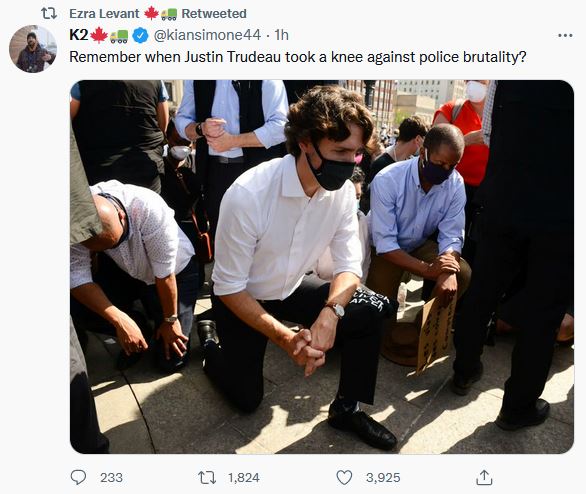
Justin Trudeau has always had a strong affinity for the symbolic gesture, especially when the media are around to record it.
And so the Trudeau era ends, not with a bang, but a simper.
Prime Minister Justin Trudeau dialled it up to “peak emotive” on Monday during his resignation speech at Rideau Cottage, even if he was only out to sing the tunes nobody wants to dance to anymore. Not even the appearance of a few prime ministerial tears could convince Canadians this day was anything but long overdue.
Much like how 1980s Hollywood cock rock once struggled to cope with the rawness of early 90s grunge, Trudeau’s cloying, self-obsessed mid-2010s Liberalism has run straight into the buzzsaw of mid-20s proto-populism. Trudeau might still label himself a fighter, but if he ever bothered to look around he would see that precious few people remain in his corner. Canadians have simply grown tired of being told how shit they are by the man they feel has done more than his fair share of putting Canada into the shitter.
Whether that’s a fair assessment of Trudeau’s efforts as a leader is beside the point. As Brutus Freeland has taken to saying, it’s all about the “vibes”. Even the quote-unquote “Trudeau media” is gleefully writing his obituary. That’s how bad things have gotten for Trudeau the man. We’re not in 2015 anymore, Toto.
I’m not sure that Justin Trudeau “does” introspection, but it shouldn’t be hard for him to see how he got here from there. Beginning with hypocrisy.
Trudeau promised to do things differently, but kept many of the same governmental command-and-control measures implemented by the hated Stephen Harper. He promised to stop cramming legislation into budget bills and then treated his own budgets as all-you-can-eat legislative buffets. Trudeau promised to be open by default, but tightened the clamps on government information.
Early talk of “sunny ways” and Conservatives being “neighbours”, not “enemies” masked a hyper-partisan who was all too eager to ascribe ill motive to his political opponents. Whether abortion, guns, convoys or trans rights, there was only ever one “correct” position for Trudeau, and anyone on the other side, no matter how well-reasoned or well-intentioned, was a sinner. In Trudeau’s Canada, everyone was a genocidaire, even if they got their citizenship yesterday and had nothing to do with the historic wrongs of residential schools. Black Lives Matter meant everyone else were racists, whether overt or closeted. Every societal wrong was an opportunity for all of us to “learn a lesson”.
But who the teacher is matters in the giving of lessons. And Trudeau, himself once a teacher, didn’t ever appear to learn any of his own.
January 9, 2025
Hollywood’s favourite creation … the “hero forgives” scene
I’ve never been much of a moviegoer or TV-watcher, so I hadn’t consciously noticed what kulak is discussing here:
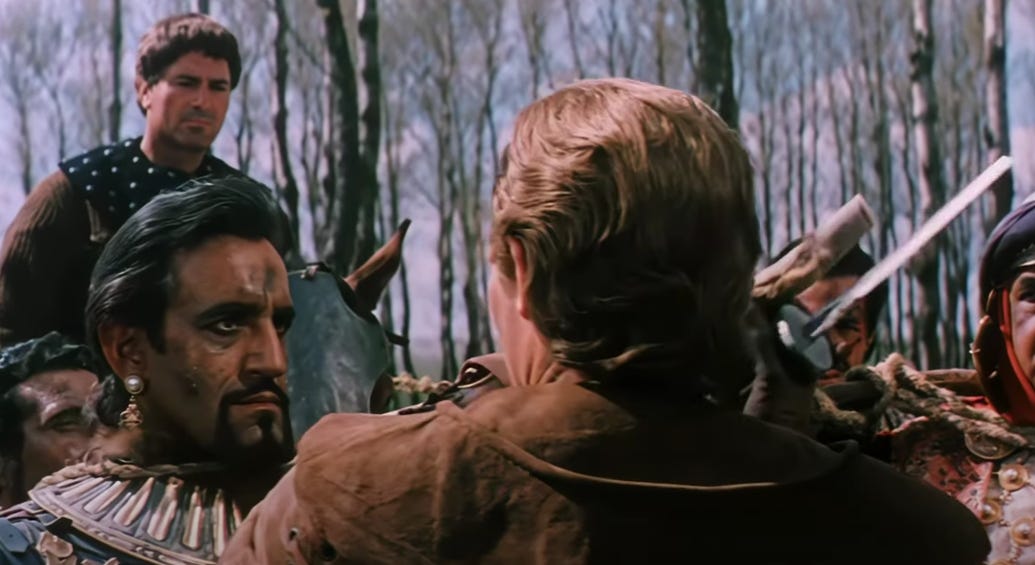
“El Cid” (Charlton Heston) releases enemy raiders who’ve just burnt down a village … for no reason.
“All that it takes for evil to triumph is for good men to do nothing.”
-Edmund BurkeThe reason the boomers are the way they are, and the reason no one in the west fights back against their dispossession and replacement is an 80 year long program to indoctrinate an Ideology I call “Hollywood Anti-justice”.
In almost every piece of media to do with violence, crime, justice, and individual heroism of the past 80 years there is a scene: The “Hero Forgives” scene.
Upon violently defeating, disarming, and capturing the villain, the hero, in spite of his every instinct, in spite of friends screaming at him and reasoning with him with arguments he can’t counter, in spite of the villains mocking unrepentance, dead to rights evidence, gleeful confessions, and even vows to reoffend.
Even if the villain is guilty of hundreds of murders, rapes, and treason, even if the hero himself has killed hundreds of henchmen to capture the villain …
The hero will refuse to kill or punish him.
Sometimes the hero will insist that he must go through the courts … Sometimes the villain will openly mock him that the courts are corrupt and will never convict him, and the hero still will refuse to take matters into his own hands …
Sometimes the hero himself IS the lawful authority. Sometimes the hero is a Military officer, post apocalyptic militia captain, Medieval Knight, Greek Hero, Roman Centurion … etc. And in fact his private judgement IS the official lawful means of passing judgement and executing obviously guilty villains … And he STILL refuses to punish or kill them.
I recently saw El Cid, where the hero, a Knight, refused to hang brigands who had pillaged, raped, burnt a town, confessed and were themselves quite resigned to dying, and even as his fellow knights berated him that the law itself demands he hang them, that it is his sacred duty to hang them, and that it would be treason for him not to…
And the Hero simply cuts their bindings and lets them go … Choosing to be forsworn as a traitor rather than hang the confessed and red-handed guilty. Now this may be a historical, but as far as I’ve been able to find such an event never occurred, it’s been made up for the film, doubly egregious because the historical El Cid almost certainly executed many criminals and brigands, committing and ordering justice … Which is NOT depicted in the film.
Even if the hero has been in this exact position before and spared the villain only for more to die, sometimes even his own family and friends, demonstrating the failure of this unspoken philosophy, the hero will STILL let them go … AGAIN.
Ussually there is some Deus Ex Machina that makes this all workout some ironic or divine punishment will find the Villain through their own folly … but not always. Indeed entire franchises have been perpetuated on THE SAME serial killer villain being forgiven, released, allowed to escape, etc. over and over again.
And audiences consistently hate this, this is always the most cliched, poorly written, out of character, film breaking scene in the entire work … Supposedly great kings, ruthless bounty-hunters, outlaws, veteran knights, military officers, grey and black market criminal anti-heroes, smugglers … All of them transformed into the most inconsistent pacifists for exactly this scene. I’ve seen audiences groan and scream at the TV “Just kill him” and yet the hero, often entirely contrary to their character, will not.
This is not an old literary trope, this is a Hollywood trope.
You can read the original Greek legends, the tales of King Arthur and his Knights, early modern nationalist heroes’ stories, the adventure stories of the Napoleonic officer, the Boys’ Own adventures of empire, and well into contemporary fiction westerns, crime stories, military science fiction, historical fiction, etc.
And in all of them you will see heroes kill their enemies in cold blood, order executions of the guilty, demand deserters, spies, and traitors be shot, seek revenge, order mass hangings … Etc.
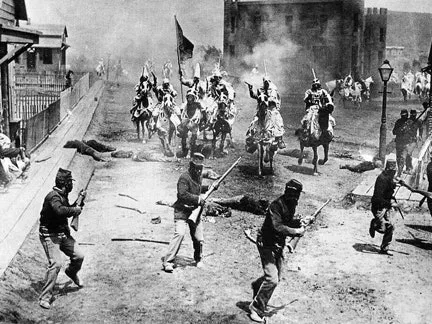
Nor is this some uniquely American madness … As late as the 1950s the vigilantes/terrorists of the original reconstruction era (1864-1877) Ku Klux Klan were treated as folk heroes… Birth of a Nation was played at the White House when it was released. The idea of vengeance, wild justice, and vigilante killings being some unconscionable moral horror was simply not the case in the first half of the 20th century … It was celebrated, much as it had been for the previous 3000 years of the west.
In 1915 the legitimacy of Vigilantism, Vengeance, and Private Justice was so accepted that even arch-progressive, Princeton University Professor, and US President Woodrow Wilson screened Birth of a Nation, a celebration of the Ku Klux Klan’s vigilante-terror campaign, at the White House.
Why did Hollywood invent this trope?
Where Hollywood producers just so attached to an idea of Christian forgiveness and pacifism that they just HAD to include it over the groans and often shouting of their audiences?
Were any of these writers, directors and producers even Christian to begin with!?
Why would the communists, atheists, Jews, and pedophiles that comprise the core of Hollywood writing include such an unusual Christian theme so insistently and often story breakingly?
Well. why do they insist on bullshit girl-bossery, race mixing, and woke theming today over the protests and disinterest of their audience?
Because it benefits them to brainwash the masses that way.
The Hollywood writers never identified with the hero refusing to kill an enemy … they identified with the villain and quite liked for him to get away (indeed many Hollywood writers will openly say as much, that they identify with the villains and much prefer writing them).
QotD: Teenagers
James Lileks, The Bleat, 2005-08-10.
January 4, 2025
QotD: The “show pillows”
It reminds me of the bathrooms of my childhood, which were stocked with forbidden things: decorative soap in a nice dish engraved with intricate patterns that evaporated on contact with water, and decorative towels. You ended up drying your hands on the curtains, or patting them dry on the inevitable polyester shag toilet-seat cover.
Anyway. You’re wondering how I recovered from this grotesque embarrassment. I fetched two pillows from Daughter’s unoccupied room, apologized on behalf of the male side of the species, and figured the matter was closed. Oh no. Ohhhh, no. The next morning my wife made up the guest room, and emerged with an expression of despair.
The pillowcases did not match.
One was white. The other — and I tremble with shame to write these words — was ivory.
Well, an apology was in order. But how? Maybe bring it up in a roundabout way at breakfast.
“So … how’d you sleep?”
“Oh … okay, I guess. Weird dreams. I was in a paint store, looking at those strips with the different hues, and two of the shades of white looked different but I couldn’t really tell if they were and then I started crying tears in two different shades of white and when the tears hit the floor they burned like acid, and then horrible off-white slugs oozed out of the hole and started singing ABBA songs in two different keys.”
“Huh. And you?”
“I had weird dreams too. There were two philosophers who agreed on everything except for one minor, obscure point, but instead of focusing on their agreement they argued about the small difference until they decided to have a duel, but the guns didn’t fire.”
“Ah, those would be the Show Pistols. Freud had something to say about those. Well, that’s on me. The pillowcase hues were not in sync. I hope we can get past this and enjoy the day.”
James Lileks, “Show Me the Pillows”, LILEKS (James), 2024-09-30.
December 31, 2024
Resolutions? Meh.
James Lileks considers the futility of New Year resolutions … for most of us, anyway:

New Year, New You — if you believe that all the cells in your body are replaced every 12 months. So we were told, right? I don’t think that’s the case. The brain, for example, stays constant, which is good, because the idea of the cells handing off memories to the new cells would probably end up like a game of Telegram, and after 15 years you’re convinced your first kiss was not on a boat in the lake on the 4th of July but deep in the Amazon forest on a dugout canoe during a meteor shower.
I don’t think your liver renews itself, alas. It has to sit there and take it. The bones, being the tentpoles for the cellular circus that is You, have to remain solid. No, the New You is entirely a matter of will, of resolutions and revelations undertaken on the First of the Year with solemn gravity, so you can be disappointed with yourself two weeks later.
Resolutions are always matters of self-improvement, and this presents a certain amount of difficulty. I’m at the age where the available options for self-improvement consist of the trivial and the insurmountable. Example: I should resolve to be more patient on the road with drivers who dawdle along a few miles below the speed limit, perhaps giving me adequate time to study the various political and philosophical statements glued to the rear of their auto. Why — why yes, you’re right, you cannot hug your child with nuclear arms. You also cannot defend the continental United States against the threat of ballistic bombardment with maternal limbs. A more pressing issue might be thus: Can we make the green light? No, we’re not going to make the green light.
I would indeed be happier if I could accept with zen detachment the lumbering pace of the car ahead. My impatience, my self-righteous desire to arrive at our destinations before Haley’s Comet arcs anew through the heavens — well, it brings me no joy. But this will not change. What’s the phrase? To thine own self be true. Well, being peeved because the driver ahead of me believes their face will ripple with G-forces if they go 21 MPH is my true self, and I am not about to deny who I am.
December 28, 2024
QotD: “If women ran the world” reality check
Severian “… if women were in charge there’d be no war …”
Backinmyyouth, early 20s or so, I was an even bigger smart ass than I am now. I had a class with one of those new-fangled feminists that people were talking about back then. She made that argument, about how if only women were in charge there would be no more wars. So as a polite smart ass I raised my hand, and she called on me.
I said, “I completely agree with you. I’d even say that if women had been in charge from the beginning that there would only have been one war in all of human history. It would have started in the stone age, and would still be doing on today, with no one remembering what it was about.”
After being warned by one of my spies in the feminist camp (wanted the professional hookup, but liked other kinds of hookups too if you know what I’m sayin’), I made sure to never take that professor for another class as she held a grudge against me till the end of time. An undying grudge for me pointing out that women hold undying grudges …
The reason I was aware of that particular female quirk was that I had recently been made aware that two of my aunts had been in a death-feud since before I was born. Pretty sure it’s still going on today in spite of one of them being dead.
Zorost99, commenting on “Friday Mailbag”, Founding Questions, 2024-09-27.


