
… the basics of the confidence game have not changed all that much with the new technology. The confidence man gets his name because he is adept at winning the confidence of the mark. The mark then lowers his defenses and foolishly trusts the con man, rather than his own natural skepticism. The mark is manipulated into thinking the con man is a friend or at least someone who can be trusted. The con man then uses that trust to exploit the mark.
The way in which the con men does this is by flattery. The mark trusts the con man, because the con man finds small ways to confirm the beliefs of the mark. The adept grifter will be a good listener and pick up the little things that the mark thinks are important, like religious beliefs or opinions about personal matters. Seemingly out of the blue, the con man will express those same opinions, which flatters the mark. After all, everyone likes being told that their private opinions are smart.
That’s something you see with the internet grifters. They often have worn a lot of masks as they seek out on-line audiences. […]
Another aspect of the con that remains constant is how the con man uses his alleged status as a victim to work the mark. Con men will use their mark’s natural empathy to win their confidence. Today that often means claiming the big bad tech companies are censoring them. Alternatively, they will claim evil trolls are haunting their internet activity, causing them harm. The term troll has been changed from meaning someone seeking attention to something almost supernatural.
The Z Man, “Carny Town”, The Z Blog, 2019-12-29.
April 29, 2025
April 16, 2025
The “medicalization” or “syndromization” of aspects of the normal human condition
On his Substack, Freddie deBoer wonders why we can’t be honest about the rise of bespoke “mental disorders” that look remarkably like typical human reaction to stimuli:

I just found a cost-free way to farm sympathy and attention 😊
I will never not be fascinated by those issues or arguments or perspectives that are studiously ignored by the media generally and the New York Times in particular. I’ve whinged about this many times when it comes to education, as the NYT is simply not going to consider the notion that different individual people have fundamentally different levels of academic potential in its pages, not even in an attempt to rebut the idea. I suppose that notion is just too challenging to the elite meritocratic liberalism that the Times epitomizes; the idea that we are all ultimately capable of achieving academic and professional greatness flatters the high-achievers who read and write the paper, and the “anyone can be anything” ethos is pleasant and unchallenging. It’s also destructive, which is the point. Bad ideas grow like weeds in the shade, or whatever the saying is. Disability issues are another place where the Grey Lady is very picky about what ideas to consider, and as usual they set the rhythm for many other publications.
This weekend the Times released a long piece looking at the ever-escalating rates of ADHD diagnoses and what exactly they tell us. What’s in the piece is fine — of course, the ADHD activist class doesn’t like it — but what’s remarkable is what isn’t in it. Once again, there’s just about zero consideration of ADHD as a social contagion, any recognition that there is now a vast and deeply annoying ADHD culture online that acts as a kind of evangelical movement for a neurodevelopment disorder. There are millions of people on ADHD TikTok and ADHD Tumblr and ADHD Twitter. There’s a vast universe of facile memes, dubious statistics, and self-flattering nostrums about ADHD floating around out there, and increasingly they’re penetrating into broader internet culture. (I am genuinely unaware of a subculture that is more directly and shamelessly self-celebrating than the online ADHD community, and I’ve read the comments at LessWrong.) Unsurprisingly, a big subsidiary industry has sprung up, with all kinds of products and services for sale, books and apparel and tchotchkes and conferences and boutique forms of therapy and exclusive members-only Discords … Whether neurodevelopmental disorders should have merch is an open question. What’s not subject to questioning is that this is happening. Five minutes of cursory searching would reveal the remarkable scope of online ADHD culture.
And yet the piece’s author, Paul Tough, is just about totally silent on this glaring reality. I find it genuinely bizarre. In a long and rambling (in a good way) piece where he kicks the various rocks of ADHD and asks good-faith questions about how diagnostic rules and social perception of the disorder influence medical practice, he still somehow fails to ever refer to the large, influential, and growing online movement that has raised the profile of the disorder even beyond its prior notoriety and in doing so injected a ton of money into the equation. You can dismiss that community as an online sideshow if you choose, but of course the online world has become profoundly influential on real life, and in other contexts neither the New York Times specifically nor the elite media generally has any problem acknowledging that fact. Why not here?
This tendency extends beyond ADHD. Recently Holden Thorp, editor in chief of the prestigious journal Science, wrote an essay for the NYT that explores the rise of autism diagnoses, which have expanded at truly ludicrous rates. To the extent that it’s referenced at all, the idea of social contagion is dismissed without argument. A couple years ago the Times published a piece by Azeen Ghorayshi about the absurd case of Tourette’s spreading (or “spreading”) among too-online adolescent girls via TikTok; though Ghorayshi is admirably clear that those young women did not in fact have Tourette’s, her piece is also slavishly, almost comically sympathetic to them, never bothering to suggest that maybe these were just bored teenagers who engaged in a frivolous and offensive bit of minstrelsy. (Imagine, judging teenagers for doing something stupid!) The idea that anyone could ever have unserious and wrongheaded motivations for adopting a disability seems to be one of those stories that the New York Times absolutely refuses to tell.
But why? People make up fake illnesses all the time, both consciously and unconsciously. Factitious disorders are real; we have references to what we might now call psychosomatic illnesses that stretch back to antiquity. Munchausen by internet is real. Hypochondria, factitious illness, Munchausen’s, the worried well … these have represented a major challenge for psychiatry for as long as the field has been formalized and integrated into the larger medical project. Why does no one ever talk about this stuff in our stuffy elite publications? Why do so many people in our media dance and shuffle rather than ask direct questions like “How many of these diagnoses are fundamentally faulty?” Why can’t anyone point out that saying you have a medical disorder is a shortcut to getting sympathy and attention, and that human beings crave sympathy and attention the way they crave water and air? We’ve lived through something like a “vibe shift,” and previously-unchallengeable social justice pieties are increasingly challenged, in good ways and bad. Yet under the broad umbrella of disability rhetoric, it’s always 2018, with both traditional and social media operating under a cloud of fear of giving offense. As I’ve said many times, the number of people who privately agree with me about all this is legion. The number who are willing to say so publicly are very few indeed. Nobody wants to paint that target on their back, I suppose. But why do these issues make people feel like targets at all?
April 7, 2025
Confessions of a book-hoarder
In the latest SHuSH newsletter, confessed book-hoarder Ken Whyte has a confession to make:
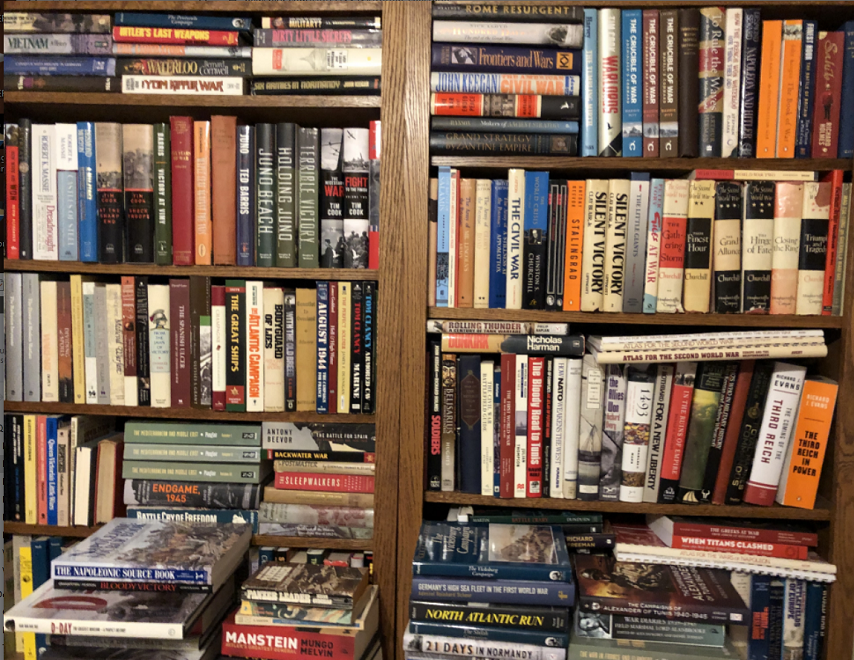
A small portion of my own book hoard. These shelves at least have a bit of commonality to them, unlike a lot of other shelves I could share.
I’ve been trying to reduce my hoard of books in recent months and it’s not going well.
And let’s be clear, it is a hoard, not a collection. A collection implies the books were selected with deliberation; that they are organized around subjects, themes, authors; that they are displayed with care. In a word, curated.
My books have been accumulated over time, some for work, some for pleasure. More were acquired impulsively than purposefully. Most people would not discern any organizational principles on my shelves. The fiction tends to be separate from the nonfiction, and books I’ve used to write books of my own tend to be grouped together, but not always. Hardbacks are mixed with paperbacks. I have some first editions that may be moderately valuable, although I’m not positive about that and I’ve never checked.
The hoard has been culled on occasion, usually in response to domestic complaints. The last major cull was a decade ago and since then I’ve been on a book diet, meaning that I can’t bring a new book home without getting rid of one already there.
I cheat on my diet all the time.
This part of the post could just as easily have been written by me … except that my sudden ejection from working life ten years back put me on an involuntary book-buying hiatus. From my peak buying years where I’d be accumulating multiple volumes per week, I was down to less than half a dozen new (or new-to-me) books through all of 2024.
That I’ve enjoyed a surplus of space for most of the last six years — the Sutherland House office is just two blocks from home — has abetted the cheating. The first week I took possession of the office, I lined it with solid metal shelves in optimistic anticipation of Sutherland House books to come. A good number of those shelves soon filled with boxes of personal books I could no longer keep at home and couldn’t bring myself to dump (along with a rather impressive archive of materials related to the founding of the National Post relocated from home to office for similar reasons).
Now Sutherland House is producing more books in one year than we produced in total over our first three years, and there are more of us in the office. Space is getting tight. I’ve been telling myself every weekend since before Christmas that I need to reduce the hoard.
It should not be difficult to jettison a quarter, a third, or even half of an impulsively amassed, haphazardly organized pile of books. You just face the shelf and pull out the ones you least want to keep. First to go are the never-cracked: anything that’s been sitting on the shelf for more than a decade without an attempt at reading. Next, books you’ve read and you know you’ll never want to read again. Then the yellowest paperbacks. Those three rules alone ought to get rid of half.
On a Saturday afternoon in mid-March. I faced a bookcase of eight shelves with about forty books per shelf. I challenged myself to get rid of one book for every book I kept. An hour later, I had half the books on the floor. Hurrah.
The next step was to put the unwanted books in boxes and haul them away.
They’re still sitting on the floor.
[Raises hand sheepishly] Yeah, I’ve got a few piles of books in various rooms of the house that failed the initial culling, yet somehow never made their way to the next stage of leaving the house.
I walk past them regularly and doubt my choices. I ask myself what harm would come from putting them all back on the shelves — makes more sense than leaving them on the floor. I wonder if a better solution to my storage problems wouldn’t be more shelves, or a storage locker.
I’ve read all the reasons why it’s difficult to get rid of books (or records, or art, or collections or hoards of any variety). The individual objects are companions, the scaffolding of your intellectual and emotional life, tokens of time, experience, identity, aspirations. Psychologists talk of loss aversion, the endowment effect that makes things feel more valuable simply because you own them, and the sunk-cost fallacy that leads you to hold onto and keep investing in things because you’ve already invested in them.
None of that makes me feel any better about my hoard (or the more than 10,000 photos and 30,000 emails I have on my laptop). The psychological explanations are just embarrassing.
When I’m levelling with myself, I can admit there are less than a hundred books I own where it genuinely matters to me to keep my particular copy. The rest are fungible. I freely admit that if I were to later miss any individual title I discarded, I could chase down a replacement in a day (in a minute electronically) at modest expense.
It used to matter to me to be surrounded by books in my living space. Now that I’m surrounded by books in my work space, not so much. For every instance when I spot a title on a shelf at home and think I really want to read that one someday, there are many more instances when I look at a whole shelf and think I’m never going to read any of these—they’re just taking up space. And I have a dust allergy, for christ sake.
Yet I can’t seem to do anything about it.
March 29, 2025
QotD: Becoming a human being
She had kids, so despite having some ideological resistance to getting it, she got it. I got it too. It’s hard to describe what “it” is if you haven’t gotten it, but I’ll try to explain. The moment I first held my child, I had a vision of every human being who had ever done the same. I stood paralyzed, rooted to the spot while before my eyes a whole field of ancestors stretched back into the forgotten past, each cradling a baby just like I was doing. What was I without them? Nothing at all. A cosmic joke, a fluke, or a random collection of atoms. But with them, I was one stage of a process, a chapter of a story.
And not only that, but I was also no longer alone. It had always seemed to me that the problem of intersubjectivity could never be conquered, that between minds there yawned an unbridgeable epistemic chasm. Yet here was an experience that I shared with countless others from the most varied places and times, an experience I shared with emperors and with slaves. André Maurois once said: “Without a family, man, alone in the world, trembles with the cold”. I had always thought he meant this in a practical, or perhaps an emotional sense, but I now realized it was even truer cosmically. I had, as my aunt said, become a human being.
I didn’t just see the past. In that moment, the future also resolved itself into dreadful clarity. I had always known intellectually that someday I would die, and that the world would continue mostly as it had, but I never really believed it. Anything beyond the horizon delimited by my lifetime had been hazy and indistinct. Not anymore. Now I regarded the newborn squirming in my arms, and knew with absolute certainty that if things went well this child would bury me, and then continue living. Suddenly the far-future mattered, I had skin in the game now. I was no longer a temporal provincial, past and future both had an immediate and urgent reality, and I knew that I would never think the same way about them again.
John Psmith, “REVIEW: The Children of Men by P.D. James”, Mr. and Mrs. Psmith’s Bookshelf, 2023-04-17.
1. This was in the days before cancellation, I’ve often wondered since then whether she would have allowed herself to think the thought today.
2. It also caused me to wonder whether people without living descendants should be permitted any political representation at all.
March 28, 2025
Mistaking popular fiction for real life
At Postcards from Barsoom, John Carter recounts an odd but revealing experience with a young progressive entity:
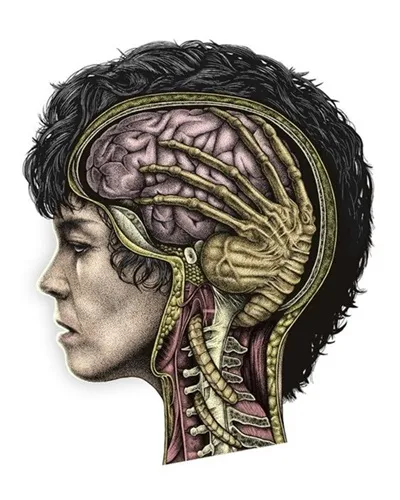
Image by Paul Jackson
Some years ago I was provided a fascinating psychological experience in the form of a young graduate student in the English literature program, whom I encountered because they (you heard me) was (God that’s grammatically awkward) married to a colleague. She (I’m not doing this anymore) specialized in the study of propaganda, by which of course she meant everything her backwards conservative parents in Nowhere, Nebrahoma believed, and not anything she believed. One evening, after enthusiastically explaining the symbolism of the inverted pentagram tattooed on her shoulder, she informed me with invincible confidence that not only was gender an arbitrary social construction, but that even the idea of biological sex was nothing more than convention. Her reasoning, which I presume she’d gleaned from a seminar on radically liberatory queer theory, was that testosterone levels fluctuated during the day, so “males” changed their degree of “maleness” all the time, and how can something that’s constantly changing be used as the basis for a hard binary distinction?
“But that’s not how biological sex is defined,” I replied. “Testosterone is just a hormone. It’s only present in vertebrates. Insects don’t have it, and neither do plants, but they still have biological sex. Sex is defined according to whether an organism produces mobile gametes or sessile gametes, which is basically universal across multicellular life forms.”
“I don’t understand what that means,” she chirped, still thinking we were playing language games. “Like I don’t know what a ‘sessile gamete’ is.”
“Oh,” I responded helpfully, “A gamete is just a reproductive cell. Sessile means it doesn’t move. So –”
The horrible reality of what I was saying dawned upon her. “I just realized that this isn’t a conversation I should be having,” she cut me off, and walked away.
It was remarkable. The mindworm parasitizing her consciousness had detected a threat to its structural integrity, and ordered its host to remove herself from the interaction before she consumed a malinformative infohazard. She didn’t even pretend that this wasn’t what she was doing. I’d never before seen something quite like it.
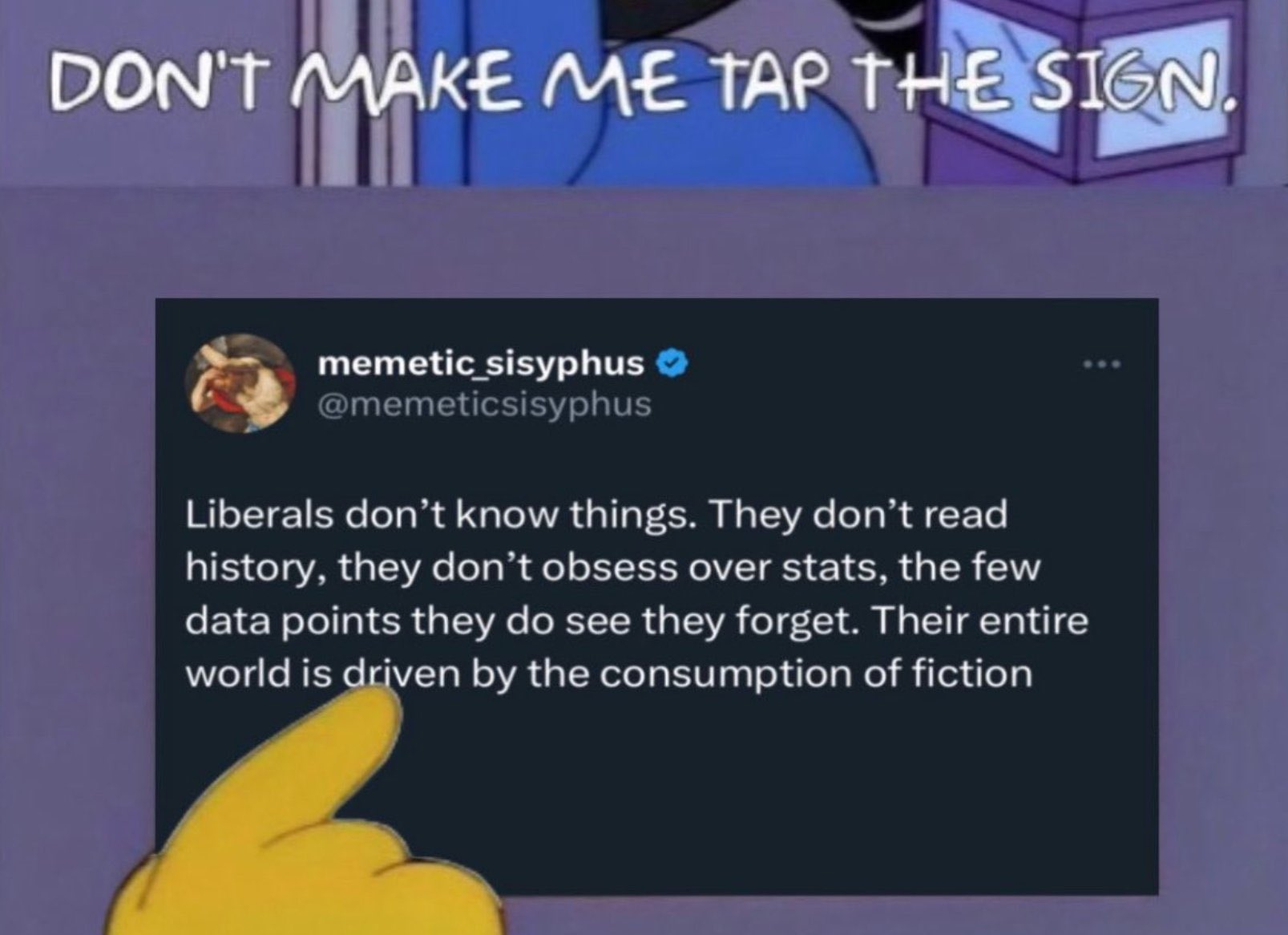
There’s a long-standing joke that liberals don’t know things, that their entire worldview seems to be formed by the ersatz experiences of visual entertainment. When they discuss the war in Ukraine, they express it in terms of Marvel comic book movies or Star Wars; when thinking of President Trump, in terms of Harry Potter. Black people are all wise and benevolent and great dancers because this is what Fresh Prince and Morgan Freeman told them; white men are all inbred stupid Klansmen because of Mississippi Burning and Roots; girls are just as strong as boys (stronger, actually) because Black Widow kicks butt; and so on. Even their favourite point of historical reference – World War Two, the Nazis, Hitler – seems to be almost entirely a palimpsest of Steven Spielberg movies like Saving Private Ryan and Schindler’s List.
It isn’t just that they use fictional references as metaphors or allusions. That’s a very human thing to do, and the right is certainly no stranger to Tolkien analogies. But liberals seem to do this a lot, with only the most tenuous connection back to reality. Their inner world is a series of self-referential fantasies. The right uses fictional references as metaphors to explain facts; the left substitutes fictional metaphors for facts, and then forgets that it does this.
The recent Netflix drama Adolescence is a striking case in point. It portrays the fictional story of a 13-year-old white boy who stabs a female classmate to death because his brain was twisted into a pretzel by exposure to the incel subculture over social media. Following its premier, the British government has been using it to gin up a moral panic, with calls to censor social media to tackle the urgent problem of toxic masculinity.
March 25, 2025
QotD: The nature of kingship
How does one cultivate power? The key factor is legitimacy. To the degree that people regard someone (or some institution) as the legitimate authority, the legitimate ruler, they will follow their orders mostly just for the asking. After all, if a firefighter were to run into the room you are in right now and say “everybody out!” chance are you would not ask a lot of questions – you would leave the room and quickly! You’re assuming that they have expertise you don’t, a responsibility to fight fires, may know something you don’t and most importantly that their position of authority as the Person That Makes Sure Everything Doesn’t Burn Down is valid. So you comply and everyone else complies as a group which is, again, the voluntary coordination of collective action (the firefighter is not going to beat all of you if you refuse so this isn’t violence or force), which is power.
At the same time, getting that compliance, for the firefighter, is going to be dependent on looking the part. A firefighter who is a fit-looking person in full firefighting gear who you’ve all seen regularly at the fire station is going to have an easier time getting you all to follow directions than a not-particularly-fit fellow who claims to be a firefighter but isn’t in uniform and you aren’t quite sure who they are or why they’d be qualified. The trappings contribute to legitimacy which build power. Likewise, if your local firefighters are all out of shape and haven’t bothered to keep their fire truck in decent shape, you – as a community – might decide they’ve lost your trust (they’ve lost legitimacy, in fact) and so you might replace them with someone else who you think could do the job better.
Royal power works in similar ways. Kings aren’t obeyed for the heck of it, but because they are viewed as legitimate and acting within that legitimate authority (which typically means they act as the chief judge, chief general and chief priest of a society; those are the three standard roles of kingship which tend to appear, in some form, in nearly all societies with the institution). The situation for monarchs is actually more acute than for other forms of government. Democracies and tribal councils and other forms of consensual governments have vast pools of inherent legitimacy that derives from their government form – of course that can be squandered, but they start ahead on the legitimacy game. Monarchs, by contrast, have to work a lot harder to establish their legitimacy and doing so is a fairly central occupation of most monarchies, whatever their form. That means to be rule effectively and (perhaps more importantly) stay king, rulers need to look the part, to appear to be good monarchs, by whatever standard of “good monarch” the society has.
In most societies that has traditionally meant that they need not only to carry out those core functions (chief general, chief judge, chief priest), but they need to do so in public in a way that can be observed by their most important supporters. In the case of a vassalage-based political order, that’s going to be key vassals (some of whom may be mayors or clerics rather than fellow military aristocrats). We’ve talked about how this expresses itself in the “chief general” role already.
I’m reminded of a passage from the Kadesh Inscription, an Egyptian inscription from around 1270 BC which I often use with students; it recounts (in a self-glorifying and propagandistic manner) the Battle of Kadesh (1274 BC). The inscription is, of course, a piece of royal legitimacy building itself, designed to convince the reader that the Pharaoh did the “chief general” job well (he did not, in the event, but the inscription says he did). What is relevant here is that at one point he calls his troops to him by reminding them of the good job he did in peace time as a judge and civil administrator (the “chief judge” role) (trans. from M. Lichtheim, Ancient Egyptian Literature, vol 2 (1976)):
Did I not rise as lord when you were lowly,
and made you into chiefs [read: nobles, elites] by my will every day?
I have placed a son on his father’s portion,
I have banished all evil from the land.
I released your servants to you,
Gave you things that were taken from you.
Whosoever made a petition,
“I will do it,” said I to him daily.
No lord has done for his soldiers
What my majesty did for your sakes.Bret Devereaux, “Miscellanea: Thoughts on CKIII: Royal Court”, A Collection of Unmitigated Pedantry, 2022-02-18.
March 24, 2025
Postcards from academia’s zombie apocalypse
Ted Gioia points out exactly why them there kids ain’t learnin’ no more:
[High school students] just care about the next fix — because that’s how addicts operate. They have no long term plan, just short term needs.
They can’t get back to their phones fast enough.
How bad is it for educators right now?
Check out this commentary from one experienced teacher, who finds more engaged students in prison than a college classroom.
This comes from Corey McCall, a member of The Honest Broker community who recently posted this comment:
I saw this decline in both reading ability and interest occur firsthand between 2006 and 2021 … I had experience teaching undergrads who hadn’t comprehended the material before, but hadn’t faced the challenge of students who could read it but who simply didn’t care …
Since 2021 I’ve been teaching part-time in prison, and incarcerated students really want to learn. They love to read and think along with authors such as Plato, Descartes, and Simone de Beauvoir. I am teaching Intro to Theater this semester (the story of how this happened is interesting, but is irrelevant here) and students have been poring over Oedipus the King and asking why this amazing play isn’t performed more regularly alongside plays like Hamilton and The Lion King.
I believe that there is hope for the humanities and perhaps for culture more generally, but it will be found in unusual places.
I’ve made a similar claim in this article — where I look outside of college for a rebirth of the humanities. It would be great if it happened in classrooms, too, but I fear that they are now the epicenter of the zombie wars.
Alas, I fear the number of zombie students is still growing — and at an accelerated pace.
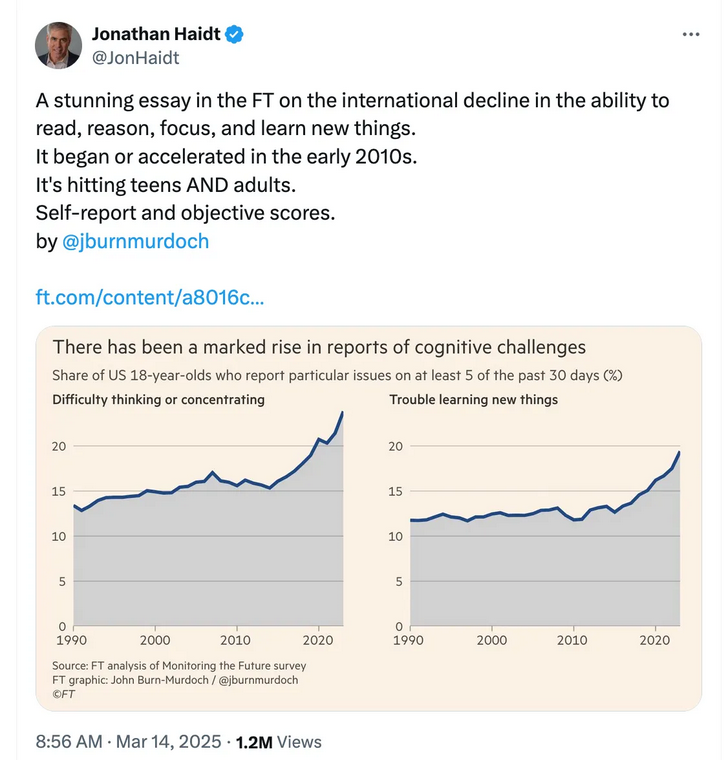
Jonathan Haidt, who has taken the lead in exposing this crisis — and thus gets attacked fiercely by zombie apologists — shares horrifying trendlines from Monitoring the Future.
This group at the University of Michigan has studied student behavior since 1975. But what’s happening now is unprecedented.
Students are literally finding it too hard to think. So they can’t learn new things.
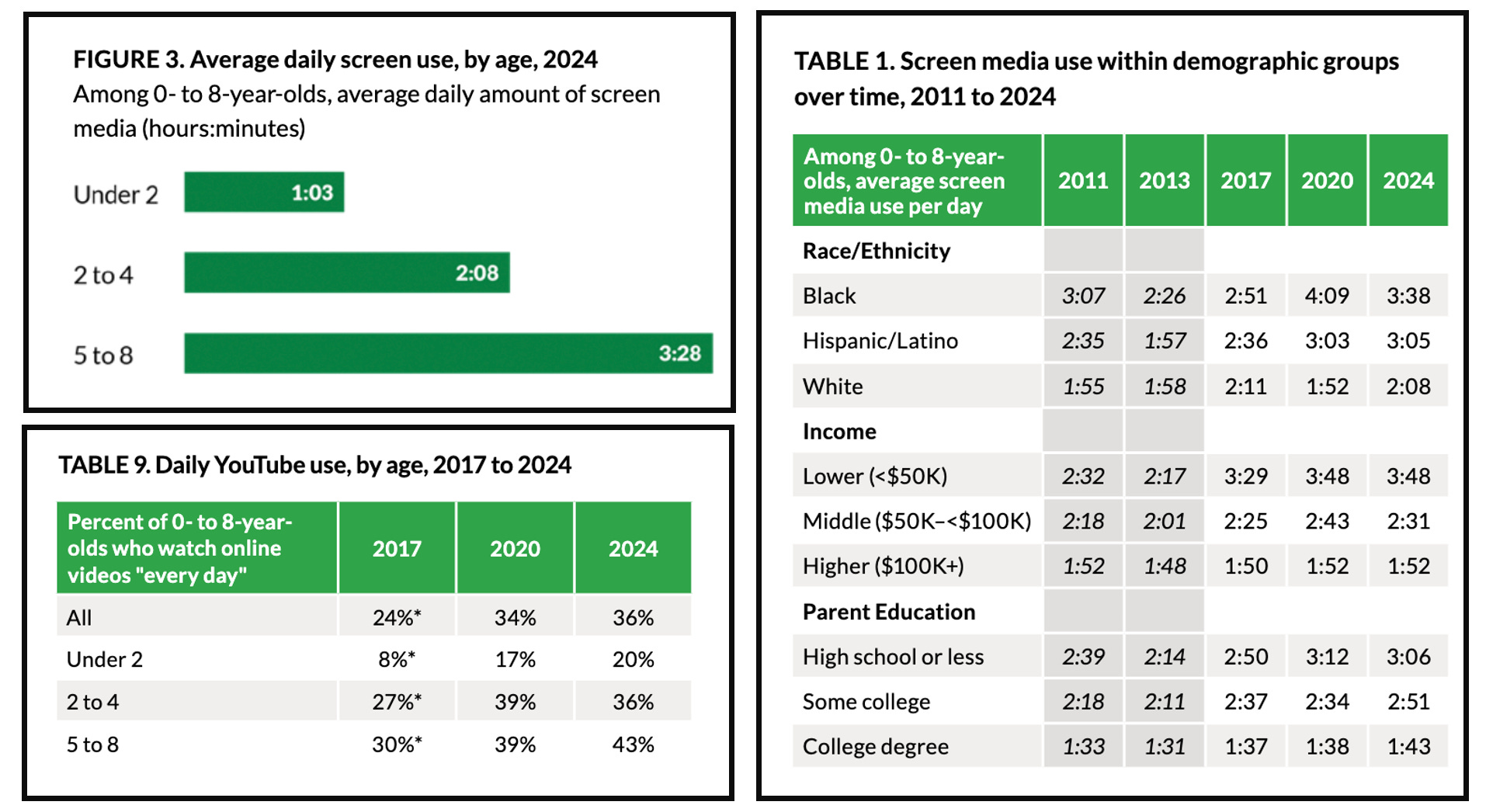
Below are more ugly numbers from another in-depth study — which looks at how children spend their day. It reveals that children under the age of two are already spending more than an hour per day on screens.
YouTube usage for this group has more than doubled in just four years.
Poor and marginalized communities are hurt the most. As your income drops, your children’s screen time more than doubles.
Source: 2025 study by Common Sense
In other words, these children are getting turned into screen addicts long before they enter the school system.
This is why teachers are speaking out. They see the fallout every day in their classrooms.
March 10, 2025
QotD: The “Basic College Dude” of the 2020s
But mostly it’s just because none of them stick in my memory. The #1 characteristic of the Basic College Dude is that even if he’s there, he’s not there. He’s checked out — mentally, emotionally, spiritually (if that even means anything anymore). Unlike the girls, all of whom seem to be in 72 different clubs and organizations (and list them all on their email auto-signatures, such that by junior year, their honorifics are longer than my entire resume), the guys don’t seem to do much of anything. How do they while away their hours? I assume with social media, like everyone, and with video games and blackout drinking …
… the latter of which I have seen, a lot, and if you’ll permit a brief digression, if you really want to know how fucked our society is, go to a student bar on a Friday night. I myself was a bit of a party animal in college, and like everyone I went over the line a few times, but college kid drinking these days is almost Soviet — they’re aiming to get knee-walking, gutter-puking, total-blackout shitfaced, and they set about it as grimly and efficiently as possible. The girls, too, with the added bonus that they’re all on Ambien and Klonopin and every other happy pill you’ve ever heard of, which makes for some interesting, by which I mean terrifying, behavior …
[…]
But mostly it’s because college dudes have had their libidos beaten out of them. […]
Not only does the BCD not know how to do this, as Nikolai says, he apparently doesn’t actually want to. Constant stimulation by blinking screens, shit diets, and a lifetime of indoctrination have reversed the sexual dilithium crystals. Heartiste used to go on about this, and while I’m no biochemist, either, I think his theory is sound: There’s so much environmental estrogen floating around that men develop the emotional equivalent of gynecomastia, while women turn butch. Throw nth wave feminism into the mix, and you’ve got women acting like the crudest, most obnoxious male stereotypes (they call this “being strong and empowered”), while the men mope and sigh to their diaries.
The end result is that the BCD walks around like he’s shellshocked. He does the bare minimum, hoping to just grind it out without any further affronts to his basic human dignity … but so mal-educated is he, that the phrase “basic human dignity” doesn’t even register with him.
Severian, “The Basic College Dude”, Founding Questions, 2021-10-05.
March 7, 2025
Trump marks the overdue end of the Long Twentieth Century, part 2
In The Conservative Woman, N.S. Lyons continues his essay contending that the arrival of Donald Trump, version 2.0, may finally end the era we’ve been living in since immediately after the end of WW2:

The Long Twentieth Century has been characterized by these three interlinked post-war projects: the progressive opening of societies through the deconstruction of norms and borders, the consolidation of the managerial state, and the hegemony of the liberal international order. The hope was that together they could form the foundation for a world that would finally achieve peace on earth and goodwill between all mankind. That this would be a weak, passionless, undemocratic, intricately micromanaged world of technocratic rationalism was a sacrifice the post-war consensus was willing to make.
That dream didn’t work out, though, because the “strong gods” refused to die.
Mary Harrington recently observed that the Trumpian revolution seems as much archetypal as political, noting that the generally “exultant male response to recent work by Elon Musk and his ‘warband’ of young tech-bros” in dismantling the entrenched bureaucracy is a reflection of what can be “understood archetypally as [their] doing battle against a vast, miasmic foe whose aim is the destruction of masculine heroism as such”. This masculine-inflected spirit was suppressed throughout the Long Twentieth Century, but now it’s back. And it wasn’t, she notes, “as though a proceduralist, managerial civilization affords no scope for horrors of its own”. Thus now “we’re watching in real time as figures such as the hero, the king, the warrior, and the pirate; or indeed various types of antihero, all make their return to the public sphere”.
Instead of producing a utopian world of peace and progress, the open society consensus and its soft, weak gods led to civilizational dissolution and despair. As intended, the strong gods of history were banished, religious traditions and moral norms debunked, communal bonds and loyalties weakened, distinctions and borders torn down, and the disciplines of self-governance surrendered to top-down technocratic management. Unsurprisingly, this led to nation-states and a broader civilization that lack the strength to hold themselves together, let alone defend against external threats from non-open, non-delusional societies. In short, the campaign of radical self-negation pursued by the post-war open society consensus functionally became a collective suicide pact by the liberal democracies of the Western world.
But, as reality began to intrude over the past two decades, the share of people still convinced by the hazy promises of the open society steadily diminished. A reaction began to brew, especially among those most divorced from and harmed by its aging obsessions: the young and the working class. The “populism” that is now sweeping the West is best understood as a democratic insistence on the restoration and reintegration of respect for those strong gods capable of grounding, uniting and sustaining societies, including coherent national identities, cohesive natural loyalties, and the recognition of objective and transcendent truths.
Today’s populism is more than just a reaction against decades of elite betrayal and terrible governance (though it is that too); it is a deep, suppressed desire for long-delayed action, to break free from the smothering lethargy imposed by proceduralist managerialism and fight passionately for collective survival and self-interest. It is the return of the political to politics. This demands a restoration of old virtues, including a vital sense of national and civilizational self-worth. And that in turn requires a rejection of the pathological “tyranny of guilt” (as the French philosopher Pascal Bruckner dubbed it) that has gripped the Western mind since 1945. As the power of endless hysterical accusations of “fascism” has gradually faded, we have – for better and worse – begun to witness the end of the Age of Hitler.
QotD: Infantry combat and esprit de corps
Well, no. Not quite.
We can approach this question through the idea of cohesion – the moral force that holds a group of combatants together on the battlefield under the intense emotional stresses of combat. The intense bonds that soldiers form in modern armies (particularly those in the European pattern) are not an accident, but a core part of how those armies, institutionally, seek to build cohesion. [W]e discussed briefly the emergence of the extensively drilled and disciplined “mechanical” soldier of Early Modern Europe, noting that this approach wasn’t necessary for the effective use of firearms (the Ottoman Janissaries, for instance, were quite good with firearms, but were not trained and organized in this way), but rather was a product of elite aristocratic (read: officer) disdain for their up-jumped peasant soldiers and thus the assumption by those aristocrats that the only way to get such men to fight effectively was to relentlessly drill them.
Now the funny thing about this system is that it clearly worked, but not for the reasons its aristocratic pioneers believed. It was only really after the Second World War that systematic study began to be made of unit cohesion (e.g. S.L.A. Marshall, Men Against Fire (1947), though subsequent literature on the topic is voluminous and Marshal’s work has its problems, but its conclusions are broadly accepted having been confirmed in subsequent studies) [NR: Some discussion on Marshall and his theories here]. What emerged quite clearly was that it wasn’t “the cause” or patriotism that held troops together under fire, but group cohesion born out of an intense need not to let fellow soldiers in the unit down. In short, what held units together and made them fight more effectively was (in part, there are many conclusions in Men Against Fire) the strong social bonds between comrades.
And, in fact, the drill and discipline of early modern European armies unintentionally did quite a lot of cohesion building things. Soldiers were removed from civilian society (isolation from larger groups builds unit cohesion), split into very small groups (keeping the core group that coheres below Dunbar’s number aids in group cohesion; thus why the platoon is a natural unit size) and then pushed through difficult and unpleasant training (that drill and discipline) creating a sense of unique shared experience and sacrifice. All of which doesn’t render men machines, but it does create strong social bonds within the units that will keep the men fighting even when they care little for their cause (which they generally did in this period; one does not find a super-abundance of patriotism among, say, the Army of Flanders).
And there is a tendency to point to this cohesion, its modern source in “toughening” boot camp and to say, “aha! That is the true universal about effective soldier-warriors!” Except – and you knew there was going to be an except – except it isn’t. Systems built on the use of drill and discipline for the development of unit cohesion through social bonds are actually, historically speaking, quite rare. We see systems like that in use by the Romans from the Middle Republic forward (but significantly faded by the end of late antiquity; the Byzantine army doesn’t seem to function this way), in China from the Han Dynasty onward, in Japan for the ashigaru infantry from the Sengoku period, and in Europe from the Early Modern period. That sounds like a lot, but that is relatively small minority of the historical period and even then in a relatively small minority of places. It is, for instance, a period that only covers about half of the historical period in Western Europe, the place most often associated with this very system of organization (though that association is perhaps unfair to East Asia).
Instead, most societies relied on existing social bonds formed outside of the experience of war for cohesion. Greek hoplite armies, for instance, generally formed up by polis (read: city) and then within those blocks by still smaller and smaller social divisions, so that family and neighbors would be standing shoulder to shoulder in the battle line (Sparta does this through the system of communal messes, the syssitia, but the idea that you fought alongside the men you dined with socially – your neighbors, generally – was perfectly normal in most Greek cities). That was intentional – it allowed the phalanx to cohere through the social pressure not to be seen as a coward before the men who meant the most to you, whose shaming gaze you would have to endure in civilian life. The same pressures, by the well, held together the (mostly volunteer) armies of the American Civil War (on this, see, McPherson, For Cause and Comrades (1997)).
By contrast, “warrior” classes often rely on a sort of class solidarity along with the demand of an individual military aristocrat to be individually militarily excellent. Richard Kaeuper quips of the literature of the medieval knightly class that it was filled with “utterly tireless, almost obsessional emphasis placed on personal prowess” (R.W. Kaeuper, Chivalry and Violence in Medieval Europe (1999)). We’ve talked a fair bit about the values of mounted aristocrats, both in their role as combatants and in their roles as generals and those values are relatively disconnected from discipline-induced forms of buddy-cohesion. Of course exactly what “good generalship” or “good officership” looks like varies wildly from place to place – Alexander was expected to command his cavalry from the front; Roman emperors rarely took the battlefield and when they did they commanded from the rear since it would be foolish to risk the “brain” of the army in personal combat and in any event someone at the front of a cavalry charge can hardly direct the rest of the army.
One of the things I find most striking about the “warrior ethos” advanced by writers like Pressfield is that it accepts as normal the unique nature of the bonds that hold soldiers together in battle, assuming this bond and its shared sacrifice to be at once unique to combat and also transcendent to all combatants. But one of the key points made very well in Sebastian Junger’s War (2010) and later Tribe (2016) is just how strange that experience is, historically. Junger notes that in earlier societies, soldiers would have returned from war into communities (often small, agricultural communities or tribal communities) every bit as close-knit as the infantry platoon – and indeed, often involving literally the same people as the infantry platoon. Instead, the intense feeling of uniqueness that modern soldiers feel about the bonds of combat is because of the historically unusual deracination produced by modern societies by the industrial revolution and the post-industrial period.
Bret Devereaux, “Collections: The Universal Warrior, Part IIb: A Soldier’s Lot”, A Collection of Unmitigated Pedantry, 2021-02-05.
March 1, 2025
“There were always scapegoats … and they were always driven out one way or another”
The second part of Nigel Biggar‘s look at the culture war in Britain includes a look at how the professional approach to young peoples’ gender issues became monomaniacal because nobody involved stopped to think for fear of being ostracized (or fired):
On the gender front, there’s plenty of reason to doubt the intellectual coherence of transgender-self-identification. When a biological male believes that his inner, authentic self is female, what exactly does he think being ‘female’ is? I’m still waiting for someone to persuade me that this doesn’t trade on gender stereotypes that feminists rightly taught us to throw overboard decades ago.
Observe how that has nothing at all to do with the care of patients, and how it has everything to do with the self-regard and political standing of the managers.
There’s even more reason to doubt that the well-being of young people is well served by taking their asserted genders at face value and allowing them to align their bodies by making irrevocable physical changes. According to Hannan Barnes’ shocking chronicle of the scandal at the Gender Identity Development Service (or GIDS) at the Tavistock Institute here in London, there was widespread doubt among clinicians about young people’s claims of “an inborn ‘trans’ nature”, awareness that these were sometimes correlated with eating disorders and self-harm, and suspicion that they might be caused by abuse or trauma. Furthermore, the long-term effects of using puberty-blockers were “largely unknown”, there was considerable uncertainty about which patients would benefit from them, and the health of some young patients actually seemed to worsen while on them.
Notwithstanding all this, “the clinical team … never discussed as a group what it even understood by the word ‘transgender'”, clinicians “never dream[t] of telling a young person that they weren’t trans”, and they always prescribed puberty-blockers unless the patient actively refused them. What’s more, expressions of doubt by staff were discouraged. “Someone would raise concerns, and someone else would move in to shut it down”, writes Barnes. “Those who persisted in asking difficult questions were not received well … those who spoke out were labelled troublemakers. [According to one witness,] ‘There were always scapegoats … and they were always driven out one way or another'”. “Junior staff looked on and learnt”.
Note the chilling effect.
The Tavistock Institute in London
Barnes’ book bears the title, Time to Think, because she identifies the general problem at GIDS as that of “not stopping to think”. That, of course, raises the question, Why? Barnes gives several reasons. One was the fact that the GIDS was propping up the Tavistock financially and that senior managers had a material interest in not disturbing its assumptions. Another was the unwillingness to offend transgender lobby groups such as Mermaids for “fear of a backlash”. But, most important of all was concern for the ‘progressive’ reputation of the management. According to David Bell, consultant adult psychiatrist at the Trust and whistleblower, “The senior management regarded [GIDS] as a star in our crown, because they saw it as a way of showing that we weren’t crusty old conservatives; that we were up with the game and cutting-edge. That was very important to the management to show we were like that”. Observe how that has nothing at all to do with the care of patients, and how it has everything to do with the self-regard and political standing of the managers. Not for the first time, the basic narcissism of progressive virtue-signaling is exposed.

Update: Added missing URL.
February 19, 2025
QotD: The inborn bias of all mankind
Why was I on a panel with a priest and a revolutionary communist? Long story — not very interesting: we were debating the future of ethics with special attention to the role of religion. The interesting part, however, is that at some point, after we all shook hands like adults and I was on my way home, I realized that I meant it — I would choke them all. Well, of course, one can’t be entirely sure that one’s actions will follow one’s intentions. The best-laid plans of mice and men, and all that. But, given some weird Twilight Zone scenario wherein all their deaths somehow saved my son’s life, I was at least hypothetically committed. The caveman intentions were definitely there.
The utilitarian demand — that I should always maximize the greatest good for the greatest number — had seemed reasonable to me in my 20s but made me laugh after my son was born. And my draconian bias is not just the testosterone-fueled excesses of the male psyche. Mothers can be aggressive lionesses when it comes to their offspring. While they are frequently held up as icons of selfless nurturing love, that’s mostly because we offspring — the ones holding them up as icons — are the lucky recipients of that biased love. Try getting between a mammal mother and her kid, and you will see natural bias at its brutal finest.
Stephen T. Asma, “Confucius Got It Right: Giving in to ‘Bias’ is Part of Living an Ethical Life”, Quillette, 2020-02-01.
February 18, 2025
QotD: The soft sexism of low expectations
- She’s been told she’s great — fabulous! — just the way she is.
- She’s been taught to dismiss all push-back as misogynistic.
- She’s been assured that she’s entitled to success — and that any failures to achieve said success are the fault of men.
- She’s been trained to demand that these dastardly men — who are totes holding her back — kindly step aside and let her take the trophy — whether she’s actually earned it or not.
You might think I’m being unfair here, but frankly? I don’t agree. Given all the stuff I’ve read in the news for the past decade plus, I believe I’m right on the money.
Everywhere I look, I see illustrations of all four of the above bullet points. I hate to keep harping on the fat acceptance movement, but really: isn’t that a textbook example of point number one? Go ahead, ladies: eff those unrealistic beauty standards and rock on with your 300 pound selves. Yas, queen, slay! (And don’t worry that you can’t make it up a single flight of stairs without getting winded. The negative impacts of extreme obesity are way over-stated, amirite?)
Then there are all the times leftists of the distaff persuasion have thrown down the poor-me-I’m-being-harassed-by-meanie-sexist-men card each time they start losing an online argument. To be sure, in the absolute dumpster fire that is internet discourse, such women probably do get burned with the occasional “die, bitch!” PM or email. But as I noted on my fan blog, men get that crap too — and oddly, I don’t see them whining about it nearly as often. (Probably because crying doesn’t work for men. Only women get picked up by the waaaaaambulance.)
And just to hit on bullets three and four: everywhere I look, I see leftists justifying moves to ease standards to give vag a hand up. Just last month, for example, it was reported that Oxford is considering removing Homer and Virgil from a foundational classics course due to “attainment gaps between male and female candidates”. Don’t buckle down and study your Latin and Greek, dears. We’ll remove that pesky obstacle for you. And oh my great and fluffy Lord, I can’t even count the number of times I’ve heard feminists complain about the academic weeding that goes on in engineering or computer science — because apparently, advanced math is oppressive and patriarchal. As a woman who numbers pretty good — indeed, I even teach that stuff for a living! — I headdesk so hard whenever I hear this BS that I’m surprised my skull is still intact.
Where does all this anal-smoke-blowing lead? When you’re told constantly that you should get prizes simply for being a good little girl — as leftist women are — the result is predictable: you stop developing. If you’re already Ms. Polly Perfect, well — that obviates the need for critical self-examination and the consequent moves towards self-improvement. If your naysayers are all dismissible as “women-hating men bitter over the loss of their privilege” (or as women suffering from “internalized misogyny”), then your arguments are almost certainly untested and malformed. And if people have always been clearing the road for you and shielding you from any real challenges, you’re no doubt much stupider than your competition — and much weaker.
Stephanie S., “Prizes for Good Little Girls Syndrome”, Conservative Thoughts, 2020-03-07.
February 15, 2025
“Trump marks the overdue end of the Long Twentieth Century”
At The Upheaval, N.S. Lyons suggests that the arrival of Donald Trump, version 2.0, may finally end the era we’ve been living in since immediately after the end of WW2:
The 125 years between the French Revolution in 1789 and the outbreak of WWI in 1914 was later described as the “Long Nineteenth Century”. The phrase recognized that to speak of “the nineteenth century” was to describe far more than a specific hundred-year span on the calendar; it was to capture the whole spirit of an age: a rapturous epoch of expansion, empire, and Enlightenment, characterized by a triumphalist faith in human reason and progress. That lingering historical spirit, distinct from any before or after, was extinguished in the trenches of the Great War. After the cataclysm, an interregnum that ended only with the conclusion of WWII, everything about how the people of Western civilization perceived and engaged with the world – politically, psychologically, artistically, spiritually – had changed.
R.R. Reno opens his 2019 book Return of the Strong Gods by quoting a young man who laments that “I am twenty-seven years old and hope to live to see the end of the twentieth century”. His paradoxical statement captures how the twentieth century has also extended well past its official sell-by date in the year 2000. Our Long Twentieth Century had a late start, fully solidifying only in 1945, but in the 80 years since its spirit has dominated our civilization’s whole understanding of how the world is and should be. It has set all of our society’s fears, values, and moral orthodoxies. And, through the globe-spanning power of the United States, it has shaped the political and cultural order of the rest of the world as well.
The spirit of the Long Twentieth could not be more different from that which preceded it. In the wake of the horrors inflicted by WWII, the leadership classes of America and Europe understandably made “never again” the core of their ideational universe. They collectively resolved that fascism, war, and genocide must never again be allowed to threaten humanity. But this resolution, as reasonable and well-meaning as it seemed at the time, soon became an all-consuming obsession with negation.
Hugely influential liberal thinkers like Karl Popper and Theodor Adorno helped convince an ideologically amenable post-war establishment that the fundamental source of authoritarianism and conflict in the world was the “closed society”. Such a society is marked by what Reno dubs “strong gods”: strong beliefs and strong truth claims, strong moral codes, strong relational bonds, strong communal identities and connections to place and past – ultimately, all those “objects of men’s love and devotion, the sources of the passions and loyalties that unite societies”.
Now the unifying power of the strong gods came to be seen as dangerous, an infernal wellspring of fanaticism, oppression, hatred, and violence. Meaningful bonds of faith, family, and above all the nation were now seen as suspect, as alarmingly retrograde temptations to fascism. Adorno, who set the direction of post-war American psychology and education policy for decades, classified natural loyalties to family and nation as the hallmarks of a latent “authoritarian personality” that drove the common man to xenophobia and führer worship. Popper, in his sweepingly influential 1945 book The Open Society and Its Enemies, denounced the idea of national community entirely, labeling it as disastrous “anti-humanitarian propaganda” and smearing anyone who dared cherish as special his own homeland and history as a dangerous “racialist”. For such intellectuals, any definitive claim to authority or hierarchy, whether between men, morals, or metaphysical truths, seemed to stand as a mortal threat to peace on earth.
The great project of post-war establishment liberalism became to tear down the walls of the closed society and banish its gods forever. To be erected on its salted ground was an idyllic but exceptionally vague vision of an “open society” animated by peaceable weak gods of tolerance, doubt, dialogue, equality, and consumer comfort. This politically and culturally dominant “open society consensus” drew on theorists like Adorno and Popper to advance a program of social reforms intended to open minds, disenchant ideals, relativize truths, and weaken bonds.
As Reno catalogues in detail, new approaches to education, psychology, and management sought to relativize truths, elevate “critical thinking” over character, vilify collective loyalties, cast doubt on hierarchies, break down all boundaries and borders, and free individuals from the “repression” of all moral and relational duties. Aspiration to a vague universal humanitarianism soon became the only higher good that it was socially acceptable to aim for other than pure economic growth.
[…]
The Long Twentieth Century has been characterized by these three interlinked post-war projects: the progressive opening of societies through the deconstruction of norms and borders, the consolidation of the managerial state, and the hegemony of the liberal international order. The hope was that together they could form the foundation for a world that would finally achieve peace on earth and goodwill between all mankind. That this would be a weak, passionless, undemocratic, intricately micromanaged world of technocratic rationalism was a sacrifice the post-war consensus was willing to make.
That dream didn’t work out though, because the strong gods refused to die.
Update, 17 February: Welcome Instapundit readers! Thanks for dropping by. Please do look around at some of my other posts! I think the last time I got linked by Instapundit was back in 2008/9 just before I moved to the current location. Please do read the entire N.S. Lyons post, as this is just a taster of the full essay!
February 11, 2025
Many young white men are choosing to “own the insult” when accused of being a fascist
Lorenzo Warby points out that some — even many — young white men are reacting to repeatedly being called “Nazi” or “fascist” by embracing the slur:

Still from Pink Floyd: The Wall
For the fuel of the contemporary networked authoritarians are angry young men. Angry young men who have a great deal to be angry about.
In so many modern schools, universities, and much of social media, if you are a low melanin count, heterosexual male you are absolutely at the bottom of the “woke” oppression-bingo hierarchy. You will be implicitly, or explicitly, held to be somehow tarred with every bad thing any person “like” you has done in history, no matter how long — even how many generations — before you were born that it happened, nor how dubious an historical characterisation it might be. There is no identity open to you that you can celebrate, or feel positively attached to, without potential or actual denigration.
If you do any reading, you can quickly work out that this is a ludicrously one-sided — and deeply unfair — way to look at history. Even in its own terms, it is nonsense, as “folk like you” — i.e., low melanin count heterosexual males — voted for every single legal advance any of the celebrated-as-oppressed groups made. “Folk like you” built the Scientific Revolution, Parliamentary Government, mass prosperity.
Of course, this was a matter of culture, institutions, the happenstance of history, not melanin content. The trouble with the racialisation of history and identity is that it is, indeed, the racialisation of history and identity. As Jews are currently (re)discovering.
Nor can many of these angry young men take much refuge in the good life, work or entertainment. Online dating has turned into a hypergamous nightmare that excludes most guys, in-person connections are fraying and migration-plus-restrictive-land-regulation has shot rents up and made home-owning unattainable.
In entertainment, masculine heroes are being replaced and degraded. Online games are being systematically “wokified”. There are systematic attacks on their heritage. Sport and advertising is also being wokified, is “bending the knee”. Where to go?
If folk systematically tar or denigrate someone’s identity, a natural response is to say “no, my identity is great, it is wonderful”. There will be certainly a market for such a response. The natural response to systematic denigration is some form of “fuck you!” and the politics of “fuck you!“.
In the contemporary world, what is the most dramatic way of saying “fuck you!“? To take the racist!, fascist! abuse and go “right on!“. Even more so if you take the ideas they invoke and turn them back against them.
Of course, if you just reverse what left-progressivism — in its “woke” iteration — stands for, you are still dancing to their tune. But rage can easily work like that.
So, these angry young men look at the folk who treat them with such continual, institutionalised, contempt — who stack everything they can against them — and decide “we hate you”. If you are going to abuse us anyway no matter what we do — the seductive logic goes — then why not simply embrace the identity you impose on us if we put our heads up? There is, after all, no more in-your-face way to shriek their anger and rejection back at those who are abusing, denigrating and excluding them than to embrace racism and fascism.
They look at ordinary conservatives, at ordinary liberals, they look at Boomers, and think “you did not stop it, you did nothing to protect people like me”, so they — and their politics — get no respect.
Instead, they go to the politics of using the operational tactics used against them — the operational politics of “wokery” — in support of politics that most completely expresses their rage. This is the updated version of what happened with 1920s Fascism in Italy and 1930s Nazism in Germany. Like the original versions, they are using — and so helping to legitimate — the operational methods of the left-progressivism.
Not that left-progressives, the “woke”, will see it. They are way too full of the stupidity of arrogance, of the blindness of moral narcissism, to pick what is happening, still less take any responsibility for it. They utterly fail to see themselves; to understand how much they come across as smug, arrogant, condescending, self-righteous, shits whose politics again and again ends up favouring people like them and whose recurrent response to disagreement is to de-legitimise, denounce and censor. Their entire view of themselves is they are the oh-so-clever, oh-so-moral people. Nothing they do is ever seriously counter-productive or fundamentally mistaken.
Faced with the rise of actual racism and actual fascism, they will shriek racist! and fascist! even harder. But they are in the situation of the boy who cried wolf! Except worse, as the boy in the story neither created, nor trained, the wolf.
They have so debased that currency, so debased historical analogy, that fascism has lost its rhetorical, or even its warning, power.
Besides, how many people will say: these folk against whom you are shrieking the same terms of abuse you have shrieked at people for decades. Are they making excuses for the mass sexual predation on young girls by migrants we did not want? Are they supporting the hormonal and surgical mutilation and sterilisation of minors? Are they teaching folk to despise their own countries and heritage? Are they pushing the narrative lies of the moment? Have they proved to be incompetent at elementary things, such as fighting crime and managing fire risk?
No? Then they sound good to me.
Left-progressives: so good at finding new ways to make the same mistakes. It is almost as if they have a pathological relationship with information. Oh, wait, they do.


