Quotulatiousness

March 12, 2026

“It is precisely the embracing of such inconsistency that shows your commitment to the cause”

Filed under: Media, Politics, USA — Tags: , , , , , , — Nicholas @ 05:00

Many, many people have called attention to the incongruity — if not total absurdity — of progressives agitating and protesting for what appear to be thoroughly anti-progressive causes. And all of those people have discovered that most progressives are in accord with Emerson’s opinion that “a foolish consistency is the hobgoblin of little minds”. As Lorenzo Warby explains, “the issue is never the issue; the issue is the revolution”:

There is a common “culture war” sport where more conservatively-minded folk, and various liberal ones, point out how inconsistent it is for various ideological/identity groups to make a thing of supporting organisations and regimes which are very much against — even murderously against — the ideals those ideological/identity groups allegedly stand for.

Queers for Palestine, and feminists for Hamas/Hezbollah/Iran, are particularly blatant examples of this. Hamas in Gaza and the Islamic regime in Iran literally kill homosexuals and violently repress women’s rights: they are religiously committed to women having less rights than men and being subordinate to them.

The inconsistency between who Hamas and the Islamic regime are, what they do, and the alleged ideals of Queers for Palestine and the feminists supporting Hamas/Hezbollah/Iran is obvious. Pointing out such inconsistency has, however, no purchase on Queers for Palestine, feminists for Hamas/Hezbollah/Iran, or similar groups.

On the contrary, pointing out the inconsistency brands one as not merely an outsider, but an enemy. It is precisely the embracing of such inconsistency that shows your commitment to the cause; to the shared political goals; to the shared politicised moralised status games. Doing all the required not-noticing, the required rationalisations, is a signal of commitment.

If they can make people ignore — or, even better, embrace — such inconsistency, that manifests their social and political dominance. The propensity of academics to be “risk averse“, and be conformist in various ways, has enabled motivated zealots to create the Critical Theory magisterium that has come to dominate more and more of Anglo-American academe.

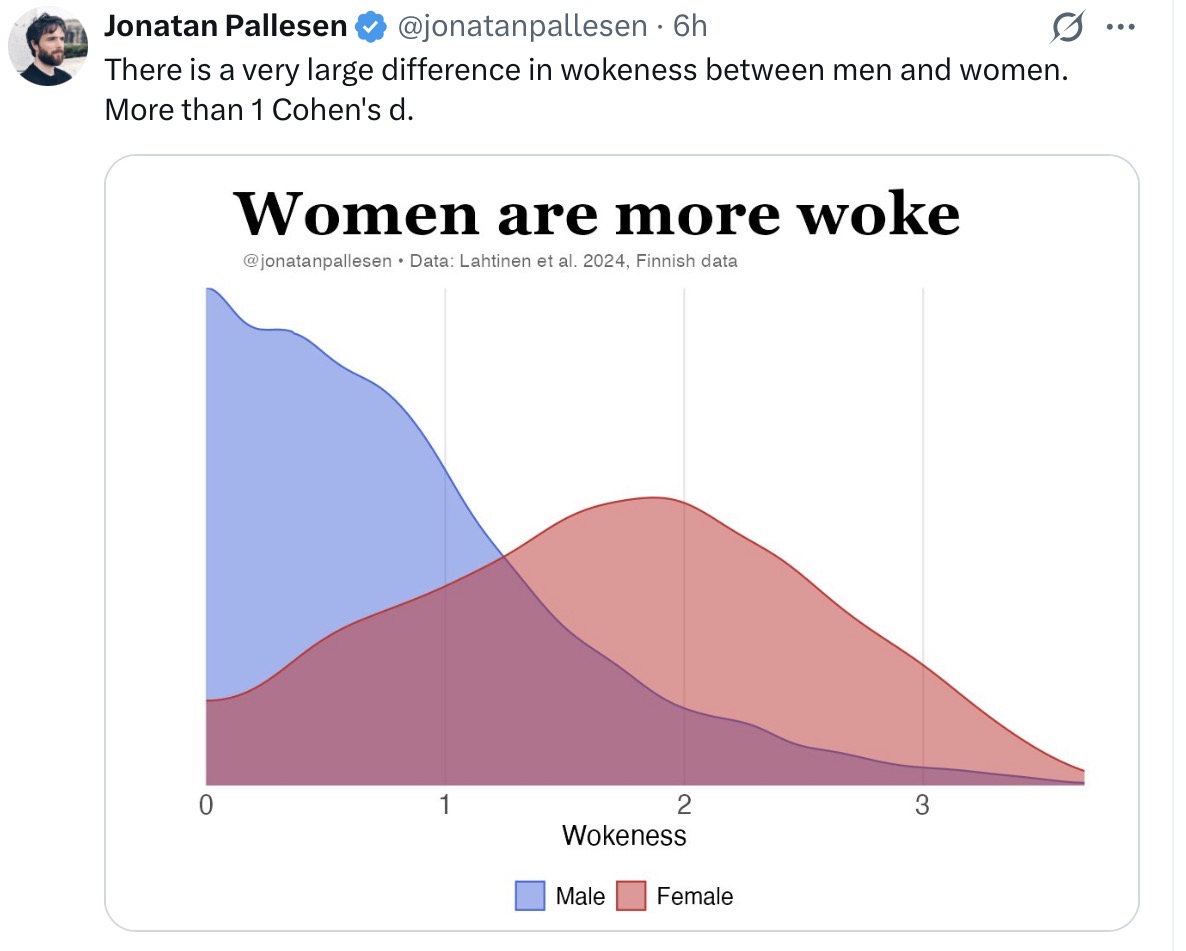
As women are more risk averse and conformist than men, this has gathered steam as academe has feminised. This effect is all the stronger when they generate an accompanying elite status strategy based on “good people believe X”, turning beliefs into moralised cognitive assets. Assets to be defended — and defended together — as shared assets in a shared status game.

By attacking such inconsistency, one is simultaneously signalling one’s outsider status and attacking the signal they are using the show commitment to the cause; to the moral in-group.

As part of such signalling commitment, believers produce commentary shorn of all inconvenient context. We saw plenty of that in commentary blaming NATO and the US for the Russian attack on Ukraine. We are seeing plenty of the same on Iran.

Even more important than this—at least among the core believers — is that, at the foundational belief level, it is not inconsistent at all. The question is not what Hamas or Hezbollah or the Islamic Regime actually stands for: the question is, who they are enemies of.

March 10, 2026

There’s ordinary virtue signalling, then there’s virtue costuming

Filed under: Media, Politics — Tags: , , , , — Nicholas @ 03:00

On the social media site formerly known as Twitter, L. Wayne Mathison describes what happens when virtue signalling becomes someone’s entire persona:

When Virtue Becomes a Costume

Here’s an old village joke: if a man walks around telling everyone how humble he is, check his pockets. He’s usually carrying a mirror.

That’s roughly how the modern “woke” phenomenon works. It presents itself as moral enlightenment, but most of the time it behaves like a status game, who can signal the most compassion, the loudest outrage, and the strongest allegiance to the fashionable cause of the week.

My definition is blunt: woke politics is moral signalling replacing moral responsibility.

It’s not about solving problems. It’s about performing concern.

And once you start looking at it that way, the pattern shows up everywhere.

The Performance Economy of Virtue

Rob Henderson calls these “luxury beliefs”.

Luxury beliefs are ideas held mostly by wealthy or highly educated people that signal status but impose real costs on everyone else. The people promoting them rarely suffer the consequences.

Think about it.

Defund the police.
Abolish prisons.
Decriminalize hard drugs.
Romanticize homelessness as a “lifestyle choice”.

Who pushes these ideas hardest?

Not the working-class neighbourhood dealing with break-ins. Not the single mother living beside a drug market. It’s usually professors, activists, and celebrities living in safe neighbourhoods with security cameras and gated buildings.

The belief becomes a badge of moral sophistication.

The consequences fall somewhere else.

This is the luxury belief machine.

The Five Laws of Stupidity at Work

Carlo Cipolla’s Five Laws of Human Stupidity explains the rest.

His argument was beautifully cynical: stupidity is not about intelligence. It’s about behaviour.

A stupid person, he wrote, is someone who causes harm to others while gaining nothing themselves.

Sound familiar?

Look around at some modern activism and you’ll see Cipolla’s laws running like background software.

Law #1: Always underestimate the number of stupid people.

Every generation believes it has escaped mass foolishness. Every generation is wrong.

Law #2: Stupidity is independent of education.

A PhD does not vaccinate someone against bad thinking. Sometimes it just gives them fancier vocabulary.

Law #3: A stupid person harms others without benefit.

Policies driven by emotional slogans often damage the very communities they claim to protect.

Law #4: Non-stupid people underestimate stupidity’s power.

This is why sensible people are constantly surprised when destructive ideas gain traction.

Law #5: A stupid person is the most dangerous type of person.

Unlike criminals, they don’t know what they’re doing. And unlike the selfish, they aren’t pursuing rational gain.

They simply push the lever harder.

The Hollywood Example

Even entertainment hasn’t escaped the pattern.

Hollywood increasingly behaves less like a storytelling industry and more like a political signalling club. The pressure to conform is real: careers depend on being publicly aligned with the dominant ideology, and dissent can carry professional consequences.

The incentives are obvious.

Actors gain admiration by championing fashionable causes. They receive praise, awards, and moral approval, often without sacrificing anything material in their own lives.

It’s “virtue” at almost zero cost.

The Moral Time Machine

Then there’s what Bill Maher once joked about: the moral time machine.

Modern activists judge people from centuries ago as if those individuals possessed today’s cultural knowledge and moral vocabulary. It’s a kind of historical self-congratulation, imagining how virtuous we would have been in 1066 if only we had been there.

But that trick isn’t really about history.

It’s about status.

If you can condemn the past loudly enough, you look enlightened in the present.

The Incentive Problem

Here’s the uncomfortable truth.

Most systems don’t run on morality. They run on incentives.

Corporations chase profit.
Media chase attention.
Algorithms chase engagement.
Political activists chase moral prestige.

If the reward structure encourages outrage and virtue signalling, that’s exactly what people will produce.

Not because they’re evil.

Because incentives work.

The Reframe

The real divide in modern politics isn’t left versus right.

It’s performance versus results.

One side asks:

“Does this policy sound compassionate?”

The other asks:

“Did it actually improve people’s lives?”

That’s the question that cuts through the noise.

Because compassion measured by intentions is theatre.

Compassion measured by outcomes is responsibility.

Here’s the test I use now.

When someone proposes a moral crusade, ask three questions:

Who pays the cost?

Who receives the applause?

What happens if the policy fails?

Luxury beliefs collapse under those questions almost instantly.

And the moment the performance stops, something interesting happens.

We can finally start solving the problem.

[NR – emphasis added]

Update, 11 March: Welcome, Instapundit readers! Have a look around at some of my other posts you may find of interest. I send out a daily summary of posts here through my Substackhttps://substack.com/@nicholasrusson that you can subscribe to if you’d like to be informed of new posts in the future.

March 9, 2026

Political and philosophical illusions, left and right

Filed under: Media, Politics, USA — Tags: , — Nicholas @ 05:00

Tom Kratman discusses how illusions distort how people on the left and on the right view reality:

There are a number of these. I am by no means certain that I’ve identified all there are, either, nor even all the important ones. Still, let’s work with what we have, shall we, concentrating especially on the ones that are obviously paired, existing on both left and right, in some form or other?

Here are the first five. Next week we’ll cover the rest of the important ones, such as I’ve been able to identify. Why bother? Because if some people on both sides could see the illusions to which they’re subject, it is just possible they could strain and maybe even converse, which may push off or make less likely the breakup of my country or descent into a really nasty civil war, which is the whole purpose of this series of columns.

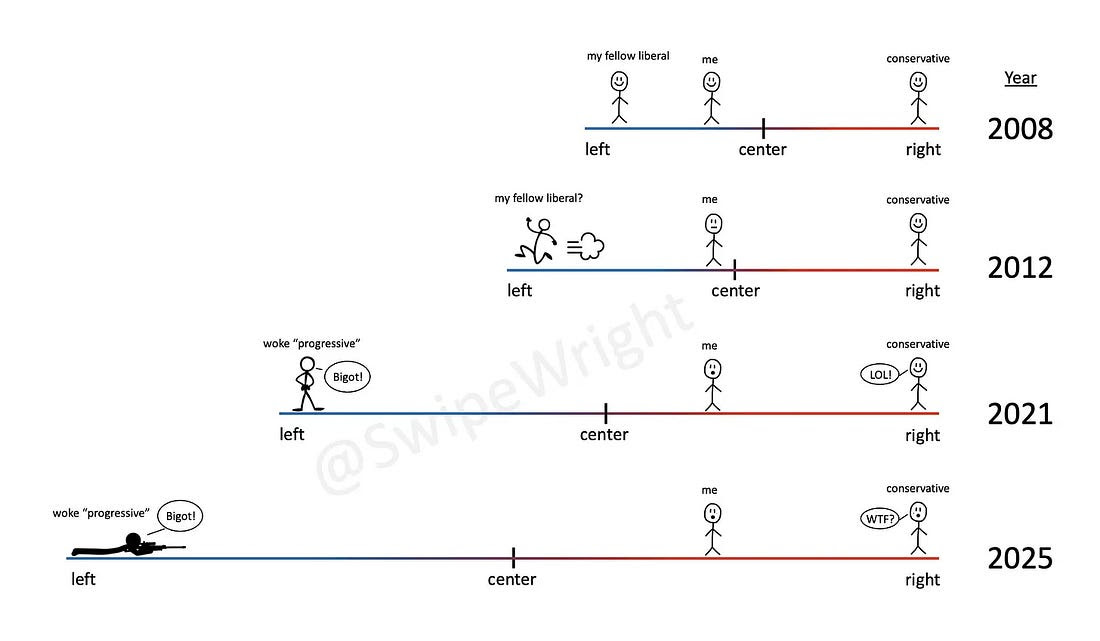
One illusion, not universal but very common, is, “I am in the reasonable political center.” Sorry, but this is rarely true. It is not true of me and it is probably not true of you. Where you probably are is in the center of your group of friends and acquaintances; that’s why they’re your group of friends and acquaintances. Indeed most people seem to exist in a hermetically sealed echo chamber, where no contrary thoughts are allowed entrance. This is how we get inane statements like Pauline Kael’s, “I live in a rather special world. I only know one person who voted for Nixon. Where they are I don’t know. They’re outside my ken. But sometimes when I’m in a theater I can feel them.”1

A second illusion has to do with distance. The reader may recall that one of the defenses I gave last week for the left-right spectrum is that it enables one to get a clearer idea of where one really is based on what can or cannot be seen, and how clearly. Imagine yourself standing somewhere near the base line for the left right spectrum. A little up or down won’t matter. (A lot up or down may mean you’re a loon, but we’ll give you the benefit of the doubt for now.) Look left. Look right. Can you see the difference between a run of the mill conservative and a Nazi? No? If not, that means you’re so far left, even if you think you’re in the reasonable center, that they’re all blending together. Can you see the difference between a Leninist and a Stalinist? Yes? That also means you are pretty far to the left. Conversely, can you not see the difference between a Leninist and a Stalinist? You are probably then somewhat to the right end. Can you see the difference between Hitler and George W. Bush? Same deal.

Oh, and if you can’t see the difference between Hitler and W, that means that not only are you pretty far left, you’re also an idiot.2

Yet a third optical illusion – well, a more or less auditory phenomenon that translates into an optical illusion – concerns vociferousness. Imagine the most moderate man or women in the country. He (or she) is the exact middle of the road. Indeed, he is so middle of the road that he makes his living renting himself out as a guide to the folks who paint the stripes on highways and byways. Imagine also that he (let’s just skip the PC bullshit, from now on, shall we? He includes she.) is quite vociferous in his political moderation, detesting everyone on the right third of the spectrum and everyone on the left third separately but equally, and voicing his disgust and contempt loudly, as often as he can find an audience. How does that man look to a leftist? How does he look to David Duke?

Easy; the lefty sees a conservative whom, for reasons mentioned above he cannot distinguish from a Nazi, while Duke sees at best, a communist. How does that happen? I think what takes place, in effect, is that both lefty and (pretty extreme to the point of disgusting) righty take that vociferousness, and add it as a height above the spectrum, then lay that elevation down in the opposite direction from themselves.

That happens to me all the time, by the way. I am – as far as I can tell, both by where I place on surveys and by what I can distinguish when looking left or right – about one third of the way from true center to the right, or, in other words, just on the right edge, the cusp, between the middle third and the right third. And I am vociferous to and past the point of being obnoxious about it, too. This is why much of the extreme right – the right so far from them that lefties cannot even distinguish it from conservatives – detests me as a liberal, while liberals see pure and unrepentant Nazi.3


  1. http://www.newyorker.com/the-front-row/my-oscar-picks#ixzz1FCt1d1Mw
  2. No, I’m not a huge fan of W, but you’re still an idiot. And ignorant.
  3. Nazi is a toughie for me, being an eclectic mix of various kinds of Celt, but also Ashkenazi Jew, which includes a small percentage of sub-Saharan African – oh, yes it does — Gyspy, Russian, Pole, and God alone alone knows what else. True story: whatever genes I have, I can tan like you wouldn’t believe. In 1998 I came back from about six weeks in the Kuwaiti desert. My eldest daughter took one look and screamed, “Mommy! Mommy! Daddy turned black.” She was exaggerating. A little.

Update, 10 March: Welcome, Instapundit readers! Have a look around at some of my other posts you may find of interest. I send out a daily summary of posts here through my Substackhttps://substack.com/@nicholasrusson that you can subscribe to if you’d like to be informed of new posts in the future.
March 4, 2026

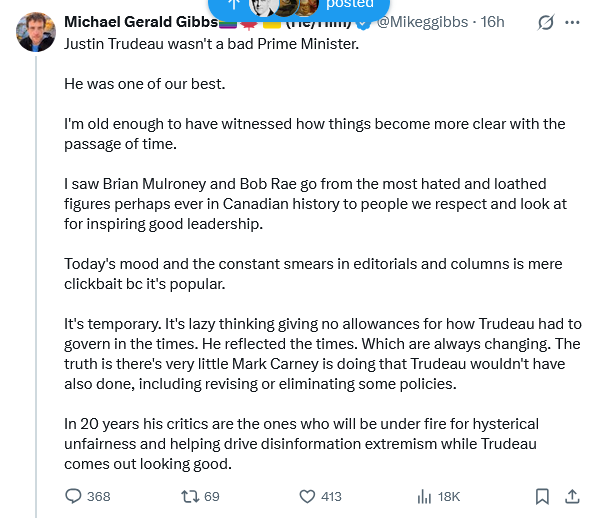
Epic bad takes – “Justin Trudeau wasn’t a bad prime minister”

Filed under: Cancon, Government, Media, Politics — Tags: , , , — Nicholas @ 03:00

On the social media site formerly known as Twitter, L. Wayne Mathison responds to someone who we shouldn’t mock, because perhaps he was dropped on his head too many times as a child or perhaps he’s a card-carrying member of the Liberal Party:

There’s a reflex in Canadian politics that drives me nuts. If you criticize a prime minister hard enough, someone eventually says, “You’re just emotional. History will fix it.”

No. History doesn’t fix weak math.

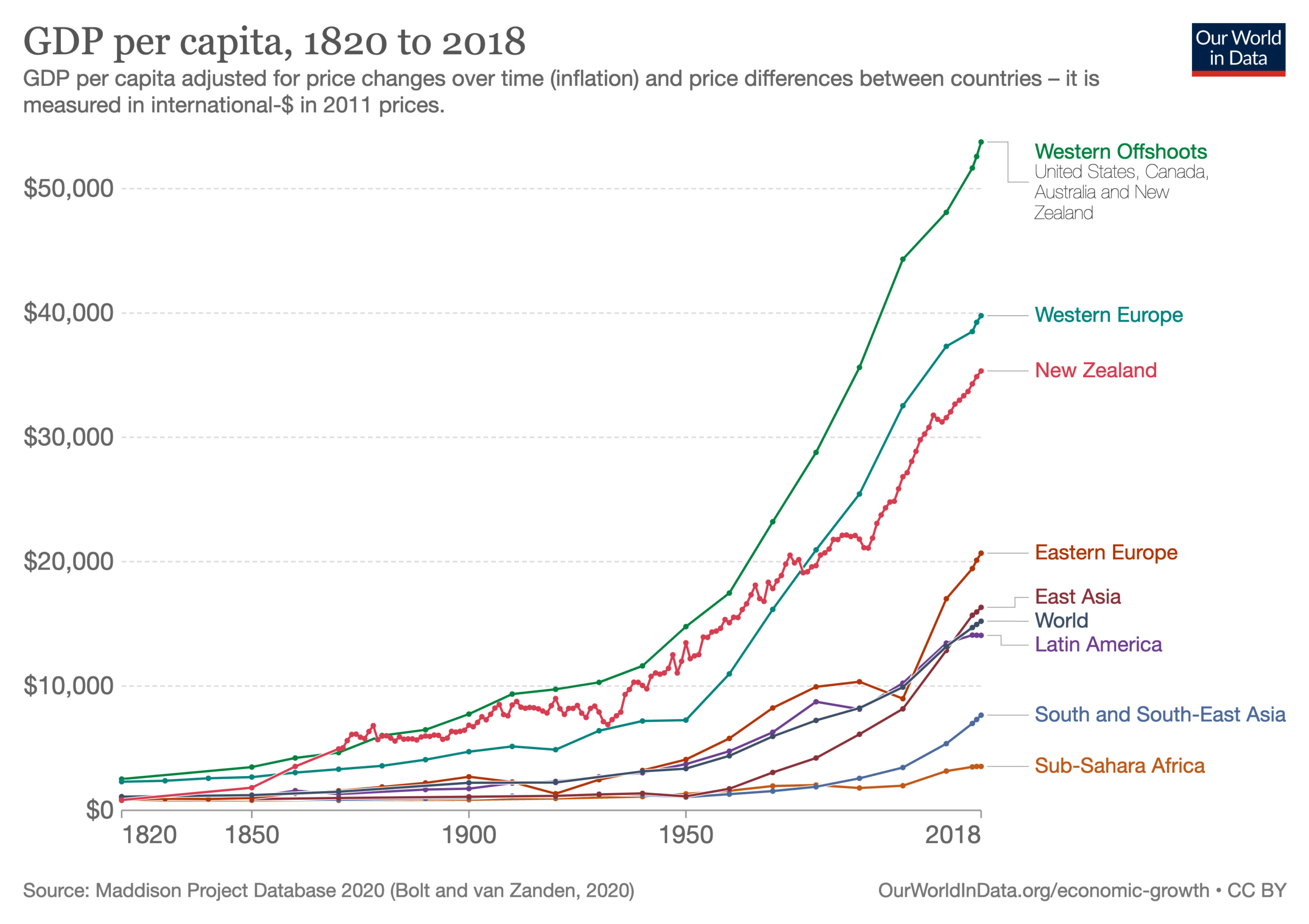
Let’s stop pretending this is about vibes. Under Justin Trudeau, federal spending didn’t just rise during COVID. It exploded before it. Deficits were normalized in good years. Productivity flatlined. GDP per capita drifted backward relative to the U.S. Housing costs detached from incomes. Regulatory layers multiplied while investment quietly left for friendlier jurisdictions.

That isn’t hysteria. That’s structural decline.

The “he governed for the times” excuse is soft thinking. Leaders are supposed to anticipate trade-offs, not amplify them. When you stack carbon taxes, capital constraints, pipeline cancellations, and endless approval timelines onto a resource economy, you don’t get moral progress. You get stalled growth and capital flight. Then you blame grocers and global headwinds.

And let’s be blunt. The brand was performance politics. Identity theatre. International applause. But governance is boring. It’s about compounding effects. Interest payments. Productivity curves. Regulatory drag. Trudeau governed like narratives create wealth.

They don’t.

Even his defenders quietly admit course corrections were needed. If policies now require rollback or “revision”, that’s not vindication. That’s damage control.

Time won’t turn fiscal drift into foresight. It won’t convert stagnant productivity into hidden genius. Mulroney is respected because NAFTA and fiscal reforms strengthened the country long term. Results earned that.

If in twenty years Canada’s energy capacity, housing stock, productivity, and fiscal health look stronger because of Trudeau’s foundations, fine. I’ll concede it.

But if the next generation is still digging out from regulatory paralysis and debt overhang, nostalgia won’t rewrite the ledger.

Simple standard. Did living standards rise sustainably?

If not, no amount of mood reframing saves the record.

February 25, 2026

Sensitive scientists skulk off to the “I❤️Science” clubhouse of Bluesky to lick their wounds

Filed under: Media, Politics, Science, USA — Tags: , , — Nicholas @ 05:00

Since the social media site formerly known as Twitter stopped being a purely leftist echo chamger — although some now claim it’s gone all the way to being a rightist echo chamber — a large number of scientists have chosen to relocate their social media participation to a site much more along the lines of pre-Elon Twitter:

Image from Science Is Not The Answer

Ressentiment and hurt feelings over lose of prestige has hit many academic scientists hard. The ebbing away of respect and deference was not something they prepared for. They were taught, all through life, that these things would be theirs in abundance, got free by flashing their degree. Only now there is often laughter instead of applause.

They should have seen it coming. Decades of predicting every single thing, with no exceptions, would worsen because of “climate change”, the idea that treating delusions by making all agree with the delusions, and by chemically and surgically altering the delusional, the hersterical overblown false cries of “Follow the Science!” in the covid panic, and the endless stream of nonsense of every stripe passed off in the name of science, all of which were funded by you, has whittled down to next to nothing the goodwill scientists earned over the years by inventing such modern miracles as chemical, biological and nuclear weapons and multiverses.

That’s my little joke. But it’s clear many scientists are running away from criticism, which is hurtful. Few enjoy being questioned, and almost none take well the abuse hurled on social media. Scientists want a return of the reflexive polite submissiveness (“Back off, man, I’m a scientist”), and many are coming to realize they aren’t going to get it. Not online, anyway.

Which is a long-winded introduction to the peer-reviewed paper — whose existence proves our thesis — “Scientists no Longer Find Twitter Professionally Useful, and have Switched to Bluesky” by DS Shiffman and J Wester in Integrative and Comparative Biology, a journal whose name would have you guess is about integrative and comparative biology, and not tittle tattle gathered, in the manner of cheap journalism, using surveys answered by those who can’t find an excuse not to answer. But the name lies. For that is exactly what this paper is.

The Synopsis, with my emphasis:

    Social media has become widely used by the scientific community for a variety of professional uses, including networking and public outreach. For the past decade, Twitter has been a primary home of scientists on social media. In recent years, new leadership at Twitter has made substantive changes that have resulted in increases in the prevalence of pseudoscience, conspiracy theory, and harassment on the platform, causing many scientists to seek alternatives. Bluesky has been suggested as a good alternative to Twitter, but the phenomenon of academics switching social media platforms has not previously been studied. Here we report on the results of a survey distributed to scientists on Twitter and Bluesky (n = 813). Results overwhelmingly confirm that changes to Twitter have made the social media platform no longer professionally useful or pleasant, and that many scientists have abandoned it in favor of Bluesky. Results show that for every reported professional benefit that scientists once gained from Twitter, scientists can now gain that benefit more effectively on Bluesky than on Twitter.

The reason this topic has not been “studied” is because, as is obvious, it is not worth studying. Asking why a handful of scientists (willing to answer) which social media platform they prefer barely counts as news. What is interesting, though, is that academic scientists have joined the Cult of the Victim.

Huh. Who knew that calculating degrees of butthurt was now an academic speciality?

February 24, 2026

The political spectrum in Canadian media runs from the far left all the way to the left-of-centre

Filed under: Cancon, Government, Media, Politics — Tags: , , , , , , — Nicholas @ 05:00

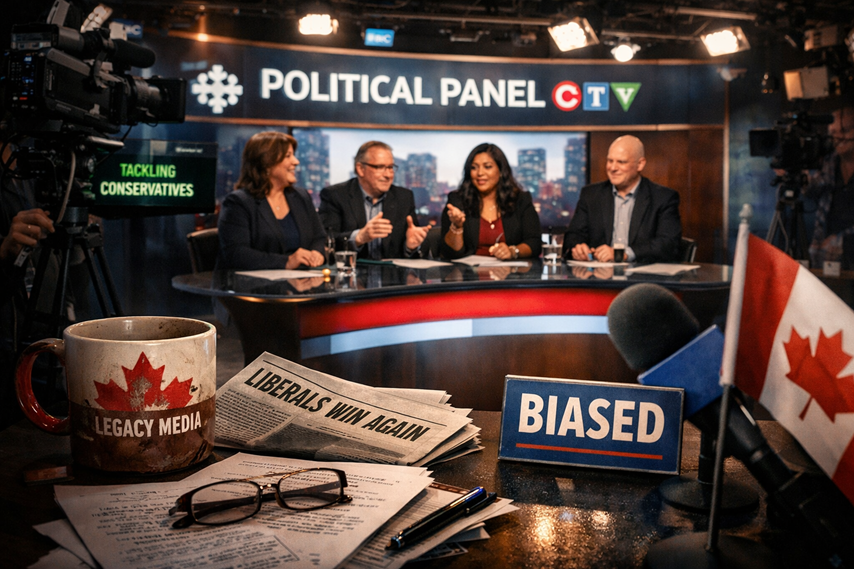
The federal government isn’t noted for being good with money. Yes, I know, understatement of the century … But they did make one investment that has been fantastically beneficial. For the Liberal Party, if not for Canadians in general. That investment was buying the support of almost all of the surviving mainstream media outlets by directly subsidizing their payrolls. Most media folks lean left anyway, but once their paycheque literally depended on keeping the Liberals happy, they joyfully co-operated in ways that 1930s German newspapers would blush at. On her Substack, Melanie In Saskatchewan explains just how far away from representative the media political spectrum has drifted (leftwards, of course, always leftwards):

If you were to draw a Venn diagram of the real Canadian political landscape and the pundit ecosystem on legacy networks, you’d find they barely overlap.

Rosemary Barton is the undisputed matriarch of the CBC’s political brand. As host of At Issue and Rosemary Barton Live, she shapes the entire panel tone for CBC political discourse and anchors the network’s election coverage. She has been at the helm of federal election panels since 2016, interviewing party leaders and moderating debates from coast to coast.

Canada’s mainstream media as Liberal Party propagandists.
Image from Melanie In Saskatchewan

Now ask yourself this: if half the population consistently feels unheard by these panels, is that a coincidence, or the predictable result of decades of the same ideological herd wandering through the same studios?

Here is the rub. The At Issue panel rarely rotates through voices that actually represent today’s conservative electorate. Instead, it routinely features professional journalists and political insiders who debate among themselves, talking about conservatives far more often than they engage with conservatives whose voters make up a massive share of the country. That is not centrism. It is an echo chamber assembled by committee.

Then there is Andrew Coyne. He is often presented as the token ideological counterweight on At Issue, the panel’s supposed nod to conservatism. After all, he has spent decades as a columnist and editorial thinker, comfortably critiquing governments from a well upholstered perch.

But let us be clear. Coyne is not remotely representative of today’s conservative electorate. He is not a reflection of the current Conservative Party base. He is not channeling the instincts of voters outside the Ottawa and Toronto corridor.

Positioning him as the conservative voice on a national panel is not balance. It is branding. It allows producers to claim ideological diversity without ever inviting someone who actually carries the convictions, tone, or priorities of the modern conservative movement. Coyne is not a grassroots conservative. He is a professional pundit whose worldview fits tidily within the Ottawa insider class. That is not ideological contrast. It is controlled opposition dressed up as pluralism.

Meanwhile, audiences have been increasingly vocal online about the sense that these panels sound like academic seminars, not reflections of the lived experience of Canadians who didn’t spend their twenties in Ottawa press galleries.

February 23, 2026

“The aim always being to shoot the kulaks and who cares about the reasoning?”

Filed under: Economics, Media, Politics — Tags: , , — Nicholas @ 03:00

It’s funny how the latest crisis always seems to have the same recommendations from the great and the good of the land – give us more money and more power. Pollution? More money and more power, please. Global poverty? More money and more power, please. Climate change? More money and more power, please. So it’s not really surprising that when the great and the good decide that global wealth inequality is a huge and growing problem, well, we all know what they’re going to recommend, don’t we?

As we all know, because we’re all told it so often, global wealth inequality is rising. Therefore something must be done! Punitive taxation and the bureaucrats get to spend everything, obviously.

The one little problem with this is that the aim, intention, is always punitive taxation and the bureaucrats get to spend everything and damn the actual evidence used to support the proposal. It’s all sub-Marxoid ever increasing concentrations of summat and therefore the kulaks need to be shot. The aim always being to shoot the kulaks and who cares about the reasoning?

30 years back — and yes, I am old enough to recall this — it was all about how income was becoming more unequal in its distribution. Therefore punitive taxes, the bureaucrats get to allocate everything and hey, look, we can shoot the kulaks! This all rather fell apart when it was pointed out that the actual effect of global neoliberalism was that income inequality was declining. For which we can thank the work of Branko Milanovic. Who did prove that income inequality was declining under global neoliberalism.

Thus, to my mind, the move to squeeing about wealth inequality. For we need that reason to shoot the kulaks and damn the intellectual perversions required to find it.

And, well, Branko and his numbers again, eh?

    New paper on the capitalization of the world with @BrankoMilan just out!

    Capital income remains very unequally distributed worldwide, but inequality has slightly declined.

Oh. Global neoliberalism is reducing the inequality of capital income, is it? Why yes yes it is:

    Global capital income inequality has declined in the 21st century, with the Gini coefficient falling from 97% to 94%. Over the same period, the share of the world population with annual capital income above $100 increased from 12% to 27%. This implies more than a doubling of the number of individuals earning positive income from interest, dividends, rents, and privately-funded pensions.

That’s alarmingly high, yes. We’d all like it to be lower too. I certainly would. I’d like us all to be living in that bourgeois American upper middle class in fact. $100k a year family incomes, $500k (later in life, obviously) in the 401(k) and all that. You know, bring it on.

We even have a mapped out plan about how we get from here to there. It’s in the SRES, which is the foundation of all that IPCC work about climate change. If we have globalised neoliberalism for the rest of this century then we’ll all be approaching that — in current $ — American upper middle class income. If we power that by going fracking, developing out solar and so on then climate change won’t be a problem either. If we power it by not going fracking and turn back to the use of coal then Bangladesh gets it. But the base idea that all will rise up into those bourgeois pleasures of three squares, a warm crib and choices in life really is in there. And, yes, it’s globalised neoliberalism that will take us there.

So, while it is alarmingly high, that inequality, we’re already solving it as we did income inequality — global neoliberalism. Pity no one gets to shoot the kulaks but there we are, reality doesn’t always accord with desires.

February 19, 2026

Too many “conservatives” today are just slower-speed liberals

Filed under: Britain, Cancon, Media, Politics — Tags: , , , , , — Nicholas @ 03:00

Most self-described conservatives in politics are not particularly inclined to “conserve” anything, as Spaceman Spiff points out, they’re pretty much onboard with the liberal vision they just want it to be fractionally slower or infinitesimally not-quite-as-liberal as the liberals. They are the ineffectual, neutered, tame opposition:

Modern conservatism is not conserving our world. Mainstream conservatives seem to have no interest in the real issues affecting us.

At best they merely wish to slow down our decline. At worst, they are fully on board with the destruction.

When they do act or speak they often pick a safe version of a sensitive issue.

In Britain there is lots of talk of illegal immigration and how the state mishandles it. None about ruinous volumes of legal immigration, almost one million per year, and what it is doing to the country.

Pushback against climate policy falters on the speed of changes, not the underlying fraud of climate science itself.

No conservative will honestly discuss the plummeting happiness of women recorded across the West and yet there it is, writ large in antidepressant prescriptions and social media videos. It may have multiple causes, but feminism cannot be challenged so they say nothing lest they are reprimanded by the sisterhood.

Everything real is forbidden. It is all an act.

Like the left, those on the right are increasingly unable to face reality which means they can never course correct. They are trapped within a self-referencing culdesac designed to maintain their position in someone else’s hierarchy. That is why they have become so ineffective and appear to do very little except moan about the pace of change while they say nothing about the changes themselves.

We sense the conservatives do wish to conserve things but they are inexplicably mesmerized by the opinion of their enemies. They seek reassurance and applause from people who view them as evil.

This makes no sense to ordinary people.

Thinking like the enemy

The problem with modern conservatives is they are animated by underlying drives that cannot create a conservative or traditional society. They have adopted the thinking patterns associated with the progressive left while still using the language of conservatism.

The left is traditionally defined by a series of interrelated traits that manifest in much of what they agitate for.

  1. A desire for centralization;
  2. A notable external locus of control;
  3. Seeking approval from the group.

Central control systems feature prominently in all left-wing schemes. From local councils to national governments, those who gravitate to the left often want to create centralized decision-making bodies to manage society. Institutions, government departments, NGOs and even charities all feature, but only when they act as the controlling authority in some field of interest.

Related to this is a clear external locus of control visible in individuals and their decisions. There is a relief others make the key decisions, so people actively seek out direction from an established authority. This ensures minimal resistance to the many centralized schemes we see emerge.

Acting solo creates discomfort. An older formulation understood this as the rejection of responsibility. Today it often manifests as an obsession with experts making key decisions for us all, partly to mask individual cowardice. People making their own decisions in life are derided as naive or dangerous.

During Covid decision makers became hysterical at the very idea we would reject the advice of experts and perform our own research despite the issue being medical and therefore dangerous.

A related phenomenon characteristic of many leftists is the need for approval, often from a group. Not just others making decisions but a dependency on confirmation and endorsement to ensure thinking and behaviour follows an established norm. This is the antithesis of original thinking or bold action; it is how adolescents often behave.

In today’s world this deep urge is reflected most in the social media landscape of harvesting attention and likes. Every fledgling narcissistic applause-seeking trait is given full expression in the endless search for approval from strangers. Whole sections of society seem lost to impulses we once understood as immature and dysfunctional.

Update: Not long after I queued this item for publication, a Canadian example popped up in the news, as yet another rock-ribbed “conservative” suddenly realized that electing a Liberal was what his constituents actually wanted when they inexplicably voted for him as a Conservative candidate in the last federal election.

Edmonton Conservative MP Matt Jeneroux has crossed the floor to the governing Liberals.

“I am honoured to welcome Matt Jeneroux to our caucus as the newest member of Canada’s new government,” said Prime Minister Mark Carney, in a post on X.

“I am grateful to Matt and his family that he will continue his service as a strong voice for Edmonton Riverbend in Parliament.”

Carney said Jeneroux, who has represented the riding of Edmonton Riverbend since 2015, will take on a new role as special advisor on economic and security partnership for the Liberals.

Jeneroux is the third Conservative to join the Liberals, after colleagues Michael Ma and Chris d’Entremont crossed the floor late last year.

A Liberal source says Jeneroux first met Carney back in November, which was the first of at least two conversations, with talks between Carney’s office and Jeneroux continuing since. That source added that it has been a “long journey” to Wednesday’s announcement.

d’Entremont crossed the floor to join the Liberals in November, which unleashed a wave of speculation as to who might be next, with Jeneroux’s name heavily floated. Jeneroux then announced his plans to resign from the Conservative caucus, citing family reasons. Since then, he has not voted with the Conservatives and did not attend the party’s recent convention in Calgary in late January.

After Carney’s announcement, the prime minister updated his daily itinerary, adding a stop in Edmonton to meet with Jeneroux before attending events in British Columbia.

“Matt brings a wealth of experience in Parliament, despite his young demeanor,” said Carney, while sitting next to Jeneroux.

The MP from Edmonton welcomed the prime minister and laid out the reasons for why he had reversed his decision to resign.

“I had announced my resignation back in November, largely due to family reasons, but quite simply, couldn’t sit on the sidelines after seeing what the prime minister’s ambitious agenda he was undertaking across the country and across the world,” he said.

“Quite honestly, it was the speech in Davos where you took everything head on,” he added.

Jeneroux said it felt disingenuous and “quite simply wrong” to sit on the sidelines.

February 17, 2026

The three core false claims of wokeness

Lorenzo Warby analyzes the three claims that underpin the intellectual structure of all the sub-categories derived from Critical Theory:

Universities across Anglo-America, and across the West more broadly, have become increasingly dominated by a Critical Theory magisterium: a teaching authority that claims ultimate or trumping moral authority. This magisterium is based on Critical Theory and its derivatives — Critical Race Theory, Critical Pedagogy, Queer Theory, Post-Colonial Theory, Settler-Colonial Theory, and so on: which constitutes the Critical Social Justice matrix.

This magisterium has come to increasingly dominate academe for a range of reasons. It generates intolerant zealots, so benefits from the dynamics of an intolerant minority.

It offers a powerful shared status game — affirm beliefs X, Y, Z and that makes you A Good Person. This status game spreads a supporting censorious intolerance, for if affirming beliefs X, Y, Z and makes you A Good Person, then denying X, Y, or Z makes you A Bad Person.

This justifies shaming and shunning anyone who denies X, Y, Z, because they are Bad People and its shows your commitment to what makes someone A Good Person. It shows commitment to the shared status game. This status game generates moralised cognitive assets, and you protect the value of those assets by participating in — or at least going along with — the shaming and the shunning.

The status game generates moral projects that the central administrations of universities can use to expand their authority, range of action, and so resources. An opportunity they have enthusiastically embraced. An opportunity that corporate, non-profit and government bureaucracies have also enthusiastically embraced.

The emotions this status game attaches to those moralised cognitive assets — care, compassion, concern for the marginalised, if you affirm those beliefs, the opposite if you deny them — also plays into fears about threatening emotions (and safety through norm conformity) which are much stronger among men than women. Women are thus systematically more hostile to freedom of speech than men.

It is an exaggeration to claim that “wokery” is just the consequence of feminisation of institutions and occupations. It is, however, true that what works for — what is emotionally resonant in — increasingly feminised institutions and occupations has been selected for.

Source: data taken from this paper.

But the Critical Theory magisterium has expanded across academe — and beyond — due to the nature of its three foundational claims:

  • A blank slate view of human nature.
  • A view of social dynamics as dominated by conflict.
  • An activist relationship with information: that the trumping purpose is not to describe the world, but to change it.

The blank slate view of human nature — not merely that we are not born without inborn ideas, but that everything that forms us is social — means that any level of social transformation that can be conceived is attainable. Provided enough social power can be assembled—to move human action, speech and thought in the correct direction—the socially-transformative society free of oppression and alienation can be created.

The grander the conceived purpose, the more energising and motivating it is. But also the more it rhetorically trumps anyone who is willing to “settle” for less than complete human liberation. This then feeds back into energising and motivating, as it provides an endless sense of being moral trumps.

A recurring version of such blank slate claims is that our “true” nature has been obscured or repressed by oppressive forces. This might be the alienation via private property (Marx) or by patriarchy, or white supremacy, or heteronormativity or whatever.

The most dramatic statement of the “repressed true nature” claim is also the earliest, in the first sentence of Jean-Jacques Rousseau‘s The Social Contract (1762):

    Man is born free and everywhere he is in chains. (l’homme est né libre, et partout il est dans les fers.)

The view that oppressive forces are blocking our true nature goes naturally with the claim that social dynamics are dominated by conflict. This dominated-by-conflict claim was classically stated by Marx and Engels as the first sentence of the first chapter of The Communist Manifesto:

    The history of all hitherto existing society is the history of class struggles.

If conflict dominates social dynamics, then the prosecution of such conflict so as to achieve human liberation becomes the ultimate moral good. Coordinating the fighters for human liberation becomes a moral urgency. To prosecute that struggle becomes the most important thing one can do.

Both of these claims naturally lead to, and gain strength from the claim, that the morally trumping thing to do with information is to prosecute the struggle for human liberation. Marx famously said:

    The philosophers have only interpreted the world, in various ways; the point is to change it. Theses on Feuerbach, Thesis Eleven, 1845.

Max Horkheimer, in his seminal essay Traditional and Critical Theory (1937) tells us that:

    Critical thinking, on the contrary, is motivated today by the effort really to transcend the tension and to abolish the opposition between the individual’s purposefulness, spontaneity, and rationality, and those work-process relationships on which society is built. Critical thought has a concept of man as in conflict with himself until this opposition is removed. If activity governed by reason is proper to man, then existent social practice, which forms the individual’s life down to its least details, is inhuman, and this inhumanity affects everything that goes on in the society.

Critical Theory is activist Theory, aimed at human liberation from the unwanted constraints of existing society and epitomises the activist relationship with information. All scholarship is trumped by this aim and so the most authoritative scholarship is that which is most committed to this aim.

Source. Notice the delusional claim of the first listed article. The intrusion of such updated Lysenkoism into contemporary science and medicine is even more rampant with matters Trans.

February 13, 2026

To be accepted as a true European, you must performatively hate Trump

Filed under: Europe, Media, Politics, USA — Tags: , , , , , — Nicholas @ 05:00

In Spiked, Frank Furedi explains why European elites and the poseurs who aspire to be counted among the elites must now ostentatiously and performatively hate US President Donald Trump (even more than they hated George Bush, if possible). Comment on dit “eLbOwS uP”?

AI-generated image from AndrewSullivan.substack.com

In recent months, anti-Americanism has emerged yet again as a respectable prejudice in Europe. It is widely promoted through the mainstream media and enthusiastically endorsed by the continent’s cultural elites. There are now even numerous campaigns to boycott American goods – most respondents to a survey in France said they would support a boycott of US brands like Tesla, McDonald’s and Coca-Cola. As a piece in Euractiv put it, anti-Americanism is “in vogue across Europe”.

This has become all too clear at the Winter Olympics, currently being held in northern Italy. At the opening ceremony for Milano Cortina 2026, Team USA and vice-president JD Vance were booed by a crowd of over 65,000 people. Someone I know who attended the event told me that the booing was spontaneous and quickly became widespread. According to the European Union’s foreign-policy chief, Kaja Kallas, those booing were displaying “European pride“. It seems that for the Brussels elites, anti-Americanism bolsters Europe’s self-esteem.

The explicit target of this resurgent anti-American animus is, of course, US president Donald Trump. But it’s implicitly aimed at all those who voted for him, too. In a piece on boycotting American goods in the normally sober Financial Times, published last March, the author gave the game away. While saying it is “wrong to conflate Americans and their president”, he argued that “it’s [also] wrong to disentangle them entirely … Trump reflects half of America. He reflects a society where a democratic majority is prepared to tolerate mass shootings and a warped political system”.

Certain politicians are being boosted by this wave of anti-Americanism. Canadian prime minister Mark Carney, in particular, has been turned into the unexpected hero of the European political establishment. His defiance of Washington has turned him into the posterboy for this new brand of anti-Americanism. “Europe has a lot to learn from Mark Carney”, was the verdict of the New Statesman. The Guardian echoed this sentiment: “Europe must heed Mark Carney – and embrace a painful emancipation from the US”.

Expressing anger against America appears to be the one emotion that binds the European political establishment. As one Financial Times commentator explained earlier this month, “Trump is Europe’s best enemy yet”. He has apparently provided Europe with the “common foe” it needs. It appears that anti-Americanism is now the glue holding together otherwise disoriented and divided European elites.

The reason usually given for this turn against the US is Trump’s behaviour towards Europe, specifically his threats to annex Greenland, impose tariffs and downgrade America’s NATO commitments. No doubt these policies have played an important role in putting Europe’s ruling classes on the defensive. However, they are not the leading cause of this wave of anti-Americanism. Rather, they have merely brought to the surface pre-existing prejudices deeply entrenched within Western Europe’s elite culture.

In his fascinating study, Anti-Americanism in Europe (2004), Russell Berman linked the growth of anti-Americanism during the 1990s and 2000s to the project of European unification. Berman claimed that, in the absence of an actual pan-European identity, anti-Americanism “proved to be a useful ideology for the definition of a new European identity”. He noted that the main way Europe defines itself as European is precisely by underscoring its difference from the United States.

February 12, 2026

“Imagine getting mad about this and still thinking you’re a good person”

Filed under: Cancon, Football, Media, Politics, USA — Tags: , , , — Nicholas @ 03:00

On the social media site formerly known as Twitter, Christian Heiens responds to a typical rage-baiting “we’re all good people except those evil right wingnuts” post:

Every invocation of “universal love” is always invoked to legitimize a very particular form of hatred.

The Left does this thing where it denies the existence of its own ideology as being political at all. It’s just “love”. It’s just morality-as-politics, or simply “being a good person”.

And Leftists insist this is all they’re doing, even as they engage in the most aggressive and ruthless forms of politics imaginable.

Nothing is ever depicted as a power struggle between competing worldviews. It’s always a crusade against social ills, pathologies, and evil itself.

“Conservatism” doesn’t exist to these people. There’s no legitimate opposition, only a criminal element that has to be destroyed because Leftists have already declared themselves to be the universal manifestation of morality, peace, kindness, love, progress, and everything that is good and just in this world.

But everyone can see just how utterly hypocritical these people are. We continuously see examples of these same people exhibiting the most immoral, disgusting, and downright evil manifestations of hatred and violence against people and factions that they despise.

They just call it “love” as they do these things.


Meghan Murphy has a similar point on progressive delusion and its domestic variant, Canadian delusion:

The phenomenon of progressive delusion is very much like the phenomenon of Canadian delusion. Both groups go about their lives presuming that everyone not only respects and admires them, but sees them as they see themselves: 100% right.

There is zero doubt in the minds of progressives and Canadians that the entire world envies their intelligence — they are the most informed, the most invested in The Science, the most rational, and the most educated. Not only that, but they view themselves as the kindest, most compassionate, and most polite.

Should a progressive deem not to ostracize, scream at, or punch a person who dares hold non-left political views, they consider themselves very generous. Imagine! They, a Correct and Good, allowing a Hateful, Stupid, and Wrong to share the same air as them.

The assumption that everyone around them bases their lives and relationships on political parties, activist movements, and propaganda that has been consistently wrong for at least a decade is strange. Imagine buying the Covid scam hook, line, and sinker, or repeating “Transwomen are women” ad nauseam for five+ years, and still assuming you and your “side” are right about everything. Imagine continuing to insist that the “good” side is that side that advocated for child sterilization, forced the elderly to die alone in hospitals on account of a cold, and banned people from the internet and public life for speaking truths we all acknowledge are true now, but were not your party line a few years ago.

I hate to break it to you, but you are the bad guys, not us.

QotD: Books for children written for “the narrative” instead of for children

Filed under: Books, Britain, History, Quotations — Tags: , , , — Nicholas @ 01:00

Children can spot books written by adults for other adults a mile away — when I read bedtime stories to my son, I always notice when he loses interest. And almost all products of the modern children’s entertainment industry are so freighted with issues and role models, and ingratiating attempts to be cool, that escape velocity cannot be reached.

C.S. Lewis, the master of escapist fiction, was prophetic in warning against such noxious paternalism from authors. “Of all tyrannies, a tyranny sincerely exercised for the good of its victims may be the most oppressive”, he wrote. “It may be better to live under robber barons than under omnipotent moral busybodies. The robber baron’s cruelty may sometimes sleep, his cupidity may at some point be satiated; but those who torment us for our own good will torment us without end for they do so with the approval of their own conscience.” Let’s hope Barbie director Greta Gerwig, who has been tapped up to direct the next year’s Chronicles of Narnia series, is taking note.

In the meantime, we have the books, the first of which, The Lion, the Witch and the Wardrobe, was published 75 years ago today. When I read this to my son, it transfixed him in a way that all those morally improving Disney and Pixar movies could not — and in a way that I recognised too from my own childhood. The Narnia books are weird and archaic and they are far from comforting. But they leave unanswerable questions and imaginative territory to roam for a lifetime.

What would compel a child to climb into a claustrophobic wardrobe, full of moth-eaten coats and spiders, as apt a symbol as any for the human psyche? C.S. Lewis knew all too well. There are real and terrible things to escape from. And the land of magic, mystery and hope that Peter, Susan, Edmund and Lucy arrived in would soon reveal that it too was blighted. By facing up to this, conquering its climate of terror, the child would become an adult. If they didn’t pass into the dark and through it, they would remain infantilised.

This partly explains the backlash against Lewis. Two years ago, it was reported that the Government’s counter-terrorism unit, Prevent, had classified his works along with some by his friend J.R.R. Tolkien as potentially leading to “radicalisation”: the kind of wormtongue deception worthy of the villains of Narnia or Middle Earth. It demonstrates that, at its best, fantasy can be the mirror that shows us who we are and what we’ve become. But then, there is a long history of people taking leave of their senses when it comes to Narnia. The books have been banned in the US for being both too Christian and not Christian enough. One critic ranked the books (with delicious venom) as worse than 120 Days of Sodom or Mein Kampf. Being shot by all sides might indicate a writer is on the right track.

For his part, Lewis lambasted “those who do not wish children to be frightened […] Since it is so likely that they will meet cruel enemies, let them at least have heard of brave knights and heroic courage. Otherwise, you are making their destiny not brighter but darker.” He knew of the existence of shadows from early in life. There is a spine-chilling passage in his memoir, Surprised by Joy, in which he recalls waking up one night with toothache when he was 10. He called out his mother’s name and she did not come. She was dying in another room. His father was never the same and sent Lewis off to a boarding school run by a deranged sadist. “With my mother’s death, all settled happiness, all that was tranquil and reliable, disappeared from my life.”

As a result, Lewis developed a fear and mistrust of the adult world in those years — and it was well-placed. Scarcely more than a boy, Lewis was sent to the trenches. He was seriously injured in the Battle of Arras (he would have shrapnel, from a shell that obliterated a colleague, embedded permanently in his body) and, like Tolkien, he watched many of his friends die. “One cannot help wondering why,” he wrote to his father.

Darran Anderson, “Save Narnia from the woke witch”, UnHerd, 2025-10-15.

Update, 13 February: Welcome, Instapundit readers! Have a look around at some of my other posts you may find of interest. I send out a daily summary of posts here through my Substackhttps://substack.com/@nicholasrusson that you can subscribe to if you’d like to be informed of new posts in the future.
February 6, 2026

This is the right way to sell Western separatism to Eastern Liberal voters

Filed under: Cancon, Economics, Media, Politics — Tags: , , , , , — Nicholas @ 03:00

On the social media site formerly known as Twitter, Paul Mitchell explains to Ontario and Quebec Liberals why they should be fully supportive of kicking Alberta (and maybe Saskatchewan) out of Confederation to ensure a 100% Liberal-dominated Canada in perpetuity:

Please share this for progressive Canadians back East …

Greetings progressive Easterners. I have noticed that some of you are quite upset and even enraged by the current quest of many Albertans to have Alberta leave Canada.

Now hear me out.

If you consider it, you’re taking this all wrong. Consider the progressive utopian paradise that Canada could be if “polluting”, “knuckle-dragging”, “bigoted”, “backward” conservative Alberta was gone! I mean, that is what you think about us, right? I see those descriptions of us every day on social media, so imagine how great it’ll be for y’all once we’re no longer holding back your progressive goals and dreams!

With Alberta gone (maybe with Saskatchewan too if you’re lucky) there will be no stopping your heart’s most desired policies from coming true. Without us there could be:

✅ unlimited diversity and immigration
✅ true Net Zero with heavy taxes for CO2 emissions
✅ collective rights over individual rights
✅ severe hate speech laws
✅ gun confiscation
✅ almost no more conservative politicians

All this and much more can be yours for the low price of zero dollars. Just let us Albertans ride off into the sunset and your dreams will become reality.

So, turn that frown upside down!

Contemplate your amazing future without Albertans bumming you out constantly. There’s no need to be upset about Alberta’s independence petition. You’re going to get what you said you always wanted: a country where progressives will be in charge, forever.

That is what you want, right?

Thanks for your kind attention, and future support for Alberta’s independence from Canada.

Fortunately for me, I have relatives in Alberta so I’d have a chance of being accepted as a refugee from remnant Canada …

February 4, 2026

Amelia, created by woke propagandists, is now the figurehead for the anti-woke

Filed under: Britain, Government, Liberty, Media, Politics — Tags: , , , , , — Nicholas @ 03:00

On the social media site formerly known as Twitter, John Michael Greer provides a quick thumbnail sketch of the Amelia story for folks who need to get caught up:

I’ve been watching the saga of Amelia from the far side of the Atlantic in a state of utter bemusement.

For those who don’t know the first act of the saga, the British government had some collection of flacks create a video game for British kids, which was designed to elicit “racist” (that is, patriotic and un-woke) statements from them — at which point the kids who fell for it would be reported to the police for, erm, reeducation. (I wish I was making this up.)

Amelia was a cartoon figure who was supposed to mouth allegedly racist slogans, and they gave her violet hair because they thought that would annoy right-wingers, who make jokes about women with dyed hair.

Ponder the immeasurable stupidity of the flacks who put nationalist and patriotic slogans in the mouth of the kind of cute female figure who would have most teenage boys reaching into their trousers on the spot. Of course these same teenage boys instantly hijacked her and turned her into a mascot, just as they did with Kek back in the day. Of course these same teenage boys, being far more computer-skilled than government flacks, started doing LLM-generated videos of Amelia speaking out in favor of nationalist and patriotic ideas.

Of course everybody in Britain who’s sick and tired of the Starmer government and its woke doctrines embraced Amelia as their latest heroine, not least because the Guardian‘s foam-flecked fury when she’s mentioned is so entertaining to watch …

And then, as with Kek, things got weird. We’re still in the early stages of the weirdening but it would not surprise me a bit to find that just as a cartoon frog ten years ago became the vessel through which an archaic Native American deity manifested and sent the US spinning down an uncharted path, a purple-haired waifu may just become another such vehicle.

Britain used to have quite a collection of war goddesses, back in Celtic times. I’m curious, not to mention apprehensive, to see just who’s taking this opportunity to stream back into manifestation.

February 1, 2026

Don’t listen to what they say, watch what they do

On the social media site formerly known as Twitter, John Carter reacts to an Australian race-grievance grifter “Race Discrimination Commissioner” bloviating talking about Australia as “stolen land”:

The implicit meaning of this framing is that Anglos stole the land so it’s only fair for them to give hundreds of millions of Hindoids the opportunity to steal the land.

Revealed preference demonstrates this. If he believes the land is stolen, and he believes theft is morally wrong, then he would not accept a salary of hundreds of thousands of dollars from the Australian government (this is blood money), and he wouldn’t live in Australia.

Since he doesn’t do either of those things, he either doesn’t believe what he’s saying, or he does but he doesn’t think theft is bad, in which case he’s simply trying to emotionally manipulate white Australians by using their own morality against them in order to guilt them into continuing to allow him and people like him to parasitize the Australian people.

He then elaborates:

It really cannot be emphasized enough how dishonest all of this is.

America stole land from the natives, purchased some African farm equipment, and has always been a “nation of immigrants”, therefore “open the borders and give us your country”.

Canada is built on stolen land, sent some kids to boarding school, and has also always been a “nation of immigrants”, therefore “Let my people in, saar”.

Australia, same narrative as Canada.

New Zealand, same as Australia.

Britain did an imperialism, therefore “your country belongs to us now, saar”.

France, same as England.

Spain, same as France.

Ireland never had an empire and hasn’t had slaves since the Viking Age, and indeed was itself colonized by England … therefore Ireland must accept unlimited migration in solidarity with other post-colonial countries.

Germany was too mean to Jews for a few years, therefore Germans must abolish themselves and give their country to North Africans.

The only peoples the Swedes ever conquered or enslaved were neighbouring Europeans, but Sweden might have sold some iron that might have gotten used on some slave ships a few centuries ago, therefore must open its borders to Bomalians and give them all the rape toys they can penetrate.

The justification differs, but the conclusion is always the same: open borders and ethnic replacement.

The uniformity of the repugnant conclusion indicates that these narratives are formed by reasoning back from that tendentious repugnance, with the arguments tailored to national conditions using whatever specific historical circumstances are handy, with the intent of emotionally manipulating native populations into laying down their arms, foregoing resistance, and placidly accepting the loss of their countries to the hundreds of millions of third-worlders intent on flooding every developed white country on the planet.

The people making these arguments don’t believe a word that they say. Their seething resentment for Europeans is entirely real, but this is almost entirely an inferiority complex, humiliation at having been so easily conquered and then taught to eat and wipe with something other than their hands. They don’t believe that slavery or conquest are wrong: if they did, they wouldn’t still practice slavery, and they wouldn’t be trying to conquer the West in the guise of beggars, by shamelessly playing to our pity and misplaced guilt. They say these things in order to trick you by playing on a conscience they don’t have themselves. It’s a sales tactic, and they’re selling you annihilation.

« Newer PostsOlder Posts »

Powered by WordPress