Quotulatiousness

October 11, 2025

QotD: Riot control tips

Filed under: Media, Military, Politics, Quotations, USA — Tags: , , , , , , — Nicholas @ 01:00

1. The press is not only the enemy; they must be presumed to be an utterly unprincipled and dishonest enemy. Anything and everything the riot control force does will be filmed and, if necessary, edited, to present it in the worst possible light. Therefore, they must have their own camera teams recording everything to both clear themselves of wrongdoing or spurious charges of indiscipline, as well as to discredit the press which will have edited the truth heavily. NB: There is no real limit to how dishonest the modern press can be and will be in support of the leftist agenda. There is no placating them. There is no degree of righteous conduct they will not twist into wrongdoing. There is thus no sense in trying to placate them, in trying to be nice, in tightly limiting violence, etc.; because they will lie about you and all those who want to believe their lies will.

2. Riot Control Women. They’re rather preposterous, in the main, if employed on the riot control line. It’s one of the reasons why MPs have for long been useless at riot control; they’re simply too heavily laden with women, who almost universally lack the size, strength, and aggressiveness for hand to hand combat with stone age weapons. Indeed, while the infantry and other combat and combat support unit in the old 193rd were excellent at riot control, the MPs – yes, I have seen it – were useless. Worse, riot control is a perfect environment to cause what the Israeli’s found out when they mixed men and women in the same units in their War of Independence; men will abandon the mission to succor one of their own women. This is the fault of the men, by the way, and not of the women, but it is even more the fault of the dogmatic shitheads of the left who refuse to see men and women for what they are.

3. Rioting women. I don’t care if you have a warrant for their arrest for murder, arson, mayhem, and massacre, plus cellulite and bad makeup, do not arrest or detain them at the scene. Shoot them if their conduct (to include dress) warrants it, but otherwise just push them away or wound them slightly and push them away. Why? Because, though ill-disciplined rabble, for the most part, the rioters are also mostly male and will also rush to the defense of “their” women. There is no better substitute for the cohesion and moral fiber a mob usually lacks than going after the women in the mob. They can turn ferocious very quickly, indeed, if you do.

And that’s all good and maybe it will get us through the summer, should it turn out as badly as it might, but, America, I suspect that you and the president are ultimately still going to need a dedicated, well trained, highly mobile, professional force for riot suppression.

Tom Kratman, The social media site formerly known as Twitter, 2025-06-11.

Update, 12 October: Welcome, Instapundit readers! Please do have a look around at some of my other posts you may find of interest. I send out a daily summary of posts here through my Substackhttps://substack.com/@nicholasrusson that you can subscribe to if you’d like to be informed of new posts in the future.

October 7, 2025

Big management shake-up at Cracker Barrel’s corporate HQ

Filed under: Business, Media, Politics, USA — Tags: , , , , , — Nicholas @ 05:00

Back in August, the US chain restaurant field saw a corporation decide that doing what their customers wanted was actually a pretty good strategy … after they’d tried the opposite and nearly gone the way of Bud Light:

Last week was the Red Wedding for Cracker Barrel.

Some senior people who were in the headquarters office last Monday weren’t there anymore as the weekend drew near, some old managers from an earlier corporate culture came back to rewind the clock, and the branding consultant that advised on the now-fatally-wounded rebranding effort was sent packing. The new logo departed. The redesigned stores were acknowledged as a failure and an embarrassment.

[…]

See what they said about the redesign? “We won’t continue with it”. The whole thing collapsed, a $700 million rebrand that slammed into a concrete wall and exploded.

It remains to be seen how much the rebranding of the rebranding will matter, and this is what Cracker Barrel stock looks like in the last month:

Now, a reminder: The New York Times columnist David French explained, just over a month ago, that the controversy over Cracker Barrel’s rebranding was an absurd fake crisis ginned up by right-wing idiots who were just pretending that something had gone wrong at the company. Along with the Sydney Sweeney thing, he concluded that we were watching some “completely frivolous and meaningless cultural disputes,” examples of the way “right-wing media both mobilizes its base and bends political reality”. If you believed that the Cracker Barrel rebranding was poorly done and would alienate the company’s customers, you were falling for an invented reality that was completely meaningless and frivolous.

Then Cracker Barrel fired a bunch of managers and its rebranding consultant, abandoned the rebranding, and apologized profusely, while its stock plummeted.

If you listened to David French, if you trusted the op-ed pages of the New York Times to explain the world to you, your understanding of the most basic outline of factual reality was flipped over, turned precisely upside down. He was only wrong about literally every single detail, completely missing what was happening, what it meant, and what would happen in the near future as a result of it. To listen to this idiot is to abuse your own mind, trapping yourself in the confines of an absurd house of ideological mirrors. He is inevitably wrong, completely wrong, reliably wrong to the point of absolute and unyielding madness.

October 6, 2025

QotD: Britain’s immigration crisis

Filed under: Britain, Government, Media, Politics, Quotations — Tags: , , — Nicholas @ 01:00

One of the consequences of massive, indiscriminate immigration – equivalent to the entire population of Sheffield, every year – is that it radically alters the general mood of those on whom this demographic transformation is being imposed. One might, for instance, aspire to the role of gracious host, as it were, of making newcomers feel welcome. But this ideal presupposes an immigration policy that is limited and selective, and in which newcomers have good reason to feel lucky – and grateful.

The graciousness of the locals, the ideal, depends on the notion that the host country is regarded as something special, a desirable thing, something worthy of respect.

But massive, indiscriminate immigration undermines that ideal. If seemingly anyone can walk in and demand goodies, any ill-mannered flotsam of the world, and if they can do so with no discernible sense of gratitude, or any expectation of such, and with no apparent regard for the norms and values of the host society, as if they were unimportant, then the indigenous population may feel they have little reason to be gracious. Indeed, being gracious may be something of a struggle.

I realise that even the idea that the locals might dare to think in such terms – of being the gracious host – is, for some, anathema, a basis for tutting and scolding. But the sense that the value of one’s society – one’s home – is being pissed away, sold off cheap, is not a promising basis for coexistence.

And yet here we are.

Doubtless there are progressives who would regard the “gracious host” attitude as wickedly hierarchical and “othering”, or even racist. But I suspect it’s how quite a few people process a sudden influx of newcomers, regardless of the gasping of lefties. I suspect that something along those lines is a necessary precondition of any subsequent coexistence. A social lubricant.

And were I to relocate to, say, South Korea, I think I would feel much like a guest – and feel a corresponding obligation to be on my best behaviour. Possibly on an indefinite basis. I very much doubt I’d feel entitled to disregard queueing norms, or to, quite literally, shit on the doorsteps of the indigenous.

But hey, maybe that’s just me.

David Thompson, Explaining Civilisation”, Thompson, Blog, 2025-07-01.

October 4, 2025

Rapid onset gender dysphoria (ROGD)

Filed under: Cancon, Health, Media, Politics — Tags: , , , , , , — Nicholas @ 05:00

At Woke Watch Canada, Igor Stravinsky tells the story of “Jane and John”, a distressing tale of rapid onset gender dysphoria:

Image via the Boston Medical Center

In Ontario elementary schools, students are taught that whether you’re a boy or a girl is not determined by your physical body. Kids are encouraged to “explore their identity”. You may have a girl’s body. But how do you feel about it?

These kinds of discussions are going on because schools have accepted what rational people call “gender ideology”, but I prefer the term “gender mythology” because an ideology usually has to do with political systems. In my view the idea that a person’s sex is unrelated to their physical body, that they have a kind of soul sex, if you will, is clearly a myth.

[…]

Jane and John

This is a true story. The names have been changed to protect the privacy of this person.

Jane was a happy, clever, talented, and expressive girl who always wanted to help others. She displayed precocious empathy and enjoyed teaching younger kids various skills. Jane became socially conscious at an early age and was bothered by the fact that she enjoyed a middle-class, Western quality of life while so many others were clearly struggling. As an elementary student, she canvassed her neighbourhood collecting donations for disadvantaged kids. She came to identify with groups she saw as persecuted or oppressed.

Her school was very racially diverse, but she did not observe much racial discrimination. What she did notice was a fair bit of homophobia. She quickly took every opportunity to be an ally to the LGBT cause. In her middle school, there was an LGBT club, which she joined. Jane would often arrive home from school in an angry state because another student had said something that upset her, like, “being gay is a sin”, for example.

Jane’s parents were progressives who made it clear that she would be loved and accepted if she were a lesbian. Jane laughed at that and replied that she “dreamed about boys”.

Jane was a high achiever who was active in athletics and music. At 16, she became a vegan. She was in most ways a typical high school student, but her allyship with LGBT people gradually moved towards activism.

At university she quickly gravitated towards Indigenous and Gender Studies. Her close friends were all LGBT people. Her best friend was a transwoman (a man who identified as a woman). Jane came out as “bisexual” but her main romantic relationship was with a man.

Then, abruptly at the age of 20, she announced to her parents that she was to be called “John” and that she was going to transition to male.

By her own admission, Jane had been perfectly happy as a girl/woman for 20 years- “until I wasn’t”. This does not fit the Gender Mythology narrative. There is simply no way you can reasonably argue that she had, at this late age, suddenly realized what she truly was. She herself did not even claim that. So, what happened?

[…]

It was pretty obvious to me that Jane’s “transition”, like [trans-race activist Rachel] Dolezal, was the result of a combination of personal qualities and social influences. All the stars aligned to point her in that direction. She desperately wanted to be part of the community she had connected with and was tired of just being an ally. Claiming to be bisexual did not really cement her position as an insider. But becoming trans was her ticket.

Due to the extreme nature of taking on that identity — lifelong drug regimens and a number of surgeries, all of which presented serious health risks, going down that road reflected a true commitment and not only made her a part of the LGBT tribe but catapulted her to the top of the hierarchy.

What Jane experienced is known as Rapid Onset Gender Dysphoria (ROGD) and was first identified by the physician/researcher Lisa Littman. Learn more about it here. If you want to get a 2SLGBTQ++ (plus whatever other letters and numbers they’re using now — I can’t keep up) activist spitting mad mention ROGD. The phenomenon proves beyond a reasonable doubt that gender dysphoria can be induced in vulnerable people by social circumstances and aligns well with the research and clinical practice of Dr. Kenneth Zucker from the Centre for Addiction and Mental Health (CAMH) in Toronto.

Zucker ran the clinic for some 20 years and was pushed out due to his refusal to accept “affirmative care” as the only acceptable treatment for gender dysphoria. Zucker found that about 80% of kids would eventually grow out of their dysphoria and thus did not believe in affirming kids’ identities but rather focused on helping them cope with their condition.

Since affirmative care (an oxymoron!) has been adopted, we thus know that 80% of the kids who have been put on the road to gender transitions (and most carry through to the end) would have seen their gender dysphoria dissipate naturally over time. But once the first step — puberty blocking drugs, is taken, kids almost always go on to cross sex hormones and many continue with various surgeries.

Gender clinics do not do follow up nor do they support de-transitioning, but it is clear that the number of young people out there who have seriously harmed themselves through “affirmation” treatments is significant, and more harm is being done day by day as long as affirmative care remains the standard treatment for gender dysphoria.

What did poor Liverpool do to deserve “the worst speech in modern British political history”?

In The Conservative Woman, Sean Walsh wonders why his home city of Liverpool was chosen to be the site of a modern political crime-against-humanity in the form of a Two-Tier Keir speech to the Labour faithful:

LIVERPOOL happens to be my city of birth, and my family is generational CIA (Catholic, Irish, Alcoholic). I get back there when I can, usually for funerals family reunions. I can confirm that if you don’t mention Thatcher, the Sun, any Manchester band, the Wirral, or ask a native to pronounce the word “chicken”, you will be made to feel more than welcome as a visitor there. Scousers are rightly celebrated for a quick, if chippy, wit and unique sense of humour. Not least by ourselves.

Hopefully that last quality will help the city survive this week’s invasion by activist lawyers, Islington familiars, boilerplate career MPs, lanyard fetishists, lobbyists, and the process algorithm who was slush-funded to the Labour leadership.

For years Liverpool dodged hosting the Labour conference and was probably resentful at the snub. Now its rejuvenated docklands are the go-to venue for this annual festival of enforced fun/confected joyfulness. It’s probably resentful at that as well.

I’m not sure British politics has seen a speech as bad as the one the Prime Minister gave to this year’s wake gathering. And before you mention Enoch Powell and “rivers of blood”, that speech was “bad” only in the minds of those who never read it or were unable or unwilling to appreciate the deep truths Powell was advancing behind the veil of metaphor.

The Prime Minister was vindictive and politically maladroit in equal measure. Powell, a genuine member of the British working class, was a trained classicist who thought, spoke and wrote in the languages and metaphors of the ancient world. Powell’s lack of condescension and unwillingness to dumb down created room for bad faith and mischievous interpretation.

Starmer, who thinks and speaks the language of the petty bureaucrat, has no such defence. Where Powell made his predictions in poetry (which have proven correct, let’s not forget), Starmer rams home his malevolence in bullet points and crass soundbites.

I make this unhappy comparison partly to draw attention to the decades-long decline in the culture of political speechcraft, which TCW recently wrote about, and to affirm that even by the standards of today Starmer was awful.

We expect our political speeches to be unlovely now. Starmer’s went beyond that and managed to be offensive and yet boring all at once. As I said, the Prime Minister is an algorithm, and there are three things you can say about algorithms: they lack memory, have no sense of humour, and are unaware that they are, well, an algorithm.

On his Substack, Christopher Gage offers “A forward-thinking manifesto to deliver change for stakeholders”. That’s just the sort of bafflegab progressive thinkers think the general public wants to hear, apparently:

Alice in Wonderland by Oskar Kokoschka (1942)

This year’s Labour Party conference kicked off in the idiosyncratic style befitting its more excitable, green-haired cohort: confusion, contradiction, and faux contrition.

On Sunday, Sir Keir Starmer, our accidental prime minister, condemned Reform’s plan to deport migrants as “racist and immoral”. By Tuesday, it was Labour policy.

Politicians will say anything to keep suckling on the erect nipples of eternal power. And Labour politicians, despite their holier-than-thou affectations, are no different. They’ve seen the polls. Reform has led with room to spare in the last one hundred.

Labour has changed its spots. Starmer’s new Home Secretary, the combative and admirable Shabana Mahmood, is one foot on planet earth, at least.

At the conference, Mahmood warned the Guardian-reading element that they “won’t like the things I do”. She duly unveiled plans to ensure migrants “earn the right” to stay here: speak English, pay their way, and don’t expect their family to follow.

These once radioactive proposals are now common sense — two-thirds support immigration restrictions, whilst one-half wants not only the door welded shut but for many recent arrivals to be ushered politely through it. If Labour wants to win another election, they’d better listen to Wetherspoon Man over Performative Male.


As the week spluttered on, Starmer opted in to opting out to opting in to opting out. But Labour is listening. Nigel Farage, the Wetherspoon Man high priest, must feel his pockets lightened this week. Just glance at the swathes of Labour members waving the Union Jack, faces stretched incredulously like those masks from The Purge.

One impression emerges from this blancmange of bodily fluids: Farage has won the argument. Labour loves Britain, mate. Britain, big tits, Stella Artois, and XL Bullies.

Starmer even took it to Boris Johnson, onetime prime minister and two-time shagger of the year. The epithet “Boriswave” leapt from Starmer’s tongue with pace-sticked regularity. According to the prime minister, letting in four million people in two years — the Boriswave in Twitter slang — is an affliction so terrible that to reverse it would be, erm, even worse.

To be fair, such logic is not so much witless as it is anti-sense. And anti-sense has defined the Labour Party since I was spermatozoa.

One thing is clear. The Labour party, which presides over the sputtering, worn-out appendage known as Great Britain, needs some dire advice.

Here are a few proposals, the wholesale adoption of which would solve every problem befalling broken Britain.

October 2, 2025

The signature politics of the unaccountable classes

Filed under: Media, Politics — Tags: , , , , — Nicholas @ 05:00

On his substack, Lorenzo Warby considers the origins of what we now call “woke” politics and how they became the predominant set of beliefs of the people who can’t be held accountable:

Western civilisation, over the last two centuries, has gone through the Emancipation Sequence whereby — taking the Anglosphere pattern — free people voted to liberate slaves, Christians to get rid of exclusions on Jews, Protestants to get rid of exclusions on Catholics, whites to get rid of exclusions on blacks, men to get rid of exclusions on women, straights to get rid of exclusions on gays and lesbians. We live in free societies of mass prosperity, yet we have highly motivated political networks that think nothing of casting our societies as marked by layers of oppression.

Yes, this is based on a monstrous (and self-serving) inflation of the concept of oppression. It also functions to channel the rage of downwardly mobile children of Western elites.

More important still, it is the signature politics of the unaccountable classes, of those paid to turn up — as distinct from the accountable classes whose income depends directly on their performance. The dominant politics of the unaccountable classes has acquired a name: it is woke politics, the politics of wokery or of being woke.

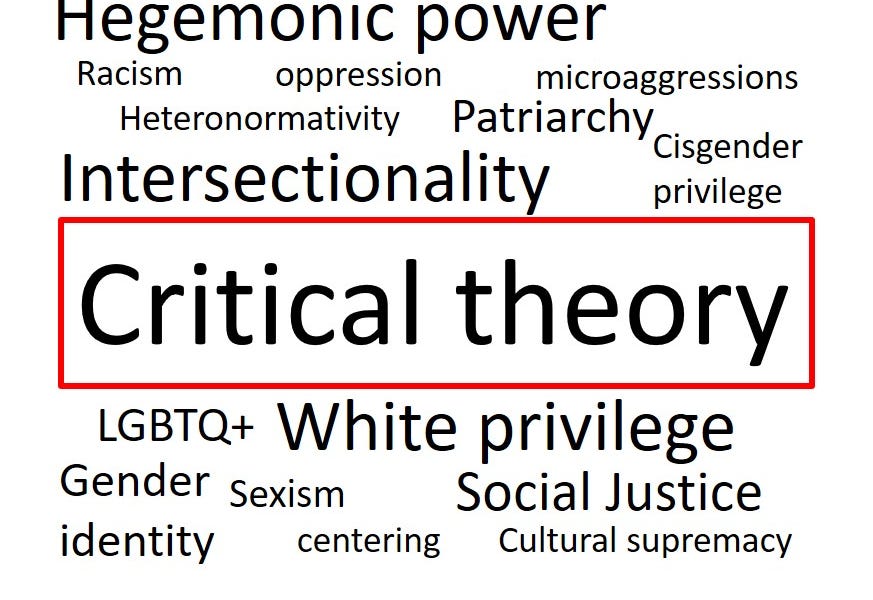
The technical name for wokery is Critical Constructivism. It is the popularisation of Critical Theory. I have labelled it Post-Enlightenment Progressivism, as it rests on critiques of The Enlightenment, and rejection of Enlightenment values, while orienting itself towards an imagined future — one where it is no longer true, as Marx and Engels wrote in The Communist Manifesto (1848), that society is based:

    on the antagonism of oppressing and oppressed classes.

That is, of oppression as they define it.

Wokery is the currently dominant form of left-progressivism. Political scientist Eric Kaufmann defines “wokery” as:

    making sacred of historically marginalised race, gender and sexual minorities.

That is how the Oppressor/Oppressed template that Critical Theory takes from Marxism is popularised in a post civil rights world, using any differences in outcomes between groups as markers of oppression. The Oppressor/Oppressed template requires oppression to be pervasive in contemporary societies, hence psychologist Steven Pinker’s observation about progressives hating progress.1

What wokery also is, is lazy self-righteousness. The self-righteousness is obvious and pervasive. These folk really do act as if they own morality; as if they can withhold the moral grace of their presence from the wicked, from wrongthinkers; as if wrongthinkers are purveyors of moral pollution. This has much to do with the dwindling of the culture of public debate.

But it is also lazy, in that it massively economises on the use of information and intellectual effort. Much of the appeal of “wokery” comes from how remarkably little accurate knowledge it demands. All one has to do is to master the lingo, the linguistic signalling, involved; the pre-set talking points; which terms of moral abuse apply and when; and be willing to engage in any required level of rationalisation and mental gymnastics. Once you do so, the moralised status game of lazy self-righteousness is open for you, with approved positions lined up for one to adopt, all based on semblances of knowing.

This dynamic has much to do with why one side of US politics is far more conformist in its political opinions than the other.

The underlying blank slate views about humans means you don’t have to accept any constraints from evolutionary biology. If we are all blank slates, if there are no inherent differences between groups, then all inequalities between groups can be classed as malicious — as signs of oppression — so you do not have to bother exploring differences in traits, cultures, life-strategies, etc.

Lazy self-righteousness does not require any thinking about successful and unsuccessful life strategies, about what makes things work, or not work. It does not require much in the way of statistical or mathematical understanding. The most mathematical it gets is whether social outcomes are proportional to a group’s population share or not.

If a group is doing better than average, they are oppressors. If they are doing worse, they are oppressed. Viewing society through the oppressed/oppressor mindset always ends up looking for (and finding) kulaks.

It is a simple metric to adopt, with the self-righteous status game built-in of opposing oppression and supporting the marginalised. No further intellectual effort is required.


  1. Pinker’s observation that populism is a phenomenon of older voters has not worn well. Also, it is a sign how reflexive future-orientated judgements have become, that the voters with the most experience of the EU were most likely to vote against it in the 2016 Brexit referendum passes people by.

The ritual humiliation of ordinary Canadians through “land acknowledgements”

Filed under: Cancon, Government, History, Politics — Tags: , , — Nicholas @ 03:00

On the social media site formerly known as Twitter, Tom Marazzo explains his objections to the ever-expanding use of “land acknowledgements”:

Let me break this down clearly so you can better understand why these mandated Land Acknowledgements are offensive to me.

They imply inherited guilt
A Land Acknowledgement usually frames the land I live and work on as “stolen”. Even if it does not say the words directly, the message is that I am benefiting from a theft. I served my country for 25 years, I have paid my taxes, raised my family responsibly, and built a life honestly. It cuts against my sense of fairness and justice to be told I must carry guilt for actions taken by people hundreds of years ago. I will not accept accountability for the past when I had no part in it.

They ignore my contribution
I have invested decades of service in the military, in my education, in my community, and in my family. These acknowledgements do not recognize those sacrifices, nor those of my ancestors who also built and defended this country. Instead, they imply my very presence is illegitimate. That denies the legitimacy of my life’s work and my family’s role in helping build this nation.

They make reconciliation into a ritual of shame
A healthy society should face the past with honesty. But what I see is not dialogue or shared responsibility. It is a scripted performance that demands I accept a label like “colonizer”, whether or not it reflects who I am. Rather than bringing people together, it divides by assigning one group permanent guilt and another permanent victimhood. That is not reconciliation. It is coerced shame.

They erase complexity
History in Canada is complicated. Many settlers and Indigenous peoples lived, worked, and fought together. There were injustices, but also cooperation, intermarriage, and shared struggles. Long before Europeans arrived, Indigenous groups also fought among themselves, sometimes brutally, with violence and cruelty toward rival tribes. No group in history is free from wrongdoing. Yet the Land Acknowledgement format reduces this reality to a one-sided story of “oppressors vs. oppressed”, which is neither fair nor accurate.

They are being mandated
Perhaps the strongest reason I find them offensive is that these acknowledgements are not voluntary. They are imposed in workplaces, schools, and public events as if they were civic duties or loyalty oaths. Refusing to participate often brings social or professional penalties. That strips away personal agency and turns what could have been a gesture of respect into a forced confession.

So my reaction is not irrational. These acknowledgements conflict with my principles of fairness, personal responsibility, and earned legitimacy. They demand I accept guilt I do not bear, while ignoring the contributions my family and I have made. They also erase the truth that no people, Indigenous or otherwise, lived without conflict or wrongdoing in the past.

The first time I encountered a “land acknowledgement” in person was at my son’s university graduation ceremony. I assumed, as the university had a major First Nations study program, that this was something only done there … but now it’s hard to find any public gathering in Canada that doesn’t have the opening cultural cringe and ritual humiliation ceremony to start the event.

September 30, 2025

“San Francisco [is] a sort of market-segmented scheme [extracting] the basic comforts of civilization and licensing them back as upgrades”

Filed under: Health, Politics, Quotations, USA — Tags: , , , , , , — Nicholas @ 03:00

On the social media site formerly known as Twitter, Devon Eriksen describes the very comfortable lives of the very wealthy, who can support any kind of luxury beliefs because they never have to face the consequences that “the poors” who ape them do:

Dear sir,

I am not a filthy poor, and therefore conditions on the street level in Portland do not matter to me.

I drive my Jaguar to nice restaurants, give it to the valet to park, then go inside and order a fancy treat. So long as the valet parks my car, and the waiter brings my fancy treat for me to consoome in peace, I am utterly unaffected by conditions ten blocks away.

While I am technically forced to acknowledge that other humans exist — otherwise who would park my car or prepare my fancy treat? — I am not actually forced to consider what their lives are like.

And if you try to force me to confront this, I will simply point out that you are a filthy poor, who is unable to live a lifestyle that insulates you from this sort of unpleasantness.

At which point I don’t have to pay attention to you, loser.

Okay, here’s what’s really going on.

At a recent gathering in San Francisco, I listened to the tech bros I was dining with and their complaints about spending a million dollars a year on security teams, and a thought occurred to me, which I shared with the congregation.

I observed that San Fransisco, and perhaps other cities as well, seemed to be a sort of market-segmented money extraction scheme whereby the basic comforts of civilization are systematically removed from the environment, and then licensed back as upgrades to those who can afford them.

In Tennessee, it doesn’t cost me a thing to not be murdered for what I write online. Sure, I have a metric fuckton of extremely high-powered weapons and the skills to use them, but let’s be honest … I own them on principle, not because I would be murdered without them.

In SF, saying right-of-center things online while not being murdered costs a million dollars a year.

It probably costs slightly less than that to have zero drugged-out and/or schizophrenic bums urinating on your porch, but again, in Tennessee, this is a free service that comes with the “Western Civilization” package.

Also, it doesn’t cost anything go to a drugstore where nothing is locked behind glass, and be told “have a nice day” by someone at the register who actually means it.

And I’m told there is some sort of mythical beast called “graffiti”, but I have to go online to find out what it looks like.

In short, the argument that “civilization is just fine because I can still buy my way out of trouble” doesn’t hold any water, because it ignores the fact that you have to buy your way out of trouble, because civilization is shrinking.

You can’t have civilization without ass-kickings.

And if you forget that, you start having to buy your way into ever more and more exclusive clubs where the uncivilized can’t afford to go.

Until they figure out that they don’t have to pay, they can just push their way past the doorman. At which point you must be prepared to kick ass again.

All civilization rests on pillars made of violence. You are in danger until the moment you understand this.

Chris Bray also responded to the Nicholas Kristof take:

Now, here’s the hugely respectable New York Times columnist Nicholas Kristof, a very important Pulitzer Prize recipient, explaining from the heights of his journalistic perch what’s really happening in Portland:

This is as flawless a summary of the progressive cathedral classes as you could possibly manage: “‘Hell’ does not serve Pinot Noir this good”.

  1. Portland street journalist: Portland is a public graveyard
  2. Progressive New York Times columnist: Akshully, the Pinot Noir is exquisite

It’s time to shove these people onto a barge and tow them out to sea.

Like Karen Bass describing the open-air drug market of MacArthur Park as a sylvan paradise full of happy children and wonderful families having picnics, Oregon Governor Tina Kotek explained this week that Donald Trump is bizarrely intervening in a utopia, and for crying out loud look at this facial expression:

No one has ever been more lost than this. Your average good urban liberal is more insane than a psych ward full of psychotics. Akshully, the Pinot Noir is delightful. We are burdened with the existence of high-status people who have departed from earthly reality, and we can’t afford them.

Update, 1 October: Welcome, Instapundit readers! Please do have a look around at some of my other posts you may find of interest. I send out a daily summary of posts here through my Substackhttps://substack.com/@nicholasrusson that you can subscribe to if you’d like to be informed of new posts in the future.

QotD: The modern cult of “victimhood”

Filed under: Law, Politics, Quotations, USA — Tags: , , , — Nicholas @ 01:00

It is the idea of “victimhood”; the idea that a man is not responsible for his acts; that he is instead a victim of the oppression of some abstraction called “society” — because he is black, or on welfare, or whatever. And everyone who isn’t can be held guilty, regardless of how they have actually behaved.

Oppressed by whom?

Oppressed, actually, by the implied permission that is granted in advance, to looters, and rapists, and thugs, and amateur neighbourhood terrorists, by that very satanic idea of victimhood, and its practical corollary, that if you can play the victim, you can manoeuvre yourself into a position to victimize everyone around you.

David Warren, “Bad Gumbo”, DavidWarrenOnline, 2005-09-03.

September 26, 2025

John Carter revisits the cancellation debate

Filed under: Media, Politics, USA — Tags: , , , , , , , — Nicholas @ 05:00

As part of a much longer essay, covering a lot more ground, John Carter considers the pro and con arguments for the much-cancelled right to fully indulge in cancelling figures on the left in the wake of the Charlie Kirk assassination and the widespread celebration of the murder by leftists:

Talking heads on network television are whining that it’s getting out of hand, while abruptly unemployed leftists take to GoFundMe to beg for support.

The purge has started, and yes, thank you, I’m feeling quite vindicated right now.

Repeating myself is boring, so I’m not going to rehash the arguments in favour of turning cancellation against the left. Suffice to say, they have it coming. It’s also worth pointing out that there’s an important distinction to be made between getting a labourer fired because he made the OK sign, and removing a medical professional who openly celebrates the death of a man for having opinions shared by half the country. Can a bloody-minded leftist doctor be trusted to give medical care to a Trump voter, when he’s on the record as advocating the execution of Trump voters? The doctor should certainly be allowed to say what he pleases, and he should have the same right to use a social media account as anyone else, but he probably shouldn’t be allowed to practice medicine.

But I don’t want to rehash that. Instead, I want to focus back in on human water fountain women as an exemplar of that choir of liars suddenly singing hymns to the sacred practice of freedom of speech. People would be shocked by this self-serving mendacity if long experience had not accustomed them to it.

We aren’t shocked because we’ve seen this before, repeatedly. The left screamed about the spontaneous unguided tour of the capitol on J6 as an insurrection and an unforgivable attack on our democracy, conveniently forgetting that the Weather Underground were bombing federal facilities, including the Capitol, back in the 70s, or that the state capitol of Wisconsin was occupied by protesters in 2011 … or that they’d attacked the White House in 2020 … to say nothing of the nation-wide Burning Looting and Murdering they committed in the wake of Floyd’s fentanyl overdose.

The curious phenomenon of leftist narrative blindness was repeatedly demonstrated during the COVID years, in which the entire professional-managerial caste would switch from one narrative to its opposite like a school of fish, confidently proclaiming on one day what they had denounced as anti-scientific misinformation just the day before.

Sure enough, in the wake of Kirk’s murder, with his blood still on the ground and their gleeful cries ringing in the world’s ears, the left went on an immediate disinformation counter-offensive. They adopted the narrative that Tyler Robinson was a right-wing groyper – an online follower of Nick Fuentes – who had assassinated Kirk for not being based enough, or for supporting Israel, or something. It was for lying about this that Kimmel was pulled off the air. The evidence for Robinson’s right-wing sympathies were that he’d been raised in a conservative Mormon household by a police officer father, and that he’d dressed up as a gopnik once or something. Robinson’s live-in relationship with a troon, the Antifa slogans he’d carved into the bullet casings, and his friends and family attesting to his left-wing radicalization were waved away. This is what abusive narcissists do: “I didn’t do the thing you just saw me do to you, and anyhow you deserved it”. Sure enough, as I wrote this, another leftist sniper attacked an ICE facility in Dallas; sure enough, leftists immediately began insisting that he couldn’t possibly have been a leftist, this time on the grounds that the shooter inscribed “Anti-ICE” rather than “Fuck ICE” on his bullets.

The left also tried to change the conversation to the supposed problem of right-wing violence. Professional-looking infographics flooded onto social media, pushed by Alex Nowrasteh of the Cato Institute, Ilhan Omar, and the Economist.

Ilhan Omar (note that the data are from the ADL).

The infographics make it look like there’s an epidemic of right-wing political violence being waged against a peaceful, tolerant, and defenceless left. This is of course nonsense. Every time someone dug into their data, it turned out that they were basically doing this:

It isn’t even necessary to subject the datasets to close scrutiny. Look at the Economist graphic. See that little black rectangle in 2020? The Economist would have you believe that there was practically no left-wing political violence at all in 2020, which as everyone remembers was a fiery but mostly peaceful year. The Economist dataset turns out to have been curated by an Antifa activist, by the way, which I suppose makes the Economist an affiliate of an international terrorist organization, now.

Now, you can say “they’re just lying”, and yes, quite a few of them know exactly what they’re doing.

[…]

In a lot of cases, however, calling them “liars” isn’t quite accurate. Lying implies conscious deception. If you’ve talked to these people, which I know you have to the point where you have post-traumatic stress disorder, you know that they seem to really believe the things they say. It does not matter in the slightest if they contradict the thing they said yesterday. They apparently have no memory of their previous statements. Their present belief is always entirely sincere. It does not matter if observable reality is in stark contradiction to their belief. They have lost the ability to distinguish between fact and fiction, with the result that they routinely mistake their own pop culture propaganda for reality.

That they do not even seem to notice when they contradict themselves suggests a void of self-awareness. This is the origin of the NPC meme, which depicts leftists as Non-Player Characters, effectively no more than computer programs that emulate human behaviour. When the meme first began to spread a few years ago, there was a purge of Twitter accounts that posted it. The NPC meme cut leftists to the quick because they instinctively recognized – as everyone did – the truth in it. Leftists complained that the NPC meme was dehumanizing, which is actually perfectly correct. An NPC is not really human.

We see evidence for this NPC absence of self-awareness everywhere. A self-aware person who had spent a decade viciously persecuting anyone who publicly contradicted leftist orthodoxy would understand that an appeal to freedom of speech once they themselves were persecuted for their words would garner mockery rather than sympathy. A clever Machiavellian would therefore preface their entreaties with expressions of contrition for their past behaviour, however insincere. Not one of them has done this, which makes it less likely that their attempt to appeal to freedom of speech is mere calculated cynicism. It is instead as though they themselves are not aware of their own previous actions.

September 24, 2025

Zardoz: A Technocratic Parody

Filed under: Britain, Environment, Media — Tags: , , , , , , , — Nicholas @ 02:00

Feral Historian
Published 30 Jun 2023

After another viewing, I now think of Zardoz as an unintentional parody of the technocratic mindset that was congealing in the 1970s. It’s a strange film, a sometimes tedious film, but it’s worth a look if only because there’s nothing else quite like Zardoz.

I keep saying “Immortals” when I mean “Eternals” and I had to recut this one a bit due to some semi-random copyright issues so I apologize for any perceptible jank.

The tip jar at Ko-Fi helps keep Feral Historians in the woods and off the streets.
🔹 Ko-Fi | ko-fi.com/feralhistorian

September 22, 2025

Materially well-off but downwardly mobile

Filed under: Media, Politics, USA — Tags: , , , , — Nicholas @ 05:00

Rob Henderson considers the plight of an entire generation of kids raised in privilege, but economically incapable of improving or even barely maintaining their material condition … the downwardly mobile children of wealthy parents:

“Free Palestine/Anti-Israel protest” by Can Pac Swire is licensed under CC BY-SA 2.0 .

For generations, Americans assumed that their children would live better than they did. Today, that assumption no longer holds. In fact, the higher your parents’ income, the less likely you are to match it.

According to The Pew Charitable Trusts, fewer than four in 10 children born into the richest fifth of households stay there; more than one in 10 fall all the way to the bottom fifth. Similarly, a 2014 study in The Quarterly Journal of Economics found that while 36.5 percent of children born to parents in the top income quintile remain there as adults, 10.9 percent fall to the bottom quintile.

Sociologist Musa al-Gharbi, in his 2024 book, We Have Never Been Woke, argues that this downward mobility of children born into wealth is the psychological engine of contemporary politics. This may look like a trivial problem — the petty disappointments of a small slice of America — but the unhappiness of this group, raised to expect the world and denied it, has outsize consequences.

To be clear, this cohort has never faced genuine poverty. Still, they have experienced the sting of loss: They came of age after the Great Recession, watched job security fade as the digital economy made their skills obsolete, and learned that highly coveted jobs in academia, media, and politics were far fewer than promised. These disappointments, al-Gharbi writes, helped power the Great Awokening. Many disillusioned strivers aimed their anger at the system they believed had failed them, and at the lucky few who did manage to retain or enhance their class position.


Unlike the working classes they so often claim to represent, these downwardly mobile elites remain armed with the tools of their upbringing: degrees, contacts, cultural fluency. They may no longer have the bank accounts their parents did, but they retain platforms in media, academia, and politics through which to broadcast their grievances. Given these advantages — or perhaps the right word is privileges — it should come as no surprise that their concerns, which seem to the average American profoundly niche, have dominated the cultural conversation.

Some of this downward mobility is voluntary. Al-Gharbi notes that many young, college-educated people would prefer “to be a freelance writer or a part-time contingent faculty member rather than work as a manager at a Cheesecake Factory”. The dream is artistic freedom and flexible work. The reality is disillusionment when prosperity does not follow.

Such disappointment isn’t totally new. George Orwell’s Keep the Aspidistra Flying follows a Cambridge-educated poet who abandons his advertising career, squanders his inheritance, and slides into genteel poverty. HBO’s Girls replayed the same theme for a new generation: Brooklynites with cultural capital but precarious incomes, simultaneously privileged and resentful. The details change, but the shape of the story remains the same — raised in affluence, buoyed by expectation, they discover too late that their choices and the system cannot sustain them.

What is different today, however, is how the disillusion now manifests itself. When reality disappoints those raised in privilege, the gap between expectation and outcome produces rage. Behavioral economics has long recognized this dynamic: Satisfaction depends less on objective conditions than on whether outcomes match or exceed expectations. And today, those expectations are far from being met.

Two years before Girls ended, sociologist Lauren Rivera, in her book Pedigree, found that graduates of lesser-ranked colleges who landed jobs at elite firms were far happier than Harvard and Stanford graduates who landed the same jobs. The reason was simple: Those jobs exceeded the expectations of the former, while for the latter they fell short. The higher the expectation, the sharper the disappointment. The harsh reality, then, is that privilege itself can encourage feelings of decline. When you’re born to — and surrounded by — overachievers, even respectable achievements can feel second-rate.

In a 2018 study, Duke sociologist Jessi Streib explored why many middle-class kids falter in school and work. Her finding was counterintuitive: Entitlement often dragged them down.

It’s not too hard to see why. Success in school requires showing up, meeting deadlines, and tolerating authority. Success at work requires completing projects on time, absorbing criticism, and cooperating with colleagues. Yet the downwardly mobile, Streib found, were often convinced such requirements were beneath them. Their grandiosity and defiance hastened their slide.

Elite overproduction is real, and has real world ramifications …

September 21, 2025

QotD: Herbert Hoover, an epitaph

Filed under: History, Quotations, USA — Tags: , , , , , , — Nicholas @ 01:00

Hoover was a man who did everything wrong. He was the quintessential High Modernist. He was arrogant, he was authoritarian, he didn’t listen to anyone, he put no effort into pleasing people or making his ideas more palatable. He never solicited stakeholders’ opinions. He lied like a rug, constantly and egregiously. He lived his life like a caricature of exactly the sort of person who should fail at philanthropy and become a horror story to warn future generations.

But he won anyway. He started from a measly few million dollars and beat out Rockefellers and Carnegies to become the most successful philanthropist in early 20th century history. Whyte’s estimate of 100 million lives saved seems much too high; there were only 100 million people in Europe total during the relevant period. But even during his own time, people universally credited him with saving millions. And he did it again and again and again. I didn’t even have space to talk about the time he saved the Southern United States from a giant flood, or half a dozen other impressive accomplishments. Maybe the rules are wrong. Maybe all of this stuff about how authoritarian approaches never work, and you need to let the people you are helping lead the way, is all just modern prejudices, and putting a brilliant and very rich engineer in charge of a hypercentralized organization is just as good as any other way of doing things.

But even this I find less interesting than his psychology. He combined a personal callousness with a love for all humanity. When he was inspecting mines in Australia, he fired the worst-performing X% of workers. One worker begged him to reconsider – he had a family to support. Hoover raised $300 for the man’s family – a lot of money at the time! Probably more than Hoover made in a month! – but fired him anyway. In 1932, when the Bonus Army marched on Washington, Hoover was adamant that he would not give these men – poor, starving veterans – a single cent more than they were entitled to by their existing benefits. But he also instructed his staff to go around to their encampments and give them food and supplies in secret.

Sometimes his stubborness calls to mind the fictional Inspector Javert, who refuses to bend the law for any reason. In this model, Hoover sympathizes with everybody, but his honor forbids him to bend the rules in favor of underperforming employees or protesters who want more than their contracts entitle them to. But this picture of a hyper-honorable Hoover crashes into his constant willingness to lie, cheat, and bend the rules in his own favor. Sometimes his lies are for the greater good, like when he tells Britain that Germany is preparing to feed Belgium. Other times they seem entirely selfish, like his various Chinese mining scams. The best that can be said about Hoover is that if he decides a principle is involved, he sticks to it.

And this is actually really good! Again and again through the book, Hoover feels like the only person with a moral compass. When it is in everyone’s strategic interest to let Belgium starve, Hoover is the only one who is able to keep fixated on the potential human toll. When it is in everyone’s interest to let the USSR starve, only Hoover – despite his fanatical anti-communism – is able to stick to the frame where the Russians are human beings and politics is beside the point. When Americans are starving during the Great Depression …

… okay, Hoover totally dropped the ball on that one. In fact, one of his Democratic opponents wrote something about how maybe if unemployed American workers pretended to be Belgians, they could get Hoover’s sympathy. I don’t have a great explanation for this. But Hoover’s weak and inconsistent sympathies are often enough to let him outdo everyone else. Or at least, he is uncorrelated with everyone else and succeeds when they fail. Again and again Hoover is accused of treating people like numbers on a piece of paper. But if this is true, it seems to be linked to the reverse talent – the ability to remember that numbers on a piece of paper represent people, even when other people would rather forget.

I’m equally confused about Hoover’s politics, although it’s not really his fault. The whole era confuses me. The Progressives, Hoover’s own faction, seem clearly related to modern progressives. But they also give me more of a technophile, rationalist feel than their modern counterparts. Am I imagining things? If not, where did this go?

And how did Hoover so deftly merge authoritarian centralizing technocratic engineer side with his small-government individual-freedom pro-capitalism side? Maybe it wasn’t that deft? Maybe he started his life as a centralizing technocrat, then made a 180 after becoming a small-government individualist helped him dunk on FDR more effectively? But it didn’t feel that way. It felt like all of it was coming from some central set of core beliefs throughout his life.

[…]

I get the impression that Kenneth Whyte is a bit of a revisionist historian, too sympathetic to his subject to tell his story the way everyone else does. But at least in Whyte’s telling, the Hoover presidency was a great missed opportunity, or at least a fulcrum of history. If a few key economic events had been a few months off in one direction or the other, FDR might have been a footnote to history, and a four-term President Hoover might have left an indelible mark on America. Instead of a New Deal, we might have gotten a optimistic small-government technocratic meritocracy that was able to merge the best aspects of a dying frontier America with the best aspects of the industrial age.

In one of the most poignant passages in the book, Commerce Secretary Hoover fires back at his socialist critics. He points out that of the top dozen US officials – the President, VP, and ten Cabinet Secretaries – eight, including himself, had begun as manual laborers and worked their way up. That was the America Hoover was working to defend. He lost, and now we have this shitshow. But it’s hard to begrudge him the attempt.

Scott Alexander, “Book Review: Hoover”, Slate Star Codex, 2020-03-17.

September 19, 2025

What’s the next thing to be devoured on Trump’s menu? Ah, Antifa it is …

Filed under: Government, Media, Politics, USA — Tags: , , , , , , — Nicholas @ 05:00

Again leaning heavily on the social media site formerly known as Twitter, ESR has several posts on Donald Trump’s announcement that Antifa is in his crosshairs:

Next comes the part where every NGO/nonprofit implicated in funding a major terrorist organization gets a proctological exam by people with no sense of humor at all.

As I have emphasized several times in the last week: the long game in taking down a terrorist network is to smash its funding chain.

ESR’s analysis begins thusly:

Antifa has just been declared a “major terrorist organization”. Putting on my intelligence-analyst hat again, I’m going to examine its strategic options in the new political and legal conditions following the assassination of Charlie Kirk.

I’m going to start with a briefing on what Antifa is and what it does.

A reminder: Antifa is not a unitary conspiracy. It’s a cluster of horizontally-networked cells, some visible aboveground, some semi-covert, possibly some that are fully underground. By design it doesn’t have a central command.

So we’re really asking what range of behaviors Antifa cells normally choose, or can choose.

Before we can explore that we have to identify what Antifa is for and how it fits into the political ecology of the U.S.

None of what I’m about to tell you is speculation. It can be verified by reading Antifa’s propaganda and watching its behavior.

Antifa is an organization of Communists and Left-Anarchists; thus the red and black flags in the main Antifa logo. Its ultimate goal is a violent anti-capitalist revolution that will destroy American constitutional government. The Communists and Left Anarchists have agreed to argue about the shape of what comes afterwards after the revolution.

In practice, Antifa acts as willing street muscle for a range of associated Communist and Socialist organizations, most notably the DSA (Democratic Socialists of America), CPUSA (Communist Party of the USA), the SWP (Socialist Workers Party), and various SWP splinter groups.

Antifa also takes strategic direction from the left wing of the Democratic Party. My readers can make their own judgments about whether there is anything remaining in the Democratic Party other than a left wing; the answer to that question is not relevant to the rest of this analysis.

An important point is that the links between the Democratic party and Antifa are personal and deniable. They probably do not run through the Democratic National Committee. A good place for counter-terror analysts to look (and I’m sure Palantir already has this mapped) would be the politicians known as “the Squad” and their close associates.

The strategic sub-goal that was being executed when Charlie Kirk was shot was the creation of a climate of fear that would inhibit public speech by conservatives. This is an explicit goal of Antifa direct action.

Antifa’s funding is deliberately obscure. Before USAID was dismantled, a significant percentage of it was probably coming from the American taxpayer through several layers of shadowy NGOs.

It is very likely that one way or another most of its money comes from low-profile liberal dark money groups such as Arabella, the Tides Foundation, and the Open Societies Foundations.

The effectiveness of Antifa as a political actor has always depended on its ability to act as a terror instrument for left-wing American politicians while maintaining deniability that the politicians’ rhetorical hate-targeting of opponents ever cashes out as violent action.

The first major constraint on Antifa’s future behavior is that this deniability is going to be much more difficult to maintain from now on. Because while the deliberate diffusion of its structure makes legal proof that something called “Antifa” shot Charlie Kirk difficult, it also made Antifa affiliation of any left-wing assassin impossible to effectively deny.

In my next post, I will examine the consequences of this shift.

Continuing the discussion:

Mafia families don’t have membership cards.

Why am I bringing this up now? Because one attempt to head off the hammer coming down on Antifa that we’re hearing from its aboveground allies is that Antifa doesn’t exist.

It’s just an idea. There’s no central command. No common funding. No membership cards. No way to tell who’s a member and who isn’t.

The reductio ad absurdum of this bullshit is to point out that, following the argument, the Mafia cannot possibly exist. Which would be interesting news to all the people it murdered.

Historical note: there was a period when the Mafia was structurally different from Antifa in that it had a Boss of All Bosses, but the position was abolished by assassination in 1931.

In reality, when you’re dealing with a criminal or terrorist conspiracy that doesn’t have membership cards, you identify members of it the same way that other members do: by their willingness to cooperate with each other on shared projects.

And sometimes, by their participation in shared bonding rituals like a Cosa Nostra initiation ceremony or a “bash the fash” demonstration.

None of this is difficult, and it’s exactly the kind of situation that the RICO (Racketeering and Corrupt Influence) laws were written to address.

From Trump’s public statements, I’m guessing that they’re going to go right past RICO to a Foreign Terrorist Organization designation.

This won’t be difficult either. If you have any doubt that at least some Antifa chapters are funded by Chinese Communist money, you really need to get out more.

The announcement clearly didn’t come out of the blue:

Still wearing my intel-analyst hat, and have realized something.

Trump’s announcement that Antifa is being designated a “major terrorist organization” doesn’t make any sense unless law enforcement is already holding evidence that the assassination of Charlie Kirk was an Antifa op.

Otherwise, the risk of political blowback from that announcement would be way too high. Trump can be erratic, but he’s cunning about stuff like this and obviously has a shrewd sense of what he can get away with.

So, yep. The most likely scenario was the correct one. The hoofbeats really were horses, not zebras. Everybody still in denial about this is destined for more pain.

And back to the analysis:

“antifa 8973ag” by cantfightthetendies is licensed under CC BY 2.0

Continuing my analysis of Antifa’s strategic options following the Charlie Kirk assassination. These have changed yet again — narrowed considerably — following President Trump’s declaration yesterday.

The Federal Government has legal instruments that it can employ. The RICO (Racketeering and Corrupt Influence) laws were specifically designed to attack a different headless network of horizontally connected nodes — organized crime. The fact that Antifa doesn’t have membership cards or a unitary command structure isn’t even going to slow the Feds down.

I think that it’s likely the Feds will designate Antifa a foreign terrorist organization, zeroing in on Chinese Communist funding of some Antifa chapters. This will allow the direct use of the CIA, which is normally heavily restricted from operations on American soil.

Nothing Antifa itself can do as an organization will be able to prevent or deflect a massive multi-agency investigation. It is very likely that Palantir already has their core membership identified and their communications channels mapped. Fusion centers will be capturing an unknown but probably large percentage of Antifa message traffic.

(They’ll be helped by the fact that Antifa’s communications security is terrible — it uses Discord for most comms, which is strictly amateur-hour. To be fair, the inner membership is likely to be savvy enough to be using Signal.)

Antifa’s only hope is pressure by its aboveground allies in politics and media. The cells with intelligent leaders will understand that they must cease all direct actions in order to avoid putting those allies in any position of appearing to support assassinations.

Unfortunately for Antifa, in order for hunkering down to work, every single cell has to have leadership that is both strategically patient and capable of restraining its more mentally unstable footsoldiers.

A related problem is that subversive and terrorist organizations that don’t act tend to develop morale problems. A certain minimum level of satisfying violence is required to keep their troops engaged.

Antifa probably has a worse issue here than the average terrorist organization because they recruit so heavily from sexual deviants and borderline mental cases who are likely to have other MBD-related issues including impulsivity and high time preference.

Over time, external pressure for Antifa to look easy for its aboveground allies to defend will remain steady or increase. This is especially so if the Democratic Party line remains Joe Biden’s “Antifa is just an idea”.

At the same time, internal pressure for direct action will increase. Antifa’s survival may depend on how long it is able to manage that pressure.

Antifa needs the investigation to be stalled out and paralyzed by Democratic lawfare before its stupidest cells do something too public and violent for its allied mainstream media to willfully ignore or suppress.

Longer-term, if Antifa survives, it faces a different problem. It dreams of revolution, but is only capable of operating on the sufferance of a general public that largely dismisses it as a LARP for nose-ringed freakazoids. Having committed a gaudy murder of an Everyman figure, it is not likely to get that sufferance back.

After the Charlie Kirk assassination, here are three possible futures

Filed under: Government, Media, Politics, USA — Tags: , , , — Nicholas @ 03:00

On the social media site formerly known as Twitter, ESR lays out what he sees are the three most likely short-term futures for the United States after the assassination of Charlie Kirk:

I’m a student of history. Here are three possible futures following the assassination of Charlie Kirk. They’re based on historical examples of what happens when a Communist subversion campaign or insurgency overplays its hand and triggers broad popular resistance.

1. Popular revulsion against aboveground leftists celebrating the murder gives the Trump administration political cover to go after Antifa and its shadow funding network hard. Both are smashed.

Communist agents of influence in the mainstream media and academia continue to self-discredit.

Relatively few Communists are arrested, but their millions of aboveground tools become isolated and demoralized.

Propelled by a huge swing in voter registrations that we are already seeing happen, the Democrats get crushed in the 2026 midterms.

The long period of fever, madness, and Left ascendancy that began with the assassination of JFK by a Soviet agent in 1963 ends not with a bang but with a whimper.

This is the best case scenario for everybody, including the Communists who don’t get thrown out of helicopters or shot down in the streets.

If things don’t go this way it will likely be because Democratic lawfare prevents the counter-subversion push from being fully effective. An obvious index of this failure would be another high-profile political assassination or attempt against a conservative target after about 4 months out.

What happens in the event of that failure, especially if the third public attempt to kill Trump succeeds:

2. A period of Caudillismo. A charismatic strongman rides popular anger into power. If this happens, the Left better pray that the strongman is an infuriated JD Vance, because any alternative to him is likely to be worse for them.

The crackdown against the Communist network becomes brutal and routinely uses extra-Constitutional means, possibly thinly covered by a declared state of emergency.

At the harder end of this range of possibilities, right-wing death squads not exactly formed by government but winked at by it go after Communist public figures that are out of reach of the law because they’ve carefully preserved deniability. Many journalists are at the top of this target list.

It is not likely that the Communist network can survive this future. The only way it happens is if they have enough popular support to develop a semi-militarized resistance — in effect making certain parts of the country no go regions for Federal agents.

Going by historical precedents, the index of this failure would be a resurgence of banditry by armed groups, initially with overtly political goals but decaying into general predation.

This would land us at:

3. Low-grade civil war, a la Bosnia or the Irish troubles. Anybody wishing for this has no idea how bloody, ugly, and brutal it would probably be. Especially if the Left succeeds at what it will with absolute certainty try to do, which is racialize the conflict.

I don’t think there is any realistic scenario in which the Communists win any of these confrontations. Not in the U.S., not in the 21st century. The question is how much blood and agony the rest of us will go through before they are finally defeated.

Update, 20 September: Welcome, Instapundit readers! Please do have a look around at some of my other posts you may find of interest. I send out a daily summary of posts here through my Substackhttps://substack.com/@nicholasrusson that you can subscribe to if you’d like to be informed of new posts in the future.

« Newer PostsOlder Posts »

Powered by WordPress