Quotulatiousness

January 11, 2026

Iran in the news

Filed under: Media, Middle East, Politics, Religion — Tags: , , , , , — Nicholas @ 03:00

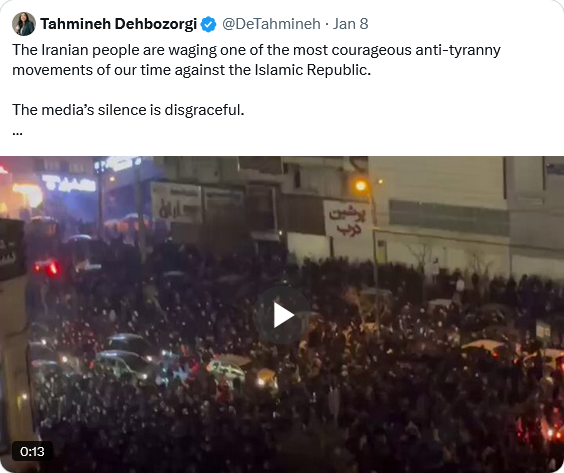
There’s a major upheaval going on in Iran, but the western media seem to be incapable of covering it with any depth — or in far too many cases, at all — even though it’s exactly the sort of thing they used to be very interested in. On the social media site formerly known as Twitter, Tahmineh Dehbozorgi provides useful context:

The Western liberal media is ignoring the Iranian uprising because explaining it would force an admission it is desperate to avoid: the Iranian people are rebelling against Islam itself, and that fact shatters the moral framework through which these institutions understand the world.

Ideally, to cover an uprising is not just to show crowds and slogans. It requires answering a basic question: why are people risking death? In Iran, the answer is simple and unavoidable. The people are rising up because the Islamic Republic of Iran has spent decades suffocating every aspect of life — speech, work, family, art, women, and economic survival — under a clerical system that treats liberty as a crime. There is no way to tell that story without confronting the nature of the regime.

Western media refuses to do so because it has fundamentally misunderstood Islam. Or worse, it has chosen not to understand it.

Islam, in Western progressive discourse, has been racialized. It is treated not as a belief system or a political ideology, but as a stand-in for race or ethnicity. Criticizing Islam is framed as an attack on “brown people”, Arabs, or “the Middle East”, as if Islam were a skin color rather than a doctrine.

This confusion is rooted in historical illiteracy. Western liberal media routinely collapses entire civilizations into a single stereotype: “all Middle Easterners are Arabs”, “all Arabs are Muslim”, and “all Muslims are a monolithic, oppressed identity group by white European colonizers”. Iranians disappear entirely in this framework. Their language, history, and culture — Persian, not Arab; ancient, not colonial; distinct, not interchangeable — are erased.

By treating Islam as a racial identity rather than an ideology, Western media strips millions of people of their ability to reject it. Iranian protesters become unintelligible. Their rebellion cannot be processed without breaking the rule that Islam must not be criticized. So instead of listening to Iranians, the media speaks over them — or ignores them entirely.

There is another reason the Iranian uprising is so threatening to Western media is economic issues.

As you know, Iran is not only a religious dictatorship. It is a centrally controlled, state-dominated economy where markets are strangled, private enterprise is criminalized or co-opted, and economic survival depends on proximity to political power. Decades of price controls, subsidies, nationalization, and bureaucratic micromanagement have obliterated the middle class and entrenched corruption as the only functional system. The result is not equality or justice. It is poverty, stagnation, and dependence on government’s dark void of empty promises.

Covering Iran honestly would require acknowledging that these policies are harmful. They have been tried. They have failed. Catastrophically.

This is deeply inconvenient for Western media institutions that routinely promote expansive state control, centralized economic planning, and technocratic governance as morally enlightened alternatives to liberal capitalism. Iran demonstrates where such systems lead when insulated from accountability and enforced by ideology. It shows that when the state controls livelihoods, non-conformity becomes existentially dangerous. That lesson cannot be acknowledged without undermining the moral authority of those who advocate similar ideas in softer language.

Western liberal media prefers not to hear this. Acknowledging it would require abandoning the lazy moral categories that dominate modern discourse: oppressor and oppressed, colonizer and colonized, white and non-white. Iranian protesters do not fit. They show that authoritarianism is not a Western invention imposed from outside, but something many societies are actively trying to escape.

That is what terrifies Western liberal media. And that is why the Iranian people are being ignored.

So the silence continues.

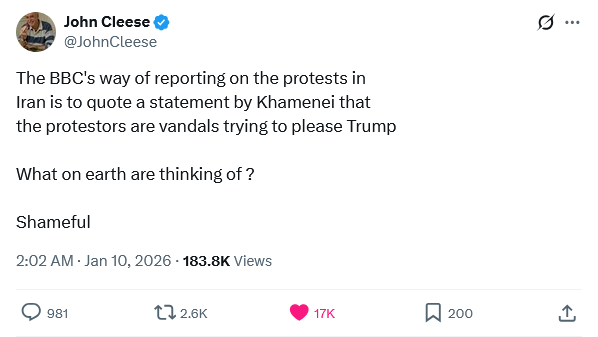
John Cleese:

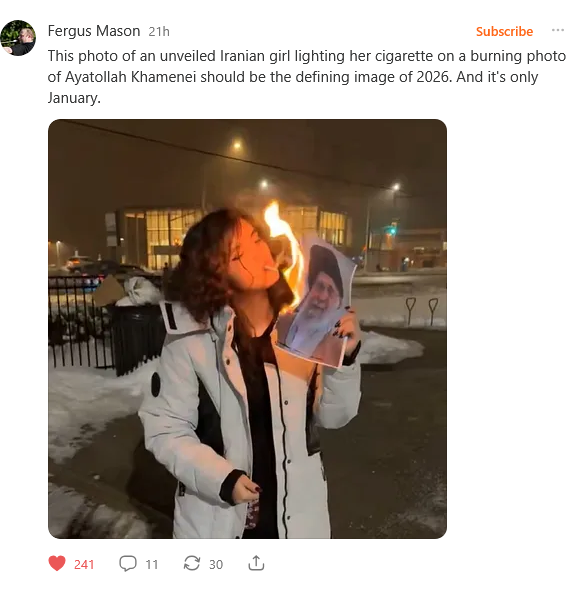
On Substack Notes, Fergus Mason shares what might be the most iconic photo of the young year:

Update, 12 January: Welcome, Instapundit readers! Have a look around at some of my other posts you may find of interest. I send out a daily summary of posts here through my Substackhttps://substack.com/@nicholasrusson that you can subscribe to if you’d like to be informed of new posts in the future.

January 7, 2026

QotD: Refuting “Limitarianism”

Filed under: Books, Economics, Media, Politics, Quotations — Tags: , , , , — Nicholas @ 01:00

The visible edge of economic populism — the slogans, the soundbites — often conceals an intellectual iceberg beneath: ideas inherited from defunct economists, or sometimes living ones. One such idea with deep roots is limitarianism: the belief that there should be a cap on personal wealth.

Thomas Piketty defines it as “the idea that we should set a maximum on how much resources one individual can appropriate”. Its most articulate modern advocate is Ingrid Robeyns, whose recent book, Limitarianism: The Case Against Extreme Wealth, calls for a global wealth cap, which she suggests could be set around $10 million per person.

But limitarianism rests on an old intellectual error. An error common not only on the Left but even among some classical liberals too: the mistaken division between “production” and “distribution”. The assumption is that production happens through economic forces and that distribution is purely political, so policymakers can reshape who gets what without damaging how much is created.

This assumption leads to the view of the economy as a fixed pie. If one person has a large slice, others must go hungry. As Percy Shelley put it in Queen Mab (1813), “The rich have become rich by the toil of the poor … they increase in wealth by the misery of the workers”. While that may describe life under socialism, it misunderstands how wealth is generated in a capitalist system.

In capitalism, you can grow rich by making the pie bigger: creating products, companies, jobs and innovations that benefit not only yourself, but millions of others. This insight was first observed by French sociologist Gabriel Tarde, and later expanded by economists like Ludwig von Mises and Friedrich Hayek. Tarde noted how luxuries eventually become necessities. His example was forks and spoons, once the preserve of the wealthy, now found in every home.

For our generation, consider childbirth. Queen Anne had 17 pregnancies, yet none of her children survived to adulthood. Today, even the poorest families in developed countries can expect their children to live. This transformation wasn’t delivered by committees or redistribution. It was driven by the freedom of innovators to experiment, often starting with products only the wealthy could afford.

As Hayek wrote in The Constitution of Liberty:

    What today may seem extravagance or even waste, because it is enjoyed by the few and undreamed of by the masses, is payment for the experimentation with a style of living that will eventually be available to many.

Mani Basharzad, “What Zohran Mamdani Doesn’t Understand about Wealth”, Foundation for Economic Education, 2025-09-30.

January 5, 2026

International law is more like International “law”

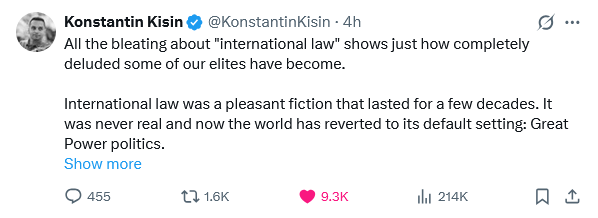
On the social media site formerly known as Twitter, Konstantin Kisin points out that calling it “International Law” gives it a semi-mythic quality that it absolutely does not deserve:

All the bleating about “international law” shows just how completely deluded some of our elites have become.

International law was a pleasant fiction that lasted for a few decades. It was never real and now the world has reverted to its default setting: Great Power politics.

This is why, as a strong Ukraine supporter, I have never talked about international law or called Putin’s attack an “illegal invasion”.

Laws are based on submission to an overarching authority backed by force. There is no such international authority and even if you view the UN as one, it does not have the ability to use force against those who violate “international law” other than against small countries with weak militaries.

When the US attacked Iraq, the UN did nothing.
When Russia invaded Ukraine, the UN did nothing.
If China invades Taiwan tomorrow, the UN will do nothing.

If you cannot enforce a law, it’s not a law.

I do not support Ukraine because naughty Vlad broke the rules. I support Ukraine because it’s not in OUR interest in the West to have Russia marauding its way through friendly countries on the borders of Europe. It’s in our interest for us to be as strong as possible and for our adversaries to be as weak as possible.

President Trump is a realist and a pragmatist. He sees through the fictions other “leaders” cling to.

A good leader advances the national interests of his country. If more Western leaders did this, our civilisation would be in a much better place.

I commented on another post that,

For a lot of people (Canadian Liberals and American Democrats in particular), the invocation “international law” has a mesmerizing effect on their ability to reason [insert usual disclaimer that if they could foresee the results of their enlightened beliefs, they wouldn’t be progressives]. They seem to have a quasi-religious belief in the UN as if it were some kind of God-given supergovernment that is always right and must always be obeyed. “World opinion” might as well be the hand of God to them, so any time the legacy media can portray the US (and Trump in particular) as going against “world opinion” they want to get out the sackcloth and ashes … or sack a city and turn it into ashes, whichever comes first.

vittorio analyzes the default position of most progressives on the social media site formerly known as Twitter:

most political issues nowadays can be explained by understanding that american leftists dont have positions, they have oppositions.

their entire belief system is defined by negation of whatever the right supports. this is why portland chants “free maduro” while actual venezuelans celebrate in the streets. they’re not pro-venezuelan or pro democracies, or pro tyrant, or pro maduro, they’re simply anti-american-right.

they’ve outsourced their worldview to institutional narratives for so long that genuine self-reflection would require questioning everything. for them it’s much easier to just oppose. the beliefs arent coherent because they were never meant to be coherent. they only need to signal tribal membership, and leftist membership is gained by opposing the right.

trump does X? the left screams and cries because they wanted Y

trump does Y? the left screams and cries and riots because even if they said they wanted Y, what they meant is that X was the way to go

trump cures cancer? they’ll argue that the cancer cells are alive have a right of free determination

trump saves lives? they’ll protest because somehow those lives didn’t matter and should have been ended

no coherent word model. no logic. pure opposition

at some point you just have to stop engaging with it as if it’s a real political position. it’s not. it’s aesthetic opposition wearing the costume of ideology

As Severian at Founding Questions often remarks, progressives’ core belief is The Great Inversion: “whatever is, is wrong”.

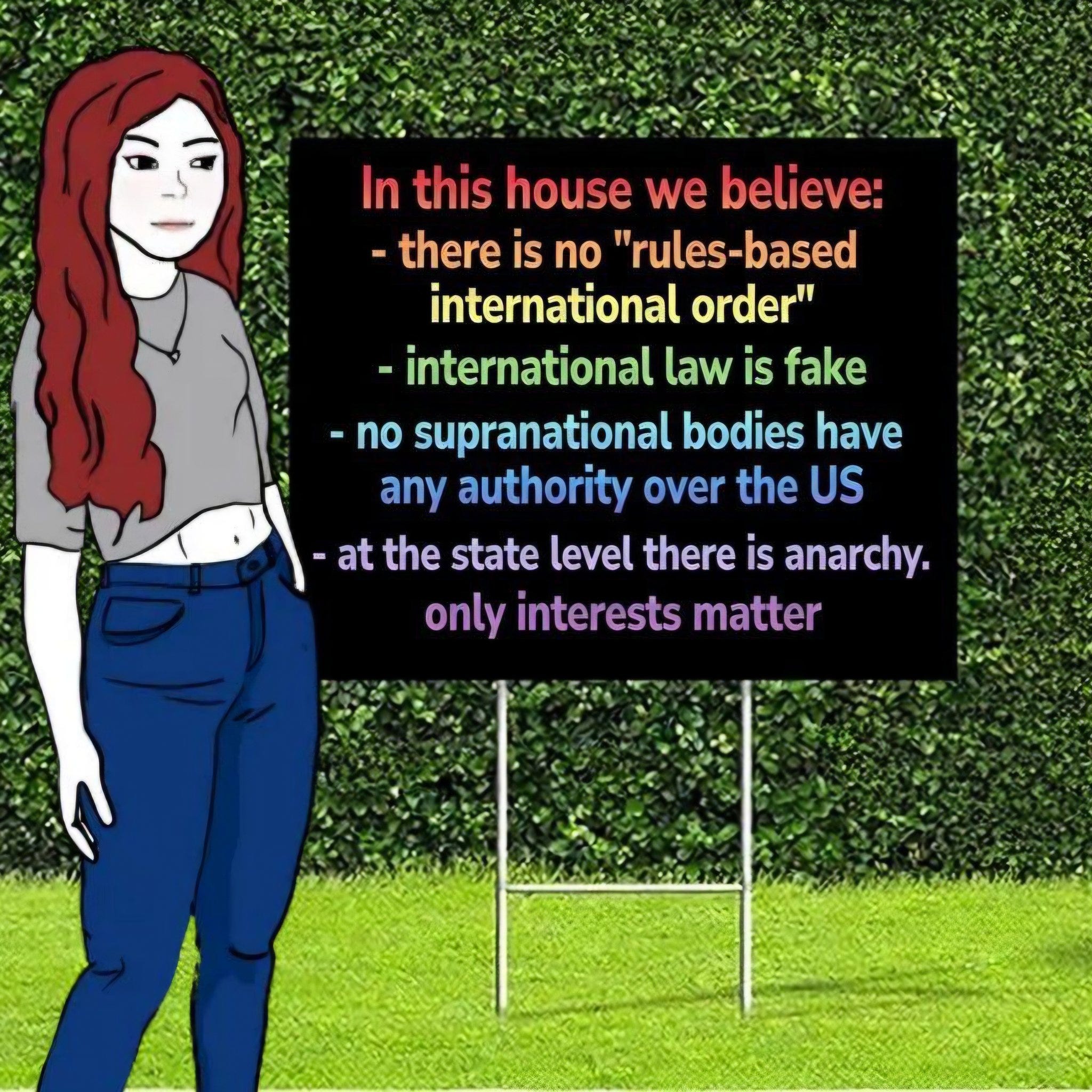
Bingo Bobbins makes the case that “International law is fake and gay”:

Was this operation necessary? Was Maduro really a “narcoterrorist”? I admit that I haven’t really been following all the drama with Venezuela recently, but my intuition is that Maduro was probably accepting bribes to look the other way with regards to drug trafficking, rather than being directly involved. And sure, he was a socialist dictator but there’s plenty of those around. The US doesn’t go and topple dictators unless there is a perceived US interest in doing so.

What Maduro was actually doing was cozying up to China. In fact, he had just finished a meeting with some Chinese ambassadors hours before Delta Force snatched him up by the scruff. This was actually a warning to China not to mess around in our hemisphere. The Trump administration is re-establishing the Monroe Doctrine, or, as he recently called in a press conference, “The Donroe Doctrine“. As far as I can see, this is completely in keeping with my preferred Vitalist Foreign Policy.

You can agree or disagree with this show of force, but please don’t whine to me about “International Law”. International Law is fake and gay. I certainly don’t care that the Trump administration “targeted a political leader”. This is the complaint being leveled by many leftists in regard to the operation. Really, this is just because leftists are anti-American third-worldists, and they are filled with butthurt because “their guy” lost. But, let’s examine this “rule” of not being allowed to target a countries rulers, because it’s particularly ridiculous.

If you have a problem with a specific country, who do you really have a problem with? You have a problem with that country’s leaders, since they are the ones making the decisions. Why wouldn’t you target the leaders? The only reason is that all the leaders from all the countries got together and agreed that they wouldn’t target each other. They would rather resolve their differences by throwing cannon fodder at each other, while keeping themselves off the table. And sure, I understand why that is great for them, but not why it would be great for me (or you).

Of course, the CIA has been ignoring this “international law” for decades, but they’ve been doing it in a very effeminate way, skulking about the world, funding Color Revolutions and clandestinely arming insurgent groups in order to subvert existing regimes. The Donroe Doctrine is much better. Imagine if the Trump administration had tried to handle Maduro the way the Obama administration tried to handle Assad. Fund a decades long civil war, accidentally establish a caliphate, fight a war against said caliphate, facilitate the deaths of tens of thousands of Christians, all to have an even worse dictator eventually rise to power.

Update, 6 January: Welcome, Instapundit readers! Please do have a look around at some of my other posts you may find of interest. I send out a daily summary of posts here through my Substackhttps://substack.com/@nicholasrusson that you can subscribe to if you’d like to be informed of new posts in the future.

January 4, 2026

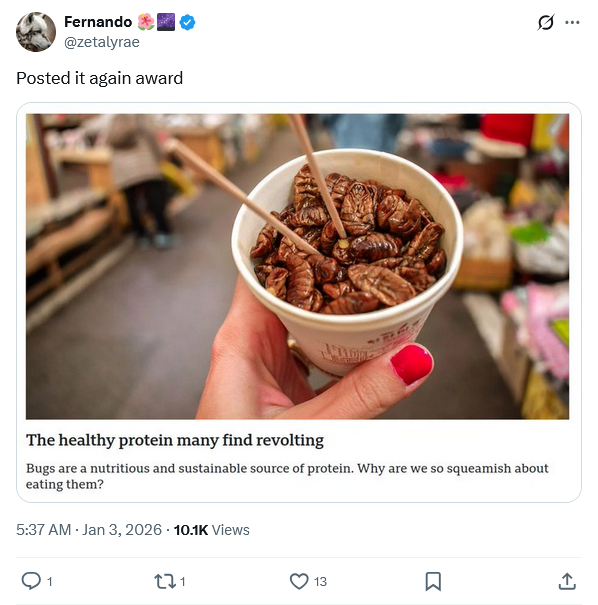
“You will eat the bugs, peasant!”

Filed under: Food, Government, Media, Politics — Tags: , , , , , , — Nicholas @ 03:00

On the social media site formerly known as Twitter, ESR reacts to yet another “bugs are yummy, peons, you are going to eat them” post:

Contemplating this picture, I had a realization about the people who want you to eat bugs.

The fact that the bugs are disgusting to you is the whole point. Enlisting you as the principal enforcer of your oppression is the program. Fucking with your head is the actual goal, not just a tactic.

It doesn’t matter whether or not Western prejudice against eating insects is irrational. In an alternate world where we routinely eat insects, the people who want you to eat the bugs would find some other kind of disgusting garbage and play to make you eat it.

Because this isn’t sustainability or any of that bullshit. The degradation is the point.

However, even the powers-that-be can’t magically create economic conditions in which insect factories earn profits:

In the renewable frenzy of the early 2020s Ÿnsect raised €600 million to “Reinvent the food chain” and pioneer alternative foods that “respect the planet’s boundaries”. Some $200 million of their funding came from hapless taxpayers somewhere. But in record time, seemingly before it began, it has already gone. Bankrupted. And not because people don’t want to eat mealworms (which they don’t) but because there wasn’t much market in making animal feed either. It turns out that farm owners didn’t want to spend 2 to 10 times as much on “sustainable” cattle fodder. So the company shifted focus to high end pet food, where besotted owners have money to spare, but that crashed too.

h/t Tom Nelson

    How reality crushed Ÿnsect, the French startup that had raised over $600M for insect farming
    By Anna Heim, TechCrunch

    The company’s demise is hardly a surprise, as Ÿnsect had been embattled for months. Still, there is plenty to unpack about how a startup can go bankrupt despite raising over $600 million, including from Downey Jr.’s FootPrint Coalition, taxpayers, and many others.

    Ultimately, Ÿnsect failed to fulfill its ambition to “revolutionize the food chain” with insect-based protein. But don’t be too quick to attribute its failure to the “ick” factor that many Westerners feel about bugs. Human food was never its core focus.

It’s only money …

    And revenue was the problem. According to publicly available data, Ÿnsect’s revenue from its main entity peaked at €17.8 million in 2021 (approximately $21 million) — a figure reportedly inflated by internal transfers between subsidiaries. By 2023, the company had racked up a net loss of €79.7 million ($94 million).

The vainglorious heady days of climate communism meant some bureaucrats thought it made sense to spend $200 million dollars feeding bugs to cows to try to change rainfall in 2100 AD.

January 3, 2026

QotD: “Fumbling towards bicameralism”

Filed under: Health, Media, Politics, Quotations, USA — Tags: , , , — Nicholas @ 01:00

“Fumbling towards bicameralism” also seems to explain one of the Left’s other signature pathologies: Their ability to “lie” to themselves, and I’m going to have to stop putting stuff in quotation marks lest I destroy my keyboard, but here again “lie” is far too weak a word. Leftist self-deception is so total, we unicameral folks can’t grasp it. They know, right? On some deep down fundamental level? If only because it’s impossible — damn it, impossible — that they don’t know. How can they keep fucking up so egregiously, in exactly the same way, every single goddamn time, and learn nothing?

And yet, “self-deception” shouldn’t be possible. How can you lie to your self? It raises all kinds of heavy epistemological issues, explored in a fun little book called Self-Deception by philosopher Herbert Fingarette. As I recall (it has been years since I’ve read it), Fingarette ends up advancing a kind of split-consciousness theory, too, as the only internally consistent one. How could it be otherwise? The “liar’s paradox” is a fun little game to play in the first class meeting of Logic 101, but nobody can really live that way … and yet we do deceive ourselves, all the time, and no one more than SJWs, whose lives indeed seem to be nothing but “self-deception.”

Bicamerality explains that. The “god” that lives in the smartphone says X today, so X it is. That same “god” says not-X tomorrow, so now it’s not-X! It’s not self-contradiction, it’s not self-deception, for the simple reason that there’s no real “self” at all.

Finally, it explains what might be the most frustrating thing about the Left, the thing that’s likely to end in a nuke or two here before too long: Their utter inability to see the glaringly obvious consequences of their actions. Those of us who tend to see “Leftism” as a big conspiracy love to point out that if they, the Left, were just stupid (childish, contrarian, herd animals, whatever), cold impersonal chance alone would guarantee that at least some of their fuckups would benefit us at least some of the time. Much like The Media’s “retractions” and “admissions” and so on, the “mistakes” always always always go in only one direction … ergo, they’re not mistakes.

That’s the reef on which we “emergent behavior” types always crash. To me, “emergent behavior” still seems like the best explanation … but however the behavior emerges, it’s always retarded. They’ve never made a non-stupid decision, not once, and it’s always stupid in exactly the same way. I remember waking up one morning to the sound of something crashing into my bedroom window. I figured it was a bird, which happens all the time, and it was … except that it kept happening, monotonously, every fifteen seconds or so. I got up to look, and here was a robin, smashing itself into the glass over and over and over again. It was early spring — mating season — and this stupid robin had mistaken its own reflection for a rival. I must’ve watched this bird slam himself into the glass for ten minutes, “attacking” his “rival”, before he knocked himself out cold …

That’s how the Left do. Always. They simply can’t learn, and they can’t change their pattern. The only explanation for that, therefore, must be that it’s programmed. Literally. Zero consciousness involved. They do what they do because they literally cannot do otherwise. Their “god” has put “rage” into their thumos. Just as Achilles would’ve literally jumped off a cliff had his “god” told him to, so the Left does … well, pretty much everything their teevee tells them to.

Needless to say, this has some important implications for practical action. How does one “get inside that OODA loop”, as the keyboard commandos like to say? In the land of the utterly unconscious, the one-brained man is king …

Severian, “Striving Towards Bicamerality”, Founding Questions, 2022-03-20.

Update, 4 January: Welcome, Instapundit readers! Please do have a look around at some of my other posts you may find of interest. I send out a daily summary of posts here through my Substackhttps://substack.com/@nicholasrusson that you can subscribe to if you’d like to be informed of new posts in the future.

December 19, 2025

The strange rebirth of English patriotism

Filed under: Britain, Media, Politics, Religion — Tags: , , , , , , , — Nicholas @ 04:00

In The Conservative Woman, Niall McCrae discusses what he calls “a new crusade” as the downtrodden English rediscover — or in many cases, discover for the first time — patriotic feelings for their nation, and earn the scorn and contempt of the ruling class and their media fart-catchers:

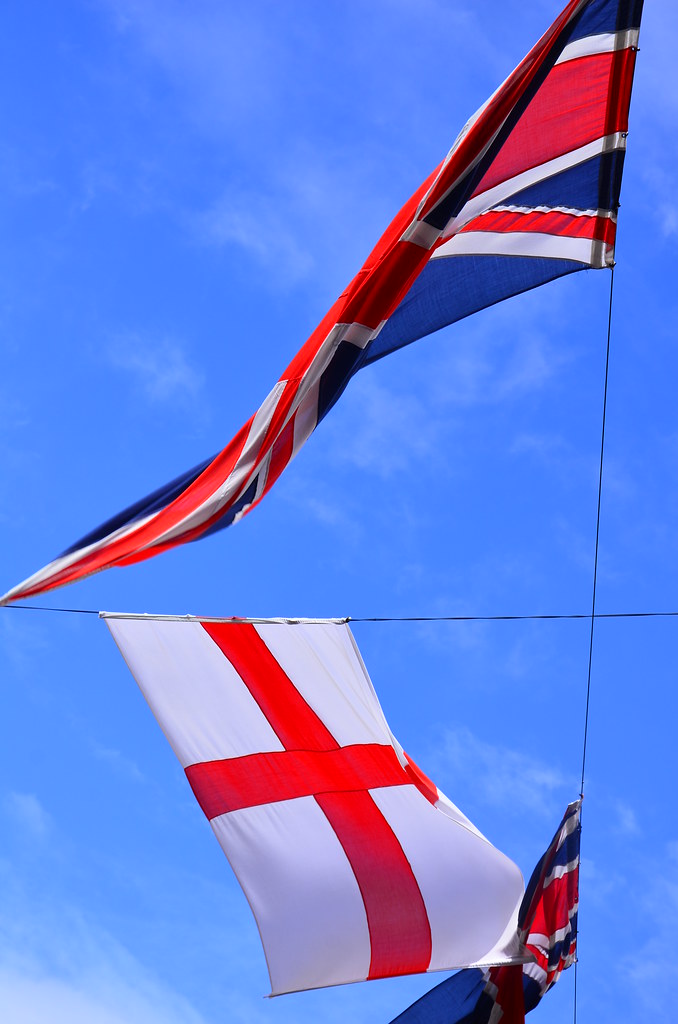
“Union Jacks and crosses of St George” by Ben Sutherland is licensed under CC BY 2.0 .

A wave of patriotism swept across England last summer. Flags were tied to lampposts up and down the country, but while these displays had wide public support, the intelligentsia were troubled, particularly as the colours were often flown in areas of cultural diversity or on roads passing hotels accommodating illegal immigrants. This suggested provocation, rather than the use of national flags to celebrate sporting success.

Politicians and Guardian commentators were careful not to appear too negative, but they emphasised unity and inclusion over nationalistic fervour. The Union Jack was preferable to the St George’s Cross, because they associated the latter more with the far right (this is not accurate, as groups such as the National Front and BNP rallied under the Union Jack).

The Union Jack (properly termed “flag” as a jack is hoisted at sea), comprises the crosses of St George, St Andrew and St Patrick. It is perhaps the most impressive flag in the world, a classic design of great cultural impact. How globalists, the EU and Islamists would like to banish it!

The “Unite the Kingdom” march led by Tommy Robinson in September, which brought a million people to the streets of London, was a marvellous spectacle of patriotism. For the counter-Jihad movement, conflict in the Middle East is regarded as an existential struggle against militant Islam. Israeli flags are often waved towards pro-Palestine marchers, and the London rally gave several Zionists a platform at Whitehall. However, the vast majority of marchers were there for one country only – their own. This was truly a British event, with a roughly equal mix of Union and St George flags, alongside some Welsh dragons and Scottish saltires, and Irish tricolours too.

Significantly, there was another symbol prominently at the London march: the Christian cross. A poignant moment was at the ramparts of Westminster Bridge, where a fearless young man mounted the head of the stone lion and from that precarious pedestal raised in one hand the flag of St George, and in the other a wooden cross. (https://www.instagram.com/reel/DOpagGvkQk9/)

I first observed the resurgence of Christian faith at the huge protests against the Covid-19 regime. Several marchers bore crosses, or placards asserting the power of God over earthly evil. The Book of Revelation was quoted, and when the “vaccine” was launched it was cast as the “Mark of the Beast”.

Socially unacceptable they may have been, but now St George and Christian crosses are regularly appearing together in gatherings for patriotic or traditional causes. In his book Worth Dying For: The Power and Politics of Flags (2017), Tim Marshall observed that “with the rise of Islam in Europe, these symbols are likely to be increasingly used by the far right to try to define the continent as what they think it is, and in opposition to what they think it is not”. You can’t get a book released by a mainstream publisher without expressing such approved outlook, but Marshall is making the mistake of blaming patriots for the devaluing of their national flag; it is surely the subversive ideology of the progressive left that has taught generations that national pride is regressive and bigoted. Meanwhile “woke” warriors are not shy of waving the Pride rainbow, transgender stripes and the flag of Palestine. And the likes of Hope Not Hate had no complaint about huge fascist-style marches awash in the blue and yellow stars of the EU.

Brendan O’Neill on the Islamophobia racket

In the National Post, Brendan O’Neill criticizes Australian Prime Minister Anthony Albanese in particular, but he’s just the most recent exemplar of western politicians trying to blame society in general and “right wing extremists” in particular for the terrorist attacks by Islamic extremists:

Australian Prime Minister Anthony Albanese spoke a total of 5,022 words in the day after the slaughter of Jews at Bondi Beach. And not one of those words was “Islam”. Or “Muslim”. Or even “Islamic extremism”.

He did talk about the “far right” though. Twice. We need to tackle “the rise of right-wing extremist groups”, he said.

What an odd thing to focus on the day after a father-and-son Islamofascist outfit had mown down 15 innocents, all while proudly displaying the black flag of ISIS.

To fret about the far right hours after suspected Islamic militants had carried out the worst slaughter of Jews in Australian history is cognitive dissonance of epic proportions.

It would be like turning up to the bloody aftermath of a KKK massacre and flat-out refusing to say the words “Klansmen”, “racist” or “white supremacist”. Well, we wouldn’t want to offend the pointed-hood community.

Some Australians were dumbfounded by the PM’s bullish refusal to name the ideology that fuelled this act of antisemitic savagery.

After all, at the time he was holding forth on the various threats to the Aussie way of life, officialdom had found the killers’ ISIS flag and other paraphernalia suggesting they had taken the knee to the death cult of radical Islam.

“What happened at Bondi was an act of radical Islamic terrorism”, thundered Sean Bell of the populist party One Nation. If the PM “cannot be honest” about the “radical Islamic ideology”, he said, “then he has no place leading the country”.

It’s hard to disagree. The first duty of a leader following the barbarous slaying of citizens is to tell the truth. If Albanese can’t even bring himself to mouth the words “Islamic extremism”, how’s he going to fight it?

The PM’s yellow-bellied dodging of the i-word was shocking but not surprising. Other Western leaders have behaved similarly in the wake of Islamist outrages. They have furiously thumbed their thesauruses for spins on the word “extremist” — fanatic, militant, evil — all so that they can avoid committing that most gauche faux pas in polite society: talking about the problems in Islam.

This is the dire handiwork of the Islamophobia industry. For years now, Islam has been ruthlessly ringfenced from free, frank discussion.

Mock Muhammad and you’ll be damned as “phobic”. Crack a joke about the Koran and you can expect a mob of fundamentalists at your front door. Say Islam has an extremism problem and the self-elected guardians of correct-think will drag you off for re-education.

We’ve witnessed the rehabilitation of medieval strictures against “blasphemy”. The end result is that even as women and children writhe in agony from the wounds inflicted on them by Islamist militants, still our leaders won’t say that i-word. It clogs in their throats. They dread cancellation more than they cherish truth.

[…]

After every attack, the same platitudes are trotted out. “Nothing to do with Islam”. “Islam is a religion of peace”. We’re gagged from naming the threat we face, from correctly identifying the men who are killing our fellow citizens.

Believe them when they show you what they are, Oz edition:

In The Line, Ariella Kimmel thinks there are signs that at least some political figures are getting the right lessons out of the events of the last few years:

In the wake of the terrorist attack in Bondi Beach, it seems as if leaders are finally starting to realize the risk of allowing antisemitic extremism to run unchecked for years.

Calgary’s new mayor offered a powerful example of what this means in practice.

At Calgary City Hall’s Chanukah celebration, Mayor Jeromy Farkas delivered remarks that stood out not only for their eloquence, but for their accountability. He spoke plainly about antisemitism and acknowledged the very real fear that Jewish communities are living with. Most importantly, he made clear that civic leadership means showing up publicly, consistently, and without excuses.

In a room of just over a thousand, he declared “let me be absolutely crystal clear. There is no place for antisemitism in Calgary. Not on our streets, not in our schools or campuses, not at protests, not online, not hidden behind slogans, not excused as politics, because Jewish lives are not expendable. Jewish safety is not expendable.”

That moment was especially symbolic given Calgary’s recent past. Two years ago, then-Mayor Jyoti Gondek refused to attend a Chanukah event amid pressure and controversy. Farkas’ presence this week marked a break from that pattern. It signalled that someone, finally, was willing to take responsibility.

That is what leadership looks like.

The Bondi Beach attack should force a reckoning in Canada. If we want to avoid becoming the next headline, this country must do more than mourn; we must decide, clearly and concretely, that extremism has consequences and that antisemitism will not be indulged.

In Canada, politicians were quick to offer condolences. Statements flowed with the standard lines – “my thoughts are with the community”, “our government condemns all forms of hate”, “no one should be targeted for practicing their religion”. The words are familiar, and quite frankly hollow, because for the past two years, many of the same leaders issuing their thoughts and prayers have either ignored, excused, or actively engaged with movements that normalize hostility toward Jews.

Since October 7, Jewish Canadians have watched as public spaces became hostile territory. Synagogues require police protection, while Jewish schools are shot at and community centres are defaced. Rallies openly glorify terrorist groups, call for the destruction of Israel, and chant slogans that any reasonable person understands as genocidal, such as calls to “globalize the intifada”, “from the river to the sea Palestine will be free”, “there is only one solution, intifada revolution”, and “resistance is justified”.

What makes the current moment particularly dangerous is the gap between rhetoric and reality among leaders. Politicians speak of fighting hate while refusing to enforce existing laws against intimidation, mischief, and hate-motivated harassment. They speak of unity while legitimizing groups and movements that openly reject the safety of Jewish communities, even giving funding through government programs meant to combat antisemitism, to organizations that perpetrate it. They issue statements condemning violence abroad while tolerating the ideological conditions that make violence inevitable at home.

December 17, 2025

“The core hypocrisy of modern Western governance”

Filed under: Australia, Britain, Cancon, Europe, Media, Politics, USA — Tags: , , , , , , — Nicholas @ 03:00

On the social media site formerly known as Twitter, Tom Marazzo discusses the extremely weird experience we’ve all lived through since 9/11 in almost every major western nation:

For more than 20 years, Western governments told their citizens that Islamist extremism posed an existential threat. Entire generations were sent to fight the Global War on Terror. Soldiers were killed, families were broken, civil liberties were curtailed, and trillions were spent, all justified by the claim that terrorism had to be stopped over there so it would not reach us here.

Then something strange happened.

The same governments that built their legitimacy on that fear now insist that even discussing the cultural, security, or integration risks associated with mass immigration from unstable regions is immoral. Raise concerns and you are no longer a citizen asking questions, but a bigot, an extremist, or a threat yourself. In some countries, speech alone now draws police attention, while violent acts are reframed as isolated incidents or stripped of ideological context.

The irony deepens when you look at the timeline.

During the first years of Covid, terrorism all but vanished from news coverage, just as Covid seemed to erase the common cold, cancer, and every other cause of death from public discourse. Nothing had disappeared. The narrative had simply changed. Attention was redirected. Fear was reassigned.

Now, as governments pursue aggressive mass immigration policies, the public is told that questioning outcomes is unacceptable, even as the very threats once used to justify war reappear domestically. The message is clear and profoundly cynical: the danger was real when it justified foreign wars, but discussion becomes forbidden when it complicates domestic policy.

This is not tolerance. It is coercion.

And now comes the final insult.

The same political class that demands silence at home is preparing to demand sacrifice abroad. The same citizens who are told to accept social breakdown, rising crime, collapsing services, and cultural fragmentation are being told they may soon be required to fight Russia to “defend our way of life”.

What way of life, exactly?

The one being systematically dismantled by the very governments issuing the call. The one they are actively transforming into something unrecognizable through reckless policy, moral intimidation, and managed decline. They are asking people to die for values they no longer practice and for societies they are actively degrading.

This is the core hypocrisy of modern Western governance.

We were told to fight, bleed, and die to defend liberal democratic values. Now we are told those same values require silence, compliance, and obedience, while our countries are reshaped without consent and against the will of the people who built them.

A government that suppresses debate at home while demanding loyalty abroad is not defending democracy. It is consuming it.

And history is not kind to regimes that ask their people to die for a future they are busy destroying.

QotD: The origins of Progressivism

Filed under: Books, History, Politics, Quotations — Tags: , , , — Nicholas @ 01:00

If you want to know what’s really going on in American and world politics, it is absolutely essential to comprehend the following sequence of events. Nothing else explains the stark insanity this country has been going through for the past couple of years. Nothing else can prepare us for what’s likeliest — and ugliest — to happen next. I claim no special expertise or knowledge — especially not the telepathic abilities that the political left so often claims to possess (“No I can’t point to anything concrete he ever said or did”, they tell us, “I just know he’s a racist!”) — I only claim an above-average understanding of history and human nature.

Vladimir Lenin, I’ll remind you, once famously said “The goal of socialism is communism”. Both are political and ethical “philosophies” based on taking stuff away from those who created it or earned it, and giving it to those who didn’t — who’ll vote for you. Collectivism, which is the generic term for both of these viewpoints and every other politic-economic scam like them, is nothing more than a pathetically transparent, sleazy attempt to make theft appear respectable. It’s always easier to take away or destroy than to create or build. Stealing from others became very popular in the first half of the 19th century (“Property is theft” — Pierre-Joseph Proudhon) when it was formalized as an ideology.

From that beginning, 170 years ago, socialists began to imagine a bright, glowing, prosperous Utopian future for themselves, based entirely on theft. With every decade that passed, their physically, logically impossible fantasies became more and more real to them. It’s like the old psychiatrist joke that the difference between neurotics and psychotics is that neurotics build castles in the air, whereas psychotics move in and live in them.

The “Progressive” movement began to really blossom in the latter half of the 19th century. They were establishing socialist colonies practically everywhere. American socialist newspaper editor Horace Greeley told his readers, “Go west, young man” and to establish socialist colonies. Looking Backward, a badly-written socialist screed by Edward Bellamy and more-talented others like H. G. Wells’ When the Sleeper Wakes and The Time Machine became immensely popular. The idea of an inevitable, unstoppable socialist “wave of the future” became popular and lasted at least until I was in college in the 1960s.

L. Neil Smith, “Why They Hate Donald Trump”, Libertarian Enterprise, 2018-12-30.

December 16, 2025

If your military embraces “Net Zero”, you’ve actually got a civil service in uniform, not a military

Filed under: Britain, Environment, Government, Military, Russia — Tags: , , , , , — Nicholas @ 05:00

In The Critic, Maurice Cousins points out the painful truth (painful that is to policians and career bureaucrats) that no serious military can prepare and carry out their prime duties if they also tout their allegiance to “Net Zero” bullshit:

Two developments explain the shift in tone. The first is the protracted US–Russia peace talks conducted largely over Europe’s head. The second is the publication of Donald Trump’s National Security Strategy, which makes explicit that Europeans must now assume far greater responsibility for their own defence. None of this should surprise anyone who has been paying attention. The Trump administration has been saying the same thing, bluntly and repeatedly, since its inauguration.

Speaking at the NATO Defence Ministers’ meeting in February 2025, the US War Secretary, Pete Hegseth, put it plainly: “To endure for the future, our partners must do far more for Europe’s defence. We must make NATO great again. It begins with defence spending, but must also include reviving the transatlantic defence industrial base, prioritising readiness and lethality, and establishing real deterrence.”

After nearly eighty years of relying on American power to underwrite their security, European leaders are being forced to relearn the fundamentals of hard power and grand strategy. It is difficult to overstate how profound a challenge this represents for both Europe and the UK. It demands a rethink across policy areas that, for decades, have been treated as marginal to national security.

Since the 1990s, Britain’s political and intellectual elite has operated within a fundamentally different paradigm. The “end of history” has become a cliché, but it is worth recalling just how deeply it shaped elite thinking. In the aftermath of the Soviet Union’s collapse, Anthony Giddens — one of the intellectual architects of New Labour — argued in The Third Way that the West no longer faced “clear-cut enemies”. Cosmopolitanism, he claimed, would be both the “cause and condition” of the disappearance of large-scale war between nation-states. The “strong state”, once defined by preparedness for war, “must mean something different today”. They believed that post-material and post-traditional values, including ecological modernisation, human rights and sexual freedom, would come to dominate politics.

For realists, this utopian worldview was always naïve. In her final book, Statecraft (2003), Margaret Thatcher warned that the post-Cold War world was far more likely to vindicate Samuel Huntington’s “clash of civilisations” than Francis Fukuyama’s progressive vision of an “end of history”, in which liberal democracy emerged as the inevitable global victor.

Clearly, the liberal internationalist illusion should finally have been shattered by Russia’s annexation of Crimea in 2014. Alas, it was not. Instead of prompting a fundamental strategic reset, Britain’s governing class doubled down on the same post-material, cosmopolitan assumptions that had shaped the 1990s and 2000s. In 2015, Europe and the UK embraced the Paris Climate Agreement. In 2019 — a year after the attempted murder of Sergei Skripal on British soil with a chemical weapon — ministers enshrined Net Zero in law and banned fracking. Each decision reflected the same belief: that geopolitics could remain subordinate to “climate leadership”, and that the material foundations of security could continue to be dismantled.

That worldview is now colliding with reality.

The US National Security Strategy contains a series of blunt truths about Europe’s condition. British commentary has focused on its remarks about culture, migration and defence spending. But one critical area has been largely overlooked: energy and industry.

The document begins from a hard material premise: that dominance in dense and reliable sources of energy — oil, gas, coal and nuclear — is essential to the ability of the United States, and its allies, to project power. From that foundation it draws a sharper conclusion, rejecting what it describes as the “disastrous ‘climate change’ and ‘Net Zero’ ideologies” that have hollowed out Europe’s industrial base while subsidising its adversaries. The result, it argues, is a defence problem that runs far deeper than military budgets. Alongside cultural weaknesses, myopic energy policy and de-industrialisation — exemplified by Germany’s recent offshoring of its chemical industry to China — are identified as anti-civilisational forces that directly erode Western hard power.

This makes Carns’s most important observation all the more sobering. While armies, navies and air forces respond to crises, he said, it is “societies, industries and economies [that] win wars”. He is unequivocally right.

On his Substack, Niccolo Soldo discusses the contents of the Trump administration’s new National Security Strategy:

Egyptian President Gamel Nassar had some choice lines to describe US foreign policy too:

    The genius of you Americans is that you never make clear-cut stupid moves, only complicated stupid moves which make the rest of us wonder at the possibility that we might be missing something.

    With the Soviet Union, you know where you stand today and where you will stand tomorrow. With the United States, you never know where you will stand tomorrow—and sometimes not even today.

    America is like a beautiful woman who changes her mind every night. You can love her, you can fear her, but you can never be sure what she will do in the morning.

And then there is this recent classic from Russia’s chief diplomat, Sergey Lavrov:

    The USA is agreement non-capable.

The point of sharing these quotes is to highlight the obvious fact that US foreign policy has long been unpredictable. This wouldn’t be too much of an issue if it were a middling power. When a superpower routinely upends the table, it makes life very, very difficult for those countries that have become “states of interest” for the Americans. Creating and pursuing foreign policy strategies require a lot of time and effort, meaning that they are very rarely predicated on short-term trends. When the predictability of foreign actors is removed from the strategic equation, the foundation of any plan becomes very weak.

Earlier this month, the White House issued its 2025 National Security Strategy vision in a 33 page .pdf document available for all to see and read here. This is an action that the US Executive Branch is mandated to do, ever since the Goldwater-Nichols Act of 1986. The point of this exercise is to articulate the vision of the President of the United States of America regarding foreign policy, so as to effectively communicate said vision to Congress and the American people. It does not mean that it is an official foreign policy strategy, since this area of governance is the responsibility of both the executive and legislative branches of the US Government.

Because this is the Trump Administration, and because of the fever pitch that has coloured both of his terms in office, a lot of attention is being given to this iteration of this mandatory document. This document is intentionally high-level (meaning that it purposely doesn’t drill down into specifics), keeping within the tradition of previous administrations. However, attention is warranted this time, because the vision outlined by President Trump per this document indicates a significant break in both the USA’s approach to and philosophical arguments regarding how and why it conducts its foreign policy. Despite the obvious Trumpist (think: transactional) touches interspersed throughout this document, what it does represent is a stated desire to break with certain idealist practices of recent administrations in favour of a more realist approach and worldview, one that stresses respect (if we accept the document at face value) for national sovereignty, and an admission that US global hegemony is simply not possible.

So what we are left with is a document that outlines a new vision for US foreign policy, one that has determined that taking on both Russia and China simultaneously is the wrong approach to securing American national interests. This makes it very worthy of closer inspection and analysis (something that I have been thinking about deeply since it was first made available to the public a fortnight ago). Before we begin to dive into it, I am asking you all to temporarily suspend your cynicism and take the strategy outline at face value for the sake of this analysis. I will once again repeat that this is not official policy, and there is a very strong chance that it will never be adopted as that.

December 11, 2025

Your words are violence to an astounding 91% of US college students surveyed

Filed under: Education, Media, Politics, USA — Tags: , , , , , — Nicholas @ 03:00

J.D. Tuccille presents some depressing poll results from American college students who have massively bought into the illogical position that words can be the same as actual violence:

Of all the stupid ideas that have emerged in recent years, there may be none worse than the insistence that unwelcome words are the same as violence. This false perception equates physical acts that can injure or kill people with disagreements and insults that might cause hurt feelings and potentially justifies responding to the latter with the former. After all, if words are violence, why not rebut a verbal sparring partner with an actual punch? Unfortunately, the idea is embedded on college campuses where a majority of undergraduate students agree that words and violence can be the same thing.

Most Believe Words Can Be Violence

“Ninety one percent of undergraduate students believe that words can be violence, according to a new poll by the Foundation for Individual Rights and Expression [FIRE] and College Pulse”, FIRE announced last week. “The survey’s findings are especially startling coming in the wake of Charlie Kirk’s assassination — an extreme and tragic example of the sharp difference between words and violence.”

The survey posed questions about speech and political violence to undergraduate students at Utah Valley University, where Kirk was murdered, and at colleges elsewhere — 2,028 students overall. FIRE and College Pulse compared the student responses to those of members of the general public who were separately polled.

Specifically, one question asked how much “words can be violence” described respondents’ thoughts. Twenty-two percent of college undergraduates answered that the sentiment “describes my thoughts completely”, 25 percent said it “mostly” described their thoughts, 28 percent put it at “somewhat”, and 15 percent answered “slightly”. Only 9 percent answered that the “words can be violence” sentiment “does not describe my thoughts at all”.

It’s difficult to get too worked up about those who “slightly” believe words can be violence, but that still leaves us at 75 percent of the student population. And almost half of students “completely” or “mostly” see words and violence as essentially the same thing. That’s a lot of young people who struggle to distinguish between an unwelcome expression and a punch to the nose.

Depressingly, 34 percent of the general public “completely” or “mostly” agree. Fifty-nine percent at least “somewhat” believe words can be violence.

In 2017, when the conflation of words and violence was relatively new, Jonathan Haidt, a New York University psychology professor, worried that the false equivalence fed into the simmering mental health crisis among young people. He and FIRE President Greg Lukianoff wrote in The Atlantic that “growing numbers of college students have become less able to cope with the challenges of campus life, including offensive ideas, insensitive professors, and rude or even racist and sexist peers” and that the rise in mental health issues “is better understood as a crisis of resilience”.

Conflating Words and Violence Encourages Violence

Telling young people who haven’t been raised to be resilient and to deal with the certainty of encountering debate, disagreement, and rude or hateful expressions in an intellectually and ideologically diverse world plays into problems with anxiety and depression. It teaches that the world is more dangerous than it actually is rather than a place that requires a certain degree of toughness. Worse, if words are violence it implies that responding “in kind” is justified.

“At a time of rapidly rising political polarization in America, it helps a small subset of that generation justify political violence,” Haidt and Lukianoff added.

December 9, 2025

The “Great Feminization” of western culture

In the National Post, Barbara Kay outlines the way society has been trending further away from traditional values and more and more toward the values of “empathy, safety, and cohesion” which have been predominantly feminine values in contrast to more male-oriented values of “rationality, risk, and competition”:

In September, public intellectual Helen Andrews caused a stir when she delivered a provocative 17-minute speech, titled “Overcoming the Feminization of Culture”, to the National Conservatism Conference, later published as an article for Compact, titled “The Great Feminization“.

Andrews summarized feminization as the prioritizing of feminine over masculine interests, but additionally prioritizing “empathy over rationality, safety over risk, cohesion over competition”. All these traits combine, she believes, in institutions where females are numerically dominant, to define “wokeness” and “cancel culture”.

Andrews points to Bari Weiss’ 2020 resignation letter from the New York Times where Weiss was labeled and ostracized for her social ties and cut off by perceived friends. In 2018, the newsroom there had tipped to a female majority which Andrews argues changed the work environment’s dynamics to one where cohesion is preferred, and covert undermining would replace open debate in favour of emotional harmony.

And I would argue that the more feminized society’s institutions become, the more readily extreme, empathic attitudes replace rational decision-making at policy-making levels, and the more society loses confidence in its ability to thrive.

Ironically, instead of directing empathy towards our own citizens, feminization also tends to direct empathy internationally. That is exactly what is happening at our national level, when our government earmarks funds for programs such as “Gender-Just, Low-Carbon, Rice Value Chains in Vietnam”.

This is also happening at a micro-level to the Jewish community in North America. Our spiritual leadership in non-orthodox synagogues is growing increasingly female, and, by no coincidence, is wokeness spreading, and, by no further coincidence, so is alignment with radical anti-Zionism.

[…]

Claims that Israel was guilty of genocide and apartheid, the authors write, were a constant feature of their education. Most shockingly, they write — and this at a rabbinical training institution headed by a female rabbi — that “the sexual violence Israelis experienced (on October 7) was never mentioned, even during Women’s History Month”.

What about the Christian clergy? A 2024 report on female Christian clergy found that in a 2018 sample, about 14 per cent of U.S. churches were headed by a senior female clergyperson. So, churches are not yet in danger of feminization. Good luck to them.

If there is a solution to the feminization-linked problem of anti-Zionism in the non-Orthodox rabbinate, I don’t know what it is. I only know this trend cannot end well for our community. What is essential in Jews’ spiritual homes now, more than ever in our history, is that they be spaces where “ahavat Yisrael” — love of Israel — is the prevailing norm. If we are not for ourselves, who will be?

On a more individual level, the Great Feminization has worked not to make women equal, but to increase their existing privileges and to demonize men who even notice the inequality now runs directly opposite to the narrative:

Image from Steve’s Substack

Over thirty years ago, I knew a woman who felt ecstatic joy taunting men with her nudity. She loved to flash her breasts at truckers on the highway. Thrilled at the thought that she left them frustrated, she would boast about her sexual power.

This is clear, unequivocal abuse. Imagine her taunting a village of starving Africans with BBQ’d steak. She then flees to her 5-star hotel, laughing and bragging that she had left them hungry and frustrated. This is how the West raises women. Self-obsessed, over-entitled and insufferable (insert obligatory, “not-all-women” clause here – yawn).

Feminists have gotten more sophisticated with their abuse since then. We now have transgressions that include absurd accusations like prolonged looking, mansplaining and manspreading. TikTokers go to the gym essentially nude in order to video and humiliate men who happen to notice.

We had the, “Yes means Yes” campaign that insists a man should repeatedly pester his partner with endless questions for permission during every intimate encounter. Never mind that a normal woman is likely to leave the bed after a few of these interruptions, rightly despising the insecure man who obeys that tripe. Anywhere outside of a deep feminist indoctrination camp, a woman will wonder whether your mother dropped you on your head as a child. I’ll bet that not even the most committed believer follows their own advice. This is not good communication — it denies healthy context, body language and facial expression.

And there’s nothing romantic about it; it is designed for feminist power. There is no number of reassurances that could possibly satisfy. The emphasis upon a non-stop verbal Q&A is courtroom strategy. And that’s the point: eliminate the human context, and set a trap for the man. “Did he ask permission to engage in number 17 of the 32 listed steps before sex? No, your honor, that’s where the sexual assault happened.”

Human intimacy is negotiated using mostly unspoken signals, and everybody likes it that way. Obviously there’s a need for clear communication, especially in a new relationship. I only need to include this disclaimer because the world is filled with pedantic manhating feminists eager to accuse me of denying women’s humanity. Grow up, child. Healthy women have absolutely no problem setting their own limits during intimacy. I’ve never met one who didn’t.

We cover for even the worst of women’s transgressions. When a woman murders her child, we call it infanticide and blame postpartum depression. When she murders her husband we call it battered wife syndrome, which is the title of a book by Canadian feminist law professor, Elizabeth Sheehy. Feminist lawyers even argue to eliminate female incarceration and close all women’s prisons, and for decriminalization of husband murder. This nonsense from the feminist cult for women with daddy issues protects mentally ill women who need psychological help, and/or belong in prison.

Every woman has a plethora of options, and near-infinite sympathy and support, in Western culture. Maybe that’s the problem: we don’t hold women responsible for their own behavior. Many women have not been socialized into adulthood.

At risk of making this a TLDR post, here’s Mark Steyn on the cultural side of our ever-more-feminized culture:

Welcome to another in our ongoing series of As I Said Twenty Sod-Bollocking Years Ago. Women have inherited the thrones of great powers — Elizabeth I, Catherine the Great, Victoria — and presided over massed ranks of courtiers drawn from the “pale, male and stale” (thank you, David Cameron). But America and its client states are the first in history in which every significant venue aside from ladies’ sport is now dominated by women. The west is closer than any society should be to the end of men — which is a big source of the terrible confusion in our schools that has led children to offer themselves up for bodily mutilation and irreversible infertility. Helen Andrews’ much noted “viral” essay on the phenomenon informs us inter alia that by 2024 American law schools were fifty-six per cent female and that sixty-three per cent of judges appointed by Joe Biden’s autopen are likewise on the distaff side. Elsewhere, fifty-five per cent of New York Times reporters are women (up from ten per cent half-a-century ago) and 57.3 per cent of US undergraduates are what we would once have called “coeds”.

At the same time, the principal source of immigration to the west is from a patriarchal culture even more severe (if you can believe it) than 1950s sitcom dads. If you live in London, Paris, Brussels, Stockholm, Dearborn, do you see more body-bagged crones on the streets than you did a generation back? Are you figuring on seeing more still in another twenty years? Or are you betting that the tide will have receded?

It is at the intersection of these two not entirely compatible trendlines — a feminised society with a patriarchal immigration policy — where lies the future (such as it is) of the western world. With that in mind, the annual commemoration of the 1989 Montreal massacre each December 6th has a symbolism that extends far beyond my own deranged dominion. Not just because it was an early example of the state hijacking the actual news to impose a narrative more helpful to its own needs. In the dismantling of manhood and manliness, no lie is too outrageous. As I wrote in The National Post of Canada on December 12th 2002 – twenty-three years ago:

    For women’s groups, the Montreal Massacre is an atrocity that taints all men, and for which all men must acknowledge their guilt. Marc Lépine symbolizes the murderous misogyny that lurks within us all.

    M Lépine was born Gamil Gharbi, the son of an Algerian Muslim wife-beater, whose brutalized spouse told the court at their divorce hearing that her husband “had a total disdain for women and believed they were intended only to serve men”. At eighteen, young Gamil took his mother’s maiden name. The Gazette in Montreal mentioned this in its immediate reports of the massacre. The name “Gamil Gharbi” has not sullied its pages in the thirteen years since.

The Gazette notwithstanding, that might open up many avenues of journalistic investigation, don’t you think? The potential implications of Canadian immigration policy. The misogyny in particular of Islam, and its compatibility with developed societies. But instead everyone who mattered in the Dominion’s elite decided it was all the fault of Canadian manhood in general — of Gordy and Derek’s, or Émile and Pierre’s, culture of toxic masculinity. That narrative has held for two generations. The only even slight modification has been from a sliver of academics who posit Gamil Gharbi as “the first incel“. I’m not sure “incels” — young men who are “involuntarily celibate” — existed as a mass phenomenon back in 1989: they are a consequence of the societal feminisation Ms Andrews writes about. The “incel” segment was by far the most interesting part of the Tucker/Fuentes convo, and the least remarked upon, but the notion that they’re itching to kill women bolsters the original 1989 framing, so the media are minded to entertain it.

Yet we all know, surely, that the young ladies in that Montreal classroom would have benefited from a little bit of available “masculinity” that day. Alas, the men to hand were in a certain sense far more profoundly disarmed than the wildest dreams of “gun control” advocates. From my book After America:

    To return to Gloria Steinem, when might a fish need a bicycle? The women of Montreal’s École Polytechnique could have used one when Marc Lépine walked in with a gun and told all the men to leave the room. They meekly did as ordered. He then shot all the women.

Which is the more disturbing glimpse of Canadian manhood? The guy who shoots the women? Or his fellow men who abandon them to be shot? For me, the latter has always been the darkest element of the story. From my column in Maclean’s, January 9th 2006:

    Every December 6th, our own unmanned Dominion lowers its flags to half-mast and tries to saddle Canadian manhood in general with the blame for the Montreal massacre — the fourteen women murdered by Marc Lépine, born Gamil Gharbi, the son of an Algerian Muslim wife-beater, though you wouldn’t know that from the press coverage. Yet the defining image of contemporary Canadian maleness is not M Lépine/Gharbi but the professors and the men in that classroom, who, ordered to leave by the lone gunman, obediently did so, and abandoned their female classmates to their fate — an act of abdication that would have been unthinkable in almost any other culture throughout human history. The “men” stood outside in the corridor and, even as they heard the first shots, they did nothing. And, when it was over and Gharbi walked out of the room and past them, they still did nothing. Whatever its other defects, Canadian manhood does not suffer from an excess of testosterone.

So the annual denunciation of manhood in general is the precise inversion of the reality of the event. That was unusual in 1989, but has become routine since: the UK Government’s “Prevent” programme, set up in the wake of the July 7th Tube bombings to “prevent” further “Islamist” attacks, now focuses its energies on the threat from a “far right” boorish enough to insist on noticing all these Islamic provocations; January 6th is an insurrection for which trespassing gran’mas have to be hunted down and banged up in solitary, but Thoroughly Modern Milley telling the ChiComs he’ll ignore his commander-in-chief or James Comey taking to Twitter to urge his chums to “eighty-six” the President is true patriotism of the highest order; in German cities saving democracy is so critical that it is necessary to ban the leading political party.

So the inversion of reality is pretty much standard operating procedure these days. There is, however, a sense in which that terrible one-off atrocity from the late Eighties has become a portent of tomorrow — of a western world thoroughly unmanned. Your average feminist lobby group doesn’t see it that way, naturally. “The feminism I think of is the one that embodies inclusivity, multiculturalism and the ability to change the world through the humanity that women do bring,” says Stephanie Davis, executive director of Atlanta’s Women’s Foundation. “If there were women in power in representative numbers — fifty-two per cent — I think that the World Trade Center would still be standing.”

December 8, 2025

If Britain’s political leadership were trying to destroy the country, what would they have done differently?

My Canadian readers — and possibly the occasional Aussie or Kiwi — can read Spaceman Spiff‘s essay and feel it applies almost 100% to our respective nations as well:

Image from Postcards from the Abyss

Britain is a disaster. The country seems to be in terminal decline.

Not only do we see a lack of ability to turn things around we witness leaders and prominent decision makers evidently clueless about normal life and the hardships many now face.

The political and media classes best reflect this phenomenon. Their views are insular, fictional and at odds with reality. They promote unorthodox ideas that are widely derided yet their enthusiasm is evident as are their hostile responses to being challenged.

Minor comments about immigration are treated as precursors to genocide. Criticism of a biased media unwilling to report events is dismissed as conspiracy. No discussion of climate policy and its unaffordable costs is tolerated. Deviation from the establishment view means excommunication and social exile.

Those in leadership positions drive Britain’s descent into authoritarian governance. Attempts to discuss changes to society leads to extreme overreactions, including jailing noticers, something they now boast about.

Britain has become a madhouse. Our leaders are unable to think like normal people. None of them are facing reality. They seem crazy.

Or, rather, they seem neurotic.

Neurosis is everywhere

Britain has degenerated into a technocratic regime that views the public as its enemy. Normal people disgust the country’s leaders and it shows. They no longer hide their contempt.

But there is a palpable sense of fear emanating from the powerful. Their reactions to normal events paint a troubling picture of who is leading the country, particularly the political and media classes.

If the British establishment were a person we would think them mentally unstable. The qualities we see most are those of a neurotic individual, a type that is well understood.

Here are some features visible in Britain’s ruling class.

Chronic anxiety and worry

A key attribute of neurosis is persistent fear or worry. Rumination is commonplace, circling around and around the same problems. There is also a tendency to overreact, with the response disproportionate to the issue at hand.

The current British regime is wracked with anxiety and worry. This defines them. They are vocal about their concerns.

We are reminded of an endless series of horrors we must attend to; systemic racism, lack of diversity, an imperial past and our cultural dominance along with our impact on the world.

One simple example illustrates the degree to which minds can become distorted by excessive worry.

James Watt perfected the steam engine in 1769 which kickstarted in the industrial revolution, changing the world forever. This would ultimately elevate most nations on earth and led eventually to the establishment of cheap abundant energy for almost everyone.

Until recently these events were viewed as an epoch-defining moment of engineering brilliance. Now this has been recast as a dark stain on Britain’s place in the world, with climate zealots keen to blame the British for all pollution caused by industrialization.

Instead of pride we now see embarrassment and even anxiety about the “damage” Britain has done to the world because it ushered in an era of cheap widespread energy for everyone.

Any rational person would understand this extreme view to be a distortion of reality and excessively negative, yet it permeates everything. Those who rule Britain are ashamed of our past. They worry about it. Only they do this, normal people are proud of our history.

[…]

Welcome to the madhouse

A system of governance driven by neurotics takes on their characteristics. Britain has become a neurotic bureaucracy; a neurocracy.

Neurotics overthink and live inside their heads. They lack the calm, detached strength needed to govern sensibly. Power structures inevitably take on these qualities.

The British government has become paranoid. Digital IDs, internet regulation, censorship. They jail normal people for social media posts. Dissenting views are increasingly punished with custodial sentences.

These are not the actions of the mentally strong. This is an embattled minority fighting reality and becoming desperate.

A gulf is opening between the rulers and the ruled. Increasingly no common ground is even conceivable as the fictions needed to maintain narratives grow. They become overtly false but are needed to feed the neurosis.

One of the things I like about the social media site formerly known as Twitter is how quickly authoritarian bullshit like this can get called out:

Update, 9 December: Welcome, Instapundit readers! Please do have a look around at some of my other posts you may find of interest. I send out a daily summary of posts here through my Substackhttps://substack.com/@nicholasrusson that you can subscribe to if you’d like to be informed of new posts in the future.

December 5, 2025

QotD: The Anglosphere

Filed under: Britain, Europe, Politics, Quotations, USA — Tags: , , — Nicholas @ 01:00

Contemplating the riots/demonstrations of the weekend (statues defaced and pulled down, police officers assaulted, social distancing ignored, etc) I ask myself about the extraordinary power of events a thousand-plus miles away in the US to excite supposedly “spontaneous” reactions here in the UK. And yet if, say, French police get all heavy with yellow-jacket protesters, I don’t recall marches of demonstrators in front of the French embassy. Or nor do I see this if or when there are problems in Germany, Italy or Spain (racism is a thing in these countries, after all).

Ironically – and this must drive those of a pro-EU frame of mind nuts – it is still North America, with its rawer culture and politics, its legal similarities to the UK (for good and for ill) that resonates, even in the minds (for want of a better noun) of the sort of folk going on BLM demos. What goes on in France, Germany or Italy tends not to have the same grip on the mind. The Atlantic is wide and the Channel is narrow, but in every other sense, it is the other way around. To that extent, then, the Anglosphere lives, even in the hearts and minds of the far Left.

Johnathan Pearce, “The Anglosphere and our present discontents”, Samizdata, 2020-06-08.

December 4, 2025

“… the biggest problem facing disabled people is that they aren’t eager enough to call themselves disabled”

Filed under: Health, Media, Politics, USA — Tags: , , , , — Nicholas @ 05:00

On his Substack, Freddie deBoer decries the New York Times viewpoint that “there is no such thing as a person, only beings that exist to function as sets of interlocking identities”:

(you would find this horribly condescending too)
Image from Freddie deBoer

I’m not joking! Paula Span has produced this particular bit of scolding for The Official Publication of Liberals Who Occasionally Look Up From Their Crosswords to Disapprove of Everyone and Everything. Span writes

    Identifying as a person with a disability provides other benefits, advocates say. It can mean avoiding isolation and “being part of a community of people who are good problem-solvers, who figure things out and work in partnership to do things better”

Of course, you can enjoy those benefits without identifying as disabled, without allowing one unfortunate aspect of your life become an entire identity. But that doesn’t fly in the world of the brownstone liberals who fund and run the New York Times, who seem to believe that there is no such thing as a person, only beings that exist to function as sets of interlocking identities.

Here’s the maddening thing about this piece: it quietly smuggles in a worldview that has metastasized across the discourse, a worldview in which the biggest problem facing disabled people is that they aren’t eager enough to call themselves disabled. Not, you know, being blind or paralyzed or suffering from dementia or constantly wracked with chronic pain, no, all of that is subservient to the only question anybody seems to care about anymore, the all-devouring question of identity. The whole thing hums along with the cheery institutional conviction that the answer to every human frailty is more identitarian self-labeling. If only the elderly would embrace the capital-D Disability identity, we’re told, everything would be better — their health care would run smoother, their interactions with institutions would be less demeaning, their sense of community would blossom. Maybe they’d even be happier! The Times treats this as self-corroborating common sense, like, well, everything else argued in the New York Times.

What this kind of thinking actually represents is the natural endpoint of a cultural project that has turned medical pathology into a personality type. It’s the codification of a worldview where suffering is not something to address, treat, alleviate, or recover from, but a new kind of boutique identity, complete with community membership, branded discourse, and moral status. It turns vulnerability into a form of social currency, rewarding performance over authenticity and turning genuine suffering into a spectacle for peer validation. In doing so, it erodes the very possibility of meaningful treatment, because the focus is no longer on recovery or well-being, but on cultivating a carefully curated self-image that fixates on impairment. And what I think, as I read this person tut-tutting senior citizens for not embracing that new ethos, is “Maybe they just feel like they’re too fucking old to take part in such nonsense?”

The piece insists, without evidence or even really argument, that treating disability as an identity will improve access to accommodation. Disability accommodations matter; of course they do. But what this article is concerned with is patently not getting older adults the practical support they need. The piece is instead fixated on the idea that the real issue here is that people don’t want to be disabled in the metaphysical, self-defining sense, as though the reluctance of an 84-year-old to call herself Disabled-with-a-capital-D is some retrograde psychological failure rather than a perfectly sane human impulse born of a lifetime of struggle. Span frames this as a story about insufficiently enlightened seniors who need to be ushered into the disability “community”. But maybe the reluctance they’re describing is the whisper of something older and much wiser: the understanding that disability is not a polity you join, not a club whose membership conveys special epistemic authority, but a condition of life that you endure and attempt to mitigate. These older people don’t identify as disabled because they remember, stubbornly enough, the distinction between having a problem and being the problem. They treat disability as a practical reality, not an existential category. And they’re right to do so.

Update, 5 December: Welcome, Instapundit readers! Please do have a look around at some of my other posts you may find of interest. I send out a daily summary of posts here through my Substackhttps://substack.com/@nicholasrusson that you can subscribe to if you’d like to be informed of new posts in the future.

« Newer PostsOlder Posts »

Powered by WordPress