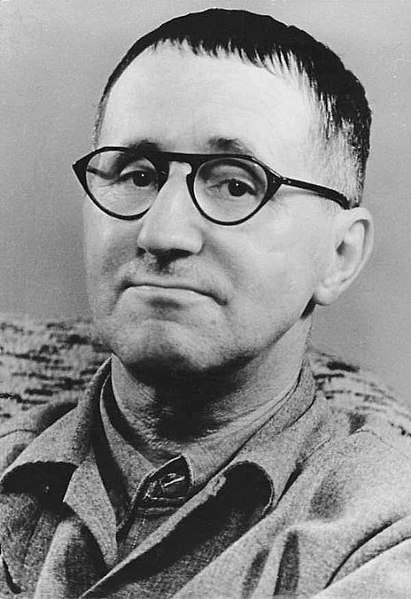
Nach dem Aufstand des 17. Juni
Ließ der Sekretär des Schriftstellerverbands
In der Stalinallee Flugblätter verteilen
Auf denen zu lesen war, daß das Volk
Das Vertrauen der Regierung verscherzt habe
Und es nur durch verdoppelte Arbeit
zurückerobern könne. Wäre es da
Nicht doch einfacher, die Regierung
Löste das Volk auf und
Wählte ein anderes?After the uprising of June 17th
The Secretary of the Authors’ Union
Had leaflets distributed in the Stalinallee
Which said that the people
Had forfeited the government’s confidence
And could only win it back
By redoubled labour. Wouldn’t it
Be simpler in that case if the government
Dissolved the people and
Elected another?Bertolt Brecht, 1953.
November 5, 2019
QotD: Die Lösung (The Solution)
October 30, 2019
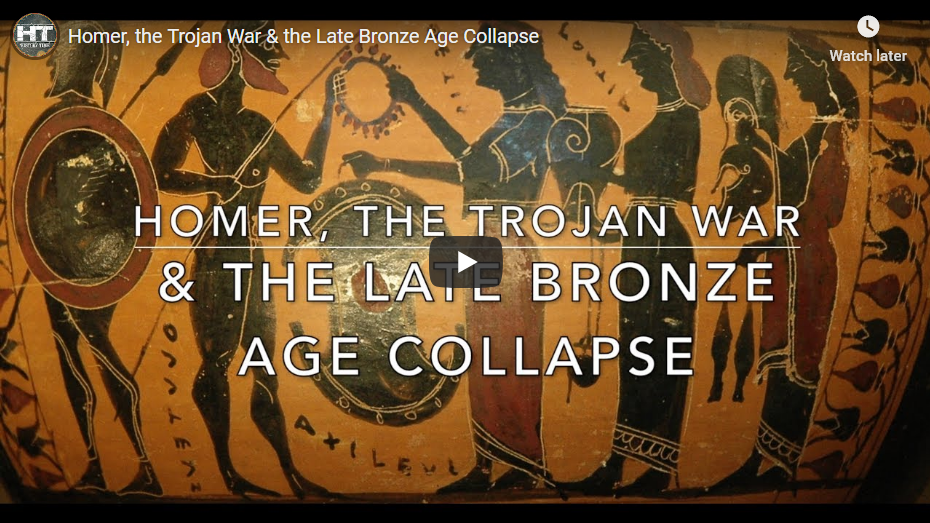
Homer, the Trojan War & the Late Bronze Age Collapse
History Time
Published 20 Mar 2018This is the first in a new series I will be producing on the Late Bronze Age Collapse.
If you enjoyed this video and would like to see more then please consider supporting me on Patreon:-
https://www.patreon.com/historytimeUK (every dollar helps)Are you a budding artist, illustrator, cartographer, or music producer? Send me a message at petekellywriter@gmail.com No matter how professional you are or even if you’re just starting out, I can always use new music and images in my videos. Get in touch! I’d love to hear from you.
I’ve compiled a reading list of my favourite history books via the Amazon influencer program. If you do choose to purchase any of these incredible sources of information then Amazon will send me a tiny fraction of the earnings (as long as you do it through the link) (this means more and better content in the future) I’ll keep adding to and updating the list as time goes on:-
https://www.amazon.com/shop/historytimeI try to use copyright free images at all times. However if I have used any of your artwork or maps then please don’t hesitate to contact me and I’ll be more than happy to give the appropriate credit.
September 15, 2019
QotD: “Whenever I hear the word ‘culture’ I reach for my Browning”
This, attributed to Goering but rather indited by some other nutjob mediocrity, is among my favourite phrases. Often I cite it with glee. I know just what he meant; rarely has one the chance to empathize with Nazis. Monsters they were, but also human, and if we lose the means to recall what made them tick, we are disadvantaged against their successors.
Ditto with Islamic terrorists, incidentally. Unless we can see them, sometimes, from the angle that makes them most attractive, we miss the whole picture. Know the enemy, I say. The worst psychopath may offer to share some droll humour. It is my firm belief that even liberals and progressives can be charming, sometimes.
I wonder which part of Mr Browning’s works Herr Goering would reach for? Would it be an earlier work, as Paracelsus or Sordello? A later, such as Jocoseria or Asolando? Me, I think I would start with a dilatory romp through the Dramatic Idylls, then hunker down with The Ring and the Book.
David Warren, “Include me in”, Essays in Idleness, 2017-08-30.
May 12, 2019
History-Makers: Homer
Overly Sarcastic Productions
Published on 10 May 2019Visit PhilosophicalPhridays.com to learn more about Blue’s BOOK!
“History-Makers” is a new series from Blue, digging into the backstories of history’s most influential writers and their great works. We begin at the beginning, with the Greek poet Homer, trying to figure out how exactly he wound up with the Iliad and Odyssey!
Let me know which History-Maker you’d like me to cover in the comments below!
PATREON: https://www.Patreon.com/OSP
April 3, 2019
A review of Woke by Titania McGrath
The poetic titan of Twitter, ultra-woke voice of her generation Titania McGrath (recently revealed to be the creation of comedian Andrew Doyle), is now a published author:
… Titania McGrath, the radical intersectional feminist poet who verbally bombards the “white supremacist patriarchy.” A malcontent who is fed up with us ignoramuses, McGrath has published her first book. Simply titled Woke: A Guide to Social Justice, it’s a manifesto written in prose possessing a revolutionary zeal so potent Che Guevara would lecherously swoon and request that she provide him with remedial education in social revolution.
McGrath addresses the vast intricacies of wokeness and responds to the counterarguments that the agents of the patriarchy often make. She also outlines how this puritanical movement can attract converts. Her insight is sought after since, after all, “our society is a slumbering beast that has been trapped in its coma for far too long.”
Proving to be Winston Churchill’s 21st-century equivalent, McGrath teabags “the foes of justice with a gender-neutral scrotum.” And challenges the “illusion of freedom” to extirpate Nazis and destroy any other obstacles to the “Intersectional Socialist Utopia.”
We all live in a “heteronormative patriarchy” that’s a “Tyranny of Facts” erected by the “Scourge of Whiteness.” Knowledge is a “patriarchal construct” that is only convenient for those who want to strengthen the white male authoritarians’ grip on power. So what must we do to rectify this?
According to McGrath, our society is almost irreparably “unwoke,” and we might have to implement drastic purgatory measures. We shall be heedful of the wisdom of brave reformists like Hannah Gadsby and eradicate anything offensive. Reforming things like comedy and any other art form perceived to be toxically masculine should be our first priority. Scientists will also tremble at the feet of these woke revolutionaries. As McGrath avers: “The idea that knowledge is more important than feelings is everything that is wrong with the field of modern science.”
With a knack for conflict analysis that would rival Churchill’s, McGrath identifies our real enemies with panache. “Every sperm is an invader” if you didn’t know, and those who commit cultural genocide by doing yoga are civilization’s true adversaries. As are compilers of the English dictionary who give credence to antediluvian definitions of racism that enable us to think a person of colour can also be racist.
March 8, 2019
December 15, 2018
December 12, 2018
QotD: G.K. Chesterton’s political Catholicism
Ten or twenty years ago, the form of nationalism most closely corresponding to Communism today was political Catholicism. Its most outstanding exponent — though he was perhaps an extreme case rather than a typical one — was G. K. Chesterton. Chesterton was a writer of considerable talent who whose to suppress both his sensibilities and his intellectual honesty in the cause of Roman Catholic propaganda. During the last twenty years or so of his life, his entire output was in reality an endless repetition of the same thing, under its laboured cleverness as simple and boring as ‘Great is Diana of the Ephesians.’ Every book that he wrote, every scrap of dialogue, had to demonstrate beyond the possibility of mistake the superiority of the Catholic over the Protestant or the pagan. But Chesterton was not content to think of this superiority as merely intellectual or spiritual: it had to be translated into terms of national prestige and military power, which entailed an ignorant idealisation of the Latin countries, especially France. Chesterton had not lived long in France, and his picture of it — as a land of Catholic peasants incessantly singing the Marseillaise over glasses of red wine — had about as much relation to reality as Chu Chin Chow has to everyday life in Baghdad. And with this went not only an enormous overestimation of French military power (both before and after 1914-18 he maintained that France, by itself, was stronger than Germany), but a silly and vulgar glorification of the actual process of war. Chesterton’s battle poems, such as Lepanto or The Ballad of Saint Barbara, make The Charge of the Light Brigade read like a pacifist tract: they are perhaps the most tawdry bits of bombast to be found in our language. The interesting thing is that had the romantic rubbish which he habitually wrote about France and the French army been written by somebody else about Britain and the British army, he would have been the first to jeer. In home politics he was a Little Englander, a true hater of jingoism and imperialism, and according to his lights a true friend of democracy. Yet when he looked outwards into the international field, he could forsake his principles without even noticing he was doing so. Thus, his almost mystical belief in the virtues of democracy did not prevent him from admiring Mussolini. Mussolini had destroyed the representative government and the freedom of the press for which Chesterton had struggled so hard at home, but Mussolini was an Italian and had made Italy strong, and that settled the matter. Nor did Chesterton ever find a word to say about imperialism and the conquest of coloured races when they were practised by Italians or Frenchmen. His hold on reality, his literary taste, and even to some extent his moral sense, were dislocated as soon as his nationalistic loyalties were involved.
Obviously there are considerable resemblances between political Catholicism, as exemplified by Chesterton, and Communism. So there are between either of these and for instance Scottish nationalism, Zionism, Antisemitism or Trotskyism. It would be an oversimplification to say that all forms of nationalism are the same, even in their mental atmosphere, but there are certain rules that hold good in all cases.
George Orwell, “Notes on Nationalism”, Polemic, 1945-05.
December 8, 2018
The Iliad – what is it really about?
Lindybeige
Published on 4 Mar 2016The Iliad – Homer’s epic poem of Achilles and the Trojan War. It was the Bible of its day, but what is it really about? Spoilers!
Support me on Patreon: https://www.patreon.com/Lindybeige
Here I summarise the plot of the Iliad, which may surprise and disappoint those who thought that it was the story of the Trojan War, and then describe and illustrate one of its main themes: the glory and tragedy of war; and then go on to point out the crucial scene of the poem, in which Priam begs for the return of the body of his son, and argue that this is actually the scene that gives meaning to the piece.
Lindybeige: a channel of archaeology, ancient and medieval warfare, rants, swing dance, travelogues, evolution, and whatever else occurs to me to make.
▼ Follow me…
Twitter: https://twitter.com/Lindybeige I may have some drivel to contribute to the Twittersphere, plus you get notice of uploads.
website: www.LloydianAspects.co.uk
September 24, 2018
Drafting – Poetry – Georg von Trapp I OUT OF THE TRENCHES
The Great War
Published on 22 Sep 2018Chair of Wisdom Time!
September 11, 2018
May 13, 2018
QotD: The lost works of Epicurus
[Most of the original writings of Epicurus have been lost.] There are the elaborate refutations of Epicureanism by Cicero and Plutarch. These inevitably outline and sometimes even quote what they are attacking. There are hundreds of other references to Epicurus in the surviving literature of the ancient world. Some of these are useful sources of information. Some are our only sources of information on certain points of the philosophy.
During the past few centuries, scholars have been trying to read the charred papyrus rolls from a library in Herculaneum buried by the eruption of Vesuvius in 79 AD. Some of these contain works by Philodemus of Gadara, an Epicurean philosopher of the 1st century BC. Much of this library remains unexcavated, and most of the rolls recovered have not really been examined. There are hopes that a complete work by Epicurus will one day be found here.
Above all else, though, is the De Rerum Natura of Lucretius. He was a Roman poet who died around the year 70 BC. His epic, in which he claims to restate the physical doctrines of Epicurus, was unfinished at the time of his death, and it is believed that Cicero himself edited the six completed books and published the text roughly as it has come down to us. This is one of the greatest poems ever written, and perhaps the strangest of all the great poems. It is also the longest explanation in a friendly source of the physical theories of Epicurus.
Therefore, if anyone tries to say in any detail what Epicurus believed, he will not be arguing from strong authority. If we compare the writings of any extant philosopher with the summaries and commentaries, we can see selective readings and exaggerations and plain misunderstandings. How much of what Karl Marx really said can be reliably known from the Marxist and anti-Marxist scholars of the 20th century? Even David Hume, who wrote very clearly in a very clear language, seems to have been consistently misunderstood by his 19th century critics. For Epicurus, we may have reliable information about the main points of his ethics and his physics. We have almost no discussions of his epistemology or his philosophy of mind. Anyone who tries writing on these is largely guessing.
All this being said, enough has survived to make a general account of the philosophy possible. Epicurus appears to have been a consistent thinker. Though it may only ever be a guess — unless the archaeologists in Herculaneum find the literary equivalent of Tutankhamen’s tomb — we can with some confidence proceed from what Epicurus did say to what he might have said. Certainly, we can give a general account of the philosophy.
Sean Gabb, “Epicurus: Father of the Enlightenment”, speaking to the 6/20 Club in London, 2007-09-06.
April 11, 2018
The Aesir-Vanir War – Extra Mythology
Extra Credits
Published on 9 Apr 2018Sponsored by God of War! http://bit.ly/2FBqVPH
One day, a mysterious visitor appeared among the Aesir, one of two races of Nordic gods. An epic and long war began, and yet despite the bloodshed, their war eventually gave poetry to the world.
March 28, 2018
Samuel HaNagid – A Prince of Jews – Extra History
Extra Credits
Published on 11 Jun 2016Forced to flee from his home in Cordoba, Samuel HaNagid made a new name for himself in the kingdom of Granada. He picked his allies carefully and rose to the position of vizier, an unheard of honor for a Jew in a Muslim kingdom. His fame as a poet, a leader, and a patron of Judaic studies spread across the Mediterranean.
March 13, 2018
The Queen of Lesbos – Poetess Sappho l THE HISTORY OF SEX
IT’S HISTORY
Published on 16 Sep 2015The Greek poetess Sappho from the Isle of Lesbos is the most important female lyricist of the classical age. She worshipped women and often addressed her work to beautiful ladies. Although her definite sexuality will remain a mystery, it is almost as widely discussed as her work itself. The constant myth that Sappho was gay remains which is why the term “lesbian” dates back to Sappho’s erotic poetry. Learn all about the great Sappho and what the term “doing it like the ladies of Lesbos” actually means, on IT’S HISTORY.