
Real Time History
Published 7 Apr 2023The Crimean War between the Ottoman Empire and Russia (and later the UK and France) has been called the last crusade and the first modern war at the same time.
(more…)
April 8, 2023
Russia’s Last Crusade – The Crimean War 1853-1856
Comments Off on Russia’s Last Crusade – The Crimean War 1853-1856
March 29, 2023
The Grauniad something something glass houses something something throwing stones
In UnHerd, Ashley Rindsberg recounts the details we know so far about the Guardian‘s embarassing historical project to find out about the newspaper’s links to the slave trade:
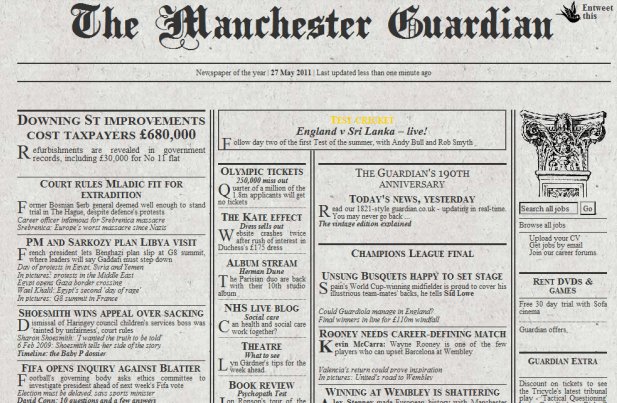
The Guardian prides itself on being one of the most Left-leaning and anti-racist news outlets in the English-speaking world. So imagine its embarrassment when, last month, a number of black podcast producers researching the paper’s historic ties to slavery abruptly resigned, alleging they had been victims of “institutional racism”, “editorial whiteness”, “microaggressions, colourism, bullying, passive-aggressive and obstructive management styles”. All of this might smack of progressive excess, but, in reality, it merely reflects an institution incuriously at odds with itself.
Questions about The Guardian‘s ties to slavery have been circulating since 2020, when, amid the media’s collective spasm of racial conscience following the murder of George Floyd, the Scott Trust announced it would launch an investigation into its history. “We in the UK need to begin a national debate on reparations for slavery, a crime which heralded the age of capitalism and provided the basis for racism that continues to endanger black life globally,” journalist Amandla Thomas-Johnson wrote in a June 2020 Guardian opinion piece about the toppling of a statue of 17th-century British slaver Edward Colston. A month later, the Scott Trust committed to determining whether the founder of the paper, John Edward Taylor, had profited from slavery. “We have seen no evidence that Taylor was a slave owner, nor involved in any direct way in the slave trade,” the chairman of the Scott Trust, Alex Graham, told Guardian staff by email at the time. “But were such evidence to exist, we would want to be open about it.” (Notably, Graham, in using the terms “slave owner” and “direct way”, set a very specific and very high bar for what would be considered information worthy of disclosure.)
The problem is that the results of the investigation, conducted by historian Sheryllynne Haggerty, an “expert in the history of the transatlantic slave trade”, have never been made public. When contacted with questions about what happened to the promised report, Haggerty referred all inquiries to The Guardian‘s PR, which has remained silent on the matter. (The Guardian was asked for comment and we were given the stock PR response The Guardian gave following the podcaster’s letter.) But what we do know is this: according to Guardian lore, a business tycoon named John Edward Taylor was inspired to agitate for change after witnessing the 1819 Peterloo Massacre, when over a dozen people were killed in Manchester by government forces as they protested for parliamentary representation. Two years later, Taylor, a young cotton merchant, with the backing of a group of local reformers known as the Little Circle, founded the paper.
“Since 1821 the mission of The Guardian has been to use clarity and imagination to build hope,” The Guardian‘s current editor, Katharine Viner, proudly proclaims on the “About us” page of the paper’s website. Part of this founding myth concerns one of the defining social and political issues of the day, slavery, which the Little Circle members, including Taylor, vigorously opposed as a moral affront. “The Guardian had always hated slavery,” Martin Kettle, an associate editor, wrote in a 2011 apologia on why during the Civil War the paper had vociferously condemned the North while equivocating on the South.
That may be true, but it also presents an incomplete picture. The Manchester Guardian, as the paper was then known, was founded by cotton merchants, including Taylor, who were able to pool the money needed to launch the paper by drawing on their respective fortunes. While none of these men, many of whom were Unitarian Christians, is likely to have engaged in slavery, they didn’t just benefit from but depended upon the global slave trade that provided virtually all of the cotton that filled their mills. As Sarah Parker Remond, an African American abolitionist, said upon visiting Manchester in 1859: “When I walk through the streets of Manchester and meet load after load of cotton, I think of those 80,000 cotton plantations on which was grown the $125 million worth of cotton which supply your market, and I remember that not one cent of that money ever reached the hands of the labourers.”
Comments Off on The Grauniad something something glass houses something something throwing stones
February 20, 2023
“There is no way Justin Trudeau won any of the last three elections”
Elizabeth Nickson on recent rather alarming confirmation of many things told by various “conspiracy theorists” and purveyors of “misinformation”:
Cracks are beginning to appear in the massive election fraud strategy prosecuted against western democracies. Berlin last week reversed its city election because it had been stolen by the left, and Berliner-Zeitung revealed that a team of reporters from The Marker, Haaretz and Radio France had gone undercover for six months as clients of a company that did nothing but election theft. That company, Jorge, had “intervened in 33 national election campaigns and votes. In 27 cases, it is said to have influenced the elections in favor of its clients. In order to control the opinion on the Internet, the secret company controls over 30,000 credible fake accounts on social media platforms”.
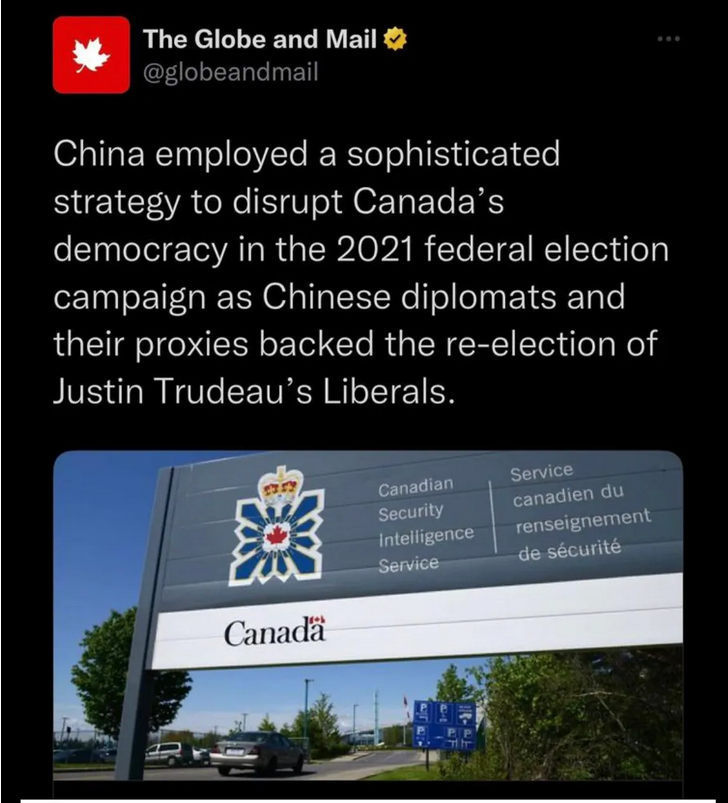
And in Canuckistan this morning, in the organ of the bien-pensant liberal establishment, there was this nugget.
There is no way Justin Trudeau won any of the last three elections. And, honey, this little story from Canada’s most prestigious newspaper is just the beginning.
But first, a story of my own …
When I turned right I had been hired to write an op-ed column for the above Globe and Mail, and what unfurled from my fingers was pure conservatism. I’d hold up my fingers and think, What the hell? Where did that come from? But I continued, and as I did, family and friends sheered away until, except for my mother, I was left virtually friendless.
I had moved back to Canada, you see, and we are 100% captured by the left. There are a handful of conservative writers in the country, but they are soft and weak and they prevaricate because otherwise they would not eat. Luckily I had spent most of my adult life out of the country, had a broader pool to draw from, and given my new thinking, mirable dictu for every friend I lost, I made five new ones. And they were smarter, more responsible, more interesting people. I missed the clothes, restaurants and parties for a while, then I gave up on those too. Essentially, sickening. Finally corrupting.
But it continues, since we live in a hard-left community. We are isolated. Even Jamie, because he lives with me, has lost friends and family. We have his sons, his ex-wife, one of my brothers. The rest are just cold, pitiless. Cruel.
This has happened to hundreds of thousands of people. It’s called “bad-jacketing” and is part of the Fifth Generation Warfare launched against malcontents large and small (like me) up and down the social ladder. Millions. Tens of millions. The competent are targeted, isolated and bad jacketed. It is meant to drive the competent out of the culture. Why is everything breaking? Why is the economy failing? Everyone left in the system is incompetent and vicious with it. It’s why Soviet Russia failed, why the Eastern Bloc collapsed, it is why China went for a capitalist hybrid. Everywhere socialism is tried it destroys the competent and then destroys everything else.
The left is implacable and they punish. They hurt you until you give up. They will break anything you have. Thinking about helping a young neighbor last month, which would require a week or more of brutal work, I finally thought: I have not helped or befriended one single socialist — and she was an avowed socialist — who hasn’t eventually stabbed me in the back. Not one.
When I was driven out of the profession, I spent ten years studying. Was I right? Was I wrong? I should have signed up for a remote doctoral program, because I worked. I study, therefore I am. I studied therefore I was, should be written on my cremation plaque in the family plot. Not that they’ll let me in.
We are all intimidated by that level of hate and exclusion. All of us, politicians, editors, bureaucrats, charities, all of us are terrified of being taken down in our personal lives. Bad-jacketed, rejected by those you love deeply. I know how that feels and I bet you do too.
Comments Off on “There is no way Justin Trudeau won any of the last three elections”
February 19, 2023
Andrew Sullivan on the legacy media’s coverage of transgender issues
In the free portion of his Weekly Dish, Andrew Sullivan looks at how the legacy media chooses to cover (or ignore) different aspects of pre-teen and teenage transgenderism:

Two people at EuroPride 2019 in Vienna holding an LGBTQ+ pride rainbow flag featuring a design by Daniel Quasar; this variation of the rainbow flag was initially promoted as “Progress” a PRIDE Flag Reboot.
Photo by Bojan Cvetanović via Wikimedia Commons.
One more criticism of the letter. It uses the terrible history of the [New York Times] on coverage of gay men and AIDS in the 20th century as equivalent to the reporting of Bazelon, Baker, et al, today. This is unhinged. Transgender people today are fully covered under the Civil Rights Act; in the 1980s, gays had nothing. In the 1980s and 1990s, the NYT opposed using the word “gay” because it legitimized homosexuality in some way; today the NYT prints “queer” or “trans” or LGBTQ+ in almost every other article.
Today, the paper has published a mountain of empathetic coverage of trans people — over 800 stories in the past year. Since January 1, the NYT has run a moving profile about a trans man in Mexico; a celebration of “queer” life in Alabama by a trans staffer; an exploration of nonbinary fashion; a critical orgasm over “queer” theater; and a news story explaining that “the flood of [trans-related] legislation is part of a long-term campaign by national groups that see transgender rights as an issue on which they can harness voter anger”. Comparing this with A.M. Rosenthal’s reign of homophobic terror and censorship is just obscene.
One historical analogy does seem salient to me, though: the drugs they now give to gender-dysphoric teens are very closely related to the drugs they used to “cure” Alan Turing of his gayness. Every time I think of that I shudder.
And this attempt to suppress reporting on the subject comes at a very strange time. Next week, a new book will be published about the Tavistock Centre, the place responsible for the medical and psychological treatment of children with gender dysphoria in Britain. It’s written by a liberal female journalist, Hannah Barnes, of a flagship British documentary show, Newsnight.
Her book exposes a huge medical scandal, in which countless children were put on puberty blockers with almost no psychological evaluation, and with rates of autism and domestic abuse that were already through the roof. It shows what happened when the new affirmation-only puberty-blocker experiment, only begun in the late 1990s, was left to run its course, with no opposition and no dissent allowed. Check out an extract here. Here’s where I sat up straight:
Clinicians recall multiple instances of young people who had suffered homophobic bullying at school or at home, and then identified as trans. According to the clinician Anastassis Spiliadis, “so many times” a family would say, “Thank God my child is trans and not gay or lesbian.” Girls said, “When I hear the word ‘lesbian’ I cringe”, and boys talked to doctors about their disgust at being attracted to other boys.
When Gids [the Gender Identity Development Service] asked adolescents referred to the service in 2012 about their sexuality, more than 90 per cent of females and 80 per cent of males said they were same-sex attracted or bisexual. Bristow came to believe that Gids was performing “conversion therapy for gay kids” and there was a bleak joke on the team that there would be “no gay people left at the rate Gids was going”.
Just think about that for a second. And remember that gay groups cheer this on; and several gay writers put their names to the letter. What a massive reckoning may be in store for them. If any of this pans out, and gay groups have endorsed it, it could easily be the greatest scandal in the history of the gay rights movement.
More than a third of the kids pushed onto the trans track had autism, sometimes severe. Others were victims of domestic abuse: “[A natal girl] who’s being abused by a male, I think a question to ask is whether there’s some relationship between identifying as male and feeling safe”, one clinician at the center said. No questions about other aspects of a child’s mental health were considered if the kid was identifying as the opposite sex. And this took place in a socialized system, with constant oversight, and no massive financial incentives to treat children. Just imagine what could be happening in the US private system where trans patients are among the most lucrative to have in your care, and are under treatment their entire life.
[…]
One obvious area for research: why have the sex ratios shifted so radically in the past decade or so — with girls now vastly outstripping boys in the young patients involved? Why the explosion in requests? It’s far more dramatic and skewed to one sex than it would be if merely a function of declining stigma. Yet for woke journalists, it’s all Principal Skinner: “Let’s have no more curiosity about this bizarre cover-up.”
Something is going on among teen girls more generally. The CDC just issued a frightening new report:
Nearly 3 in 5 teen girls (57%) said they felt “persistently sad or hopeless”. That’s the highest rate in a decade. And 30% said they have seriously considered dying by suicide — a percentage that’s risen by nearly 60% over the past 10 years.
Now check out Jamie Reed’s and Tavistock’s overwhelmingly female, often deeply unhappy, clients. Is there a connection? I don’t know. What I do know is that it’s the job of the media to find out, and not to shut itself down.
The lobby groups and often well-intentioned doctors who have pioneered this massive experiment on children will naturally resist any idea they have been facilitating abuse, or concede any points — because as soon as they confess doubt, the whole house of cards can come tumbling down; and lawsuits alone could end the practice very quickly. The Democrats and the Biden administration have locked themselves to the idea that this kind of treatment is a no-brainer and never does any harm — and they just keep repeating that like a mantra and never address the recent restriction of these experimental practices in progressive Europe. The far right can use the issue to gin up homophobic tropes and cruel treatment of trans people.
February 12, 2023
QotD: The heyday of Victorian newspapers
A few years ago, I did some research on three early Victorian murders that caused me to read several provincial newspapers of the time. I discovered incidentally to my research that the owners or editors of about half of the British provincial newspapers also sold patent medicines; and this made perfect sense, for by far the greatest advertisers in provincial newspapers were the manufacturers of patent medicines. The owners or editors of the newspapers sold advertisements to the producers of patent medicines, then they sold the newspapers in which the advertisements appeared, and finally they sold the products themselves to the readers. It was an excellent example of rational commercial synergy. (About half of the medicines, by the way, were either to cure or to prevent syphilis — a disease, then, that was a great support to the press of the time.)
Now, the principal quality or characteristic of the sellers of patent medicine has always been effrontery, that is to say the blatant insinuation of the false. Thomas Holloway’s innovation was to insinuate such falsehood on a mass or industrial scale. There was hardly a newspaper in which he did not place a weekly advertisement; moreover, he pioneered the advertisement that masquerades as news story. He would ensure that reports of miracle cures in faraway places, supposedly wrought by his pills and ointment, and written as matter-of-factly as possible, were placed in every newspaper, reports whose veracity no one could possibly check for himself, of course.
As Napoleon once said, repetition is the only rhetorical technique that really works — besides which hope and fear render people susceptible to effrontery. In Thomas Holloway’s time, the fear of illness was often, and the hope of cure rarely, justified; at least Holloway’s preparations were unlikely to do much harm (they contained aloe, myrrh, and saffron), unlike the prescriptions of the orthodox doctors of the time. They allowed for the possibility of natural recovery, whereas orthodox medicine often hurried its consumers into their graves. Nevertheless, the claims Holloway made for his ointment and pills were preposterous, and something is not curative just because it fails to kill.
Holloway made an immense fortune by his effrontery and founded a women’s college in the University of London on the proceeds.
Theodore Dalrymple, “The Way of Che”, Taki’s Magazine, 2017-10-28.
Comments Off on QotD: The heyday of Victorian newspapers
February 7, 2023
Big Sky fascism, according to the New York Times
In The Free Press, Walter Kirn expresses dismay to discover that he’s been living in a “quasi-fascist” state for 30 years and didn’t even notice until the Grey Lady informed him about it recently:

Just a few weeks back, I sat down with my morning coffee, opened up the paper and learned that I now live in a quasi-fascist state. It said so in the paper.
The paper wasn’t a local publication but one from a couple thousand miles away, the New York Times, whose glossy Sunday magazine included a lengthy, illustrated feature with the five-alarm headline How Montana Took a Hard Right Turn Toward Christian Nationalism. To illustrate the state’s alleged swerve toward neo-fascist theocratic rule — a dire development I’d somehow missed — the story included a scary gothic photo, heavily filtered to bring out its dark tones, of a ghostly white cross on a bare hillside reflected in a passing rearview mirror. It also included, of course, a Yellowstone reference and Kevin Costner’s name — right up top, where the search engines would see them.
Since moving to small-town Montana from New York City over 30 years ago, I’d lived through at least a couple of cycles of ominous national coverage of my state. Without going into the details, let me assure you that this article was bunk, as exaggerated as the photo.
But fiction is fact where Montana is concerned, particularly on the country’s coasts, where tales are told about the country’s interior that the country’s interior lacks the clout to counter, much as our guns lack the range to bring down aircraft. Despite our legendary swagger, Montanans are largely helpless against the country’s more powerful forces. The missiles on our prairies aren’t missiles we asked for, just missiles that formidable others wished to plant here. They make us a target, but we don’t control them.
Do I sound defensive? Perhaps I am.
I live in a state with zero big-league sports teams, not a single Fortune 500 corporation, and no national media influence to speak of — unless you count made-up shows about fake ranchers slugging it out in scripted brawls. I’m one of about a million residents, all of whom, no matter their circumstances, are up against the myth-making machines of cities and states of imperial wealth and numbers. And imperial attitudes, dare I say, which emerge in their basic, perennial story about us: those folks from the steppes and mountains are growing restless, including the ones who’ve just moved there to go skiing, who appear to be worse than the ones already living there, who we’ve always found unsettling enough.
When the spy balloon floated across America, the rest of the country got a taste, perhaps, of Montana’s stoic colonial impotence. For days, we could point, but we weren’t allowed to shoot — great-power diplomacy prevented it. Americans may think we’re tough, as Montanans may think they’re tough, but it seems that we’re tough in the way that actors in westerns are: only with the permission of the director, only symbolically. Down went the balloon on Saturday to much applause, but the spectacle was pure cinema by then, like a fistfight on Yellowstone that draws fake blood.
But at least we proud Montanans kept our honor. We spied the lurking villain, we called the sheriff, we warned our neighbors, we did what we could do. I suspect we’ll continue in this role, watchful vigilantes of the skies. There’s trouble afoot – you can feel it everywhere, particularly if you dwell near nuclear missiles, particularly if you live where there’s no cover — and someone has to stand lookout on the hill.
Comments Off on Big Sky fascism, according to the New York Times
February 5, 2023
“[E]very story now assumes ‘white supremacy’ as the core truth of the world”
Andrew Sullivan on the state of the American legacy media in an age of young, woke reporters driving the narrative forward at the expense of any hint of objectivity:

Memphis police officers charged in the beating death of Tyre Nichols.
There are times when I actually feel some pity for the editors in mainstream media. In the last few years, pressured relentlessly by young, super-leftist staffers, they have slowly and then precipitously dropped the goal of objectivity and news in favor of subjectivity and narratives. The struggle against white supremacy has become too urgent for news that may not advance “social justice”. Here’s a glimpse of what the old guard is dealing with, in a leaked transcript of a NYT staff meeting in 2019. An early question from a NYT reporter was:
I’m wondering to what extent you think that the fact of racism and white supremacy being sort of the foundation of this country should play into our reporting. Just because it feels to me like it should be a starting point, you know? … I just feel like racism is in everything. It should be considered in our science reporting, in our culture reporting, in our national reporting. And so, to me, it’s less about the individual instances of racism, and sort of how we’re thinking about racism and white supremacy as the foundation of all of the systems in the country.
And, as you can see every day, this is what the NYT subsequently did. Distilled that year with The 1619 Project (now airing on Hulu!), everything was and is parsed through the lens of critical race/gender/queer theory — from birdwatching to knitting to “literally abolishing the police”. It’s their foundation.
The same ideological fervor swept over the WaPo, of course — right down to the racist birds! And this week, the former executive editor, Len Downie, a near-icon of the old school, published a report on journalism and found a broad consensus among his colleagues that, in the words of one editor-in-chief, “Objectivity has got to go!” So every story now assumes “white supremacy” as the core truth of the world.
So what happens when stories arrive which, on the face of it, seem to refute that entirely? Take three recent events: two mass killings of Asian-Americans within two days in California by an Asian-American (in Monterey Park) and a Chinese national (in Half Moon Bay); five black police officers in a majority-black police force with a black police chief all but lynched and murdered an innocent black man; and a trans woman was convicted of the rape of two other women with the use of her penis.
How on earth do these fit into the pre-arranged “white supremacy” template?
They can’t of course. They reflect a reality far more complex than the crude racial hierarchies beloved of actual white supremacists and woke activists alike. They show individual actors, with a range of possible motives, in unique moments that will always escape predictable narratives. Maybe racial prejudice is present; maybe not; or maybe mixed into a range of other possible factors. You work empirically from the ground up.
But if the facts don’t fit the narrative, you move on quickly to a story that will. So with the Asian-American massacres, after some initial excitement, the MSM lost interest as soon as a white man could not be blamed. (Contrast that with the days-long feeding frenzy over the Atlanta spa massacre, despite zero evidence of any anti-Asian motive from the white killer.) Or they try to force it into their narrative anyway.
Comments Off on “[E]very story now assumes ‘white supremacy’ as the core truth of the world”
“We need to find a couple of big-fish donors who want to see a bunch of vets going out and collecting digital Nazi scalps”
Chris Bray examines the cutting edge of anti-Nazi crusading:
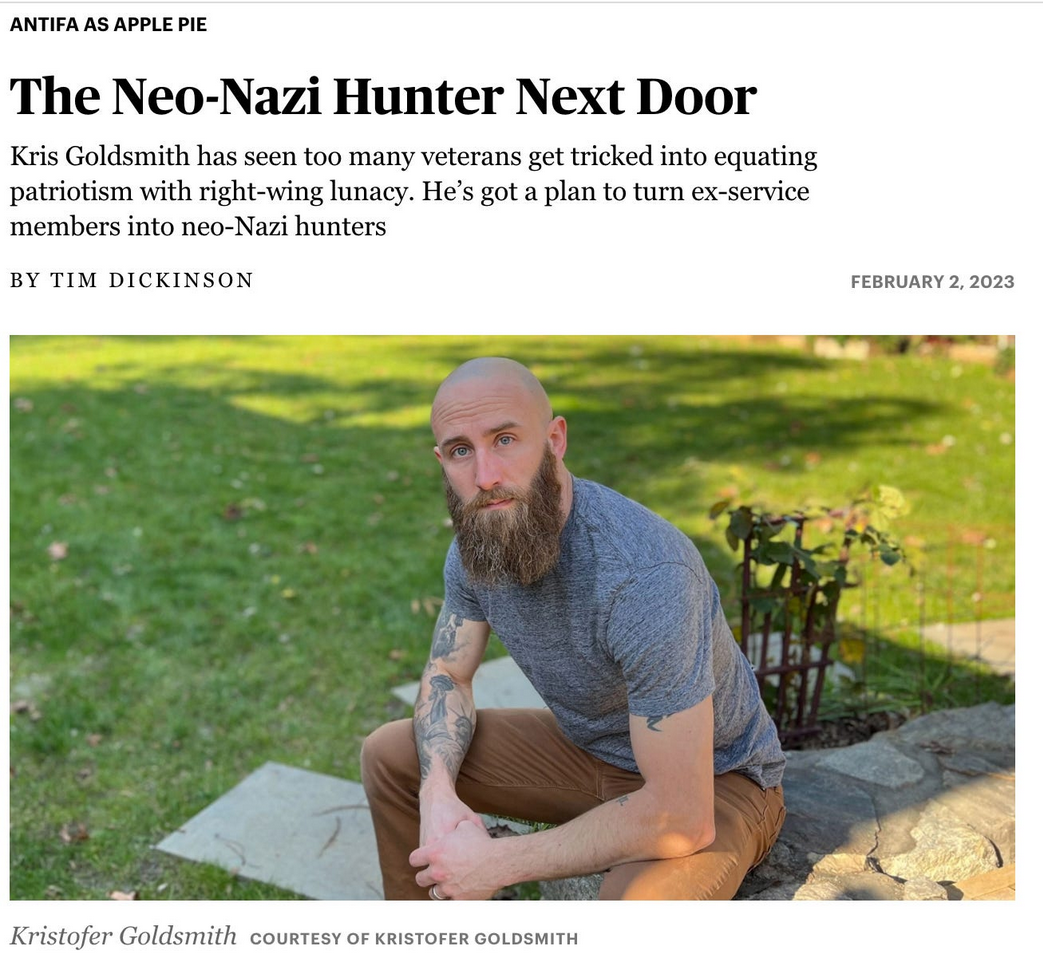
So here’s the most important political story to appear in Rolling Stone since Sabrina Rubin Erdely earned early retirement:
There’s a growing movement of American Nazis, you see, so military veterans are pulling on their boots to fight for their country again, hunting those Nazis and taking them out. But actually reading the story is, pardon me for a moment, a little like hammering a fucking spike into your brain. Every claim self-refutes; paragraph by paragraph, the story tells you X and Not X, side-by-side, with equal authority.
Start with the foundation of the claim. Goldsmith’s work, Rolling Stone explains, “centers on exposing the inner workings and public wrongdoing of neo-fascist groups through deep-dive intelligence reports that can give prosecutors the evidence they need go after the hatemongers in court.” Try to find a definition of “neo-fascist” in the story, though, and you fail. Fascism, it turns out, is being mean. It’s politics for the TikTok era: fascism is haters! Actual fascists thought they believed in the sacredness and centrality of the state, government as the highest form of human expression; the LARPers tracking fascists in 2023 think it means you didn’t contribute to WinBlue last month.
And so Goldsmith says he’s tracking “these people who would literally kill their fellow Americans to install a fascist dictator”, which would be a pretty dire confrontation. Then, making the claim concrete, Goldsmith gets to this description of the Patriot Front, his primary Nazi nemesis:
I have come to understand them as a unique threat against the people of the United States. While they’re a small group — they may have 200, 220 members at any given time — the thing that makes them so dangerous is the cult like atmosphere.
So the headline is a life-and-death struggle between the rising tide of American fascists who are preparing to kill us all and install their Hitler; the story is 200 people — maybe 220! — “at any given time”. Here, by the way, is a leaked Patriot Front training video, so you can see just how terrifyingly dangerous they are:
The only thing the Patriot Front threatens is the retail availability of your favorite product at Dunkin’ Donuts, but let’s go on.
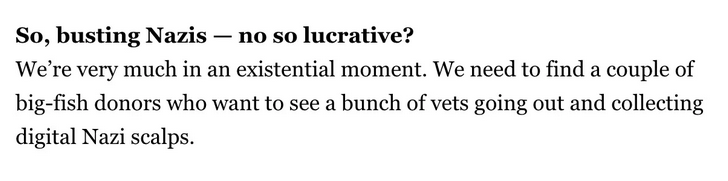
Standing across the battlefield from this terrifying group, the story reveals, Goldsmith & Co. now total a force of “two dozen volunteers”. Then comes this exchange, deep into the Q&A:
Rolling Stone has turned a cosplayers-on-cosplayers circle jerk into the Battle of the Bulge. Compare THE NAZI HUNTER NEXT DOOR to a living room’s worth of unpaid hobbyists who could really turn into something if someone would just, like, give us some money.
Now, the punchline: The NAZI HUNTER is very much having his big media moment, scoring a series of profiles since the start of the year. Here he is being interviewed by the New York Times (where his wife is an editor) in January, for example, under an intro that says he’s hunting “antigovernment” extremists who are fascist. We all remember how the original fascists were passionately anti-government, of course. Hitler, Franco, and Mussolini — big libertarians, all. Hardly wanted to have any government, so people could just hang loose and roll however they chose.
The tediousness of pumping all this sad-sackery into a big national story is exhausting, as is the news media in general. But we need the distraction of Nazis and insurrections, or we’d risk talking about things that are real.

Comments Off on “We need to find a couple of big-fish donors who want to see a bunch of vets going out and collecting digital Nazi scalps”
February 1, 2023
It’s the job of the music critic to be loudly and confidently wrong as often as possible
Ted Gioia points out that a lot of musical criticism does not pass the test of time … and sometimes it’s shown to be wrong before the ink is dry:
When I was in my twenties, I embarked on writing an in-depth history of West Coast jazz. At that juncture in my life, it was the biggest project I’d ever tackled. Just gathering the research materials took several years.
There was no Internet back then, and so I had to spend weeks and months in various libraries going through old newspapers and magazines — sometimes on microfilm (a cursed format I hope has disappeared from the face of the earth), and occasionally with physical copies.
At one juncture, I went page-by-page through hundreds of old issues of Downbeat magazine, the leading American jazz periodical founded back in 1934. And I couldn’t believe what I was reading. Again and again, the most important jazz recordings — cherished classics nowadays — were savagely attacked or smugly dismissed at the time of their initial release.
The opinions not only were wrong-headed, but they repeatedly served up exactly the opposite opinion of posterity.
Back in my twenties, I was dumbfounded by this.
I considered music critics as experts, and hoped to learn from them. But now I saw how often they got things wrong — and not just by a wee bit. They were completely off the mark.
Nowadays, this doesn’t surprise me at all. I’m painfully aware of all the compromised agendas at work in reviews — writers trying to please an editor, or impress other critics, or take a fashionable pose, or curry favor with the tenure committee, or whatever. But there is also something deeper at play in these huge historical mistakes in critical judgments, and I want to get to the bottom of it.
Let’s consider the case of the Beatles.
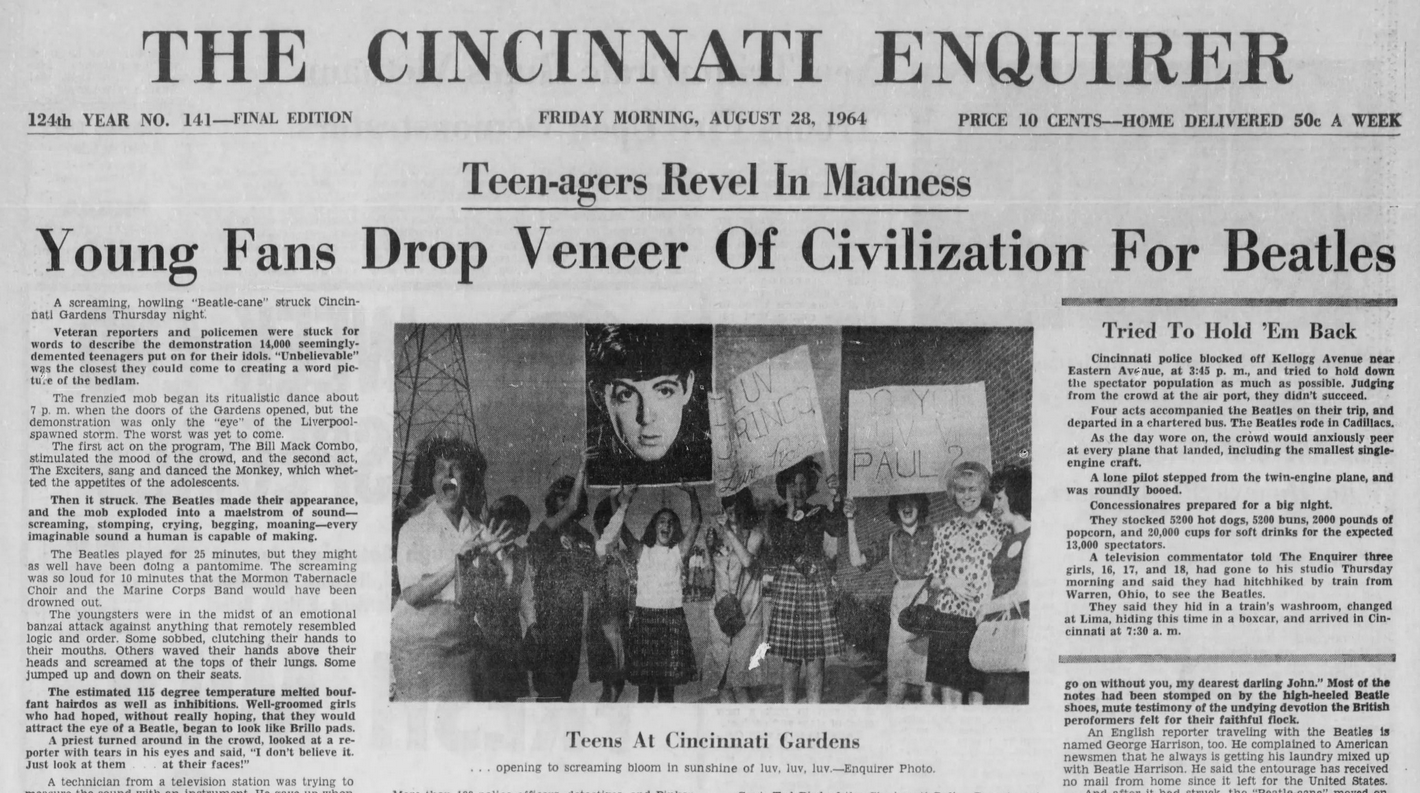
When the Beatles went on the road, stories like this followed them everywhere
On the 50th anniversary of Sgt. Pepper’s Lonely Hearts Club Band, the New York Times bravely reprinted the original review that ran in the newspaper on June 18, 1967. I commend the courage of the decision-makers who were willing to make Gray Lady look so silly. But it was a wise move — if only because readers deserve a reminder of how wrong critics can be.
“Like an over-attended child, ‘Sergeant Pepper’ is spoiled,” critic Richard Goldstein announced. And he had a long list of complaints. The album was just a pastiche, and “reeks of horns and harps, harmonica quartets, assorted animal noises and a 91-piece orchestra”. He mocks the lyrics as “dismal and dull”. Above all the album fails due to an “obsession with production, coupled with a surprising shoddiness in composition”. This flaw doesn’t just destroy the occasional song, but “permeates the entire album”.
Goldstein has many other criticisms — he gripes about dissonance, reverb, echo, electronic meandering, etc. He concludes by branding the entire record as an “undistinguished collection of work”, and even attacks the famous Sgt. Pepper’s cover — lauded today as one of the most creative album designs of all time — as “busy, hip, and cluttered”.
The bottom line, according to the newspaper of record: “There is nothing beautiful on ‘Sergeant Pepper’. Nothing is real and there is nothing to get hung about.”
How could he get it so wrong?
Comments Off on It’s the job of the music critic to be loudly and confidently wrong as often as possible
January 12, 2023
How the New York Times describes the Congressional Republican dissidents
It’s not the news, it’s the substitution of opinion for reporting:
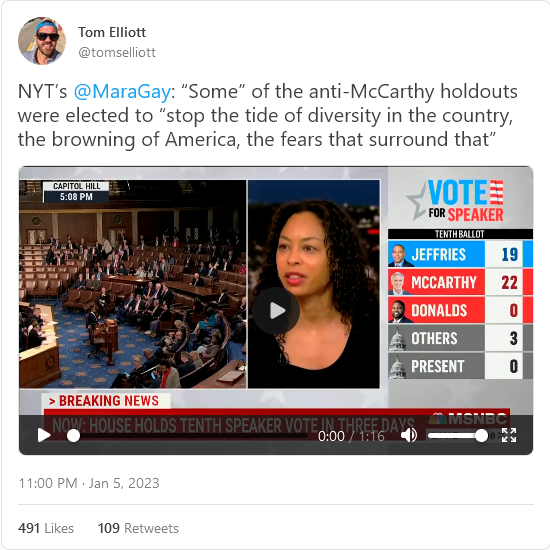
Here’s the political journalist Mara Gay — currently of the New York Times, formerly of the Wall Street Journal and The Atlantic — explaining what the twenty Republican holdouts were up to in their maneuvering over the selection of a Speaker of the House:
It’s leftie Twitter in human form, with all of the slogans. Angry, hateful voters, disturbed by “diversity”, sent some dumb atavists to represent them in D.C., because they hate government and want to “burn it to the ground”. (“And really, that’s what these people were sent to do.”)
Time magazine, which apparently still exists, comes to much the same conclusion, in a piece that I tragically can’t read in full without creating an account, which I wouldn’t do for a free steak dinner or a blanket future pardon from the governor of my choice:
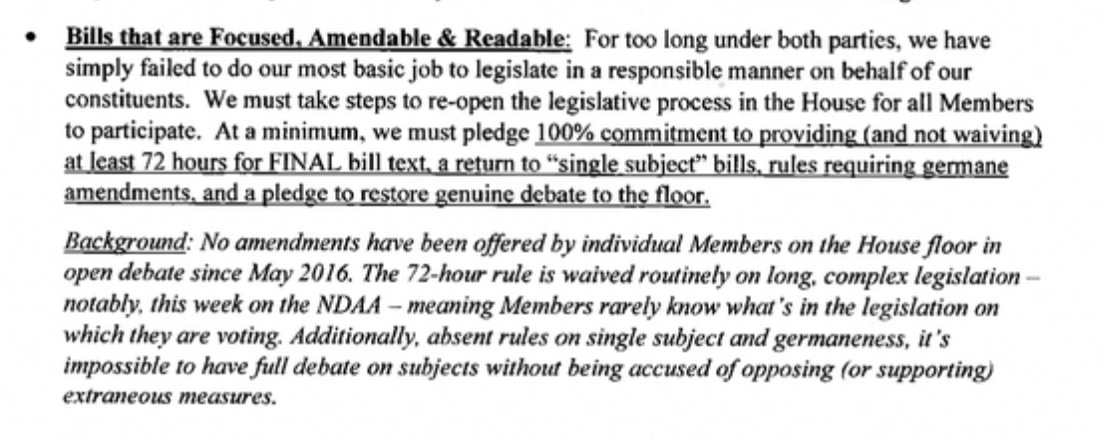
So the twenty GOP holdouts hate government and want to sow chaos and burn democratic norms to the ground, mainstream political journalists calmly explain. Now, via RedState, here’s a letter from seven of the holdouts listing their actual demands as conditions for their vote. Sample demand:
So the monsters who hate government and want to burn it all down were demanding clearly written legislation that every legislator has time to read and fully debate before casting their vote on it.
Subject of Journalism: We want bills that are focused and readable
Journalist: They want to destroy all government because of racism
It’s not even sort of an interpretation or an argument about the thing being discussed — it’s just a wholesale invention, completely severed from the thing that’s allegedly being analyzed. It’s like you ordered a tuna melt, so the waitress broke into your house and mailed your couch to Finland. “There’s your tuna melt,” she says, handing you the receipt from the post office. It’s so aggressive a non-sequitur that it would usually suggest the need for a neurology consult. Have you recently suffered a serious fall, Ms. Gay? Have you experienced dizziness or unexplained nause— oh, wait, I see from your chart that you’re just a political journalist.

Comments Off on How the New York Times describes the Congressional Republican dissidents
December 17, 2022
Canada’s consciously anemic foreign and military policies
In The Line, Matt Gurney explains why Canada consistently fails to “punch above their weight” in foreign and military matters and that it’s not at all accidental:

Canadian politicians have an inputs problem. Maybe that’s actually the wrong way to describe it — the problem is with the outputs. But it’s the inputs they love talking about.
If that all sounds a little vague, maybe this sounds familiar: “Hey there, citizen. Alarmed about Troubling Issue X? Well, don’t worry. We’re pledging $300 million over the next six years to Troubling Issue X. Oh, and Annoying Irritant Y? We’re announcing a task force to report back on that.”
Does Troubling Issue X get solved? Does Annoying Irritant Y get less annoying and irritating? Eh. We probably don’t collect enough stats to even know. The purpose of the announcement isn’t to solve the problem. It’s to announce something and hope people stop paying attention.
Canadian politicians — especially the current federal government — are notorious for announcing the same “new thing” in as many ways and in as many different contexts as they can. They get several hundred dollars of positive press coverage for every actual dollar spent on whatever the announced spending is supposed to be devoted toward. If they can recycle announcements from months past into a new set of announcements, you’re pretty much guaranteed they’ll do it. Announcing spending is, one must assume, what gets people to cast their votes for the party announcing the spending.
A lot of what looks like policy failure in Canadian foreign and military affairs only looks like a failure when you forget that accomplishing something wasn’t the point. Being photographed and videotaped saying you’ll accomplish something was the point. And the announcement itself accomplishes that!
This was true even before the Trudeau government started handing out bushel baskets of money to various Canadian newspapers, TV networks, magazines, and other legacy media entities. What was once merely praise is now bought sychophancy from the (literally) paid media.
On the military side of things, the Canadian Armed Forces are an organization the government grudgingly funds, but only enough to look good for the self-same media:
It’s not that Canada accomplishes nothing on the world stage. We accomplish things. Sometimes we even play an outsized role — Canada did, for instance, perform well and above expectations in Kandahar. The odd exception aside, though, when it comes to foreign policy generally and especially with defence policy, successive Canadian governments have set a very clear target: we will do, technically, more than nothing. We won’t often do much more than that. But we’ll do enough to not get kicked out of the club of allied nations.
Why do we want to be in the club? Not because we feel any sense of duty or obligation to lead and take on any real burden. But because being in the club makes us safer, and it would, after all, be embarrassing to get kicked out.
It’s important to remember that Canada is, by any standard, a rich country. We could be an actual force for good and stability on the world stage if we wanted to. We could build a bigger fleet and patrol more places, more often — we’d be welcome! We could have a bigger army and lead more peacekeeping missions, or contribute more to NATO. A bigger air force, likewise, could contribute more to our allies, especially in Europe in these unsettled times. In a parallel universe where we did these things, we’d then be able to say with a straight face that the purpose of Canada’s navy was contributing to the safety and security of the seas, the purpose of our army was to assist allies and provide peacekeepers to help end international crises, and the purpose of our air force was to project power and bring support to threatened allies.
In the world we actually live in, though, the purpose of the navy is to technically have a navy that technically does things, the purpose of the army is to technically have an army that technically does things, and the purpose of the air force … you see where this is going, right?
Our navy does things! It shows up places, and patrols areas. But only as much as necessary to technically tick that box. The army is in much the same condition; with a growing number of domestic commitments sapping its strength and budget, even its ability to assist with disasters at home is largely maxed out, but we send a few hundred soldiers here and there, thereby allowing ourselves to proclaim that we’ve … sent soldiers somewhere. The air force, as was just reported this week, can’t even really do even that much this year. The exhausted force is skipping the very modest — a half-dozen fighter jets — annual mission to Europe. The air force is just too burnt out to sustain even that tiny mission.
This is a big and growing problem. Canada, again, is rich enough to make a difference in global security affairs, if we chose to make different choices with how we spend our money. We have made the opposite choice. We field just enough of a military to be able to make just enough difference to avoid being accused of being total deadbeats, and no more.
Can it fight? Eh, maybe a bit. Can it make a difference? Depends how you define “difference”, I guess. Does it make the world and our allies safer? In a way? Can it keep Canadians safe at home? Sort of.
This isn’t a failure of our policy. This is our policy. We show up with as little as possible for as brief a time as possible, but gosh, do we ever talk about the showing up.
Comments Off on Canada’s consciously anemic foreign and military policies
December 16, 2022
The Online News [Shakedown] Act passes the House of Commons
Michael Geist summarizes the farcical progress of Justin Trudeau’s legalized theft from the “tech giants”:

Later today, the House of Commons will vote to approve Bill C-18, the Online News Act, sending it to the Senate just prior to breaking for the holidays. While Canadian Heritage Minister Pablo Rodriguez and media lobbyists will no doubt celebrate the milestone, it should not go unremarked that the legislative process for this bill has been an utter embarrassment with an already bad bill made far worse. The government cut off debate at second reading, actively excluded dozens of potential witnesses, expanded the bill to hundreds of broadcasters that may not even produce news, denigrated online news services as “not real news”, and shrugged off violations of international copyright law. All the while, it acknowledged that mandated payments for links are the foundation of the bill with officials stating that individual Facebook posts accompanied by a link to a news story would be caught by the law. As for the purported financial benefits, the government’s own estimates are less than half those of the Parliamentary Budget Officer, who also concluded that more than 75% of the revenues will go to broadcasters such as Bell, Rogers, and the CBC. The end result is a bill that will undermine competition and pose a threat to freedom of expression, while potentially leading Facebook to block news sharing in Canada and Google to cancel dozens of existing agreements with Canadian news outlets.
As I’ve chronicled for months, Bill C-18 is the product of an intense lobbying campaign from some of Canada’s largest media companies. While the Globe and Mail broke from the pack at the last minute, years of one-sided editorials — even devoting full front pages to the issue — had its effect. Indeed, Canadian newspapers would be exhibit #1 for how government intervention in the media space has a direct impact on an independent press. From the moment of its introduction, the consequences were immediately obvious as payments for links serves as the foundation for a law that treats “facilitating access to news” as compensable. Canadians can be forgiven for thinking the bill is about compensating for reproduction of news stories. It is not, since the platforms don’t do that. Instead, it is about requiring payments for links, indexing or otherwise directing traffic to the news organizations who are often the source of the link itself. In most circumstances, recipients pay for the benefits that come from referral traffic. With Bill C-18, the entities providing the referrals pay for doing so.
Further, the bill is about far more than struggling Canadian newspapers as it expands eligibility into broadcasters such as the CBC, foreign news outlets such as the New York Times, and hundreds of broadcasters licensed by the CRTC that are not even required to produce news. The end goal is negotiated payments for links, backed by the threat of a one-sided arbitration process overseen by the CRTC in which the arbitration panel can simply reject offers if it believes it fails to meet the government’s policy objectives. That isn’t a commercial deal, it is a shakedown.
I’ve been operating on the assumption that the government is betting that the big internet companies won’t do the obvious and ban linking to any Canadian media outlet on their respective platforms, but the feds don’t have a great track record of predictions in recent years …
In a later post, Michael Geist illustrated the literal misinformation that was pushed by government MPs during Bill C-18’s path through to final reading by quoting some of Liberal MP Lisa Hepfner’s contributions:
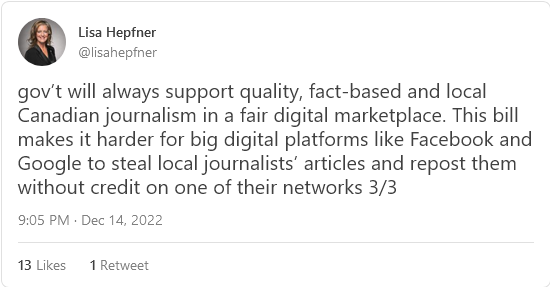
Last month, Liberal MP Lisa Hepfner shocked Canadian online news outlets by stating that “they’re not news. They’re not gathering news. They’re publishing opinion only.” The comments sparked instant criticism from news outlets across the country, leading Hepfner to issue a quick apology. In the aftermath of the comments, Hepfner said nothing for weeks at Heritage committee studying Bill C-18. That bill passed third reading yesterday – I posted on the embarrassing legislative review – and Hepfner was back at it. Rather than criticizing online news outlets, this time she targeted the Internet platforms, saying the bill would make it “harder for big digital platforms like Facebook and Google to steal local journalists’ articles and repost them without credit.”
[…]
Hepfner’s comment not only provide a troubling example of an MP engaging in misinformation about links who has effectively labelled her own Facebook posts as theft, but strikes at the heart of the problem with Bill C-18. As government officials have acknowledged, the entire foundation of the bill is based on paying for links. In fact, when a proposal to remove links from the bill was raised at committee, government MPs described the change as a loophole and voted against it. In the case of the CBC links, the government confirmed that Hepfner could write about the availability of children’s medications (ie. “Great news! CBC reports a million bottles of pain medication are on the way”) but once she added a link to provide a source for the claim, Bill C-18 is triggered.
These examples highlight the absurdity of a law that treats links as compensable and MPs who equate those links to theft. To be clear, there is nothing wrong with Hepfner or anyone else providing a link to a story on greater availability of children’s medicine. In fact, the CBC story has effectively already been paid for by the public and should be shared widely without the government creating barriers to sharing that information. What is wrong that is ill-informed MPs have voted for Bill C-18, creating a framework in which the government is imposing a mandatory payment scheme for some platforms for hosting links. The bill is now headed to the Senate which will hopefully make the necessary amendments to set Hepfner’s mind at ease that her own Facebook posts do not make her an accomplice to theft.
Comments Off on The Online News [Shakedown] Act passes the House of Commons
December 12, 2022
QotD: Oversensitivity is not constrained by the mere passage of time
It seems a reader of the Mercury ran across a brief news item about the suicide of a 16-year-old girl in its pages, and was horrified at the sensational, detailed nature of the report. The story described Dorothy Balchin as being “of a reserved and morbid disposition” and described the romantic disappointment — a beau’s emigration to Australia — that preceded her suicide. The newspaper noted that a photograph of her boyfriend was found immediately below her hanged body, and even printed the text of two notes she left. In other words, the news copy broke every rule that newspapers now normally observe in mentioning suicide.
But of course no one had thought of any of those rules in the year 1912.
Which is when the story had appeared in the Mercury.
Which didn’t stop some reader from complaining to the paper in the year 2019.
Colby Cosh, “Want a newspaper job? Dream of making films? Be careful what you wish for”, National Post, 2019-05-09.
Comments Off on QotD: Oversensitivity is not constrained by the mere passage of time
December 10, 2022
United States Empire – The Spanish-American War
The Great War
Published 9 Dec 2022The Spanish-American War (fought in Cuba and the Philippines) kickstarted US global ambitions and expanded their influence far beyond the borders of the United States. At the same time the war marked the endpoint of the decline of Spain as a global power.
(more…)
Comments Off on United States Empire – The Spanish-American War
December 7, 2022
The media: they hate you, they really hate you
In a follow-up to yesterday’s post at Thank You Truckers!, Donna Laframboise provides more details on one of the individual cases highlighted by Douglas Murray in the Munk Debates last week:
Collectively, those examples demonstrate three things: Egregious journalistic bias. A frightening inability to empathize with the working class. And a bizarre eagerness to slander and dismiss fellow human beings.
Because the examples cited by Murray are vile, I didn’t amplify them. But those of you who watched the three-minute clip heard about them. On further reflection, therefore, I’m going to highlight one of them. Simply to make the point that Murray wasn’t exaggerating. When he used the words rancid and corrupt to describe our current media environment, he was wholly on target. Here’s a small portion of Murray’s remarks, including some third party profanity:
You had a Toronto Star columnist saying, quote (sorry for the language), it’s a homegrown hate farm that was then jet-fuelled by an American right-funded rat-fucking operation …
Yup, that was a real tweet from Bruce Arthur, who earns his living as a sports writer, currently for the Toronto Star. Below is his full reply to comments made by another Canadian journalist, Jeet Heer, who writes for The Nation, a far-left US publication:
I worked with both these gentlemen 20 years ago, in the earliest days of the National Post. It was a large newsroom. I didn’t get to know either of them.
The day after they catapulted these deluded, venomous tweets into the world, I arrived in Ottawa. I spent a week there, taking photos and actually talking to people. The Freedom Convoy protesters I met were supremely decent human beings. Since then, I’ve formally interviewed many of them. I’ve learned about their lives, their triumphs, their troubles, their sorrow.
My conclusion? If I were stranded on a desert island — or if a nuclear bomb detonated anywhere near me — I’d be sticking close to folks like these. People who know how to fix things, how to build things, and how to get things done. People sufficiently concerned about right and wrong to put themselves at risk. People of faith, many of them, who show us religion at its finest — a stable, calming force. A source of courage, strength, and big picture perspective.
Those who protested in Ottawa were human beings, not saints. That’s true of every large gathering. But overwhelmingly, they were decent, salt-of-the-earth people.

Even the members of the Canadian media still trying to be more even-handed in their coverage felt obligated to go looking for the red-hatted Trump supporters, the “hard men”, and the potential trouble-makers to the point that those relatively few people seemed disproportionally represented in the published articles. Of course, all of them spent a lot of time and effort desperately searching for more idiots like that paid government agent who’d briefly been able to get on-camera waving his Nazi flag …
Comments Off on The media: they hate you, they really hate you


