Quotulatiousness

February 1, 2023

It’s the job of the music critic to be loudly and confidently wrong as often as possible

Filed under: Britain, History, Media, USA — Tags: , , , , , — Nicholas @ 03:00

Ted Gioia points out that a lot of musical criticism does not pass the test of time … and sometimes it’s shown to be wrong before the ink is dry:

When I was in my twenties, I embarked on writing an in-depth history of West Coast jazz. At that juncture in my life, it was the biggest project I’d ever tackled. Just gathering the research materials took several years.

There was no Internet back then, and so I had to spend weeks and months in various libraries going through old newspapers and magazines — sometimes on microfilm (a cursed format I hope has disappeared from the face of the earth), and occasionally with physical copies.

At one juncture, I went page-by-page through hundreds of old issues of Downbeat magazine, the leading American jazz periodical founded back in 1934. And I couldn’t believe what I was reading. Again and again, the most important jazz recordings — cherished classics nowadays — were savagely attacked or smugly dismissed at the time of their initial release.

The opinions not only were wrong-headed, but they repeatedly served up exactly the opposite opinion of posterity.

Back in my twenties, I was dumbfounded by this.

I considered music critics as experts, and hoped to learn from them. But now I saw how often they got things wrong — and not just by a wee bit. They were completely off the mark.

Nowadays, this doesn’t surprise me at all. I’m painfully aware of all the compromised agendas at work in reviews — writers trying to please an editor, or impress other critics, or take a fashionable pose, or curry favor with the tenure committee, or whatever. But there is also something deeper at play in these huge historical mistakes in critical judgments, and I want to get to the bottom of it.

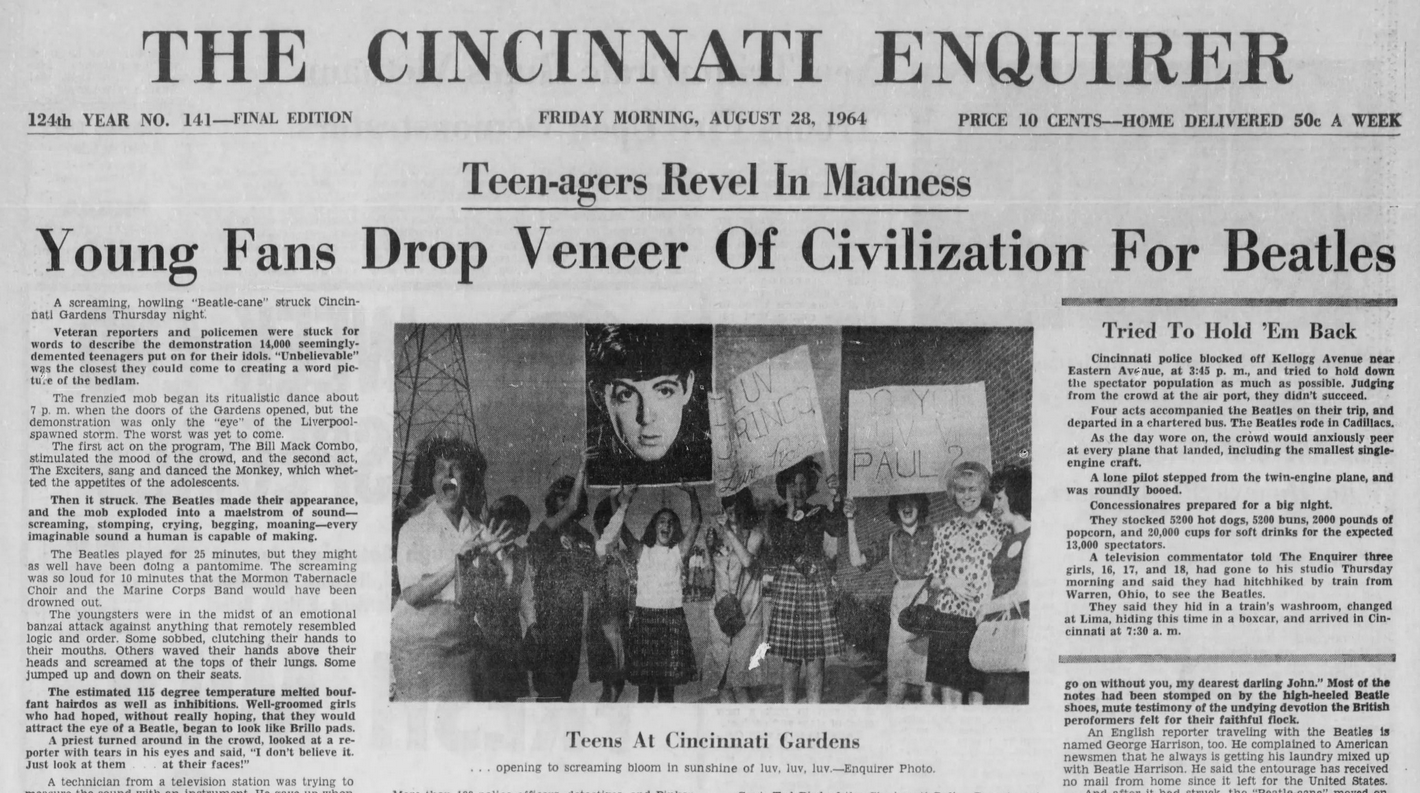
Let’s consider the case of the Beatles.

When the Beatles went on the road, stories like this followed them everywhere

On the 50th anniversary of Sgt. Pepper’s Lonely Hearts Club Band, the New York Times bravely reprinted the original review that ran in the newspaper on June 18, 1967. I commend the courage of the decision-makers who were willing to make Gray Lady look so silly. But it was a wise move — if only because readers deserve a reminder of how wrong critics can be.

“Like an over-attended child, ‘Sergeant Pepper’ is spoiled,” critic Richard Goldstein announced. And he had a long list of complaints. The album was just a pastiche, and “reeks of horns and harps, harmonica quartets, assorted animal noises and a 91-piece orchestra”. He mocks the lyrics as “dismal and dull”. Above all the album fails due to an “obsession with production, coupled with a surprising shoddiness in composition”. This flaw doesn’t just destroy the occasional song, but “permeates the entire album”.

Goldstein has many other criticisms — he gripes about dissonance, reverb, echo, electronic meandering, etc. He concludes by branding the entire record as an “undistinguished collection of work”, and even attacks the famous Sgt. Pepper’s cover — lauded today as one of the most creative album designs of all time — as “busy, hip, and cluttered”.

The bottom line, according to the newspaper of record: “There is nothing beautiful on ‘Sergeant Pepper’. Nothing is real and there is nothing to get hung about.”

How could he get it so wrong?

January 12, 2023

How the New York Times describes the Congressional Republican dissidents

Filed under: Media, Politics, USA — Tags: , , , , , — Nicholas @ 03:00

It’s not the news, it’s the substitution of opinion for reporting:

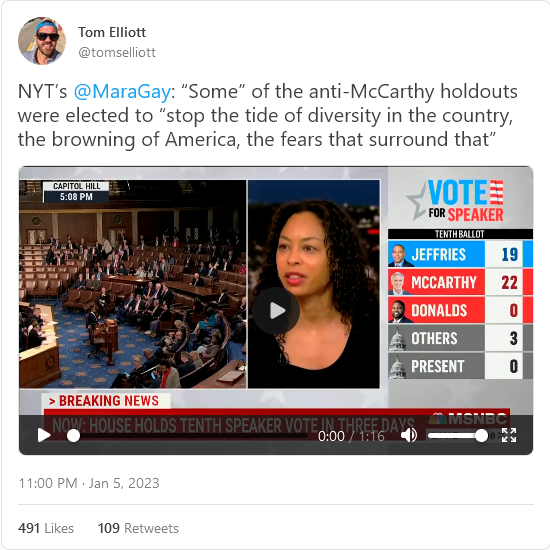
Here’s the political journalist Mara Gay — currently of the New York Times, formerly of the Wall Street Journal and The Atlantic — explaining what the twenty Republican holdouts were up to in their maneuvering over the selection of a Speaker of the House:

It’s leftie Twitter in human form, with all of the slogans. Angry, hateful voters, disturbed by “diversity”, sent some dumb atavists to represent them in D.C., because they hate government and want to “burn it to the ground”. (“And really, that’s what these people were sent to do.”)

Time magazine, which apparently still exists, comes to much the same conclusion, in a piece that I tragically can’t read in full without creating an account, which I wouldn’t do for a free steak dinner or a blanket future pardon from the governor of my choice:

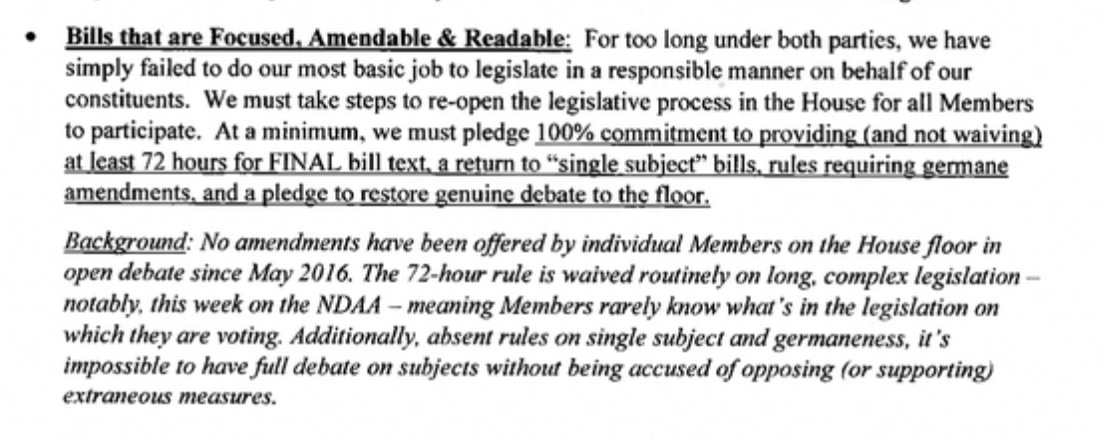
So the twenty GOP holdouts hate government and want to sow chaos and burn democratic norms to the ground, mainstream political journalists calmly explain. Now, via RedState, here’s a letter from seven of the holdouts listing their actual demands as conditions for their vote. Sample demand:

So the monsters who hate government and want to burn it all down were demanding clearly written legislation that every legislator has time to read and fully debate before casting their vote on it.

    Subject of Journalism: We want bills that are focused and readable

    Journalist: They want to destroy all government because of racism

It’s not even sort of an interpretation or an argument about the thing being discussed — it’s just a wholesale invention, completely severed from the thing that’s allegedly being analyzed. It’s like you ordered a tuna melt, so the waitress broke into your house and mailed your couch to Finland. “There’s your tuna melt,” she says, handing you the receipt from the post office. It’s so aggressive a non-sequitur that it would usually suggest the need for a neurology consult. Have you recently suffered a serious fall, Ms. Gay? Have you experienced dizziness or unexplained nause— oh, wait, I see from your chart that you’re just a political journalist.

December 17, 2022

Canada’s consciously anemic foreign and military policies

In The Line, Matt Gurney explains why Canada consistently fails to “punch above their weight” in foreign and military matters and that it’s not at all accidental:

Canadian politicians have an inputs problem. Maybe that’s actually the wrong way to describe it — the problem is with the outputs. But it’s the inputs they love talking about.

If that all sounds a little vague, maybe this sounds familiar: “Hey there, citizen. Alarmed about Troubling Issue X? Well, don’t worry. We’re pledging $300 million over the next six years to Troubling Issue X. Oh, and Annoying Irritant Y? We’re announcing a task force to report back on that.”

Does Troubling Issue X get solved? Does Annoying Irritant Y get less annoying and irritating? Eh. We probably don’t collect enough stats to even know. The purpose of the announcement isn’t to solve the problem. It’s to announce something and hope people stop paying attention.

Canadian politicians — especially the current federal government — are notorious for announcing the same “new thing” in as many ways and in as many different contexts as they can. They get several hundred dollars of positive press coverage for every actual dollar spent on whatever the announced spending is supposed to be devoted toward. If they can recycle announcements from months past into a new set of announcements, you’re pretty much guaranteed they’ll do it. Announcing spending is, one must assume, what gets people to cast their votes for the party announcing the spending.

A lot of what looks like policy failure in Canadian foreign and military affairs only looks like a failure when you forget that accomplishing something wasn’t the point. Being photographed and videotaped saying you’ll accomplish something was the point. And the announcement itself accomplishes that!

This was true even before the Trudeau government started handing out bushel baskets of money to various Canadian newspapers, TV networks, magazines, and other legacy media entities. What was once merely praise is now bought sychophancy from the (literally) paid media.

On the military side of things, the Canadian Armed Forces are an organization the government grudgingly funds, but only enough to look good for the self-same media:

It’s not that Canada accomplishes nothing on the world stage. We accomplish things. Sometimes we even play an outsized role — Canada did, for instance, perform well and above expectations in Kandahar. The odd exception aside, though, when it comes to foreign policy generally and especially with defence policy, successive Canadian governments have set a very clear target: we will do, technically, more than nothing. We won’t often do much more than that. But we’ll do enough to not get kicked out of the club of allied nations.

Why do we want to be in the club? Not because we feel any sense of duty or obligation to lead and take on any real burden. But because being in the club makes us safer, and it would, after all, be embarrassing to get kicked out.

It’s important to remember that Canada is, by any standard, a rich country. We could be an actual force for good and stability on the world stage if we wanted to. We could build a bigger fleet and patrol more places, more often — we’d be welcome! We could have a bigger army and lead more peacekeeping missions, or contribute more to NATO. A bigger air force, likewise, could contribute more to our allies, especially in Europe in these unsettled times. In a parallel universe where we did these things, we’d then be able to say with a straight face that the purpose of Canada’s navy was contributing to the safety and security of the seas, the purpose of our army was to assist allies and provide peacekeepers to help end international crises, and the purpose of our air force was to project power and bring support to threatened allies.

In the world we actually live in, though, the purpose of the navy is to technically have a navy that technically does things, the purpose of the army is to technically have an army that technically does things, and the purpose of the air force … you see where this is going, right?

Our navy does things! It shows up places, and patrols areas. But only as much as necessary to technically tick that box. The army is in much the same condition; with a growing number of domestic commitments sapping its strength and budget, even its ability to assist with disasters at home is largely maxed out, but we send a few hundred soldiers here and there, thereby allowing ourselves to proclaim that we’ve … sent soldiers somewhere. The air force, as was just reported this week, can’t even really do even that much this year. The exhausted force is skipping the very modest — a half-dozen fighter jets — annual mission to Europe. The air force is just too burnt out to sustain even that tiny mission.

This is a big and growing problem. Canada, again, is rich enough to make a difference in global security affairs, if we chose to make different choices with how we spend our money. We have made the opposite choice. We field just enough of a military to be able to make just enough difference to avoid being accused of being total deadbeats, and no more.

Can it fight? Eh, maybe a bit. Can it make a difference? Depends how you define “difference”, I guess. Does it make the world and our allies safer? In a way? Can it keep Canadians safe at home? Sort of.

This isn’t a failure of our policy. This is our policy. We show up with as little as possible for as brief a time as possible, but gosh, do we ever talk about the showing up. 

December 16, 2022

The Online News [Shakedown] Act passes the House of Commons

Filed under: Business, Cancon, Government, Media — Tags: , , , , , , , , — Nicholas @ 03:00

Michael Geist summarizes the farcical progress of Justin Trudeau’s legalized theft from the “tech giants”:

Later today, the House of Commons will vote to approve Bill C-18, the Online News Act, sending it to the Senate just prior to breaking for the holidays. While Canadian Heritage Minister Pablo Rodriguez and media lobbyists will no doubt celebrate the milestone, it should not go unremarked that the legislative process for this bill has been an utter embarrassment with an already bad bill made far worse. The government cut off debate at second reading, actively excluded dozens of potential witnesses, expanded the bill to hundreds of broadcasters that may not even produce news, denigrated online news services as “not real news”, and shrugged off violations of international copyright law. All the while, it acknowledged that mandated payments for links are the foundation of the bill with officials stating that individual Facebook posts accompanied by a link to a news story would be caught by the law. As for the purported financial benefits, the government’s own estimates are less than half those of the Parliamentary Budget Officer, who also concluded that more than 75% of the revenues will go to broadcasters such as Bell, Rogers, and the CBC. The end result is a bill that will undermine competition and pose a threat to freedom of expression, while potentially leading Facebook to block news sharing in Canada and Google to cancel dozens of existing agreements with Canadian news outlets.

As I’ve chronicled for months, Bill C-18 is the product of an intense lobbying campaign from some of Canada’s largest media companies. While the Globe and Mail broke from the pack at the last minute, years of one-sided editorials — even devoting full front pages to the issue — had its effect. Indeed, Canadian newspapers would be exhibit #1 for how government intervention in the media space has a direct impact on an independent press. From the moment of its introduction, the consequences were immediately obvious as payments for links serves as the foundation for a law that treats “facilitating access to news” as compensable. Canadians can be forgiven for thinking the bill is about compensating for reproduction of news stories. It is not, since the platforms don’t do that. Instead, it is about requiring payments for links, indexing or otherwise directing traffic to the news organizations who are often the source of the link itself. In most circumstances, recipients pay for the benefits that come from referral traffic. With Bill C-18, the entities providing the referrals pay for doing so.

Further, the bill is about far more than struggling Canadian newspapers as it expands eligibility into broadcasters such as the CBC, foreign news outlets such as the New York Times, and hundreds of broadcasters licensed by the CRTC that are not even required to produce news. The end goal is negotiated payments for links, backed by the threat of a one-sided arbitration process overseen by the CRTC in which the arbitration panel can simply reject offers if it believes it fails to meet the government’s policy objectives. That isn’t a commercial deal, it is a shakedown.

I’ve been operating on the assumption that the government is betting that the big internet companies won’t do the obvious and ban linking to any Canadian media outlet on their respective platforms, but the feds don’t have a great track record of predictions in recent years …

In a later post, Michael Geist illustrated the literal misinformation that was pushed by government MPs during Bill C-18’s path through to final reading by quoting some of Liberal MP Lisa Hepfner’s contributions:

Last month, Liberal MP Lisa Hepfner shocked Canadian online news outlets by stating that “they’re not news. They’re not gathering news. They’re publishing opinion only.” The comments sparked instant criticism from news outlets across the country, leading Hepfner to issue a quick apology. In the aftermath of the comments, Hepfner said nothing for weeks at Heritage committee studying Bill C-18. That bill passed third reading yesterday – I posted on the embarrassing legislative review – and Hepfner was back at it. Rather than criticizing online news outlets, this time she targeted the Internet platforms, saying the bill would make it “harder for big digital platforms like Facebook and Google to steal local journalists’ articles and repost them without credit.” 

[…]

Hepfner’s comment not only provide a troubling example of an MP engaging in misinformation about links who has effectively labelled her own Facebook posts as theft, but strikes at the heart of the problem with Bill C-18. As government officials have acknowledged, the entire foundation of the bill is based on paying for links. In fact, when a proposal to remove links from the bill was raised at committee, government MPs described the change as a loophole and voted against it. In the case of the CBC links, the government confirmed that Hepfner could write about the availability of children’s medications (ie. “Great news! CBC reports a million bottles of pain medication are on the way”) but once she added a link to provide a source for the claim, Bill C-18 is triggered.

These examples highlight the absurdity of a law that treats links as compensable and MPs who equate those links to theft. To be clear, there is nothing wrong with Hepfner or anyone else providing a link to a story on greater availability of children’s medicine. In fact, the CBC story has effectively already been paid for by the public and should be shared widely without the government creating barriers to sharing that information. What is wrong that is ill-informed MPs have voted for Bill C-18, creating a framework in which the government is imposing a mandatory payment scheme for some platforms for hosting links. The bill is now headed to the Senate which will hopefully make the necessary amendments to set Hepfner’s mind at ease that her own Facebook posts do not make her an accomplice to theft.

December 12, 2022

QotD: Oversensitivity is not constrained by the mere passage of time

Filed under: Britain, History, Media, Quotations — Tags: , , , — Nicholas @ 01:00

This newspaper lost its editor-in-chief and guiding light to academia a few weeks ago, and we — you know, the talent! — are all still moping. Meanwhile, however, the job is open, and is being publicly advertised. The pay is pretty good, but if you are thinking of applying, you should really be conscious of what a top editor has to deal with these days. BBC News provided a good example on Wednesday, offering a brief account of a controversy at the Teesdale Mercury, a rural paper in princely, scenic County Durham. (The county called Durham in England, that is.)

It seems a reader of the Mercury ran across a brief news item about the suicide of a 16-year-old girl in its pages, and was horrified at the sensational, detailed nature of the report. The story described Dorothy Balchin as being “of a reserved and morbid disposition” and described the romantic disappointment — a beau’s emigration to Australia — that preceded her suicide. The newspaper noted that a photograph of her boyfriend was found immediately below her hanged body, and even printed the text of two notes she left. In other words, the news copy broke every rule that newspapers now normally observe in mentioning suicide.

But of course no one had thought of any of those rules in the year 1912.

Which is when the story had appeared in the Mercury.

Which didn’t stop some reader from complaining to the paper in the year 2019.

Colby Cosh, “Want a newspaper job? Dream of making films? Be careful what you wish for”, National Post, 2019-05-09.

December 10, 2022

United States Empire – The Spanish-American War

Filed under: Americas, Asia, Europe, History, Media, Military, USA — Tags: , , , , , , , — Nicholas @ 04:00

The Great War
Published 9 Dec 2022

The Spanish-American War (fought in Cuba and the Philippines) kickstarted US global ambitions and expanded their influence far beyond the borders of the United States. At the same time the war marked the endpoint of the decline of Spain as a global power.
(more…)

December 7, 2022

The media: they hate you, they really hate you

Filed under: Cancon, Media, Politics — Tags: , , , — Nicholas @ 03:00

In a follow-up to yesterday’s post at Thank You Truckers!, Donna Laframboise provides more details on one of the individual cases highlighted by Douglas Murray in the Munk Debates last week:

Collectively, those examples demonstrate three things: Egregious journalistic bias. A frightening inability to empathize with the working class. And a bizarre eagerness to slander and dismiss fellow human beings.

Because the examples cited by Murray are vile, I didn’t amplify them. But those of you who watched the three-minute clip heard about them. On further reflection, therefore, I’m going to highlight one of them. Simply to make the point that Murray wasn’t exaggerating. When he used the words rancid and corrupt to describe our current media environment, he was wholly on target. Here’s a small portion of Murray’s remarks, including some third party profanity:

    You had a Toronto Star columnist saying, quote (sorry for the language), it’s a homegrown hate farm that was then jet-fuelled by an American right-funded rat-fucking operation

Yup, that was a real tweet from Bruce Arthur, who earns his living as a sports writer, currently for the Toronto Star. Below is his full reply to comments made by another Canadian journalist, Jeet Heer, who writes for The Nation, a far-left US publication:

I worked with both these gentlemen 20 years ago, in the earliest days of the National Post. It was a large newsroom. I didn’t get to know either of them.

The day after they catapulted these deluded, venomous tweets into the world, I arrived in Ottawa. I spent a week there, taking photos and actually talking to people. The Freedom Convoy protesters I met were supremely decent human beings. Since then, I’ve formally interviewed many of them. I’ve learned about their lives, their triumphs, their troubles, their sorrow.

My conclusion? If I were stranded on a desert island — or if a nuclear bomb detonated anywhere near me — I’d be sticking close to folks like these. People who know how to fix things, how to build things, and how to get things done. People sufficiently concerned about right and wrong to put themselves at risk. People of faith, many of them, who show us religion at its finest — a stable, calming force. A source of courage, strength, and big picture perspective.

Those who protested in Ottawa were human beings, not saints. That’s true of every large gathering. But overwhelmingly, they were decent, salt-of-the-earth people.

Even the members of the Canadian media still trying to be more even-handed in their coverage felt obligated to go looking for the red-hatted Trump supporters, the “hard men”, and the potential trouble-makers to the point that those relatively few people seemed disproportionally represented in the published articles. Of course, all of them spent a lot of time and effort desperately searching for more idiots like that paid government agent who’d briefly been able to get on-camera waving his Nazi flag …

December 6, 2022

The outcome of the latest Munk Debates

Filed under: Cancon, Media, Politics — Tags: , , , , , , , — Nicholas @ 03:00

Donna Laframboise summarizes what happened last week in the Munk Debates as Matt Taibbi and Douglas Murray spoke in favour of the proposition “Be it resolved, don’t trust mainstream media” while Malcolm Gladwell and Michelle Goldberg argued against:

Last week, an old fashioned public debate took place here in Canada. The topic:

Be it resolved, don’t trust mainstream media.

Journalists Douglas Murray (UK) and Matt Taibbi (US) argued the pro/agree side.

Journalists Malcolm Gladwell (Canada) and Michelle Goldberg (US) argued the con/disagree side.

The event was sponsored by Munk Debates, which has been holding these events since 2008. Before the debate commences, audience members vote. Two hours later, they vote again.

On this occasion, the opinion swing was dramatic. The “don’t trust” side grew by 39% — apparently the largest swing ever in a Munk debate. At the beginning, slightly less than half of the in-house audience held this opinion (48%). Afterward, it was two-thirds (67%).

(When two-thirds of a population agrees on anything, you’re in supermajority territory — a number large enough to change constitutions.)

Here’s the key point: the winning side of the debate placed great emphasis on the scandalous manner in which Canada’s mainstream media covered the Freedom Convoy. Residing as he does in Britain, Douglas Murray had no trouble cutting through the nonsense. In the 3-minute video clip at the top of this post, he says our Prime Minister started by calling protesters names, and ended by invoking the Emergencies Act. Here’s what he says next:

    At such a time, what would the mainstream media do? It would question it. It would question it. The Canadian mainstream media did not.

    The Canadian mainstream media acted as an Amen chorus of the Canadian government. I will give you a couple of examples, but ladies and gentlemen I could go on for hours with examples of this. You had a CBC host describing the Freedom Convoy as a quote feral mob

    Why is this so rancid? Utterly, utterly rancid and corrupt. Because in this country, your media, your mainstream media is funded by the government. A totally corrupted system.

December 2, 2022

Matt Taibbi – “This is not journalism. It’s political entertainment, and therefore unreliable.”

Filed under: Cancon, Media, USA — Tags: , , , — Nicholas @ 05:00

Matt Taibbi posted his opening remarks for the Munk Debate on the topic “Be it resolved: Do not trust the mainstream media”:

President Harry S. Truman holds up an election day edition of the Chicago Daily Tribune, which – based on early results – mistakenly announced “Dewey Defeats Truman.”
AP Photo/Byron Rollins from November 4, 1948, via Wikimedia Commons

I love the news business. It’s in my bones. But I mourn for it. It’s destroyed itself.

My father had a saying: “The story’s the boss.” In the American context, if the facts tell you the Republicans were the primary villains in this or that disaster, you write that story. If the facts point more at Democrats, you go that way. If it turns out they’re both culpable, as was often the case for me across nearly ten years of investigating Wall Street and the causes of the 2008 crash for Rolling Stone, you write that. We’re not supposed to nudge facts one way or another. Our job is to call things as we see them and leave the rest up to you.

We don’t do that now. The story is no longer the boss. Instead, we sell narrative, as part of a new business model that’s increasingly indifferent to fact.

When there were only a few channels, the commercial strategy of news companies was to aim for the whole audience. A TV news broadcast aired at dinnertime and was designed to be consumed by the whole family, from your crazy right-wing uncle to the sulking lefty teenager. This system had its flaws. However, making an effort to talk to everybody had benefits, too. For one, it inspired more trust. Gallup polls twice showed Walter Cronkite of CBS to be the most trusted person in America. That would never happen today.

[…]

Our colleagues on the other side tonight represent two once-great media organizations. Michelle, the Pew survey says the audience for your New York Times is now 91% comprised of Democrats. Malcolm, the last numbers I could find for the New Yorker were back in 2012, and even then, only 9% of the magazine’s readers were Republicans. I imagine that number is smaller now.

This bifurcated system is fundamentally untrustworthy. When you decide in advance to forego half of your potential audience, to fulfill the aim of catering to the other half, you’re choosing in advance which facts to emphasize and which to downplay. You’re also choosing which stories to cover, and which ones to avoid, based on considerations other than truth or newsworthiness.

This is not journalism. It’s political entertainment, and therefore unreliable.

With editors now more concerned with retaining audience than getting things right, the defining characteristic across the business — from right to left — is inaccuracy. We just get a lot of stuff wrong now. It’s now less important for reporters to be accurate than “directionally” correct, which in center-left “mainstream” media mostly comes down to having the right views, like opposing Donald Trump, or anti-vaxxers, or election-deniers, or protesting Canadian truckers, or any other people deemed wrongthinkers.

In the zeal to “hold Trump accountable”, or oppose figures like Vladimir Putin, ethical guardrails have been tossed out. Silent edits have become common. Serious accusations are made without calling people for comment. Reporters get too cozy with politicians, and as a result report information either without attribution at all or sourced to unnamed officials or “people familiar with the matter”. Like scientists, journalists should be able to reproduce each other’s work in the lab. With too many anonymous sources, this becomes impossible.

November 30, 2022

James Gillray

Filed under: Books, Britain, History, Media, Politics — Tags: , , , , , — Nicholas @ 03:00

In The Critic, James Stephens Curl reviews a new biography of the cartoonist and satirist James Gillray (1756-1815), who took great delight in skewering the political leaders of the day and pretty much any other target he fancied from before the French Revolution through the Napoleonic wars:

During the 1780s Gillray emerged as a caricaturist, despite the fact that this was regarded as a dangerous activity, rendering an artist more feared than esteemed, and frequently landing practitioners into trouble with the law. Gillray began to excel in invention, parody, satire, fantasy, burlesque, and even occasional forays into pornography. His targets were the great and good, not excepting royalty. But his vision is often dark, his wit frequently cruel and even shockingly bawdy: some of his own contemporaries found his work repellent. He went for politicians: the Whigs Charles James Fox (1749-1806), Edmund Burke (1729-97), and Richard Brinsley Butler Sheridan (1751-1816) on the one hand, and William Pitt (1759-1806) on the other. Fox was a devious demagogue (“Black Charlie” to Gillray); Burke a bespectacled Jesuit; and Sheridan a red-nosed sot. But Gillray reserved much of his venom for “Pitt the Bottomless”, “an excrescence … a fungus … a toadstool on a dunghill”, and frequently alluded to a lack of masculinity in the statesman, who preferred to company of young men to any intimacies with women, although the caricaturist’s attitude softened to some extent as the wars with the French went on.

As the son of a soldier who had been partly disabled fighting the French, Gillray’s depictions of the excesses of the Revolution were ferocious: one, A Representation of the horrid Barbarities practised upon the Nuns by the Fish-women, on breaking into the Nunneries in France (1792), was intended as a warning to “the FAIR SEX of GREAT BRITAIN” as to what might befall them if the nation succumbed to revolutionary blandishments. The drawing featured many roseate bottoms that had been energetically birched by the fishwives. He also found much to lampoon in his depictions of the Corsican upstart, Napoléon.

[…]

Some of Gillray’s works would pass most people by today, thanks to the much-trumpeted “world-class edication” which is nothing of the sort: one of my own favourites is his FASHIONABLE CONTRASTS;—or—The Duchefs’s little Shoe yeilding to the Magnitude of the Duke’s Foot (1792), which refers to the remarkably small hooves of Princess Frederica Charlotte Ulrica Catherina of Prussia (1767-1820), who married Frederick, Duke of York and Albany (1763-1827) in 1791: their supposed marital consummation is suggested by Gillray’s slightly indelicate rendering, in which the Duke’s very large footwear dwarfs the delicate slippers of the Duchess.

“In 1791 and 1792, there was no one who received more attention in the British press than Frederica Charlotte, the oldest daughter of the King of Prussia, whose marriage to the second (and favorite) son of King George and Queen Charlotte, Prince Frederick, the Duke of York set off a media frenzy that can only be compared to that of Princess Diana in our own day.”
Description from james-gillray.org/fashionable.html

All that said, this is a fine book, beautifully and pithily written, scholarly, well-observed, and superbly illustrated, much in colour. However, it is a very large tome (290 x 248 mm), and extremely heavy, so can only be read with comfort on a table or lectern. The captions give the bare minimum of information, and it would have been far better to have had extended descriptive captions under each illustration, rather than having to root about in the text, mellifluous though that undoubtedly is.

What is perhaps the most important aspect of the book is to reveal Gillray’s significance as a propagandist in time of war, for the images he produced concerning the excesses of what had occurred in France helped to stiffen national resolve to resist the revolutionaries and defeat them and their successor, Napoléon, whose own model for a new Europe was in itself profoundly revolutionary. What he would have made of the present gang of British politicians must remain agreeable speculation.

November 29, 2022

In a dangerous and insecure world, the EU appears to feel that the greatest enemy is on the other side of the Atlantic

Filed under: Europe, France, Germany, Media, Politics, USA — Tags: , , , , — Nicholas @ 05:00

CDR Salamander on how the EU’s movers and shakers (i.e., mostly not democratically elected leaders) seem to have decided that their one true enemy is the United States:

If you are an American who lived on the European Continent, specifically Western Europe, you’re very familiar with an exceptionally sharp strain of anti-Americanism that resides in a significant percentage of their ruling elite – an adult version of the middle school mean girls. Though present in all nations to one degree to another, it is especially acute in Germany and France for slightly different reasons but are all working towards the same goal; degrade American influence in Europe.

The best way for this political and corporate anti-Americanism to find a lever of power is through the the trans-national and anti-democratic modern iteration of the European Union – made even more problematic with the departure of Great Britain who once played a balancing role between the Continental powers as she has for centuries.

Why primarily France and Germany? To start with, this is part of the sibling rivalry between the children of Charlemagne for primacy in Europe that has churned Europe over the last thousand years. The Anglo-Saxons on both sides of the Atlantic kept getting in the way of their return to the struggle.

Their armies under various blood-soaked leaders moved across Iberia to Moscow and back for centuries in order to be THE driver of power in influence on the continent. The European Union, once the “trade association” nose was in the tent, is now seen – fairly – as a mechanism to centralize power so The Smartest People in the Room™ no longer have pesky minor powers and – Buddha forgive – voters getting in their way. Without checks, power only seeks more power for itself. The morphing of the EU is just the latest example.

Not unlike their American counterparts who would like the USA to extract itself from foreign entanglements (NB: as I have written through the years, I am sympathetic/supportive of these efforts), many of the strongest proponents of the EU just want the USA to go home.

The Europeans, while benefiting from the WWII/Cold War leftover presence of the USA, want it to end and the influence that comes with it. If any opportunity to push back against the USA appears, they have their talking points ready to dirty up the reputation and standing of the USA. If that can be done while blaming Eurocrat failures on the USA as well, even better.

You know the Americans, citizens of that mongrel nation whose gene pool is full of religious zealots, failed revolutionaries, slaves, economic refugees, grasping second sons, criminals, and their descendants – spoiled with a continent overflowing with food, water, minerals, forests and open land they don’t even appreciate.

Loud. Fat. Pushy. Americans.

The usual snarled insults cobbled together by smug people who get much of their opinions of the USA by reading The Washington Post or The New York Times. “I know America, I read your newspapers.” That is right after, “I’ve been to America. I spent a week in DC/NYC/Boston/Chicago. I studied a semester at Brown.”

[…]

The smaller European nations don’t trust France and Germany all that much, for good historical reasons. Most of the Europeans in the “new territories” in the east like the USA. They see the Americans as a more reliable guarantee of safety from hostile powers in the East, having a few centuries of experience of the Western European Frankish tribes carving them up for fun and profit – irrespective of local desires. Collectively these nations are not that large in GDP or population – not much more than Italy (for now), but that’s OK. They have the correct geography.

If we shape this relationship correctly, we don’t have to permanently garrison this part of Europe. Poland is already establishing a new paradigm of proper levels of security investment. Once NATO’s eastern front calms down a bit, we can rotate through forces for exercises and training. Perhaps even create some combined training and logistics bases ready to scale up in case of trouble in Mordor. A template we should have put in place in Western Europe decades ago.

Reward positive behavior and let the French and Germans continue their millennium-length struggle – peaceful this time – in the west; keep them frothing in Brussels and Strasbourg while the forward-looking nations try to set up the next thousand years of Western progress in a positive direction.

Perhaps.

November 26, 2022

Britain’s experiment with mass immigration since 2014

Filed under: Britain, Economics, Europe, Media — Tags: , , , , , , — Nicholas @ 03:00

Ed West considers the legacy media’s quick dismissal of conservative concerns about rising immigration from poorer European countries in 2014 with the reality only eight years later:

“Xenophobia” by malias is licensed under CC BY 2.0 .

It was a sort of mini-publicity stunt by Vaz, but all for a good cause: a response to fear mongering by the Right-wing press who warned that we’d be “flooded” by Romanians, and predictions by MigrationWatch that’d we have 50,000 new arrivals a year from the A2 countries (as Romania and Bulgaria were called).

Twitter that day was full of journalists and other public intellectuals laughing about how we were going to be “swamped”. Why would Romanians, after all, want to come here, to this miserable rainy island?

“We’ve seen no evidence of people who have rushed out and bought tickets in order to arrive because it’s the 1st of January,” Vaz concluded.

Various publications, with the ill-founded confidence so often found in the journalist trade, soon declared that the Romanian influx was a conservative fantasy.

“Eastern European invasion comes to nothing”, the Independent declared on the day, just a tad prematurely you might say.

A Guardian commentator suggested the year before that the number of Romanians and Bulgarians arriving might actually fall following accession, and that “all the ‘invasion’ predictions … have more in common with astrology than demography.”
[…]

As it turned out, in the year to September 2015, 206,000 Romanians and Bulgarians took out a National Insurance number, meaning they were registering to work here. By late 2017, there were 413,000 Romanian and Bulgarians living in Britain, suggesting 90,000 had arrived each year since January 2014, while just 6,200 Britons had made the opposite journey.

By mid-2018, there were more than 400,000 Romanians in Britain, making them one of the largest national minorities in England. The real figure is hard to tell, because the British state has lost the capacity or will to count the number of foreign residents, and it may be higher.

[…]

The scale of immigration in the 2000s and 2010s led to the rise of Ukip, the referendum and the political chaos that followed; what follows now we can’t yet say, but no one has seemed to have learned the lesson: that in the 21s century, because of easier travel, smartphones, smuggling networks and establishment communities in the West, the sheer scale of potential migration is astronomical. Yet people often have a very 20th or even 19th century understanding of how much people are able and willing to move, which makes them vastly underestimate the potential numbers arriving.

The Turkish Cypriots of north London are a case in point, the example Paul Collier used in Exodus to show the huge extent of potential migration between countries with different levels of wealth. 

Because of colonial links, North Cyprus had free movement with Britain and so provided a test case: as a result, there are now more Turkish Cypriots in Britain than in Cyprus. In fact, not only did the majority of Turkish Cypriots move, but back in their homeland they become outnumbered by arrivals from a third, even poorer country, mainland Turkey, who are permitted to settle there.

In a theoretical world of open borders, Britons would be outnumbered very quickly; infrastructure would start to buckle under the strain, and governments would find it difficult to increase the necessary number of houses, schools, hospitals and other services for this expanded population, because society would now lack the social capital and cohesion to make the personal sacrifices. People would begin to lose faith in the police, a difficult role in such a transient and diverse society, and politics would become increasingly unstable and aligned along ethnic lines.

November 17, 2022

“The most disturbing concept Freud ever invented – and he had a few, that bloke – is Thanatos, or the ‘death instinct'”

Filed under: Books, Business, Education — Tags: , , , — Nicholas @ 03:00

Ted Gioia on the apparent death wish of the academic publishing industry:

The most disturbing concept Freud ever invented — and he had a few, that bloke — is Thanatos, or the “death instinct”. This is an alleged drive among living organisms to destroy themselves.

Many have disputed that such a thing exists. Instincts preserve life — that’s their evolutionary purpose. The idea of a death instinct is impossible, so the critics claim. It’s like that Peacekeeper Missile or soft rock or marijuana initiative or any of those other two-word combinations of things that don’t belong together.

I’ve often criticized Freud, but I’ve come to accept this Thanatos notion, at least as a sociocultural concept. It explains so many otherwise inexplicable happenings in our society.

Take, for example, academic publishers. They are clearly imbued with a death instinct, no? How else can you explain their self-destructive behavior?

Universities have been publishing books for almost 500 years — dating back to 1534 A.D. when King Henry VIII allowed Cambridge University to set up a printing press. Running one of these publishing outfits is almost a requirement if a college wants to rise in the rankings, but I wonder how much longer this can last. After all, how can you succeed as a publisher if you put so little energy into selling books?

I know one academic publisher that previously sent out two hundred or more review copies of each new book — because they obviously wanted publicity for these titles. Those days are gone. Nowadays their preferred strategy is to send out zero physical copies to reviewers. I’m not exaggerating — I’ve heard it straight from their mouths: their goal is to distribute absolutely no hard copies to media outlets and book critics.

    College students are spending 26% less on textbooks this year. That’s a bloodbath for the publishers. But this is the inevitable result whenever you assume the customer has no choice — because, sooner or later, they actually do.

Okay, I don’t blame the publishers entirely — just consider how rarely the New York Times reviews books from academic presses. You might think the cultural elites in New York would give some support to their fellow travelers in idea-mongering, but no dice. They treat those academic books like they’re toxic.

(By the way, I’m grateful to the Times Literary Supplement over in London, which still takes time to tell me about important scholarly works, most of them ignored in US media. But even that last holdout in Britain feels precarious — I fear they’ve been too contaminated by Yankee values.)

Yankee values? That’s up there with the Peacekeeper Missile.

But the lack of review copies is just one symptom among many. Let’s look at a few others.

Just consider the flurry of rebranding efforts in academic publishing. As I’ve explained elsewhere, successful organizations rarely redesign their logos or “refresh” their brands. They don’t have time for such nonsense. But even more to the point, when you’re thriving, your logo is part of that success — it’s a sign of your strength, and you just don’t mess with it.

But that’s clearly not the case in academia nowadays.

I could give you countless examples from college campuses — where “rebranding” is more popular than a hot high school football prospect on a recruiting visit. But I’ll settle for two instances:

My only disappointment is that these brand redesigns didn’t come packaged with a new slogan. May I suggest something along the lines of: Information Solutions for a Changing World.

Or maybe, if we can be a bit more boastful: The Ultimate in Handheld Data Storage.

Does anybody still believe in this rebranding malarkey? Surely any reasonable person can see it’s all smoke and mirrors? But that hardly matters, because the brand redesign has tremendous symbolic value.

That’s why they do it.

The road to hell was once paved with good intentions — but nowadays we settle for symbolic gestures. They’re much cheaper than good intentions. And there’s no shortage of symbolic gestures nowadays — more than enough to pave that whole damned highway to hell.

It’s a shame that symbolism doesn’t pay the bills. Or fix problems. And it certainly won’t sell books.

November 16, 2022

“Angertainment is unlikely the sole cause of US political polarisation, but it certainly hasn’t helped”

Filed under: Media, Politics, USA — Tags: , , , , , — Nicholas @ 03:00

At Quillette, Claire Lehmann rounds up the rising distrust/disgust among the American public in their views of the legacy media:

In October, a study published in PLOS One provided some fresh insight into how and why American media has become so dysfunctional. Over the past 20 years, the study reported, headlines that convey anger, fear, sadness, and disgust have been increasing, while headlines conveying neutrality or joy have been in decline. These trends have coincided with a massive drop in trust in news journalism, particularly in the US.

According to Gallop polling, seven percent of Americans say they have “a great deal” of trust in the media, while 38 percent say they have none at all. As angertainment has increased, trust has decreased. As one political tribe provides angertainment for its loyal readers and viewers, the other becomes increasingly alarmed and disgusted. Angertainment may be profitable for journalism in the short-term but over the long-term it trashes the integrity of the profession.

Angertainment is unlikely the sole cause of US political polarisation, but it certainly hasn’t helped. Just as mad cow disease was caused by feeding bovine-meal to cows, angertainment feeds on polarisation which in turn feeds on angertainment. It’s a cannibalistic cycle.

[…]

The incentives for journalism are broken. This is not always the fault of individual journalists, although some strive for truth and accuracy with more sincerity than others. Nor is it solely the fault of media companies, although many of them prioritise profit and engagement over rigour and fairness. It is not even the fault of “Big Tech”, even though social media companies have built the machine on which these broken incentives run.

It’s the fault of all of us. We are the ones who devour angertainment and get high on watching our enemies suffer. We are the ones who want to see various idiots eviscerated and dismembered by the bayonets of Twitter. We are the ones who clamour after content which makes us feel virtuous, complacent, and like we belong. The 20-year incline in headlines denoting fear, anger, disgust, and sadness in American media would not have occurred if audiences had not been rewarding it. In a competitive eco-system, media organisations must adapt to their audiences, feed them what they want, or die. But like the cows feeding on the meat-and-bone meal of other cows, this feedback loop creates the cultural equivalent of a neurodegenerative disease.

I have been just as guilty of this as any other publisher, consumer, or creator of media. But in recent months I’ve largely stepped back from social media, stood outside this machine, and have watched it whir and whizz from the sidelines. It is possible to disengage and reconsider the machine from a safe distance, starving it of fuel. And every day at Quillette I am reminded by my writers and readers and subscribers that it is possible to publish and create journalism that is appreciated for its analytical and aesthetic value, rather than for the artillery it provides in a never-ending culture war. It’s a war in which facts and reputations exist merely as cannon fodder, and where truth is less important than tribe. The media’s incentives may be broken, but we as individuals do not have to be.

November 8, 2022

The inevitable next act of the media subsidy game – “Before long we will be back for more”

Filed under: Business, Cancon, Government, Media, Technology — Tags: , , , , , , — Nicholas @ 05:00

In The Line, Peter Menzies outlines the state of play in the continued efforts of the federal government to pass C-18, a bill that will massively benefit certain media outlets … or convince the “tech giants” to pull out of the Canadian market altogether rather than pay the blackmail:

News Media Canada’s persistent campaigning finally produced its Holy Grail — Bill C-18. All might have been well for Torstar, Postmedia and Le Devoir except that once the flesh was thrown on the bones of the Act, broadcasters that aren’t facing economic peril heard the dinner bell and came running.

The result, according to the Parliamentary Budget Officer, is that Bill C-18 is expected to produce $329 million in annual revenue for Canadian media (for context, that’s less than the Calgary Herald, Edmonton Journal, Edmonton Sun and Calgary Sun were bringing in between them 20 years ago). Of that, $249 million will go to broadcasters, few of whom are on a fiscal ledge and a good many of whom have contributed to the demise of local newspapers. Remarkably, the CBC, already receiving $1 billion in taxpayer funding, will get the most of that cash, followed by CTV (Bell), Rogers, Videotron and others. The newspapers and start ups will have $80 million (a little more than what the Edmonton Journal and Edmonton Sun used to make in combined annual profit) to fight over.

And very few of those previously mentioned startups — run by mostly young and often female innovators — trying to find a sustainable business model for good journalism can expect anything more than a token pay off. No. They will have to go to the little kids table and see what they can find on the children’s menu of subsidies.

It is distressingly obvious that while so many were tricked into believing this was the most progressive Canadian government ever, it is in fact, a slave to the status quo; as staunch a defender of the corporate establishment as the Toronto Club could wish for. With the 21st century and all its opportunities staring it in the face, Justin Trudeau’s government has not only turned its back on innovation, it has put its thumb on the scale in favour of failed business models that long ago ran out of ideas.

Yet there may be a final twist in this tale.

Bill C-18’s particulars are, as Meta/Facebook’s Kevin Chan put it to a Parliamentary committee last week “globally unprecedented”. For all its sins — and for all we know there are a few more skeletons rattling around in its closet — Meta is unlikely to pay up. Sure, it can cover the Canadian shakedown; what it can’t afford though is to pay every other country in the world that makes the same demand. So Meta says it may simply stop serving up news links which, when you think about it, is a better idea in the long run than permanently entrenching its dominant market position

So while the publishers of those blank pages appear to have bullied even the Conservatives into supporting this travesty, they are still left to ponder:

“Imagine if Facebook wasn’t there.”

« Newer PostsOlder Posts »

Powered by WordPress