
Work outwards from this change and you will begin to have some idea of how much Britain has altered. The bits you don’t or can’t see are as unsettlingly different as those tattoos. Look up instead at the Houses of Parliament, all pinnacles, leaded windows, Gothic courtyards and cloisters, which look to the uninitiated as if they are a medieval survival. In fact they were completed in 1860, and are newer than the Capitol in Washington, D.C. The only genuinely ancient part — not used for any governing purpose — is the astonishing chilly space of Westminster Hall, faintly redolent of the horrible show trial of King Charles I, still an awkward moment in the national family album. But those who chose the faintly unhinged design wanted to make a point about the sort of country Britain then was, and they were very successful. Gothic meant monarchy, Christianity, and conservatism. Classical meant republican, pagan, and revolutionary, and mid-Victorian Britain was thoroughly wary of such things, so Gothic was chosen and the Roman Catholic genius Augustus Welby Pugin let loose upon the design. Wherever you are in the building, it is hard to escape the feeling of being either in a church, or in a country house just next to a church. The very chimes of the bell tower were based upon part of Handel’s great air from The Messiah: “I know that my Redeemer liveth”.
I worked for some years in this odd place. It is by law a Royal Palace, so nobody was ever officially allowed to die on the premises, in case the death had to be inquired into by some fearsome, forgotten tribunal, perhaps a branch of Star Chamber. Those who appeared to have deceased were deemed to be still alive and hurried to a nearby hospital where life could be pronounced extinct and an ordinary inquest held. We were also exempt from the alcohol laws that used in those days to keep most bars shut for a lot of the time, and if the drinks were not free they were certainly amazingly cheap.
In my years of wandering its corridors and lobbies, of hanging about for late-night votes and dozing in committee rooms, I came to loathe British politics and to mistrust the special regiment of journalists (far too close to their sources) who write about it. I had hoped for a kingdom of the mind and found a squalid pantry in which greasy, unprincipled deals were made by people who were no better than they ought to be.
But I came to love the building. Once you had got past the police sentinels, who knew who everyone was, you could go everywhere, even the thrilling ministerial corridor behind the Speaker’s chair, from which Prime Ministers emerged to face what was then the genuine ordeal of Parliamentary questions, twice a week. There was a rifle range beneath the House of Lords, set up during World War I to make sure honorable members of both Houses would be able to shoot Germans accurately if they ever met any. There was a room where they did nothing but prepare vast quantities of cut flowers, and which perfumed the flagstone corridor in which it lay. There was a convivial staff bar (known to few) where the beer was the best in the building and politicians in trouble would hide from their colleagues. The Lords had a whole half of the Palace, with lovely murals illustrating noble moments of our history, and the Chief Whip’s cosy, panelled office where reporters would be summoned once a week for dangerous gossip and perilously large glasses of whisky or very dry sherry, generously refilled. And high up in the roof, looking down over the murky Thames, was the room where the government briefed us, in meetings whose existence we were sworn never to reveal. Now they are pretty much public, so the real briefings must happen somewhere else, I suppose.
Peter Hitchens, “An Empty Parliament”, First Things, 2017-10-03.
December 11, 2023
QotD: The Palace of Westminster
December 9, 2023
The coming Micro-Macro culture war … and who’s going to win it
Ted Gioia outlines the dismal state of the “macro” culture — television, movies, newspapers, book publishing and all the big corporations that control them — with the dynamism of the “micro” culture:
In the beginning, all culture was microculture.
You knew what was happening in your tribe or village. But your knowledge of the wider world was limited.
So you had your own songs and your own stories. You had your own rituals and traditions. You even had your own language.
But all these familiar things disappeared when you went off into the world. That was dangerous, however. That’s why only heroes, in traditional stories, go on journeys.
You learn on the journey. But you might not survive.
But all that changed long before I was born.
In my childhood, everything was controlled by a monoculture. There were only three national TV networks, but they were pretty much the same.
When I went to the office, back then, we had all watched the same thing on TV the night before. We had all seen the same movie the previous weekend. We had all heard the same song on the radio while driving to work.
The TV shows were so similar that they sometimes moved from CBS to NBC, and you never noticed a change. The newscasters also looked pretty much the same and always talked the same — with that flat Midwestern accent that broadcasters always adopted in the US.
The same monoculture controlled every other creative idiom. Six major studios dominated the film business. And just as Hollywood controlled movies, New York set the rules in publishing. Everything from Broadway musicals to comic books was similarly concentrated and centralized.
The newspaper business was still local, but most cities had 2 or 3 daily newspapers — and much of the coverage they offered was interchangeable. Radio was a little more freewheeling, but eventually deregulation allowed huge corporations to acquire and standardize what happened over the airwaves. [NR: I suspect the “freewheeling” went away once the government started imposing regulations, and the corporate consolidation was enabled when they “deregulated” the radio licensing regime several decades later.]
When I went to work in an office, back then, we had all watched the same thing on TV the night before. We had all seen the same movie the previous weekend. We had all heard the same song on the radio while driving to work.
And that’s why smart people back then paid attention to the counterculture.
The counterculture might be crazy or foolish or even boring. But it was still your only chance to break out of the monolithic macroculture.
Many of the art films I saw at the indie cinema were awful. But I still kept coming back — because I needed the fresh air these oddball movies provided. For the same reason, I read the alt weekly newspapers and kept tabs on alt music.
In fact, whenever I saw the word alt, I paid attention.
That doesn’t mean that I hated the major TV networks, or the large daily newspaper, or 20th Century Fox. But I craved access to creative and investigative work that hadn’t been approved by people in suits working for large organizations.
The Internet should have changed all this. And it did — but not much. Even now the collapse in the monoculture is still in its early stages.
But that’s about to change.
If you don’t pay close attention, the media landscape seems pretty much the same now as it did in the 1990s. The movie business is still controlled in Hollywood. The publishing business is still controlled in New York. The radio stations are still controlled by a few large companies. And instead of three national TV networks plus PBS, we have four dominant streaming platforms — who control almost 70% of the market.
So we still live in a macro culture. But it feels increasingly claustrophobic. Or even worse, it feels dead.
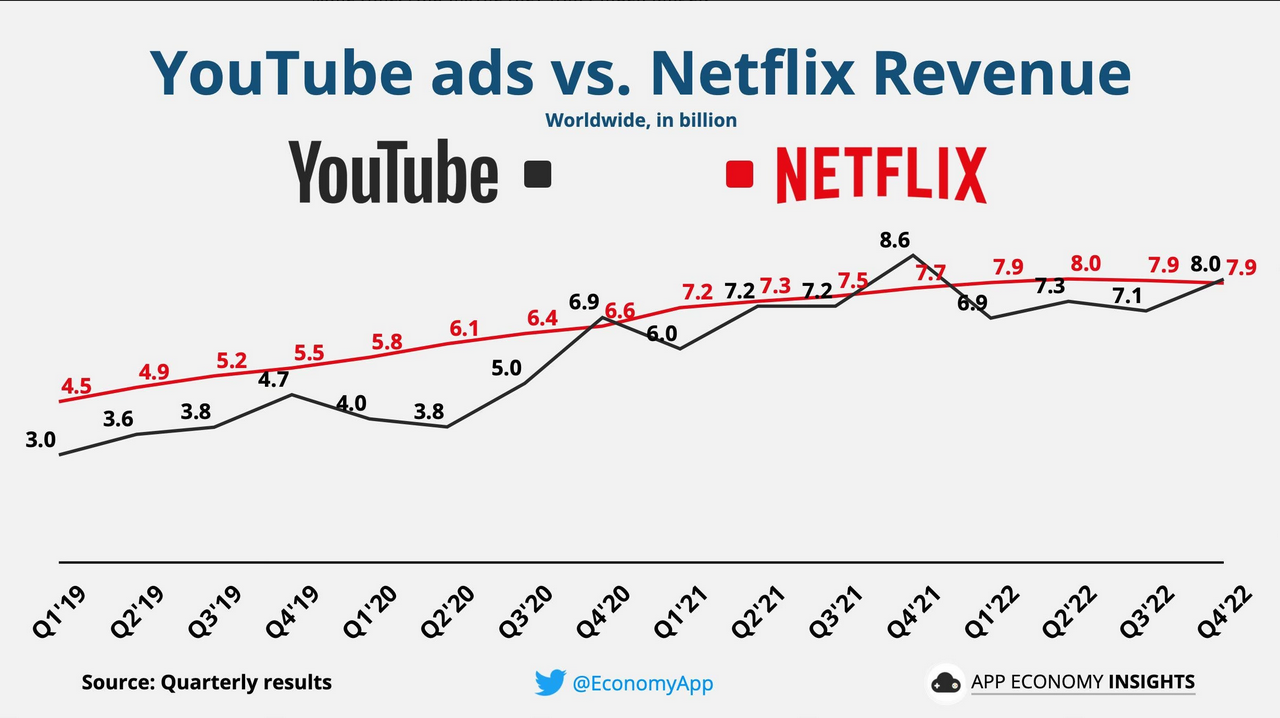
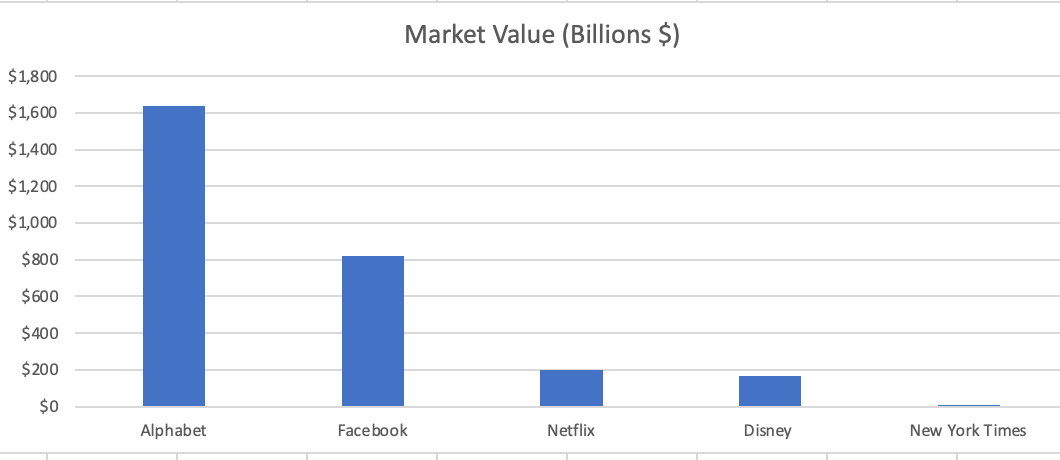
Meanwhile, a handful of Silicon Valley platforms (Google, Facebook, etc.) have become more powerful than the New York Times or Hollywood studios or even Netflix. It’s not even close — the market capitalization of Google’s parent Alphabet is now almost ten times larger than Disney’s.
But here’s the key point — these huge tech companies rely on the microculture for their dominance.
Where is Facebook without users contributing photos, text and video? Where is Google’s YouTube without individual creators?
In terms of economic growth or audience capture, the microculture has already won the war. But it doesn’t feel that way.
Why not?
First and foremost, Silicon Valley is a reluctant home for the microculture. To some extent Alphabet and Facebook are even going to war with microculture creators — they try to make money with them even while they punish them.
- So Mark Zuckerberg needs creators, but won’t even let them put a live link on Instagram and limits their visibility on Facebook and Threads.
- Alphabet needs creators to keep YouTube thriving, but gives better search engine visibility to total garbage that pays for placement.
- Twitter also claims it wants to support independent journalists — but if you’re truly independent from Elon Musk, your links are brutally punished by the algorithm.
This tension won’t go away, and next year it will get worse. The microculture will increasingly find itself at war with the same platforms they rely on today.
And legacy media and non-profits are even more hostile to emerging media. Go see who wins Pulitzer Prizes, and count how many journalists on alternative platforms get honored.
I’ll save you the trouble. They don’t.
December 2, 2023
QotD: Western media and Putin’s war
Regarding [Vladimir Putin’s] Magical Mystery War, I’m going with the stoyak that the casualty counts peddled by the [western media] is part of a very very old playbook which various Western observers have peddled since 1905-that of Russian stupidity and indifference to casualties. Russia loses a war? They’re stupid gopniks who flung their soldiers into meat grinders until they rebelled (1905 or 1917). Russia wins a war? They’re stupid gopniks who flung their soldiers into meat grinders until they won (1945, 2023). Note that you can effortlessly pivot your propaganda when it becomes obvious in hindsight the outcome of the war. This becomes very important when [Putin] negotiates his 18th century kabiniettskreig ending to the war, since nobody in the West, especially AINO, understands how a cabinet war is fought, much less ends. They will claim that they foiled Putin’s plan for conquering all Ukraine (which he never has wanted) by killing hundreds of thousands of poor, oppressed, stupid, vodka-fueled gopniks used as cannon fodder who simply overwhelmed the valiant forces of good by sheer numbers. Not by superior strategy or tactics, or weapons, but the good ol’ Russian sledgehammer. Just like Hitler’s excuse in 1945, when Ivan was knock knock knockin’ on his bunker door. His generals who survived carried that piece of gospel West when the US Army started studying how to fight the Reds and asked the Germans how they did it. Their answer was happily embraced by the next generation of Very Clever Boys in the 1960s and carried forward to today’s Fistagon — Wunderwaffen.
Pickle Rick, commenting on “Friday Mailbag”, Founding Questions, 2023-12-01.
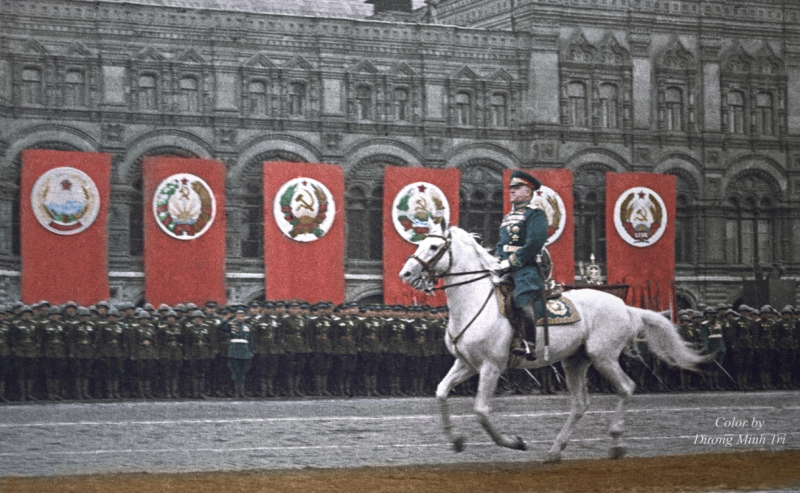
Rick agreed to me posting this quote as long as I included this colourized photo of Marshal of the Soviet Union Georgy Zhukov (“because it’s gangsta as FUCK”)
November 25, 2023
“Three or more reporters, arranged in a scrum … are dumber together than any of them alone”
I’m not a fan of the legacy media, although I’ve met good folks who worked or still work in the field, and the modern incarnation of the media has become so much more transparently a PR team for the big progressive wet dreams of bigger and bigger government and more and more centralized control over peoples’ lives. I’ve never met Paul Wells, but he’s respected by some of the media people I’ve met and generally has interesting things to say, perhaps more so that he’s his own boss and publishes on Substack these days:

Images returned for an image search for “Stephen Harper media scrum”
One reason I don’t like to play along with subscribers who assume this newsletter is a running critique of “the mainstream media” is that I know too many journalists. The best ones are wonderful and most are fine. Most are better at some part of the craft than I am. They don’t hesitate to make that fourth or fifth call, they’re forever willing to butt their heads against the surreal access-to-information regime, they understand interest rates, whatever. They often (not always!) admit errors publicly, which gives the occasional schoolyard bully a chance to make fun of them for doing what bullies never do. Many have an appropriately tragic sense of what it means to work in an industry that has been collapsing for 20 years.
But as a robust rule, reporters don’t mass well. Three or more reporters, arranged in a scrum — the term of art for an impromptu news conference that the newsmaker can leave at any moment — are dumber together than any of them alone. I caught glimpses of this early on. The first time I ever had to scrum a prominent politician at an important moment, I couldn’t believe how bad most of my more experienced colleagues’ questions were. My National Post column and my first book often featured satirical descriptions of scrum dynamics. But it really got bad when Stephen Harper was prime minister.
Harper was a master at generating dumb scrums. The ingredients for a dumb scrum are (1) pre-existing mutual animosity between newsmaker and reporters; (2) a tight limit on time or the number of permitted questions; (3) a few minutes before the scrum to allow the reporters to work on ways to maximize their advantage. This last is not essential but it’s a tremendous catalyst of dumbness, because reporters who are trying to select the best questions always ask worse questions.
If 10 reporters know they will only have time for two to four questions, their responses become predictable. They will need to “get him” (the newsmaker) on “the story of the day”. That is, they need to collect audio and video clips of the newsmaker talking about a dramatic event that happened within the last several hours. That’s because broadcast has room for fewer words than print does, so broadcast’s needs are more rigid. It’s simply pointless to urge colleagues before a scrum to get the newsmaker reminiscing about his youth, or to drag up some disagreement from 2019 that might be newly relevant, or to debate the fine points of trade law. The questions that work in scrums are of the “Aren’t you …” or “Didn’t you …” kind.
Unfortunately, such questions are child’s play to defuse. A junior staffer can tell her cabinet minister what to expect in a scrum, and in 70 guesses over a month she might be wrong three times. Scrum questions are always narrow and pointed, even though every reporter learned early that it’s their very narrowness that makes such questions easy to dodge. “Aren’t you siding with the convoy protesters when you …?” “Not at all. I’m calling for basic fairness.”
Often, the goal in a scrum is to record the newsmaker confessing to a terrible error, ideally a complete moral breakdown. Sometimes it’s not even personal, although the aforementioned pre-existing mutual animosity definitely helps. It’s just that it would be fantastic radio if the newsmaker did collapse in an audibly self-incriminating heap. This too is an easy bullet to dodge. Once I know you are trying to get me to confess my soulless incompetence, all I have to do is talk about anything else, and I win.
Dumb scrum dynamics are hard to avoid. They’re the product of simple physics — there is no time for a thoughtful exchange — mixed with collegial generosity. Reporters with more complex ambitions have to take one for the team, so the clip people can get their clip. None of the rules I have described is set in stone. In 2015 I spent several days covering Stephen Harper’s last campaign, and my colleagues let me simply ask my questions without telling them what I’d ask. But I had to do it in rotation, which meant I got two questions in a week. Meanwhile most of them worked together to concoct questions he could see coming from a mile away.
November 10, 2023
Canadian media’s self-immolation an object lesson for British media
Marc Edge discusses how Canada’s legacy media joined together in a virtual suicide-pact to force Google and Facebook to give them millions in unearned revenue:

The best-laid plans of Canada’s biggest media owners went badly awry this summer, when Meta began blocking news across the country on its social media networks Facebook and Instagram in response to the Online News Act passed in June. Newspaper publishers lobbied the federal government relentlessly to force Google and Meta to compensate them for supposedly “stealing” their news stories by carrying links to them. But instead of bringing them hundreds of millions of dollars a year from the digital giants, as a similar law has in Australia, their campaign backfired badly in what has been described as “a massive policy blunder“, and “the most spectacular legislative failure in Canada’s living political memory“.
Not only will publishers not be getting any money from Meta, they likely won’t get any from Google either, as they have threatened to similarly block news in Canada when the law comes into effect in December. Ironically, publishers will instead lose millions instead, as the agreements they already have with at least Meta will be cancelled, and probably those with Google as well. The knock-on effect makes it a triple-whammy when you also consider the traffic that news media will lose to their websites from the platforms. Worst affected will be online-only publications which have depended on that traffic to build an audience. Most did not want the Online News Act and many spoke out against it, but they were drowned out by the newspaper lobby led by industry association News Media Canada. It is dominated by the country’s two largest chains, which are now owned by a private equity firm and US hedge funds.
The Online News Act is the second in a series of bills designed to regulate the Internet, which, when taken together, include many of the same elements as the UK’s omnibus Digital Markets, Competition and Consumers Bill now before Parliament. An Online Streaming Act passed in April will tax and regulate digital video services in Canada, which are mostly owned by U.S. companies such as Netflix, Disney, and Amazon. A so-called Online Harms Act designed to combat hate speech and online bullying was introduced in 2021 but died on the order paper with an election call. It was criticised by civil libertarians for potentially prohibiting otherwise lawful speech and was thus being revised, but so far it has not been re-introduced. Legislation aimed at increasing online privacy and consumer rights is also planned.
One of these things, on closer scrutiny, is not quite like the other ones, and a realisation is growing in Canada that the government may have been co-opted in its enthusiasm to regulate the Internet to participate in what has been called a “shakedown” of the digital giants. Canada’s news media have literally been on the dole for the past five years since they lobbied the government for a five-year $595-million bailout that expires next spring. This has prompted publishers to adopt Rupert Murdoch’s successful strategy in Australia of persuading the government to force the digital giants to share their advertising revenues with newspapers.
Canadian publishers lobbied for the Online News Act in part by running blank front pages for a day and also spiked several opinion articles by academics that had been accepted for publication by editors. Canada has long had one of the free world’s highest levels of media ownership concentration, along with Australia. It went to another level in 2000 with the “convergence” of newspaper and television ownership, against which Canada had no regulatory safeguards, unlike most other countries. The multimedia business model collapsed with the 2008-09 recession, when advertising revenues dropped sharply, and Canada’s news media have been lurching from bad to worse ever since. The country’s largest newspaper chain, Postmedia Network, was acquired out of bankruptcy in 2010 by a consortium of US hedge funds which had bought much of its previous owner’s high-interest debt on the bond market for pennies on the dollar. They have since taken more than $500 million out of the company in debt payments. The country’s second-largest chain, Torstar, was bought from its owning families at the outset of the pandemic in 2020 by private equity firm NordStar Capital, which has been similarly stripping the company with closures, redundancies, and asset sales.
October 27, 2023
Two wild-eyed optimists claim that things aren’t as bad as you think
Who lets these dangerous lunatics talk to the press? If anyone listens to them, they may get unwarranted optimistic notions that go against the narrative:
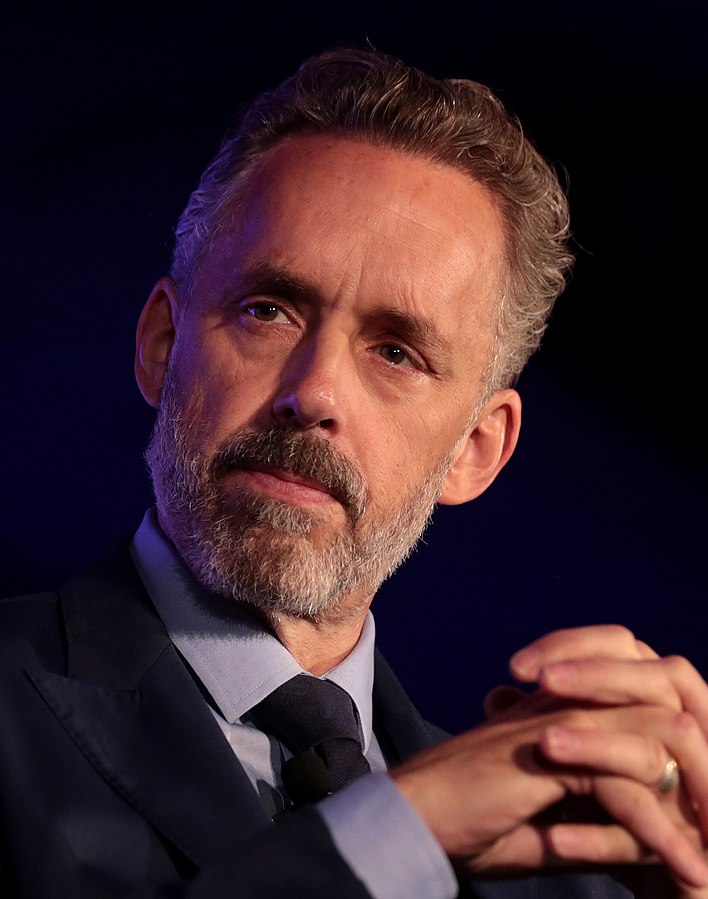
Jordan Peterson speaking at an event in Dallas, Texas on 15 June, 2018.
Detail of a photo by Gage Skidmore via Wikimedia Commons.
War is endlessly and eternally horrific. It is understandable and even necessary that the media spotlights today’s conflicts. But this can make us believe that we’re living through unprecedented violence. Russia’s war indeed meant that battle deaths in 2022 reached a high for this century, but they are still very low by historical standards. Last year, 3.5 in 100,000 people died as a consequence of war, below even the 1980s and far below the 20th-century average of 30 per 100,000. The world has in fact become much more peaceful.
This is of course little consolation to those living in conflict zones. But the data speaks to the problem with the constant barrage of contextless catastrophe and doom. Analysis of media content across 130 countries from 1970 to 2010 indicates that the emotional tone has dramatically and consistently become more negative. Negativity sells, but it informs badly.
The same pattern characterizes climate change reporting. A pervasive and false apocalyptic narrative draws together every negative event — ignoring the bigger picture almost entirely. Last summer, for example, forest fires made headlines, but coverage largely failed to mention that the annual burned global area has been declining for decades, reaching the lowest level ever last year. Likewise, deaths from droughts and floods make fill the front pages, but we don’t hear that deaths from such climate-related disasters have declined 50-fold over the past century.
The data show what we all fundamentally know: the world has improved dramatically. Life expectancy has more than doubled since 1900. Two centuries ago, almost everyone was illiterate. Now, almost everyone can read. In 1820, nearly 90 per cent of people lived in extreme poverty. Now it’s less than 10 per cent. Indoor air pollution has declined dramatically, and its outdoor equivalent has also done so in rich countries. If we could choose when to be born, having all the facts at hand, few would choose any time before today.
This incontrovertible progress has been driven by ethical and responsible conduct, trust, well-functioning markets, the rule of law, scientific innovation and political stability. We have to recognize, appreciate and proclaim the value, and comparative rarity, of each of these.
The constant barrage of negative stories may lead us to imagine that our forward progress is about to end. However, the evidence at hand does not support this conclusion. The latest Intergovernmental Panel on Climate Change scenarios indicate that, if not for climate change, the average person would be 4.5-times richer by the end of the century than they are today.
October 23, 2023
QotD: The real meaning of “Watergate”
[…]
Recently, reading Mark Levin’s Unfreedom of the Press, I was reminded that, before reporters went on their great crusade against Richard Nixon, they had overlooked a whole lot of corruption in the Democrat presidents who preceded him.
Levin tells how John F. Kennedy, with the knowledge of his brother and Attorney General Robert, nudged the IRS into auditing conservative groups. With Kennedy’s approval, the FBI was also employed to investigate those the administration disliked, including Martin Luther King Jr. Lyndon Baines Johnson would later increase the politically motivated auditing and spying. None of this was uncovered until later on.
Ben Bradlee — the editor of the Washington Post, where Woodward and Bernstein broke the Watergate story — was well aware of his pal Kennedy’s misuse of the tax and investigative agencies. Not only did he not report it, he allowed himself and his paper to be manipulated by information JFK had wrongly obtained.
This totally changes the Watergate narrative. Nixon’s dirty tricks and enemy lists may have been creepy and wrong, but the press exposure of these misdemeanors came after years of ignoring similar and worse malfeasance by Democrat administrations.
That changes what Watergate means. That transforms it from a heroic crusade into a political hit job, Democrat hackery masquerading as nobility. The press turned a blind eye to the corruption of JFK and LBJ, then raced to overturn the election of a man they despised — despised in part because he battled the Communism many of them had espoused.
Andrew Klavan, “‘Watergate’ Doesn’t Mean What the Press Thinks It Means: The press turned a blind eye to the corruption of JFK and LBJ, then raced to overturn the election of a man they despised”, The Daily Wire, 2019-08-31.
October 15, 2023
“… officials gesture and perform with a constant focus on the optics. The act of governing becomes the act of calculated sloganeering”
Chris Bray explains how politicians and government officials have so damaged their own credibility that significant portions of the population greet each and every news story as pre-calculated propaganda to advance this or that cause. Thanks to their breathtaking cynicism, the swivel-eyed conspiracy theorist of old has more credibility than a high-ranking government official:
The moral and intellectual sickness of the global governing class is infecting us all. They’ve poisoned the public sphere.
In the society of the spectacle, authority has become a display; officials gesture and perform with a constant focus on the optics. The act of governing becomes the act of calculated sloganeering: This vaccine is safe and effective. The use of evidence is a conspiracy theory; disagreement is disinformation. What we learned from the discovery process in Missouri v. Biden is that, yes, the government has manipulated what you’ve been allowed to read and to know. Everyone who gets vaccinated against COVID-19 becomes a dead end for the virus, and don’t you dare say otherwise.
The British journalist Laura Dodsworth told us, with considerable evidence, that governments were using nudge units of social scientists to deliberately crank up public terror over the pandemic, embracing mask mandates as a way of planting a symbol of fear on our faces. We wake up every morning knowing that governments lied for the purpose of manipulating our behavior.
And now we see the devastating cost. I wrote on Substack this week about video of the Hamas attacks on Israel and quickly began seeing the themes of a low-trust society in the comment thread, comments that were echoed all over social media: Why do the authorities want us to see this footage? What’s their game? How did they pull off this psyop? What’s causing them to launch this false flag attack at this exact moment?
The repeated message was about the importance of being skeptical: The war machine is trying to propagandize us into another stupid war!
But what I began seeing — what we all began seeing — wasn’t skepticism, the diligent search for clear evidence, but a wholesale refusal at the political margins to believe anything at all.
The certainty that all images are lies is the psychological mirror of the reflex to believe the news, identically displaying the refusal to parse evidence and make choices. It’s all one thing or the other: Oh, right, Hamas attacked Israel, moron! I GUESS THE SHEEPLE JUST BELIEVE WHATEVER THEY’RE TOLD!
It’s scorched-earth nihilism, the blanket rejection of inconvenient reality. And I understand it. People who’ve been lied to assume that they’re being lied to.

October 2, 2023
Glenn Reynolds explains “why leftist groups use underage kids as their stalking-horses, shock troops, and human shields”
In his most recent Substack post, Glenn Reynolds (aka the “Instapundit”) grants the late Senator Dianne Feinstein a kind mention before digging into the widespread phenomenon of progressive groups using children and younger teens as their public face:

One reason is the “culture of youth”, with dates back to around the time I was born. The notion – alien to human civilization for almost its entirety – was that younger people know more, are more insightful, and deserve more attention than older people.
The problem with this argument is that it is absurd. (There’s a reason why it’s alien to pretty much all previous human civilization, and it’s not because previous human civilization didn’t know what it was doing). Well, that’s one problem. Another problem is that it is manipulative and dishonest. And it’s sufficiently damaging for the young people involved that it borders on abuse.
First, the manipulative and dishonest part. Kids are cute; people instinctively (literally) like them. Associating them with your ideology is intended to produce a halo effect. (Even the Nazis did this.)
But people’s natural feelings toward adorable kids, like their feelings for puppies, baby goats, etc., have nothing to do with policy. Relying on something like that is practically an admission that your views lack substance.
Likewise, the fact that kids believe your views means nothing. Kids believe in Santa Claus, the Tooth Fairy, and superheroes. The very essence of kidhood is the inability to reliably make rational choices. We recognize this with laws setting the age of consent for sex, a drinking age, and a voting age, as Sen. Feinstein pointed out.
The really manipulative part, though, lies in sending kids to express your views, then calling it abusive if people point out that the views they’re expressing are stupid. (We got this all the time with children’s crusaders like David Hogg and Greta Thunberg until they became too old for it to work, at which time their stars began to set.)
If your ideas need to be expressed by people that others aren’t allowed to criticize, that’s a solid indicator that your ideas can’t withstand criticism, because they’re stupid.
It’s also abusive to put kids through this. Telling kids that they’re needed to save the world may fit Harry Potter / Percy Jackson childhood fantasies – but putting that pressure on them in the real world is enormously stressful. Turning kids to crusaders tends to end badly – see, e.g., the original Children’s Crusade – and is likely to be emotionally draining and damaging for them at the very least. Kids shouldn’t take responsibility for the world. That’s adults’ job. Encouraging them to do so for political ends is abusive and wrong.
Nonetheless political groups do this all the time, and usually don’t get a lot of pushback. I think it’s time for that to end.
September 22, 2023
Political psychosis and the never-ending “narrative”
Chris Bray points out several instances of the legacy media continuing to push “the narrative” despite any inconvenient facts that cast doubt on the official story:
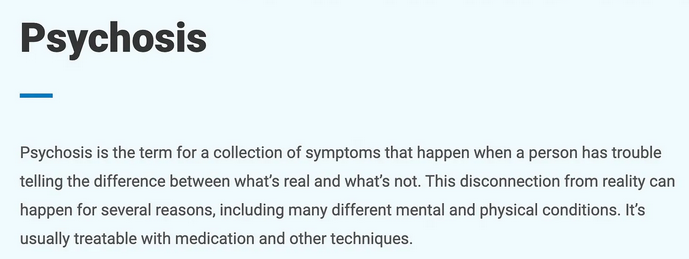
Every day is opposite day. Every day is a bucket of fake. The narrative is the narrative; once it’s established, nothing penetrates it. It rattles on down the road, impervious to inputs, convinced of its own truth without regard to events outside the shell. Psychologists have a term for this.
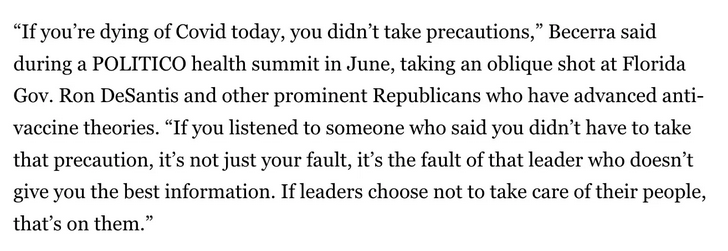
So Politico warns this week that faith in vaccines is falling, and anti-vaxxer narratives are “on the rise.” Sample paragraph, this one describing Health Secretary Xavier Becerra:
The summer of 2023, a claim made in June and credulously repeated in the bottom half of September: If you take Covid vaccines, you can’t get sick, but if you don’t take Covid vaccines, you die. Government leaders who don’t push the 7th and 8th doses of the mRNA injections “choose not to take care of their people”.
[…]
But the narrative rolls on, unperturbed. If you’re dying of Covid, it’s because you hesitated to get your 7,369th dose, anti-vaxxer! Maybe you should have stopped being such a Nazi! In the news media, it’s 2021 forever, and the virtuous science-lovers are rolling up their sleeves to rebuke the science-hating morons, who will not survive the … okay, well, who will not survive the next … okay, well, YOU’LL PROBABLY DIE AT SOME POINT because you didn’t get it. You’re facing a winter of severe illness and death by 2054, at the latest. No amount of evidence will force the storytellers to stop telling this story. It’s the story, so they tell it. The Politico thing ends by quoting Peter Hotez, by the way, as you knew it would.
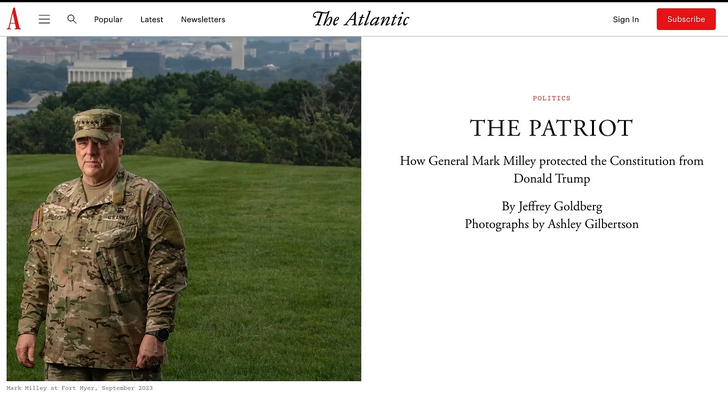
Similarly, The Atlantic warns now that Donald Trump was a time bomb who kept nearly going off for four years, and only the courage of General Mark Milley kept him under control. Look at the premise at the top of the piece: Disobeying, resisting, and undermining the President of the United States, a military officer protected the Constitution.
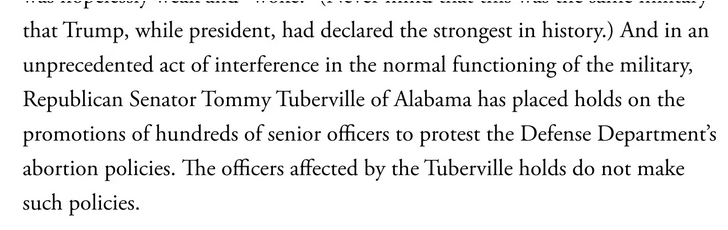
How well does the story parse the constitutional issues at stake? This well:
The military decided to have an abortion travel policy, and to fund it. A senator is now interfering in military policy and the unilateral executive appropriations of the Department of Defense, a sign of the ongoing constitutional crisis that began with Trump. Typically, you see, in our constitutional order, the military does whatever it wants, and spends money on its own authority however it feels like spending it, but Tuberville is engaging in the “unprecedented” act of suggesting that Congress should decide how to appropriate federal funds and regulate the armed forces, which means that he hates the Constitution. Article I, Section 8 would like a word, in this obviously extremist description of the authority of Congress:
To raise and support Armies, but no Appropriation of Money to that Use shall be for a longer Term than two Years;
To provide and maintain a Navy;
To make Rules for the Government and Regulation of the land and naval Forces;
And so on. Why is Tommy Tuberville being such a Nazi?
September 17, 2023
How much mis-, mal-, and dis-information do you encounter on an average day on the internet?
I don’t know the answer to that question … although I suspect it’s a pretty big proportion of what you’ll see, especially if you stick to legacy media sites who regularly indulge in cover-up, state propaganda, and outright lies while condemning other media as “conspiracy theorists”. Chris Bray, on the other hand, thinks there are hopeful signs that we’ve passed peak disinformation as the pandemic lockdowns get further behind us:
I’ve been trying to come up with a count: If you consume a typical amount of news media and social media product, how many individual pieces of dishonest, misleading, and calculatedly or ignorantly unreal “information” do you take on board over the course of a typical day?
Walter Kirn’s one-sentence summary of contemporary media is stuck in my head: “This is a world-concealing layer of diversionary and illogical and internally inconsistent noise, under which the world exists somewhere.” How much noise do you have to purge to merely get to zero, not at all informed but not not deeply misinformed? And if you encounter the deep thoughts of Ruth Ben-Ghiat, does the deficit merely double, or is it much worse than that?
Democracy means you must not question or oppose the head of state
I’ve been reading on The Site Formerly Known as Twitter this week that Elon Musk’s refusal to activate the privately owned Starlink network over Crimea is a violation of the Geneva Conventions, which now apparently apply to corporate product, and also high treason, for which Elon Musk should be executed. At the risk of mixing metaphors, it’s like the Internet allows strangers to use your brain as a toilet. Although, as the Twitter randos always end up explaining, I just feel this way because I’M PUTIN’S NAZI BUTTBOY.
All day, every day, 24/7/365 — well, maybe with some breaks for sleep, but only if you stop looking at your phone at night — you take on garbage. Your brain is loaded with information barriers, dressed up as information. You read and hear sentences that are designed to prevent understanding.
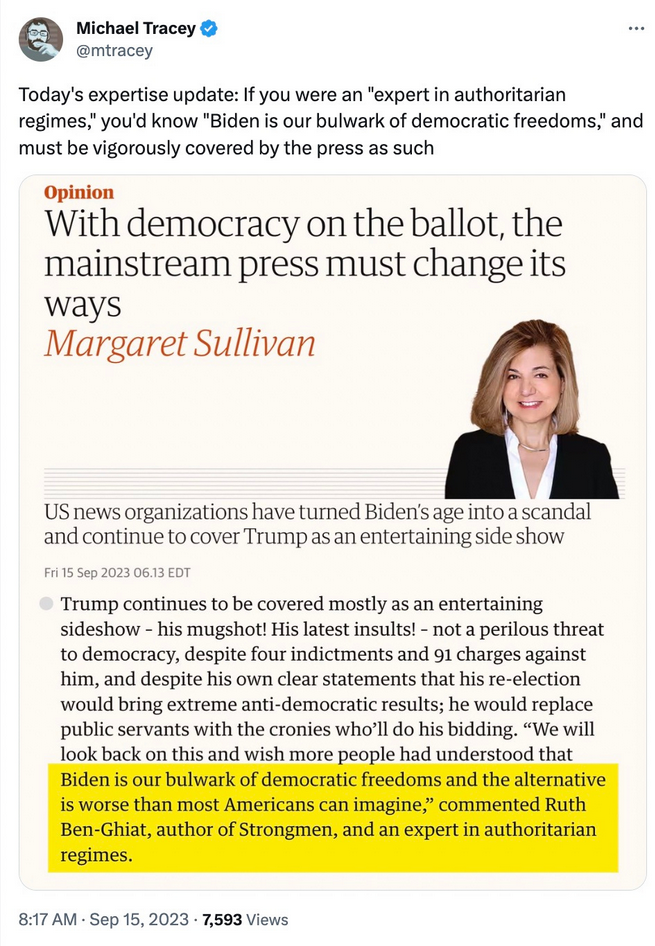
September 8, 2023
The legacy media really value Conservative gab-fests like the current CPC convention
Chris Selley explains why the fringe views of obscure Conservative riding associations get so much more juice in the legacy media than equivalent brain-farts from Liberal or NDP groups:

Whatever lands in your news hole from the Conservative Party of Canada convention, which kicks off Thursday night in Quebec City, it’s a safe bet you’ll hear the result of the vote on Policy Resolution 1258. Sponsored by the North Okanagan—Shuswap riding association, it reads, in part, as follows: “A Conservative government will protect children by prohibiting life-altering medicinal or surgical interventions on minors under 18 to treat gender confusion or dysphoria”.
Needless to say this hasn’t gone down very well at the Ottawa press club, where discussion generally confines itself to two countries. “The pitch is similar to ones found across the United States, including in Florida where Gov. Ron DeSantis signed a bill in May banning gender-affirming care for transgender youth,” the increasingly breathless Canadian Press reported. “(It’s) a move many health professionals, parents and advocates of LGBTQS+ youth says places them at greater risk for suicide and depression.”
This is a distraction that leader Pierre Poilievre really doesn’t need. As I wrote last week, on the question of how schools should treat children who wish to change name or gender at school even quite reasonable policies can receive extraordinarily negative press if they are perceived to have been drafted by intolerant people. It’s as if the policies, reasonable on paper, might have some kind of cooties that could harm the children they affect. (That said, in some cases journalists and commentators don’t even seem to have read the policies in question.)
Policy Resolution 1258, like New Brunswick’s and Saskatchewan’s supposedly extreme “social transitioning” policies, isn’t at all extreme by world standards. Gender issues have enflamed the American culture wars, true enough — at last count 19 states, including Florida, had implemented new rules on “gender-affirming care” for kids (and in some cases adults). Naturally Canadian conservatives are watching, some approvingly.
So the legacy media loves intramural disputes within parties on the right, both because it gives them interesting things to report and pontificate about, and also because as a class, journalists tend to skew very heavily progressive. This leads naturally to a difference between how Conservative fringe opinions and progressive fringe opinions are treated in the media.
Especially for a neutral like myself, and especially given how much power party leaders have amassed relative to everyone else, there is a certain pleasure in making a party leader squirm. In the often hidebound and unimaginative world of Canadian politics, that can have benefits. These resolutions often serve as a sort of conscience-check for the party in question: Why aren’t the Liberals liberal enough? Why aren’t the Conservatives conservative enough? Sometimes the party even listens.
That said, I have no idea why parties inflict this on themselves. Mostly these resolutions just stir up trouble. Opposition parties and media alike use these resolutions to craft the dastardly narratives of their choice. The Conservatives in particular suffer from this, and in particular from the Ottawa media.
When the Conservatives ran advertisements claiming the Liberal government wanted to legalize hard drugs — a 2018 policy resolution brought forward by the caucus itself — CTV News declared the ads objectively “false.” The Liberals routinely chuck overboard progressive-minded proposals that come from the party’s left — on legalizing prostitution, for example, or electoral reform — and they’re never heard about again.
The Conservatives’ more right-wing policy proposals seem to get chucked into a giant narrative cauldron and fished out by reporters whenever necessary to prove that there is, in fact, a narrative that needs propagating: on abortion, on climate change, on euthanasia, on gender dysphoria, you name it, and no matter what the leader of the day — the guy everyone knows is in charge — might say.
September 1, 2023
How the term “the Deep State” morphed from left-wing to (extreme, scary, ultra-MAGA) right-wing jargon
Matt Taibbi wants to track the changes in political language in US usage, starting today with “Deep State”:
In July of last year David Rothkopf wrote a piece for the Daily Beast called, “You’re going to miss the Deep State when it’s gone: Trump’s terrifying plan to purge tens of thousands of career government workers and replace them with loyal stooges must be stopped in its tracks.” In the obligatory MSNBC segment hyping the article, poor Willie Geist, fast becoming the Zelig of cable’s historical lowlight reel, read off the money passage:
During his presidency, [Donald] Trump was regularly frustrated that government employees — appointees, as well as career officials in the civil service, the military, the intelligence community, and the foreign service — were an impediment to the autocratic impulses about which he often openly fantasized.
This passage portraying harmless “government employees” as the last patriotic impediment to Trumpian autocracy represented the complete turnaround of a term that less than ten years before meant, to the Beast‘s own target audience, the polar opposite. This of course needed to be lied about as well, and the Beast columnist stuck this landing, too, when Geist led Rothkopf through the eye-rolling proposition that there was “something fishy, or dark, or something going on behind the scenes” with the “deep state”.
Rothkopf replied that “career government officials” got a bad rap because “about ten years ago, Alex Jones and the InfoWars crowd started zeroing in on the deep state, as yet another of the conspiracy theories …”
The real provenance of deep state has in ten short years been fully excised from mainstream conversation, in the best and most thorough whitewash job since the Soviets wiped the photo record clean of Yezhov and Trotsky. It’s an awesome achievement.
Through the turn of the 21st century virtually no American political writers used deep state. In the mid-2000s, as laws like the PATRIOT Act passed and the Bush/Cheney government funded huge new agencies like the Department of Homeland Security, the word was suddenly everywhere, inevitably deployed as left-of-center critique of the Bush-Cheney legacy.
How different was the world ten years ago? The New York Times featured a breezy Sunday opinion piece asking the late NSA whistleblower Thomas Drake — a man described as an inspiration for Edward Snowden who today would almost certainly be denounced as a traitor — what he was reading then. Drake answered he was reading Deep State: Inside the Government Secrecy Industry by Marc Ambinder, whose revelations about possible spying on “eighteen locations in the Washington D.C. area, including near the White House, Congress, and several foreign embassies”, inspired the ACLU to urge congress to begin encrypting communications.
On the eve of a series of brutal revelations about intelligence abuses, including the Snowden mess, left-leaning American commentators all over embraced “deep state” as a term perfectly descriptive of the threat they perceived from the hyper-concentrated, unelected power observed with horror in the Bush years. None other than liberal icon Bill Moyers convinced Mike Lofgren — a onetime Republican operative who flipped on his formers and became heavily critical of the GOP during this period — to compose a report called “The Deep State Hiding in Plain Sight“.
August 31, 2023
Why New York Destroyed 3 Iconic Landmarks | Architectural Digest
Architectural Digest
Published 6 Apr 2023Michael Wyetzner of Michielli + Wyetzner Architects returns to AD, this time to look at the history and creation of three New York City landmarks that have since been demolished — but are far from forgotten. From the once (and future?) majesty of Penn Station to the New York Herald building and the original 19th-century Madison Square Garden, Michael gives expert insight into these three historic architectural landmarks, why they were laid to ruin, and what came to replace them.
(more…)
August 22, 2023
With Bill C-18 about to come into effect, there is zero sense for the “tech giants” to start negotiating
Michael Geist explains why there are no incentives for Google and Meta to begin any kind of negotiations with the Canadian government over the ruthlessly self-destructive Online News Act:
The rhetoric around Bill C-18 has escalated in recent days in light of the awful wildfires in NWT and British Columbia. In my view, the issues associated with these tragic events have little to do with Meta blocking news links and the attempt to bring it into the conversation is a transparent attempt to score political points (the connectivity issues with some NWT communities completely taken offline for days is somehow never mentioned). The reality is that Meta was asked about just this scenario at committee and it made it clear that it would not block any non-news outlet links. That is precisely what has been happening and the government’s legislative choices should be the starting point for understanding why compliance with the law involves blocking a very broad range of news links that extend beyond even those sources that are defined as “eligible news outlets”.
The government and supporters of Bill C-18 talking points now emphasize two things in relation to Meta blocking news links: the law has yet to take effect and there is room to address their concerns in the regulation-making process. Both of these claims are incredibly deceptive, relying on the assumption that most won’t bother to read the actual legislation. If they did, they would see that (1) the law has received royal assent and can take effect anytime and (2) the regulation making process addresses only a small subset of Bill C-18 issues with most of the core issues finalized. In other words, the time to shape the law and address many of the key concerns was before the government repeatedly cut off debate in order to ensure it that received royal assent before the summer break.
Start with when the law takes effect. As noted above, the law has been passed and received royal assent. It is the law of the land and there is no scope for changes or amendments without a new bill that must be passed by Parliament. Section 93 establishes when the provisions come into force. The law initially envisioned a staged approach whereby certain sections would be proclaimed in effect by the government in stage one, followed by four additional stages, some of which were contingent on certain regulations coming into force. Yet at the last minute the government approved a Senate amendment that basically discarded the entire approach. Section 93(6) states:
(6) Despite subsections (1) to (5), any provision of this Act that does not come into force by order before the 180th day following the day on which this Act receives royal assent comes into force 180 days after the day on which this Act receives royal assent.
The entire law therefore takes effect no later than 180 days after royal assent, which is December 19, 2023. This change was included at the urging of the Canadian media sector (specifically Quebecor) which lobbied to have it take effect as soon as possible. Under this approach, the law can take effect at any time as the government need only issue the relevant Orders-in-Council. There is now little wiggle room. As of today’s post, the latest the law will take effect is in 120 days but it could happen well before that.
Once the law takes effect, the clock on negotiations and potential mediation and arbitration begins. The timelines are fixed in Section 19(1) of the law: 90 days to negotiate and 120 days for mediation. If there is no agreement and no request to the CRTC to extend the deadlines, the issue can go to final offer arbitration. To be clear, none of these timelines are subject to the regulation making process. They are fixed and they create obvious urgency for anyone facing compliance requirements.
The government threatened Meta and Google with mandated payment to Canadian news sources if their online services merely linked to articles or videos from those news sources. Meta and Google rationally decided that the tiny little Canadian market wasn’t worth the cost of paying CBC and other Canadian news outlets for the privilege of sending them readers and are in the process of obeying the letter of the new law and blocking such links on their respective platforms. They told the Canadian government that this is what they’d do if the law was passed in its current form, yet the government is pretending to be shocked and surprised that Meta and Google are going to obey the law.
After all, there’s no real risk that lives might be endangered because so many Canadians are used to getting their news by way of Facebook or Google, is there?


