
JB Anderton
Published Jan 8, 2024Batman TV Theme written by Neil Hefti
Arrangement by JB Anderton
Bass, guitar, keyboards and drum loop programming – JB AndertonBatman ’66 is a registered trademark of Greenway Productions/20th Century Fox. No infringement is intended.
#KingCrimson #Batman66
May 20, 2024
If King Crimson Played the Batman TV Theme
Comments Off on If King Crimson Played the Batman TV Theme
May 19, 2024
Rush Meets LOONEY TUNES???
pdbass
Published Jan 4, 2024Remember that time Rush worked music from cartoons into one of their greatest recordings?
Digging into “La Villa Strangiato” from 1978’s Hemispheres, breaking down Geddy Lee’s wicked bass solo (and its Jazz connections) and showing you how pianist/composer Raymond Scott will always be linked to this iconic prog rock instrumental.
(more…)
Comments Off on Rush Meets LOONEY TUNES???
May 14, 2024
The Eurovision non-binary song contest
Unless you’re very tuned in to all things Euro, you might not have known that the gala Eurovision Song Contest has again come and gone (I only noticed after the fact myself). It wouldn’t be a televised pan-European event if there wasn’t at least a tiddly bit of controversy, so that role appears to have been eagerly filled by the Irish contestant, in whom Brendan O’Neill is unimpressed:

What a thing of beauty that Israel beat Ireland in Saturday’s Eurovision Song Contest. That Israel’s serene songstress, Eden Golan, got more points than Ireland’s warbling, gurning, pseudo-Satanic they / them, Bambie Thug. That an actually decent song trumped the caterwauling of a fake punk who mistakes having tattoos, identifying as “nonbinary” and saying “I’m queer!” for a personality. More importantly, that a singer who was harangued by baying mobs of Hamas fanboys did better than the “singer” who helped to whip up this orgy of cruelty by saying she cried when she heard Israel had made it to the final. Boo-fucking-hoo. I bet you’re crying even more now, Ms Thug.
This is the news – the beautiful news – that Israel came fifth and Ireland sixth in the Eurovision Song Contest. Of course – because they are racist and mentally unstable – Israel haters on social media are saying the Zionist octopus helped to bump up Israel’s points. One pictures Mossad agents taking a break from hunting down the anti-Semites who slaughtered a thousand of their compatriots to post memes on Facebook saying “Screw Bambie, Vote Eden!”. In truth, the reason Israel did so well in the public vote – getting the maximum “douze points” from no fewer than 14 of the 37 nations eligible to vote in Eurovision – is because normal people don’t share the Euro-bourgeoisie’s feverish loathing for the Jewish State. It wasn’t only the emotionally incontinent Israelophobe Bambie Thug who took a beating last night – so did the entire anti-Israel middle class whose cries for a boycott of Eurovision clearly fell on deaf ears.
We shouldn’t get ahead of ourselves, of course, given it’s only Eurovision, and given that some people (me, for example) were highly motivated to vote for Israel in order to wind up the wankers of Europe. But it is undeniably delicious that, despite the pompous pleas of drag queens and other paragons of morality for everyone to switch off Eurovision this year, millions watched. Around 7.6million Brits tuned in. Yes, that’s lower than last year – when we were the hosts – but it’s higher than every year between 2015 and 2021. It will be a source of mirth for me for some time that while the LGBTQ lobby was self-importantly putting away the glitter, locking the drinks cabinet and doing their very best not to check X for Eurovision updates, the general public were watching and enjoying the daftness of it all. Rarely has the moral gulf between us and our preening cultural overlords been so starkly exposed.
Then there were the votes for Israel. It felt like a tiny rebellion against the hysteria of the elites. Brits gave Israel 12 points. So did France, Germany, Belgium, Italy and others. This was people saying “We don’t agree with your bullying of a young woman and your obsessive hatred for her homeland”. Even the good people of Ireland gave Israel 10 points. As someone who knows and loves Ireland, it would not surprise me one iota to discover that people there are as yawningly vexed by Bambie Thug as everyone else in Europe who enjoys the sense of hearing. The land that gifted Eurovision Dana, Johnny Logan and Riverdance now finds itself represented by a self-styled “goth gremlin goblin witch” who does “primordial screaming” (shorter version: she can’t sing). What a mess. I’ve been listening to Logan’s “Hold Me Now” (winner in 1987) to try to liberate my brain from Thug’s narcissistic howling.
Andrew Doyle also commented on the “non binary” emphasis of many participants:
This year the trophy went to Switzerland’s Nemo, a man in a skirt who identifies as “non-binary”. The UK entry, Olly Alexander, calls himself “gay and queer and non-binary” but magnanimously accepts the pronouns “he” and “him”. And then there is the “queer” and “non-binary” Irish entry Bambie Thug, a woman who came sixth in the competition but first in the award for the sorest of losers. Having being beaten by Israel, whose very presence in the competition was a source of outrage for Thug, she had the following to say:
I’m so proud of Nemo winning. I’m so proud that all of us are in the top ten that have been fighting for this shit behind the scenes because it has been so hard and it’s been so horrible for us. And I’m so proud of us. And I just want to say, we are what the Eurovision is. The EBU [European Broadcasting Union] is not what the Eurovision is. Fuck the EBU. I don’t even care anymore. Fuck them. The thing that makes this is the contestants, the community behind it, the love and the power and the support of all of us is what is making change. And the world has spoken. The queers are coming. Non-binaries for the fucking win.
One might argue that all of this is simply an extension of the high-campery of old. Thug certainly looks pantomimic, with her Christmas-cracker devil horns, and the layers of makeup piled on to what used to be a face. But what were once the glittery fripperies of gay culture have been hijacked by the acolytes of gender identity ideology, a movement that has appropriated this whimsical sheen to advance its authoritarian and sinister goals. It is this same movement that has successfully lobbied governments to introduce draconian speech laws, has hounded people out of their jobs for wrongthink, and has normalised bullying and threats of violence in the name of “social justice”.
The very notion of “non-binary” is a reactionary concept dressed up in the guise of progressivism. Most of those who identify as non-binary are embracing, rather than rejecting, sex stereotypes. They claim to feel neither sufficiently masculine nor feminine, which is simply another way of reinforcing what it means to be male or female.
The same ambiguity goes for “queer”. Many gay people see this as a anti-gay slur, associating the term with the practice of “queer-bashing”. But now, many young heterosexuals are identifying themselves into this category as a means to claim the high status that now accompanies victimhood. Dannii Minogue, a lifelong heterosexual, recently “came out” as “queer”. To those who have been the victims of homophobic abuse and violence, it’s galling to see straights embracing the term as a fashion accessory. Minogue may as well have come out as a “faggot” or a “dyke”.
Comments Off on The Eurovision non-binary song contest
QotD: Sporting songs
[A]ll the great football songs are by Americans — Rodgers and Hammerstein (“You’ll Never Walk Alone”) and Livingston and Evans, whose “Que Sera, Sera” has a British lyric of endearing directness:
Mi-illwall, Millwall
Millwa-all, Millwall, Millwall
Millwa-all, Millwall, Millwall
Mi-illwall, Millwall.
(Repeat until knife fight)Mark Steyn, “Hyperpower”, Daily Telegraph, 2002-06-22.
Comments Off on QotD: Sporting songs
May 9, 2024
“[B]ad music does seem to disappear – you just need to wait 70 or 80 years, more or less”
I’m far from a modern music fan, so I find Ted Gioia’s analysis of the genre to be hopeful for the future … there’s so much objectively bad music being released these days, but the vast majority of it will sink without a trace:

Handwritten score by Bach
“No stupid literature, art or music lasts.”
That’s a quote from literary critic George Steiner (1929-2020) — in his highly recommended book Real Presences from 1986.
I was shocked when I read that sentence. But pleasantly shocked.
Could it really be true that all the sonic detritus circulating in our culture will just magically disappear? It seems too good to be true.
And Steiner wrote that before the rise of the Internet and AI. If he thought we were drowning in crappy art back in the 1980s, what would he think now?
Around 100,000 songs are uploaded online every day. I can’t listen to more than a fraction of them, but almost every day I check out random new tracks on Bandcamp — and sometimes the process is painful.
Nobody can say that I’ve shirked my responsibilities as a music critic. In recent months, I’ve listened to death metal bands from Croatia who sounded like they were ready to bludgeon the entire population of Zagreb; incoherent Christian drone pop that only delivers the Good News when it’s finally over; entire albums of static, buzzes, burps, or toots; people singing to backup tracks, but apparently unaware that they are in different keys; and various home recordings that should never have left the basement.
It’s an ugly job, but somebody has to do it. I occasionally find that rare gem, a self-produced needle of rare pointedness in the otherwise dismal haystack. That makes it all worthwhile.
But Steiner may be on to something. Most of the bad stuff disappears without anyone worrying about it. In fact, it disappears for that very reason — because nobody worries about it.
And the deeper I peer into the past, the more I see the same Darwinian trend. He called it survival of the fittest.
My considered judgment is that almost every musical work from the 17th and 18th centuries that survives in the standard repertoire possesses some merit. An interesting case is Bach, who is the presiding genius among the known composers from that era. Bach was unfairly forgotten in the years following his death — in fact, his sons got more acclaim than their dad.
Bach had been dead for more than 75 years before his reputation started rising again. The neglect was unfair, almost horrendously so. But with the passage of time, he gained preeminence, almost as if an invisible hand — much like those the economists describe — was setting things right. You could tell similar stories about other composers, from Antonio Vivaldi to Scott Joplin. It’s almost magical the way things work.
I must say that this is a judgment that takes a long time to make. Back at age twenty, I couldn’t have told you if Bach wrote better fugues than other composers, or Joplin composed better rags. Yet after decades seeking lost masterpieces from the past, and picking through the works of secondary and tertiary figures, I’ve concluded that the legendary figures from the past definitely earned their preeminence.
As a result, I worry more about the artists whose work has disappeared completely. Those are wrongs that can’t be rectified.
Comments Off on “[B]ad music does seem to disappear – you just need to wait 70 or 80 years, more or less”
May 4, 2024
Process optimization can definitely be taken too far
Freddie deBoer considers systems that have been overoptimized to the detriment of most users and the benefit of a small, privileged minority:

I know a guy who used to make his living as an eBay reseller. That is, he’d find something on eBay that he thought was underpriced so long as the auction didn’t go above X dollars, buy it, then resell it for more than he paid for it Classic imports-exports, really, a digital junk shop. Eventually he got to the point where, with some items, he didn’t ever have physical possession of them; he had figured out a way to get them directly from whoever he bought an item from to the person he had sold the item to, while still collecting his bit of arbitrage along the way. This buying and selling of items on eBay, looking for deals, was sufficient to be his full-time job and pay for a mortgage. But the last time I saw him, a few years ago, he had gotten an ordinary office job. He told me that it had become too difficult to find value; potential sellers and buyers alike had access to too many tools that could reveal the “real” price of an item, and there was little delta to eke out. He’s not alone. If you search around in eBay-related forums, you’ll find that many longtime sellers have reached similar conclusions. The hustle just doesn’t work anymore.
I don’t suppose there’s any great crime there — it’s all within the rules. And there does appear to still be an eBay-adjacent reselling economy; it’s just that, as far as I can glean, it’s driven by algorithms and bots that average resellers simply don’t have access to. It appears that some super-resellers have implemented software solutions to identify underpriced goods and buy them automatically and algorithmically. They have optimized the system for their own use, giving them an advantage, putting other sellers at a disadvantage, and arguably hurting buyers by eliminating uncertainty that sometimes results in lower-than-optimal-to-sellers prices. This is all in sharp contrast to the early years, when my friend would keep listings for lucrative product categories open – in separate windows, not tabs, that’s how long ago this was – and refresh until he found potential moneymakers. That sort of human searching and bidding work stands at a sharp disadvantage compared to those with information-scraping capacity and automated tools. It’s a good example of how access to data has left systems overoptimized for some users. One of the things that the internet is really good at is price discovery, and these digital tools help determine the “optimal” price of items on eBay, which results in less opportunity for arbitrage for other players.
My current working definition of overoptimization goes like this: overoptimization has occurred when the introduction of immense amounts of information into a human system produces conditions that allow for some players within that system to maximize their comparative advantage, without overtly breaking the rules, in a way that (intentional or not) creates meaningful negative social consequences. I want to argue that many human systems in the 2020s have become overoptimized in this way, and that the social ramifications are often bad.
Getting a restaurant reservation is a good example. Once upon a time, you called a restaurant’s phone number and asked about a specific time and they looked in the book and told you if you could have that slot or not. There was plenty of insiderism and petty corruption involved, but because the system provided incomplete information that was time consuming to procure, there was a limit to how much you could game that system. Now that reservations are made online, you can look and see not only if a specific slot has availability but if any slots have availability. You can also make highly-educated guesses about what different slots are worth on the market through both common sense (weekend evenings are the most valuable etc) and through seeing which reservations get snapped up the fastest in an average week. And being online means that the reservation system is immediate and automatic, so you can train a bot to grab as many reservations as you want, near-instantaneously, and you can do so in a way that the system doesn’t notice. (Unlike, say, if you called the same restaurant over and over again and tried to hide your voice by doing a series of fake accents.) The outcome of all this is that getting a reservation at desirable places is a nightmare and results in a secondary market that, like seemingly everything in American life, is reserved for the rich. The internet has overoptimized getting a restaurant reservation and the result is to make it more aggravating and less egalitarian.
As has been much discussed, nearly the exact same scenario has made getting concert tickets a tedious and ludicrously-pricy exercise in frustration.
Comments Off on Process optimization can definitely be taken too far
QotD: Why Donald Trump beat Hillary Clinton
(I’m embarrassed just to type that). In one flash, I knew that Trump would win. Not because Clinton’s playlist was lame, obvious, safe, uninspiring … I’m not judging her taste in music, or lack thereof, nor would I count myself qualified to do so. I knew instantly she would lose because it was so clear that no one on earth would ever want to see her playlist. Let alone listen to it. No one on earth would want to know that such a playlist existed, much less care a raspberry fuck what was in it, what genre, what generation, what anything. For all the negative feelings I may have entertained concerning Trump’s personality, moral and ethical nature, honesty, decency etc., etc., I had to confess that I was fascinated to know what might be in his playlist. For all I knew, it could be polka music, soft rock, clawhammer bluegrass, death metal, light classical, Nu-folk, Tesco1, psychedelic funk, Tijuana brass. It didn’t matter. What mattered was that I was interested. And I knew with a certainty that might be regarded as deeply arrogant that my belief – that a Hillary Clinton playlist was among the least interesting ideas ever proposed – would be a belief shared by most people, whatever their political leanings. It’s not fair on Hillary Clinton that this should be the case, but the case is what it is. We smell it at once. Hillary Clinton’s playlist? No. Therefore, somehow, Hillary no.
Statistics and group theory can take us a long way, but smell takes us further.
Stephen Fry, “The One and the Many”, The Fry Corner, 2024-02-02.
1. Tesco, as a branch of dance music, does, or at last briefly did, exist. It’s a blend of techno and disco. You knew that.
Comments Off on QotD: Why Donald Trump beat Hillary Clinton
April 22, 2024
The internal stresses of the modern techno-optimist family
Ted Gioia on the joys of techno-optimism (as long as you don’t have to eat Meal 3.0, anyway):
We were now the ideal Techno-Optimist couple. So imagine my shock when I heard crashing and thrashing sounds from the kitchen. I rushed in, and could hardly believe my eyes.
Tara had taken my favorite coffee mugs, and was pulverizing them with a sledgehammer. I own four of these — and she had already destroyed three of them.
This was alarming. Those coffee mugs are like my personal security blanket.
“What are you doing?” I shouted.
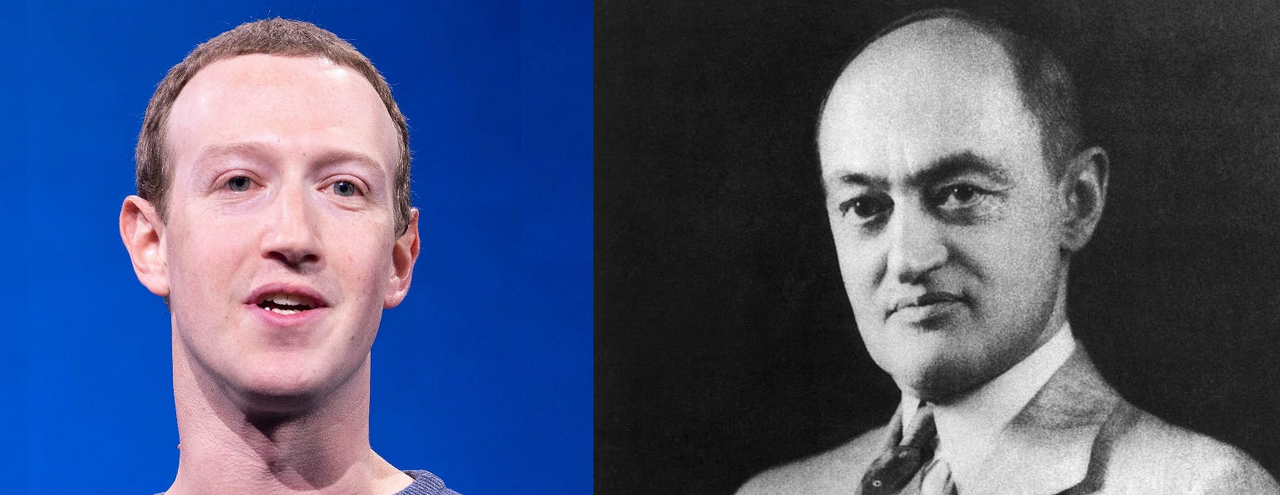
“We need to move fast and break things“, she responded, a steely look in her eyes. “That’s what Mark Zuckerberg tells us to do.”
“But don’t destroy my coffee mugs!” I pleaded.
“It’s NOT destruction,” she shouted. “It’s creative destruction! You haven’t read your Schumpeter, or you’d know the difference.”
Mark Zuckerberg and Joseph Schumpeter
She was right — it had been a long time since I’d read Schumpeter, and only had the vaguest recollection of those boring books. Didn’t he drink coffee? I had no idea. So I watched helplessly as Tara smashed the final mug to smithereens.
I was at a loss for words. But when she turned to my prized 1925 Steinway XR-Grand piano, I let out an involuntary shriek.
No, no, no, no — not the Steinway.
She hesitated, and then spoke with eerie calmness: “I understand your feelings. But is this analog input system something a Techno-Optimist family should own?”
I had to think fast. Fortunately I remembered that my XR-Grand was a strange Steinway, and it originally had incorporated a player piano mechanism (later removed from my instrument). This gave me an idea:
I started improvising (one of my specialties):
You’re absolutely right. A piano is a shameful thing for a Techno-Optimist to own. Our music should express Dreams of Tomorrow. [I hummed a few bars.] But this isn’t really a piano — you need to consider it as a high performance peripheral, with limitless upgrade potential.
I opened the bottom panel, and pointed to the empty space where the player piano mechanism had once been. “This is where we insert the MIDI interface. Just wait and see.”
She paused, and thought it over — but still kept the sledgehammer poised in midair. Then asked: “Are you sure this isn’t just an outmoded legacy system?”
“Trust me, baby,” I said with all the confidence I could muster. “Together we can transform this bad boy into a cutting edge digital experience platform. We will sail on it together into the Metaverse.”
She hesitated — then put down the sledgehammer. Disaster averted!
“You’re blinding me with science, my dear,” I said to her in my most conciliatory tone.
“Technology!” she responded with a saucy grin.
Comments Off on The internal stresses of the modern techno-optimist family
April 18, 2024
Wagner’s Ring Cycle, summarized
I have to admit that aside from some amazing helicopter music, most of Wagner’s music isn’t my cup of tea drinking horn of mead. As a result, I didn’t know what the whole Ring Cycle was all about and mostly didn’t care. Coming to my rescue, Kulak provides a summary for my fellow non-Wagner fans:
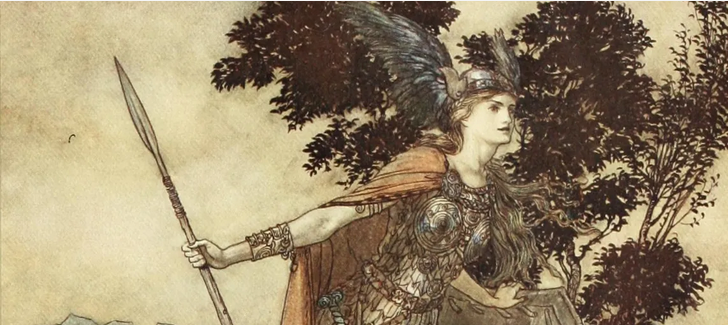
So researching my epic length piece on female warriors, pre-Christian sexual politics, and the unique development of North European culture I got really into Richard Wagner’s Ring Cycle after stumbling on Arthur Rackham’s gorgeous illustrations to the English translations of the text of the operas (Link 1, Link 2).
And one of the things that immediately jumped out to me, even beyond everything listed in the long piece, is how weird and unique the sexual politics of Pagan Germanic culture is.
Sure it’s Wagner, it’s not a primary source. It’s a 19th century romantic composer interpreting several different legends of pagan era Germany and Scandinavia, as record by Christian monks and scholars 100s of years after the fact. So academically not the most accurate thing to draw conclusions from, however if you subscribe to any blood memory, or spirit of a people, or eternal culture theory … it’s almost better.
This is the version of the tale that’s survived and been refined across first oral, then written traditions, then preserved by Christian monks, then revived by high Victorian romantics into one of the most celebrate and popular operas of all time. If there’s anything we could learn about the eternal character of North European women, sexuality, and sexual politics (and by extension modern sexual politics, we’re all North Europeans now) it is here.
And damned … what a datapoint.
What follows is a MeToo story on hyperborean crack.
The Female lead Brunhilde starts out as a Valkyrie who disobeys her master/father the god Wotan (Odin) in a matter of divine importance so as to save a mortal man. For her disobedience Wotan strips her of her divine nature and curses her to sleep on the earth as a mortal woman until such a time as the first man to find her wakes her, then she is to be his wife. However, taking pity Wotan lays out an magical wall of fire to guard her so no coward, only a great hero, would ever succeed. (end opera 1/3).
20-ish years later Siegfried, the son of the man Brunhilde saved, finds her (she hasn’t aged a day), and perfectly fearless he braves the fire to wake her, where-upon they fall in love (end opera 2/3)… then taking leave for more adventure Siegfried takes off promising to return and remember their. Where-upon he meets the King Gunther and his sister Gutrune, who seduces Siegfried and makes him forget Brunhilde. Making friends with Gunther, Siegfried conspires with him that he should have Brunhilde for a wife (given she’s the best woman he can think of for his friend), but there’s a problem … Gunther cannot brave the fire, he’s not fearless like Siegfried. So Siegfried, conspires to impersonate Gunther using his magic, brave the fire again, seduce Brunilde again, get her to consent to marry him in the Guise of Gunther, spend the night using his sword to divide himself from Brunhilde. Then in the morning swap back, Siegfried Married to Gutrune, Gunther to Brunhilde … The plan worked perfectly.
Then Brunhilde found out.
Learning what had been done she conspires with Siegfried’s enemies to have him killed, falsely accuses him of rape, and successfully maneuvers him into admitting to lying in an oath he wasn’t even aware was a lie … so that his fearless perfect life can end with a stab in the back.
So you may ask: Having avenged herself does she settle-down with her husband?
Hell no! You think you could fill the shoes of Siegfried you curr, you coward, you beta-cuck?! You will NEVER be Siegfried.
Instead she gives the mother of all angry speeches denounces Gertrude and everyone else of the court to their face, and then rides Siegfried’s horse onto his funeral pyre, determined it is better to die with Chad than live with Brad.
THE END.
Of the entire opera cycle. No more.
The Fat Lady has sung.
Your 4 day trip into the German mountains to experience 3 1/2 Operas over as many days and a combined 15 hours has concluded. Go Home.
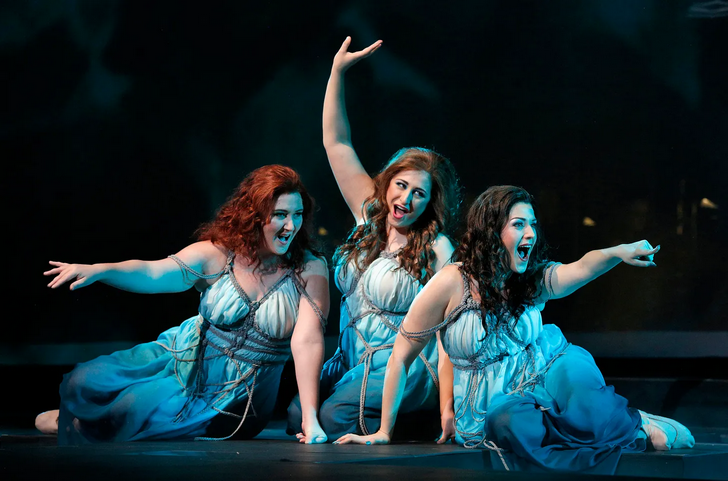
Rhinemaidens, Minnesota Opera production of Das Rheingold
I’m Sorry bros, the hoes have always been like this.
Even in the mythical past of high Germanic mythology … the hoes were like this.
Comments Off on Wagner’s Ring Cycle, summarized
March 24, 2024
“[A] term was coined in Britain for playing music on your phone in public: ‘sodcasting’ – after ‘sod’ for ‘sodomite’, i.e. something that only a total ASSHOLE would do”
We’ve all been there at some point, especially in waiting rooms or on public transit: someone is either accidentally or deliberately subjecting everyone else in the vicinity to their personal soundtrack:

The modern world is noisy, I get that. I’m fine dealing with busy, urban places. But that surely makes those other places where you can escape the noise all the more vital in the constant struggle for sanity in this century. This is perhaps the one issue on which uber-leftist Elie Mystal and I agree. He found himself this week in a waiting room, full of peeps “listening to content on their devices with no headphones … LOUDLY. What the SHIT is this?? Is this normal?” His peroration: “I’M DEAD. I CAN FOR REAL FEEL THE VEINS IN MY HEAD THROBBING. THIS IS HOW I DIED.” #MeToo, my old lefty comrade.
The degradation of public space in America isn’t entirely new, of course. As soon as transistor radios became portable, people would carry them around — for music or sports scores on construction sites or wherever. But the smartphone era — thanks once again, Steve Jobs, you were so awesome! — gave us an exponential jump in the number of people with highly portable sound-broadcasting machines in every public space imaginable. In other words: Hell on toast.
At the beginning of this phone surge, a term was even coined in Britain for playing music on your phone in public: “sodcasting” — after “sod” for “sodomite”, i.e. something that only a total ASSHOLE would do. Sodcasting was just an amuse bouche, though, compared with our current Bluetooth era, where amplifiers the size of golf-balls have dialed it all up to 11, and the age of full-spectrum public cacophony — including that thump-thump-thump of the bass that carries much farther than the sodcasting treble — has truly begun.
National parks? They are now often intermittent raves, where younger peeps play loud, amplified dance music as they walk their trails. On trains? There is now a single “quiet car” when once they all were, because we were a civilized culture. Walk down a street and you’ll catch a cyclist with a speaker attached to the handlebars, broadcasting at incredible volume for 50 feet ahead and behind him, obliterating every stranger’s conversation in his path.
On a bus? Expect the person sitting right behind you with her mouth four inches from your ears to have a very loud phone conversation, with the speaker turned up, and the phone held in front of her like a waiter holding a platter. The things she’ll tell you! Go to a beach and have your neighbors play volleyball — but with a loud speaker playing Kylie Minogue remixes to generate “atmosphere”.
When did we decide we didn’t give a fuck about anyone else in public anymore?
It’s not as if there isn’t an obvious win-win solution for both those who want to listen to music and those who don’t. Let me explain something that seems completely unimaginable to the Bluetoothers: If you can afford an iPhone, you can afford AirPods, or a headset, or the like. Put them in your ears, and you will hear music of far, far higher quality than from a distant Bluetooth, and no one else will be forced to hear anything at all! What’s not to like? It follows, it seems to me, that those who continue to refuse to do so, who insist that they are still going to make you listen as well, just because fuck-you they can, are waging a meretricious assault on their fellow humans.
What could be the defense? The Guardian — who else? — had a go at it:
the ghetto blaster reminds us that defiantly and ostentatiously broadcasting one’s music in public is part of a history of sonically contesting spaces and drawing the lines of community, especially through what gets coded as “noise” … it represents a liberation of music from the private sphere in the west, as well as an egalitarian spreading of music in the developing world.
The first point is not, it seems to me, exculpatory. It’s describing an act of territorial aggression through sound. The second point may have some truth to it — but it hardly explains the super-privileged NYC homos on the beach or the white twenty-something NGO employees in the park. But would I enjoy living in Santo Domingo where not an inch — so far as I could see and hear when I was there — was uncontaminated by overheard fluorescent lights and loud, bad club music? Nope.
Whenever I’ve asked the sonic sadists whether they actually understand that they are hurting others, they blink a few times, their mouths begin to form sentences, and then they look away. Or they’ll tell me to go fuck myself, or say I’m the only one who has complained, which is probably true because most people don’t want public confrontation, and have simply given up and moved on. Then there is often the implication that I’m the one being the asshole. On no occasion has anyone ever turned their music off after being asked to. Too damaging to their pride.
One reddit forum-member had this excuse: “It’s because earbuds hurt my ears and headphones don’t stay on.” Another got closer: “A lot of people that play their music out loud think that others won’t mind it.” Self-absorption. One other factor is simply showing off: at Herring Cove, rich douchefags bring their expensive boats a little off-shore so they can broadcast with their massive sound systems. It strengthens my support for the Second Amendment every summer.
February 20, 2024
Welcome to Dopamine culture
Ted Gioia thinks the annual “State of the Union” address is boring, but a much more relevant thing would be a “State of the Culture” address … and he’s got lots of concerns about modern day culture:
Many creative people think these are the only options — both for them and their audience. Either they give the audience what it wants (the entertainer’s job) or else they put demands on the public (that’s where art begins).
But they’re dead wrong.
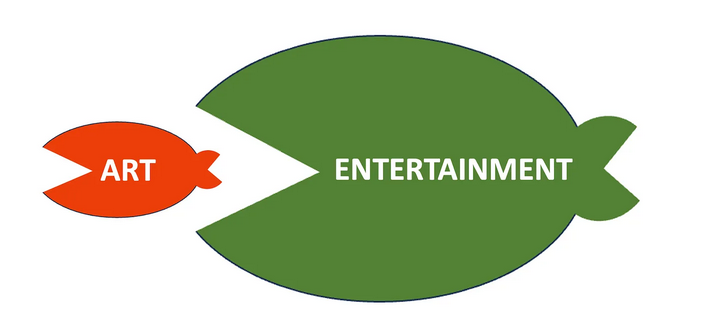
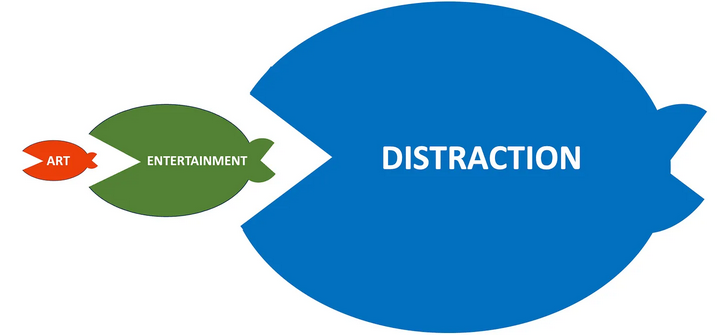
Maybe it’s smarter to view the creative economy like a food chain. If you’re an artist — or are striving to become one — your reality often feels like this.
Until recently, the entertainment industry has been on a growth tear — so much so, that anything artsy or indie or alternative got squeezed as collateral damage.
But even this disturbing picture isn’t disturbing enough. That’s because it misses the single biggest change happening right now.
We’re witnessing the birth of a post-entertainment culture. And it won’t help the arts. In fact, it won’t help society at all.
[…]
Here’s a better model of the cultural food chain in the year 2024.
The fastest growing sector of the culture economy is distraction. Or call it scrolling or swiping or wasting time or whatever you want. But it’s not art or entertainment, just ceaseless activity.
The key is that each stimulus only lasts a few seconds, and must be repeated.
It’s a huge business, and will soon be larger than arts and entertainment combined. Everything is getting turned into TikTok — an aptly named platform for a business based on stimuli that must be repeated after only a few ticks of the clock.
TikTok made a fortune with fast-paced scrolling video. And now Facebook — once a place to connect with family and friends — is imitating it. So long, Granny, hello Reels. Twitter has done the same. And, of course, Instagram, YouTube, and everybody else trying to get rich on social media.
This is more than just the hot trend of 2024. It can last forever — because it’s based on body chemistry, not fashion or aesthetics.
Our brain rewards these brief bursts of distraction. The neurochemical dopamine is released, and this makes us feel good — so we want to repeat the stimulus.
[…]
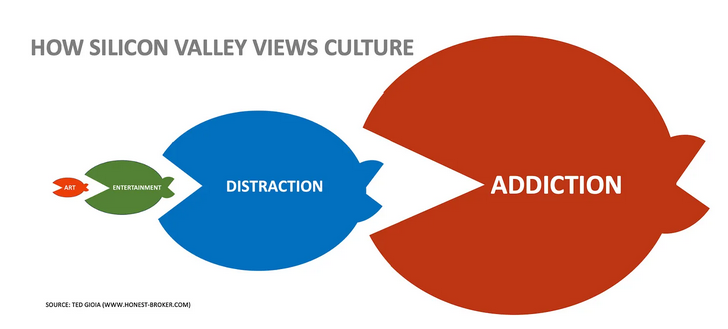
So you need to ditch that simple model of art versus entertainment. And even “distraction” is just a stepping stone toward the real goal nowadays — which is addiction.
Here’s the future cultural food chain — pursued aggressively by tech platforms that now dominate every aspect of our lives
The tech platforms aren’t like the Medici in Florence, or those other rich patrons of the arts. They don’t want to find the next Michelangelo or Mozart. They want to create a world of junkies — because they will be the dealers.
Addiction is the goal.
They don’t say it openly, but they don’t need to. Just look at what they do.
February 19, 2024
Justin Hayward performs “Forever Autumn” after telling the story behind it
RockEm Live Music
Published Jul 20, 2023The Justin Hayward Band performs “Forever Autumn” at the Plaza Live in Orlando, Florida on February 3, 2023. “Forever Autumn” was written by Jeff Wayne, Gary Anthony Osbourne and Paul Anthony Vigrass, and Justin explains how he got involved in the project at the beginning of this video.
Justin Hayward – Lead Vocals & Guitar
Mike Dawes – Guitars
Julie Ragins – Keyboards & Vocals
Karmen Gould – Flute, Percussion & Vocals
Comments Off on Justin Hayward performs “Forever Autumn” after telling the story behind it
February 10, 2024
Fake artists? On my Spotify feed? Say it ain’t so …
Ted Gioia rounds up a bunch of smaller music-related items in this post, including more evidence that Spotify continues to use fake artists:
I’ve griped a lot about the fake artists problem at Spotify. It’s like a stone in my shoe, and just gets worse and worse.
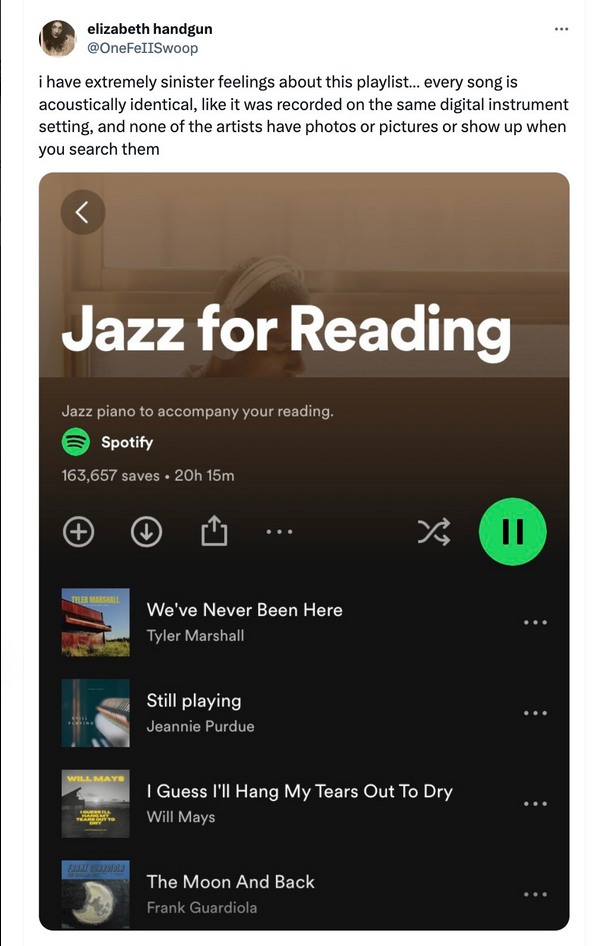
I’m especially alarmed by those strange playlists — filled with mysterious artists who may not really exist, or almost identical tracks circulating under dozens of different names.
Here’s a new example — a 20 hour playlist called “Jazz for Reading”.
I’m supposed to be a jazz expert. So why haven’t I heard of these artists? And why is it so hard to find photos of these musicians online?
I listened to twenty different tracks. There’s some superficial variety in the music, but each track I heard had the same piano tone and touch. Even the reverb sounds the same.
But the musicians are allegedly different.
Of course, I haven’t listened to the whole playlist. It feels endless, lasting almost an entire day!
But what’s going on here?
In other fields, this would be a scandal.
Imagine if you ran a medical office with physicians’ names on the door, but patients never got a glimpse of a flesh-and-blood doctor. Or a law firm gave out legal advice, but no lawyers were ever seen in the office.
Maybe Spotify will allay my concerns by putting these “artists” on tour. Why do I doubt that will happen?
Comments Off on Fake artists? On my Spotify feed? Say it ain’t so …
January 19, 2024
Music journalism, RIP
Ted Gioia explains why music journalism is collapsing and who committed the murder:
Just a few weeks ago, Bandcamp laid off 58 (out of 120) employees — including about “half of its core editorial staff“.
And Bandcamp was considered a more profitable, stable employer than most media outlets. The parent company before the recent sale (to Songtradr) and subsequent layoffs, Epic Games, will generate almost a billion dollars in income this year — but they clearly don’t want to waste that cash on music journalism.
Why is everybody hating on music writers?
Many people assume it’s just the same story as elsewhere in legacy media. And I’ve written about that myself — predicting that 2024 will see more implosions of this sort.
Sure, that’s part of the story.
But there’s a larger problem with the music economy that nobody wants to talk about. The layoffs aren’t just happening among lowly record reviewers — but everywhere in the music business.
- Universal Music announced layoffs two days ago.
- YouTube announced layoffs yesterday.
- Soundcloud announced last week that the company is up for sale — after two rounds of layoffs during the last 18 months.
- Spotify announced layoffs five weeks ago.
- That same week, Tidal announced layoffs.
- A few weeks earlier, Amazon Music laid off employees on three continents.
Meanwhile, almost every music streaming platform is trying to force through price increases (as predicted here). This is an admission that they don’t expect much growth from new users — so they need to squeeze old ones as hard as possible.
As you can see, the problem is more than just music writers — something is rotten at a deeper level.
What’s the real cause of the crisis? Let’s examine it, step by step:
- The dominant music companies decided that they could live comfortably off old music and passive listeners. Launching new artists was too hard — much better to keep playing the old songs over and over.
- So major labels (and investment groups) started investing huge sums into acquiring old song publishing catalogs.
- Meanwhile streaming platforms encouraged passive listening — so people don’t even know the names of songs or artists.
- The ideal situation was switching listeners to AI-generated tracks, which could be owned by the streaming platform — so no royalties are ever paid to musicians.
- These strategies have worked. Streaming fans don’t pay much attention to new music anymore.
I’ve warned about each of these — but we are now seeing the long-term results.
This is why Pitchfork is in deep trouble. If people don’t listen to new music, they don’t need music reviews.
And they don’t need interviews with rising stars. Or best of year lists. Or any of the other things music writers do for their readers.
But this problem will get much, much worse. Even the people who made these decisions will suffer — because living in the past is never a smart business strategy.
If these execs were albums, they’d deserve a zero score on the Pitchfork scale.

Comments Off on Music journalism, RIP
January 9, 2024
Matt Gurney on what he learned from Geddy Lee
The Line went into holiday mode during the Christmas season and into the first week of the new year. To fill in, the editors invited contributions on things the contributors were grateful for. Matt Gurney included his own piece, encouraged by Geddy Lee’s recent book My Effin’ Life (which I haven’t read, but hope to at some point):
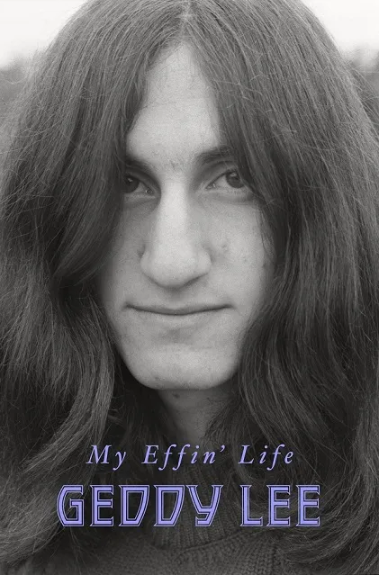
Most Line readers probably know that I am an unrepentant Trekkie. Many of you will not know, but will not be surprised to discover, that I’m also a huge fan of Canadian rock band Rush. (These two things do often seem to go together, I’ve noted.) Last year, Rush bassist and lead singer Geddy Lee published a memoir, playfully titled My Effin’ Life.
Lee began to work on the memoir during the pandemic lockdowns, when we all suddenly found ourselves with a lot of time on our hands. Lee has been very open, both in his memoir and in his public comments, about the sad series of life events that led him to decide to begin writing his memoir in the first place.
The first, of course, was the effective end of Rush, back in 2015. Lee was eager to continue making music and touring. Rush lyricist and drummer Neil Peart, afflicted with some health issues and worried he could no longer perform at the standard he expected of himself, was eager to retire and spend more time with his new, young family. (Rush fans will know the awful story of what happened to Peart’s first family; it’s not necessary to recap it here, but I have absolutely kept it in mind when counting my own blessings.) Lee has been honest about being frustrated and even bitter about the end of Rush’s active career, but the news got worse, when, early in what was supposed to be the second act of Peart’s family life, the drummer was diagnosed with a cruel, terminal cancer. He died in 2020, almost four years ago to this day, after a long, private struggle, a struggle that Lee did his part to keep private. As if that wasn’t enough, not long after the death of his long-time friend and bandmate, Lee lost his mother, Mary Weinrib, a Holocaust survivor and a huge and active presence in Lee’s life until the very end. Weinrib died in 2021.
That’s a lot of loss packed into a short period, and the timing was awful. As COVID hit North America and began to rack up its victims, Lee, like so many of us, retreated inside his own home. While there, he had many ghosts and sorrows to keep him company, and it clearly weighed on him. So he began writing.
And what resulted was, perhaps to the surprise of even Lee, a happy memoir. A story of gratitude and laughter. A memoir full of funny stories, jokes, and things for which he was thankful.
As 2023 was drawing to a close, my father gifted me a ticket to a book reading at Toronto’s Massey Hall, featuring none other than Geddy Lee. The special surprise interviewer and cohost for the evening — though not really that much of a surprise — was Lee’s surviving Rush bandmate and friend of decades, guitarist Alex Lifeson. The two men, both now 70, sat down on the stage and spent the next couple of hours swapping stories, jokes and memories, happy and sad. They strongly hinted, but did not promise, that some version of Rush may reunite and perform again.
And that would be great. I would spend an unwise amount of money to go see that. But it wasn’t my excitement about possible opportunities to see some version of my favourite band perform again that began changing my perspective on 2023. It was just seeing the two of them on that stage. I’m sure these guys have had to deal with all the creeping aches and pains and a need for new contact lens prescriptions that I catalogued above. And I can guarantee you that they’ve both endured more personal loss than I have. But what I saw that evening was simply two old buddies, with 30 years on me, sitting on a stage and having a blast. And I realized that to these guys, something that happened when they were 40 would have seemed like a long time ago. Because they’d lived a lot since then.
Comments Off on Matt Gurney on what he learned from Geddy Lee


