Why, though, did Germans feel such a special affinity with “die Königin“? The most obvious reason is that the Royal Family is, to a great extent, of German extraction. The connections go back more than a thousand years to the Anglo-Saxons, but in modern times they begin with George I and the House of Hanover. This reverse takeover of the British monarchy by the Germans transformed the institution in countless ways. They may be summarised in four words: music, the military, the constitution and Christmas.
Music was a language that united the English and the Germans. The key figure was, of course, Handel — the first and pre-eminent but by no means the last Anglo-German composer. Born in Halle, Georg Friedrich Händel had briefly been George I’s Kapellmeister in Hanover yet had already established himself in England before the Prince Elector of Hanover inherited the British throne in 1714.
In London — then in the process of overtaking Paris and Amsterdam to become the commercial capital of Europe — he discovered hitherto undreamt-of possibilities. There he founded three opera companies, for which he supplied more than 40 operas, and adapted a baroque Italian art form, the oratorio, to suit English Protestant tastes.
His coronation music, such as the anthem, “Zadok the Priest”, imbued the Hanoverian dynasty with a new and splendid kind of sacral majesty. But he also added to its lustre by providing the musical accompaniment for new kinds of public entertainment, such as his Music for the Royal Fireworks: 12,000 people came to the first performance.
Along with music, the Germans brought a focus on military life. Whereas for the British Isles, the Civil War and the subsequent conflicts in Scotland and Ireland had been something of an aberration, war was second nature to German princes. Among them, George II was not unusual in leading his men into battle, although he was the last British monarch to do so.
Still, the legacy of such Teutonic martial prowess was visible in the late Queen’s obsequies: uniforms and decorations, pomp and circumstance, accompanied by funeral marches composed by a German, Ludwig van Beethoven. Ironically, the German state now avoids any public spectacle that could be construed as militaristic, yet most Germans harbour boundless admiration for the way that the British monarchy enlists the ceremonial genius of the armed services.
Even more important was the German contribution to the uniquely British creation of constitutional monarchy.
Each successive dynasty has left its mark on the monarchy’s evolution: from the Anglo-Saxons and Normans (the common law) to the Plantagenets (Magna Carta and Parliament) and Tudors (the Reformation). Only the Stuarts failed this test, at least until 1688. Even after the Glorious Revolution, the Bill of Rights and other laws that conferred statutory control over the royal prerogative, the constitutional settlement still hung in the balance when Queen Anne, the last Stuart ruler, died in 1714.
Coming from a region dominated by the theory and practice of absolute monarchy, the Hanoverians had no choice but to adapt immediately and seamlessly to the realities of politics in Britain, where their role was strictly limited. Robert Walpole and the long Whig ascendancy, during which the doctrine of parliamentary sovereignty embedded itself irrevocably, could not have taken place without the acquiescence and active support of the new dynasty.
George III has been accused of attempting to reverse this process. The charge is unjust. Rather, as Andrew Roberts demonstrates in his new biography, he was “a monarch who understood his extensive rights and duties under the constitution”. He still had the right to refuse royal assent to parliamentary bills, but in half a century he never once exercised his veto (the last monarch to do so was the Stuart, Queen Anne in 1708).
At a time when enlightened despotism was de rigueur on the Continent, the Hanoverians were content to participate in an unprecedented constitutional experiment in their newly acquired United Kingdom. It was neither the first Brexit, nor the last, but it happened courtesy of a Royal Family that was still very German.
Daniel Johnson, “Why Germany mourned our Queen”, The Critic, 2022-10-30.
December 29, 2023
QotD: The Hanoverian “reverse takeover of the British monarchy by the Germans”
December 25, 2023
Repost – “Fairytale of New York”
Time:
“Fairytale of New York” by The Pogues featuring Kirsty MacColl
This song came into being after Elvis Costello bet The Pogues’ lead singer Shane MacGowan that he couldn’t write a decent Christmas duet. The outcome: a call-and-response between a bickering couple that’s just as sweet as it is salty.
December 20, 2023
Eat Like a Medieval Nun – Hildegard of Bingen’s Cookies of Joy
Tasting History with Max Miller
Published 5 Sept 2023
(more…)
December 17, 2023
Mark Knopfler – “Sailing To Philadelphia” (The Studio Albums 1996-2007)
Mark Knopfler
Published 15 Jul 2022Official video to part 2 of Mark Knopfler’s The Studio Albums 1996-2007 featuring the remastered recordings from Sailing To Philadelphia.
(more…)
December 14, 2023
Pervasive disrespect for the human form in art (and everything else) is a leading indicator of collapse
My headline isn’t exactly what Ted Gioia says here (although this is only the beginning of his article, as the rest is behind a paywall) but it’s definitely an aspect of what he’s seeing:
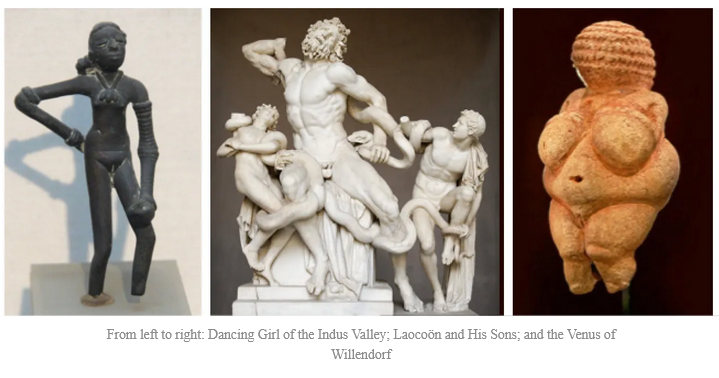
For thousands of years, flourishing societies treated the human form with love and respect.
The connection is hard to describe with precision. But, it seems, you can’t make much progress promoting human rights if you don’t start with some degree of reverence for the embodied individual.
Even neanderthals knew about ornamentation and figurative art, but paintings of actual people, created by communities along the Nile River, some 8,000 years ago, signaled the rise of more advanced, stable institutions. It’s no coincidence that democracy and personal autonomy in Greece and Rome happened in conjunction with obsessively realistic renderings of the human body.
Much of this was lost in the post-classical world, but Renaissance artists rediscovered this passion for the human figure — which was embedded in its nurturing of science, art, and free inquiry
But something very different is happening in our own time.
I won’t offer any theories today. I’ll just share the facts — in the form of news stories, all about different subjects.
None of these stories have any direct connection with the others. Yet they fit together like the pieces of a strange puzzle. The picture they make is ominous.
Maybe you have some explanations. In the meantime, let’s just plunge in …
1. You can’t hear people talking in movies — because directors prefer to share background sounds.
“I used to be able to understand 99% of the dialogue in Hollywood films. But over the past 10 years or so, I’ve noticed that percentage has dropped significantly — and it’s not due to hearing loss on my end. It’s gotten to the point where I find myself occasionally not being able to parse entire lines of dialogue when I see a movie in a theater, and when I watch things at home, I’ve defaulted to turning the subtitles on to make sure I don’t miss anything crucial to the plot.”2. Lead vocalists are getting quieter while the sound of the instruments become louder.
“Lead vocalists have gotten quieter over the decades, compared with the rest of the band. That’s the conclusion of a new study that analyzes chart-topping pop tunes from 1946 to 2020 …”3. Anthropophobia — the fear of other people — is on the rise.
“Anthropophobia, or the fear of people, has so far been America’s most searched-for phobia this year. In that study, anthropophobia accounted for 22% of all phobias that people searched for online, a five-fold increase over 2019. And the state-by-state results affirm common stereotypes. New York’s most-searched phobia in 2020, for example, has been “philophobia.” That’s a big word for the fear of intimacy.”4. Time spent alone is rising for all demographic groups.
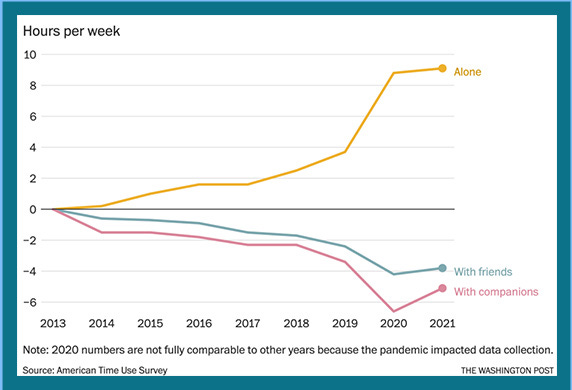
“According to data from the American Time Use Survey, the amount of time people spent with their friends, family and other companions was mostly unchanged between 1970 and 2013. Then, after decades of stability, the numbers began falling. By 2019, on average people were spending almost three hours less with their friends than only six years earlier, and four hours less with their family, neighbors and other companions.
“None of that time was transferred to more time with partners, children or others. All of it was swallowed up by time spent alone … Strikingly, the average American teenager today spends 11 hours fewer with their friends than they did only eight years ago, and 12 hours more time alone.”
5. Clothing retailers replace realistic mannequins with abstract forms.
“There were a ton of used mannequins sitting in retailers’ attics and storerooms. Every time they re-merchandised or remodeled, they were bringing in new mannequins to replace the old, increasingly replacing realistics with abstracts. And it wasn’t just full mannequins, it was head forms, leg forms, maternity mannequins, swimwear mannequins and all kinds of props, as well. Retailers would throw these items in the trash.”6. Social media causes children to dislike their own bodies.
“Three out of four children as young as 12 dislike their bodies and are embarrassed by the way they look, increasing to eight in 10 young people aged 18 to 21 … Nearly half of all children and young people aged from 12 to 21 questioned said they have become withdrawn, started exercising excessively, stopped socialising completely or self-harmed because they are regularly bullied or trolled online about their physical appearance.
December 2, 2023
Shane MacGowan, RIP
I’ve been a long-time fan of the Pogues, and Shane MacGowan was the original lead singer for their first several albums. His lifestyle and undependability brought about a break with the rest of the band who continued on without him. I rather lost track of him soon after his next band, the Popes, had one okay album that showed MacGowan hadn’t shaken his demons. I still post his duet with the late Kirsty MacColl every Christmas. In The Pillar, Ed Condon remembers MacGowan:

Shane MacGowan performing in Japan on an unknown date.
Photo by Masao Nakagami via Wikimedia Commons.
Yesterday Shane MacGowan, lead singer of the Pogues, died at age 65.
He was, in every sense, a living legend of Irish music — so much so that many people, sincerely, expressed shock that he was actually still alive. [NR: Literally the words out of my mouth when Elizabeth told me he’d died.]
Most people, at least in this country, know him best for his fiercely melancholic Christmas ballad “Fairytale of New York”, though the Pogues albums Rum, Sodomy & the Lash and If I Should Fall from Grace with God firmly fixed MacGowan as the living conduit of a musical tradition all too often dismissed as a postcard anachronism, created to appeal to tourists.
There was nothing contrived, though, about MacGowan, who was the living embodiment of the distinctly Irish contradiction of “fierce melancholy.” An incredibly gifted writer and poet, he wrote, performed — and lived — with a kind of burning urgency that seemed at once self-consuming and yet in him, rather than from him.
It would be easy to dismiss the riotous drinker and singer, whose punk-inflected incarnation of Irish ballardry seemed stoked with some terrible ferocity, as just an eloquently wounded product of a now nearly vanished Irish society. But what marked him out, to me, was that he was driven by something from within, not without.
Born on Christmas Day in 1957 to Irish parents in England, he spent his early life back in Ireland, living in a family cottage in rural Tipperary, where the children slept three to a bed, there was no running water, and the family cooked on an open fire.
According to his parents, music and storytelling were the focus of their family life in those days.
“It was basic and beautiful,” he said of his childhood. “It was the end of an era that I just happened to catch. And I’m glad I caught it, you know?”
[…]
“All I ever had were happy times,” is how MacGowan described his childhood in Ireland.
This deep understanding and love for his own history and where he came from, which John Paul II also wrote about in Memory and Identity, suffused MacGowan’s music.
But even as he became a kind of living totem in his home country it was clear he loathed the spotlight, writhed during interviews, and fought, often unsuccessfully, to balance his natural reticence with the convulsive need to make his music.
It drove him to at times terrible self-destruction, but the defiance and desperation of his singing seemed always directed back within himself. And it was a great comfort to read his family’s announcement that he’d died with the last rites imparted.
He was a man for whom the words of Jim Harrison, another great poet, seemed to be written:
Some people hear their own inner voices with great clearness and they live by what they hear. Such people become crazy, or they become legend.
Rest in peace, Shane.
December 1, 2023
Gregorian – “Stairway To Heaven”
gregorianmusiccom
Published 20 Jun 2015We proudly present the new fan-video “Stairway to Heaven” performed and made by members of the Gregorian-music.com fan club.
(more…)
November 19, 2023
Ted Gioia wonders if we need a “new Romanticism”
He raised the question earlier this year, and it’s sticking with him to the point he’s gathering notes on the original Romantic movement and what it was reacting against:
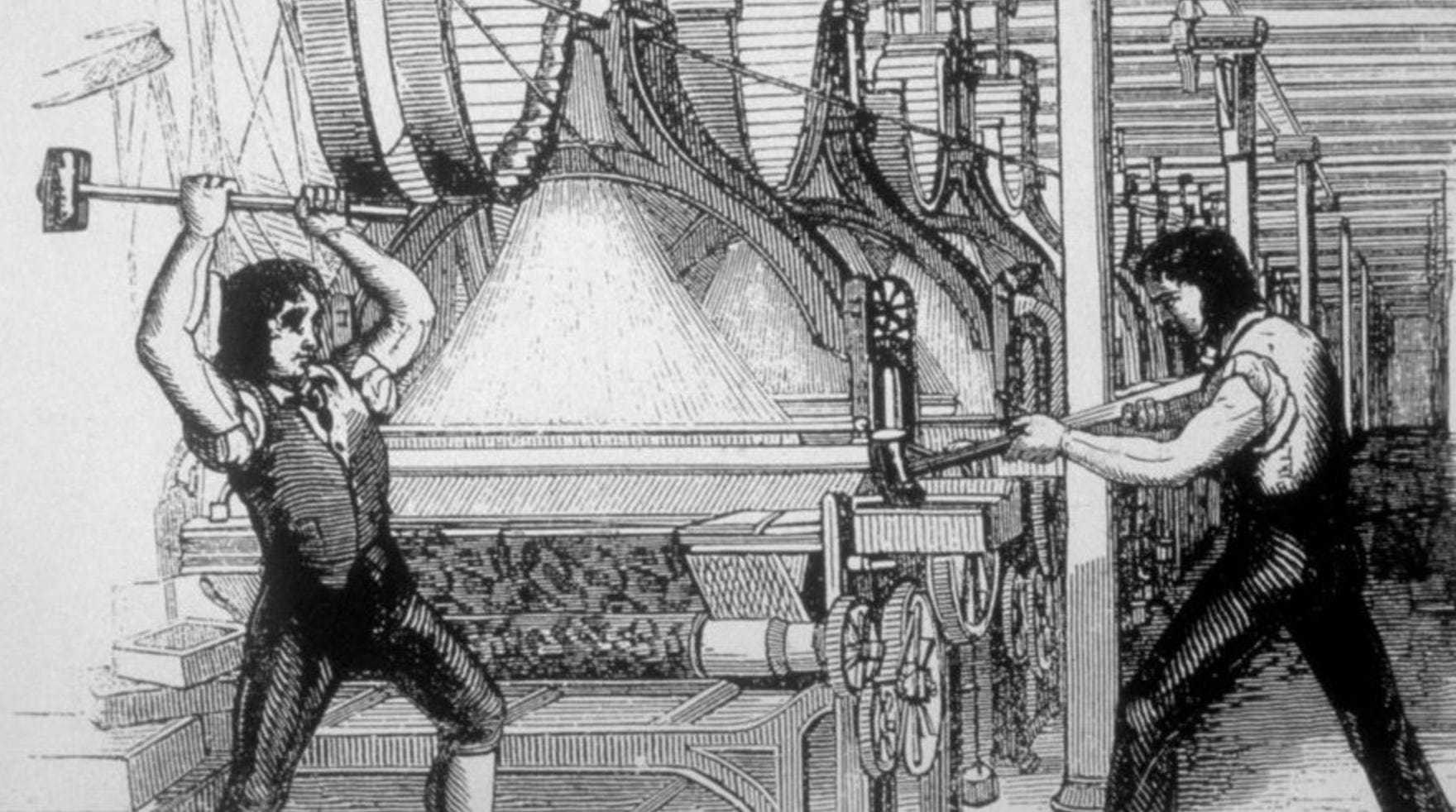
The issues that enraged the original Luddites certainly have many modern echoes.
I realized that, the more I looked at what happened circa 1800, the more it reminded me of our current malaise.
- Rationalist and algorithmic models were dominating every sphere of life at that midpoint in the Industrial Revolution — and people started resisting the forces of progress.
- Companies grew more powerful, promising productivity and prosperity. But Blake called them “dark Satanic mills” and Luddites started burning down factories — a drastic and futile step, almost the equivalent of throwing away your smartphone.
- Even as science and technology produced amazing results, dysfunctional behaviors sprang up everywhere. The pathbreaking literary works from the late 1700s reveal the dark side of the pervasive techno-optimism — Goethe’s novel about Werther’s suicide [Wiki], the Marquis de Sade’s nasty stories [Wiki], and all those gloomy Gothic novels [Wiki]. What happened to the Enlightenment?
- As the new century dawned, the creative class (as we would call it today) increasingly attacked rationalist currents that had somehow morphed into violent, intrusive forces in their lives — an 180 degree shift in the culture. For Blake and others, the name Newton became a term of abuse.
- Artists, especially poets and musicians, took the lead in this revolt. They celebrated human feeling and emotional attachments — embracing them as more trustworthy, more flexible, more desirable than technology, profits, and cold calculation.
That’s the world, circa 1800.
The new paradigm shocked Europe when it started to spread. Cultural elites had just assumed that science and reason would control everything in the future. But that wasn’t how it played out.
Resemblances with the current moment are not hard to see.
“Imagine a growing sense that algorithmic and mechanistic thinking has become too oppressive. Imagine if people started resisting technology. Imagine a revolt against STEM’s dominance. Imagine people deciding that the good life starts with NOT learning how to code.”
These considerations led me, about nine months ago, to conduct a deep dive into the history of the Romanticist movement. I wanted to see what the historical evidence told me.
I’ve devoted hours every day to this — reading stacks of books, both primary and secondary sources, on the subject. I’ve supplemented it with a music listening program and a study of visual art from the era.
What’s my goal? I’m still not entirely sure.
October 30, 2023
The rapidly fading market for “song investing”
Ted Gioia called it over two years ago, and now it’s coming true:
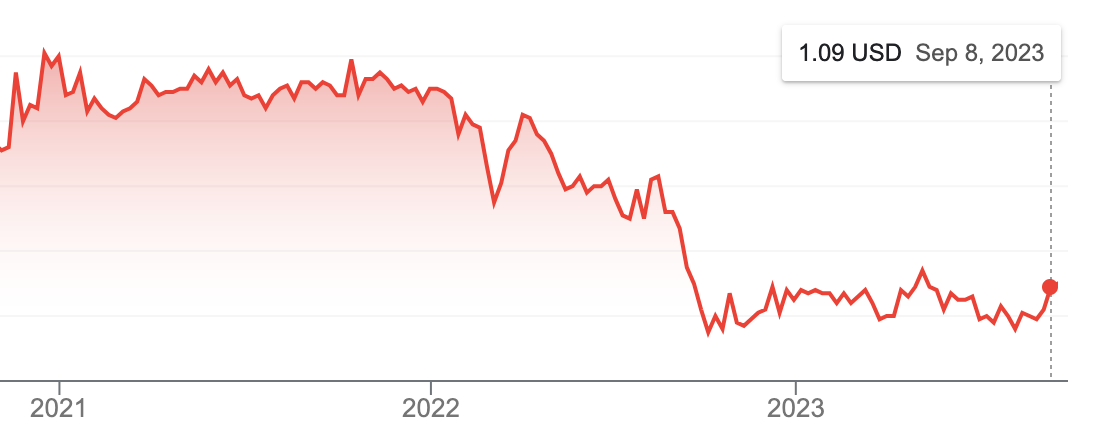
The collapse finally came.
When I analyzed the song buyout mania, led by the Hipgnosis fund, back in June 2021, I predicted that this ultra-hot investment trend would “come to an unhappy end”. And now the collapse has arrived.
We’ve reached the endgame. The song fund’s share price has dropped 50% since I made that assessment — and now shareholders have voted to dissolve or reorganize the investment trust.
But where do we go from here? What are old songs really worth? And who will end up owning all these old rock and pop tunes?
Below I offer 12 predictions.
Much of what I have to say is harsh. That’s unfortunate — if I were a real judge, I’d err on the side of leniency. It’s never fun issuing such hardass verdicts. But if I claim to be the Honest Broker, I really have to stick with truths, even when (as in this case) they’re painful truths.
(1) Many musicians still want to sell their songs, but it will be hard to find generous buyers.
Bob Dylan got out at the top, but the times are now a-changin’. Musicians won’t get the big payouts available back in 2021. A telltale sign will be more deals with “undisclosed terms” — because nobody will want to brag about these lowball transactions.(2) Professional financiers have finally learned their lesson.
The two big finance outfits promoting song investing, Hipgnosis and Round Hill, have faltered and will now sell the songs they bought. Sophisticated investors no longer believe the hype. So don’t expect to see the launch of new song investment funds any time soon. The remaining buyers will be bottom fishers and the terminally naive (described in more detail below).[…]
(5) Look out for these vultures in all sectors of the music business.
When private equity firms knock on your door, it’s a sign that you’re already half dead. These folks actually enjoy picking on carcasses — which is easier work than hunting for live prey. I tend to avoid name-calling, but there’s a reason why some folks refer to them as vulture capitalists. That’s their specialty and their economic model is built on bottom-feeding. This is why private equity firms bought up lots of failing local newspaper, struggling local radio stations, etc. Guess what’s next on their list? Expect to see these tough hombres play a bigger role in all aspects of the music business over the next decade.[…]
(7) This whole situation is a case study in misallocated investment capital.
There’s a general lesson here too. I realized, early on in my consulting work, that the single biggest mistake large corporations make is investing too much to keep their old business units alive — when they would be wiser putting that cash to work in new opportunities. The major record labels in the current moment are poster children for exactly this mistaken sense of priorities. They will support the “old songs” business model at all costs — it’s a core part of their self image — but return on investment will be dismal.
October 15, 2023
QotD: The two eras of Jazz
Dylan Jones, “The 100 best jazz albums you need in your collection”, GQ, 2019-08-25.
October 14, 2023
Ray Manzarek – “Riders On The Storm”
EliasIak2011
Published 30 Nov 2012“The Doors: Mr. Mojo Risin’ — The Story of LA Woman“
September 29, 2023
QotD: Collecting jazz
And there were some things I just didn’t get. Ornette Coleman was one. At the same time Miles Davis was breaking through with modal jazz forms, Coleman invented free jazz with The Shape Of Jazz To Come. Over half a century after the event it is difficult to recapture the shock that greeted the arrival of this record, but it just gave me a headache. Coleman played a white plastic saxophone that looked like a toy, he dressed like a spiv and was a master of the one-liner, the “Zen Zinger” (stuff like, “When the band is playing with the drummer, it’s rock’n’roll, but when the drummer is playing with the band, it’s jazz”), so I really wanted to like his music. But I couldn’t. No matter how much I tried. As far as I was concerned he was improvising up his own sphincter.
Dylan Jones, “The 100 best jazz albums you need in your collection”, GQ, 2019-08-25.
September 26, 2023
“Brothers in Arms” | The Bands of HM Royal Marines
The Bands of HM Royal Marines
Published 23 May 2022“Brothers in Arms” by Dire Straits, arranged by Capt Phil Trudgeon RM, and performed at the Mountbatten Festival of Music 2022 in the Royal Albert Hall, London.
(more…)
September 18, 2023
It turns out that buying up the rights to old rock songs wasn’t a good investment after all
Ted Gioia enjoys a little bit of schadenfreude here because he was highly skeptical of the investments in the first place, although the geriatric rockers who “sold out” seem to have generally made out like bandits this time around:
Back in 2021, investors spent more than $5 billion buying the rights to old songs. Never before in history had musicians over the age of 75 received such big paydays.
I watched in amazement as artists who would never sell out actually sold out. And they made this the sale of a lifetime, like a WalMart in El Paso on Black Friday.
Bob Dylan sold out his entire song catalog ($400 million — ka-ching!). Paul Simon sold out ($250 million). Neil Young sold out ($150 million). Stevie Nicks sold out ($100 million). Dozens of others sold out.
As a result, rock songs have now entered their Madison Avenue stage of life.
Twisted Sister once sang “We’re Not Gonna Take It”. But even they took it — a very large payout, to be specific. A few months ago, the song showed up in a commercial for Discover Card.
Bob Dylan’s song “Shelter from the Storm” got turned into a theme for Airbnb. Neil Young’s “Old Man” was rejuvenated as a marketing jingle for the NFL (touting old man quarterback Tom Brady).
Fans mocked this move. Even Neil Young, now officially a grumpy old man himself, expressed irritation at the move. After all, the head of the Hipgnosis, the leading song investment fund, had promised that the rock star’s “Heart of Gold” would never get turned into “Burger of Gold”.
That hasn’t happened (yet). But where do you draw the line?
I was skeptical of these song buyouts from the start — but not just as a curmudgeonly purist. My view was much simpler. I didn’t think old songs were a good investment. […] But even I didn’t anticipate how badly these deals would turn out.
The more songs Hipgnosis bought, the more its share price dropped. The stock is currently down almost 40% from where it was at the start of 2021.
Things have gotten so bad, that the company is now selling songs.
On Thursday, Hipgnosis announced a plan to sell almost a half billion dollars of its song portfolio. They need to do this to pay down debt. That’s an ominous sign, because the songs Hipgnosis bought were supposed to generate lots of cash. Why can’t they handle their debt load with that cash flow?
But there was even worse news. Hipgnosis admitted that they sold these songs at 17.5% below their estimated “fair market value”. This added to the already widespread suspicion that current claims of song value are inflated.
August 22, 2023
Societal norms breaking down even among music fans at concerts
Ted Gioia on the increasing number of performing artists on stage who are being physically attacked by their own fans at live concerts:
Consider these recent events:
- During a Pink concert in London, a fan tossed a bag of human ashes on stage. Pink was totally chill, and on the video of the incident can be heard asking: “Is this your mom?”
- A fan threw a cellphone at Drake during a Chicago performance — and the singer almost caught it, but it hit his hand instead.
- Pop singer Bebe Rexha wasn’t so fortunate, and a hurled phone sent her to the hospital in June.
- Harry Styles has been repeatedly struck with objects while performing — taking on everything from a flying Chicken McNugget to a water bottle in the groin.
- Country star Kelsea Ballerini was struck by a flying bracelet thrown by a fan in Boise, Idaho. Jewelry is a lovely gift, but in this instance the impact caused the singer to flinch, and stop playing her guitar. A few minutes later she had to leave the stage.
- An assailant actually jumped on stage during an Ava Max performance in Los Angeles, and slapped the singer, scratching her eye in the process — before a security guard restrained him. The singer somehow managed to finish the song.
- Rapper Latto got hit with a flying object during a concert in Germany. She responded by telling the perpetrator “I’ma beat your ass.”
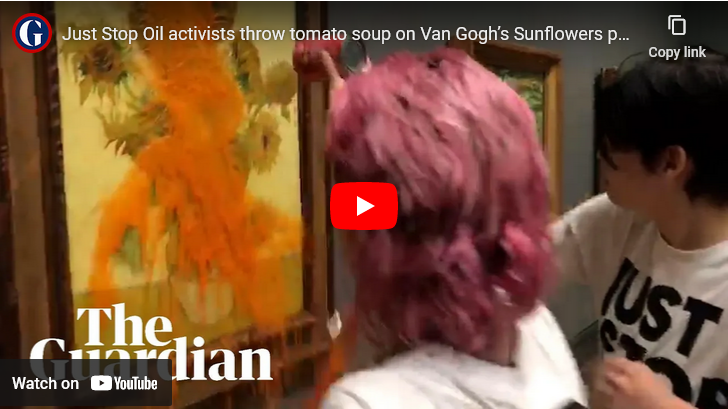
It’s a curious coincidence that, during this same period, activists have started throwing things at famous works of art. You wouldn’t normally think of museums and concert halls as epicenters of paintball-esque outbursts. But in the year 2023, they are hot spots for all the worst tendencies.
Of course, there’s a long history of fans throwing things on stage. But until recently, they were usually nice things. Only in the rarest instance — for example, a vaudeville show of embarrassingly low quality — were tomatoes tossed at a performer.
[…]
Our culture has changed, and not for the better. I have come to believe — as I’ve explained elsewhere — that US society shifts between cycles of hot and cool. We are currently approaching the peak of the hot cycle, and this is always accompanied by anger, conflict, and violence.
When I first started to say this, more than 15 years ago, people were skeptical. But who will deny it after everything we’ve seen in the intervening years?
You may think that violence plays out on the battlefield, not at a pop concert. But music has always been a cultural indicator. In some ways, it is our most revealing source of information on society. Sometimes the future shows up in our music even before it gets covered in the newspapers.
So even if I am saddened by the craziness at music concerts, I can’t say I’m surprised There’s something ugly simmering in our society, and it has finally arrived at the pricey front row seats of concerts. All of sudden, fans have decided that an expensive ticket gives them the right to do something abusive to their favorite pop star.
It makes no sense, but it’s definitely part of the zeitgeist. And it will almost certainly get worse before it gets better.
But these cycles eventually turn. There’s a law of reflexivity at work. People do burn out on anger, sooner or later. I’m hoping it will be sooner in this instance.