
Dire Straits
Published 28 Apr 2023Dire Straits performing ‘Tunnel Of Love’ at Rockpop in Concert on December 19th 1980.
Footage licensed from ZDF Enterprises. All rights reserved.
(more…)
August 1, 2023
Dire Straits – Tunnel Of Love (Rockpop In Concert, 19th Dec 1980)
Comments Off on Dire Straits – Tunnel Of Love (Rockpop In Concert, 19th Dec 1980)
July 21, 2023
Country music world (and legacy media) convulsed by country song that isn’t woke
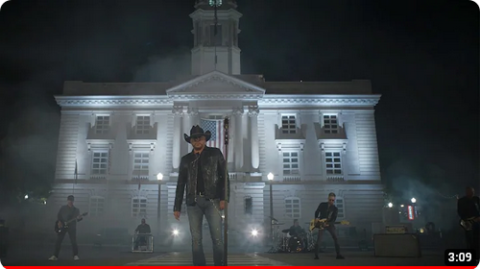
There’s been a lot of wailing by the usual suspects about a recent video released by Jason Aldean for his song “Try That in a Small Town”, alleging all sorts of horrible things including promotion of lynching, outright racism, and inciting violence:
… writer Zachary Faria notes that the left is rabidly protective of Black Lives Matter. In fact, they’re so protective of it that they’ll take issue with criticism of literally anything that ever even happened at a Black Lives Matter protest.
Entire neighborhoods were burned to the ground? A small price to pay for social justice, at least in their minds.
So the idea of people standing up to them — warning them to try that in a small town — is despicable.
Remember that these are the same people who continue to accuse Kyle Rittenhouse of murder despite having been acquitted of the crime. These are the same people who call the kid a racist despite him having shot three white dudes. They say he acted unprovoked despite one trying to take his gun from him, another hitting him in the head with a blunt object, and a third literally pointing a gun at him.
Through it all, they act like Rittenhouse should have just rolled over and allowed his murder to happen, all because the cause of Black Lives Matter cannot be criticized.
Where Aldean sinned is because he, too, thinks ill of the riots that engulfed every major city in this nation.
He’s harkening back to a time when communities were full of people protecting one another. That’s a very good thing, and I’m someone who would love to see that happen again.
Instead, the people claiming that Aldean’s song is about lynching are telling on themselves.
There doesn’t seem to be any part of the song that says a thing about black people or anything like that. In fact, most of the people involved in the riots, at least as I saw them, seemed to be white. But the fact that this is where the leftists went tells us plenty. It tells us they think the only kind of person who would cross that line is a black person.
Comments Off on Country music world (and legacy media) convulsed by country song that isn’t woke
June 28, 2023
Ted Gioia’s confession – he’s a Dan stan
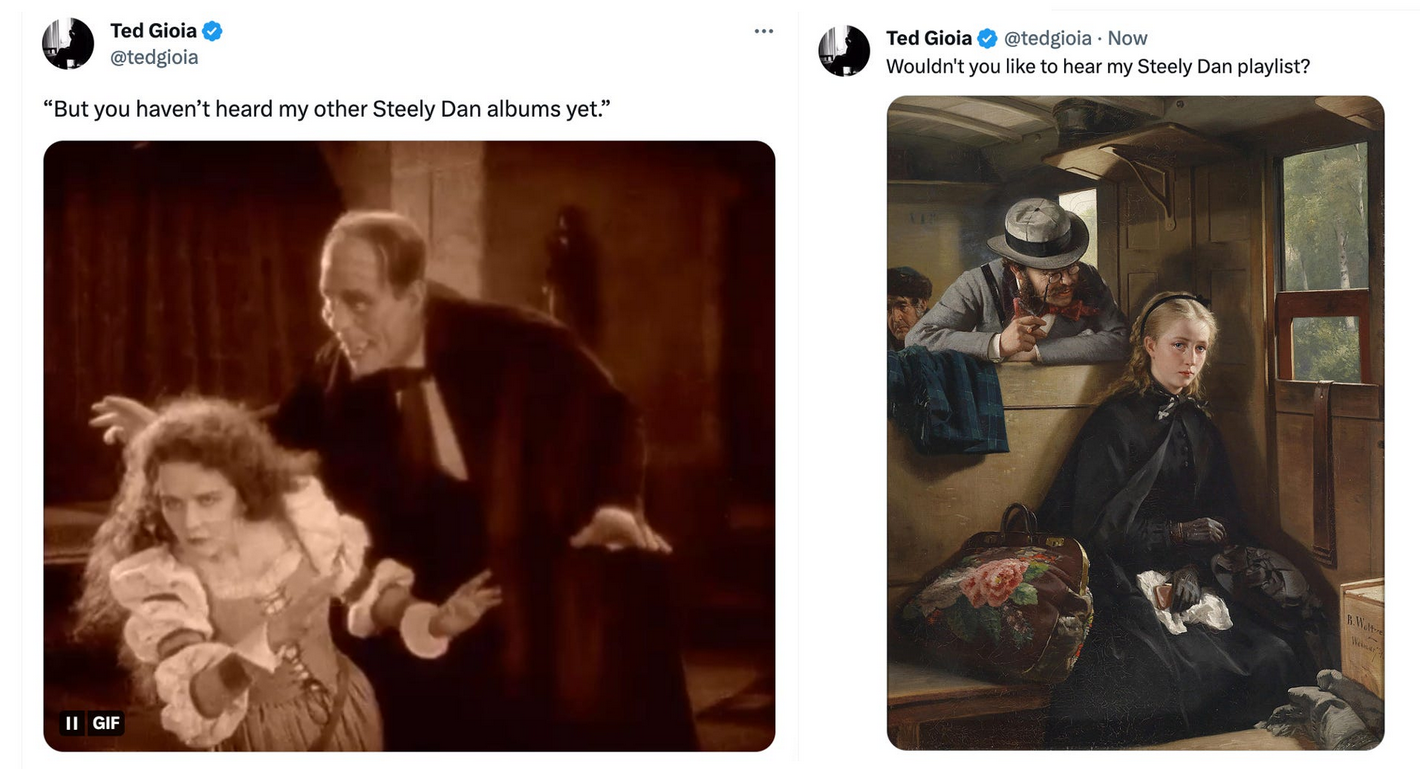
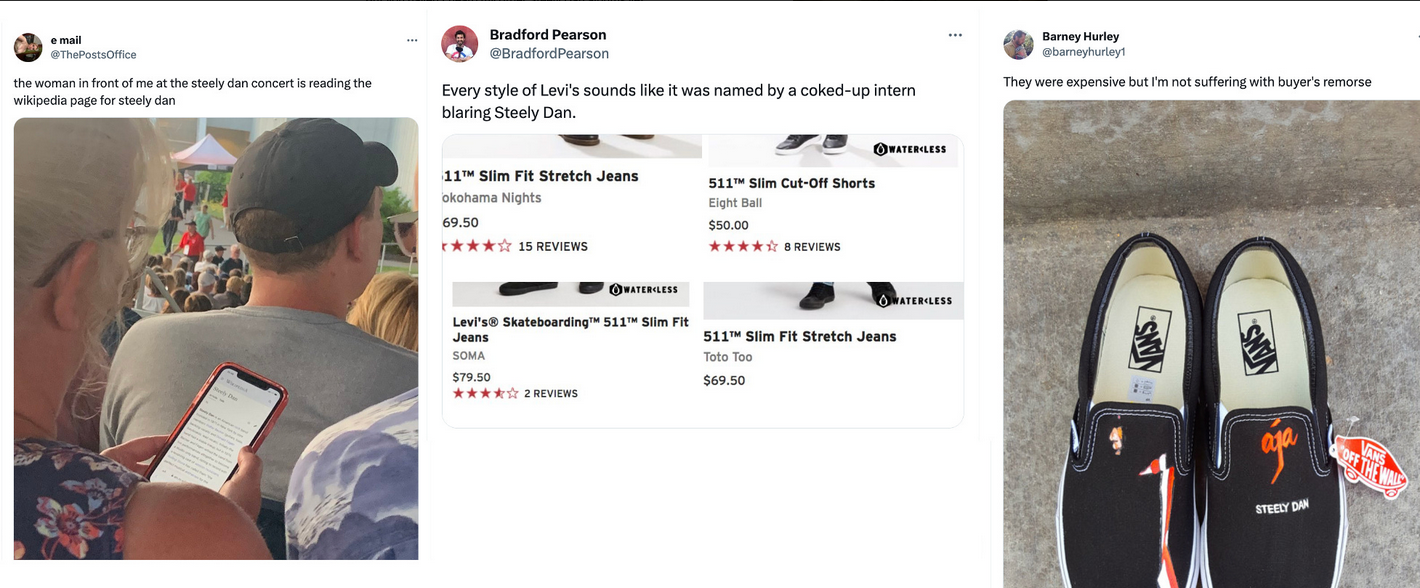
While I’ve never been much of a musicologist — and definitely not any kind of musician — I admit I had a very similar evolution of feeling toward the music of Steely Dan as Ted Gioia, who charts his progress from Never Dan to Dan stan:
I often make jokes about Steely Dan fans.
They’re bros and geeks and sad wannabes. But the painful truth is that I’m one of them now.
And if you don’t watch out, it could happen to you too.
At least I can laugh at myself. That’s good, because fans like me are the real target of the jokes.
And it’s true — we are a trifle obsessed.
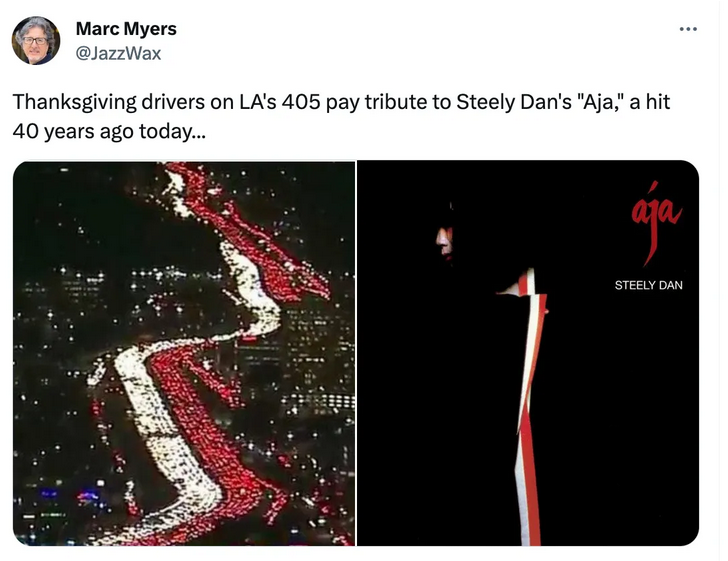
If you’re a Dan stan, you see the band’s influence everywhere. Random patterns take on new Dan-esque shapes. For you it’s just rush hour traffic, but for us it’s a message from the cosmos.
But I wasn’t always like this. Once upon a time, I was a Steely Dan skeptic, a real Dan-o-phobe. I thought I was safe from their pernicious influence, but I was wrong.
This is my story.
Comments Off on Ted Gioia’s confession – he’s a Dan stan
June 9, 2023
Rush – The Making of “YYZ”
marvincandle815
Published 17 Apr 2011From the Classic Albums: 2112 & Moving Pictures special. Made some minor cuts to avoid repetition and to keep it under 10 minutes.
Comments Off on Rush – The Making of “YYZ”
May 28, 2023
Musical copyrights – crazy as they are now – were far worse in history
Ted Gioia outlines just how the concept of musical copyrights produced even more distortions in the past than they do today:

Assignments of copyrights photostat copies by mollyali (CC BY-NC 2.0) https://flic.kr/p/5JbsPE
People tell me it was never this bad before. But they’re wrong. The music copyright situation was even crazier 500 years ago.
The Italians took the lead in this, and it all started with Ottaviano Petrucci gaining a patent from the Venetian Senate for publishing polyphonic music with a printing press back in 1498. Andrea Antico secured a similar privilege from Pope Leo X, which covered the Papal States.
It’s hard to imagine a Pope making decisions on music IP, but that was how the game was played back then. In 1516, Pope Leo actually took away Petrucci’s monopoly on organ music, and gave it to Antico instead. You had to please the pontiff to publish pieces for the pipes.
Over time, this practice spread elsewhere. In a famous case, the composer Lully was granted total control over all operas performed in France. He died a very wealthy man — with five houses in Paris and two in the country. His estate was valued at 800,000 livres—some 500 times the salary of a typical court musician.
But the most extreme case of music copyright comes from Elizabethan England. Here the Queen gave William Byrd and Thomas Tallis a patent covering all music publishing for a period of 21 years. Not only did the two composers secure a monopoly over English music, but they also could prevent retailers or other entrepreneurs in the country from selling “songs made and printed in any foreign country.”
If anybody violated this patent, the fine was 40 shillings. And the music itself was seized and given to Tallis and Byrd. They probably had quite a nice private library of scores by the time the patent expired.
But that’s not all. Byrd and Tallis’s stranglehold on music was so extreme it even covered the printing of blank music paper. That meant that other composers had to pay Tallis and Byrd even before they had written down a single note. Not even the Marvin Gaye estate makes those kinds of demands.
Tallis died a decade after the patent was granted—putting Byrd in sole charge of English music. I’d like to tell you that he exercised his monopoly with a fair and open mind—especially because I so greatly esteem Byrd’s music, and also I’d like to think that composers are better at arts management than profit-driven businesses. But the flourishing of music publishing in England after the expiration of the patent — when, for a brief spell, anybody could issue scores — makes clear that Byrd did more to constrain than empower other composers.
Comments Off on Musical copyrights – crazy as they are now – were far worse in history
May 26, 2023
May 25, 2023
QotD: How long does “celebrity” last?
The first warning sign was when they renamed Bob Hope Airport.
Back in the 1940s, Bob Hope was the most popular comedian in the world. He was a radio star. He was a movie star. He would later become a TV star at NBC.
When Hope died in 2003, it made perfect sense to name the Burbank airport after him. After all, his longtime employer NBC was the best known company in Burbank, and Bob Hope had spent a half-century on the network — usually at the top of the ratings.
So the local airport got renamed.
But the only thing that lasts forever in pop culture is the fact that nothing last forever. By 2017, Bob Hope was only a dim memory at NBC, and young passengers flying to SoCal had no idea who he was. So they changed the name to the Hollywood Burbank Airport.
By coincidence this happened almost exactly 80 years after Hope rose to fame — when Paramount signed him to star in the film The Big Broadcast of 1938. In that hit movie, he sang his charming theme song “Thanks for the Memories” — which he kept singing until the end of the 20th century. Not long ago, everybody knew that song.
But then the memories ran dry.
I’ve long believed that 80 years is a typical span of pop culture fame for superstars. I’m referring to the biggest names — the lesser stars burn out in 80 months or 80 weeks or 80 days. But the top draws retain their fame for the entire lifetime of their youngest fans — and given current life expectancies of the US audience, that can’t be much more than 80 years.
We already see the price of Elvis Presley memorabilia starting to drop. The recent Elvis biopic might slow the erosion, but will never bring back the King’s red hot fame of the 1950s. By my measure, Elvismania will be officially dead in the year 2034. That will be the 80th anniversary of his first hit single “That’s All Right”. Almost none of his original audience will still be around to celebrate the anniversary, and that can’t bode well, even for the nostalgia crowd.
Some reputations do flourish after 80 years, but only because the entertainers somehow found an audience outside of pop culture. Louis Armstrong was famous as an entertainer during his lifetime, but enjoys posthumous renown as an artistic and cultural figure. Back in the 1920s, Rudy Vallée sold more records than Armstrong, but never made the transition outside of pop culture.
Ted Gioia, “How Long Does Pop Culture Stardom Last?”, The Honest Broker, 2023-02-23.
Comments Off on QotD: How long does “celebrity” last?
May 22, 2023
Dire Straits – “Sultans Of Swing” (Old Grey Whistle Test, 16th May 1978)
Dire Straits
Published 21 Oct 2022Dire Straits performing “Sultans Of Swing” in their first ever TV performance live on BBC’s The Old Grey Whistle Test in May, 1978. This performance took place three days before the UK release of their debut single of the same name.
(more…)
Comments Off on Dire Straits – “Sultans Of Swing” (Old Grey Whistle Test, 16th May 1978)
May 8, 2023
Gordon Lightfoot, RIP
Mark Steyn on perhaps the best-known song of the late Gordon Lightfoot:

Edmund Fitzgerald, 1971
Detail of a photo from Wikimedia Commons
In November 1975 Lightfoot chanced to be reading Newsweek‘s account of the sinking of a Great Lakes freighter in Canadian waters. He’s a slow and painstaking author, which is one reason he’s given up songwriting – because it takes too much time away from his grandkids. But that day forty-three years ago the story literally struck a chord, and he found himself scribbling away, very quickly:
The legend lives on From the Chippewa on down
Of the big lake they called Gitche Gumee
The lake, it is said Never gives up her dead
When the skies of November turn gloomy …“Gitche gumee” is Ojibwe for “great sea” – ie, Lake Superior – as you’ll know if you’ve read your Longfellow, which I’m not sure anyone does these days. Evidently Hiawatha was on the curriculum back east across Lake Huron in young Gordy’s Orillia schoolhouse. The Gitche Gumee reference may be why, when I first heard “The Wreck of the Edmund Fitzgerald”, I assumed its subject had sunk long before the song was written. In fact, it sank on November 10th 1975 — just a few days before Lightfoot wrote the number. When she’d launched in 1958, the Edmund Fitzgerald was the largest ship on the Great Lakes, and, when she passed through the Soo Locks between Lakes Superior and Huron, her size always drew a crowd and her captain was always happy to entertain them with a running commentary over the loudspeakers about her history and many voyages. For seventeen years she ferried taconite ore from Minnesota to the iron works of Detroit, Toledo and the other Great Lakes ports … until one November evening of severe winds and 35-feet waves […]
That said, human tragedy alone does not make for singable material. The last contact from the SS Edmund Fitzgerald was with another ship, the SS Arthur M Anderson. Yet “The Wreck of the Arthur M Anderson” would have been a far less evocative title. Arthur Marvin Anderson was on the board of US Steel, as Edmund Fitzgerald was on the board of Northwestern Mutual. But there is something pleasingly archaic about the latter name: in fact, as I think of it, I believe the last Edmund I met was one of Gordon Lightfoot’s fellow Canadian singers — the late operetta baritone Edmund Hockridge. Pair “Edmund” to “Fitzgerald”, and you have something redolent of Sir Walter Scott or Robert Louis Stevenson, of shipwrecks off Cornwall or the Hebrides. Perhaps that’s why “The Wreck of the Edmund Fitzgerald” either sounds like an old Scots-Irish folk tune or, alternatively, actually is one. For any IRA members reading this, Bobby Sands, the hunger striker who starved himself to death in a British gaol, wrote in his cell a song called “Back Home in Derry”, about Irish prison deportees en route to Australia and set to a tune remarkably like “The Wreck of the Edmund Fitzgerald”, which it seems unlikely he ever heard.
I see some musicologists claim the tune is in Dorian mode, although it sounds Mixolydian to me (like “The Wexford Carol”). Whichever it is, there is a perfect union between the emphatic melody, the crash of the waves, the antediluvian moniker of Northwestern Mutual’s chairman, and even the obvious filler phrases, so typical of ancient folk songs:
The lake, it is said
Never gives up her dead— which returns far more effectively in the final verse:
Superior, they said
Never gives up her dead— as if Gitchee Gumee is some vast ravening beast. Go back to Orillia, to Fourth Grade in 1947, and the parents listening to Mr and Mrs Lightfoot’s little boy sing “Too-Ra-Loo-Ra-Loo-Ral” as if a bit of synthetic shamrock from an old Tin Pan Alleyman were a genuine Irish lullaby from the mists of Emerald Isle antiquity. That’s the genius of “The Wreck of the Edmund Fitzgerald”: It was born sounding as if it’s a hundred years old. And its agelessness is all the more amazing when you consider that it’s essentially an act of journalism, an adaptation of a news report about something that happened a few days earlier – just the facts, ma’am, with minimal artistic license:
In a musty old hall
In Detroit they prayed
In the maritime sailors’ cathedral …“Maritime sailors” is surely a redundancy, and it’s not a cathedral but the “Mariners’ Church”, which doesn’t quite go the distance syllable-wise. And a parishioner wrote to Lightfoot to say the church isn’t in the least bit “musty”, so these days he finds alternative adjectives.
But that’s all details. The power of the song lies in its storytelling. It immortalized the fate of the freighter not just for the families of the dead, “the wives and the sons and the daughters”, but for everyone, and it made the Edmund Fitzgerald the Titanic of the Great Lakes – except that the Titanic never inspired any song like this. The mournful toll of the lakes in the penultimate stanza is Gordon Lightfoot at his very best:
Lake Huron rolls Superior sings
In the rooms of her ice-water mansion
Old Michigan steams Like a young man’s dreams
The islands and bays are for sportsmen
And farther below Lake Ontario
Takes in what Lake Erie can send her
And the iron boats go As the mariners all know
With the gales of November remembered …The gales of November howl and the waves rise up and devour the ship. And then the gales subside and the placid surface betrays no trace of twenty-nine men, taken deep into the rooms of an ice-water mansion and never to be found.
Comments Off on Gordon Lightfoot, RIP
May 4, 2023
QotD: Gesamtkunstwerk
As I said, that’s awfully heavy for an album whose most famous song asks how can you have any pudding if you don’t eat your meat, but it’s nonetheless an accurate description of what Roger Waters was trying to do with the integrated concept album / movie / stage show. Whether or not he knew he was attempting a Gesamtkunstwerk in the full Wagnerian sense is immaterial, as is the question of whether or not he succeeded. Nor does it matter if The Wall is any good, musically or cinematically or lyrically.* The point is, he gave it one hell of a go … and nobody else has, even though these days it’d be far, far easier.
Consider what a band like Rush in their prime would’ve done with modern technology. I’m not a musician, but I’ve been told by people who are that you can make studio-quality stuff with free apps like Garage Band. Seriously, it’s fucking free. So is YouTube, and even high-quality digital cameras cost next to nothing these days, and even laptops have enough processor power to crank out big league video effects, with off-the-shelf software. I’m guessing (again, I’m no musician, let alone a filmmaker), but I’d wager some pretty good money you could make an actual, no-shit Gesamtkunstwerk — music, movie, the whole schmear — for under $100,000, easy. You think 2112-era Rush wouldn’t have killed it on YouTube?
I take a backseat to no man in my disdain for prog rock, but I have a hard time believing Neal Peart and the Dream Theater guys were the apex of rock’n’roll pretension. I realize I’ve just given the surviving members of Styx an idea, and we should all be thankful Kilroy Was Here was recorded in 1983, not 2013, because that yawning vortex of suck would’ve destroyed all life in the solar system, but I’m sure you see my point.** Why has nobody else tried this? Just to stick with a long-running Rotten Chestnuts theme, “Taylor Swift”, the grrl-power cultural phenomenon, is just begging for the Gesamtkunstwerk treatment. Apparently she’s trying real hard to be the June Carter Cash of the New Millennium™ these days, and hell, even I’d watch it.***
The fact that it hasn’t been attempted, I assert, is the proof that it can’t be done. The culture isn’t there, despite the tools being dirt cheap and pretty much idiot proof. Which says a LOT about the Current Year, none of it good.
* The obvious comment is that Roger Waters is no Richard Wagner, but that’s fatuous — even if you don’t like Wagner (I don’t, particularly), you have to acknowledge he’s about the closest thing to a universal artistic genius the human race has produced. It’s meaningless to say that Roger Waters isn’t in Wagner’s league, because pretty much nobody is in Wagner’s league. And philistine though I undoubtedly am, I’d much rather listen to The Wall than pretty much any opera — I enjoy the symphonic bits, but opera singing has always sounded like a pack of cats yodeling to me. I’m with the Emperor from Amadeus: “Too many notes.”
** If you have no idea what I’m talking about, then please, I’m begging you, do NOT go listen to “Mr. Roboto.” Whatever you do, don’t click that link …
… you clicked it, didn’t you? And now you’ll be randomly yelling “domo arigato, Mister Roboto!!” for days. You’ll probably get punched more than once for that. Buddy, I tried to warn you.
*** Anthropological interest only. I know I’m in the distinct minority on this one, but she never turned my crank, even in her “fresh-scrubbed Christian country girl” stage. Too sharp featured, and too obviously mercenary, even back then.
Severian, “More Scattered Thoughts”, Rotten Chestnuts, 2020-10-13.
Comments Off on QotD: Gesamtkunstwerk
May 2, 2023
QotD: The musical importance of the city of Córdoba
Is it New York or London? Paris or Tokyo? Los Angeles or Shanghai? Nashville or Vienna? Berlin or Rio de Janeiro?
That depends on what you’re looking for. Do you value innovation or tradition? Do you want insider acclaim or crossover success? Is your aim to maximize creativity or promote diversity? Are you seeking timeless artistry or quick money attracting a large audience?
Ah, I want all of these things. So I only have one choice — but I’m sure my city isn’t even on your list.
My ideal music city is Córdoba, Spain.
But I’m not talking about today. I’m referring to Córdoba around the year 1000 AD.
I will make a case that medieval Córdoba had more influence on global music than any other city in history. That’s probably not something you expected. But even if you disagree — and I already can hear some New Yorkers grumbling in the background — I think you will discover that the “Córdoba miracle,” as I call it, is an amazing role model for us.
It’s a case study in how communities foster the arts — and in a way that benefits everybody, not just the artists.
[…] a thousand years before New Orleans spurred the rise of jazz, and instigated the Africanization of American music, a similar thing happened in Córdoba, Spain. You could even call that city the prototype for all the decisive musical trends of our modern times.
“This was the chapter in Europe’s culture when Jews, Christians, and Muslims lived side by side,” asserts Yale professor María Rosa Menocal, “and, despite their intractable differences and enduring hostilities, nourished a complex culture of tolerance.”
There’s even a word for this kind of cultural blossoming: Convivencia. It translates literally as “live together.” You don’t hear this term very often, but you should — because we need a dose of it now more than ever. And when scholars discuss and debate this notion of Convivencia, they focus their attention primarily on one city: Córdoba.
It represents the historical and cultural epicenter of living together as a norm and ideal.
Even today, we can see the mixture of cultures in Spain’s distinctive architecture, food, and music. These are both part of Europe, but also separate from it. It is our single best example of how the West can enter into fruitful cultural dialogue with the outsider — to the benefit of both.
Ted Gioia, “The Most Important City in the History of Music Isn’t What You Think It Is”, The Honest Broker, 2023-01-26.
Comments Off on QotD: The musical importance of the city of Córdoba
April 27, 2023
QotD: The unexpected sources of musical innovation
These epicenters of musical innovation are always densely populated cities where different cultures meet and mingle, sharing their distinctive songs and ways of life. This intermixing results in surprising hybrids — new ways of making music that nobody can foresee until it actually happens in this hothouse environment.
New Orleans provides a great example. Around the time jazz originated in New Orleans, it was the most diverse city in the world — an intense intermixing of French, Spanish, African, Caribbean, Latin American, and other cultures. And the mixture was enhanced by the huge number of travelers and traders who came to the region because of the prominence of the Mississippi River as a business and distribution hub.
Here’s how I described this process in the appendix to my book Music: A Subversive History, where I shared 40 precepts on the evolution of human songs.
I wish I had time to defend these assertions here with empirical evidence. But we don’t have the space to do that. Let me say, however, that these statements are amply documented and supported with dozens of examples and case studies in the course of that book.
Ted Gioia, “The Most Important City in the History of Music Isn’t What You Think It Is”, The Honest Broker, 2023-01-26.

Comments Off on QotD: The unexpected sources of musical innovation
April 24, 2023
Unconventional hiring practices
In The Honest Broker, Ted Gioia recounts tracking down Jazz saxophonist Jimmy Giuffre to interview him for a chapter in the book he was writing and discovering things about team-building that he hadn’t learned at Stanford Business School:
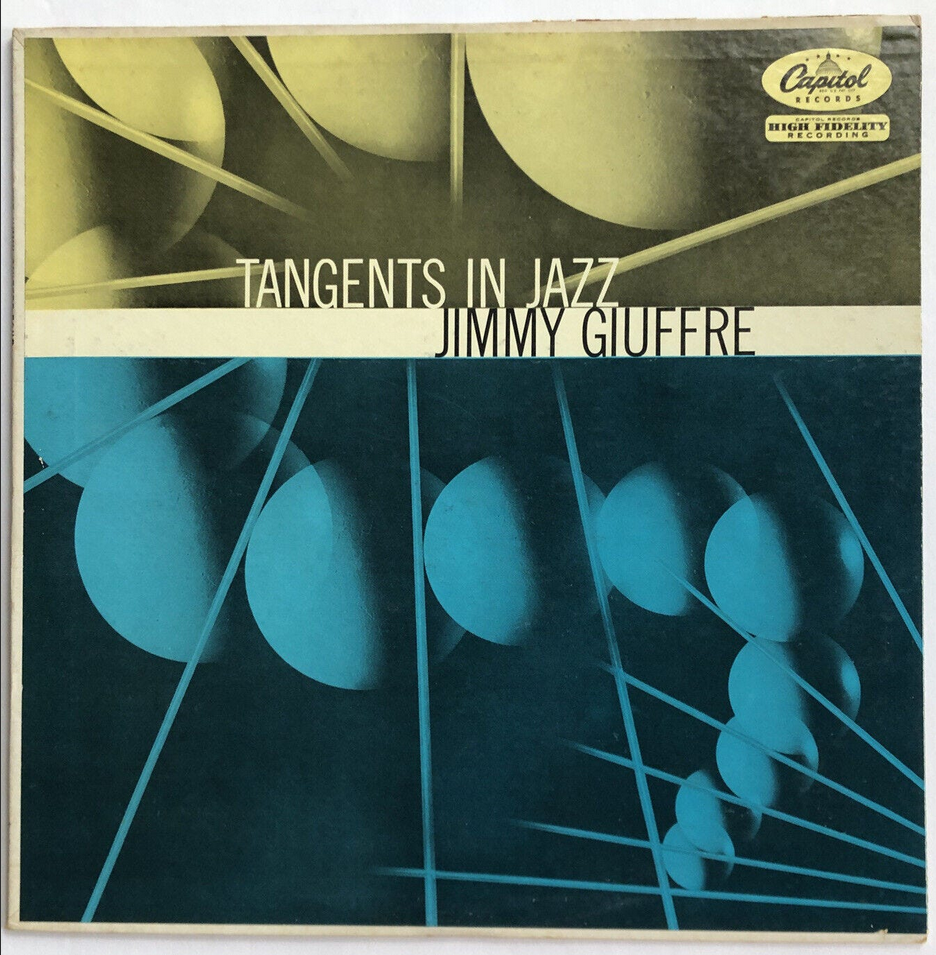
Back when I interviewed Jimmy Giuffre, I was gigging constantly and the format was obvious. The best option was piano, bass, and drum with at least one horn. If I didn’t have enough money to cover that, I brought just a trio — piano, bass, and drums — to the gig. If I couldn’t afford that, I did just piano and bass. And if cash was really tight, I opted for solo piano.
And which players did I hire?
Back then, I wanted to play with the best of the best. I kept careful tabs on all the jazz musicians in the greater San Francisco area, and wanted to play with all the top cats. Even if I didn’t know the musician, I’d make a cold call and try to hire them, provided I could afford it. If I got turned down, I went to the next name on my list.
Didn’t everybody do it that way?
Not Jimmy Giuffre. He explained that musicians played better when they were happier. Now that was a word I’d never heard in organizational theory class.
Giuffre continued to spell it out for me — surprised that I couldn’t figure this out for myself. Didn’t I know that people are always happier when they were with their friends? So group productivity is an easy problem to solve.
In other words, if my three best buddies played bongos, kazoo, and bagpipe, that should be my group.
When I heard this, I thought it made no kind of sense. They don’t call it “show friends” — they call it show business. I couldn’t imagine following Giuffre’s advice.
But over the years, I’ve thought a lot about what Jimmy Giuffre said about group formation—which is not only unusual for a music group but also violates everything I was taught back at Stanford Business School.
[…]
Can I turn this into a rule? And, even more to the point, could you apply this to other settings? Could you start a business with this approach?
That seems like a recipe for disaster, at least at first glance.
But I now think even large corporations could benefit from a dose of Jimmy Giuffre’s thinking. One of the biggest mistakes in hiring practices, as handled by HR (Human Resources) professionals in the current day is an obsession with the “required qualifications” for the job. They won’t even give you an interview unless you mention the right buzz words on your resume. But the best people take unconventional paths, and this checklist approach will exclude precisely those individuals.
(I’ve even heard of a scam for getting interviews — which involves copying and pasting the job description word-for-word at the bottom of your resume. This apparently rings all the bells in their algorithms and gets you moved to the top of the candidate list.)
Giuffre’s quirky theory gets straight to the heart of the problems with contemporary society outlined by Iain McGilchrist in his book The Master and His Emissary. That book is ostensibly a study of neuroscience, but is actually a deep-thinking critique of institutions and cultural biases. The best decisions. McGhilcrhist shows, are made by holistic thinkers who can see the big picture, but the system rewards the detail orientation of people who manage with checklists and jump through all the bureaucratic hoops.
Yet I’ve seen — and I’m sure you have too — amazing people whose skill set can’t be conveyed by their resume. Not even close. I’ve worked alongside visionaries whose education ended with high school, but have ten times the insight and ability as their colleagues with graduate degrees and fancy credentials.
That’s why Duke Ellington is such a great role model for running an organization. He hired people because of their musical character, rather than their sheer virtuosity or technical knowledge. And he certainly paid no attention to formal degrees. I wouldn’t be surprised to learn that Duke went through decades of hiring for his band without looking at a single resume.
That piece of paper wouldn’t have told him a single thing he needed to know.
For all those reasons, I no longer dismiss Jimmy Giuffre’s peculiar views on group formation. I’d recommend them myself — maybe even especially in groups where no music is made.
Comments Off on Unconventional hiring practices
April 20, 2023
It’s not your imagination, you really did just hear that song again … and again … and again
Ted Gioia on some sort of scam-like activity going down on Spotify and other large web platforms:
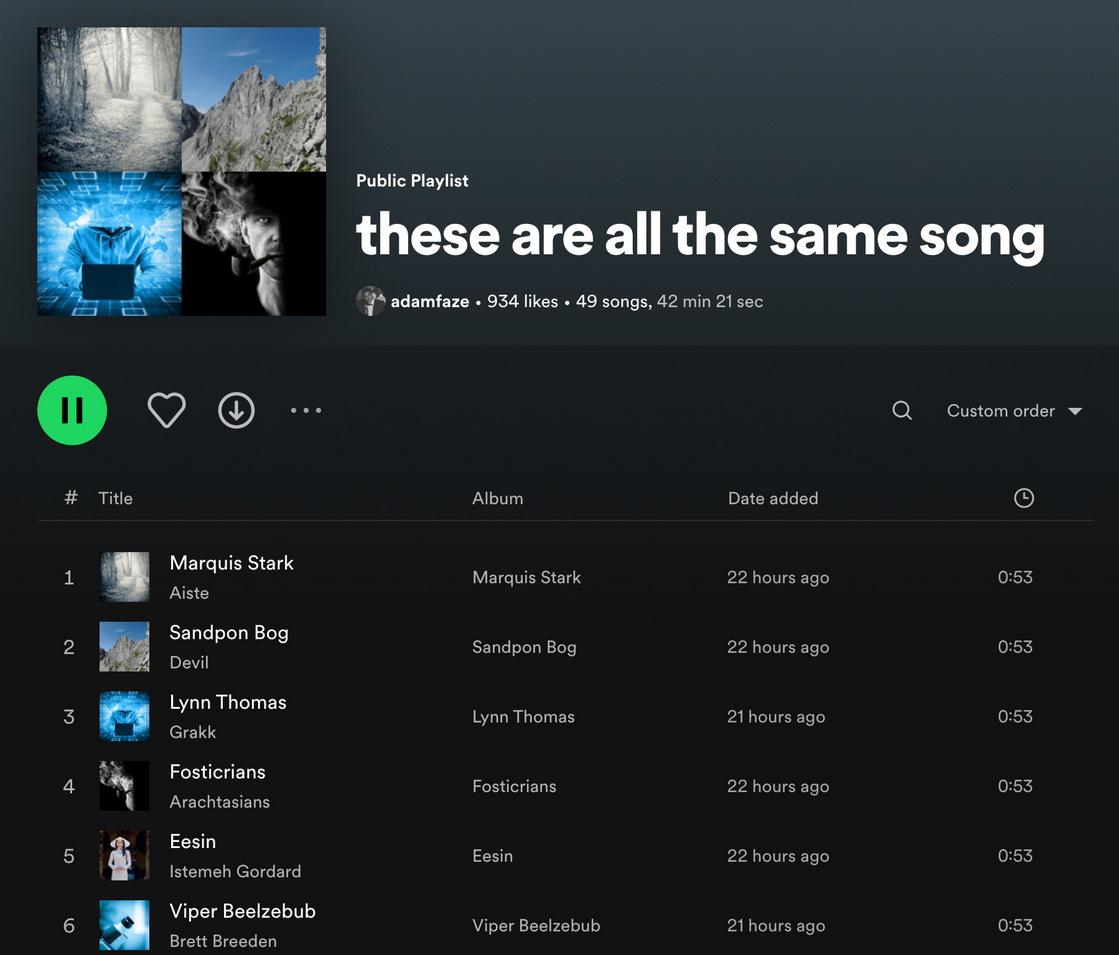
Adam Faze kept hearing the same song on Spotify over and over again.
Such things aren’t unusual. Hit songs get played repeatedly—although this one seemed more annoying than most.
But in this case, something even more bizarre was happening.
When Adam looked to see the name of the song, it was always different. The titles were a wild assortment—almost as if a random word generator had been used to pick them:
- “Trumpet Bublefig”
- “The Proud Dewdrop Amulet”
- “Thorncutter”
- “Viper Beelzebub”
- “Whomping Clover”
- Etc. etc.
But the music was always the same.
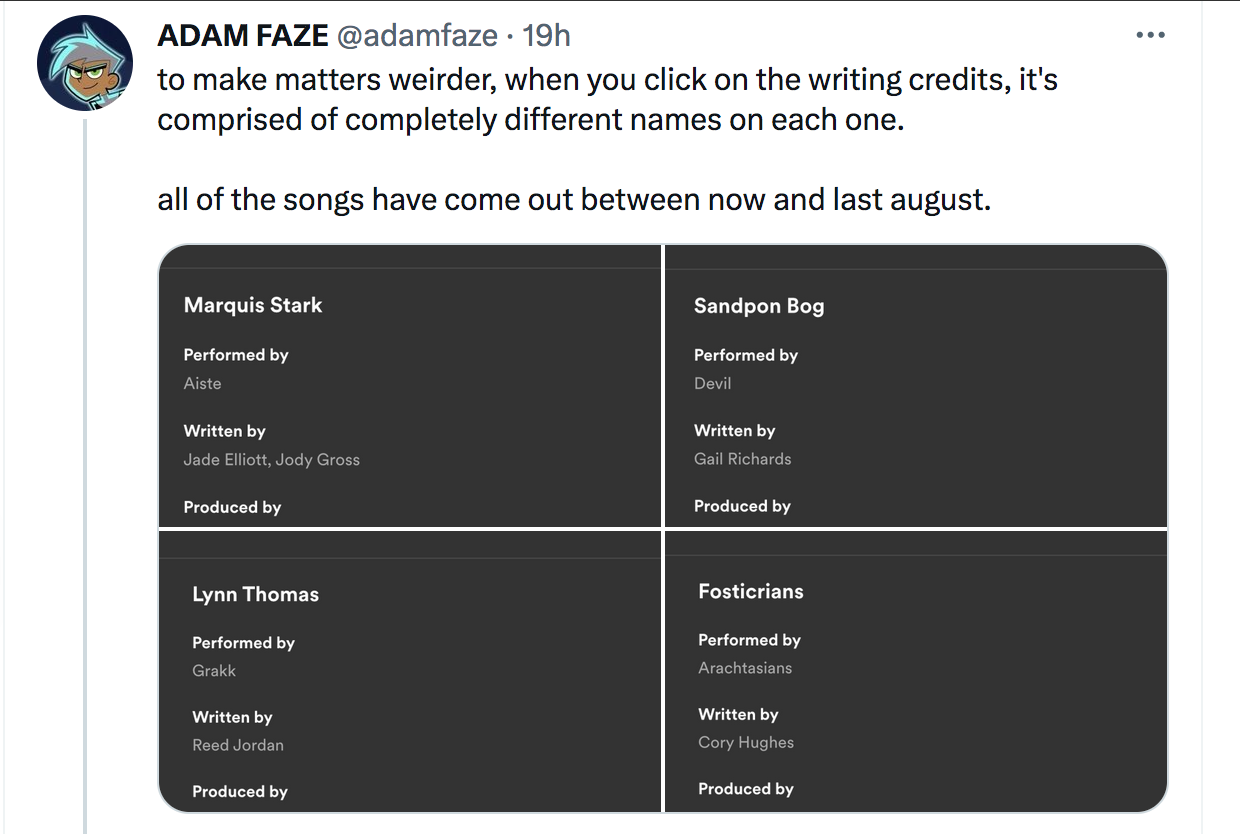
Even stranger, the artist was also different in each instance. And if you clicked on the writer credits, those were all different too.
How could the same track be attributed to dozens of different musicians? How could the same song be written by dozens of different composers?
Adam started compiling a playlist, and adding each new iteration of this song when he found it. When he got to 49 versions, he shared the playlist on social media. “I’ve officially stumbled upon the weirdest thing I’ve ever seen”, he announced.
A Twitter user, alerted by this, quickly discovered another 10 iterations of the same song. This banal tune was everywhere. The use of multiple aliases made it difficult to gauge the full extent of the deception, but Spotify was pushing this track so aggressively that it was impossible to hide the charade they were playing.
When asked how it was possible to find so many examples, Adam replied: I’m completely serious when I say it was starting to be every other song after a while.”
The song itself is just 53 seconds. And you’re glad when it’s over, because this tune is a loser — almost a Frank-Ocean-at-Coachella level of bad. Even call centers have better taste in their on-hold music.
Comments Off on It’s not your imagination, you really did just hear that song again … and again … and again
April 11, 2023
The amplifier may have been the key technological innovation that let vocalists and guitarists become stars
Chris Dalla Riva, guest-posting at Ted Gioia’s Honest Broker, considers how instrumental hits used to be far more popular before (among other factors) microphone technology let vocalists compete with orchestras and guitar amplifiers let the strings dominate the pop music market:
Clarinet players aren’t sex symbols. I say this with no disrespect for those that play the single-reeded woodwind. But if you asked a random person on the street to name a clarinet player, I suspect most people couldn’t come up with one, let alone one known for their good looks. Then again, this isn’t a particular indictment of clarinetists. If you asked that same person to name a sexy musician, I’d bet a large sum of money they’d name a vocalist.
This wasn’t always the case, though. In Kelly Schrum’s book Some Wore Bobby Sox: The Emergence of Teenage Girls’ Culture, 1920-1945, she notes that in high school yearbooks in the 1930s some students expressed a passion for “Benny Goodman while other girls had a ‘weakness’ for Artie Shaw or were classified as Glenn Miller ‘fanatics’, faithful fans of Tommy Dorsey, or ‘Happy while listening to Kay Kyser’. Cab Calloway, Xavier Cugat, and Harry James were also popular favorites.” Of those musicians, only Calloway was a singer. Goodman, Shaw, and Kyser played the clarinet. Miller and Dorsey played the trombone. Cugat played violin. James played trumpet.
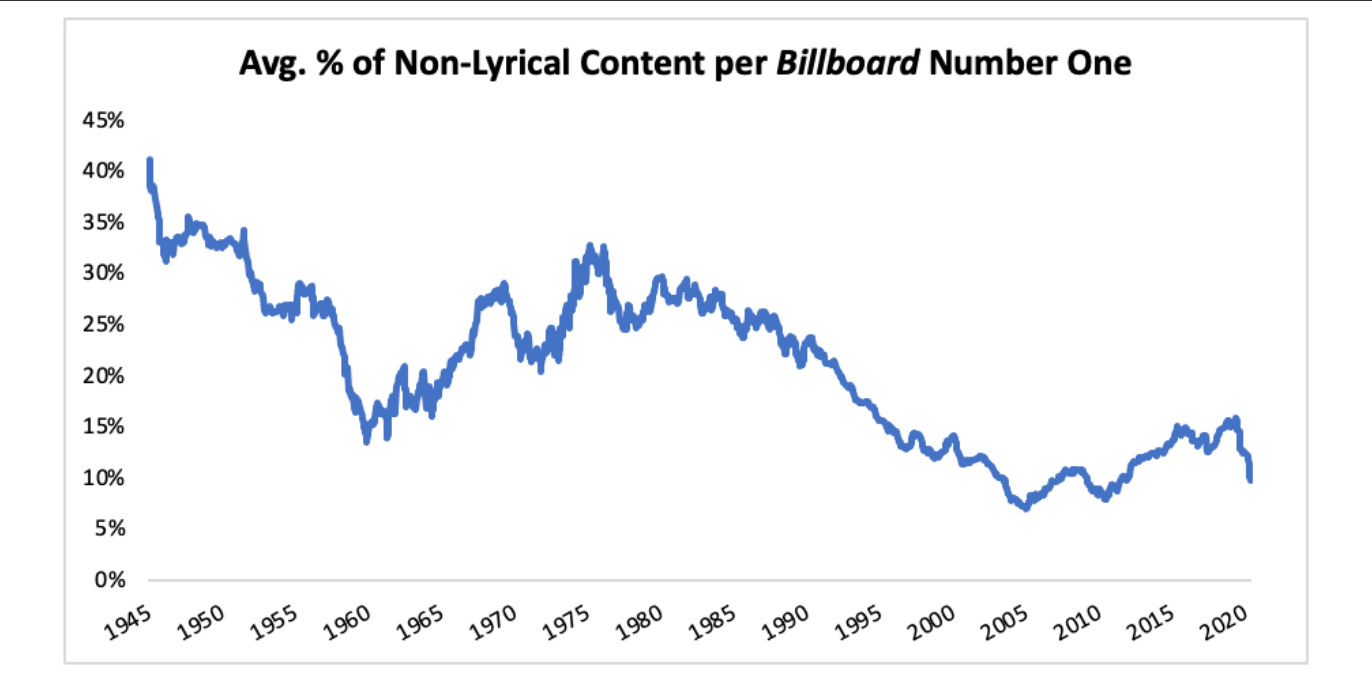
Given that our contemporary musical world is dominated by vocalists, this seems bizarre. It feels like if you have a musical group it must be centered around the vocalist. If we measure the average percent of instrumental content per Billboard number hit between 1940 and 2021, we see demonstrable evidence for not just the decline of the instrumental superstar but the instrumentalist generally, with the sharpest declines beginning in the 1950s and the 1990s.
NOTE: Data from July 1940 to August 1958 comes from Billboard‘s Best Sellers in Stores chart. After August 1958, Billboard deprecated that chart in favor of the Hot 100, which initially aggregated sales, jukebox, and radio data. The Hot 100 remains the premiere pop chart, though it has come to include many more sources, like streams and digital downloads. The above displays a 50-song rolling average.
What’s going on here? How could throngs of high schoolers long for the clarinet-wielding Artie Shaw 80 years ago when most teenagers today would struggle to name a musician who isn’t also a singer. I believe it comes down to four factors: improved technology, the 1942 musicians’ strike, WWII, television, and hip-hop.
Improved Technology
In the VH1-produced documentary The Brian Setzer Orchestra Story, Dave Kaplan, Setzer’s manager, recounts a conversation he had with Setzer before assembling a guitar-fronted big band in the 1990s: “Nobody had ever fronted a big band with an electric guitar … I asked Brian, ‘Why wouldn’t somebody have tried it?’ [Setzer replied,] ‘Well there weren’t amps.'” Albeit a simplification, Setzer’s quip is pretty accurate.
While there were some famous guitar players among the big bands of the first half of the 20th century, we don’t see the guitar become a driving force in popular music until amplification improved. This was not only a boon for the guitarists but also vocalists. Unlike brass and wind instruments, you can sing while you play the guitar. Thus, it’s not shocking that the rise of the guitar coincided with the rise of the vocalist.
But it wasn’t just guitar amplification technology that was vital. It was also microphone technology. Again, microphones had to improve so vocalists could compete with the cacophony of a loud band. On top of this, recording had to change to capture more subtlety in the human voice.
Comments Off on The amplifier may have been the key technological innovation that let vocalists and guitarists become stars


