
When a piece of instrumental music is popular, it’s hard to resist the temptation to put words to it, and thus make it even more popular. As noted in this space over the years, a big chunk of Duke Ellington’s “songs” aren’t songs at all, but jazz instrumentals to which a lyric has been awkwardly appended: “Yoooooooooo…. must Take The A-Train/Toooooooo… get to Sugar Hill way up in Harlem.” Who needs it? Just about any instrument playing that line would do a better job than those words do. And “Take The A Train”‘s lyric is a work of genius by comparison with “Prelude To A Kiss”. Ira Gershwin always resisted offers to put words to “Rhapsody in Blue” or “An American in Paris”. He and his brother had written plenty of songs over the years, and he figured if George had wanted “Rhapsody” to have lyrics he’d have mentioned it at the time. Leroy Anderson liked words: He spoke at least nine languages (English, Swedish, Norwegian, Danish, Icelandic, French, German, Italian, Portuguese) and, indeed, fancied himself as a lyricist in at least a couple of them. But he didn’t think as a songwriter; he thought as a composer. Unlike, say, Cole Porter or Richard Rodgers, he orchestrated his own music, and so he conceived it instrumentally rather than vocally. Although you can find texts that were written for his most popular pieces, they sound very much like words set to pre-existing notes which don’t particularly require them.
Mark Steyn, “Sleigh Ride”, Steyn Online, 2019-12-08.
September 7, 2024
QotD: Instrumental music doesn’t always need or want lyrics attached
August 8, 2024
“The future was then” – the Avant-Garde is so passé
Ted Gioia shares some observations on the Avant-Garde in modern culture, where the bourgeoisie seem to have become immune — or at least inured — to all the épater-ie:

Some time back, I was invited to attend a concert by an up-and-coming avant-garde band. These musicians were hellbent on disruption and mayhem, proving their transgressive credentials at every turn.
My companion that evening was a well-known jazz musician and, at the end of the concert, he turned to me and said:
“The future was then.”
I laughed, because this was so true. The performance we had just experienced wanted to be cutting-edge and futuristic, but every note played reflected a notion of the avant-garde as it existed sixty years ago.
The future was then.
I thought of that concert recently when a magazine convened a group of artists and intellectuals and asked them a troubling question:
What happened to the avant-garde?
Few people paid attention to their hand-wringing. I didn’t even hear about this online colloquium until months had passed — and I try to stay on top of precisely these kinds of issues. Nobody I know mentioned it, and I stumbled upon it purely by chance.
But that only proves that there really is a crisis in the avant-garde. It’s a crisis of neglect. Of disinterest.
People once got worked up about cutting edge art and transgressive culture. They loved it or hated it, but they always had strong feelings. Nowadays they hardly notice.
Perhaps they are just deadened to it from over-exposure.
You can put up the strangest statue in the town square nowadays — let’s say Albert Einstein getting swallowed by a monster snail — and people just walk by it. They’ve seen it all before.
You have too.
Artists can make the most bizarre music, destroying instruments, shouting obscenities, and creating all sorts of noise. But — yawn! — somebody’s great-grandpa was doing all that three generations ago.
QotD: The real reason modern music sounds the same
Fast forward a few years, though, and now they’ve got a pretty good idea of what “rock” is. More importantly, they’ve got a pretty good handle on what the market for rock is. At that point, they do what execs in any industry do. Why bother trying to find the hot new thing, when you can just make it yourself?
And that’s why two guys you’ve never heard of, Max Martin and a dude calling himself “Dr. Luke”, have written every #1 pop hit for the last 15 years. I’m sure they don’t work cheap, but it’s a lot cheaper than scouting every bar band in America for a sound / look / stage act that might or might not pan out. Much easier to focus group a few traits, call up central casting, have them send over a made-to-order bimbo, and have him / her / xzhem front Dr. Luke’s latest computer-generated ditty.
And if everything on the radio all sounds exactly the same, that’s because it is exactly the same. Max Martin and Dr. Luke, and their zillion Mini-Mes at every level of the record biz, sometimes write songs for specific people — hey, guys, Katy Perry needs another ballad for her new album, hop to it! But mostly they write on spec, and shop it around. Different singers, different bands, different genres, doesn’t matter — this time it’s the two generic prettyboys in the “country” band Florida-Georgia Line singing it, but last time it was Katy Perry, the next time it’ll be the Backstreet Boys on their triumphant comeback tour, feat. Jay-Z and MC Funetik Spelyn. Same exact song, literally — it’s just that Kenny Chesney needed one more track on his album this time, and Taylor Swift didn’t, so now it’s #5 with a bullet on the “country” chart.
Severian, “Own Goals”, Rotten Chestnuts, 2021-07-21.
August 7, 2024
QotD: The crew of HMS Sheffield in the Falklands
May 4th 1982: As HMS Sheffield is abandoned and the fire spreads towards the Sea Dart ammunition. The remaining crew gather on the foredeck singing “Always look on the bright side of life”.
Now I have heard that story and I’ve always thought it were more than a little bit mythmaking. And yet, and yet. Someone I know (our fathers knew each other, he took a sister out a few times, we worked together for 6 months later on) was actually there. Running the flight control stuff from the next ship over:
Singing led by the FC that we had loaned to them. One of our Sea Kings closed on the fo’c’sle to pick up wounded and saw them all swaying from side to side with their arms outstretched. I learned why when he got back.
I’ll take that as being something that really happened then. Not for publication, not something published for home consumption, but something that actually happened. Young men, on a burning ship, not knowing whether they’d be lifted off before the fire got to the missiles and the kaboom of their little bits all over the South Atlantic. […]
We’re a weird, weird culture here in Britain. We will, and do, take the piss out of absolutely anything, including our own impending death.
Now, whether that’s quite what the economists mean by institutions that aid in economic development is another thing but it is indeed one of those institutions of that British culture.
It’s also wholly glorious but then I’m a Brit so I would say that, wouldn’t I?
Tim Worstall, “The British Are A Very, Very, Weird People”, It’s all obvious or trivial except …, 2024-05-06.
August 5, 2024
Short-term technological forecast – “If I were a commercial pilot, I’d tell you to return to your seats and buckle up”
Most of this Ted Gioia post is behind the paywall (and if you can afford it, I’m sure you’d get your money’s worth for a subscription):
I anticipate extreme turbulence on every front for the remaining five months in 2024. You will see it in politics, business, economics, culture, world affairs, the stock market, and maybe even your own neighborhood.
That’s one of the themes of my latest arts and culture update below.
What happened to the AI business model last week?
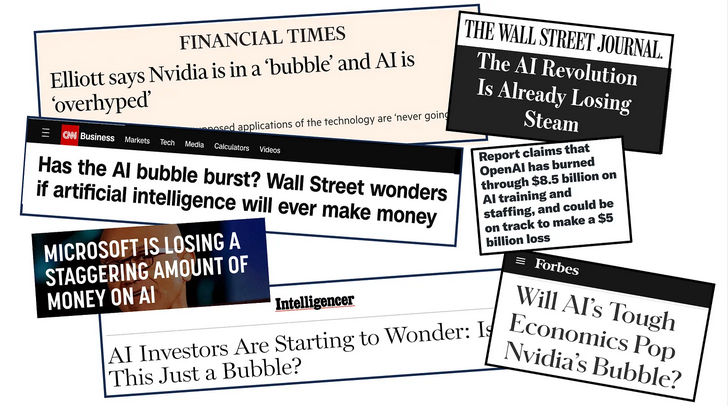
After almost two years of hype, the media changed its opinion on AI last week.
The hype disappeared almost overnight
All of a sudden, news articles about AI went sour like reheated 7-Eleven coffee. The next generation AI chips are delayed, and 70% of companies are behind in their AI plans. There are good reasons for this — most workers now say AI makes them less productive.
People are also noticing that AI businesses want to use the entire electricity grid to run their money-losing bots. Meanwhile AI companies are burning through cash at historic levels. Even under the best case scenario, this all feels unsustainable.
But the worst disclosure, in my opinion, came on July 24 — just eleven days ago.
A study published in Nature showed that when AI inputs are used to train AI, the results collapse into gibberish.
This is a huge issue. AI garbage is now everywhere in the culture, and most of it undisclosed. So there’s no way that AI companies can remove it from future training inputs.
They are caught in the doom loop I described last week.
That same day, the Chief Investment Officer at Morgan Stanley warned investors that AI “hasn’t really driven revenues and earnings anywhere”. One day later, Goldman Sachs quietly released a report admitting that the AI business model was in serious trouble.
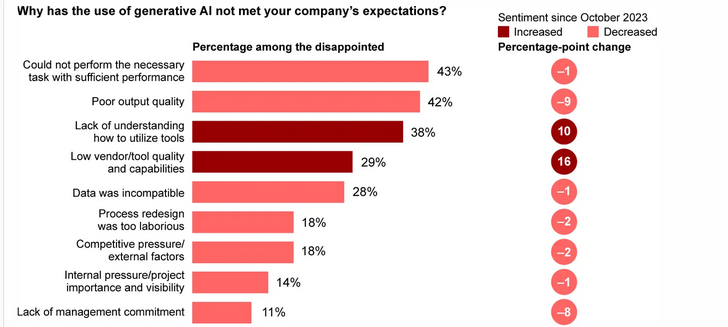
Even consulting firms, who make a bundle hyping this tech, are backtracking. Bain recently shared the following chart (hidden away at the end of a report) which explains why AI projects have failed.
These findings are revealing. They show that management is absolutely committed to AI, but the tools just don’t deliver.
And, finally, last week the media noticed all this.
They published dozens of panic-stricken articles. Investors got spooked too — shifting from greed to fear in a New York minute. Over the course of just two days, Nvidia’s stock lost around $400 billion in market capitalization.
In this environment, true believers quickly turn into skeptics. The whole AI business model gets scrutinized — and if it doesn’t hold up, investment cash flow dries up very quickly.
This is exactly what I predicted 6 months ago. Or even a year ago.
I expect that the next few weeks — or maybe even the next few days — will be extremely turbulent in the AI world.
Buckle up!
The dominant AI music company just admitted that it trained its bot on “essentially all music files on the Internet”.
Suno is a huge player in AI music — it tells investors it will generate $120 billion per year. Microsoft is already using its technology.
But there’s a tiny catch.
The company now admits in a court filing:
Suno’s training data includes essentially all music files of reasonable quality that are accessible on the open internet, abiding by paywalls, password protections, and the like, combined with similarly available text descriptions
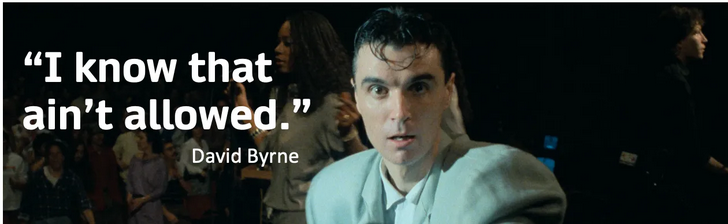
Hey, this is totally illegal — it’s like Napster all over again.
Suno will need to prove that all these copyrighted songs are “fair use” in AI training. I doubt that any court will take that claim seriously.
If the music industry is smart, they will use this violation to shut down AI regurgitation of copyrighted songs.
If the music industry is stupid — run according to my “idiot nephew theory” — they will drop charges in exchange for some quick cash.
July 25, 2024
Poptimism?
Freddie deBoer has a few things to say about “poptimism” (whatever the heck that might be):
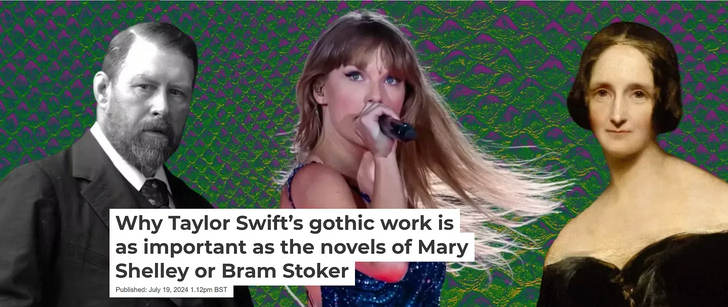
this piece is by a literature professor btw
I mean, honestly, what are we doing here? Where does this go? When does the madness end? What degree of all-swallowing society-wide celebration of pop music might be considered sufficient, for pop fans? How much more slavish devotion can Taylor Swift engender before they stop calling her an underdog? What is the endgame? What level of delusion is yet to be achieved, in the space of pretending that pop music is somehow marginalized or disrespected? This is, I’m told, “pop girl summer“, and it is genuinely difficult to find new music that gets any burn that isn’t some 18 to 28 year old photogenic woman, autotuning over shlocky overproduced midtempo backing tracks complete with beats stolen from mid-2010s EDM and muddy indistinct synth lines that all sound exactly the same. (Jack Antonoff should be put to death for his crimes.) My friends: you get all the streams, you get all the good reviews, you get all the Grammys, you get all the magazine covers. There exist almost no mainstream publications that regularly cover any music other than the kind you like. If anyone uses words like “authenticity” in music criticism, they will be sent to the gulag; if anyone suggests that musicians who write their own songs possess some sort of intimate connection to them, that person receives the digital equivalent of being pressed to death like Giles Corey. What more adulation do you want for your stars? What additional level of respect is there for them to secure? What do you want?
NPR says “This summer’s music charts are dominated by pop girl underdogs”. Underdogs cannot dominate! Definitionally! If they are dominating, they are not underdogs! This is the modern hell of crybullying, the person who tells you that you’re oppressing them while they’re busy mashing your face into the asphalt.
And, of course, it’s mostly all a negotiation with aging. As one of the oldest Millennials, I’m watching as my generation reaches middle age and reacts to that transition, and I can give you an initial verdict on how it’s going: not well, at all. We’re mostly adjusting to it by not adjusting to it. So, so many Millennials are confronting the end of their youth by performatively embracing youth culture, loudly declaring that the only music that matters is that which you discover on TikTok. They need everyone to know that they’ve spent the cost of a new Toyota on tickets to the Eras Tour. (Which soaks up seats that might otherwise be available to actual young people, not wine moms with too much money, but nevertheless.) They might like music. But in a much deeper way, they need it. They need what they think it represents.
Of course, this is all made a little bleaker by the fact that elder Millennials were once defined as the “hipster” generation, Williamsburg residents swilling PBR at backyard parties where they listened to the latest indie darling. In other words, they — we — have gone from being ostentatiously countercultural to ostentatiously mainstream, in the span of twenty years, which makes it hard not to conclude that they — we — never actually had aesthetic tastes at all and have instead lived like little reeds in the wind, terrified of ever appearing to not be The Right Kind of Person, which can only ever be defined through our capitalist consumption, since we think that all we are is our capitalist consumption.
July 19, 2024
QotD: The value of contemporary music
Bruce Ivar Gudmundsson, “The Timelessness of Elle Cordoba”, Extra Muros, 2024-04-18.
July 7, 2024
QotD: Musical criticism
Steve H., “Music to Slowly go Insane By: A Partial List of Popular Musicians Who Should be Publicly Dismembered”, Hog on Ice, 2005-06-13.
July 4, 2024
QotD: “The Battle Hymn of the Republic”
Mine eyes have seen the glory of the coming of the Lord
He is trampling out the vintage where the grapes of wrath are stored…In 1861, the United States had nothing that was recognized as a national anthem, and, given that they were now at war, it was thought they ought to find one – a song “that would inspire Americans to patriotism and military ardor”. A 13-member committee was appointed and on May 17th they invited submissions of appropriate anthems, the eventual winner to receive $500, or medal of equal value. By the end of July, they had a thousand submissions, including some from Europe, but nothing with what they felt was real feeling. It’s hard to write a patriotic song to order.
At the time, Dr Samuel Howe was working with the Sanitary Commission of the Department of War, and one fall day he and Mrs Howe were taken to a camp a few miles from Washington for a review of General McClellan’s Army of the Potomac. That day, for the first time in her life, Julia Ward Howe heard soldiers singing:
John Brown’s body lies a-mould’ring in the grave
John Brown’s body lies a-mould’ring in the grave…Ah, yes. The famous song about the famous abolitionist hanged in 1859 in Charlestown, Virginia before a crowd including Robert E. Lee, Stonewall Jackson and John Wilkes Booth.
Well, no, not exactly. “By a strange quirk of history,” wrote Irwin Silber, the great musicologist of Civil War folk songs, “‘John Brown’s Body’ was not composed originally about the fiery Abolitionist at all. The namesake for the song, it turns out, was Sergeant John Brown, a Scotsman, a member of the Second Battalion, Boston Light Infantry Volunteer Militia.” This group enlisted with the Twelfth Massachusetts Regiment and formed a glee club at Fort Warren in Boston. Brown was second tenor, and the subject of a lot of good-natured joshing, including a song about him mould’ring in his grave, which at that time had just one verse, plus chorus:
Glory, glory, hallelujah
Glory, glory, hallelujah…They called it “The John Brown Song”. On July 18th 1861, at a regimental march past the Old State House in Boston, the boys sang the song and the crowd assumed, reasonably enough, that it was inspired by the life of John Brown the Kansas abolitionist, not John Brown the Scots tenor. Over the years in the “SteynOnline Song of the Week”, we’ve discussed lyrics featuring real people. But, as far as I know, this is the only song about a real person in which posterity has mistaken it for a song about a completely different person: “John Brown’s Body” is about some other fellow’s body, not John Brown the somebody but John Brown the comparative nobody. Later on, various other verses were written about the famous John Brown and the original John Brown found his comrades’ musical tribute to him gradually annexed by the other guy.
Mark Steyn, “The Battle Hymn of the Republic”, Steyn Online, 2019-05-26.
July 3, 2024
Tanks! – Allied tanks of WW2 – Sabaton History 127
Sabaton History
Published Mar 14, 2024Sabaton has written several songs about tanks — the boys are tank CRAZY! Songs like “Ghost Division” or “Panzerkampf” are about the German panzers and even the Soviet ones, but what about those of the Western Allies? Were they any good? And if so, how did they lose the Battle of France?
(more…)
July 2, 2024
The virtue-signalling Olympics … aka “Glastonbury”
In Spiked, Brendan O’Neill documents the awesomely awful human beings at the Glastonbury music festival this year (like most years):
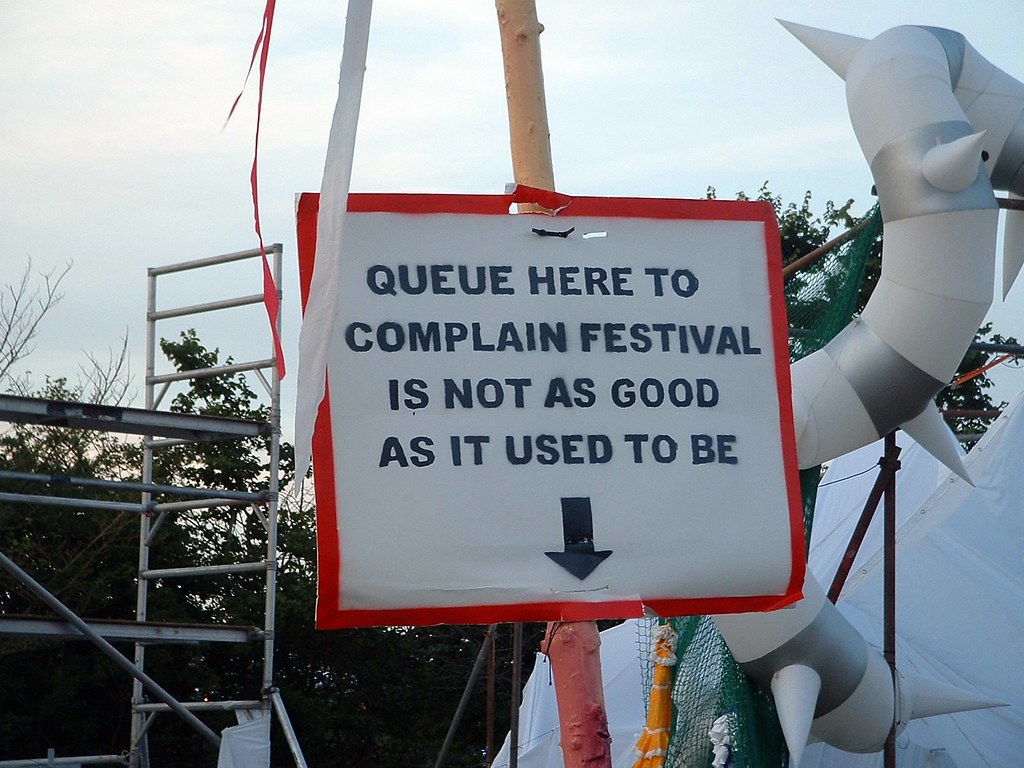
“Sign of the times @ Glastonbury Festival” by timparkinson is licensed under CC BY 2.0 
 .
.
Virtue-signalling reached its nadir on Friday night. It was at the Glastonbury music festival. Of course it was. A swaying crowd of the time-rich, turbo-smug thirtysomethings who make up Glasto’s clientele passed around an inflatable dinghy filled with dummies designed to look like migrants crossing the English Channel. As some band you’ve never heard of sang a song about “beautiful immigrants”, the audience hoisted the blow-up boat above their heads and basically crowd-surfed it. What a gauche display of phoney virtue. What an orgy of hollow vanity. Surely it would have been cheaper to rustle up a banner saying, “Aren’t we fucking wonderful?”.
It will surprise not a living soul that the boat was the handiwork of Banksy, every posh twat’s favourite graffiti artist. Banksy has never once seen a moneyed, mostly white audience that he didn’t want to titillate with platitudes about Tory scum and cruel capitalism, so it was only natural he would gravitate towards Glastonbury. He knows it’s rammed with people called Archie and Poppy who lap up his unsubtle stencils about the rat race that is neoliberal society and how dreadfully frightful war can be. So who better to dragoon into his boat stunt than these folk who likewise love advertising to the world how much they care about migrants and stuff?
Let’s leave to one side how unbelievably crude it is for a rich graffitist and Brits who can afford to fork out £355 to listen to crap music for five days to celebrate boat journeys that often end in death. One wonders if any of the audience members who cheered illegal immigration later retired to one of Glasto’s luxury yurts, which contain not only “proper flushing toilets” but also toilet attendants. You can hire one for £5,000, which, ironically, is around the same amount of money dirt-poor migrants are forced to stump up to criminal gangs for a seat on one of their perilous crossings that the righteous of Glasto think it’s a hoot to sanctify.
No, even worse than the sight of the well-off of Worthy Farm using the wretched of the Earth to burnish their moral credentials is the fact that if any Channel-crossing migrant were to rock up to Glastonbury they’d be cuffed and shoved in the back of a paddy wagon faster than you could say “What time’s Dua Lipa on?”. Glastonbury is one of the most fortified zones in Britain. It is surrounded by a fence that is 4.12m high and 7.8km long and which has numerous “unique high-security features”, including an “external roadway to prevent tunnelling”, a “45-degree overhang to prevent climbing” and “zero nuts and bolts to stop the fence being tampered with”. “No borders!”, cry the virtuous of Glasto while surrounded by a border fence that the screws of Alcatraz would have envied.
June 20, 2024
The “Idiot Nephew Theory” of show business management
Ted Gioia recalls his hopes of getting into the entertainment industry after graduation:
The story of how I became a strategy consultant is shameful.
I was a student at Stanford’s Graduate School of Business, and needed a job after graduation. I wanted to work in the music or entertainment industries — but I soon learned this was an impossible dream.
They didn’t want me. And they didn’t want my classmates either.
Hundreds of companies came to our business school to recruit talent, and they included most of the leading US corporations. So I talked with everybody — Coca Cola, Morgan Stanley, Atari, Procter & Gamble, you name it.
But no record label or movie studio ever showed up. They didn’t even send job listings.
Can you guess why?
I asked around on campus and was told the following (off the record):
Come on, Ted. You will never see the entertainment business recruit here. Those folks are not looking for business talent.
They give the choice jobs to their family members — the idiot nephew gets hired, not an MBA. Even better if it’s an idiot son.
And if there are other openings? Well … You’ve heard about the casting couch, haven’t you? Let me give you a hint — that couch isn’t just for auditioning the cast.
But you wouldn’t want a job there even if they gave you one. When time comes for a promotion, the drooling idiot nephew moves up — not you.
I’ve never shared that story before — because I know how people inside the music business hate hearing it.
And maybe it’s not a fair story.
All I can say is that I found this advice very helpful. I stopped planning on a career in the music business. And I also developed a very useful theory to explain why record labels are so bad at making strategic decisions.
I call it the “Idiot Nephew Theory”:
THE IDIOT NEPHEW THEORY: Whenever a record label makes a strategic decision, it picks the option that the boss’s idiot nephew thinks is best.
And what does the idiot nephew decide? That’s easy — they always do whatever the company lawyer recommends.
Maybe this theory is wrong. All I can say is that it helps me predict events in the entertainment industry with a surprising degree of accuracy.
I always operate on the assumption that there’s no business strategy in the music or movie business — only legal maneuvering.
Years later, when the music business got totally reamed by tech companies — a phase we’re still living through, by the way — I wasn’t surprised in the least. The record labels respond to every new music technology by litigating, but whenever they encounter a company with more legal clout than them (Apple or Google/YouTube, for example), they simply gave up.
In the future, you can test this theory yourself. You will see that it possesses great explanatory power.
May 29, 2024
“The more they rant, scream and lecture, the more cool singing ‘Ausländer raus‘ and ‘Deutschland den Deutschen‘ will become”
Our deep undercover secret informant in Deutschland, eugyppius, recounts the latest scary outbreak of deadly neofascist singing in the beleaguered country:

The latest threat to German democracy including “one of the men in the video can be seen offering a slack, distinctly metrosexual Roman salute and giving himself a two-fingered Hitler moustache”
“Fascism”, as popularly understood, is both very bad and also very ill-defined, being a negative political vice characterised primarily in opposition to that equally ill-defined political virtue known as “democracy”. This “democracy”, whatever it may be, is distinguished above all by its fuzzy associations with a wide array of other virtues, like diversity, inclusiveness, equity and transsexuality. Fascism is mostly the opposite of all of these things, which sounds bad enough, but it gets much worse: Because democracy is a very fragile virtue, forever requiring vigilant defence and social fertiliser, fascism has become the most ineradicable and indestructible of weeds.
Or perhaps it is better, in our post-pandemic era, to say that fascism is like a virus. It is always spreading, despite (or because of?) our best efforts to kill it off. We vaccinate children against the fascist virus with years of indoctrination about the evils of National Socialism in school, but to judge from the present state of our political discourse, this programme has worked about as well as the mRNA jabs worked against Covid. Never have we preached so stridently against fascism, and never has it been so omnipresent.
Another curious property of fascism, is that it does not merely infect human brains. It can also taint cultural artefacts, like phrases. All of the very best people can use a specific phrase, but that does not matter at all should the fascists get ahold of it. Once they have run the benign words through their evil fascist mouths, anyone who utters them afterwards – whatever his intentions – may well be guilty of fascism. If only democracy were that effective and powerful.
As we’ve learned from the events of the past week, the Germ Theory of Fascism applies also to songs, even vacuous pop music. All of the most democratic people in Germany have worked themselves up into a collective outrage against an unremarkable 1999 Italodance tune called “L’amour toujours” (“Love always”) by Gigi D’Agostino, because some very bad fascists have been caught singing some very naughty lyrics to its indifferent melody. The fascists themselves have been cancelled of course, and the song is on its way to its own separate cancellation as well.
But I’m getting ahead of myself.
[…]
The SPD only deepened their performative self-parody by posting this graphic to Instagram:
The Sylt revellers had chanted “Germany for the Germans”, but in this image the SPD proposed an improvement: “Germany for those Germans who defend our democracy”. Checkmate fascists! Except, “Germany for the Germans” is a slogan most closely identified with Der Heimat (formerly the NPD), an “ultranationalist” and “neo-Nazi” party. Realising that they had unwittingly reproduced the forbidden Nazi incantation, and were therefore guilty of spreading this horror virus, our crack SPD social media team swiftly deleted their post and threw up a hasty apology:
We just published a post condemning in the strongest possible terms what we all saw in a video from Sylt. We did not manage to strike a tone that would resonate with everyone. We would like to sincerely apologise for this. Our aim is to make it clear that we do not want to leave this country to the far right and hate preachers. We want to defend our democracy and our freedom. Let’s continue this fight together in solidarity!
This is one of those missteps that really leaves you scratching your head. After hours of foaming at the mouth about “neo-Nazi slogans”, our virtue-mongering social democrats posted their own version of those very same tainted words to Instagram, in apparent ignorance of their origins and deeper significance. We are left to ask what they imagined they were angry about in the first place.

It’s hard not to agree with eugyppius’ conclusion:
I have my own theory about all of this.
Once upon a time, teenagers sustained a vibrant countercultural leftism, which was all about telling the establishment to go fuck itself, ingesting inadvisable quantities of drugs and engaging in a lot of inadvisable sex. All of that was very transgressive and exciting, directed as it was against a much more conservative and straight-laced German society. They shocked people, and that was the point. In the decades since, all of those hippies have grown old, and the most ideologically committed of them have become that which they used to hate, namely a lot of insufferable shrivelled scolds. As is the way with scolds everywhere, they’ve unwittingly inspired a new countercultural movement on the opposite side of the political spectrum. The more they rant, scream and lecture, the more cool singing “Ausländer raus” and “Deutschland den Deutschen” will become. Maybe, if they don’t like these words, they should try chilling out and finally shutting the fuck up about fascism. God knows there are more important things to screech about.
In the meantime, our new fascist anthem L’amour toujours has hit the top of the German charts.
May 25, 2024
Fathers of Light and Darkness – Rockets and Explosives – Sabaton History 126 [Official]
Sabaton History
Published Feb 7, 2024There are many inventors whose creations have been turned into weapons of war. A couple that really stand out are Alfred Nobel and Wernher von Braun. Today we’ll take a deep dive into their stories and the paradox of using destructive weapons for good, or creative weapons for destruction.
(more…)
May 21, 2024
“Modern pop music is to the West what speeches by [Dear Leader] are to North Korea, namely inescapable”
Poor Theodore Dalrymple is finding that everyone around him seems to be actively imposing their questionable music choices on him no matter how he tries to decline the offer:
Whenever I try to escape pop music relayed in public places at high volume — which is often, though considerably less often with success — the thought comes into my mind that the harnessing of electricity was a disaster, if not for humanity, at least for civilization if good taste be part of that much-derided entity.
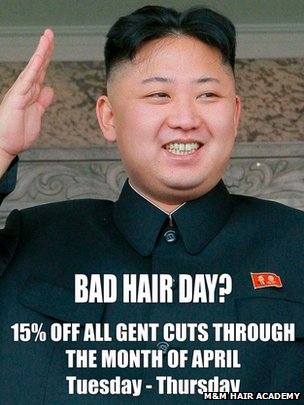
Modern pop music is to the West what speeches by North Korea’s greatest scientist, composer of operas, huntsman, industrial chemist, engineer, poet, agronomist, philosopher, economist, military strategist — in short, its present leader — are to North Korea, namely inescapable. If I were an absolute dictator, which fortunately for me among others I am not, I would forbid the public relay of such music under pain of death by deprivation of sleep.
Unnecessary noise should be regarded in the same way as cigarette smoke now is, a pollutant that infringes the rights of anyone subjected involuntarily to it. My sensitivity to cigarette smoke, incidentally, is now very acute: The other day, in the open street, there was a man sitting on a low wall smoking a cigarette a few yards from me, and I began to cough. This was not merely a psychosomatic reaction; I began to cough before I saw the source of what caused me to do so.
I must have grown up in a world that smelt like an ashtray, so great was the proportion of the population that smoked, but I did not notice it, any more than I noticed the air itself. Every curtain, every carpet, must have been saturated with such smoke, now stale, to say nothing of the fug created by cigarettes under current use. I remember the days when you could smoke on trains and airplanes. At the back of the cabin of the planes were the seats for smokers, not separated off from the rest of the fuselage, and if you were a nonsmoker such as I, you were often (so it seemed) allocated the row just in front of the first of the smokers’ seats, such that you might as well have been in the midst of them. Cigarette smoke on flights was as inescapable as crying babies now seem to be.


