
I had the singular honor of attending an early private screening of Gandhi with an audience of invited guests from the National Council of Churches. At the end of the three-hour movie there was hardly, as they say, a dry eye in the house. When the lights came up I fell into conversation with a young woman who observed, reverently, that Gandhi’s last words were “Oh, God,” causing me to remark regretfully that the real Gandhi had not spoken in English, but had cried, Hai Rama! (“Oh, Rama”). Well, Rama was just Indian for God, she replied, at which I felt compelled to explain that, alas, Rama, collectively with his three half-brothers, represented the seventh reincarnation of Vishnu. The young woman, who seemed to have been under the impression that Hinduism was Christianity under another name, sensed somehow that she had fallen on an uncongenial spirit, and the conversation ended.
At a dinner party shortly afterward, a friend of mine, who had visited India many times and even gone to the trouble of learning Hindi, objected strenuously that the picture of Gandhi that emerges in the movie is grossly inaccurate, omitting, as one of many examples, that when Gandhi’s wife lay dying of pneumonia and British doctors insisted that a shot of penicillin would save her, Gandhi refused to have this alien medicine injected in her body and simply let her die. (It must be noted that when Gandhi contracted malaria shortly afterward he accepted for himself the alien medicine quinine, and that when he had appendicitis he allowed British doctors to perform on him the alien outrage of an appendectomy.) All of this produced a wistful mooing from an editor of a major newspaper and a recalcitrant, “But still …” I would prefer to explicate things more substantial than a wistful mooing, but there is little doubt it meant the editor in question felt that even if the real Mohandas K. Gandhi had been different from the Gandhi of the movie it would have been nice if he had been like the movie-Gandhi, and that presenting him in this admittedly false manner was beautiful, stirring, and perhaps socially beneficial.
Richard Grenier, “The Gandhi Nobody Knows”, Commentary, 1983-03-01.
April 30, 2018
QotD: Gandhi versus Gandhi
April 11, 2018
Mumbai’s high court demonstrates lack of economic knowledge in theatre ruling
Movie theatres and multiplexes generally charge more for the concessions than sometimes adjacent businesses in the same area, and also usually forbid patrons from bringing in their own food to consume on the premises. A recent case before the Bombay High Court argued that this was unfair to moviegoers and the court agreed:

Bombay High Court in Mumbai
© A.Savin, Wikimedia Commons
This is an interesting little test of the judicial system – you know, those told that the Beatles were a popular beat combo – on the subject of property rights. The Bombay High Court has just failed this test too. The question is, multiplex cinemas, why is the food so expensive in them? The correct answer is because the owners of multiplex cinemas make a profit in that manner. According to the court this doesn’t wash. In fact, they seem not to have even considered the argument in that manner:
The Bombay High Court has ruled that food items and bottled water be sold at regular prices inside multiplexes. The directive was issued by a division bench of Justices S.M. Kemkar and M.S. Karnik last week in response to a Public Interest Litigation (PIL) filed by Mumbai resident Jainendra Baxi. He had challenged the prohibition on carrying outside food in movie theatres and multiplexes across Maharashtra.
The economics here is simple enough. The people who order food inside the cinema, at those higher prices, subsidise the others who only buy the ticket to see the movie. Sure, that’s not the first round outcome, but it is the competitive equilibrium. Cinema owners being able to profit from food makes the basic ticket cheaper.
The rights based part is also simple enough. I’m running a business, I can and should be able to decide how people access that business. If I’m running a restaurant I’m entirely at liberty to insist that you only get to consume things at my table that you’ve bought from me. Even if I show a film at the same time.
Another way to put this is that the judges have just failed Chesterton’s Fence. They’ve not grasped why the limitation is in place to start with, therefore they see nothing wrong in ridding everyone of the limitation. And the net effect of this is going to be higher multiplex cinema ticket prices for everyone in Maharashtra.
April 10, 2018
New Year’s Day in 2019 will be a big day for works finally entering public domain
The US government messed around with the copyright laws so that from 1998 until the end of this year, very little material was allowed to slip out of copyright protection and into the public domain. (Many people point their fingers at the Disney corporate lawyers and their pliable friends in Washington DC for this oddity.) In The Atlantic, Glenn Fleishman explains some of the legal issues that will finally begin to allow works to enter public domain status in the US normally next year:
The Great American Novel enters the public domain on January 1, 2019 — quite literally. Not the concept, but the book by William Carlos Williams. It will be joined by hundreds of thousands of other books, musical scores, and films first published in the United States during 1923. It’s the first time since 1998 for a mass shift to the public domain of material protected under copyright. It’s also the beginning of a new annual tradition: For several decades from 2019 onward, each New Year’s Day will unleash a full year’s worth of works published 95 years earlier.
This coming January, Charlie Chaplin’s film The Pilgrim and Cecil B. DeMille’s The 10 Commandments will slip the shackles of ownership, allowing any individual or company to release them freely, mash them up with other work, or sell them with no restriction. This will be true also for some compositions by Bela Bartok, Aldous Huxley’s Antic Hay, Winston Churchill’s The World Crisis, Carl Sandburg’s Rootabaga Pigeons, e.e. cummings’s Tulips and Chimneys, Noël Coward’s London Calling! musical, Edith Wharton’s A Son at the Front, many stories by P.G. Wodehouse, and hosts upon hosts of forgotten works, according to research by the Duke University School of Law’s Center for the Study of the Public Domain.
Throughout the 20th century, changes in copyright law led to longer periods of protection for works that had been created decades earlier, which altered a pattern of relatively brief copyright protection that dates back to the founding of the nation. This came from two separate impetuses. First, the United States had long stood alone in defining copyright as a fixed period of time instead of using an author’s life plus a certain number of years following it, which most of the world had agreed to in 1886. Second, the ever-increasing value of intellectual property could be exploited with a longer term.
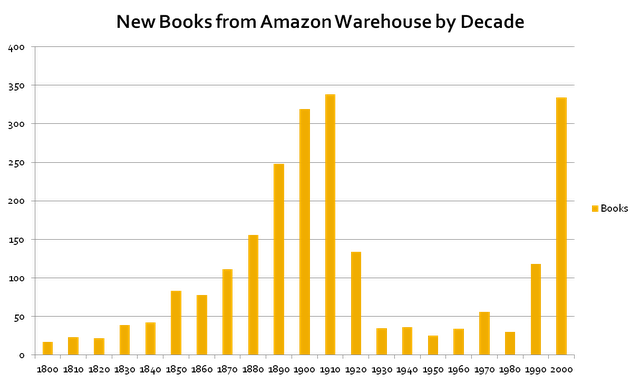
Here’s a graphical representation of how the copyright laws interact with Amazon’s ability/interest in stocking or otherwise making available older still-in-copyright works (graphic from 2015):
So, what’s the Disney connection?
The details of copyright law get complicated fast, but they date back to the original grant in the Constitution that gives Congress the right to bestow exclusive rights to a creator for “limited times.” In the first copyright act in 1790, that was 14 years, with the option to apply for an automatically granted 14-year renewal. By 1909, both terms had grown to 28 years. In 1976, the law was radically changed to harmonize with the Berne Convention, an international agreement originally signed in 1886. This switched expiration to an author’s life plus 50 years. In 1998, an act named for Sonny Bono, recently deceased and a defender of Hollywood’s expansive rights, bumped that to 70 years.
The Sonny Bono Act was widely seen as a way to keep Disney’s Steamboat Willie from slipping into the public domain, which would allow that first appearance of Mickey Mouse in 1928 from being freely copied and distributed. By tweaking the law, Mickey got another 20-year reprieve. When that expires, Steamboat Willie can be given away, sold, remixed, turned pornographic, or anything else. (Mickey himself doesn’t lose protection as such, but his graphical appearance, his dialog, and any specific behavior in Steamboat Willie — his character traits — become likewise freely available. This was decided in a case involving Sherlock Holmes in 2014.)
The reason that New Year’s Day 2019 has special significance arises from the 1976 changes in copyright law’s retroactive extensions. First, the 1976 law extended the 56-year period (28 plus an equal renewal) to 75 years. That meant work through 1922 was protected until 1998. Then, in 1998, the Sonny Bono Act also fixed a period of 95 years for anything placed under copyright from 1923 to 1977, after which the measure isn’t fixed, but based on when an author perishes. Hence the long gap from 1998 until now, and why the drought’s about to end.
March 27, 2018
History Buffs: Tora! Tora! Tora!
History Buffs
Published on 21 Jun 2017Tora! Tora! Tora! is a 1970 Japanese-American historical war film that dramatizes the Japanese attack on Pearl Harbor in 1941. The film was directed by Richard Fleischer, Toshio Masuda and Kinji Fukasaku and stars an ensemble cast, including Martin Balsam, Joseph Cotten, Sō Yamamura, E. G. Marshall, James Whitmore and Jason Robards. The title is the Japanese codeword used to indicate that complete surprise had been achieved. “Tora” means “tiger” in Japanese.
Cynical Historian: Pearl Harbor review – https://www.youtube.com/watch?v=oUlwDDeAQNE
March 3, 2018
5 Great Libertarian Movies!
ReasonTV
Published on 2 Mar 2018Forget the Oscars! Here are five great movies made over the past quarter-century that any libertarian will (must?) enjoy.
_____The Incredibles (2004)
This Pixar film directed by Brad Bird is so full of speeches extolling individualism, it sometimes sounds like an Ayn Rand novel (in fact, Rand is clearly part of inspiration for the character of Edna Bird). Even the supervillain in The Incredibles is a creature of self-invention and self-improvement. While the Incredibles are born with their powers, Syndrome is a normie who worships Mr. Incredible and is desperate to be his sidekick.
Like an animated version of Richard Nixon, Syndrome’s ambition ultimately gets the best of him.
The Barbarian Invasions (2003)
Québécois director Denys Arcand’s brilliant sequel to The Decline of the American Empire is the single-best depiction of the depredations of socialized medicine. Canada’s health-care system is so sclerotic that the movie’s protagonist, a retired academic named Rémy, cannot even score the drugs he needs to commit suicide until his estranged son, a banker, buys them on the black market.
Even more disturbing is the moment when the terminally ill Rémy and his former colleagues admit that their intellectual faddishness led them to embrace every awful left-wing “ism” of the past 30 years despite their massive human toll.
Dallas Buyers Club (2013)
Set in the 1980s, Matthew McConaughey plays Ron Woodroof, a boozey roughneck who is given 30 days to live after being diagnosed with AIDS. Faced with a death sentence, he schools himself on a wide variety of treatments, first in Mexico and then all over the world. With the help of a cross-dressing party girl named Rayon, Woodroof skirts FDA prohibitions against importing, using, and selling unapproved drugs by creating a “buyers club,” in which members pay a monthly fee and assume all risks.
The depiction of official indifference to patient suffering and the bureaucratic quashing of medical freedom even for people who are certain to die is inspirational, especially now that even Donald Trump has endorsed “right-to-try” legislation that would allow terminally ill patients access to non-approved medicines.
Joy (2015)
Jennifer Lawrence became a mega-star playing the anti-government rebel Katniss Everdeen in The Hunger Games movies. While there’s no shortage of libertarian sentiment coursing through that trilogy, it’s actually a quieter movie starring Lawrence that embodies libertarian virtues of hard work, commercial innovation, and entrepreneurship.
In Joy, Lawrence plays real-life “Miracle Mop” inventor Joy Magano, who helped make cleaning your floors easier while making herself rich. The film is nothing less than a paean to capitalism’s genius at allowing self-expression and self-fulfillment.
In a dramatic scene with Bradley Cooper, who plays an executive at a home-shopping network, Joy summarizes in a few sentences what it took Joseph Schumpeter, Friedrich Hayek, and Milton Friedman whole books to say.
As former Reason Editor Virginia Postrel wrote, the film “acknowledges the wealth-creating value of incremental improvements even in the most mundane items.”
Ghostbusters (1984)
Released in 1984, Ghostbusters quickly became one of most successful comedies in film history.
The movie was perfectly in synch with the Reagan Revolution’s valorization of business and demonization of government. Ghostbusters begins with a team of paranormal investigators getting kicked out of Columbia University and starting a ghost-hunting business. But even though New York is literally being invaded by evil spirits, the real villain of the movie is not the otherwordly demon Gozer but an Environmental Protection Agency bureaucrat named Walter Peck, who shuts down their operation and puts the city at risk.
Well, what do you think? How far off the mark are we? What great libertarian movies would you add to the list? Let us know in the comments.
Produced by Todd Krainin. Written and narrated by Nick Gillespie.
February 10, 2018
When cinematography wins out over reality
Earlier this month, Charles Stross talked about why he’s been reading less and less science fiction lately, and touched on SF movies and (for example) why George Lucas chose to model space combat on World War 1 aircraft battles:
When George Lucas was choreographing the dogfights in Star Wars, he took his visual references from film of first world war dogfights over the trenches in western Europe. With aircraft flying at 100-200 km/h in large formations, the cinema screen could frame multiple aircraft maneuvering in proximity, close enough to be visually distinguishable. The second world war wasn’t cinematic: with aircraft engaging at speeds of 400-800 km/h, the cinematographer would have had a choice between framing dots dancing in the distance, or zooming in on one or two aircraft. (While some movies depict second world war air engagements, they’re not visually captivating: either you see multiple aircraft cruising in close formation, or a sudden flash of disruptive motion — see for example the bomber formation in Memphis Belle, or the final attack on the U-boat pen in Das Boot.) Trying to accurately depict an engagement between modern jet fighters, with missiles launched from beyond visual range and a knife-fight with guns takes place in a fraction of a second at a range of multiple kilometres, is cinematically futile: the required visual context of a battle between massed forces evaporates in front of the camera … which is why in Independence Day we see vast formations of F/A-18s (a supersonic jet) maneuvering as if they’re Sopwith Camels. (You can take that movie as a perfect example of the triumph of spectacle over plausibility at just about every level.)
… So for a couple of generations now, the generic vision of a space battle is modelled on an air battle, and not just any air battle, but one plucked from a very specific period that was compatible with a film director’s desire to show massed fighter-on-fighter action at close enough range that the audience could identify the good guys and bad guys by eye.
Let me have another go at George Lucas (I’m sure if he feels picked on he can sob himself to sleep on a mattress stuffed with $500 bills). Take the asteroid field scene from The Empire Strikes Back: here in the real world, we know that the average distance between asteroids over 1km in diameter in the asteroid belt is on the order of 3 million kilometers, or about eight times the distance between the Earth and the Moon. This is of course utterly useless to a storyteller who wants an exciting game of hide-and-seek: so Lucas ignored it to give us an exciting game of …
Unfortunately, we get this regurgitated in one goddamned space opera after another: spectacle in place of insight, decolorized and pixellated by authors who haven’t bothered to re-think their assumptions and instead simply cut and paste Lucas’s cinematic vision. Let me say it here: when you fuck with the underlying consistency of your universe, you are cheating your readers. You may think that this isn’t actually central to your work: you’re trying to tell a story about human relationships, why get worked up about the average spacing of asteroids when the real purpose of the asteroid belt is to give your protagonists a tense situation to survive and a shared experience to bond over? But the effects of internal inconsistency are insidious. If you play fast and loose with distance and time scale factors, then you undermine travel times. If your travel times are rubberized, you implicitly kneecapped the economics of trade in your futurescape. Which in turn affects your protagonist’s lifestyle, caste, trade, job, and social context. And, thereby, their human, emotional relationships. The people you’re writing the story of live in a (metaphorical) house the size of a galaxy. Undermine part of the foundations and the rest of the house of cards is liable to crumble, crushing your characters under a burden of inconsistencies. (And if you wanted that goddamn Lucasian asteroid belt experience why not set your story aboard a sailing ship trying to avoid running aground in a storm? Where the scale factor fits.)
Whatever you do, don’t go asking him about Han Solo’s claimed Kessel Run in less than 12 parsecs…
January 24, 2018
Peter Jackson to bring modern digital technology to bear on IWM film footage of the Great War
Elizabeth sent me a link to this Daily Mail article on Peter Jackson’s new project:
When you think of First World War footage, chances are you conjure up grainy images of soldiers and jumpy footage of the trenches.
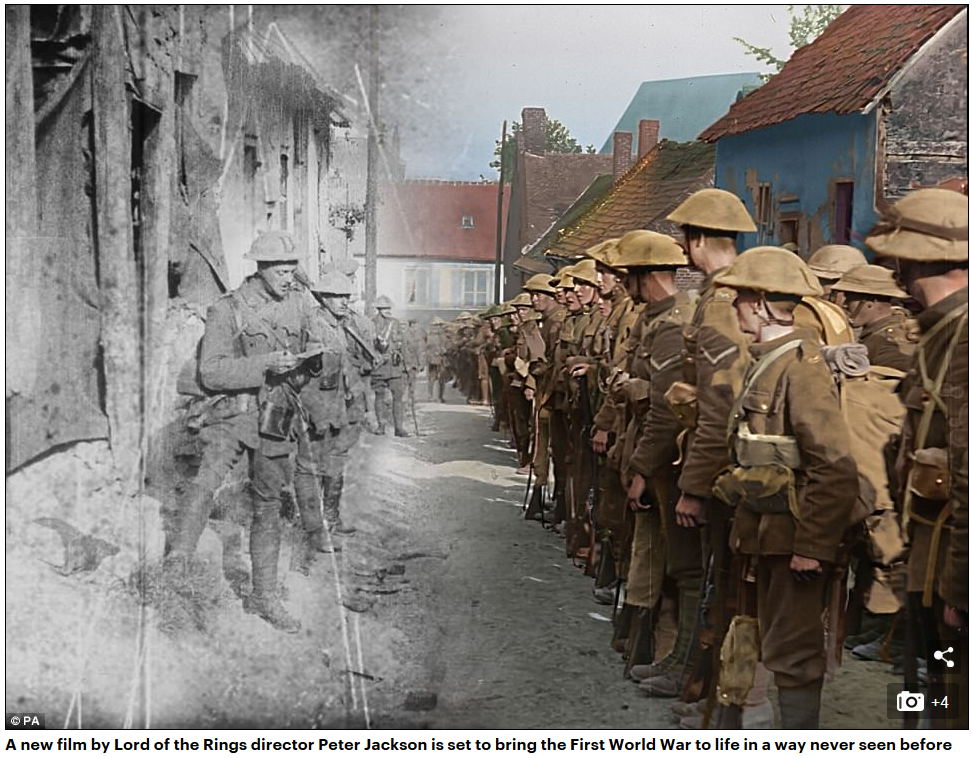
But a new 3D film by Lord of the Rings director Peter Jackson is set to bring the conflict to life in a way never seen before.
The Oscar-winner has restored and colourised 100-year-old footage from the Imperial War Museum’s vast archive, and early photos suggest the results will be remarkable.
One comparison shot shows the dramatic transformation from poor quality black-and-white scenes to clear colour images, while another shows the radically sharpened faces of our troops.
Jackson said he hoped the film, which will premiere at the BFI London Film Festival before airing on BBC1 later this year, will help audiences better connect ‘with the events on screen’.
Explaining the painstaking process of restoring the footage, he said: ‘We started to do some experiments and I was honestly stunned by the results we were getting. We all know what First World War footage looks like.
‘It’s sped up, it’s fast, like Charlie Chaplin, grainy, jumpy, scratchy, and it immediately blocks you from actually connecting with the events on screen.
January 13, 2018
Actors and public morality
Jonah Goldberg on the differences in the way actors were viewed historically and today:
It may be hard for some people to get the joke these days, but for most of human history, actors were considered low-class. They were akin to carnies, grifters, hookers, and other riffraff. In ancient Rome, actors were often slaves. In feudal Japan, Kabuki actors were sometimes available to the theatergoers as prostitutes — a practice not uncommon among theater troupes in the American Wild West.
In 17th century England, France, and America, theaters were widely considered dens of iniquity, turpitude, and crapulence. Under Oliver Cromwell’s Puritan dictatorship, the theaters were forced to close to improve moral hygiene. The Puritans of New England did likewise. A ban on theaters in Connecticut imposed in 1800 stayed on the books until 1952.
Partly out of a desire to develop a wartime economy, partly out of disdain for the grubbiness of the stage, the first Continental Congress in 1774 proclaimed, “We will, in our several stations, … discountenance and discourage every species of extravagance and dissipation, especially all horse-racing, and all kinds of gaming, cock-fighting, exhibitions of shews [sic], plays, and other expensive diversions and entertainments.”
[…]
The most recent Golden Globes ceremony has already been excoriated for being a veritable geyser of hypocritical effluvia, as the same crowd that not long ago bowed and scraped to serial harasser and accused rapist Harvey Weinstein, admitted child rapist Roman Polanski, and that modern Caligula, Bill Clinton, congratulated itself for its own moral superiority.
The interesting question is: Why have movie stars and other celebrities become an aristocracy of secular demigods? It seems to me an objective fact that virtually any other group of professionals plucked at random from the Statistical Abstract of the United States — nuclear engineers, plumbers, grocers, etc. — are more likely to model decent moral behavior in their everyday lives. Indeed, it is a bizarre inconsistency in the cartoonishly liberal ideology of Hollywood that the only super-rich people in America reflexively assumed to be morally superior are people who pretend to be other people for a living.
I think part of the answer has to do with the receding of religion from public life. As a culture, we’ve elevated “authenticity” to a new form of moral authority. We look to our feelings for guidance. Actors, as a class, are feelings merchants. While they may indeed be “out of touch” with the rest of America from time to time, actors are adept at being in touch with their feelings. And for some unfathomably stupid reason, we now think that puts us beneath them.
January 8, 2018
Mark Steyn reviews Darkest Hour
The latest screen depiction of Winston Churchill gets the once-over from Mark Steyn:
Churchill tends to the Churchillian, which is to say the epic. Darkest Hour, by contrast, is very finely focused. Joe Wright, director, and Edward McCarten, writer, confine their two dark hours of screen time to a couple of critical weeks in May 1940, when Hitler’s invasion of Norway precipitated Neville Chamberlain’s retreat from Downing Street. Aside from some rather elaborately choreographed overhead shots and a lush grandiose score, Darkest Hour is filmed claustrophobically, too – in poky sitting rooms, Downing Street basements, attics, Westminster ante-rooms, and chilly lavatories; the lighting is crepuscular. The fate of the world is being determined, but we never glimpse the far horizons, only the dingy backrooms.
What happened that month was a showdown between the two principal contenders for the Prime Ministership, Mr Churchill and Lord Halifax. Stephen Dillane is excellent as Halifax, the vulpine cadaver looking down (in every sense) from the Commons gallery at Churchill’s turns at the dispatch box. Unfortunately, aside from skillful deployments of his inscrutable yet condescending eyebrows, he gets somewhat short shrift on screen, so as a Churchill vs Halifax cage match it never quite comes off – presumably because the third Viscount Halifax is entirely unknown in Hollywood. (“Third Viscount Halifax? Hey, let’s see what the first two gross before we commit to that…”)
This is a pity, because the two men were on opposite ends of the seesaw, and, capacious as Churchill’s own bottom is, most of the other players – the King, Chamberlain, the parliamentary party, defeatist generals, Dominion prime ministers around the globe – were inclined to park their own butts down Halifax’s end. On May 10th, the day Winston became PM, the Germans invaded Belgium, France and the Netherlands. Ten days later, Hitler’s army reached the Channel, and was within reach of throttling the 300,000-strong British Expeditionary Force at Dunkirk, and seizing the entire French fleet. In that dreadful month of May, Churchill wanted to fight on; Halifax preferred to use Mussolini’s “good offices” to sue for a “peace” that would leave Britain and its empire more or less “intact” – save for East Africa, Suez, Malta, Gibraltar and sundry other places that would have to be addressed, per the Italian ambassador in London, “as part of a general European settlement”.
In other words, we are at the great hinge moment of the twentieth century: Had Halifax prevailed, there would have been a neutered Berlin-friendly British Empire directly bordering America on the 49th parallel and all but directly the Soviet Union in Central Asia. There would have been no potential allies for Moscow in the event of war with Germany, thus incentivizing a successful conclusion in late 1940 to Molotov’s talks in Berlin to join the Axis; and no allies whatsoever for Washington, assuming Japan still felt the need to bomb Pearl Harbor the following year. Instead, Churchill prevailed – and Britain and its lion cubs fought on, playing for time until first the Soviets and then the Americans joined the war against Germany, Italy and Japan. That year in which the moth-eaten Britiish lion and its distant cubs stood alone is, more than any other single factor, the reason why the world as ordered these last seventy years exists at all.
[…]
As with Christopher Nolan’s Dunkirk, one’s admiration for the film is tempered by a terrible profound sadness – for a people who “won the war, and lost their country anyway”. To anyone old enough to remember an England where one could “walk into any pub in the country and ask with perfect confidence if the major had been in”, the sense of loss can bring tears to the eye. Unlike Iron-Man 5 and Spider-Man 12 and Cardboard-Man 19 and Franchise-Man 37, this is the story of an actual, real-life superhero: You leave the theater with the cheers of the House ringing in your ears …and return to a world where quoting Churchill in his own land can get you arrested.
December 22, 2017
Learning To Be Yourself With Buddy The Elf
Foundation for Economic Education
Published on 7 Dec 2017The classic holiday film Elf offers a lot more than a good time and a bunch of laughs. It teaches you how to get the most out of your life by finding your comparative advantage – the intersection between what you’re good at and what people need.
After watching this video, download our free ebook “Your Life, Your Work” to learn more about how to find your own comparative advantage and build a life you’re excited about.
Get it here: https://info.fee.org/your-life-your-work
December 21, 2017
William Gibson: The 80s Revolution – Extra Sci Fi – #7
Extra Credits
Published on 19 Dec 2017Start your free 1-month trial for The Great Courses Plus! http://ow.ly/3iLM30egcfR
After Star Wars, the science fiction genre suddenly became a pop culture darling, and a flood of schlocky imitations followed. William Gibson led the charge to reclaim space in the genre for his concept of future history – one that, in turn, eventually launched cyberpunk.
December 16, 2017
What? There’s another Star Wars movie? Did the Death Star regenerate itself?
My level of excitement for new Star Wars movies probably peaked just before the release of The Revenge of the Return of the Bride of the Jedi, and now has fallen and can’t get up. I’m perhaps not alone, as David “Iowahawk” Burge kindly illustrates:
Oh great another Star Wars movie so I get to read through another 3 weeks of cartoon character theological debates
— David Burge (@iowahawkblog) December 15, 2017
Spoiler alert: in the new Dawn of the Blasticons, Grabnar Jibbersnorf laser-freezes the Bloongsnoodi, even though his charmcloak DIDN'T HAVE THE POLARIAN CRYSTALS 😟😟😣🤬🧐😵😵🦖🦖
— David Burge (@iowahawkblog) December 15, 2017
And then they expect us to believe Roobu Gark would let Grabnar and D-60Z tractorpod the carbonzone, without their infinitysocks! I mean like WTF?
— David Burge (@iowahawkblog) December 15, 2017
THEY'RE DESTROYING MY WHOLE CHILDHOOD
— David Burge (@iowahawkblog) December 15, 2017
December 2, 2017
Great Movie Fighting Techniques as illustrated by Helen of Troy
Lindybeige
Published on 31 Jan 2014This video played fine within Sony Vegas Studio, but very oddly in Windows Media Player. On YouTube it seems to be part way between the two. I just wish my videos would look and sound the way I set them in the editing software. No matter – this will have to be good enough. I have delayed uploading it too long already.
This feature film (also broadcast as a mini-series) has I think enough commentable material in it for one more video.
November 26, 2017
Fire-arrows!
Lindybeige
Published on 10 Jun 2016Fire-arrows – did archers really use them in battles? We see them in the movies, so presumably not.
This is the most-anticipated video of all for this channel, which naturally makes me a bit nervous. Will people be hideously disappointed? I mentioned two and a half years ago that I would make a video on this topic, and this video shows that I am as good as my word, and not over-hasty either.
My thanks to the three people who pointed out quite correctly that when I said ‘Francis Bacon’ (1561-1626) I meant Roger Bacon (1219-1292).
November 8, 2017
QotD: The second coming of SF’s depressing and neurotic “New Wave”
Back in the mid to late 70’s the “New Wave” was in full force. Downbeat endings, “black and gray morality” (which can be good if handled well, at least as a change-up from more clear cut items) or worse “black and black.” Those were the tone of Science Fiction.
Then, fairly close to each other, two movies came out which took an entirely different approach: Lucas’ Star Wars and Spielberg’s Close Encounters of the Third Kind. The rogue was given back his heart of gold. The callow youth could be the hero of the piece, not ground down by the world weary cynics. Heroes who are actually heroes fighting bad guys who weren’t so “sympathetic” that you couldn’t tell hero from villain.
It was a refreshing change. And the result was that, for a time, it became OK to have good guys who were good guys. Bad guys who were actually bad and not just “oppressed” or “victims of their backgrounds”. You didn’t have to wonder who to root for.
Today we’re kind of in a similar position. One of the best selling series, for young people is The Hunger Games. Black and Very-Dark-Gray morality, little really to choose from in the sides, and (no spoilers) that’s shown pretty clearly in the ending. And in printed SF? So much “humanity is a plague” stuff. Bleah.
David L. Burkhead, “Star Wars and the Human Wave”, The Writer in Black, 2015-10-21.


