
Matt Estlea
Published on 22 Jan 2019A few of you have suggested that I try make a pen as it makes a great beginners project for the lathe. But seeing as I have previously made a pen I decided to challenge myself by using Black Palm; a notoriously difficult material to work, new Skew techniques, and a superglue finish.
It didn’t go well.
_________________________________________________________________Support what I do by becoming a Patron! This will help fund new tools, equipment and cover my overheads. Meaning I can continue to bring you regular, high quality, free content. Thank you so much for your support! https://www.patreon.com/mattestlea
_________________________________________________________________See what tools I use here: https://kit.com/MattEstlea
My Website: http://www.mattestlea.com
_________________________________________________________________My name is Matt Estlea, I’m a 23 year old Woodworker from Basingstoke in England and my aim is to make your woodworking less s***.
I come from 5 years tuition at Rycotewood Furniture Centre and 4 years experience working at Axminster Tools and Machinery where I still currently work on weekends. During the week, I film woodworking projects, tutorials, reviews and a viewer favourite ‘Tool Duel’ where I compare two competitive manufacturers tools against one another to find out which is best.
I like to have a laugh and my videos are quite fast paced BUT you will learn a lot, I assure you.
Lets go make a mess.
January 23, 2019
I Made a REALLY BAD Pen | Turning Tuesday #3
January 8, 2019
Practising using the SKEW Chisel | Turning Tuesday #1
Matt Estlea
Published on 8 Jan 2019Hello and welcome to yet ANOTHER series I am running where I commit to learning a new woodturning skill, technique or project in a bid to become more proficient on the lathe. This will largely be self taught so If you have any pointers, feel free to chip in!
_________________________________________________________________Where I learnt from:
https://www.youtube.com/watch?v=zT685…
_________________________________________________________________My Woodturning Equipment
https://kit.com/MattEstlea/woodturnin…
_________________________________________________________________Support what I do by becoming a Patron! I want to increase the production quality of my videos and thus need to finance some new equipment. Follow the link below to help me out! Thank you in advance! https://www.patreon.com/mattestlea
_________________________________________________________________
My name is Matt Estlea, I’m a 22 year old Woodworker from Basingstoke in England and my aim is to make your woodworking less s***.
I come from 5 years tuition at Rycotewood Furniture Centre and 4 years experience working at Axminster Tools and Machinery where I still currently work on weekends. During the week, I film woodworking projects, tutorials, reviews and a viewer favourite ‘Tool Duel’ where I compare two cometitive manufacturers tools against one another to find out which is best.
I like to have a laugh and my videos are quite fast paced BUT you will learn a lot, I assure you.
Lets go make a mess.
December 14, 2018
Assembling “The Cosmodemonic Sauder Adept Storage Credenza, from the dark Satanic mills of Sauder”
Having recently had a similar experience attempting to assemble a large IKEA wardrobe, I felt very sympathetic reading of Gerard Vanderleun‘s struggles with his cosmodemonic credenza from Sauder:
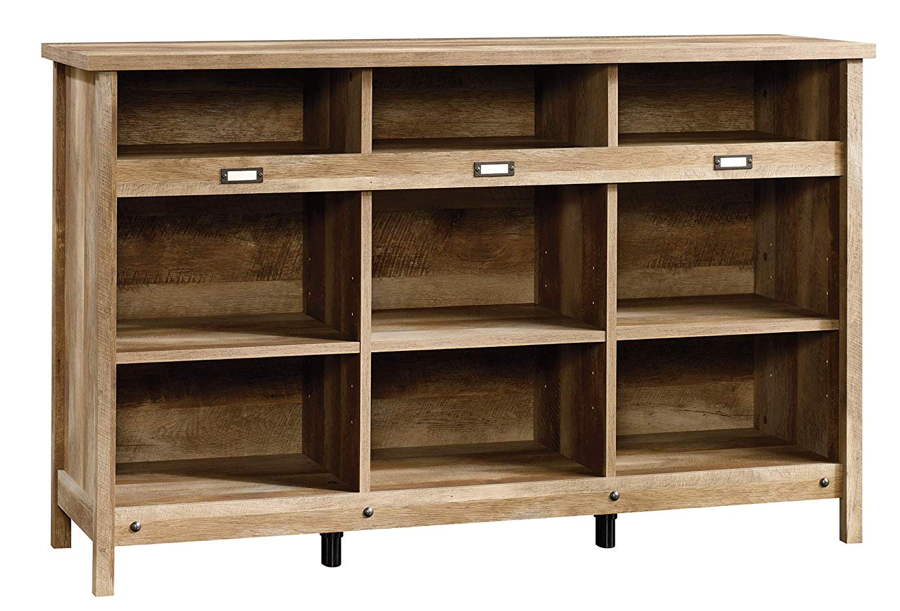
Item Weight 125 pounds
Product Dimensions 58.2 x 17.2 x 36.3 inches
Item model number 418344
Assembled Height 36.26 inches
Assembled Width 17.165 inches
Assembled Length 58.189 inches
Weight 133 PoundsSome assembly required.
Some? Some?! This little item took me the better part of 5 hours and left me shaken, exhausted, splinter struck, and drenched in a sweat that fell from the veritable fountains of profanity I launched at this !!!@@**%!*@!! item of our damned age. If it had not been a gift and if I had not just come by a pathological fear of fire, this THING would have been piled in the parking lot in front of my little apartment and set alight while I gibbered and danced about its flames in loincloth, pitchfork and torches.
Most of the first hour of trying to assemble this overweight and overbuilt POS was spent counting the nine (9!) different sacks of nails and connectors and sorting the various wooden slabs (one weighs in at around 50 pounds) and reading the always delightfully ambiguous instructions illustrated by a set of mechanical drawings in the ever-popular “oblique” style.
The next two hours would have found me assembling the various units to the mantra, “Slowly…. and ….. patiently.. and slowly… and…”
The final two hours would have found me in the 9th circle of Dante’s Inferno looking for the way out with only one beer to my name.
I’m not a petite man and I’m not a weak man. But this one brought this man to a new awareness of his age and his mortality; a mortality that I prayed would not kick in until I had hunted down the sadists behind Sauder and stood them all against the wall.
In the end I did get the !!!@@**%!*@!! item built. It stands on the back wall of my living dining area ready to receive the needful things for which it was made. As for me, I had to take to my couch for half a day just to get over the intense fatigue resulting from tossing 125 pounds of pressed wood around my house and trying to cuss it into place.
Following this experience I lay on my couch swearing to never, ever, “assemble” any item of furniture. But guess what? Unless you are ready to lay out serious cash, there are no items like that any more. Everything is Ikea-infected and made of sawdust.
December 8, 2018
How to break down plywood. A guide to cutting, moving and hauling plywood by yourself
Steve Ramsey – Woodworking for Mere Mortals
Published on 16 Nov 2018Set up shop for under $1000. Download my FREE GUIDE ►► http://mytoollist.com/
One of the most challenging woodworking tasks is dealing with plywood and other large sheet goods. They are unwieldy and a challenge to move by yourself and transport. In this video, I show you ways to make lugging it around and cutting it.
……………………………
Tools and plans in this video:
Free plans for my plywood lifting cleat: http://bit.ly/WWMMplywood
Peachtree Edge Guide► https://amzn.to/2Q3wOdq
Kreg Accu-Cut Track Guide► https://amzn.to/2KagEda……………………………
AD-FREE versions of my videos ►► https://www.patreon.com/wwmm
—————-
MAILING ADDRESS:WWMM
448 Ignacio Blvd. #237
Novato CA 94949
November 24, 2018
Things To Know About Lumber
Essential Craftsman
Published on 24 Oct 2017We are talking about softwood lumber for framing and concrete forming purposes primarily. These principles apply to all types of sawn lumber products though. thanks for watching, and have a great week.
October 18, 2018
How to Plane CORRECTLY
Matt Estlea
Published on 17 Oct 2018In this video, I explain the best techniques to employ when using a plane in order to get a smooth surface, a controlled cut, and above all a more enjoyable experience!
This is an addition to my ‘Woodworking Basics’ series where I also covered the topics of sawing and chiselling.
Sawing: https://www.youtube.com/watch?v=C5OzZ…
Chiselling: https://www.youtube.com/watch?v=Efxgv…
_________________________________________________________________Videos referenced:
How to Sharpen a Plane Blade: https://www.youtube.com/watch?v=vtCAb…
How to Set up a Plane: https://www.youtube.com/watch?v=J0ZV8…
How to reduce Tearout: https://www.youtube.com/watch?v=6fGqh…
Making a Bass Guitar: https://www.youtube.com/watch?v=wz7dt…
Making a Roubo Workbench: https://www.youtube.com/watch?v=FXKYw…
How to make a Protrusion Stop: https://www.youtube.com/watch?v=I417V…
_________________________________________________________________Support what I do by becoming a Patron! I want to increase the production quality of my videos and thus need to finance some new equipment. Follow the link below to help me out! Thank you in advance! https://www.patreon.com/mattestlea
My Website: www.mattestlea.com
_________________________________________________________________
My name is Matt Estlea, I’m a 22 year old Woodworker from Basingstoke in England and my aim is to make your woodworking less s***.I come from 5 years tuition at Rycotewood Furniture Centre and 4 years experience working at Axminster Tools and Machinery where I still currently work on weekends. During the week, I film woodworking projects, tutorials, reviews and a viewer favourite ‘Tool Duel’ where I compare two cometitive manufacturers tools against one another to find out which is best.
I like to have a laugh and my videos are quite fast paced BUT you will learn a lot, I assure you.
Lets go make a mess.
September 30, 2018
Model buildings
Lindybeige
Published on 3 Oct 2014I tell you a bit about how I made my model buildings – the ruins, the card buildings, the vacuum-formed stuff,
Lindybeige: a channel of archaeology, ancient and medieval warfare, rants, swing dance, travelogues, evolution, and whatever else occurs to me to make.
▼ Follow me…
Twitter: https://twitter.com/Lindybeige I may have some drivel to contribute to the Twittersphere, plus you get notice of uploads.
website: www.LloydianAspects.co.uk
August 2, 2018
Manufacturing the Engineered Wood Floor Joists
Bob Vila
Published on 30 Mar 2015Bob visits the Willamette I-Joist Mill in Woodburn, OR, before returning to Yonkers where the crew is assembling the second floor walls with structural insulated panels.
July 13, 2018
How It’s Made: Laminated Wood Beams
Al Hilli
Published on 25 Apr 2013
June 25, 2018
What’s inside Ikea’s “wood” ?
Rag ‘n’ Bone Brown
Published on 12 May 2018In this video I cut open one of Ikea’s Linnmon shelves to find out what’s inside.
May 10, 2018
Manufacturing plywood boards: then and now
Victoria and Albert Museum
Published on 24 Jul 2017Plywood is a simple material made by glueing together thin sheets of wood, known as veneers or plies. These basic elements have remained broadly the same throughout its history. The most significant breakthrough in its production came in the early 1800s with the development of steam-powered machines that could cut veneers cheaply. The most influential of these was the rotary veneer cutter.
The cutter rotates a log against a wide, horizontal blade, causing it to ‘peel’ into a continuous sheet of wood. This enables the creation of longer, wider sheets of veneer than previously possible and with little waste. Using these machines meant that plywood could be manufactured quickly and inexpensively on a large scale.
This film shows the stages in manufacturing plywood boards in the mid-20th century and today. The process remains essentially unchanged, although today many of the machines are much faster and computer controlled.
Produced as part of the V&A exhibition Plywood: Material of the Modern World (15 July – 12 November 2017) https://www.vam.ac.uk/plywood
Sponsored by MADE.COM. Supported by the American Friends of the V&A
Find out more about plywood with our fascinating exhibition book, Plywood: A Material Story
https://www.vam.ac.uk/shop/plywood-a-material-story-148486.html
April 25, 2018
Chris Schwarz’ Campaign Chair – Pared Down!
Popular Woodworking
Published on 3 Apr 2018Watch the original (but much cooler) portable picnic chair come together in record time. As if Chris wasn’t already moving at lighting speed! Watch the whole video here: http://bit.ly/CampaignChair
April 21, 2018
How to Make Sawhorses Introduction | Paul Sellers
Paul Sellers
Published on 20 Apr 2018Episode 1 will be released on Monday 23rd of April 2018
Paul shows how to make a pair of sawhorses using the method he first learnt when he was 16. They are very useful around the shop for resawing stock and a many others uses. The sawhorses make use of a compound housing joint that ensures a solid construction.
THE TOOLS YOU WILL NEED ARE:
Knife
Square
Combination gauge (or marking gauge)
Tape/Ruler (or both)
Sliding bevel
Chisel hammer
Chisels (at least 1″)
Smoothing plane (No 4)
Tenon saw
*Handsaw
Hand drill and screwdriver or drill driver* = optional
JOINTS LIST:
Compound housing jointFor more information on these topics, see https://paulsellers.com or https://woodworkingmasterclasses.com
April 15, 2018
How to Use a Hand Plane
This Old House
Published on 5 Dec 2015This Old House general contractor Tom Silva demonstrates the proper way to use hand planes. (See below for a shopping list, tools, and steps.)
Shopping List for How to Use a Hand Plane:
– Machine oil, used to lubricate sharpening stone
– Wood block, used to prevent tear-out in end grainTools List for How to Use a Hand Plane:
– Bench planes
– Specialty planes
– Block planes
– Sharpening stone, for sharpening plane irons
– Clamp, used to secure wood block to workpieceSteps for How to Use a Hand Plane:
1. Bench planes are used to flatten and smooth broad wood surfaces and narrow edges.
2. Long bench planes are best suited for smoothing very long surfaces and edges.
3. Specialty planes, such as a shoulder plane or rabbet plane, have plane irons (blades) that come flush with the edges of the tool.
4. Block planes are compact, versatile, and ideally suited for smoothing edges, small surfaces, and end grain.
5. Rotate the adjusting nut to control the depth of cut.
6. Pivot the lateral adjustment lever to square up the iron to the plane body.
7. Release the iron cap and extract the plane iron from the plane.
8. Test the sharpness of an iron by standing it on your thumbnail. If the iron slides off, it needs sharpening.
9. To sharpen a plane iron, start by applying machine oil to the coarse side of a sharpening stone.
10. Set the iron against the oiled stone with its beveled end facing down.
11. Tilt up the iron until its bevel is flush with the stone. Maintain that exact angle as you slowly rub the iron across the stone in a circular motion.
12. After a minute or two, flip over the iron and place it flat against the stone. Rub the iron back and forth to remove any burr from the back surface.
13. Next, flip the stone over to reveal its smooth surface. Apply oil and repeat the sharpening process.
14. Then raise the iron just a fraction of an inch, and make two or three passes across the stone.
15. Repeat the thumbnail test of Step 8 to check the iron’s sharpness.
16. When planing the narrow edge of a board, inspect the direction of the wood grain on the side of the board.
17. Always plane in the direction of the up-angling wood grain. Don’t plane against it.
18. Adjust the throat (mouth) of the plane to increase or decrease the gap between the plane iron and the bed of the plane. The proper adjustment will help prevent tearing out the grain.
19. Decrease the gap when planing end grain, and increase it when planing edge grain or making deep cuts.
20. When planing end grain, prevent tear-out by planing in from both ends toward the middle.
21. Another technique is to clamp a sacrificial wood block to the end of the board prior to planing. Then, any tear-out will occur in the block, not the board.


