Forgotten Weapons
Published 3 Nov 2025The Apache Arms carbine was a Thompson SMG lookalike that was made in small numbers in the late 1960s. It was the successor to the Spitfire carbine made by the same people, after the Spitfire was deemed a machine gun by the IRS. The Apache used M3 Grease Gun magazines and was chambered for .45 ACP. It uses a square receiver tube and many of the same cast parts as the Spitfire. It is a very interesting look at how the design was adapted to be legally considered semiautomatic.
(more…)
March 25, 2026
Apache Arms Carbine: A Saga of Compliance and Crappy Manufacture
March 23, 2026
Canada’s NEW Rifle – the CMAR
The Armourer’s Bench
Published 22 Mar 2026The Canadian Armed Forces are set to adopt variants of Colt Canada’s MRR as the Canadian Modular Assault Rifle (CMAR). The announcement stated that more than 65,000 rifles will be procured over the next 5 years to replace the Colt Canada C7 rifles and C8 carbines currently in Canadian service.
Be sure to check out our accompanying article for this video here – https://armourersbench.com/2026/03/22/canada-adopts-new-rifle/
March 22, 2026
The Original AR-15: Serial Number 6 in Original Configuration
Forgotten Weapons
Published 1 Nov 2025The very first AR15 rifles submitted to US government trials were extremely lightweight, with an assortment of interesting features that did not last long. They had top-mounted charging handles, one-piece hand guards, very thin barrels with plain muzzles, and a different safety selector configuration than became normal later one. Updates and modifications were made to virtually all of the original rifles, but today we have a chance to look at serial number 6 in the Springfield Armory collection — which is still in completely original configuration.
Thanks to the Springfield Armory National Historic Site for giving me access to this truly unique specimen from their reference collection to film for you! Don’t miss the chance to visit the museum there if you have a day free in Springfield, Massachusetts: https://www.nps.gov/spar/index.htm
(more…)
March 21, 2026
Colt LE-901 Modular Multi-Caliber AR: A Well-Designed Failure
Forgotten Weapons
Published 29 Oct 2025Colt originally developed the 901 as part of the US Army SCAR program, with the intention being to create a 7.62x51mm rifle that could also use unmodified 5.56x45mm upper assemblies. This would allow special operations units to customize a single weapon to a variety of different configurations for different mission profiles. Mechanically, the system Colt devised to do this was quite clever, and very effective. However, the rifle ultimately failed to win a military contract.
Moved to civilian sales, the system was unsuccessful fundamentally because the modular concept is just not very desirable. A single modular rifle like this inevitably sacrifices some capability in every specific configuration in exchange for the modular capability and most people would rather have two dedicated rifles in different configurations than one swappable one. It sounds appealing on paper, but almost always fails economically in practice.
(more…)
March 18, 2026
SPAS-12: Franchi’s Special Purpose Automatic Shotgun
Forgotten Weapons
Published 6 Nov 2024Franchi introduced the Special Purpose Automatic Shotgun (SPAS-12) for Italian military and police agencies in 1979 and it quickly became popular worldwide. Based originally on the gas-operated Franchi 500, that SPAS-12 was robust, reliable, and designed as a semiautomatic action with a backup pump action operation for use with underpowered ammunition (like beanbags or other less-lethal loads). In 1982 they began to be imported into the US through FIE, which was replaced by AAI as the importer in 1989. Eventually the 1994 Assault Weapons Ban ended SPAS-12 importation, and Franchi discontinued the model in 2000 in favor of the improved SPAS-15.
The SPAS-12 was almost always sold with a 21.5 inch barrel and 8-round magazine tube. It was available with either a solid sock or a top-folding type, complete with arm brace hook for shooting one-handed from a vehicle. In total, between 45,000 and 50,000 were made between 1979 and 2000, with the largest single purchaser being the Egyptian government (which took 18,000 of them).
Full video on the SPAS 15:
• SPAS-15: Franchi’s Improvement on the SPAS-12
(more…)
March 15, 2026
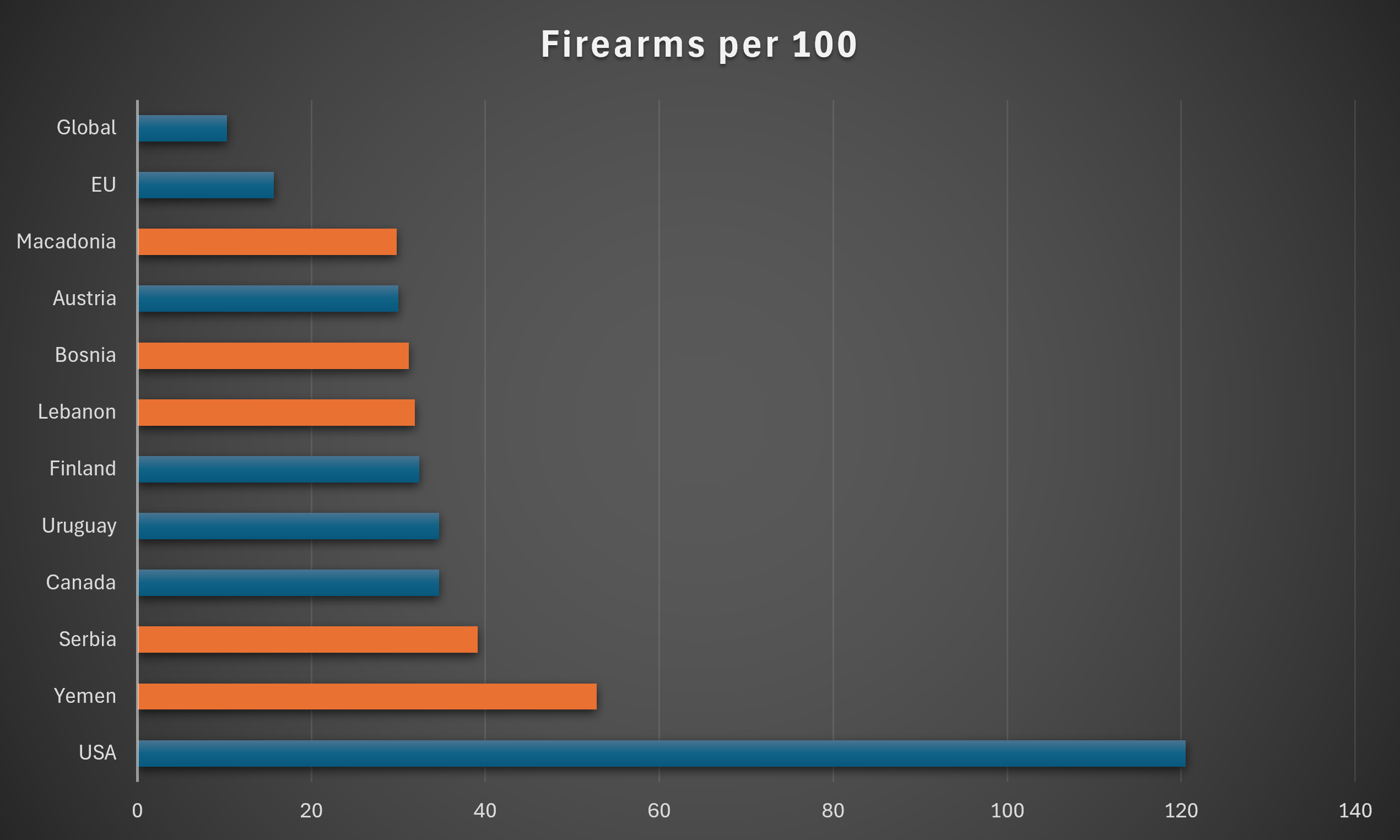
Using US gun statistics to argue against Canadian gun owners
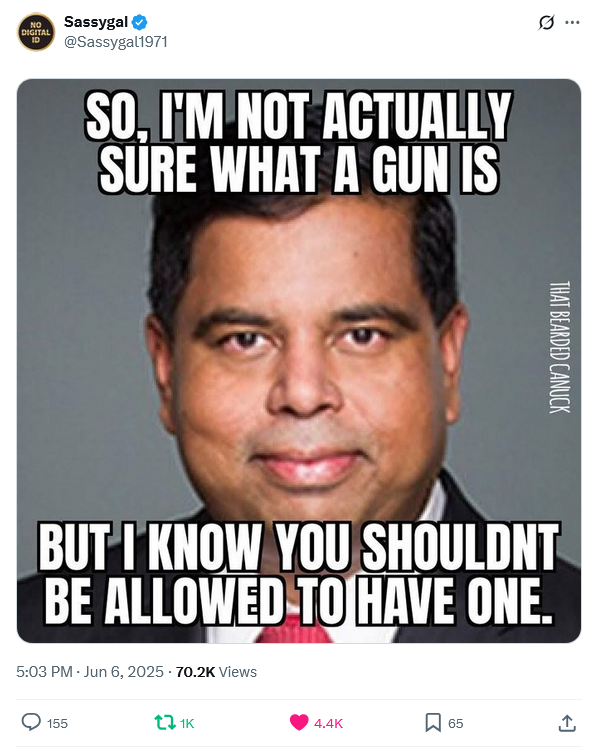
On the social media site formerly known as Twitter, Gun Owners of Canada respond to a troll post trying to confuse the legal situation for Canadian gun owners by using statistics from the US, where the laws are significantly different:
Typical. He blocked without further discussion.
But, he’s wrong.
There is a fundamental flaw in using that 1998 [US] DOJ literature review to argue the Stand on Guard Act will lead to more gun deaths. The claim relies on a completely broken comparison between U.S. and Canadian law.
Here is why applying that specific American data to this Canadian bill proposed by the CPC simply does not work.
The DOJ report relies heavily on American statistics where firearms kept for self defense are typically stored loaded and unlocked. That specific environment, meaning immediate and unrestricted access to a loaded weapon, is the primary driver for the increased rates of accidental shootings and suicides highlighted in those U.S. studies.
The Stand on Guard Act does not create that environment in Canada. Saying it does such is just fear-mongering.
This proposed legislation is strictly an amendment to Section 34(2) of the Criminal Code. It establishes a presumption that force used against a violent home invader is reasonable. The goal is to spare Canadians from years of legal limbo for defending their families.
Crucially, this bill does not amend the Firearms Act and it does not repeal Canada’s strict safe storage regulations.
A legally compliant Canadian firearm owner must still store their firearms unloaded and secured with a locking device, or locked inside a sturdy cabinet or safe. Ammunition must also be stored separately or locked up securely in the same safe.
The specific risks identified in the U.S. data, like a child finding a loaded gun or someone in crisis having instant access to a weapon, are mitigated by our existing storage framework.
Debating the merits of self defense thresholds is perfectly fair. However, importing U.S. data based on a completely different regulatory baseline to predict Canadian outcomes is a clear misapplication of the evidence. We need to ground this conversation in actual Canadian law rather than American statistics.
So, as a reminder — welcome to Canada — let’s buy Canadian, support Canadian and recognize Canadian facts.
March 14, 2026
Palmer Cavalry Carbine
Forgotten Weapons
Published 20 Jun 2015The Palmer was the first bolt action firearm adopted by the US military — it was a single-shot rimfire carbine patented in 1863 and sold to the US cavalry in 1865. The guns were ordered during the Civil War, but were not delivered until just after the end of fighting, and thus never saw actual combat service. The design is very reminiscent of the later Ward-Burton rifle, using the same style of interrupted-thread locking lugs. The Palmer, however, has a separate hammer which must be cocked independently of the bolt operation.
March 11, 2026
Foldy-Glock: The Full Conceal M3D (History and Shooting)
Forgotten Weapons
Published 18 Oct 2025Full Conceal was a company that designed a folding Glock. The intent was to create a pistol that could be easily, discreetly, and safely carried in a pocket but still offer the handing and capability of a full size service pistol. They did this by cutting off the grip of a Glock 19 (M3D) or Glock 43 (M3S) and rebuilding it with a hinged trigger guard. An extended magazine could be then carried parallel to the barrel, folded up to render the trigger safe and giving it the profile of a big cell phone instead of pistol.
The M3D and M3S were shown as prototypes at SHOT 2017 and began shipping in early 2018. In October 2020 the company filed for bankruptcy and in June 2021 its assets were sold at auction. The problem was that the guns were simply too expensive for their target market. The company tried to reduce costs by developing their own slides and frame instead of using commercial Glocks, but this was too little too late to save them financially.
(more…)
March 7, 2026
ASh-78: Albania Makes the Worst AK
Forgotten Weapons
Published 11 Oct 2025Albanian AKs are both pretty scarce to find outside Albania, and also a bit unusual in the AK field. Where most countries followed Russian AK development, Albania instead patterned theirs on the Chinese Type 56. China had Russian assistance in producing the original milled-receiver AK, but the milled AKM came after the Sino-Soviet split and so China had to create their own stamped receiver design independently. We see those features in the Albanian ASh-78, in elements like the offset front trunnion rivet, gas vent holes, stock and grip style, single trigger guard rivets, and lack of a rate reducing mechanism in the FCG.
In 1960 China began providing military aid to Albania. The first rifle production there was a version of the SKS, which are made into the early 1970s. In 1974 the Albanian state arsenal began setting up AK production with Chinese help as well. Relations between the two countries broke down shortly thereafter, and by the time production began in 1978 the Albanians were working entirely independently. They added an underfolding model (the ASh-82) in 1982, and production continued past the end of the Cold War. Total production numbers are not known, as military information was pretty tightly controlled.
(more…)
March 1, 2026
QotD: Even when you know the gun isn’t loaded … it might be loaded
You want to know why I’m a little OCD when it comes to chamber checks on firearms? Allow me to share a story:
At the first gun shop at which I worked, which was also a pawn shop, we had a relationship with a pawn shop owner down in the city. Every few months, he’d drive out to see us with a briefcase containing a few old Colt Police Positives and Smith .38/.32 Terriers and Browning Vest Pockets and suchlike and we would swap him a big box of Lorcins and Hi-Points and Jennings and cash to make up the difference.
One time he came up, the sticking point in the negotiations was a PPK, an early Interarms-marked stainless example. Initially he was thinking about keeping it. Then he wanted too much for it. Then he relented and we added it to our side of the pile.
He handed the Walther to me, and I locked the slide back and checked the chamber, and passed it to a coworker over at the computer. She printed a trigger tag out for it and handed it, slide still locked back, to one of the other salespeople, who put it in the showcase.
Then our buddy the pawn shop owner crawfished. I sighed and pulled the gun from the showcase, removed the trigger tag, and laid it on the counter between him and my boss. About the time pawn shop guy was leaving, I was walking out of the store to cross the street and get lunch for everybody.
When I came back, there was the PPK, sitting on the counter by the computer. “Arthur changed his mind again?” I asked, and was told that, indeed, he had sat in his car for a moment and then came back in and threw the Walther in on the deal at the last minute. Sweet! I still had the trigger tag handy, so I put it back on the gun and passed it to the salesman who put it back in the showcase with one hand while eating his hamburger with the other.
I wandered off to a far corner of the showroom where I could eat my burger in peace, back turned to the sales floor, when *KA-BAM!*
A customer is standing there with the PPK in his hand and an appalled look on his face, smoke wisping theatrically from the barrel and a divot in the linoleum at his feet containing a flattened Winchester Silvertip.
That’s right, Arthur had loaded the PPK back up in his car, and then brought it back in to add to the trade, and not one person who handled it from the time I picked it up and put the trigger tag on it to the time the customer made the loud noise had bothered to inspect the chamber because, hey, we had already done that when he brought it in the first time, right?
Lesson learned: I don’t care if I set the gun down and just look away for a second; that gun gets checked again when I pick it up. Period. Unless it has been in my field of vision the whole time, I don’t know what might have happened to it while I wasn’t paying attention.
Tamara Keel, “Formative experiences …”, view from the porch, 2011-08-16.
February 25, 2026
Bommarito: America’s First Toggle-Locked Battle Rifle
Forgotten Weapons
Published 1 Oct 2025Designed by Giuseppe Bommarito, this was one of the many independent rifle designs submitted to the US War Department in the 1910s hoping for military adoption. It is a short recoil operated, toggle-locked system chambered for .30-06 and using detachable 20-round magazines. It was tested (without much success) at Springfield and remained in development until 1918.
See a more complete article including original disassembly photos here:
https://www.forgottenweapons.com/m1-g…Thanks to the Springfield Armory National Historic Site for giving me access to this truly unique specimen from their reference collection to film for you! Don’t miss the chance to visit the museum there if you have a day free in Springfield, Massachusetts:
https://www.nps.gov/spar/index.htm
(more…)
February 22, 2026
An Interesting Silenced Bulgarian Makarov
Forgotten Weapons
Published 29 Sept 2025Today we are taking a look at an interesting silenced Bulgarian Makarov with a mechanism added to lock the slide. This sort of feature is usually thought of as a sneaky way to avoid ejecting brass and leaving it behind, but it actually serves a much more practical purpose. One of the loudest elements of a suppressed pistol firing subsonic ammunition is actually the noise of pressurized gas escaping when the empty case is extracted and then the slide chambering a new round. A slide lock eliminates these sources of noise by preventing the slide from opening. While this is not a factory-made variant of the Makarov, it is an interesting mechanism that I thought worth covering.
(more…)
February 16, 2026
M1918A2 MOR: How to Make a Non-NFA BAR
Forgotten Weapons
Published 24 Sept 2025Prior to 1986, Group Industries imported BAR parts kits and then manufactured and registered full-auto receivers for them. This produced transferrable guns which were subject to NFA registration and the $200 transfer tax — which was a much more significant sum at that time than it is today. Some of the potential customers were people (like reenactors) who wanted guns that looked and handled like real BARs but were not regulated by the NFA. To satisfy this subgroup of customers, Group designed a receiver which neither had nor could be adapted to have a gas piston, rendering the gun manually operated. It would fire from an open bolt, but had to be manually recocked after each shot. This was not legally a machine gun, and he made 68 of them.
When the Hughes Amendment to the FOPA passed in 1986, manufacture of new transferrable machine guns ceased, and Group Industries went out of business. Its assets were sold off, including a number of parts kits and unbuilt M.O.R. receivers. One of the buyers was Ohio Ordnance Works (then called Collector’s Corner). They got ten receivers and after selling them, decided to develop a semiautomatic BAR for that same non-NFA BAR market. That gun ended up being the M1918A3, which is still available from them today.
(more…)
February 13, 2026
Hovea M44: Husqvarna Makes a Submachine Gun
Forgotten Weapons
Published 22 Sept 2025The Hovea M44 was tested by the Danish and Swedish militaries in 1945, competing against the Carl Gustaf M45. It was designed and produced by Husqvarna (yes, the chainsaw company) and just 10 of them were made for testing. It was designed around the Suomi quad-stack magazine, which was also originally a Swedish design. Sweden chose the Carl Gustaf, but Denmark preferred the Hovea — but with a couple modifications. Specifically, they wanted the grip and stock from the Carl Gustaf, and that ended up becoming the Hovea M49 which was adopted into Danish service.
Hovea M49 video: • Denmark’s Post-WW2 SMG: the Hovea m/49
(more…)
February 10, 2026
FAMAS G1: Simplified for Export
Forgotten Weapons
Published 17 Sept 2025The FAMAS G1 was developed as a lower-cost option for FAMAS export sales. The original F1 model had been offered for international sale, but it attracted little interest largely because of its high price. In response, GIAT created the G1 with many of the extra features left optional. This allowed them to reduce the price by up to 40%. Specific feature reductions included:
- Omitting the bipod legs
- Omitting the grenade launching sights and barrel fittings
- Omitting the night sights
- Omitting the burst fire mechanism
- Replacing the trigger guard with a molded whole-hand trigger guard
The mechanism stayed the same, and all of the omitted features could be included as options. This still failed to generate any export sales, in part because GIAT came under ownership of FN, and FN’s competing assault rifle options were more profitable than the FAMAS.
The G1 did contribute elements like the whole-hand trigger guard to the mid-1990s G2 model adopted by the French Navy, however.
(more…)