Forgotten Weapons
Published 1 Nov 2025The very first AR15 rifles submitted to US government trials were extremely lightweight, with an assortment of interesting features that did not last long. They had top-mounted charging handles, one-piece hand guards, very thin barrels with plain muzzles, and a different safety selector configuration than became normal later one. Updates and modifications were made to virtually all of the original rifles, but today we have a chance to look at serial number 6 in the Springfield Armory collection — which is still in completely original configuration.
Thanks to the Springfield Armory National Historic Site for giving me access to this truly unique specimen from their reference collection to film for you! Don’t miss the chance to visit the museum there if you have a day free in Springfield, Massachusetts: https://www.nps.gov/spar/index.htm
(more…)
March 22, 2026
The Original AR-15: Serial Number 6 in Original Configuration
March 21, 2026
The Complete Chieftain Tank
The Tank Museum
Published 20 Mar 2026Chieftain. The world’s first main battle tank. An icon of the Cold War, it served the British Army for more than 30 years. Yet, it had something of a Jekyll and Hyde reputation. It was prized for having the best gun in the world but, for the British, it never fired a shot in anger. Loved by gunners. Loathed by mechanics. The Chieftain was often referred to as the best tank in the world as long as it broke down in the right place.
But was the gun truly as good as the stats make it out to be? And was the engine really that bad? It’s time to take a dive into the heart of the Iron Triangle to find out.
00:00 | Introduction
00:36 | Gun
03:44 | Engine
06:19 | Armour
11:07 | Just Deserts
13:53 | A Tragic HeroIn this film, join James Donaldson as he delves into the good, the bad, and the ugly sides of the Chieftain tank. With a great gun, revolutionary armour, and a misunderstood engine, Chieftain’s service with the British ensured the Cold War never turned hot. And hear from Chieftain veterans, Bob and Steve, as they share their experiences with this iconic tank.
(more…)
Colt LE-901 Modular Multi-Caliber AR: A Well-Designed Failure
Forgotten Weapons
Published 29 Oct 2025Colt originally developed the 901 as part of the US Army SCAR program, with the intention being to create a 7.62x51mm rifle that could also use unmodified 5.56x45mm upper assemblies. This would allow special operations units to customize a single weapon to a variety of different configurations for different mission profiles. Mechanically, the system Colt devised to do this was quite clever, and very effective. However, the rifle ultimately failed to win a military contract.
Moved to civilian sales, the system was unsuccessful fundamentally because the modular concept is just not very desirable. A single modular rifle like this inevitably sacrifices some capability in every specific configuration in exchange for the modular capability and most people would rather have two dedicated rifles in different configurations than one swappable one. It sounds appealing on paper, but almost always fails economically in practice.
(more…)
March 18, 2026
SPAS-12: Franchi’s Special Purpose Automatic Shotgun
Forgotten Weapons
Published 6 Nov 2024Franchi introduced the Special Purpose Automatic Shotgun (SPAS-12) for Italian military and police agencies in 1979 and it quickly became popular worldwide. Based originally on the gas-operated Franchi 500, that SPAS-12 was robust, reliable, and designed as a semiautomatic action with a backup pump action operation for use with underpowered ammunition (like beanbags or other less-lethal loads). In 1982 they began to be imported into the US through FIE, which was replaced by AAI as the importer in 1989. Eventually the 1994 Assault Weapons Ban ended SPAS-12 importation, and Franchi discontinued the model in 2000 in favor of the improved SPAS-15.
The SPAS-12 was almost always sold with a 21.5 inch barrel and 8-round magazine tube. It was available with either a solid sock or a top-folding type, complete with arm brace hook for shooting one-handed from a vehicle. In total, between 45,000 and 50,000 were made between 1979 and 2000, with the largest single purchaser being the Egyptian government (which took 18,000 of them).
Full video on the SPAS 15:
• SPAS-15: Franchi’s Improvement on the SPAS-12
(more…)
March 14, 2026
Palmer Cavalry Carbine
Forgotten Weapons
Published 20 Jun 2015The Palmer was the first bolt action firearm adopted by the US military — it was a single-shot rimfire carbine patented in 1863 and sold to the US cavalry in 1865. The guns were ordered during the Civil War, but were not delivered until just after the end of fighting, and thus never saw actual combat service. The design is very reminiscent of the later Ward-Burton rifle, using the same style of interrupted-thread locking lugs. The Palmer, however, has a separate hammer which must be cocked independently of the bolt operation.
March 5, 2026
You Use This Every Day – Why This Shape?
Rex Krueger
Published 4 Mar 2026https://workingwoodenplanes.com/
https://www.eaia.us/
Patrons saw this video early: / rexkrueger
Join the Mailing List: http://eepurl.com/g3rkmv
Take a course: https://www.rexkrueger.com/courses
Compass Rose Toolworks: https://www.compassrosetools.com/
Get my woodturning book: http://www.rexkrueger.com/book
Follow me on Instagram: @rexkrueger
February 25, 2026
Bommarito: America’s First Toggle-Locked Battle Rifle
Forgotten Weapons
Published 1 Oct 2025Designed by Giuseppe Bommarito, this was one of the many independent rifle designs submitted to the US War Department in the 1910s hoping for military adoption. It is a short recoil operated, toggle-locked system chambered for .30-06 and using detachable 20-round magazines. It was tested (without much success) at Springfield and remained in development until 1918.
See a more complete article including original disassembly photos here:
https://www.forgottenweapons.com/m1-g…Thanks to the Springfield Armory National Historic Site for giving me access to this truly unique specimen from their reference collection to film for you! Don’t miss the chance to visit the museum there if you have a day free in Springfield, Massachusetts:
https://www.nps.gov/spar/index.htm
(more…)
February 21, 2026
Canada’s Only Mass-Production Fighter Jet – Avro Canada CF-100 Canuck
Ruairidh MacVeigh
Published 18 Oct 2025During the 1940s and 50s, with World War II rapidly transitioning into the Cold War, Canada, as a major ally of the NATO nations and with large swathes of remote countryside that could easily be penetrated by Soviet fighters and bombers, created the CF-100 Canuck, one of the earliest production jet fighters in the world an a machine that, despite some early flaws, would go on to prove itself rugged and robust for patrolling the turbulent weather of the frozen Canadian north.
At the same time, though, the CF-100 was very much a product of its time, and despite its exceptional rigidity, by the middle of the 1950s it was very much obsolete as swept-wing and delta fighters rapidly became the norm for both Communist and Capitalist factions alike, and through its initial success would lay the groundwork for even more ambitious projects that sadly would not continue Canada’s major involvement in cutting edge military aerospace design.
Chapters:
0:00 – Preamble
0:49 – Facing a New Kind of War
4:28 – Ups and Downs
7:12 – Reworking the Design
10:36 – The CF-103 Project
15:51 – The Canuck Career
19:06 – Later Years
20:30 – Conclusion
(more…)
February 20, 2026
The Canadian Patrol Submarine Project
The Royal Canadian Navy is planning to replace its four current conventional submarines, the British-built Victoria class with a dozen new conventional submarines from either South Korea or Germany (a joint German-Norwegian design). Michael J. Lalonde, a former Canadian intelligence officer, goes through the requirements for the new submarines, the two contending designs’ strengths and weaknesses, and makes his own recommendation for the RCN’s next submarine class:

Rough transit routes to Canada’s Arctic from Esquimalt BC and Halifax NS
The first step is to assess what the Government of Canada wants out of its new submarine fleet and what capabilities it will need to achieve its objectives. I’m starting here because there is a common misconception that Canada needs submarines exclusively for Arctic patrol and surveillance, which is false. While it’s true that Arctic sovereignty and security are quite rightfully a preoccupation for the government, patrolling Canada’s Arctic is not the only capability Canada needs out of its new fleet. However, it is the most common argument in favour of a submarine fleet since Arctic sovereignty remains popular within Liberal and Conservative circles alike, along with mainstream media.
Unfortunately, this narrative forces a lopsided conversation about the role these new boats will be expected to play over the coming decades. In addition to Arctic operations, these subs will be expected to deploy far into the North Atlantic with NATO and push across the Pacific to support the Indo-Pacific Strategy. Ottawa’s own defence policy update ties submarine recapitalization to contributions with allies in both theatres.
This implies a blue-water capability, which means these conventionally powered submarines must be able to deploy and fight in the open ocean, far from home ports and daily logistics, for extended periods. This requires long range and endurance for transoceanic transits, sustained submerged persistence through air independent propulsion (AIP) and high-capacity batteries to minimize snorkelling, and habitability and maintenance margins that keep the crew and systems effective past the 30- to 60-day mark. Simply put, the new boats must be able to cross an ocean, remain covert and lethal on station, and deliver effects.
The government further stipulated specific capabilities that the new submarines must have in one of its press releases stating “Through the Canadian Patrol Submarine Project (CPSP), Canada will acquire a larger, modernized submarine fleet to enable the Royal Canadian Navy to covertly detect and deter maritime threats, control our maritime approaches, project power and striking capability further from our shores, and project a persistent deterrent on all three coasts.”
What caught my attention here is the ability to project power and striking capability further from our shores. Power projection is synonymous with a blue-water capability; however, a striking capability, which I take to mean a land strike capability, is not typical for a conventionally powered SSK, which are typically armed only with torpedoes to take out other submarines or surface vessels.
To sum up, Canada’s new subs must be able to:
- Patrol the Arctic with under-ice capability year-round
- Deploy with NATO in the North Atlantic and support Canada’s commitment to the Indo-Pacific Strategy – A blue-water capability
- Remain submerged for three weeks or more at a time
- Covertly detect and deter maritime threats
- Control Canada’s maritime approaches
- A range of 7000 + nautical miles
- Project power far from home ports
- Anti-surface and subsurface warfare
- Land-attack capability via cruise and/or non-nuclear ballistic missiles
- Insert Tier-1 special operators on coastal infiltration missions
- Conduct intelligence, surveillance, and reconnaissance in Canadian maritime approaches and abroad.
With that out of the way, let’s look at what each submarine can do.
He outlines the two competing designs and how they could meet the RCN’s needs and then plumps for the South Korean KSS-III for its stronger case for meeting those needs in the wider ocean environments than the German/Norwegian Type 212CD:
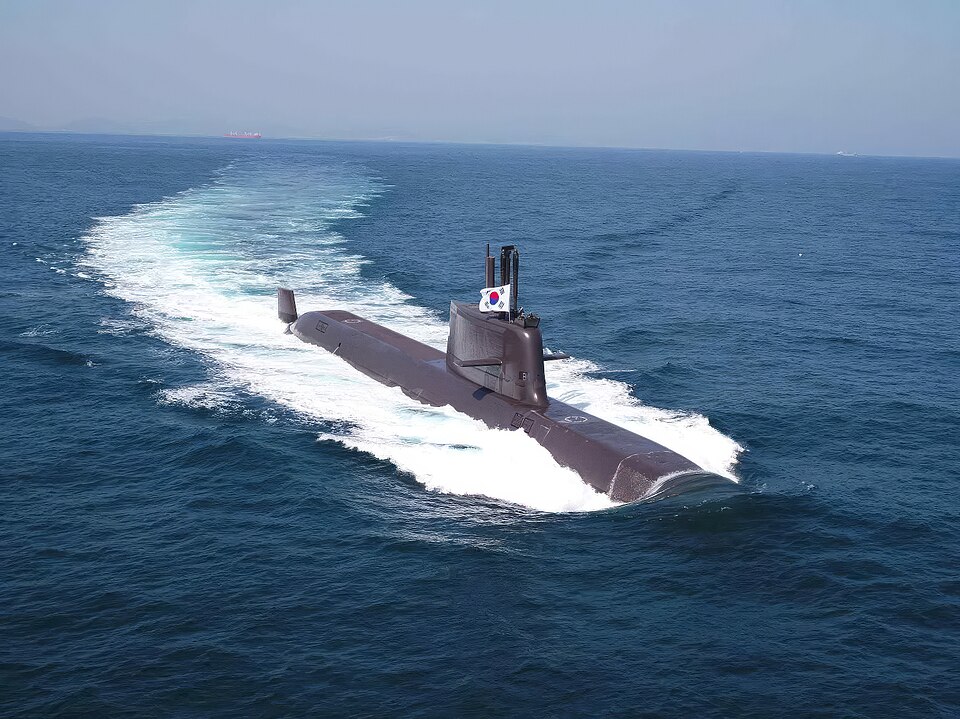
ROKS Shin Chae-ho, a KSS-III submarine at sea on 4 April, 2024.
Photo from the Defense Acquisition Program Administration (DAPA) via Wikimedia Commons.
The KSS-III is the only conventional submarine that can meet all of Canada’s requirements. It combines the blue-water reach and endurance demanded by transoceanic tasking with a vertical launch system that enables credible land-attack and complex anti-surface strike options, supported by lithium-ion batteries that lengthen quiet submerged persistence and improve sortie tempo on distant stations. Its larger hull and higher automation provide the habitability and crew margin needed for 30 to 60 day deployments from Halifax and Esquimalt to the North Atlantic, the Indo-Pacific, and the Arctic ice edge, while remaining within the conventional, non-nuclear profile Canada has set. The design’s modern combat system and sensor suite can be integrated with Canadian and allied command, control, and targeting architectures, and the bilateral sustainment framework required with South Korea can be structured by contract to include full technical data access, in-country training pipelines, and an industrial workshare that anchors through-life support domestically. The delivery cadence proposed for a 2026 award would shorten Canada’s reliance on the Victoria class and reduce associated sustainment exposure during transition, while an initial Canadian order of up to twelve boats would give Ottawa a controlling voice over configuration management, growth paths, and export-variant standards for the life of the class.
February 13, 2026
Hovea M44: Husqvarna Makes a Submachine Gun
Forgotten Weapons
Published 22 Sept 2025The Hovea M44 was tested by the Danish and Swedish militaries in 1945, competing against the Carl Gustaf M45. It was designed and produced by Husqvarna (yes, the chainsaw company) and just 10 of them were made for testing. It was designed around the Suomi quad-stack magazine, which was also originally a Swedish design. Sweden chose the Carl Gustaf, but Denmark preferred the Hovea — but with a couple modifications. Specifically, they wanted the grip and stock from the Carl Gustaf, and that ended up becoming the Hovea M49 which was adopted into Danish service.
Hovea M49 video: • Denmark’s Post-WW2 SMG: the Hovea m/49
(more…)
February 9, 2026
Keeping Up with the Pattons
The Tank Museum
Published 10 Oct 2025M46, M47, M48 and M60. They saw action in Korea, Vietnam, The Gulf and held the line in the Cold War. For almost 40 years the US produced a succession of good tanks — but they never seemed to be good enough for the top brass.
Time after time, designers sought a perfection that seemed to lay out of reach until the arrival of the step-changing M1 Abrams.
Up till then, you have what can be called “The Patton” family: a series of closely related tanks that are only intended to be temporary until the next big thing arrived …
This is the story of the “Patton” family of tanks; tanks that the US tried and failed to replace time after time, yet which despite this ended up becoming the armoured backbone of the Free World during the Cold War.
In this film, Tank Museum Historian, James Donaldson, walks us through the progression of US tanks from the M26 Pershing right up to the M1 Abrams. Commonly known as The Patton Family, this group of tanks were good… but never quite good enough. Always meant to be a stopgap, the Pattons persisted where their prospective replacements failed, leading them to become the vehicles that endured the Cold War around the globe.
00:00 | Introduction
00:58 | From Pershing to Patton
03:50 | Replacing the M46
06:25 | A Third Patton
10:01 | Yet Another Stopgap
12:44 | Irreplaceable?
(more…)
February 7, 2026
S.R.E.M.: Britain’s Experimental WW2 Bullpup Sniper
Forgotten Weapons
Published 15 Sept 2025The Sniper Rifle Experimental Model (S.R.E.M.) was designed by the “Czech Section” of small arms designers who had taken refuge in the UK to escape German occupation of Czechoslovakia. The intention was to develop a scoped sniper rifle that could be fired and cycled without disturbing the shooter’s sight picture. The idea that the designers came up with was to use the pistol grip as a moving charging handle, similar to the Czech BESA machine gun already in British service.
In 1944, the Essex Engineering Works in the UK got a contract to make 22 sample S.R.E.M.s, although only 2 were actually made. Really, the whole concept was a bit of a red herring, as the recoil from 8mm Mauser (this was made in 8mm, expected the post-war the UK would be adopting it or another modern rimless round to replace the .303) would disturb the sight picture regardless of the mechanism used to cycle the action. The project was cancelled in 1945, and this example is the only known survivor today.
(more…)
January 24, 2026
Potato Digger at War: Marlin Model 1917 Machine Gun
Forgotten Weapons
Published 27 Aug 2025John Browning’s first machine gun design was a gas operated system that used a swinging lever instead of a linear piston. He presented the first prototype to Colt in 1890, and it went into production in 1895. The US Navy bought a couple hundred, but the Army opted not to adopt it (much to Colt’s surprise). It was offered for sale internationally, but didn’t become very popular until World War One broke out.
By this time, Colt had improved it a bit with a finned detachable barrel, and they started getting orders for thousands of the guns from Belgium, Russia, Canada, Britain, and elsewhere. Unable to keep up with demand, they licensed the design to the Marlin company. Marlin made a few additional improvements (pistol grip attachment, sights, and access door for clearing malfunctions) and made several thousand for allied nations as well as 2,500 fort he US Army to use as training guns in 1917. They further improved the design by changing it to a linear gas piston, and sold some 38,000 to the US military for aircraft use.
3D animation of the Colt 1895 mechanism from vbbsmyt: • Browning 1895 ‘Potato digger’
Marlin 7MG Aircraft Gun: • Marlin 7MG aka Model 1917 Aircraft Machine…
(more…)
January 21, 2026
Soviet World War Two 50mm Light Mortars (RM-39 & RM-40)
Forgotten Weapons
Published 25 Aug 2025The Soviet Union decided to adopt a 50mm light mortar in 1937 as a company-level armament. The first such weapon they used was the RM-38, introduced in 1938. It was a complex design, with a gas venting system to adjust range (200m – 800m), a bipod specifically set to either 45 or 75 degrees, and a recoil buffering system. This was clearly too complex, and it was replaced by the RM-39 the next year. This remained a well-made mortar, but now had a freely adjustable bipod. However it quickly proved too complex and expensive and it was in turn replaced by the RM-40.
The RM-40 is a much more efficient (aka, cheap) design. It used simple stamped bipod legs and a heavy stamped baseplate. It still uses adjustable gas venting to set range and retains a simplified recoil buffer, but it is a much more quickly produced weapon. A 1941 model of completely different design did replace it though, and by 1943 the Soviet Union moved to 82mm mortars for better effectiveness.
The Soviet mortars were generally well liked by German troops who captured them, as they were significantly longer ranged than the German 50mm mortar. They were also captured in large numbers by the Finns, who used them as well but found them underpowered. In 1960 some 1,268 Soviet 50mm mortars of all models were sold by the Finnish Defense Forces to Interarms to be imported into the US. Some were registered and sold as Destructive Devices and some were deactivated and sold as dummies.
(more…)
January 20, 2026
The US Navy’s twenty years to forget
CDR Salamander takes a wincing glance back at the ship development programs the US Navy planned to implement early in the 2000s and how they all failed to meet even minimal expectations:
20 years seems like a long time, but in many ways it is not. As we look forward to what our fleet will look like at mid-century, we should look back to what we were all promised in January of 2005 that was going to transform into the Navy of the 21st century.
There were four ship classes that were going to be the surface fleet that we were promised at the time, were going to ensure America’s dominance at sea for the next half century.
(NB: most of the hypertext links below go to the tags from my OG Blog that predate my move to Substack three years ago. Those will point you towards my writing two decades ago or so on these programs at the time, if you are so interested.)
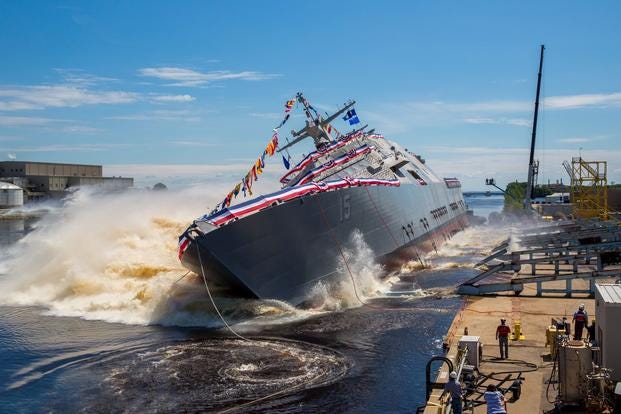
LCS. We were once supposed to get 55 of the marketing/consultancy-named Littoral Combat Ship. We’ll wind up with 25. Not suitable for combat in the littorals, but steps are being made to get some use out of them … somehow.
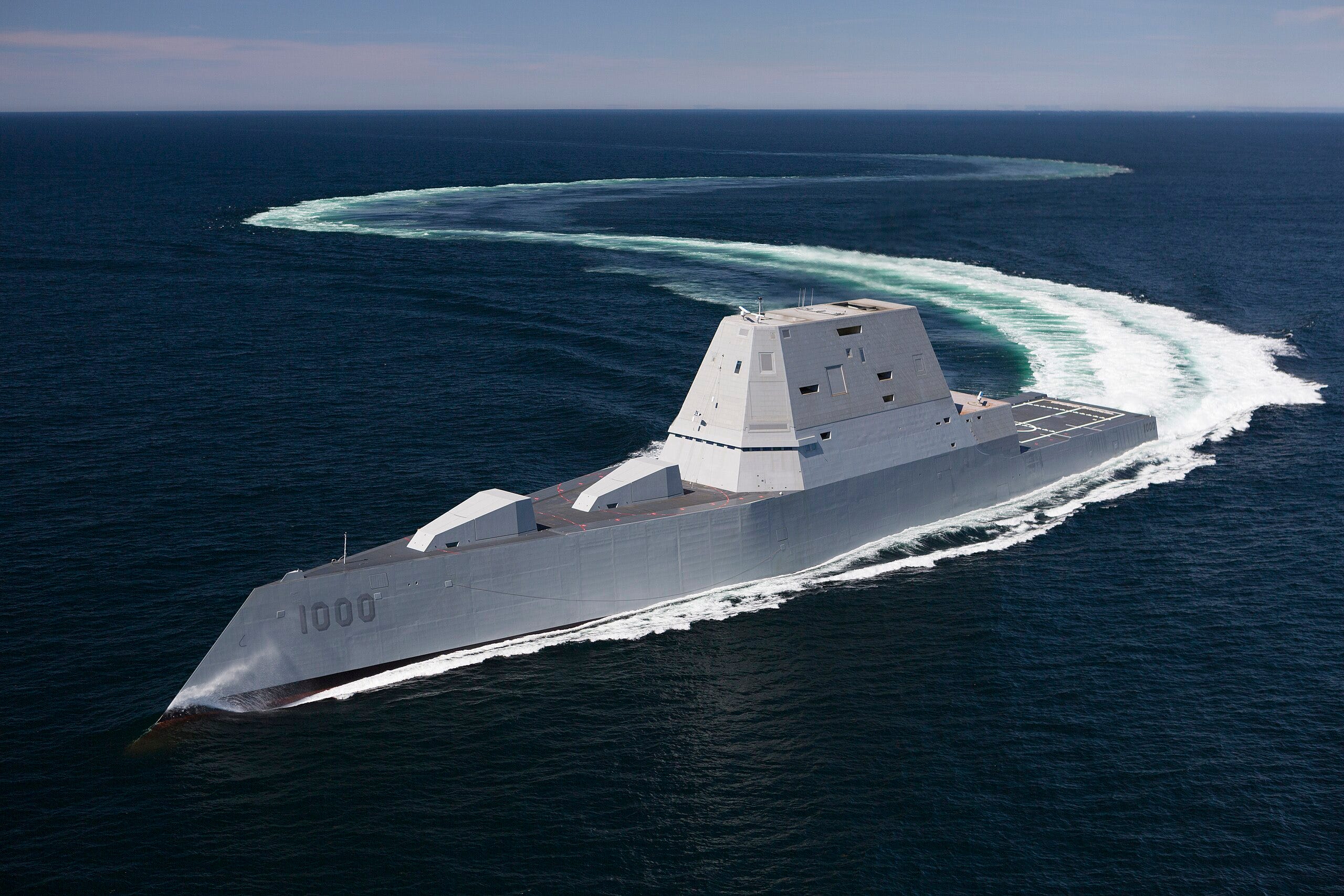
DDG-1000. We were once going to have 32 of these. We got three. Its main weapon, the two 155mm guns, were never made operational and are being removed. The ships are being turned into weapons demonstrators for Conventional Prompt Strike. I hear great things about the engineering plant, but they have yet to do a proper deployment, nine and a half years after the commissioning of hull-1.
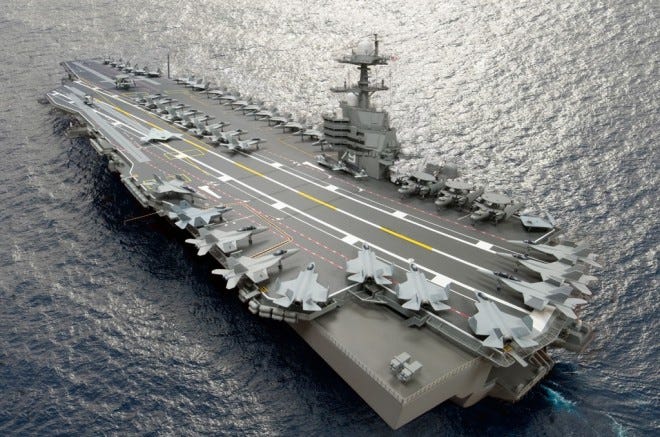
Ford Class CVN. A dozen years ago, we thought it would deploy with UAVs as you can see below (pause for a moment in honor of the martyred X-47B, the greatest crime of the Obama Era Navy), but no. Hull-1 took 8 years to commission. Hull-2 will take 12. Can’t seem to have a workable CHT system.
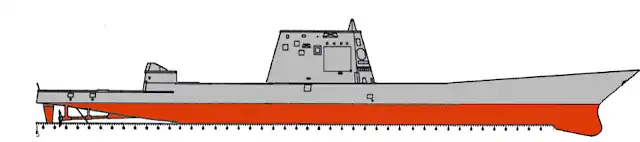
CG(X). In 2005, we thought we would build at least 19. Complete loss of control of the program to the point it was put out of its misery. We still don’t have a proper carrier escort. Looks like the Japanese will build what we should have, and the only hope we have now is … BBG-1.
Why dig all this institutional shame and dishonor up, again? Simple, we need to be humble, and the leaders today need to hoist onboard the errors of the past.
Now, back to last week. For our fleet of the 2030s and on to face the world’s largest navy (in 2005 it was the US Navy. Now it is the People’s Liberation Army Navy. Well done everyone), there are three ships right now that we have to ponder as our future surface force.