
Forgotten Weapons
Published 13 Dec 2025The PSS is a semiautomatic pistol using captive piston ammunition to achieve a comparable level of sound suppression to a .22 pistol with a good normal suppressor. It was developed to replace a couple multi-barrel derringer style captive piston pistols in Soviet use, with the semiautomatic action and (6-round) detachable magazines making it suitable for a wider variety of missions than the previous guns.
It was given the GRU catalog designation 6P28 and entered service in 1983. It fires a cylindrical steel projectile weighing 155 grains at about 620 fps, with a noise of 122 dB (1m left of the muzzle) as measured by silencer legend Phil Dater. Mechanically, the design takes its fire control system from the Makarov but uses a floating chamber system to cycle reliably with the unique ammunition. After the fall of the Soviet Union, the pistols were available for commercial export by Russian state-run export companies, although that ended in 2018. In Russian service, the PSS was replaced with the much improved PSS-2 in 2011.
(more…)
May 6, 2026
PSS: Russia’s Silent Captive-Piston Handgun
May 3, 2026
The Extremely Rare Folding Stock Beretta 38/43
Forgotten Weapons
Published 12 Dec 2025The Beretta Model 38 SMG was a very successful design, and a folding-stocked version of it was a natural development. Beretta first made a prototype of such a thing in 1941, but it never went into production — possibly because Italy ceased to have an effective paratrooper corps after El Alamein. However, many of the design elements from this experiment saw use in the simplified 38/42 and 38/44 models of the Beretta SMG. Late in the war, a small batch of folding-stocked guns were actually produced (one source says about 200) specifically for the RSI. This was the puppet government Germany operated in northern Italy after the country surrendered to Allied forces.
This particular example came out of the Balkans, and managed to acquire a Yugoslav national crest along the way — although I don’t know the details of how. Thanks to Limex for giving me access to this extremely rare piece to film for you guys!
(more…)
April 29, 2026
T31: Garand’s Bizarre Bullpup
Forgotten Weapons
Published 10 Dec 2025The T31 was John Garand’s last project during his employment at Springfield Armory. It was proposed in 1948 as a bullpup configuration rifle to minimize muzzle blast and flash. It was a select-fire rifle with a 20-round detachable box magazine and basically every aspect of the design was unorthodox. The original gas system was more pneumatic than anything else, with the whole handguard tube filling with gas when it cycled. The recoil spring is a clockwork type in the buttstock, and the bolt uses a tilting wedge to lock.
At initial testing it ran into reliability problems after 2300 rounds. Upon disassembly, the found nearly an entire pound of powder fouling in the gas tube. This led to the gun being rebuilt with a tappet type gas system, and that’s the gun we have today to look at. Only two examples were made before Garand retired in 1953, and nobody took over the project when he left.
(more…)
April 25, 2026
Steyr M1912/16 Automatic “Repetierpistole“
Forgotten Weapons
Published 8 Dec 2025In the latter half of World War One the Austro-Hungarian military experimented with a number of select-fire pistol type weapons. One of these was the Steyr Repetierpistole M1912/16, an automatic adaptation of the regular M1912 pistol. It was given a 16-round fixed magazine (loaded via two 8-round stripper clips) and a selector switch. A total of 200 were produced, each supplied with a shoulder stock to help make the blistering 1200 rpm rate of fire somewhat usable. The design was not made from scratch, but rather adapted form the existing 1912 fire control system, which makes for a rather unorthodox system.
In addition to 200 of these pistols, the Austro-Hungarian military also acquired 50 twin-gun systems, which two of these pistols were attached to a frame with a single shoulder stock between them (no surviving examples of those are known today).
Frommer Pistolen-MG Model 1917 video:
• Frommer Pistolen-MG Model 1917: A Crazy Vi…Many thanks to the VHU — the Czech Military History Institute — for giving me access to these two fantastic prototypes to film for you. The Army Museum Žižkov is a part of the Institute, and they have a 3-story museum full of cool exhibits open to the public in Prague. If you have a chance to visit, it’s definitely worth the time! You can find all of their details (including their aviation and armor museums) here:
April 22, 2026
Walther’s Forgotten SMG: The MPK (and MPL)
Forgotten Weapons
Published 3 Dec 2025Walther began developing a modern stamped sheet metal SMG in the late 1950s, and it entered production in 1963. It was an open-bolt, simple blowback gun available in a short (MPK; 6.75″ barrel) and long (MPL; 10.25″ barrel) version. It was cheap and simple, but well thought out with a number of quite good features.
The standard design was just safe/full, but a semiautomatic selector position was available if desired by the client. An excellent safety sear prevented the bolt from bouncing open and firing, and the charging handle was both non-reciprocating and capable of also serving as a forward assist if needed. The sights were a bit too clever for Walther’s own good, with a 75m notch and a 150m aperture, both of which were not really great.
Faced with competition from contemporaries like the Uzi and MP5, the Walther never really became massively popular. It did get enough small and medium sized contracts (German police, South African police, Mexican Navy, Portuguese Navy, US Delta Force, etc) to remain in production until 1985 though. Overall a solid and reliable gun even if it failed to really stand out from the other options on the market.
(more…)
April 18, 2026
The First M60 Prototype: FG42 + MG42 = T44
Forgotten Weapons
Published 1 Dec 2025The FG-42 caught the attention of a lot of countries at the end of World War Two. The British and Swiss both used it as the starting point for some developments. The US went one step simpler, and simply cut up a captured FG-42 to make into the T44, the first prototype of what would become the M60 machine gun.
This project was done in 1946 by the Bridge Tool & Die Company, who spent about six months reinforcing an FG42 and adding an MG42 feed system to it to create an unholy hybrid kludge of a gun. It was, however, successful enough to justify continuing the project. Only this one example was made before moving on to much more practical models built from the ground up instead of hacking up captured German guns.
(more…)
April 15, 2026
Origins of the Legendary CZ-75: Short Rail and Pre-B Models
Forgotten Weapons
Published 28 Nov 2025The CZ-75 began development in the late 1960s as a commercial project. It was not intended for Czechoslovak military use, but instead for export sales to bring foreign currency into Czechoslovakia. It was designed by František Koucký with some elements from other pistols (like frame rails and camming lug from the SIG P210 and a magazine based on the Browning High Power) and a healthy dose of original creativity (including the trigger mechanism). The design was finalized in 1973, approved for production in 1976, and the first production models were ready in June 1977.
The first model of the pistol is quite distinctive, with frame rails much shorter than what we see on examples today. This is called the Short Rail or Slab Side model, and it comprised just the first 16,000 guns produced, with the last ones made very early in 1980. This frame design proved prone to cracking, and in 1980 a longer frame replaced it. A half-cock notch was also added to the hammer in 1980. A few additional points in the production timeline include:
1984: Heavy black enamel paint replaces bluing as the standard finish
1986: Slightly enlarged trigger guard, grip panel design changes
1987: Magazines cease being marked with serial numbers
1988: Serial numbering changes to from 6 digits to 1 letter and 4 digits
1989: Ring hammer replaces spot
1993: CZ-75B introduced with a firing pin block in the slideIn 1992 the communist government in Czechoslovakia fell, and the country split into Slovakia and the Czech Republic. CZ became a privately owned company, and a slew of new options on the CZ-75 were rapidly introduced — so we will leave those for a separate video.
(more…)
April 12, 2026
TKIV-85: Finland’s Ultimate Mosin Nagant Sniper Rifle
Forgotten Weapons
Published 24 Nov 2025Finland’s final iteration of Mosin Nagant sniper was adopted in the 1980s to replace a mix-and-match assortment of m/39-43, m/27-66, and m/28-76 rifles. The two options were a Mosin system using a new bedding block (developed by Border Guard officer E. Toro) or a purpose-made new rifle made by Valmet (the Model 86). The Valmet was clearly the better rifle, but the Mosin option was acceptably good and much cheaper — so that’s what was adopted. The parts for the conversions were made by Valmet and assembled at Asevarikko 1.
Two different models were made. One was a military specific type, and the other was a dual-use rifle for competition shooting as well as potential military use. The competition rifles had a lighter barrel profile to meet the international competition weight limit and were fitted with competition aperture sights in addition to mounts for scopes.
Thanks to Frozen Trigger in Finland for giving me access to these examples to film for you!
(more…)
April 9, 2026
Aly & Kaufman AKB-23: Better Than the SA80 / L85
Forgotten Weapons
Published 19 Nov 2025The Aly & Kaufman AKB-23 is a set of parts that allows one to use a Brownells BRN-180 upper to create an SA80 / L85 lookalike. It’s a very clever adaptation, based on the fact that the original British L85A1 was essentially copied from the AR-180 design. By creating a new bullpup lower for Brownells’ modernized AR-180 (the BRN-180), the basic mechanics of the SA80 are used, but in a form that is well tested and reliable.
The parts include, of course, the new lower (which is legally a firearm, and requires FFL transfer). The lower is milled aluminum, and uses standard AR fire control parts. It also includes iron sights that mount onto the BRN-180 picatinny rail and a high quality 3D-printed cheek rest and front handguard.
This is a really fun rifle, and a very clever way to create an L85 analog that is affordable and accessible.
(more…)
April 8, 2026
Architectural nostalgia in our hyper-bland modern world
Freddie deBoer considers the all-too-frequent social media wave of real or performative nostalgia for the more appealing styles of older buildings followed by the inevitable anti-nostalgic backlash:

There’s a meme, of sorts, that pops up on Twitter from time to time: why don’t we build beautiful buildings anymore? The sentiment is associated with a more general yearning for the past, the kind that asserts that America or Western civilization or human culture are in decline. There certainly must be a lot of people who harbor similar concerns, as evidenced by how these tweets tend to rack up thousands of “likes”. They’ll share a picture of some beautiful old building — Art Deco classics like the Chrysler Building are common, but also Gothic buildings, and neoclassical, and others — and ask why we don’t, or can’t, or won’t make beautiful buildings anymore. They’ll point to the aesthetic qualities of older buildings, remind us that we have vastly more advanced technology and are far richer today than when those beautiful buildings were built, and wonder why we don’t build for beauty these days.
Why are so many new fancy buildings generic and forgettable works of brushed steel and glass? Why so many new ordinary buildings cookie-cutter rectilinear jobs, almost entirely free of embellishment or decoration, all flat roofs and sharp edges, and neutral in both color and effect? Why do they all look like … that? You know what I mean by “that”. Sometimes the style is referred to as Late International or The Glass Box Style, but perhaps the term Value-Engineered Modernism is more apt. Whatever you call it, this kind of building is the architectural equivalent of a default font, a soul-crushing assembly line of sterile glass monoliths that erases local identity in favor of the numbing, cookie-cutter uniformity of global bureaucracy. It’s the corporation in building form.
As is true with all social media phenomena, there is a counter-chorus, and it expresses itself in condescending, sighing, superior tones. Part of this is related to the fact that the accounts lamenting the death of public aesthetics are often right-coded; certainly a lot of the complaints are coming from Twitter users with Greek statues for profile pictures. And really, any sentiment that’s repeated often enough on social media will attract mockery in time. But a good deal of the derision comes from the online side of the YIMBY movement, which in the last decade or so has become something like the caricature mainstream Dems made of the Bernie Sanders online army back in 2016 — that is, snarky, self-righteous, and fundamentally concerned with achieving in-group status through the mechanism of arguing about politics. YIMBYs are an imperfect but important force in a country that desperately needs to build more housing and which has all manner of stupid and sclerotic zoning rules. It’s generically true, though, that the more online you get the less useful any given political movement becomes, and Twitter YIMBYs seem absolutely attached to representing all of the worst elements of that group — they’re incurious, rude, reductive, averse to basic best practices of messaging, and above all else, tribal. (Politics gets stupid when politics becomes a way to belong rather than a way to to do things.) And they’ll have you know that lamenting the death of beautiful buildings is dumb, lol lol lol lol.
The Twitter YIMBYs tend to treat concern for aesthetics as a decadent demand in a world where we need to JUST BUILD. And their particular tactic is to insist that we don’t build attractive buildings anymore because doing so is just too expensive, and really, what’s more important, the unconquerable human desire to live surrounded by beauty, or our need to put people in homes??? Case closed! But not really. It turns out that it’s simply not true that building stylish and ornamented buildings is relatively more expensive today than it was in eras past. Read all about it. Yes, Baumol’s cost disease is real, and construction is a manpower-intensive industry, but almost a century after the Empire State Building was erected, we’ve got the benefit of modern logistics and supply chains and automated production of essential parts and so on. The cost of labor cannot explain the death of decoration in modern building design. And increasingly, there seems to be an acknowledgment that it’s easier to move the public to accept new construction when said new construction is inspiring. King YIMBY Matt Yglesias had a good post on this recently; as he says, we can look at the premium people will pay to live in townhouse neighborhoods where most of the construction happened 100+ years ago as a clue to what people actually like. Housing is expensive in both Park Slope and Hudson Yards, but there’s no question that the former is an aspirational bourgie vision that has stood the test of time while the latter is barely tolerated. And aesthetics plays a large role in that.
We’re wired to pursue beauty. We are not, however, wired to pursue authenticity.
Ian McCollum’s Perfect Car: Driving His Citroen 2CV
Jimports
Published 22 Nov 2025This isn’t Forgotten Weapons, this is James Reeves here for Jimports with my close personal friend Ian McCollum, and today we are looking at what might be the most on-brand car on all of YouTube, Ian’s Citroen 2CV. This is a late production 1988 car, but it traces its roots back to the 1930s as a French farmer’s replacement for a horse and cart, and Ian walks us through how it survived World War II, why it shares DNA with cars like the VW Beetle and Fiat 500, and how a two cylinder, 26 horsepower French tin can can still cruise at 60 miles per hour and somehow feel great. We talk about the bizarre but clever suspension, inboard front disc brakes, the “French bolt action” shifter, the fold up windows, roll back roof, and all of the little details that make the 2CV weird, practical, and weirdly desirable. If you know Ian from Forgotten Weapons you already know how deep he goes on history and engineering, and this is that same energy pointed at one of the coolest European classics ever made. Check out Forgotten Weapons and Deep Dive With Ian if you have not already, and if you are new here, subscribe to Jimports so I can justify buying more dumb cars like this.
April 6, 2026
T20 Family: Springfield Makes the Garand a Grenade Launching Sniper Machine Gun
Forgotten Weapons
Published 17 Nov 2025Late in 1944 the Ordnance Committee recommended adoption of a magazine-fed, select-fire version of the M1 Garand as a new standard US infantry rifle. Both Springfield and Remington developed rifles to meet the requirement, with Springfield’s being the T20 and Remington’s the T22.
The Springfield design went through several iterations from the original T20 to the T20E1 and T20E2, with the capability to launch rifle grenades, mount optical sights, and fire in either semiautomatic or full auto. The first examples of the final T20E2 design were ready in June 1945, but the program lost momentum in August when Japan surrendered. It did continue slowly until 1949, providing some of the basis for the eventual M14 rifle.
(more…)
March 31, 2026
Japan’s navy … uh, I mean the “Japan Maritime Self-Defense Force”
On Substack, Francis Turner discusses what serious countries do (so you know the topic isn’t anything to do with Canada), and part of the post is about the Japanese Navy Japan Maritime Self-Defense Force and its latest ship building program:

Last month Japan started work on its second ASEV (Aegis System Equipped Vessel), which should probably classed a Guided Missile Cruiser, though it is unclear if the C designation will be used (let’s face it Japan still calls its two “not really aircraft carriers, honest guv” aircraft carrying warships “Helicopter Destroyers”. Though apparently it plans to change that soon).
At 190m long and 25m broad, the ASEVs will be some of the largest non-aircraft carrier ships being built by anyone this century1 until the Trump battleships start construction. The Trump battleships are projected to be about 50% larger but they haven’t yet been funded let alone contracted. The USN’s Zumwalts are roughly the same size.
It isn’t just the size that is impressive, it is also the speed of construction. The ASEV as a concept showed up in ~2020 when Japan decided the land based Aegis Ashore program was a failure and cancelled it. In October 2024, after about four years, plans had been made, budget allocated and contracts awarded for the two ships. Construction of the first started last July (2025) and the second last month (February 2026). Construction time is estimated to be around three years, with the first delivered/commissioned in March 2028 and the second one year later. Why one year later and not six months earlier? My guess is that the reason is to incorporate lessons learned from sea trials and operating the first in the final construction stages of the second. This seems similar to the Izumo/Kaga construction a decade ago.
Put together and you have ships that will have gone from concept to contract award in 4 years and contract award to fully-functioning delivery in under 5 years — assuming there are no delays. That seems plausible, the Izumo and Kaga were built in about the same time frame, and stands in stark contrast to the procurement speed of the US Navy and any European navy. The first Zumwalt, for example took over 5 years to go from concept to start of construction and another 5+ from there to commissioning and then another 4 to full acceptance. The ASEVs are also expected to be a lot cheaper, costing around JPY400B or about US$2.5 billion for the initial version. There will undoubtedly be upgrades — e.g. drone defenses, laser or rail guns — and there are some new features compared to previous ships — the SPY7 radar from Lockheed Martin for example — but this is an evolution of existing Japanese and US Aegis destroyers rather than a brand new concept which helps explain why I am confident about the timeline and budget.
Although the ASEV’s primary role is missile defense, there is no reason why one might not, in the fullness of time, be loaded with offensive missiles such as the TLAM or antiship missiles. Indeed the Naval News article lists both as options:
Each vessel will feature a 128-cell Vertical Launch System (VLS) — significantly more than the 96 cells installed on Japan’s latest Aegis destroyers.
The VLS will be capable of launching:
– SM-3 Block IIA interceptors, jointly developed by Japan and the United States for ballistic missile defense
– SM-6 missiles, capable of engaging advanced aerial threats, including hypersonic glide vehicles
The ships will also support Japan’s emerging counterstrike capability.
Planned armament includes:
– the extended-range Type 12 anti-ship missile (ship-launched improved variant)
– the U.S.-made Tomahawk cruise missile
Is that TLAM in your launcher or are you pleased to see me?
Notably the Tomahawk capability has already been fitted to one of the Aegis destroyers this class is supposed to replace. A 128 cell ASEV firing TLAMs could be very unpleasant for Little Rocket Man; if it fired antiship missiles that could make a Chicom invasion of Taiwan pretty miserable just on its own. It would also make a phenomenal commerce raider / blockade enforcer if such roles were needed.
[Aside: Unlike some country’s missiles I’d be pretty confident that the Type 12 anti-ship missile will work well]
As CDR Salamander observed on X, the real question is why Japan doesn’t make a few more and sell them to countries/navies that struggle with procurement. And for that matter why it doesn’t make a couple more for itself. Perhaps it will. I figure there’s a couple of years before there will be yard space to build them so there’s no hurry to make that decision.
Russia’s Kirov class battlecruisers are larger but a) they were built in the 1970s/80s and b) only one is currently active (for some definition of active).

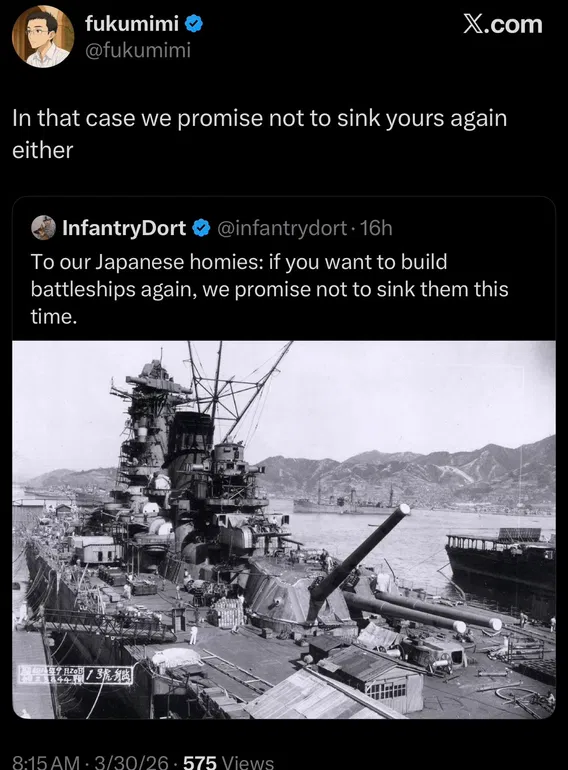
Japan’s decision to rebuild naval strength has been noted by others, too:
March 28, 2026
AK50: How Hard Could it Be? Brandon Herrera’s 10-Year Project
Forgotten Weapons
Published 5 Nov 2025Scaling the AK up to .50 BMG … how hard could it be? Today we find out, with a detailed look at all three iterations of Brandon Herrera’s AK-50 project.
(more…)
March 25, 2026
Apache Arms Carbine: A Saga of Compliance and Crappy Manufacture
Forgotten Weapons
Published 3 Nov 2025The Apache Arms carbine was a Thompson SMG lookalike that was made in small numbers in the late 1960s. It was the successor to the Spitfire carbine made by the same people, after the Spitfire was deemed a machine gun by the IRS. The Apache used M3 Grease Gun magazines and was chambered for .45 ACP. It uses a square receiver tube and many of the same cast parts as the Spitfire. It is a very interesting look at how the design was adapted to be legally considered semiautomatic.
(more…)


