Quotulatiousness

October 24, 2018

Scheer’s campaign opening has about as much attraction as a cold bucket of sick

Filed under: Cancon, Politics — Tags: , , , — Nicholas @ 05:00

Some guy we’re supposed to believe is the leader of Her Majesty’s Loyal Opposition … Andrew Shear? Shea? No, that’s not it. Something like Scheer? Yeah, maybe it’s Scheer. He’s been in some kind of witness protection for the last year or so, I guess. Anyway, he’s finally emerged to announce the start of the Conservative Party’s year-long campaign to get Justin Trudeau re-elected and to protect our sacred Supply Management system.

No, wait. That’s not quite it. Oh, it’s to get Scheer elected? Okay, then. Got it.

In the National Post, Colby Cosh attempts to find reasons for Canadians to support the Tories next year:

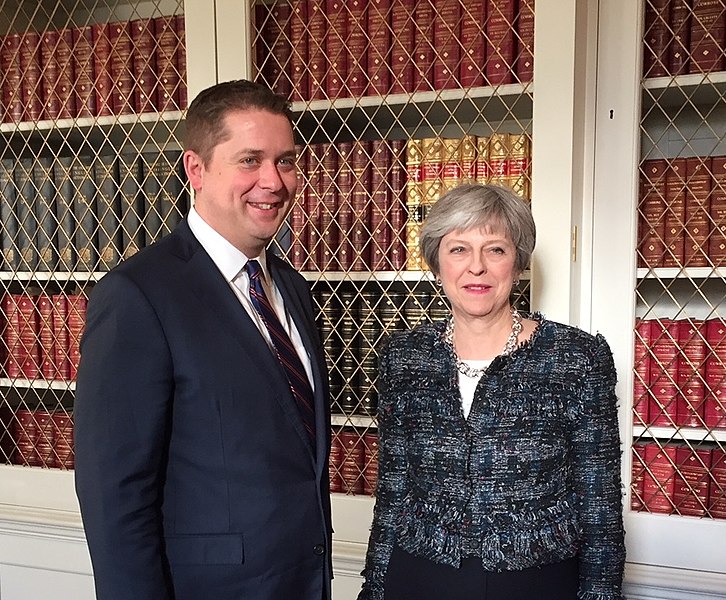
Andrew Scheer meets British Prime Minister Theresa May
Photo via Wikimedia Commons

Andrew Scheer published an “open letter to Canadians” in the Toronto Sun this Saturday. “Sunday marks exactly one year until the next federal election,” the federal Conservative leader observed, proceeding thereupon to a critique of Justin Trudeau’s government. As someone who is still trying to take stock of Scheer, I read the letter hoping for clues to his plan of attack for the 2019 election. I’m afraid it merely served to emphasize how much Scheer has remained on the defensive since winning the Tory leadership almost a year and a half ago.

That is part of the issue here: does it seem to you like a year and a half since Scheer became leader? Forgive me a very subjective observation, but I found myself hardly believing that we are much closer in time to the next election than we are to the choosing of an opposition leader who still seems like the enigmatic new guy. What are his signature issues? I am afraid the first answer that springs to mind is “dairy supply management” — which is a continuing controversy that has exposed Scheer to embarrassment, and has helped to split his party, albeit in what is likely to be an electorally insignificant way. (Maxime Bernier won’t be the next Prime Minister of Canada, but party morale is a thing in elections.)

The other major issues that have presented themselves to Scheer as opportunities haven’t proved much more helpful. When it comes to the federalization of carbon taxation, Scheer still has no good answers when he is called upon to reconcile his hypothetical support for emissions reductions with his opposition to the Trudeau plan. He doesn’t like carbon taxes, period, which will play well with climate skeptics who have three-SUV garages; I do not underestimate the impetus of that voting bloc, but the Conservatives own those voters already. Scheer also cornered himself into a lame position on the campus free-speech wars, and he is pulling sour faces about marijuana legalization, even though he is one of the few Canadian politicians who will admit to having smoked the stuff personally.

October 12, 2018

Stephen Harper, premature populist?

Filed under: Books, Cancon, Politics — Tags: , , , — Nicholas @ 03:00

Andrew Coyne reads the new book by former Prime Minister Stephen Harper, so you don’t have to:

Throughout his time as prime minister, theories abounded as to what philosophy of government, if any, could explain Stephen Harper’s apparently rudderless course. A few die-hards on the left persisted in describing his government as ideological or hard-right, even as it was borrowing billions, adding new regional development agencies and nationalizing the auto industry.

Others insisted he was a libertarian at heart who was either forced or tempted, by reality or expediency, to alter his approach once in power. A couple of loyalists essayed a reconstruction after the fact, in which the Harper government’s many disparate and contradictory policies were somehow made to fit into a single philosophical template called “ordered liberty.”

Well now we have it from the proverbial horse’s mouth. The young firebrand who famously deserted Preston Manning for being too populist and not enough of a conservative now claims the mantle of populism for himself: if not as a whole-hearted adherent, then as the statesman who understands where others only condemn. His new book Right Here, Right Now, is indeed in large part an attempt to portray his own government, not as the cynical power-seeking machine it appeared to be, but as populist before its time. In defending populism, he defends himself.

And yet the mind it reveals is not that of the subtle, sometimes rueful voice of experience he clearly wishes the reader to imagine. It is, rather, all too conventional, even banal. What are presented as iconoclastic insights, in which the rise of populism is explained in terms of the failings of conservatism — former Conservative prime minister breaks with decades of conservative orthodoxy! — are a mix of received wisdom and undergraduate shibboleths, many of them long debunked.

October 11, 2018

QotD: The radical, right wing US Supreme Court

Filed under: Law, Politics, Quotations, USA — Tags: , , , , — Nicholas @ 01:00

We don’t have a “radical right-wing Supreme Court,” despite lots of mewing on the left to the contrary. Here are some things that would be at the top of the list for a radical right-wing Court: (1) ban abortion nationwide as a violation of the right to life protected by the due process clause; (2) rule that publicly-provided (but not funded) education is unconstitutional because it inherently involves viewpoint discrimination by the government, or at least require vouchers for those who object to the public school curriculum; (3) overrule an 1898 precedent and completely abolish birthright citizenship; (4) Use the First Amendment as a sword to require “fairness” in the left-dominated media. Not only is the Supreme Court not about to do any of things, I don’t think any of these things would even get one vote on the current Court. Moreover, merely bringing the scope of Congress’s constitutional back to where it was, say, in 1935, which was already much broader than the original meaning of the Commerce power, probably wouldn’t get more than one or two votes. What you are looking at right now is a conservative Court that will only affect society on the margins, not a “radical right-wing” Court.

David Bernstein, “WE DON’T HAVE A ‘RADICAL RIGHT-WING SUPREME COURT'”, Instapundit, 2018-10-09.

October 8, 2018

Debunking state education rankings

Filed under: Bureaucracy, Education, Media, USA — Tags: , , , , — Nicholas @ 03:00

In the latest issue of Reason, Stan Liebowitz and Matthew L. Kelly explain why you should ignore those “authoritative” rankings published by U.S. News and World Report and others:

You probably think you know which states have the best and worst education systems in the country. If you regularly dip into rankings such as those published by U.S. News and World Report, you likely believe schools in the Northeast and Upper Midwest are thriving while schools in the Deep South lag. It’s an understandable conclusion to draw from those ubiquitous “Best Schools!” lists. It’s also wrong.

The general consensus on education, retold every few news cycles, is that fiscally conservative states are populated by cheapskates. In those necks of the woods, people are too ignorant to vote in favor of helping their illiterate and innumerate children. Intelligent people understand that high taxes and generous pensions for public school teachers are the recipe for an efficient and smoothly functioning education system. If skinflint voters would just lighten up, the story goes, they too could become erudite and sophisticated.

Paul Krugman rehashes this narrative regularly in his New York Times column, frequently bemoaning the country’s purportedly miserly education budgets. Increasingly, he perceives libertarian barbarians at the gates of state governments, brandishing axes for dreaded spending cuts. In April, he wrote that “we’re left with a nation in which teachers, the people we count on to prepare our children for the future, are starting to feel like members of the working poor.… One way to think about what’s currently happening in a number of states is that the anti-Obama backlash, combined with the growing tribalism of American politics, delivered a number of state governments into the hands of extreme right-wing ideologues. These ideologues really believed that they could usher in a low-tax, small-government, libertarian utopia.”

In Krugman’s view, which reflects the education establishment’s view as well, those attempting to keep the size of government in check are a danger to your child. To support this claim, education wonks and activists point to state rankings in U.S. News, Education Week, or WalletHub — outlets that grade states according to a few key measures, such as graduation rates, education spending, and test scores. When education is discussed in the news, these rankings are often cited to illustrate the havoc that restrained budget growth and right-to-work laws can wreak.

Indeed, such rankings do seem to show that the highest-quality state educational systems tend to be in big-spending states in the Northeast or Upper Midwest. These places apparently honor and respect teachers, while Southern states inexplicably abhor them. But the cheapskates in cheap states get their just deserts: Sophisticated northern jurisdictions grow ever smarter, while stingy conservative backwaters sink into ever-lower depths of ignorance. The solution is obvious: Pay up or your kids will suffer.

There’s just one problem with this narrative: Traditional rankings are riddled with methodological flaws.

September 16, 2018

Maxime Bernier and the People’s Party of Canada

Filed under: Cancon, Liberty, Politics — Tags: , , , — Nicholas @ 03:00

Andrew Coyne says there’s room in Canadian politics for Mad Max’s new party:

In principle, there is room for a new party in Canadian politics; arguably, there is a need for one.

That the established parties have tended to pander to narrow and particular interests, rather than the broader public interest, is well documented, as is the result: an ever-expanding state devoted almost wholly to redistributing income, not from rich to poor, but from taxpayers to well-organized and well-cultivated client groups (notably the state’s own employees). In the same way the state redistributes from consumers to producers, from west to east, young to old, and so on, in the service of neither efficiency nor justice nor even raw numbers but just whoever frightens politicians the most.

Which over time — people learn — has come to include everybody. We subsidize everything that moves in this country, and charge ourselves higher taxes to pay for it, then demand more subsidies to offset the burden of taxes. And the fruit of all this frantic attempt to redistribute from everybody to everybody? A nation brimming with grievance and resentment, every part of the country convinced the rest are making out at its expense.

A party that proposed to end the money-go-round — to wean the country’s business class, in particular, off the public teat, to shut down the “regional development” spigots and bust up the cartels that, behind our protectionist walls, are permitted to genteelly pick our pockets — would therefore be a signal addition to our politics. If it chose to frame this critique not as a fairly straightforward application of Economics 101 but as a radical determination to govern “for all Canadians,” so be it.

And if it made life difficult for the established parties, so much the better. The market for ideas thrives on competition and choice as much as any other. The cartelization of our economy is in part a reflection of the cartelization of our politics. A more robustly conservative party, in particular, less burdened by the Conservatives’ crippling self-doubt, would be a welcome addition, even if I don’t like all of its ideas: millions of Canadians do, and it is wrong that they should go unrepresented.

August 29, 2018

The Conservative convention, bought and paid for by the friends of supply management

Filed under: Business, Cancon, Economics, Politics — Tags: , , , — Nicholas @ 03:00

Colby Cosh relates the details of how well stage-managed the Conservative convention in Halifax was … from the point of view of the beneficiaries of supply management:

A copy of a “briefing binder” that the Dairy Farmers of Canada had given to representatives of supply-managed agriculture was carelessly discarded, found by a Calgary delegate named Matthew Bexte, and splattered onto the internet. The contents of the binder describe the strategy and outline the available forces of the supply-management squad. The resolutions being discussed by the convention included one favouring the repeal of expensive tariff protection for Canada’s egg, dairy, and poultry cartels, and the binder lists the particular responses and tactics to be used depending on how far the offending free-trade resolution advanced in the debate.

Which it didn’t. The motion in favour of letting Canadian suckers buy foreign cheese in dangerous unregulated quantities died noisily in a “breakout session,” never even reaching a vote, much less the plenary session of the convention. As the National Post’s uncannily versatile Marie-Danielle Smith documented before the briefing book was leaked, free-trade delegates had already caught the scent of a rat, complaining that the motion had been suppressed through strategic delay by operatives working for party leader Andrew Scheer.

The Dairy Farmers of Canada briefing describes this motion-suppression tactic as “Scenario 2,” calling it a “sub-optimal” outcome: “It buys us (supply-managed farmers) a reprieve, but doesn’t put the issue to rest.” According to the briefing notes, if the motion had passed in the Friday breakout session, that would plunge the world into “Scenario 3.” Under Scenario 3, a Friday evening reception at an Irish pub, with free food and potables, would come into play: quota-sucking farmers and their public-relations goons would have been given a chance to mingle with well-lubricated CPC delegates, with “infographics on a slideshow” pulsing subliminally in the background.

The hope here would be to prevent a devastating “Scenario 5,” in which the destruction of supply management came before the whole CPC assembly for a vote and won it. The prospective talking points accompanying Scenario 5 warn that “Members of the Conservative Party of Canada have sent a clear signal that they do not support Canadian farmers” and they hiss menacingly that “Canadians will remember the position taken by Conservatives today.”

Fortunately, even in the event of a flat-out Scenario 5, there would still be what the book calls the “Safety Net.” The safety net is that annual party conventions are meaningless, expensive balderdash anyway. Or, as the Dairy Farmers of Canada (DFC) book puts it: “The powers of the Leader are far-reaching in preventing a policy from being in the party platform. DFC has been told by the Leader’s office that he will exercise this power … regardless of the outcome at convention.”

Good old Andrew … he knows who put him in his current position and has signalled in advance that he’ll “stay bought”. Too bad for Canadian consumers, but great news for the leeches who benefit from the market distortions of supply management.

August 26, 2018

Australia’s most recent (as of Saturday) spill

Filed under: Australia, Politics — Tags: , , — Nicholas @ 05:00

Mark Steyn on the rather different and abrupt Australian method of defenestrating the sitting Prime Minister:

If you saw me on stage for our live show from the Manning Conference in Ottawa last year, you’ll know I was doing a lot of Canadian sesquicentennial gags that day: “It’s a hundred and fifty years since the Tory leadership race began…” and so forth. That was a very slight exaggeration, but it is a fact that the post-Harper Conservative Party decided to have a multi-year campaign to succeed him. In Australia, by contrast, a leadership race in the (supposedly) right-of-center Liberal Party lasts 150 seconds, if you’re lucky. They’re called “spills”, which is not a reference to the blood on the floor but is an Aussie coinage of at least three quarters of a century’s vintage for a suddenly called election: Like many of the Lucky Country’s contributions to the language, it’s very good, conveying the sense not of an ordered poll but of something more spasmodic, capricious and convulsive.

Don’t ask me why the two senior dominions of the Westminster system wound up with diametrically opposed systems of selecting their leaders.

New Australian Prime Minister Scott Morrison (photo from January 2014).
Via Wikimedia Commons.

Their chums in the UK Tories have much calmer contests in which all the alternative candidates self-destruct leaving Theresa May to inherit by default. The former Foreign Secretary, William Hague, has just said he doesn’t think increasing the party membership (I believe there are still seven nonagenarian paying subscribers) is the answer because a lot of beastly UKIP types might sign up and there goes the neighborhood. Given the results of these various contests, you might as well shuffle the winners and systems randomly between the three countries and see if you could do any worse.

At any rate, on Friday the latest Canberra spillage broke out and kiboshed the PM, Malcolm Turnbull. Unlike the American three-month “peaceful transfer of power”, under which the Deep State has all the time in the world to set up its plans to subvert the incoming leader, in the Australian system the new bloke has twenty minutes to freshen up in the men’s room before he’s sworn in […]

Malcolm Turnbull is Australia’s most famous republican, so he’ll appreciate Oliver Cromwell’s famous words to the Rump Parliament in 1653:

    You have sat too long for any good you have been doing lately. Depart, I say; and let us have done with you. In the name of God, go!

It’s remarkable how long it took Turnbull’s Rump to say as much to him. I wrote yesterday that, just as Tony Abbott had been toppled by Malcolm Turnbull, so Turnbull has now been toppled by Scott Morrison. And immediately a gazillion antipodean members of The Mark Steyn Club wrote to explain that no, no, Turnbull was toppled by Peter Dutton, the conservative who moved against him, but, before he could ascend the drive-thru throne, Dutton was himself toppled by Morrison, who was a so-called compromise candidate put up by frantic Turnbullites as they were being fitted for their lamppost ropes. So, if you’ll forgive the analogy, if Turnbull is Mrs Thatcher, Scott Morrison is the John Major put up to ward off Peter Dutton’s Michael Heseltine. My old pal Julie Bishop, meanwhile, after years of serving as loyal deputy to Malcolm Turnbull, Tony Abbott, Malcolm Turnbull (first time round), Brendan Nelson, Andrew Peacock, Malcolm Fraser, Sir William McMahon, Harold Holt, Sir Robert Menzies, etc, etc, finally ran for the leadership herself, and came a poor third: She had become the Black Widow of the Liberal Party – she mates, she kills – but this time it all went awry and she shot the venom into her own leg. It’s hard to remember that in some polls of 2015, when she agreed to support Turnbull’s overthrow of Abbott, she was more popular than either man. A mere three years on from what was supposed to be a swift cleansing knife in the back, the entire party is gangrenous and pustulating.

Maxime Bernier’s proposed new federal party

Filed under: Cancon, Politics — Tags: , , — Nicholas @ 03:00

Andrew Coyne on the plan to create a new conservative party at the federal level:

No one with any familiarity with the modern Conservative Party could disagree with much of what its former-almost-leader Maxime Bernier now has to say about it.

“Intellectually and morally corrupt” might be a bit over the top, but “avoids important but controversial issues”, “afraid to articulate any coherent policy”, offers “a bunch of platitudes that don’t offend anybody but don’t mean anything [or] motivate anyone” while pandering to interest groups and buying votes “just like the Liberals”? Checks out, as many Conservatives would be the first to say.

Neither is there anything objectionable in principle about Bernier’s proposal to launch a new party of the right. Obviously it would not be in the partisan interest of the Conservative Party, but whether it would be harmful to the broader cause of conservatism, as so many reflexively insist, is less clear.

As I’ve argued before, the splitting of the left-of-centre vote between two (later three, and four) parties since 1935 has not stopped the Liberals from winning 16 out of 25 elections in that time. It may even have helped. The presence of two parties saying broadly similar things has entrenched progressivism as the default mode of Canadian politics, leaving the Conservatives, to the extent they have occasionally demurred, looking like the outliers.

Rather than simply splitting a fixed percentage of the vote, that is, the two parties may have combined to expand the pool of voters from which they both fish. An upstart conservative party, more robust in its advocacy, might play the same role as the NDP on the left, pushing out the boundaries of acceptable opinion and freeing the established Conservative Party to compete more aggressively for the median voter — in part by pulling the median to the right. If nothing else it would restore some balance to the equation.

But to say that a new conservative party might be a useful addition to the political landscape is not to say that this is that party, or that now is the time, or that Bernier is its leader.

The New Democrats have never come all that close to forming a government, but over the years, they’ve gotten the other two major parties to adopt and implement almost everything they’ve ever demanded … eventually. That does show that a party doesn’t necessarily need to win the vote to win the issues. As Jay Currie suggested a few days back, a new Bernier-led small-C conservative party might not automatically lead to another term for Justin Trudeau:

Bernier does not have to play the traditional Canadian political game. The world has changed. First off, he does not have to run a candidate in every single riding in Canada. While he said he would today, he needs to rethink that position. Thirty or forty will be more than enough to ensure his new party has a national presence. But, and this is important, he can make a virtue of this necessity by making sure not to run against the many actual conservatives who currently sit, silently, in Parliament. Even better, he can endorse them.

Using a targetted riding strategy would put paid to the idea that a vote for Max is a vote for the Liberals.

With a targetted riding strategy Max can also avoid the always looming disaster of a crazy person – actual Nazi, major anti-Semite, massive homophobe – gaining a nomination in a hopeless riding and then being pinned to the party by a hostile media. Finding 30 or 40 really excellent candidates and then backing them hard pre-Writ might create the conditions for multiple wins.

Which ridings to target will be a tough choice but other than making sure to have a couple in Toronto, Vancouver and Montreal – for media exposure – they should be ridings without a currently sitting Conservative and where the demographics do not massively favour the Liberals (thus suburban and rural). And they need to be air accessible because Bernier is going to spend his campaign on an airplane.

Most importantly, Bernier needs to create a positive message. One of the problems the Conservatives have is that they are barely against most of the Trudeau Liberal positions and don’t seem to have any of their own. Bernier needs to define a Canadian message. Free Trade, economic expansion, jobs are one side of it, Canadian unity instead of division could be the other. Bernier’s objection to increased immigration and the fragmentation of multiculturalism will resonate if he can package them in a “making Canada stronger” theme.

Right from the go Bernier should avoid any suggestion that his party will form a government. Instead he should be talking about keeping the politicians in Ottawa honest and in touch with Canadians. Balance of power is the goal.

June 8, 2018

The British political scene has all the horrific fascination of a slow-motion car crash

Filed under: Britain, Europe, Politics — Tags: , , , , , — Nicholas @ 05:00

Colby Cosh says that anyone who claims to be shocked and appalled at the Ontario political mess need only glance across the pond to put things into proper perspective:

The one thing everyone seems to agree upon about Ontario’s provincial election is that it has been all kind of horrid, strange and exhausting; if there is another thing they agree upon, it is that Ontario politics will probably continue to be horrid, strange and exhausting for a while even when it’s over. I have one word for these people: Brexit. Try following U.K. politics for a while in the era of British secession from the European Union. You will scurry, shrieking, back to Queen’s Park soon enough.

The Brexit drama is a mesmerizing blend of jargon and impotence, frustration and confusion; it is a vivisection of democracy from which Britain cannot avert its gaze. In Ontario you still have distinguishable political parties: in Britain now, familiar entities have been altogether dissolved into underlying tendencies, shades and conspiracies. So-and-so is a “soft Brexiter.” How soft? Oh, not as soft as Mr. Whatnot, but distinctly softer than Miss How-Do-You-Do. Mysterious verbal puzzles — do you favour the “single market” or the “internal market”? — become theatres of struggle.

A bonus of Brexit-watching for us is that, over the past six months or so, you have often been able to get the brief neurochemical pop that Canadians all receive when Canada is mentioned abroad. The Canada-EU free-trade deal CETA, which you may remember being signed in October 2016 after some obscure trouble with Walloons, has turned out to be an important anchoring concept in the Brexit debate. CETA is the European Union’s most liberal and comprehensive trade deal with an offshore non-member — and that is just what Britain voted to become.

Advocates of a “hard” Brexit, with no judicial, bureaucratic or fiscal ties to the continent, began pointing to CETA as a readymade model for Britain-EU relations almost before the ink was dry. Problem: CETA broadly allows free movement of goods between Canada and Europe, but services are not included. Britain doesn’t make much physical stuff anymore, and it quit digging coal; it depends especially heavily on providing financial services to the world.

April 12, 2018

“Bernier was accused, variously, of naivete, hypocrisy, vanity, divisiveness and sour grapes”

Andrew Coyne covers the “revelations” (that anybody who’d been paying attention already knew) about how the federal Conservative leadership race was won and lost from Maxime Bernier’s upcoming book, Doing Politics Differently: My Vision for Canada.

You would think this would be something of a scandal. The leadership race was hijacked by members of a vested interest who not only had no prior involvement with the party, but most likely wished it ill: what in civilized countries are called “entryists.” The winner of the race, the party’s current leader, sold himself and the party, not just to the highest bidder, but to a particularly venal bidder at that, with a direct financial interest in the outcome.

The result was to leave the party hitched to what is widely acknowledged as an indefensible policy, one that takes food off the table of the country’s poorest families for the benefit of a dwindling number of wealthy quota-owners. That the policy — combining internal supply quotas, sky-high external tariffs, and heavy doses of government regulation — makes a mockery of every principle for which the party allegedly stands is probably worth mentioning as well.

So naturally the response of party supporters, on being lately reminded of all this, was fury … at the guy who pointed it out.

That would be Bernier. In his forthcoming book, the plangently titled Doing Politics Differently: My Vision for Canada, a chapter of which was released this week, the former industry minister recalls how Scheer’s campaign courted the dairy industry’s “fake Conservatives,” who were “only interested in blocking my candidacy and protecting their privileges.” He notes the ballooning of party membership in Quebec just before the vote, from 6,000 to 16,000, and its collapse back to 6,000 shortly afterward.

And that’s about it. He does not attribute his defeat solely to his stand on supply management: indeed he thinks he won more votes than he lost over it. Neither does he question the legitimacy of Scheer’s victory — indeed he acknowledges that Scheer’s tactic is “fair game in a democratic system.” He merely points out that this sort of squalid trading of votes for favours is “why so many people are so cynical about politics.”

April 6, 2018

Kevin Williamson fired for expressing a view shared by at least 40% of Americans

Filed under: Business, Media, Politics, USA — Tags: , , , — Nicholas @ 03:00

Katherine Mangu-Ward responds to Williamson’s short tenure at The Atlantic after they found themselves shocked and horrified when it was discovered that he really was an outspoken anti-abortion conservative:

Williamson expressed the view that abortion is murder and should be punished to the full extent of the law (although he also later indicated that he has mixed feelings about capital punishment). I do not share his view. But by declaring Williamson to be outside the Overton window of acceptable political discourse because he believes strongly that abortion is a serious, punishable crime, The Atlantic is essentially declaring that it cannot stomach real, mainstream conservatism as it actually exists in 21st century America.

Williamson uses colorful and sometimes rash language. He didn’t have to detail the grisly form of punishment he would inflict on women who decide to terminate their pregnancies. He chose to do so because he enjoys provoking a reaction. But The Atlantic knew that about him before it hired him.

[…]

It is, of course, the perfect right of The Atlantic‘s editors to publish whomever they wish. Reason staffers are all libertarian, under a big-tent understanding of that term (not to brag, but we are repping the pro-life view). That’s written into our mission as a magazine. But if The Atlantic purports to capture a broad spectrum of American political views, Williamson’s firing is a sign that it hasn’t yet figured out how to do so. And the reader outcry against him (and his rightish heterodox kinfolk at The New York Times) is a sign of a market that has grown increasingly squeamish about a genuinely inclusive journalistic vision.

I have personally been the beneficiary of this doublethink on ideological diversity for years. When institutions recognize the need to have a nonliberal somewhere in their midst, they look across the landscape and discover that the closest thing to conservatism that they can tolerate is a relatively mild-mannered, young(ish), female, pro-choice libertarian. Which is to say, not a conservative at all.

The Atlantic publishes lots of interesting heterodox voices, of course. And I’d like to think I do provide ideological diversity in situations where I’ve been called in. But putting me on a panel is not nearly the same thing as giving the conservative side of the American political spectrum a hearing.

March 12, 2018

And the next premier of Ontario is likely to be … Doug Ford?

Filed under: Cancon, Politics — Tags: , , , , — Nicholas @ 03:00

Saturday’s Ontario Progressive Conservative leadership contest went down to the wire … and beyond, as voting glitches pushed the announcement of a winner beyond the time the party had rented the facility in Markham, so attendees had to go elsewhere to wait for the final result. In a disturbingly similar way to the last US presidential election, Christine Elliot won the popular vote, but the result hinged on the number of constituencies won, which went to Ford. Several of my (Liberal or NDP) friends on Facebook, who’d announced they’d joined the PCs explicitly to vote against Ford, were aghast at the result.

New Ontario Progressive Conservative leader Doug Ford at the 2014 Good Friday procession in East York.
Photo via Wikimedia.

In the National Post, Chris Selley reports on the three-ring circus:

In the end, maybe caucus had it right. If more than anything else Ontario’s Progressive Conservatives wanted to win on June 7 then maybe they should have stuck with interim leader Vic Fedeli. If the ultra-folksy MPP for Nipissing wasn’t the most compelling imaginable premier-in-waiting, he would certainly have cut a less divisive figure than Doug Ford, who was announced as the party’s new leader late Saturday night in a small room at a Markham conference centre.

“To the party members I say thank you. To the people of Ontario I say relief is on its way,” Ford told reporters and campaign workers. “And to Kathleen Wynne, I say your days as premier are numbered.”

That got a massive cheer, of course, but this is an outcome that many in the party consider a worst-case scenario. An Angus Reid poll released this week asked “soft” Tory voters whether each candidate would make them more or less likely to support the party: Ford’s net score (more likely minus less likely) was minus 27 per cent; Christine Elliott, who finished a very narrow second Saturday — her third failed shot at the position — was at plus 20.

Sticking with Fedeli would also have spared the party the hideous embarrassment of Saturday’s botched convention. Vote-counting dragged on for hours thanks to a chunk of ballots that had been allocated to the wrong ridings. A packed crowd of partisans was left in the dark for three hours, then told to hang tight for another 30 minutes, and then sent away into the night with no result. In lieu of a cascade of balloons, there was booing and hollering. Various Ford supporters, citing ostensibly conclusive media reports earlier in the day that Ford had won, alleged party elites were trying to steal it.

These were not the ideal circumstances in which to build unity, which was the stated purpose of the event. “You’ve been through a very tough couple of months — perhaps the toughest times in the history of the Progressive Conservative Party of Ontario,” Alberta United Conservative Party leader Jason Kenney told the crowd. “You’ve gone through weeks of anxiety and adversity. But I am certain that you will overcome this time of trial, and that this afternoon, with the election of your leader, you will emerge stronger, united and victorious in the election.”

“This afternoon,” he said. We were so young then.

The flow of votes from Allen to Ford was expected, but what I didn’t expect was the proportion of Mulroney votes that flowed to Ford instead of Elliot (I’d expected roughly 100% to Elliot, but a significant number went to Ford instead).

Perhaps the most surprising thing about the leadership campaign was how well Ford managed to stick to his talking points and not be baited into the kind of media spectacle his late brother seemed to specialize in. A tougher test awaits in the June provincial election, however. The Liberals and NDP have been gifted a full warehouse of attack ads, based on the Ford brothers’ chaotic and at times incoherent term in office in Toronto, but there may be a limit to the overall usefulness of this arsenal: rather like the US media attacking Trump during the last US election, we’ve probably heard it all before.

The circus may not be over yet, however, as reports on Sunday indicated that Christine Elliot is demanding an investigation into the election.

March 10, 2018

Jacob Rees-Mogg versus the Tory establishment

Filed under: Britain, Politics — Tags: , , , , , — Nicholas @ 05:00

In the Continental Telegraph, Hector Drummond describes the rise of Jeremy Corbyn despite the bitter resistance of the Labour party establishment and says that the mistake Labour made was allowing Corbyn on the ballot in the first place — the party rank and file were far more ideologically “left” than the MPs and party officials. “When Corbyn was elected leader, it looked like Labour had shot itself through the foot. It now looks like what actually happened was that New Labour shot itself through the heart.”

On the other side, the closest equivalent threat to the Tory party establishment appears to be Jacob Rees-Mogg:

It’s clear that the wet Tory establishment is not keen on Jacob Rees-Mogg. On the surface that appears to be because he holds robust views that are at odds with theirs: he’s an actual Conservative, and they are, of course, anything but. But I wonder if there’s a deeper fear there as well: do they worry that if Rees-Mogg becomes leader then the party will slip out of their grasp in the way that Labour was taken over by hard-left, Momentum commies?

[…]

So I suspect the Tory establishment think that at all costs Rees-Mogg must be kept off a leadership ballot, because there’s a good chance he would win: he constantly tops the polls among party members for preferred leader. You see how the thinking would go after that. He’ll appoint a dry Cabinet. The likes of Gove and Johnson would be given a freer rein. Maybe even John Redwood would come into cabinet. All the disgruntled right-wingers who’ve quit the party in recent decades would come flocking back, including all the racists. We’d have a proper Brexit. The new members would get involved in choosing more right-wing candidates in local constituencies, which the central office would now be okay with. Some centrist MPs and councillors would quit the party, and The Guardian and the BBC will big up their huffy resignation letters. Anna Soubry, having left the party, will do wall-to-wall TV interviews telling the BBC and CNN how bad the Tories are under Rees-Mogg. And so the Tories would lose voters from the middle as they come to be seen as another bunch of UKIP-style golf-club bores, and Jeremy Corbyn will win the election (which the Tory establishment will think is a horrible outcome, but not quite as horrible as Rees-Mogg winning the election).

However, such fears are a bit overblown. True, Anna Soubry probably would quit, but that’s a good thing. Disgruntled right-wingers may come back into the fold, but that’s a good thing as long for the Tories (as long as overt racists are kicked out) – the Tories need those people back voting for them, and working for them.

But I can’t see Rees-Mogg upturning the Conservative establishment. Maggie Thatcher couldn’t do it, she remained a outlier for her entire career despite being PM for years, so I doubt Rees-Mogg could either (although I hope he can). And although there’s a lot of energy on the right at the moment, there’s nothing like Momentum, with its quasi-religious fervour, and its Stalinist-style fanaticism. Plus the wider establishment, like the BBC, the civil service and the Universities are virulently anti-right, and they have a vice-like grip on power, and they’ll harry the Conservatives under Rees-Mogg. So the party would go right to some degree, but not to any great extent. And eventually the squishy MPs will kill off Rees-Mogg once he makes a mistake.

But it should be good while it lasts, as long the Establishment fails to prevent him getting onto the leadership ballot paper.

March 8, 2018

Trump’s ideology is more like psychology

Filed under: Government, Politics, USA — Tags: , , , — Nicholas @ 03:00

Jonah Goldberg on how Trump’s instincts are far more significant to his behaviour than any residual attachment to an ideology:

On the left, there’s an enormous investment in the idea that Trump isn’t a break with conservatism but the apotheosis of it. This is a defensible, or at least understandable, claim if you believe conservatism has always been an intellectually vacuous bundle of racial and cultural resentments. But if that were the case, Commentary magazine’s Noah Rothman recently noted, you would not see so many mainstream and consistent conservatives objecting to Trump’s behavior.

Intellectuals and ideologically committed journalists on the left and right have a natural tendency to see events through the prism of ideas. Trump presents an insurmountable challenge to such approaches because, by his own admission, he doesn’t consult any serious and coherent body of ideas for his decisions. He trusts his instincts.

Trump has said countless times that he thinks his gut is a better guide than the brains of his advisers. He routinely argues that the presidents and policymakers who came before him were all fools and weaklings. That’s narcissism, not ideology, talking.

Even the “ideas” that he has championed consistently — despite countervailing evidence and expertise — are grounded not in arguments but in instincts. He dislikes regulations because, as a businessman, they got in his way. He dislikes trade because he has a childish, narrow understanding of what “winning” means. Foreigners are ripping us off. Other countries are laughing at us. He doesn’t actually care about, let alone understand, the arguments suggesting that protectionism can work. Indeed, he reportedly issued his recent diktat on steel tariffs in a fit of pique over negative media coverage and the investigation into Russian election interference. His administration was wholly unprepared for the announcement.

News emanating from the White House is always more understandable once you accept that Trumpist policy is downstream of Trump’s personality.

March 7, 2018

The reception Mulroney Sr. got shows how little “sizzle” the Conservatives can offer now

Filed under: Cancon, Politics — Tags: , , , — Nicholas @ 04:00

Chris Selley covered the recent Caroline Mulroney event featuring her father Brian:

Watching 79-year-old Brian Mulroney campaign for his daughter on Tuesday, I’d be hard-pressed to argue age matters at all.

The public-facing aspects of this leadership campaign have often been stilted, joyless and jittery, with Doug Ford carefully keeping his powder dry and Mulroney trying to build confidence without screwing up. Only Christine Elliott has often sounded passionate, confident and halfway credible all at once.

Mulroney père, on the other hand, waltzed into a packed banquet hall in Vaughan at noon on Tuesday like a conquering hero, to a standing ovation, and settled in behind the lectern like it was a favourite sweater and a mug of hot cocoa. When he was done, but for the greyer beards, the camera-wielding mob that escorted him out of the room might as well have had Justin Trudeau at its centre.

Mulroney regaled us with a smorgasbord of chucklesome anecdotes, bons mots and name-dropping. He cheerfully batted away several entreaties that he return to politics. He said he mooted the idea to Mila during Jean Chrétien’s infamous “I don’t know if I am in West, South, North or East Jerusalem” press conference in 2000.

“I think it’s a wonderful idea,” she supposedly replied, “and I know your new wife is really going to love the experience.” Much mirth!

Mulroney pooh-poohed the need for legislative experience in an aspiring premier — perhaps the biggest knock against his daughter — arguing he had none when he won the Tory leadership in 1983 and rampaged to a majority government, and suggesting he “want(s) no part of” the sort of experience that Kathleen Wynne and Co. have in spades.

“I knew Ontario when it was the driver of Confederation, the engine of Canada’s economy, a glorious leader in this country,” he prated, crediting the “strong, consistent and brilliant” leadership of Tory premiers John Robarts, Bill Davis and Mike Harris for “the large measure” of its success. “And now Ontario has been reduced to accepting equalization payments from Newfoundland and Labrador.”

[…]

Demonstrably, in Canada, you do not need a huge, room-filling personality to govern effectively. But if you haul out Brian Mulroney to campaign for you, you’re going to invite comparisons. And if you’re going to claim that the current government has literally laid waste to the province, a guy like Mulroney is liable to highlight just how modest the Conservatives’ proposals are to rebuild it all from scratch.

« Newer PostsOlder Posts »

Powered by WordPress