All teaching takes a toll on what’s taught, but high school is wondrously efficient at making interesting things dull. So why are kids forced to go? Well, one reason has to do with child-labor laws. In the middle of the 19th century, kids in most states could stop going to school after eighth grade, once they had learned to read and do a little arithmetic, and they got jobs. They worked on farms or in dark satanic mills, and one by one the states made laws (or began to enforce existing laws) that said that young people had to stay in school so their morals wouldn’t be corrupted and they wouldn’t languish in ignorance and be roped into a life of labor from dawn to dusk and die of consumption before they reached 30. So the government built high schools, lots of them, and the number of kids in high school burgeoned, and blossomed, and ballooned. By 1940, there were five times as many high-school graduates as there were before the labor-law reforms. It was a huge change all over the country, and it required discipline. Squads of truant officers would go sniffing around finding kids who were evading high school, and they threatened parents with fines or even jail time and got them to comply.
What happens if you suddenly have millions of kids in high school who would have been working under the old laws? You have to hire more teachers, and you have to figure out what they’re going to teach. You then get endless debates about cultural literacy — about what subjects should be required. Should everyone in high school learn Greek? What about Latin? What about sewing? Or needlepoint? Cursive? And the schools became bigger. The local schoolhouse went away, and the gigantic brick edifice on the edge of town took its place. James Conant, a president of Harvard, decided in the 1960s that the ideal high school should have at least 750 students. That’s a lot of students — it’s a battalion of students, in fact — and that’s perhaps where it all began to go wrong. The regional schools became meatpacking plants, or Play-Doh fun factories, squeezing out supposedly educated human beings, marching them around from class to class — bells bonging, punishments escalating, homework being loaded on. And yet the human beings who were marching from class to class weren’t being paid. “Review the elements of transcendentalism listed on Page 369.” Oh, and do it for free.
Every day something like 16 million high-school students get up at the crack of dawn, slurp some oat clusters while barely conscious, hop on a bus, bounce around the county, show up and sit in a chair, zoned out, waiting for the first bell. If they’re late, they are written up. Even if they don’t do much academic work, they are physically present. Their attendance is a valuable commodity, because if students don’t attend, teachers and guidance counselors and principals and textbook makers and designers of educational software have no jobs. A huge lucrative industry is built around them, and the students get nothing out of it but a G.P.A. They deserve not to have their time wasted.
And it is wasted, as everyone knows. Teachers spend half their time shouting themselves hoarse, and young adults are infantilized. Their lives are absurdly regimented. Every minute is accounted for. They sit in one hot room after another and wait for each class to end. Time thickens. It becomes like saltwater taffy — it becomes viscous and sticky, and it stretches out and it folds back on itself through endless repetition. Tuesday is just like Wednesday, except the schedule is shuffled. Day after day of work sheets. By the time they graduate, they’ve done 13 years of work sheets. When they need to go to the bathroom, they have to write their name on a piece of paper by the door. If they hide in the bathroom, they’re in trouble. Whole hierarchies of punishment for scofflaws arise — school-supplied iPads are restricted, parents are called on the phone, in-school suspensions are meted out.
What makes all this almost tolerable is the kids themselves. They find ways to make it entertaining. They discover friends and co-conspirators. They rebel. They interrupt one another constantly in search of some tiny juicy Jolly Rancher of surprise. They subvert the system. They learn to lie convincingly to avoid work. The teacher’s aide (sometimes it was me) says, “Are you all caught up?” Kid: “Yep.” Aide: “Did you do that BrainPOP about the flipflap of the doodlesquat?” Kid: “Yep, handed that in yesterday.” One young man I talked to seemed unusually intelligent but downcast. I asked him how he survived his days. He pulled out his earbud, and he said one word: “music.”
Nicholson Baker, “Fortress of Tedium: What I Learned as a Substitute Teacher”, New York Times Magazine, 2016-09-07.
September 30, 2016
QotD: Why is high school so deadly dull?
September 22, 2016
QotD: The plight of the substitute teacher
I taught all ages, from kindergarten to high school; I taught remedial classes and honors students. One day we factored polynomials, another day we made Popsicle-stick bird feeders for Mother’s Day, another day it was the Holocaust. Sometimes I substituted for an “ed tech” — a teacher’s aide whose job was to shadow kids with A.D.H.D. or dyslexia, or kids who simply refused to do any work at all. I was a bungling substitute most of the time; I embarrassed myself a hundred different ways, and got my feelings hurt, and complained, and shouted, and ate espresso chocolate to stay awake. It was shattering, but I loved it. After a while, I stopped being so keen on developing my grand treatise on educational theory, and instead I found that I enjoyed trying to keep a class going and watching it fall apart. I liked listening to students talk — even when they were driving themselves, and me, bonkers. The result of my 28 hellish, joyous days of paid work (I made $70 a day) was a book, more chronicle than meditation, called “Substitute: Going to School With a Thousand Kids.”
The teachers left me daily assignments called “sub plans” to follow — which I clutched throughout the day until they became as finely crumpled as old dollar bills — and mostly what the sub plans wanted me to do was pass out work sheets. I passed them out by the thousands. Of all the work sheets I passed out, the ones in high school were the worst. In my experience, every high-school subject, no matter how worthy and jazzy and thought-provoking it may have seemed to an earnest Common Corer, is stuffed into the curricular Veg-O-Matic, and out comes a nasty packet with grading rubrics on the back. On the first page, usually, there are numbered “learning targets,” and inside, inevitably, a list of specialized vocabulary words to master. In English it’s unreliable narrator, or ethos, or metonymy, or thesis sentence. This is all fluff knowledge, meta-knowledge. In math, kids must memorize words like apothem and Cartesian coordinate; in science they chant domain! kingdom! phylum! class! etc., etc., and meiosis and allele and daughter cell and third-class lever and the whole Tinkertoy edifice of terms that acts to draw people away from the freshness and surprise and fantastic interfused complexity of the world and darkens our brains with shadowy taxonomic abstractions. The instantly forgettable gnat-swarm of word lists is useful in big-box high schools because it’s easier to test kids on whether they can temporarily define a set of terms than it is to talk to them and find out whether they have learned anything real and thrilling about what’s out there.
Nicholson Baker, “Fortress of Tedium: What I Learned as a Substitute Teacher”, New York Times Magazine, 2016-09-07.
August 15, 2016
QotD: Tragic sweet deprivation
Tiffany knew what the problem was immediately. She’d seen it before, at birthday parties. Her brother was suffering from tragic sweet deprivation. Yes, he was surrounded by sweets. But the moment he took any sweet at all, said his sugar-addled brain, that meant he was not taking all the rest. And there were so many sweets he’d never be able to eat them all. It was too much to cope with. The only solution was to burst into tears.
Terry Pratchett, The Wee Free Men, 2003.
June 25, 2016
June 18, 2016
The full story of the Pop-Tart kid suddenly makes more sense
I admit, I’ve occasionally referred to the Pop-Tart incident as a prime example of bone-headed application of so-called “zero tolerance” rules, but given the full story, I’ll have to stop doing that:
Remember the Pop-Tart gun kid? He was 7 years old when he was suspended for chewing his breakfast (not actually a Pop-Tart, as it turned out) into the shape of a weapon and pretending to fire it at his classmates. Now he’s 11, and Anne Arundel County Circuit Court Judge Ronald A. Silkworth just upheld his suspension.
In the end, the case hinged on whether the pastry incident was, in fact, the last straw in a long line of disciplinary problems. The Maryland school says yes; the parents say at the time of the suspension they were told that the two day suspension was a direct result of the deployment of food weaponry and that no other incidents were mentioned.
[…]
The records strongly suggest that this kid was trouble, but also that he was troubled. He was new to the school and joined the class late. In addition to the incidents of aggression, records contain multiple reports of the boy banging his own head on his desk and walls.
So why did the breakfast gun make the teachers go nuclear? On the day of the incident, before anyone at the school realized this would be a national story, the administration went straight to DEFCON 1, sending a letter home with every child in the school [PDF] which read, in part, “If your children express that they are troubled by today’s incident, please talk with them and help them share their feelings. Our school counselor is available to meet with any students who have the need to do so next week. In general, please remind them of the importance of making good choices.”
But the documentation makes equally clear that pointing chewed up breakfast food at his classmates wasn’t the most worrisome thing the kid got up to. The records say that over the span of a few months he left the school grounds during the instructional day, threw a chair, and punched a child in the nose.
If the school had suspended the child over that violent incident, I doubt anyone outside the local area would ever have heard of the situation. The media’s focus on the gun-shaped pastry part of the story ended up giving many people (including me) a very distorted picture of what was really the issue.
June 1, 2016
QotD: The evolutionary advantage of conformity
In the environment of evolutionary adaptedness (EEA) an individual could not survive outside the group of their birth and so conformity was a matter of life and death. Conform or be cast out. Conformity to arbitrary convention was not in fact arbitrary but signalled affiliation. Conformity banded groups together.
Today, however, conformity is often counter-productive. Trying to enforce the arbitrary conventions of one’s in-group impedes social cooperation on the scale that makes modernity possible. Conformity also slows the development of new ideas and new ways of doing things — the essence of growth and progress. Even though conformity is now counter-productive the desire to conform and to enforce conformity is buried deep–the atavism of social justice.
Individualism and liberalism are foundational ideas for modernity but these adult ideas battle the desire to conform in our childish hearts.
Alex Tabarrok, “The Developmental Roots of Conformity Bias”, Marginal Revolution, 2016-05-20.
May 31, 2016
“Illegal” British schools – “If this whole fuss were any more of a smear you could use it to test for cervical cancer”
Natalie Solent uses up some past-the-use-by-date outrage over a report of “illegal” schools in Britain:
Here is a BBC story from a couple of weeks ago: Thousands of children taught in ‘illegal schools’. Similar pieces appeared in the Times, the Guardian, and other newspapers. When this story came out I listened on the radio to an interview on the subject with some Ofsted guy, either the Sir Michael Wilshaw quoted by the BBC or one of his minions. Whoever it was, he came across as so evasive on one particular point that by comparison even the BBC interviewer was plain-spoken. From the way Ofsted Guy spoke of these illegal schools as places where only “religion” was taught you’d think clicking on the BBC Bitesize GCSE Religious Studies page makes a red light flash in GCHQ, and from the way he spoke of “radicalisation” you’d think that all roots resulted in the same flower. Oh, and from the way he spoke of these schools being “illegal” you would think that they had been convicted in a court of being illegal. The BBC interviewer pressed him and eventually got him to admit that the alleged illegality was merely his opinion, not having been tested in court, and that “some” of these schools were Islamic.
That’s progress of a sort. The Guardian article linked to above does not mention Islam at all but has a quote from a disgruntled former pupil at a Charedi school. We should all be very grateful to the Charedim and the Belzers. When one simply must have someone other than the Muslims to point to, they are there. They ought to start an agency and charge for their services: “Jews in Hats: the safe option for all your denunciation needs.”
The Times says the unauthorized schools are “predominantly Islamic”.
So far this post has almost written itself. The usual pathetic fear of naming Islam from the establishment, the usual pushback from angry commenters, the usual opportunity for bloggers like me to use up old out-of-code packets of sarcasm from the bottom of the freezer. But now things get a little odd and diffuse and unsatisfactory.
I would like to offer a few scattered thoughts regarding three points. (1) Not for the first time, the efforts of the media to conceal that some minority are disproportionately involved in some disfavoured activity has resulted in the public overestimating the involvement of that minority; (2) this whole effort on the part of the so-called Office for Standards in Education has all the characteristics of a power-grab and a smear; and (3) there is no evidence that these little informal schools, including the Muslim ones, do any worse than the state schools at either education or terrorism-prevention. There is some reason to suppose they might do better in some circumstances despite worse facilities. Many children turn to these schools having suffered bullying at normal schools. The low number of people involved means that everyone, teachers and pupils, knows everyone else; no one can “slip through the cracks”. Another benefit is that the presence of an affordable alternative helps keep more traditional types of schools on their toes.
May 25, 2016
Teaching girls versus teaching boys in the modern school
Sarah Hoyt explains why your school-age sons may not be getting as much (if anything) from their education compared to your daughters:
… most of [my sons’] generation PARTICULARLY THE GIRLS are coddled and protected within an inch of their lives and treated as prodigies. And don’t argue with me on the girl thing. If you don’t have kids in school — particularly sons — you don’t know how skewed it is. Most of the work is geared to “a woman’s way of learning”, things are demanded at appropriate ages FOR GIRLS who develop faster than boys (for instance to deliver work on time with no demands. Teen boys can’t do that till about 16, but it’s demanded at 11. If your male middle schooler is floundering, you know why. Add to that that most teachers are women, and women of a certain generation, who feel they are “sticking it to the patriarchy” by “encouraging” girls more and what you have is a recipe for disaster, particularly for girls.
Let’s right now admit men and women are different, with different capacities. If I ever persuade my brain-researcher friend to give you a post on how hormones influence brain development, we’ll have a biological base to build on. But still, statistically across all the various cultures of the world, men and women are different in raw capabilities. Men prefer spacial and mathematical reasoning (well, abstract, where mathematical is iffy) and enjoy danger more. Women are linguistically inclined and able to multitask or work in an “Interrupted environment” better.
Now these are all statistical capabilities, which applied to real life mean very little, and applied to real humans are not predictive. I mean, you’d expect to see more male engineers and more female linguists — and you do — but it means nothing as to whether your own very special male or female apple blossom should be one or the other.
[…]
I’ll add here that I don’t understand the NEED of the cognoscenti in our society to fight natural inclination and make male nurses and female engineers. It seems to me they’re working out some bur under their own psychological saddle, so to speak, by playing with the lives of others.
On the other hand if women want to be engineers and are willing to work hard enough they should stand the same chance as any man. And yet, we have classes that start out with equal numbers of male and female, in engineering, but by the end it is, as younger son puts it “a sausage fest” most women having deserted to Business or Art or Art of Business or Business of Art or whatever.
A lot of these were probably never that interested, and were pushed by parents/teachers. But those that were were handicapped.
Any number of boys quits too. Fewer than the girls, because they weren’t as handicapped.
These kids are handicapped by making their lives too easy. If the school goes out of their way to value “a woman’s way of learning” a woman will never learn to stretch her wings. If even boys are taught “you’re special and unique” and every thing they toss out with little thought is praised, they don’t learn what their blind spots are or to compensate for them.
What this means is that sooner or later they’ll come up against things they’re bad at — the best “rounded” person has things they suck at — and they don’t know what reserves they have, nor how to fill in the holes in natural talent with work.
May 23, 2016
“Kiww the Wabbit” smuggled opera into middle American childhood
Some actual opera stars admit that their very first exposure to opera music was through Elmer Fudd’s pursuit of Bugs Bunny in “What’s Opera, Doc?”:
Like many other singers and crew staging the 17-hour, four-opera Wagner extravaganza at the Kennedy Center, Ms. Bishop got her first taste of opera from a cartoon rabbit and his speech-impaired nemesis.
“I could sing you the entire cartoon before I knew what opera really was,” says Ms. Bishop, who performs the part of Fricka, wife of Wotan, king of the gods.
The rabbit in question is Bugs Bunny, who, in the 1957 Warner Bros. cartoon “What’s Opera, Doc?” finds himself hunted by Elmer Fudd, in the part of the hero, Siegfried.
“Kiww the wabbit! Kiww the wabbit!” Elmer, in an ill-fitting magic helmet, sings to the urgent strains of Ride of the Valkyries as he jabs his spear into a rabbit hole.
Bugs flees, dons a breast plate and blond braids, climbs atop an obese white horse, and for two minutes and a ballet interlude, fools the smitten Elmer into thinking he is Brünnhilde.
“Oh, Bwünnhilde, you’re so wovewy,” Elmer croons.
“Yes, I know it,” Bugs answers coquettishly. “I can’t help it.”
“Those of us who didn’t freak at the sight of a rabbit in a winged helmet sliding off of the back of a fat horse — we went into opera,” says Ms. Bishop, 49, who grew up in Greenville, S.C.
It’s just one of those cases of art imitating art imitating art. Generations of people in the opera world grew up spending Saturday mornings eating breakfast cereal and watching Bugs Bunny on TV sets tuned with rabbit ears. For many, “What’s Opera, Doc?” was their first glimpse of opera and Wagner. Even if it didn’t exactly inspire their careers, it planted an ear worm that made the music recognizable once they heard the real thing.
April 24, 2016
QotD: Learning when to walk away
… the point of my book is that failure is inevitable, so you’d better learn to deal with it as best you can. Don’t say “Failure is not an option” the way they do in movies, because I promise you, failure is always an option. Prepare for it. Learn from it. Move on.
The follow-up question I frequently got — and a completely fair one — is “OK, how do you know when it’s time to pack it in? ‘If at first you don’t succeed, try, try again’ only takes you so far, after all.”
In response, I ended up telling a story. It’s the story of a girl who was destined to be around 6’2″, a fact ascertained during her toddlerhood by the family doctor. (Apparently you can reasonably approximate adult height by measuring a little kid’s leg bones. Or maybe by looking at her 6’7″ dad.)
This little girl briefly wanted to be a gymnast. This was not in her destiny. So she settled on a new ambition. She wanted to be a jockey.
The girl grew very fast. By the time she was in fifth grade, she was over 5′ tall. By seventh grade, she had reached her full height. And it was just around this time that someone pointed out that she was already a foot too tall to be a jockey.
Should this girl — and yes, it was our very own Megan McArdle — have pluckily ignored the critics and the naysayers and dedicated herself to achieving her dream? To answer that, ask yourself another question: Should you try to dislodge a stuck lemon peel from the garbage disposal while it’s still running?
No, no, no. This can only end in disaster.
Sometimes what failure is telling you is “this doesn’t work” or “you don’t have what it takes.” Ignoring those messages is, in fact, how many of the folks I chronicled in my book turned a simple failure into a total disaster.
Megan McArdle, “Will Mitt Romney Know When It’s Time To Quit?”, Bloomberg View, 2015-01-16.
February 13, 2016
QotD: Education
I put the donkey ears on “teaching” to this purpose. I do own a tweed jacket, though as a priestly colleague has pointed out, it lacks the regulation elbow patches. That is about the extent of my formal credentials as a pedagogue, yet by unlikely fate I have found myself “teaching” sometimes, at the “post-secondary” level, on a variety of topics — from development economics, to science and scientism in Hellenistic times, to the elements of typography, to the prehistory of modern journalism, to proper English Lit — and these days will do almost anything for money.
My father was also reduced to teaching, on several occasions — medicine, for instance — in addition to art, when it was discovered in a certain developing country that he actually knew some anatomy, and had access to a nursing textbook belonging to my mother.
From him, I learned to cite Hippocrates: “First do no harm.” The young, shall we call them, have almost invariably greater capacities for learning than will be revealed in modern schools. This is not only because their wee minds are therein seldom teased nor challenged. It is also because subjects are taught to them in a methodically lethal way, dispensed in cubes from the intellectual freezer, by teachers who, as a general rule, know nothing of the subjects themselves. (They have specialized degrees in “education.”)
I retain vivid memories of a Canadian high school where best efforts were made to kill my budding interests in poetry, theatre, music, art, biology, physics, math, &c.
There are, as George Bernard Shaw once counted, two basic methods of teaching. One is “education through art,” in which the student learns essentially through mimesis, by doing and making, gradually unfolding himself, as a flower to the sun in the moist air, feeding upon the nutrients beneath him — rich soils collecting through time. And the other is through torture. Each has its own standards. (I’m not against torture as a last resort.)
The expression “education through art” could easily mislead the literal-minded, who may not realize that science is an art. One acquires science by doing science, starting at the most rudimentary level, with small children, magically enthralled. Moreover, the various subjects are entwined. To master biology, for instance, one must learn to draw, in order to observe with precision. Physics, which naturally pairs with math, also pairs with music, which turns to pair with dance. The art of writing requires the art of reading, but vice versa equally so. And as throughout this world, while body and soul stay united, form has everything to do with content; meaning everything to do with style. Neither, and nothing, can be “prioritized”: until it comes time for the waterboarding.
“First do no harm.” God has set before every teacher this anciently humane instruction. Even if he should fail to do a student any good, at least do no evil. Do not repel him from the book forever; nor clutter his head with falsities. Even the torture should be carefully administered, leaving a prospect of some better way, and the happier alternative of following it.
David Warren, “Sigrid Undset”, DavidWarrenOnline.com, 2014-12-04.
January 21, 2016
QotD: Obesity
What about obesity? We put a lot of social effort into fighting obesity: labeling foods, banning soda machines from school, banning large sodas from New York, programs in schools to promote healthy eating, doctors chewing people out when they gain weight, the profusion of gyms and Weight Watchers programs, and let’s not forget a level of stigma against obese people so strong that I am constantly having to deal with their weight-related suicide attempts. As a result, everyone … keeps gaining weight at exactly the same rate they have been for the past couple decades. Wouldn’t it be nice if increasing obesity was driven at least in part by changes in the intestinal microbiota that we could reverse through careful antibiotic use? Or by trans-fats?
What about poor school performance? From the social angle, we try No Child Left Behind, Common Core Curriculum, stronger teachers’ unions, weaker teachers’ unions, more pay for teachers, less pay for teachers, more prayer in school, banning prayer in school, condemning racism, condemning racism even more, et cetera. But the poorest fifth or so of kids show spectacular cognitive gains from multivitamin supplementation, and doctors continue to tell everyone schools should start later so children can get enough sleep and continue to be totally ignored despite strong evidence in favor.
Scott Alexander, “Society Is Fixed, Biology Is Mutable”, Slate Star Codex, 2014-09-10.
January 15, 2016
Malthusian thinking
Matt Ridley on how horrible implementations of the ideas of Thomas Malthus have made the world an even more cruel place:
For more than 200 years, a disturbingly vicious thread has run through Western history, based on biology and justifying cruelty on an almost unimaginable scale. It centres on the question of how to control human population growth and it answers that question by saying we must be cruel to be kind, that ends justify means. It is still around today; and it could not be more wrong. It is the continuing misuse of Malthus.
According to his epitaph in Bath Abbey, the Rev Thomas Robert Malthus, author of An Essay on the Principle of Population (1798), was noted for “his sweetness of temper, urbanity of manners and tenderness of heart, his benevolence and his piety”. Yet his ideas have justified some of the greatest crimes in history. By saying that, if people could not be persuaded to delay marriage, we would have to encourage famine and “reprobate specific remedies for ravaging diseases”, he inadvertently gave birth to a series of heartless policies — the poor laws, the British government’s approach to famine in Ireland and India, social Darwinism, eugenics, the Holocaust, India’s forced sterilisations and China’s one-child policy. All derived their logic more or less directly from a partial reading of Malthus.
To this day if you write or speak about falling child mortality in Africa, you can be sure of getting the following Malthusian response: but surely it’s a bad thing if you stop poor people’s babies dying? Better to be cruel to be kind. Yet actually we now know, this argument is wrong. The way to get population growth to slow, it turns out, is to keep babies alive so people plan smaller families: to bring health, prosperity and education to all.
Britain’s Poor Law of 1834, which attempted to ensure that the very poor were not helped except in workhouses, and that conditions in workhouses were not better than the worst in the outside world, was based explicitly on Malthusian ideas — that too much charity only encouraged breeding, especially illegitimacy, or “bastardy”. The Irish potato famine of the 1840s was made infinitely worse by Malthusian prejudice shared by the British politicians in positions of power. The Prime Minister, Lord John Russell, was motivated by “a Malthusian fear about the long-term effect of relief”, according to a biographer. The Assistant Secretary to the Treasury, Charles Trevelyan, had been a pupil of Malthus at the East India Company College: famine, he thought, was an “effective mechanism for reducing surplus population” and a “direct stroke of an all-wise and all-merciful Providence” sent to teach the “selfish, perverse and turbulent” Irish a lesson. Trevelyan added: “Supreme Wisdom has educed permanent good out of transient evil.”
In India in 1877, a famine killed ten million people. The viceroy, Lord Lytton, quoted almost directly from Malthus in explaining why he had halted several private attempts to bring relief to the starving: “The Indian population has a tendency to increase more rapidly than the food it raises from the soil.” His policy was to herd the hungry into camps where they were fed on — literally — starvation rations. Lytton thought he was being cruel to be kind.
January 2, 2016
QotD: Where did all those helicopter parents come from?
One of the things you might notice about novels from the 1950s and 1960s is how many of the affluent people in them are engaged in trades like selling insurance, manufacturing some dull but necessary article, or running a car lot. These people are rarely the heroes of the novel (even then, writers found it much easier to imagine themselves as doctors or lawyers or, for that matter, as rough-hewn working-class types than as regional office-supplies distributors). But it is telling that those novelists took for granted that the writers and professionals would be intermingled with the makers and sellers, something that comes across as distinctly odd to the residents of the modern coastal corridors. Few of my friends even run a budget outside their own households, much less a profit and loss statement, and very few indeed have ever gone on a sales call.
The change in our novels reflects a change in our economy: the decline of manufacturing; the rise in the number and remuneration of professional jobs; the increase in the size of service firms; and the resulting shift toward salaried positions rather than partnerships or sole proprietorships. As a result of these changes, the upper middle class has found itself in a curious bind. In some ways, its economic fortunes are better than ever: They make more money, more reliably, than they used to. But because they are employees rather than business owners, they have a very limited ability to pass their good fortune onto their children.
A parent who had built a good insurance business in 1950 had a valuable asset that he could hand over to his sons. As long as they put a full day in at the office, they too would be able to take home a good living. That calculation applies across a broad range of manufacturing, retail and service businesses that used to form the economic bulwark of the prosperous middle class.
An MBA, however, is not heritable. Neither is a law degree, a medical degree, or any of the other educational credentials that form the barriers to entry into today’s upper middle class. Those have to be earned by the child, from strangers — and with inequality rising, the competition for those credentials just keeps getting fiercer.
Of course, parents have always worried about their kids making it; small family firms were often riven by worries about Uncle Rob’s ability to settle down to the business. But those were worries about adults, at an age when people really do settle down and become less wild. These days, we’re trying to force that kind of responsibility onto teenagers in their freshman year of high school. Of course, we don’t tell them that they need to earn a living; we tell them they need to get into a good college. But the professionalization of the American economy means that these are effectively the same thing for large swathes of the middle class.
Many teenagers — and I include myself at that age — do not quite have the emotional maturity and long-term planning skills for the high-stakes economic competition they find themselves engaged in. So their parents intervene, managing their lives so intensely that their child doesn’t have much opportunity to, well, act like a child instead of a miniature middle-aged accountant. Since the professional class can’t pass down its credentials, it passes down its ability to navigate the educational system that produces the credentials. The more inequality widens, the more obsessively they will manage their kids through school — and the more economic mobility will stagnate, since parents outside the professional class will have grave difficulty replicating this feat.
Megan McArdle, “What Really Scares Helicopter Parents”, Bloomberg View, 2015-11-30.
December 24, 2015
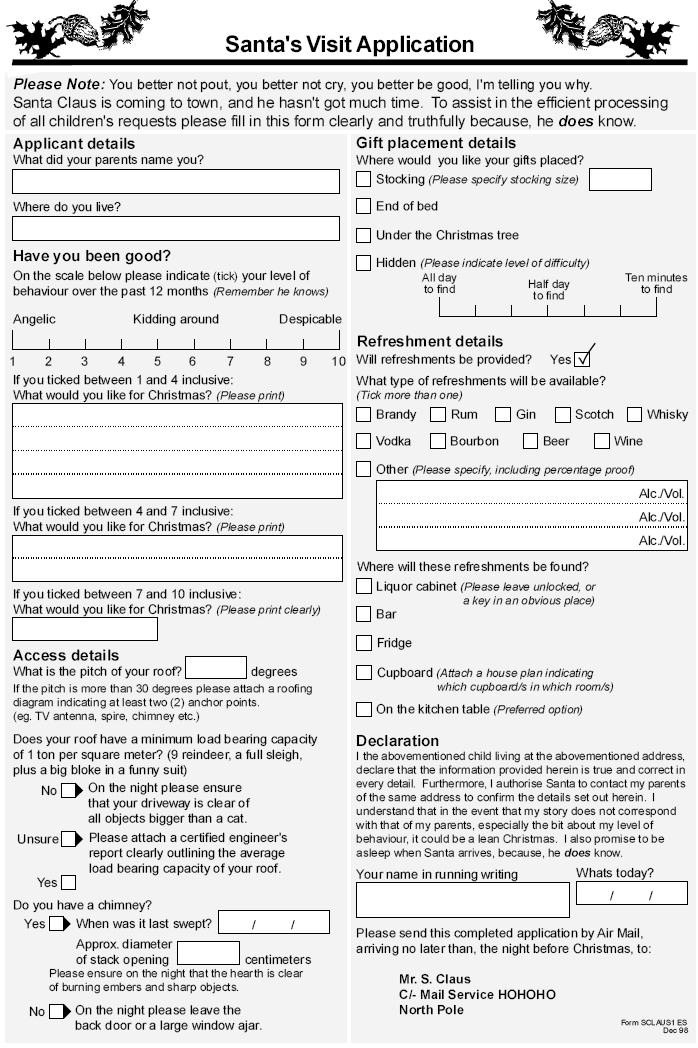
Repost – Hey Kids! Did you get your paperwork in on time?
If you hurry, you can just get your Santa’s Visit Application in before the deadline tonight!