Quotulatiousness

September 24, 2019

More on the demands from the “climate strike” protests

Filed under: Environment, Politics — Tags: , , , — Nicholas @ 03:00

Arthur Chrenkoff on the far beyond pie-in-the-sky demands coming discordantly from the amorphous climate protest groups coalescing around poor Greta Thunberg and her “climate strike”:

Greta Thunberg at the EU Parliament, 16 April, 2019.
European Parliament photo via Wikimedia Commons.

Fighting “climate change” is a very broad umbrella. What does the Global Climate Strike actually stand for? Greta Thunberg’s (I jokingly referred to her as St Joan of Arc of the Children’s Crusade against Carbon, but the marchers in Paris did carry a poster of Thunberg as a saint) initiative does not offer any extensive manifestos or programs on its website, perhaps not unexpectedly for a child-centric project, but it does provide a brief answer to the question “What are you [as a participant asking for?”:

    The climate crisis is an emergency – we want everyone to start acting like it. We demand climate justice for everyone. Our hotter planet is already hurting millions of people. If we don’t act now to transition fairly and swiftly away from fossil fuels to 100% renewable energy for all, the injustice of the climate crisis will only get worse. We need to act right now to stop burning fossil fuels and ensure a rapid energy revolution with equity, reparations and climate justice at its heart [emphasis in the original].

It’s not much, but already more than a great majority of those taking part are probably aware of they were striking for.

It doesn’t help that some of the more outrageous claims are clearly not true:

What of the other aspects of the Global Climate Strike’s five-sentence program? What exactly is “climate justice”? And what the hell are the “reparations” in this context?

The Strike site doesn’t provide answers, but “climate justice” in the last sentence hyperlinks to the website for The People’s Demands for Climate Justice, which explains itself as “Collectively shaped by people’s movements around the world, these demands are an international statement rooted in southern movements, and with input from numerous climate justice organizations and people’s movements around the world. The People’s Demands lays out a vision for a truly just international climate policy. We must ensure the demands of people, not the fossil fuel industry and other Big Polluters, is what is centered in the lead up to and during COP24 in Poland this December, 2018.” (a case here for updating your website.) While the Global Climate Strike is neither a “convening” nor an “endorsing” organisation among the 403 groups who are, by linking it clearly subscribes to the People’s Demands’ vision. Some of which includes:

    Support global efforts for a just and equitable transition that enables energy democracy, creates new job opportunities, encourages distributed renewable energy, and protects workers and communities most affected by extractive economies …

    Adopt a technology framework that recognizes the importance of endogenous and indigenous technologies and innovations in addressing climate change, and enables developing countries and communities to develop, access, and transfer environmentally sound, socially acceptable, gender responsive and equitable climate technologies.

    Respect and enable non-corporate, community-led climate solutions that recognize the traditional knowledge, practices, wisdom, and resilience of indigenous peoples and local communities, and protect rights over their lands and territories …

    Developed countries must make new concrete pledges of public climate finance accompanied by a definite timeline for delivery.

    Commit to climate reparations to those most affected but least responsible for climate change.

In addition to fossil fuels, the People’s Demands are also against any market mechanisms to reduce emissions (like emission trading schemes), carbon offsets, carbon sequestration technologies, geoengineering and other “techno-fixes”, nuclear power, biofuels and use of biomass to generate energy, and large scale hydro projects – i.e. most of the potential solutions accepted by the serious mainstream climate change political-scientific consensus. This pretty much leaves only solar and wind, geothermal in a few lucky places (like Iceland, which is sitting on top of volcanoes) and small scale hydro to power the entire world post 2030. In other words, a complete fantasy world of green Luddites.

September 23, 2019

The “Global Climate Strike”

The big “let’s all play hooky from school” event’s Toronto organizers have been getting positive coverage from some of the local media, because of course they have. Here’s Tanya Mok for BlogTO, listing the totally reasonable and not in any way unrealistic “demands” of the movement:

FridaysForFuture Demonstration, 25 January 2018 in Berlin.
Photo by C. Suthorn via Wikimedia Commons.

The coalition has made a list of seven demands, which “reflect the rallying cries of the intersectional movements” they belong to. Some of those demands include:

  • Indigenous rights and sovereignty.
  • The protection of forests, land, and water sources.
  • A shift to publicly-owned renewable energy, and reducing national carbon emission by 65% by 203, reaching zero emissions by 2040.
  • A $15 minimum wage for all, and higher taxation on the rich.
  • Universal public services like health care and dental care, free university and college, housing as a human right, and free public transit.
  • Justice for migrants and refugees, allowing status for all. That includes putting an end to deportations and allowing for the full access to public services.

There will be a concert at Queen’s Park after the rally, as well as a follow-up benefit concert at the Tranzac Club in the evening. A giant street mural project run by Greenpeace will also be taking place prior to the rally, around 10 a.m., at the southern point of Queen’s Park.

September 17, 2019

“Clean” alternative energy sources are not free … in fact, they’re quite expensive

Filed under: Economics, Environment, Technology — Tags: , , , , — Nicholas @ 03:00

Earlier this month in Foreign Policy, Jason Hickel wrote about the requirements for expanding current renewable energy generation (wind and solar):

The phrase “clean energy” normally conjures up happy, innocent images of warm sunshine and fresh wind. But while sunshine and wind is obviously clean, the infrastructure we need to capture it is not. Far from it. The transition to renewables is going to require a dramatic increase in the extraction of metals and rare-earth minerals, with real ecological and social costs.

We need a rapid transition to renewables, yes — but scientists warn that we can’t keep growing energy use at existing rates. No energy is innocent. The only truly clean energy is less energy.

In 2017, the World Bank released a little-noticed report that offered the first comprehensive look at this question. It models the increase in material extraction that would be required to build enough solar and wind utilities to produce an annual output of about 7 terawatts of electricity by 2050. That’s enough to power roughly half of the global economy. By doubling the World Bank figures, we can estimate what it will take to get all the way to zero emissions — and the results are staggering: 34 million metric tons of copper, 40 million tons of lead, 50 million tons of zinc, 162 million tons of aluminum, and no less than 4.8 billion tons of iron.

In some cases, the transition to renewables will require a massive increase over existing levels of extraction. For neodymium — an essential element in wind turbines — extraction will need to rise by nearly 35 percent over current levels. Higher-end estimates reported by the World Bank suggest it could double.

The same is true of silver, which is critical to solar panels. Silver extraction will go up 38 percent and perhaps as much as 105 percent. Demand for indium, also essential to solar technology, will more than triple and could end up skyrocketing by 920 percent.

And then there are all the batteries we’re going to need for power storage. To keep energy flowing when the sun isn’t shining and the wind isn’t blowing will require enormous batteries at the grid level. This means 40 million tons of lithium — an eye-watering 2,700 percent increase over current levels of extraction.

That’s just for electricity. We also need to think about vehicles. This year, a group of leading British scientists submitted a letter to the U.K. Committee on Climate Change outlining their concerns about the ecological impact of electric cars. They agree, of course, that we need to end the sale and use of combustion engines. But they pointed out that unless consumption habits change, replacing the world’s projected fleet of 2 billion vehicles is going to require an explosive increase in mining: Global annual extraction of neodymium and dysprosium will go up by another 70 percent, annual extraction of copper will need to more than double, and cobalt will need to increase by a factor of almost four — all for the entire period from now to 2050.

Wind turbines require a lot of concrete to stabilize them on site (hundreds of tons of it), and that concrete is very carbon-intensive to create in the first place (nearly 930 Kg of CO2 per 1,000 Kg of cement), but even those huge turbine blades have a limited working lifespan and can’t be easily recycled into anything economically, so they generally end up in landfills.

September 10, 2019

We’ve noticed this too…

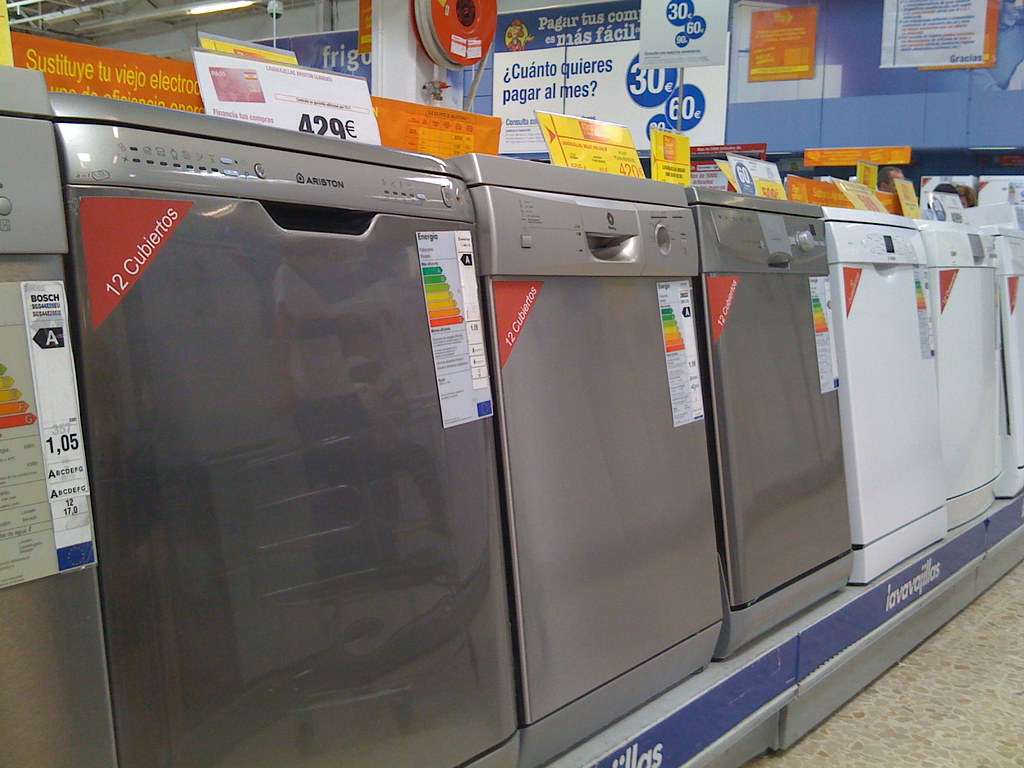
Sarah Hoyt on the increasing “green-ness” of her appliances — and the increasing uselessness of same:

For years we got expensive front loaders, and yet our clothes kept smelling, there were stains that would not come out, and these things seemed to last only 5 years, on the outside. And I knew it wasn’t our problem, as such, because at the same time we started noticing we couldn’t get our clothes clean, the detergent aisle of the supermarket sprouted an entire section of odor removing things, Febreeze got added to detergents, and, in general, people smelled odd …

Then the washer broke while we were also very, very broke (we were paying mortgage and rent in the run up to buying this. I saw an ad for, I THINK a $300 washer, and we went to look. What we found, instead, was a $200, not advertised washer. As we’re looking at it the saleswoman hurries over and tells us we don’t want it. This washer, she says, uses lots of water. For those who don’t know I suffer from an unusual form of eczema. While it’s triggered mostly by stress with a side of carbs, it can also, out of the blue, take offense at a slight trace of detergent left on the clothes. I’ve found that the eczema got markedly worse the less water the washer used. And it required me to run the washer three times, once with soap and two without to avoid major outbreaks. The idea of using lots and lots of water was great, so I was all excited. Which shocked the poor saleswoman halfway to death. I will point out, though, though that this washer washes well enough I can get away with only one extra rinse cycle and if I forget it it’s usually survivable. Also, our clothes don’t smell. Unfortunately, we’ve not found that [type] of washer any of the times we’ve walked through the appliance aisle, so I think that choice has been eliminated.

Certainly the choice of dishwashers that use “lots” (i.e. what they used 20 years ago) of water and electricity was never offered to us. And since we seemed to have really lousy luck with dishwashers, I found every time we replaced one over the last 20 years, they had less space for dishes (more insulation, to allow for less electricity) to the point that I needed to do 3 or even 4 loads for a family of four. I mean, I cook from scratch, but I really don’t use that much stuff. And it ran slower than before. Right now our dishwasher actually washes (a bonus) but it takes four hours to run a cycle. I rarely do more than one wash a day, though, because it’s just Dan and I, and we … well … the kids used a lot more glasses and little plates, and frankly meals get more complicated for four people.

All the same, there was a time there, for like 10 years, where we were running all this “green” approved stuff, and not only was I running the washer and drier more or less continuously, but to make things more “interesting” I was using MORE water and electricity, in the sense that I was running the appliances a ton more.

This of course is what I also found with the “low flush” toilets. We had them in our previous house, and we found that we spent an inordinate amount of time flushing the toilet. Also, since it took four or five flushes to do the job or one, the fact we were actually only using half the water per flush didn’t save any water. We spent instead twice to three times the amount of water the “high flush” toilets had spent.

All this, btw, to appease Paul Ehrlich — the prophet of wrong. As in, if he foresees something it will be wrong — and his ridiculous idea we’d run out of potable water in 1978. Apparently none of these people have noticed that 1978 has come and gone with no problems. And as for electricity, if they stop their idiocy about nuclear, it’s not even a consideration. (And no, Chernobyl isn’t a caution about nuclear energy. It’s a caution about stupid communist regimes. They can’t run anything — not even a nuclear plant — without destroying it.)

Lightbulbs are another favourite … several years back, our provincial government was pushing us all to get rid of our old incandescent bulbs and replace them with these great new energy-efficient compact fluorescent bulbs. The new CFLs cost roughly ten times as much as the old bulbs, but we were assured up and down that they’d last twenty times longer, so we’d not only save money on electricity, but also have to replace the bulbs so infrequently. Of course, the CFL bulbs were pathetically bad — not only were they expensive, the light they gave was (at best) marginal and they didn’t even last as long as typical incandescent bulbs.

So now, of course, we’re being encouraged to use LED bulbs. Sure, they’re more expensive than the old incandescent bulbs, but they save on electricity and last many times longer! Except, of course, they don’t. The old incandescent bulbs in my office started to fail one after another, so when I was down to only one working bulb, I gave in and bought four replacement LED bulbs … they were on sale for only 2-3 times as much as the old bulbs! That was in March. I’ve already had to replace two of the LED bulbs. This is starting to feel familiar…

On the bright side (pun unintentional), the LED bulbs don’t provide the entertainment of a toxic waste cleanup in your home the way the CFL bulbs did when they were broken.

August 16, 2019

The CO2-reduced future the elites want for the rest of us

Arthur Chrenkoff outlines the self-imposed hardship of a new Swedish MEP as he struggles to make his 24-hour weekly commute between Stockholm and Strasbourg (because he’s pretending that there are no flights between those two locations) and explains that it’s emblematic of the kind of future “our” leaders want all of us peasants to be living in the future:

Greta Thunberg at the EU Parliament, 16 April, 2019.
European Parliament photo via Wikimedia Commons.

Listen, I’m all for it; if people want to go back in time as a result of their own free choice that’s wonderful. At least these martyrs for Gaia are putting their money where their mouth is – on train as opposed to plane tickets. They are not being hypocrites, unlike the two hundred celebrities who came on 114 private jets and numerous superyachts to Google’s climate change summit in Sicily the other week. Even St Greta herself, the teenage idiot savant of the green movement, will be eschewing plane travel and going to the UN Climate Action Summit in New York in September on a zero-emission yacht. Want to suffer 24-hour Strasbourg-Stockholm regular commutes or a few weeks at sea between Europe and America so as not to sin again the planet, knock yourself out. My problem starts as soon as the environmental flagellanti decide it’s not enough that simply they care and want to start imposing their totalitarian solutions on everyone else.

[…]

This indeed seems to be the vision of an ecommunist utopia now increasingly on offer from its vocal and influential supporters:

  • As Thunberg herself declares in her musical collaboration with the Brit pop band The 1975 released last month (all proceeds to the pests of Extinction Rebellion who have a tendency to glue themselves to busy intersections): it’s “time to rebel” and for “civil disobedience” … “We have to acknowledge that the older generations have failed, all political movements in their current form have failed, but Homo sapiens have not yet failed … Now is not the time for speaking politely. Now is the time to speak clearly.”
  • David Runciman, politics professor at Cambridge University: “If electoral democracy is inadequate to the task of addressing climate change, and the task is the most urgent one humanity faces, then other kinds of politics are urgently needed … Channeling more energy into these other forms of democracy — into citizens’ assemblies and civil disobedience, rather than elections and party-building — will change our politics drastically. But it may be the only way to ensure our planet does not change beyond recognition.”
  • Greenpeace: “We’re not advocating that everyone adopt a ‘meatless’ diet tomorrow. But we all must develop “meat consciousness” and reduce the level of meat in our diets. Shifting to more plant-based foods is essential to combatting climate change, soil, air and water pollution, ocean dead zones, and myriad other problems caused by industrial livestock production.” Sentiments echoed this week by UN’s Intergovernmental Panel on Climate Change.
  • And don’t even mention Alexandria Ocasio-Cortez’s Green New Deal.

This is the future according to eco-warriors: anti-democratic, anti-growth and prosperity, with your options on everything from how (and if) you travel to what you eat restricted by your moral betters.

As my more favourite Scandinavian, Bjorn Lomborg, wrote recently:

    This year, the world will spend $US162 billion ($230bn) subsidising renewable energy, propping up inefficient industries and supporting middle-class homeowners to erect solar panels, according to the International Energy Agency. In addition, the Paris Agreement on climate change will cost the world from $US1 trillion to $US2 trillion a year by 2030. Astonishingly, neither of these hugely expensive policies will have any measurable impact on temperatures by the end of the century …

    Global warming is a real, man-made problem — but it is just one of many challenges facing humanity. We shouldn’t base our policy decisions on Hollywood movies or on scare scenarios but on the facts. According to the UN Intergovernmental Panel on Climate Change, even if we did absolutely nothing to respond to global warming, the total impact by the 2070s will be the equivalent to a 0.2 per cent to 2 per cent loss in average income. That’s a challenge that requires our attention — but it’s far from the end of the world …

    Despite costing a fortune, the Paris Agreement will have virtually no impact on global temperatures. The UN Framework Convention on Climate Change has estimated that even if every country makes every single carbon cut suggested in the Paris treaty to the fullest extent, CO2 emissions would be cut by only 1 per cent of what would be needed to keep temperature rises under 2C. Incurring an annual $US1 trillion cost while failing to rein in temperature rises is a very poor idea.

July 4, 2019

Assorted green scams

David Warren briefly returns to the current day (away from his normal 13th-century preferences) to look at a few of the many green scams being run by various government and industry scam artists:

Speaking with a gentleman who vends in a neighbourhood farmers’ market, I learnt something interesting, and probably true. Surviving family farms usually lack “organic” credentials. This is because getting them, from the bureaucracies that dispense them, is an immensely time-consuming process, and involves costs that would erase most of the little farmer’s profits. You have to be a big, faceless, industrial operation to afford the official “organic” labels that sucker big city consumers into paying double for essentially the same goods. That the whole system is massively corrupt, can almost go without saying. It was designed to be.

Organic scams are far from new, but perhaps more insidious because corporations love to add that “organic” label on stuff to jack up the prices on all sorts of things, like spices, wine, and many, many other items. Restaurants do the same trick on their menus, frequently assuming nobody will ever check up on them. That said, it’s mostly the well-off who get fooled because, well, they’re eager to be fooled on that score. The US government even admitted that organic certification is not about food safety or nutrition: it’s all marketing.

By coincidence, the same day my eye caught, by accident on the Internet, the announcement of a Green Award to a big car assembly “park.” They had changed all the light bulbs in their factory buildings, thus saving themselves a few thousand dollars on their multi-million electric bill, and seem to have installed new toilets, too. This sprawling high-tech carriage works remains three hundred acres of unspeakable aesthetic horror, in which human beings are enslaved to machines. But now it is “Green.”

The greenwashing of modern industrial and commercial buildings is a long-running scam, with the much-desired “LEED Platinum” certification usually, if not always, awarded to those who game the system most successfully. “What LEED designers deliver is what most LEED building owners want – namely, green publicity, not energy savings

The environmental business — currently buoyed by unprovable, often fatuous claims of anthropogenic global warming — is perhaps the most cynical. It has spawned vested interests on a global scale, that will not be overturned by occasional exposure. At its heart is the manipulation of statistics, and scare-mongering through compliant mass media. The general public are hypnotized by repetition. I have noticed in desultory dips into the news that e.g. anomalous weather will invariably be attributed to “climate change,” when more plausible explanations are easily at hand.

This zombification extends to most other areas of reportage: invisible bogeys blamed for imaginary trends. Solutions to “environmental problems” are proposed that will not make the slightest dent in them.

Of course, the constant demands for “clean energy” almost always explicitly reject the use of nuclear power because reasons.

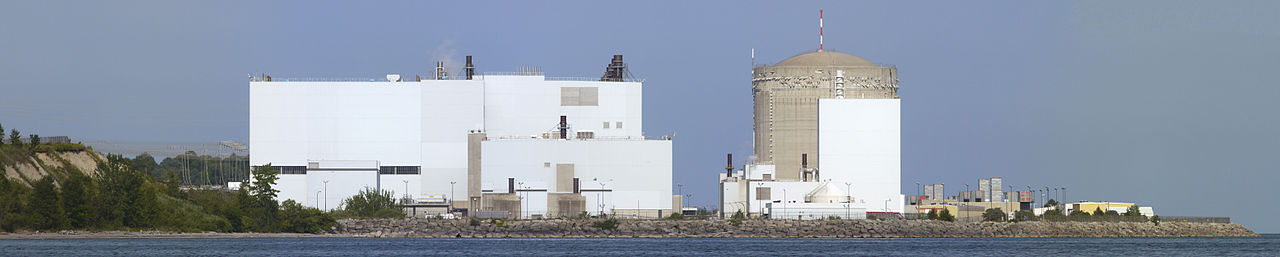
Darlington Nuclear Generating Station in Clarington, Ontario.
Photo by Óðinn via Wikimedia Commons.

But nuclear power, most easily in the form of molten salt reactors (on which research was killed fifty years ago), could replace most uses of coal, oil, and gas within a decade, through much smaller facilities eliminating huge transmission costs. It would be the cheaper because the fuels are readily available to start in the form of recycled nuclear waste, and the raw materials would be abundantly available thereafter.

On the question of safety, the death toll from mining, drilling, hydro dams, &c, is quite considerable — in the tens of thousands at least, post-War. Except for Chernobyl (one of many Soviet-era environmental disasters), the death toll from nuclear accidents remains about nil. No one died at Three Mile Island. Not one death was caused by the flooded Fukushima reactors (though well over twenty thousand were killed by the tsunami that caused the difficulty there).

In short, “clean energy” is not a problem. It had to be made into one by the fright campaigns of the environmentalcases, whose own power and income depends on sustaining the problem, and preventing the most obvious solutions.

February 9, 2019

The price tag for Alexandria Ocasio-Cortez’s renewable energy dream

Filed under: Economics, Environment, Politics, USA — Tags: , — Nicholas @ 03:00

At Reason, Ronald Bailey looks at how much it would cost to implement Alexandria Ocasio-Cortez’s post-fossil-fuel plans:

There’s a lot to consider in this resolution, but let’s for the time being focus on the goal of “meeting 100 percent of the power demand in the United States through clean, renewable, and zero-emission energy sources” by 2030. The resolution is light on fiscal details, so let’s consider the question of how achieving this goal would cost.

As it happens, a team of Stanford engineers led by Mark Jacobson outlined just such a plan back in 2015. Jacobson’s repowering plan would involve installing 335,000 onshore wind turbines; 154,000 offshore wind turbines; 75 million residential photovoltaic systems; 2.75 million commercial photovoltaic systems; 46,000 utility-scale photovoltaic facilities; 3,600 concentrated solar power facilities with onsite heat storage; and an extensive array of underground thermal storage facilities.

Assuming steep declines in the costs of each form of renewable electric power generation, just running the electrical grid using only renewable power would still cost roughly $7 trillion by 2030. The Information Technology and Innovation Foundation calculated that the total cost of an earlier version of Jacobson’s scheme would amount to $13 trillion. And based on how fast it has taken to install energy generation infrastructure in the past, Jacobson’s repowering plan would require a sustained installation rate that is more than 14 times the U.S. average over the last 55 years and more than six times the peak rate.

The cost — $7 trillion — would be spent to save … how much?

    ..global warming at or above 2 degrees Celsius beyond preindustrialized levels will cause— (A) mass migration from the regions most affected by climate change; (B) more than $500,000,000,000 in lost annual economic output in the United States by the year 2100;

$500 billion a year isn’t a lot in the context of the US economy. It’s currently around $20 trillion in size, so we’re talking about 2.5% of the economy being lost. But of course we’re also predicting that the economy will grow between now and then. Actually, we think the US economy will be about $100 trillion a year by 2100. So we’re talking about 0.5% of that economy. Or about the change in size of the US economy between September and December last year. Think how much richer we did feel over those few months. And how much poorer we’d be if it hadn’t happened, that growth.

Oh, and to avoid that loss AOC is suggesting that we spend $7 trillion now? That just doesn’t pass the cost benefit test. It doesn’t even pass at the Stern Review’s special discount rate.

Which is, of course, what all the economists have been trying to tell us all about dealing with climate change. Don’t do it by central planning, do it by using market incentives. Have a carbon tax. Don’t try and do it too quickly – William Nordhaus gained his Nobel in part for saying this – but do it more gradually over time. Don’t junk what we’ve got that already works, instead when the normal time comes to replace it then make sure it’s non-carbon emitting. Finally, don’t do it the expensive way, do it the cheap way. For the cheaper we make it to solve it then the more of the problem we’ll solve. You know, humans usually doing less of the expensive things and more of the cheap?

November 27, 2018

Cutting back on ethanol makes financial and environmental sense

Craig Eyermann explains why President Trump’s push to expand the use of ethanol in cars is a bad call for many reasons:

For example, because ethanol packs less energy per gallon than gasoline does, vehicle owners can expect to get even lower fuel mileage from the expansion of E15 fuel (a blend of 15% ethanol with 85% gasoline) under the new mandate to include more ethanol in automotive fuels, which would be 4% to 5% less than they would achieve if they only filled their vehicles with 100% gasoline. Today’s vehicle owners already pay a fuel efficiency penalty of 3% to 4% lower gas mileage from the E10 ethanol-gasoline fuel blend mandated under the older ethanol content rules, where the new rules will require even more fill-ups.

Beyond that, to the extent that it diverts corn from food markets to fuel production, corn-based ethanol production also jacks up the price of food—the corn itself, plus everything that eats corn, like beef cattle. One review of multiple studies found that the U.S. government’s corn-based ethanol mandates added 14% to the cost of agricultural commodity prices from 2005 through 2015.

Last summer, the Environmental Protection Agency also found that burning increasing amounts of ethanol has made America’s air dirtier because it generates more ozone pollution, which contributes to smog formation. Worse, growing the additional corn to make more ethanol has also increased agricultural fertilizer runoff pollution in the nation’s rivers and waterways.

That runoff has been linked to the increased incidence of harmful algal blooms, which have been responsible for contaminating drinking water and contributing to red tide events in coastal regions, where fish and other aquatic organisms have been killed off.

There is a solution to these federal government-generated pollution problems: stop forcing corn-based ethanol to be used in the nation’s fuel supplies. There’s even a case study from Brazil, where the city of Sao Paulo found that its air became cleaner after it switched from ethanol-based fuels to gasoline in the years from 2009 to 2011.

October 31, 2018

Premier Ford’s promise to lower electricity rates in Ontario

Filed under: Business, Cancon, Government — Tags: , , , , — Nicholas @ 05:00

In the Financial Post, Lawrence Solomon says Doug Ford can’t risk abandoning his promises about Ontario electricity costs, despite his cabinet’s worries about provincial reputation damage:

Ford has every reason to return the power system to some semblance of economic sanity. Ontario is now burdened by some of the highest power rates of any jurisdiction in North America, throwing households into energy poverty and forcing industries to close shop or move to the U.S. The biggest reason by far for the power sector’s dysfunction is its renewables, which account for just seven per cent of Ontario’s electricity output but consume 40 per cent of the above-market fees consumers are forced to provide. Cancelling those contracts would lower residential rates by a whopping 24 per cent, making good on Ford’s promise to aid consumers.

[…]

To date, Ford has stopped renewable developments that haven’t been completed, which will prevent things from getting worse, but he has failed to tear up the egregious contracts of completed developments, which will prevent things from getting better. Based on conversations that I and others have had with government officials, it appears that Ford is inclined to cancel the contracts and honour his signature promise, but he is being thwarted by cabinet colleagues who fear that Ontario’s reputation will take a hit in the business community if they don’t play nice.

Except, there’s nothing nice about betraying a promise to the voters who democratically put you in power in order to avoid pressure from lobby groups who think governments are entitled to hand out sweetheart deals to their favoured cronies. There’s also nothing democratic about it. It is an axiom of parliamentary government that “no government can bind another.”

Canadian governments, including Ontario governments, have in the past torn up odious contracts, including those in the energy sector. When they did, upon passing binding legislation, they were able to reset the terms, offering as little or as much compensation as they wished. Outraged business lobbies’ claims that the reputation of governments would be affected were not borne out. Moreover, such rightings of political wrongs serve the interest of small government and free markets, because businesses have always understood that there’s an inherent risk in contracting with governments that are able to unilaterally rewrite contracts. To overcome that inherent risk, businesses add a risk premium when getting in bed with government, helping to explain the rich contracts the renewables developers demanded. That risk premium acts to make business-to-business dealings more economic than business-to-government dealings.

October 5, 2018

A quick way for Doug Ford to reduce Ontario’s electrical rates

Filed under: Business, Cancon, Economics, Government — Tags: , , , — Nicholas @ 03:00

Ross McKitrick, Elmira Aliakbari and Ashley Stedman outline one of the fastest ways for the Ontario government to get Ontario electricity rates back down toward the national average:

The Ford government seems to want to repair Ontario’s electricity market. It recently moved to scrap the Green Energy Act and reportedly plans to eliminate or alter the so-called Fair Hydro Plan.

While these moves will mitigate future price increases, they won’t reduce current electricity prices. In fact, according to a Fraser Institute study being released today, to lower existing prices the government must reduce what’s known as the “Global Adjustment” — an extra charge on electricity. It won’t be easy, but reducing the global adjustment could bring down electricity prices by about 24 per cent.

This would be welcome news for Ontarians, as electricity prices increased 71 per cent from 2008 to 2016, far outpacing electricity-price growth in other provinces.

[…]

Between 2008 and 2017, the GA grew from less than one cent per kilowatt-hour (a common billing unit for energy) to about 10 cents, accounting for the entire increase in Ontario electricity commodity costs over that time. Therefore, the key to lowering power prices in Ontario is to reduce the GA.

In our study, we use reports published by the Ontario Energy Board to breakdown the GA to better understand where the money goes and provide specific recommendations on how to lower electricity prices. We found that the largest component of the GA charge — nearly 40 per cent — funds subsidies paid to renewable energy sources (wind, solar, etc.) under feed-in-tariff contracts, yet these sources only provide seven per cent of Ontario’s power output.

And notably, the GA provides almost 90 per cent of revenue earned by renewable generators, with only 10 per cent coming from actual power sales. This overwhelming reliance on government subsidies (paid by ratepayers) rather than actual electricity sales reveals how distorted the pricing structure has become in Ontario.

October 1, 2018

QotD: The idiocy of “solar roads”

Filed under: Quotations, Technology — Tags: — Nicholas @ 01:00

First, solar roads are a terrible idea. Even if they can be made to sort of work, the cost per KwH has to be higher than for solar panels in a more traditional installations — the panels are more expensive because they have to be hardened for traffic, and their production will be lower due to dirt and shade and the fact that they can’t be angled to the optimal pitch to catch the most sun. Plus, because the whole road has to be blocked (creating traffic snafus) just to fix one panel, it is far more likely that dead panels will just be left in place rather than replaced.

And who in their right mind would ever accept the statement that the solar panel roads would be cheaper to fix than a roadway? What agency anywhere takes out whole patches of road to fix small cracks? Square foot for square foot a solar road would be orders of magnitude harder to fix than just patching a pothole somewhere.

I love the line about “ideally” paying for themselves. I am sure this is their ideal, but what is the reality? I will bet anyone a million dollars that if all installation and maintenance costs are included, these will not come close to paying for themselves. The first rule of alternate energy in any news article is to give the installation cost or the energy output, but never both, so actual return on investment can’t be calculated. If they give neither, as in this case, it really sucks.

And finally, what is not to love about the last paragraph, which says effectively that roads should be as smart as the cars that drive on them. I have toyed with the idea of creating a whole new blog category on things people say that get millennials excited but make absolutely no sense. This would be a good example. Embedding solar panels in a road when just about any other flat surface anywhere would be a better place to put them is not “smart”, it is painfully stupid. A smart road might embed guide wires or some other technology to aid self-driving cars, but nothing like this.

Warren Meyer, “The Terrible Idea That Won’t Die: Solar Roads”, Coyote Blog, 2016-07-06.

September 6, 2018

Trans-partisan planning

At Coyote Blog, Warren Meyer offers a plan to address man-made climate change, pitched to avoid being dismissed as “typical” of one or the other side:

While I am not deeply worried about man-made climate change, I am appalled at all the absolutely stupid, counter-productive things the government has implemented in the name of climate change, all of which have costly distorting effects on the economy while doing extremely little to affect man-made greenhouse gas production. For example:

  • Corn ethanol mandates and subsidies, which study after study have shown to have zero net effect on CO2 emissions, and which likely still exist only because the first Presidential primary is in Iowa. Even Koch Industries, who is one of the largest beneficiaries of this corporate welfare, has called for their abolition
  • Electric car subsidies, 90% of which go to the wealthy to help subsidize their virtue signalling, and which require more fossil fuels to power than an unsubsidized Prius or even than a SUV.
  • Wind subsidies, which are promoting the stupidist form for power ever, whose unpredictabilty means fossil fuel plants still have to be kept running on hot backup and whose blades are the single largest threat to endangered bird species.
  • Bad government technology bets like the massive public subsidies of failed Solyndra

Even when government programs do likely have an impact of CO2, they are seldom managed intelligently. For example, the government subsidizes solar panel installations, presumably to reduce their cost to consumers, but then imposes duties on imported panels to raise their price (indicating that the program has become more of a crony subsidy for US solar panel makers, which is typical of these types of government interventions). Obama’s coal power plan, also known as his war on coal, will certainly reduce some CO2 from electricity generation but at a very high cost to consumers and industries. Steps like this are taken without any idea of whether this is the lowest cost approach to reducing CO2 production — likely it is not given the arbitrary aspects of the program.

These policy mess is also an opportunity — it affords us the ability to substantially reduce CO2 production at almost no cost.

July 7, 2018

The bad economics of rooftop solar installations

Norman Rogers points out where the numbers don’t add up for many jurisdictions’ domestic solar power schemes:

Photovoltaic panels on a roof, 28 April, 2015.
Photo by Antonio Chaves, via Wikimedia Commons.

A modest proposal:

We’ve all heard about “shop local” and “get your food from local farmers, not distant corporate farms.” Lots of people have apple trees in their backyards. Often they can’t begin to eat or give away all the apples. In the meantime, big supermarkets sell corporate apples for one dollar a pound and up. I propose that people with backyard apples be able to take them to the supermarket and sell them to the supermarket for the same price at which the supermarket is selling apples. Furthermore, they should be able to take them at any time and receive payment. If the store gets too many local apples, it can reduce its purchase of corporate apples.

My apple proposal may seem ill advised, but that is exactly how rooftop solar power works. The homeowner gets to displace power from the power company, and if the homeowner has more power than he needs, the power company is obligated to purchase it, often for the same retail price at which it sells electricity. That policy is called net metering. In order to accommodate the homeowner’s electric power, the utility has to throttle down some other power plant that produces power at a lower wholesale price.

The exact arrangements for accepting rooftop solar vary by jurisdiction. In some places, net metering is restricted in one way or another.

A large-scale natural gas-generating plant can supply electricity for around 6 cents per kilowatt-hour. Rooftop solar electricity costs, without subsidies, around 30 cents per kilowatt-hour, or five times as much. Average retail rates for electricity in most places are between 8 cents and 16 cents per kilowatt-hour. Yet, paradoxically, the homeowner can often reduce this electric bill by installing rooftop solar.

It is actually worse than forcing the power company to take 30-cent electricity that it could get from a natural gas plant for 6 cents. When the company throttles down a natural gas plant to make room for rooftop electricity, it is not saving six cents, because it already has paid for the gas plant. All it saves is the marginal fuel that is saved when the plant is throttled down to make room for the rooftop electricity. The saving in fuel is about 2 cents per kilowatt-hour. So 30-cent electricity displaces grid electricity and saves two cents.

July 1, 2018

Over-generous subsidies encourage fraud and waste

Filed under: Britain, Economics, Environment, Government — Tags: , , , , , — Nicholas @ 03:00

At Catallaxy Files, Rafe Champion continues discussing Matt Ridley’s book Climate Science: The Facts:

Ridley went on to criticise biodiesel programs and the promotion of diesel cars. Then he mentioned one of the most outlandish schemes – the clearing of forests on the west coast of the US to convert into wood pellets to burn in British furnaces instead of coal to generate electricity. The Daily Mail reported that this was one of the legacies of Energy Secretary Chris Huhne.

    Mr Huhne, who served in the coalition government and was later jailed for perverting the course of justice, championed the energy source in office and is now European chairmen of Zilka Biomass, a US supplier of wood pellets.

Nice work if you can get it.

And then there are the household biomass furnaces in Britain, promoted by Huhne under the Renewable Heat Incentive (RHI) scheme whereby businesses and households pay for a renewable energy boiler upfront then receive payments for up to 20 years depending on the amount of heat they produce.

    Some unscrupulous homeowners can double the amount they produce by using heat generated under the RHI to dry wood or other materials.

    This can then be fed back into the boiler to burn it and generate even more heat – and money from the public purse.

    The scheme was started in 2011 by Chris Huhne, then Liberal Democrat energy secretary, for businesses then extended to domestic customers three years later. Households and firms can apply for grants to switch from fossil fuel heating systems to renewable ones such as biomass boilers, which burn wood pellets, chips or logs.

As the scheme is open to applications until 2021, final payments to participants will run to at least 2041. By this time, the bill for taxpayers is expected to hit £23billion.

Closely related is the the Irish “Cash for Ash” scandal that paid more than the cost of the fuel. An orgy of corruption was sparked by renewables in Spain and there was the strange phenomenon of solar power generated in the dark because the Spanish subsidy was initially so generous is was worthwhile to shine diesel-powered lights on the panels overnight.

September 10, 2017

QotD: Peak oil

Filed under: Economics, Quotations, Technology, USA — Tags: , , , — Nicholas @ 01:00

Witness, brothers and sisters, witness. The oil, it’s going to run out. Peak production of the world’s oilfields has either passed or is about to pass; from here on out it’s rising oil prices forever. Now we wave our hands and pronounce that the energy-guzzling capitalist West (and especially Amerikka) is so addicted to cheap oil that its decadent empire will collapse, collapse I tell you. Barely concealed gloating follows.

There are so many mutually-reinforcing idiocies here that it’s hard to know where to start. As I was thinking of writing about this, one of my commenters pointed out that above $32 per barrel it becomes economical to build Fischer-Tropf plants and make your oil out of coal. This is old tech; the Germans did it during WWI. At slightly higher price points, MHD generators to burn garbage start to look good.

These are instances of a more general phenomenon: markets adapt to price shifts! To wreck an economy with oil-price rises, they’d have to spike so fast and so far that you somehow couldn’t run the cement trucks to build the Fischer-Tropf plants. Not gonna happen.

In fact, the long-term trend will be that the amount of oil invested per constant-dollar value of goods produced in the U.S. economy drops faster than the price of oil rises. This is a safe prediction not because manufacturers have all bought into Green ideology but because they want to make money. This means that they have a market incentive to use their inputs (including oil) a efficiently as possible, and to substitute less expensive inputs for more expensive ones. It’s called capitalism, and it works.

(And, by the way, the cheapest input of all is information. Buckminster Fuller pointed out forty years ago that as technologies mature, the products tend to get smaller and lighter and less energy-intensive and smarter. Your cellphone today weighs less than it used to, and costs less oil to produces than it used to, because its design is smarter. Information has replaced mass. This trend will continue and accelerate.)

The peak-oil collapse scenario is not credible for five minutes to anybody who understands market economics. But the sort of people who believe it are blinded by their own prejudices; fundamentally they think market economics is an invention of the Devil. They need to believe in the collapse, because they need to believe that the wickedness of Americans and capitalists and Republicans will be punished.

Eric S. Raymond, “Peak Oil — A Wish-Fulfillment Fantasy for Secular Idiots”, Armed and Dangerous, 2005-11-13.

« Newer PostsOlder Posts »

Powered by WordPress