Quotulatiousness

July 7, 2019

Does this sound like your gym?

Filed under: Business, Health, USA — Tags: — Nicholas @ 05:00

Instapundit linked to this older Sean Kelly article about the “Planet Fitness” chain of health clubs. According to him, it’s even less pretty than you might have thought:

Here’s what you need to know…

  1. Planet Fitness: The gym for people who don’t really want to get in shape, owned by people who really can’t afford for the members to be there.
  2. A survey of over 20 different Planet Fitness locations in 12 different states revealed that they provide no nutritional guidance. They do however supply candy and pizza.
  3. Planet Fitness seems to promise that health and fitness will ultimately be comfortable and not involve any real effort.
  4. Planet Fitness is a big, purple-colored adult daycare marketed to people afraid to go to an actual gym.
  5. Many Planet Fitness members do want to make progress of course, but the gym’s own rules and operating guidelines seem to dissuade this.

Do the Brits hate the French?! – WW2 – 045 – July 6 1940

Filed under: Africa, Britain, France, Germany, History, Japan, Military, WW2 — Tags: , , , , — Nicholas @ 04:00

World War Two
Published on 6 Jul 2019

The repercussions of the fall of France are not yet seen in full. But this week Britain makes it clear it isn’t about to give up, even if it will mean some really hard decisions.

Join us on Patreon: https://www.patreon.com/TimeGhostHistory
Or join The TimeGhost Army directly at: https://timeghost.tv

Follow WW2 day by day on Instagram @World_war_two_realtime https://www.instagram.com/world_war_t…
Join our Discord Server: https://discord.gg/D6D2aYN.
Between 2 Wars: https://www.youtube.com/playlist?list…
Source list: http://bit.ly/WW2sources

Written and Hosted by: Indy Neidell
Produced and Directed by: Spartacus Olsson and Astrid Deinhard
Executive Producers: Bodo Rittenauer, Astrid Deinhard, Indy Neidell, Spartacus Olsson
Creative Producer: Joram Appel
Research by: Indy Neidell
Post production director: Wieke Kapteijns
Edited by: Iryna Dulka
Map animations: Eastory

Colorisations by Daniel Weiss, Norman Stewart and Julius Jääskeläinen https://www.facebook.com/JJcolorization/

Eastory’s channel: https://www.youtube.com/channel/UCEly…
Archive by Screenocean/Reuters https://www.screenocean.com.

Sources:
WM: H 4610, A 3589
Narodowe Archiwum Cyfrowe
Jacques Mulard
Colorization of Göring by Klimbim
Romanian National Archives

A TimeGhost chronological documentary produced by OnLion Entertainment GmbH.

Cancelling student loans would be a really, really bad economic move

Filed under: Economics, Education, Politics, USA — Tags: , , , , — Nicholas @ 03:00

Art Carden explains why cancelling outstanding student loan debt — despite its huge popularity on the campaign trail — would be a very bad idea:

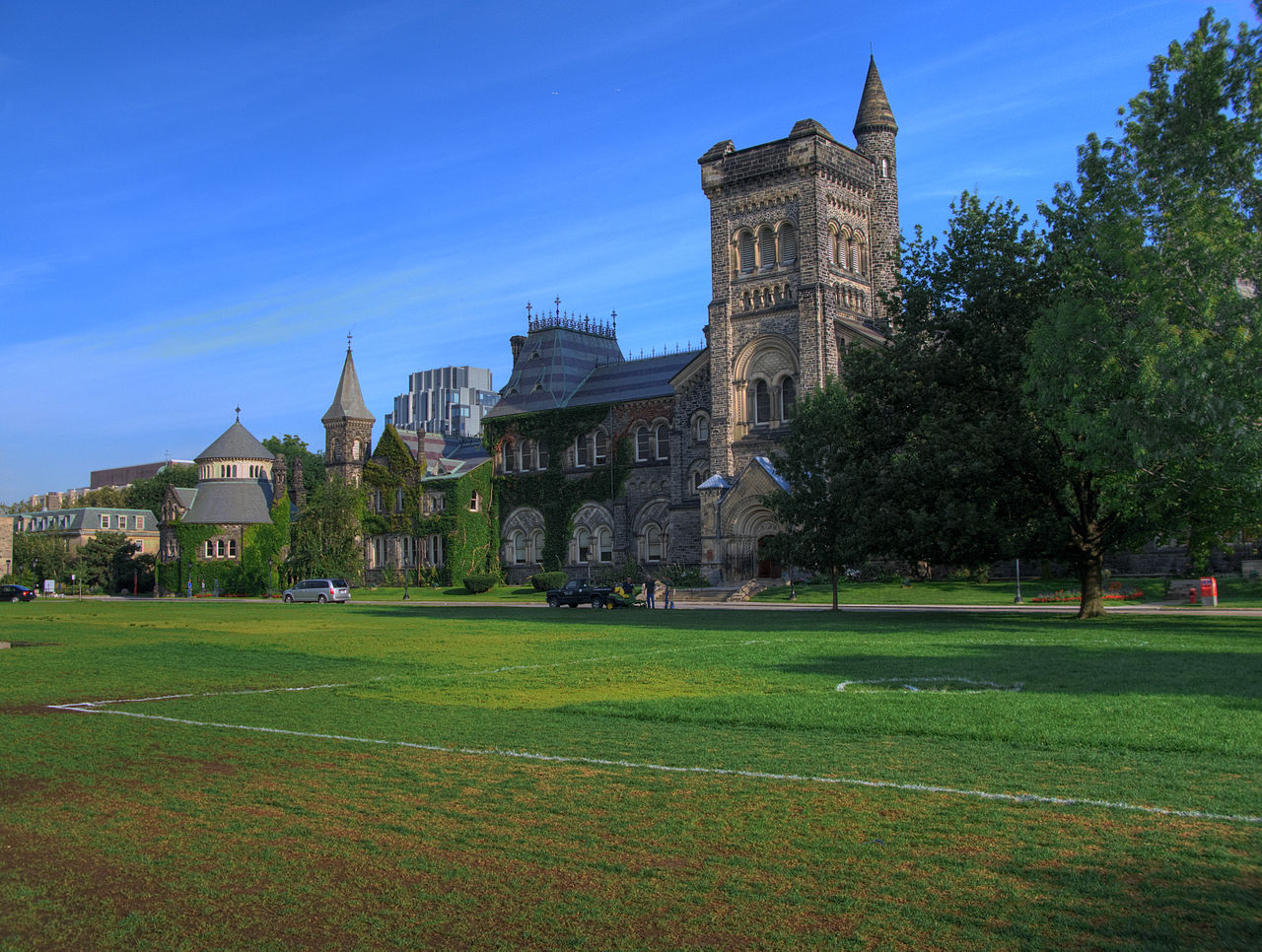
University College, University of Toronto, 31 July, 2008.
Photo by “SurlyDuff” via Wikimedia Commons.

It’s one of the rules of electoral success: advocate policies that concentrate the benefits on an easy-to-identify interest group (preferably one that is sympathetic in the public eye) and disperse the costs onto the entire electorate. It’s how we get Coke sweetened with corn syrup rather than actual sugar. It’s also how we get proposals to cancel student loans. As my AIER colleague Will Luther points out, the fact that two of the Democratic frontrunners have made debt cancellation such an important part of their campaigns suggests that the issue is going to be with us for a while.

But would it be a good idea to cancel student debt? And importantly, how does even the prospect of canceled student debt affect people’s incentives?

Regressive Tax

First, let’s consider the quality of the policy. A lot of commentators are pointing out that it’s fundamentally regressive, meaning that we’re basically taxing the poor to pay the rich. As economist Alexander William Salter puts it in the Dallas Morning News, it’s

    a transfer of wealth to those with relatively high levels of expected lifetime income, at the expense of those with relatively lower levels of expected lifetime income.

The idea might have some merit, but it will make wealth and income inequality worse rather than better.

Even saying that the idea might have some merit is perhaps too charitable. In 2011, economist Justin Wolfers called it the “Worst. Idea. Ever.” in a Freakonomics post. Why? First, there’s the distributional effect. If we’re going to have policies that transfer wealth from one group to another, it doesn’t make much sense to transfer wealth from taxpayers generally to high-income college graduates. As Will Luther and so many others have pointed out, a college degree brings spectacular financial returns. As a group, college graduates aren’t “needy” by any reasonable definition.

Granatbuchse GrB-39 Antitank Rifle

Filed under: Germany, History, Military, Technology, Weapons, WW2 — Tags: , , — Nicholas @ 02:00

Forgotten Weapons
Published on 29 Aug 2015

http://www.patreon.com/ForgottenWeapons

Hammer price: $13,000

Like most countries, Germany had a standard-issue antitank rifle when World War II began — the Panzerbuchse 39. It fired an 8 x 94mm cartridge with a small very high velocity armor-piercing bullet. And like the other AT rifles from the 1930s, the PzB-39 became obsolete quickly as tank armor improved during the war. However, while most countries simply scrapped their antitank rifles, the Germans opted instead to convert the guns into dedicated grenade launchers.

Because the PzB-39 was already designed for a very high pressure cartridge, it was ideally suited to handle the stresses of firing large anti-tank grenades. Rather than relying on simple kinetic energy to penetrate, the grenades could use shaped charge technology to be vastly more effective than AP bullets.

In converting the PzB-39 into the GrB-39, the barrels were cut down, grenade launching cups attached to the muzzles, new sights designed for grenade use, bipods lengthened, and the folding stocks were fixed in place. Most of the PzB-39 rifles in service were subject to these modifications, and the resulting GrB-39 guns were able to be reasonably effective through the end of the war.

QotD: Speaking for the dead

Filed under: Government, Quotations, USA — Tags: , , , — Nicholas @ 01:00

The House of Representatives passed a constitutional amendment on flag burning last week, in the course of which Representative Randy “Duke” Cunningham (Republican of California) made the following argument:

    Ask the men and women who stood on top of the Trade Center. Ask them and they will tell you: pass this amendment.

Unlike Congressman Cunningham, I wouldn’t presume to speak for those who died atop the World Trade Center. For one thing, citizens of more than 50 foreign countries, from Argentina to Zimbabwe, were killed on 9/11. Of the remainder, maybe some would be in favor of a flag-burning amendment; and maybe some would think that criminalizing disrespect for national symbols is unworthy of a free society. And maybe others would roll their eyes and say that, granted it’s been clear since about October 2001 that the Federal legislature has nothing useful to contribute to the war on terror and its hacks and poseurs prefer to busy themselves with a lot of irrelevant grandstanding with a side order of fries, they could at least quit dragging us into it.

And maybe a few would feel as many of my correspondents did last week about the ridiculous complaints of “desecration” of the Koran by US guards at Guantanamo – that, in the words of one reader, “it’s not possible to ‘torture’ an inanimate object”.

That alone is a perfectly good reason to object to a law forbidding the “desecration” of the flag. For my own part, I believe that, if someone wishes to burn a flag, he should be free to do so. In the same way, if Democrat Senators want to make speeches comparing the US military to Nazis and the Khmer Rouge, they should be free to do so. It’s always useful to know what people really believe.

Mark Steyn, “The Advantage of Knowing What People Really Think”, SteynOnline, 2017-06-14 (originally published in The Chicago Sun-Times, 2005-06-26).

July 6, 2019

JourneyQuest Four – Now on Kickstarter!

Filed under: Gaming, Humour, Media — Tags: , — Nicholas @ 06:00

Zombie Orpheus Entertainment
Published on 5 Jul 2019

Campaign ends July 12, 2019. Pledge at http://kck.st/2EEFIY3

Missing new ZOE content? Watch for free on our new platform: http://thefantasy.network

New shows include….

The Gamers: The Shadow Menace
Strowlers (Three new episodes!)
JourneyQuest Season 3.5
Demon Hunters: Slice of Life
• And more!

Want to share your thoughts? Join us on Discord (https://discordapp.com/invite/fhPckP7)

Putting global worker pay into perspective

Filed under: Business, Economics — Tags: , , , — Nicholas @ 05:00

Tim Worstall explains why the headline-friendly numbers in a recent ILO report are nothing to be surprised at:

“Nearly half of all global pay is scooped up by only 10% of workers, according to the International Labour Organization, while the lowest-paid 50% receive only 6.4%.

“The lowest-paid 20% – about 650 million workers – get less than 1% of total pay, a figure that has barely moved in 13 years, ILO analysis found. It used labour income figures from 189 countries between 2004 and 2017, the latest available data.

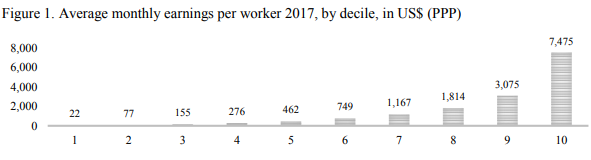
“A worker in the top 10% receives $7,445 a month (£5,866), while a worker in the bottom 10% gets only $22. The average pay of the bottom half of the world’s workers is $198 a month.”

[…]

The explanation? To be in the top 10% of the global pay distribution you need to be making around and about minimum wage in one of the rich countries. Via another calculation route, perhaps median income in those rich countries. No, that £5,800 is the average of all the top 10%.

Note that this is in USD. About £2,000 a month puts you in the second decile, that’s about UK median income of 24,000 a year.

And as it happens about 20% of the people around the world are in one of the already rich countries. So, above median in a rich country and we’re there. Our definition of rich here not quite extending as far as all of the OECD countries even. Western Europe – plus offshoots like Oz and NZ, North America, Japan, S. Korea and, well, there’s not much else. Sure, it’s not exactly 10% of the people there but it’s not hugely off either.

So, what is it that these places have in common? They’ve been largely free market, largely capitalist, economies for more than a few decades. The most recent arrival, S. Korea, only just managing that few decades. It is also true that nowhere that hasn’t been such is in that listing. It’s even true that nowhere that is such hasn’t made it – not that we’d go to the wall for that last insistence although it’s difficult to think of places that breach that condition.

History Summarized: Hong Kong

Overly Sarcastic Productions
Published on 5 Jul 2019

Sometimes small corners of the map can have outsized effects on the surrounding world. Hong Kong is undoubtedly one of History’s greatest examples of big things coming from small beginnings. If you’re curious about Hong Kong’s current political situation, there’s no better place to start than at the beginning.

LEARN MORE about Hong Kong’s current events:
China is Erasing its border with HK: https://www.youtube.com/watch?v=MQyxG…
HK’s huge protests, explained: https://www.youtube.com/watch?v=6_Rdn…

Further Historical Reading:
A Modern History of China — Steve Tsang https://www.amazon.com/Modern-History…

PATREON: https://www.Patreon.com/OSP

The Iron Bridge in Shropshire

Filed under: Britain, History, Technology — Tags: , , , — Nicholas @ 03:00

Roger Henry sent along this information on the most recent restoration of the world’s oldest iron bridge near Coalbrookdale:

The Iron Bridge across the River Severn, completed in 1779. The first major bridge to be made of iron.
Photo by shirokazan via Wikimedia Commons.

Wikipedia says:

The Iron Bridge is a bridge that crosses the River Severn in Shropshire, England. Opened in 1781, it was the first major bridge in the world to be made of cast iron, and was greatly celebrated after construction owing to its use of the new material.

In 1934 it was designated a Scheduled Ancient Monument and closed to vehicular traffic. Tolls for pedestrians were collected until 1950, when ownership of the bridge was transferred to Shropshire County Council. It now belongs to Telford and Wrekin Borough Council. The bridge, the adjacent settlement of Ironbridge and the Ironbridge Gorge form the UNESCO Ironbridge Gorge World Heritage Site. The bridge is a Grade I listed building, and a waypoint on the South Telford Heritage Trail.

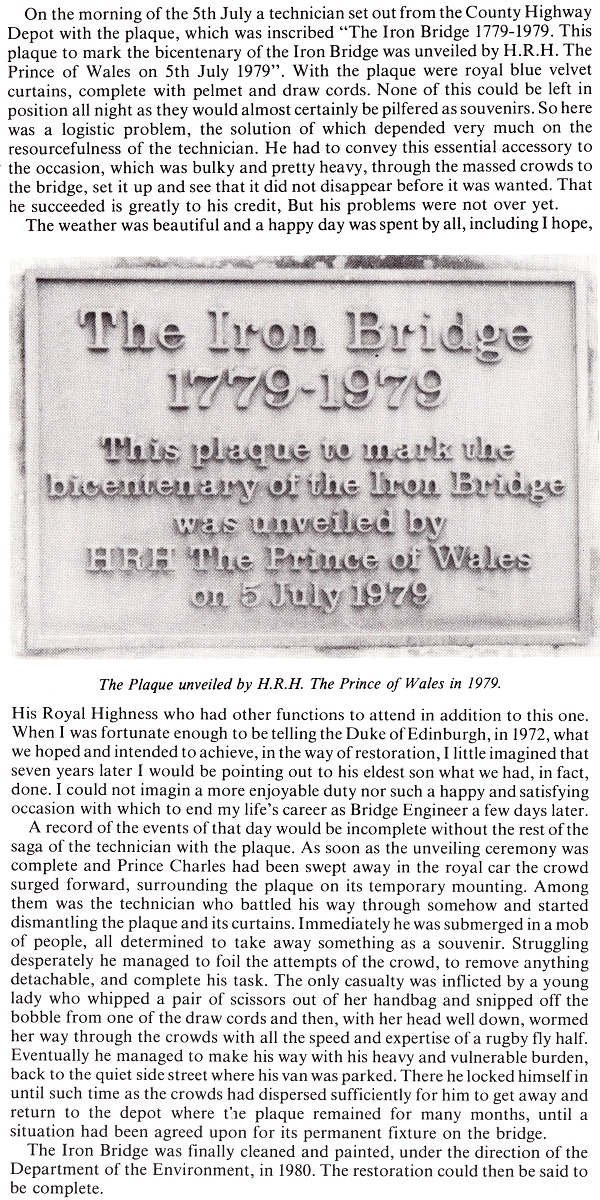
Anthony Blackwall, who was the Shropshire County Bridgemaster, recounts the 1979 celebrations in “Historic Bridges of Shropshire”, Shropshire Libraries, 1985:

The most recent restoration was completed late in 2018:

The bridge, the first of its kind, was closed for a year after surveyors found cracks and stresses in its historic cast ironwork.

English Heritage launched a £3.6 million programme of repairs in autumn of 2017.

Kate Mavor, the charity’s CEO, came to the gorge to get a first-hand look at the historic bridge restored, and spoke of her pride.

“This is the first English Heritage site I remember coming to when I was about 11, and now it looks much the same as it did then.

“This is the first time I’ve seen it refurbished and I think it sits very nicely in the gorge, and with the red paint it will especially look good in autumn colours.

“I’ve been following the repairs closely since they began, it is an extraordinary project.

“The gorge is a world heritage site, the bridge was the first of its kind and it’s been there since 1779.

“It has survived a number of pernicious influences including an earthquake.

“We’re very proud of what we’ve been able to do here because it’s been unlike any other project of ours.

“We’re very grateful to everyone that has supported the project.

“The amazing response we had to English Heritage’s first ever crowdfunding campaign was fantastic too.”

Kate said that the surveys carried out before the project started revealed that the bridge had originally been painted a deep red, unlike the recognisable black or grey layer of recent years.

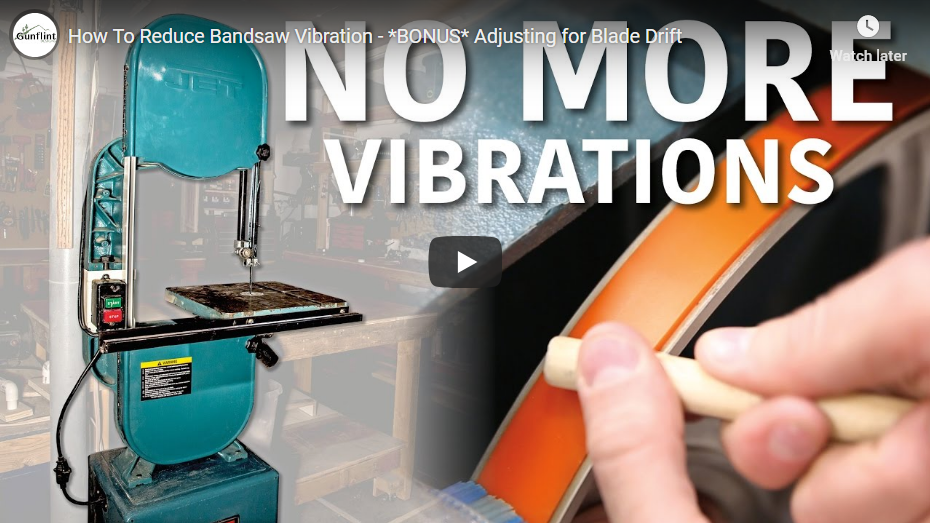
How To Reduce Bandsaw Vibration – *BONUS* Adjusting for Blade Drift

Filed under: Tools, Woodworking — Tags: — Nicholas @ 02:00

Gunflint Designs
Published on 27 Apr 2017

Check out how I tuned up my bandsaw and took it from a shaky, unpleasant monster, to a smooth running dream. I installed some new urethane tires and a new drive belt and completely changed the attitude of this machine. Stay till the end to see the really simple method I use to adjust a bandsaw fence to account for blade drift.

QotD: How to learn

Filed under: Books, Economics, Education, Quotations — Tags: , , — Nicholas @ 01:00

I can imagine an economics professor reading through The Literary Book of Economics in search of things he can use in his teaching. But I find it hard to imagine anyone else doing so on his own initiative, merely because he enjoyed reading it. There is a reason why a book is the length it is; a novel is not, with rare exceptions, a series of short stories. I conclude that most of the people reading [Michael] Watts’ book, most of the people it was written for, will be students reading it because their professor told them to. And, judging by my experience of students over the years, many of the students told to read it won’t.

That fits the pattern of most modern schooling at all levels. Someone else decides what you should learn, tells you what you must do to learn it, and makes some attempt to make sure you follow his instructions. It is not a model I think highly of. A much superior model in my view, if you can pull it off, is to get someone to learn something primarily because he finds it interesting. The best way of doing that is to provide students with things to read that are worth reading on their own, not things they read only because they are ordered to. Not even things they read only because they think the labor of reading them will pay off in future benefit.

That view of education is why both children of my present marriage were unschooled. It is also why all of my nonfiction books, with the partial exception of Price Theory, were targeted at the proverbial intelligent layman. They can be, and sometimes are, used as textbooks, but they were written with the assumption that if the reader did not find a chapter worth finishing he was likely not to finish it.

David Friedman, “Thoughts on Literature, Economics and Education”, Ideas, 2017-05-01.

July 5, 2019

“Far From The Fame” – Karel Janoušek – Sabaton History 022 [Official]

Filed under: Europe, History, Media, Military, WW1, WW2 — Tags: , , , — Nicholas @ 04:00

Sabaton History
Published on 4 Jul 2019

The life of Karel Janoušek is anything but ordinary. Throughout his live, he served in the militaries and air forces of multiple countries, but time and again he ends up fighting for his native Czechoslovakia. The Sabaton song “Far from the Fame” on the Heroes album describes his life, his adventures and his experiences.

Support Sabaton History on Patreon: https://www.patreon.com/sabatonhistory

Check out the trailer for Sabaton’s new album The Great War right here: https://www.youtube.com/watch?v=HCZP1…

Listen to Sabaton on Spotify: http://smarturl.it/SabatonSpotify
Official Sabaton Merchandise Shop: http://bit.ly/SabatonOfficialShop

Hosted by: Indy Neidell
Written by: Markus Linke and Indy Neidell
Directed by: Astrid Deinhard and Wieke Kapteijns
Produced by: Pär Sundström, Astrid Deinhard and Spartacus Olsson
Creative Producer: Joram Appel
Executive Producers: Pär Sundström, Joakim Broden, Tomas Sunmo, Indy Neidell, Astrid Deinhard, and Spartacus Olsson
Maps by: Eastory
Edited by: Iryna Dulka
Sound Editing by: Marek Kaminski

Eastory YouTube Channel: https://www.youtube.com/channel/UCEly…
Archive by: Reuters/Screenocean https://www.screenocean.com
Music by Sabaton.

Source:
Icon by Stephen Hutchings from iconfinder.com
IWM: 1034-4, Q 97835, Q 112704, Q 112720, D 1730, CH 15869, H 26244, CL 3333), D 10206

An OnLion Entertainment GmbH and Raging Beaver Publishing AB co-Production.

© Raging Beaver Publishing AB, 2019 – all rights reserved.

Miscellaneous Myths: Rainbow Crow

Filed under: Americas, History — Tags: , , , — Nicholas @ 02:00

Overly Sarcastic Productions
Published on 31 May 2019

This is one of the shortest videos I’ve ever made, and I’d feel bad about that if this month hadn’t been very long and tiring already. Enjoy this bite-sized myth, everybody!

SOME ADDITIONAL RESOURCES FROM THE LENAPE: If you’d like some further reading, try http://www.nanticoke-lenape.info/history.htm, or the official Nanticoke-Lenape online museum at http://nanticokelenapemuseum.org/. The official Lenape tribe website is at http://www.lenapeindiantribeofdelaware.com/, and the Delaware Tribes overall have a site at http://delawaretribe.org/.

And guess what I actually remembered to do before I archived my project file? I actually remembered to note down the SONGS I USED! In order, they are:
•Rondo Alla Turca (Mozart)
•Starfall (Two Steps From Hell)
•Morning Mood (Grieg)
•Fire And Ice (City of the Fallen)
•Flight of the Silverbird (Two Steps From Hell)
•The End Of The Battle (Shadow of the Colossus OST)

PATREON: https://www.Patreon.com/OSP

QotD: The paradox of tolerance

Filed under: Books, Liberty, Politics, Quotations — Tags: , , — Nicholas @ 01:00

In 1945, the philosopher Karl Popper wrote in his book, The Open Society and Its Enemies that “in order to maintain a tolerant society, the society must be tolerant of intolerance.”

This is now referred to as “the paradox of tolerance.”

Popper argues that unlimited tolerance is self-defeating. If a tolerant society is tolerant of the intolerant, the intolerant will defeat the tolerant. Therefore, tolerance is all well and good, but to defend itself, it must maintain a certain degree of intolerance towards the intolerant.

It it this defense of intolerance that radicals use to justify violence against their political opponents.

If one dares to question the legitimacy of “direct action” from communist groups against their political opponents, these groups will quickly cite this paradox of tolerance. When fascists are shooting up mosques and synagogues, it’s difficult to defend them against mere milkshakes.

Which is why the paradox of tolerance is constantly brought up to defend violence: It’s hard to argue against. Only the most strict pacifist will argue against violence in (the name of) self-defense. Karl Popper was right to point out that a tolerant society that is tolerant toward its enemies will be destroyed.

Nathan Kreider, “Misconceptions of the Paradox of Tolerance”, Being Libertarian, 2019-05-31.

July 4, 2019

Assorted green scams

David Warren briefly returns to the current day (away from his normal 13th-century preferences) to look at a few of the many green scams being run by various government and industry scam artists:

Speaking with a gentleman who vends in a neighbourhood farmers’ market, I learnt something interesting, and probably true. Surviving family farms usually lack “organic” credentials. This is because getting them, from the bureaucracies that dispense them, is an immensely time-consuming process, and involves costs that would erase most of the little farmer’s profits. You have to be a big, faceless, industrial operation to afford the official “organic” labels that sucker big city consumers into paying double for essentially the same goods. That the whole system is massively corrupt, can almost go without saying. It was designed to be.

Organic scams are far from new, but perhaps more insidious because corporations love to add that “organic” label on stuff to jack up the prices on all sorts of things, like spices, wine, and many, many other items. Restaurants do the same trick on their menus, frequently assuming nobody will ever check up on them. That said, it’s mostly the well-off who get fooled because, well, they’re eager to be fooled on that score. The US government even admitted that organic certification is not about food safety or nutrition: it’s all marketing.

By coincidence, the same day my eye caught, by accident on the Internet, the announcement of a Green Award to a big car assembly “park.” They had changed all the light bulbs in their factory buildings, thus saving themselves a few thousand dollars on their multi-million electric bill, and seem to have installed new toilets, too. This sprawling high-tech carriage works remains three hundred acres of unspeakable aesthetic horror, in which human beings are enslaved to machines. But now it is “Green.”

The greenwashing of modern industrial and commercial buildings is a long-running scam, with the much-desired “LEED Platinum” certification usually, if not always, awarded to those who game the system most successfully. “What LEED designers deliver is what most LEED building owners want – namely, green publicity, not energy savings

The environmental business — currently buoyed by unprovable, often fatuous claims of anthropogenic global warming — is perhaps the most cynical. It has spawned vested interests on a global scale, that will not be overturned by occasional exposure. At its heart is the manipulation of statistics, and scare-mongering through compliant mass media. The general public are hypnotized by repetition. I have noticed in desultory dips into the news that e.g. anomalous weather will invariably be attributed to “climate change,” when more plausible explanations are easily at hand.

This zombification extends to most other areas of reportage: invisible bogeys blamed for imaginary trends. Solutions to “environmental problems” are proposed that will not make the slightest dent in them.

Of course, the constant demands for “clean energy” almost always explicitly reject the use of nuclear power because reasons.
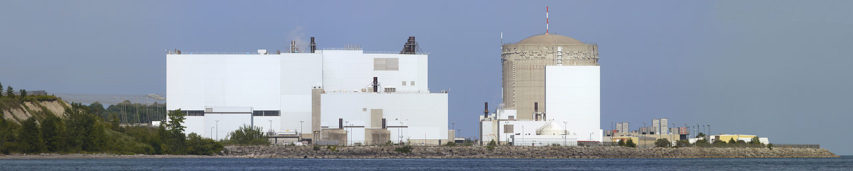
Darlington Nuclear Generating Station in Clarington, Ontario.
Photo by Óðinn via Wikimedia Commons.

But nuclear power, most easily in the form of molten salt reactors (on which research was killed fifty years ago), could replace most uses of coal, oil, and gas within a decade, through much smaller facilities eliminating huge transmission costs. It would be the cheaper because the fuels are readily available to start in the form of recycled nuclear waste, and the raw materials would be abundantly available thereafter.

On the question of safety, the death toll from mining, drilling, hydro dams, &c, is quite considerable — in the tens of thousands at least, post-War. Except for Chernobyl (one of many Soviet-era environmental disasters), the death toll from nuclear accidents remains about nil. No one died at Three Mile Island. Not one death was caused by the flooded Fukushima reactors (though well over twenty thousand were killed by the tsunami that caused the difficulty there).

In short, “clean energy” is not a problem. It had to be made into one by the fright campaigns of the environmentalcases, whose own power and income depends on sustaining the problem, and preventing the most obvious solutions.


« Newer PostsOlder Posts »

Powered by WordPress