Quotulatiousness

January 4, 2020

Looking back at the ’20s … the 1620s

In the latest installment of Anton Howes’ Age of Invention, he takes us back to what he calls the “transformative 20s” of the seventeenth century:
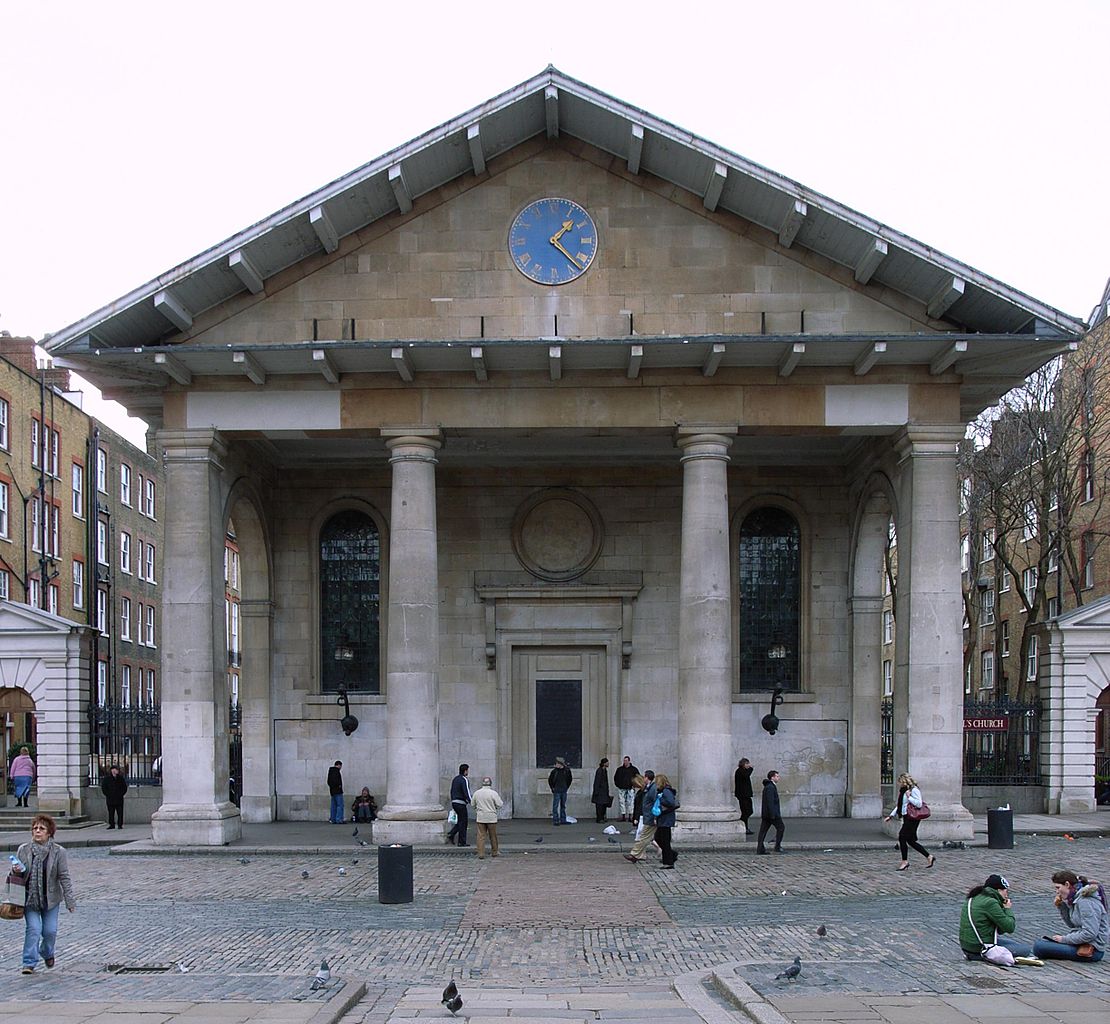
St. Paul’s Church in Covent Garden (built 1631-8) by Inigo Jones.
Photo by Steve Cadman via Wikimedia Commons.

The 1620s saw an upsurge in major projects to transform Britain’s landscape. Engineers from the Dutch Republic like Cornelius Vermuyden came to straighten its rivers, build canals, and even drain its marshes, converting them into pasturage and farmland — in the decades that followed, they would even begin to drain the Great Fens. The cityscapes changed too. The former theatre designer and architect Inigo Jones — by 1615 the Surveyor-General of the King’s Works — introduced classical architecture from the continent, drawing upon the rules of beauty and proportion that had been set down by Vitruvius in the first century BCE and resuscitated in Renaissance Italy by Andrea Palladio. Jones’s influence transformed England’s palaces, churches, cathedrals, and even Covent Garden square, to reflect his ancient Roman ideal.

But the environment, built or natural, would be most transformed by the experiments of a few individuals with fossil fuels. Dud Dudley, an illegitimate child of the 5th Baron Dudley, in the 1620s experimented with smelting iron with peat and coal. Dudley was not the first to do so — the patent on using coal instead of charcoal to work iron had been sold on from person to person since at least 1589 — but his experiments were among the most influential. The famous Abraham Darby, who achieved commercial success in applying coal to smelting metals in the early eighteenth century, was Dud Dudley’s great-great-nephew.

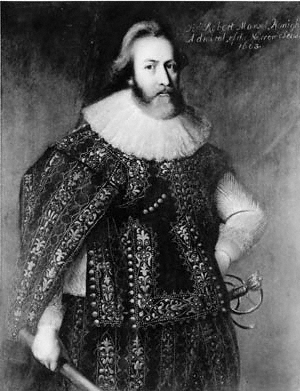
Sir Robert Mansell (1570/71–1652), by an unknown artist.
Image via Wikimedia Commons.

The decade also saw major new attempts to use coal as a fuel in other processes, such as glass-making. Although the patent on using coal to make glass had been around since at least 1610, by the 1620s Sir Robert Mansell had bought out the partners who owned it and was pouring a fortune into setting up glassworks at Newcastle. In this case, the transformation was institutional. Mansell’s political connections allowed him to widen the terms of his patent, such that he even tried to ban all other kinds of glass in England, regardless of whether they were made using other fuels, or even imported. Usually, patents of invention were for things entirely new, and were not supposed to interfere with existing English industries. But over the course of the 1610s, various abuses like Mansell’s came to light. King James I, eager for cash, had sold monopolies on ancient trades, as well as the new — one crony was even awarded a patent for inns and alehouses. Mansell’s patent, along with the others, was attacked in Parliament in the 1620s, and even revoked. The outcry ultimately led to the Statute of Monopolies of 1624 — the earliest patent legislation in England, which sought to regulate the royal practice of granting them. (Ironically, Mansell was so well-connected that he managed to get his controversial glass-making patent renewed and then exempted from the new Act.) The Statute of Monopolies was the only English patent legislation in force during the Industrial Revolution — there was no more patent legislation until 1852.

Finally, the ’20s saw a transformation of science. It was the decade in which Francis Bacon published some of his most significant works, on how to collect, refine, and systematise human knowledge for the good of humankind. He set out a comprehensive programme for the organisation of science and invention, with his utopian work New Atlantis setting out his ideal R&D lab – “Salomon’s House”. (Despite these high-minded aims, Bacon was also Mansell’s brother-in-law, and as attorney-general had helped draft the controversial glass-making patent. In 1621 he was convicted, fined, and even briefly imprisoned in the Tower of London for his role in the corrupt early patent system, though he appears to have been a scapegoat.)

Ivan the Terrible – the first Russian tsar I IT’S HISTORY

Filed under: History, Russia — Tags: , , — Nicholas @ 02:00

IT’S HISTORY
Published 14 Feb 2018

Ivan IV Vasilyevich commonly known as Ivan the Terrible was the first tsar of Russia. Did he deserve his title?

QotD: “Starchitects”

In my school, the status of “Corb” (as we were encouraged to affectionately call him) as a hero was a given, and dissenting from this position was risky. Such is the power of group-think which universities are, sadly, no less prone to than anywhere else. To be fair, nobody was still plugging the megalomaniac aspect of their hero; his knock-down-the-center-of-Paris side. All those undeniably God-awful tower blocks for “rationally” housing “the people” that sprang up all over Europe in his name? Well, we were assured, they could not be blamed on Corb; it was just that his more pedestrian architectural acolytes hadn’t properly understood what he had meant. In addition to the persistence of Corb-hero worship itself, two cancerous aspects of its radical mindset have survived intact in our schools of architecture.

One is the idea that an architect aspiring to greatness must also aspire to novelty. It is this imperative to “innovate” that underpins the diagrammatic design concepts of the Deconstuctivists. There is of course nothing wrong with innovation per se; it is the knee-jerk compulsion to innovate, or “reinterpret” — as a kind of moral imperative — that is the mid-20th-century aesthetic legacy. To be fair to the profession, I would come to the defense of much innovative public and commercial architecture, most of it by architects that the public has never heard of. Tragically though, these unpretentious and unsung essays in steel, glass, and masonry have been eclipsed in the public imagination by the “starchitect” bling that is currently turning the centers of our great cities into a collection of (in James Stevens Curl’s memorable phrase) “California-style roadside attractions”.

The other cancer is the idea that building design has sociological, psychological, and macro-economic dimensions that the architect — simply by virtue of being an architect — is competent to judge. What really matters to your average architecture student is drawing — which is fine, and just as it should be, until the vain idea emerges that their drawings represent some kind of implicit vision for mankind. At my school, any student’s design presentation had to include a verbal rationale — often post hoc and invariably half-baked — of how the form, massing, and materials of the design are expressive of such imponderables as the supposed psychological “needs” and “aspirations” of the users and the wider “community” that the building is to serve. The students were simply reciting the bogus language of their tutors — in which buildings might be said to be “fun,” “thought provoking,” “democratic,” “inclusive” and other such nonsense.

Graham Cunningham, “Why Architectural Elites Love Ugly Buildings”, The American Conservative, 2019-11-01.

January 3, 2020

The Battle of Alesia (52 B.C.E.)

Filed under: Europe, France, History, Military — Tags: , , , , — Nicholas @ 06:00

Historia Civilis
Published 24 Apr 2015

Patreon | http://patreon.com/HistoriaCivilis
Donate | http://www.paypal.com/cgi-bin/webscr?…
Merch | http://teespring.com/stores/historiac…
Twitter | http://twitter.com/HistoriaCivilis
Website | http://historiacivilis.com

Music is “The Life and Death of a Certain K. Zabriskie, Patriarch” by Chris Zabriskie. (http://chriszabriskie.com/)

Fallen flag – the Pennsylvania Railroad

Filed under: Business, History, Railways, USA — Tags: , , , , — Nicholas @ 05:00

The origins and an outline history of the “Standard Railroad of the World” for Classic Trains magazine by George Drury:

The original Pennsylvania Railroad ran from Philadelphia to Pittsburgh. Much of its subsequent expansion was accomplished by leasing or purchasing other railroads.

Construction began in 1847. Two years later the Pennsy made an operating contract with the Harrisburg, Portsmouth, Mountjoy & Lancaster, and by late 1852 rails ran from Philadelphia to Pittsburgh via a connection with the Portage Railroad between Hollidaysburg and Johnstown, Pa. The summit tunnel was opened in 1854, bypassing the inclined planes and creating a continuous railroad from Harrisburg to Pittsburgh.

In 1857 PRR bought the Main Line of Public Works and in 1861 leased the Harrisburg, Portsmouth, Mountjoy & Lancaster, putting the entire Philadelphia to Pittsburgh line under one management.

PRR also acquired interests in two major railroads, the Cumberland Valley and the Northern Central. The Cumberland Valley was opened in 1837 from Harrisburg to Chambersburg, and it was extended by another company in 1841 to Hagerstown, Maryland. The Baltimore & Susquehanna was incorporated in 1828 to build north from Baltimore. Progress was slowed because of the reluctance of Pennsylvania state officials to charter a railroad that would carry commerce to Baltimore. The line reached Harrisburg in 1851 and Sunbury in 1858. By then the railroad companies that formed the route had been consolidated as the Northern Central Railway. Pennsy acquired majority ownership of the Northern Central in 1900.

The Pennsy expanded into northwestern Pennsylvania by acquiring an interest in the Philadelphia & Erie Railroad in 1862 and assisting that road to complete its line from Sunbury to the city of Erie in 1864. The line to Erie was not particularly successful, but from Sunbury to Driftwood it could serve as part of a freight route with easy grades. The rest of that route was the Allegheny Valley Railroad, conceived as a feeder from Pittsburgh to the New York Central and Erie railroads. The Pennsylvania obtained control in 1868, and in 1874 opened a route with easy grades from Harrisburg to Pittsburgh via the valleys of the Susquehanna and Allegheny rivers. PRR leased the Allegheny Valley Railroad in 1900.

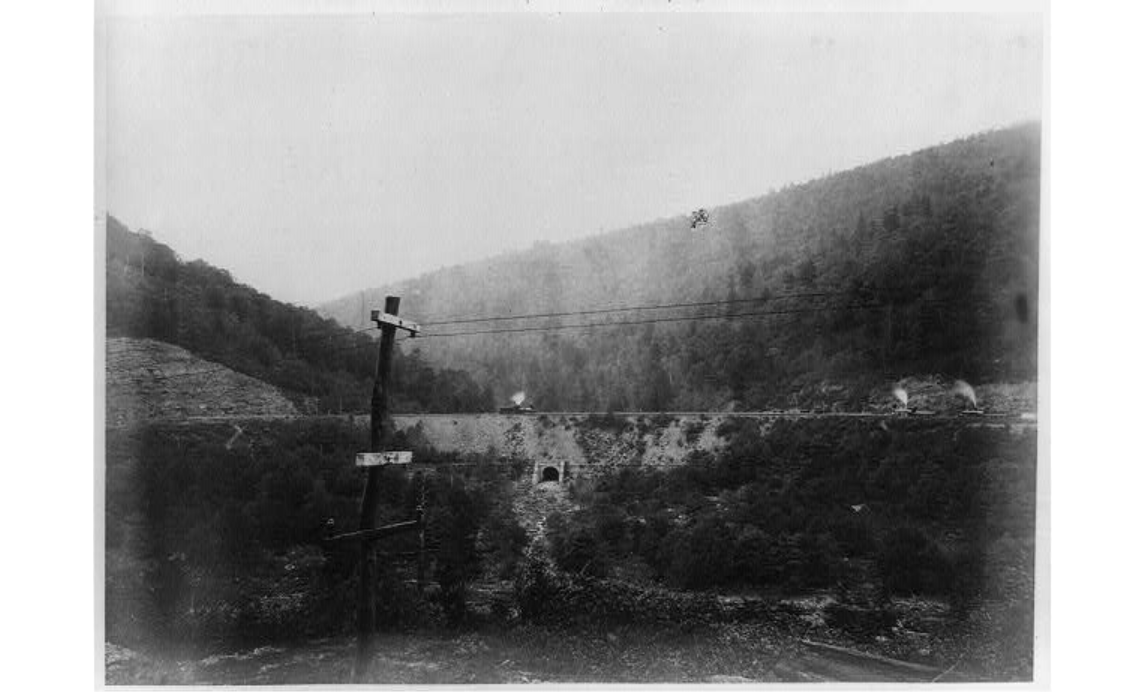
Horse shoe curve near Altoona on the Pennsylvania Railroad, circa 1874.
Photo by W.P. Mange & Co. via the Library of Congress.

But even the mighty can fall, and the PRR fell into difficult times after WW2:

During World War II Pennsy’s freight traffic doubled and passenger traffic quadrupled, much of it on the eastern portion of the system. The electrification was of inestimable value in keeping the traffic moving. After the war Pennsy had the same experiences as many other railroads but seemed slower to react. PRR was slower to dieselize, and when it did so it bought units from every manufacturer.

As freight and passenger traffic moved to the highways, Pennsy found itself with far more fixed plant than the traffic warranted or could support, and it was slow to take up excess trackage or replace double track with Centralized Traffic Control.

PRR was saddled with a heavy passenger business. It had extensive commuter services centered on New York, Philadelphia, and Pittsburgh and lesser ones at Chicago, Washington, Baltimore, and Camden, New Jersey. It had gone through the Depression without going bankrupt.

Pennsylvania and New York Central surprised the railroad industry by announcing merger plans in 1957. The two had long been rivals, and the merger would be one of parallel roads rather than end-to-end. The merger took place on February 1, 1968 — and Penn Central fell apart faster than it went together.

PRR E8A 5803 with Train 72, The Red Bird, passing the Hartsdale, Indiana tower and crossing the NYC and EJ&E on November 26, 1965.
Photo from the Roger Puta collection via Wikimedia Commons.

“Union” – Battle of Monte Cassino – Sabaton History 048 [Official]

Filed under: Europe, Germany, History, Italy, Media, Military, WW2 — Tags: , , , — Nicholas @ 04:00

Sabaton History
Published 2 Jan 2020

In early 1944, as the Allies are nearing Rome, Albert Kesselring orders a defensive line the likes of which rivals some of history’s greatest fortifications. Here, with the old hilltop abbey Monte Cassino looking down on the two front, the Axis and the Allies duel it out in a bloody and tiring fight for control of central Italy…

Support Sabaton History on Patreon: https://www.patreon.com/sabatonhistory

Listen to The Art Of War (where Union is featured):
CD: http://bit.ly/TheArtOfWarStore
Spotify: http://bit.ly/TheArtOfWarSpotify
Apple Music: http://bit.ly/TheArtOfWarAppleMusic
iTunes: http://bit.ly/TheArtOfWariTunes
Amazon: http://bit.ly/TheArtOfWarAmz
Google Play: http://bit.ly/TheArtOfWarGooglePlay

Listen to Sabaton on Spotify: http://smarturl.it/SabatonSpotify
Official Sabaton Merchandise Shop: http://bit.ly/SabatonOfficialShop

Hosted by: Indy Neidell
Written by: Markus Linke and Indy Neidell
Directed by: Astrid Deinhard and Wieke Kapteijns
Produced by: Pär Sundström, Astrid Deinhard and Spartacus Olsson
Creative Producer: Joram Appel
Executive Producers: Pär Sundström, Joakim Broden, Tomas Sunmo, Indy Neidell, Astrid Deinhard, and Spartacus Olsson
Production Intern: Rune Væver Hartvig
Post-Production Director: Wieke Kapteijns
Edited by: Iryna Dulka
Sound Editing by: Marek Kaminski
Maps by: Eastory – https://www.youtube.com/c/eastory

Archive by: Reuters/Screenocean https://www.screenocean.com
Music by Sabaton.

Sources:
– Narodowe Archiwum Cyfrowe
– National Portrait Gallery
– Bundesarchiv
– National Army Museum
– IWM E446, E 3020E, MH 1557, NA 12895, NA 15139, MH 6352, MH 11250, NA15141, C4363, HU 16546, NA 9807, NA 13274
– Soldiers of 100th Infantry Battalion during the Battle of Monte Cassino courtessy of Bco100bn from Wikimedia Commons
Gebirgsjäger in position in Saltdal in 1940, Courtessy of Rudi Margreiter through Arkiv i Nordland
– Fondo Antiguo de la Biblioteca de la Universidad de Sevilla

An OnLion Entertainment GmbH and Raging Beaver Publishing AB co-Production.

© Raging Beaver Publishing AB, 2019 – all rights reserved.

Magical thinking in names

Theodore Dalrymple relates the rather odd story of a young girl’s media-publicized objection to a math problem in school and then considers the girl’s given name in the larger context:

Popular first names in the United States, 2010.
Image from Behind the Name.

My attention was also caught by the first name of the politically-correct child: Rhythm. This is not a traditional name, though not actually ugly; but her parents have evidently accepted the increasing convention of giving a child an unconventional, and sometimes previously unheard of, name. This is a worldwide, or at least occident-wide, phenomenon. In Brazil, for example, parents in any year give their children one of 150,000 names, most of them completely new, made up like fake news, and in France, 55,000 children are born every year who are given names that are shared by three or fewer children born the same year. This latter is all the more startling because, until 1993, there was an old Napoleonic law (admittedly not rigidly enforced) that constrained parents to choose among 2000 names, mainly those of either saints or classical heroes.

What does the phenomenon of giving children previously unheard-of names signify — assuming that it signifies something? I think it is symptomatic of an egoistic individualism without true individuality, of self-expression without anything to express, which is perhaps one of the consequences of celebrity culture.

I performed an internet search on the words Rhythm as a given name. I soon found the website of a group called the Kabalarians, who believe that the name given to a child determines, or at least contributes greatly, to its path through life, especially in conjunction with the date of birth:

    When language is used to attach a name to someone this creates the basis of mind, from which all thoughts and experiences flow. By representing the conscious forces combined in your name as a mathematical formula, one’s specific mental characteristics, strengths and weaknesses can be measured.

It invited readers to inquire about the psychological characteristics and problems of people with various given names. I invented a child called Rhythm of the same age, more or less, as Rhythm Pacheco. This was the result:

    The name of Rhythm causes this child to be extremely idealistic and sensitive. She will find it difficult to overcome self-consciousness and to express her deeper thoughts and feelings in a free, natural way. She is too easily hurt and offended, and will often depreciate her own abilities. Because of her lack of confidence and her sensitivity, she will go to great lengths to avoid an issue. True affection, understanding, and love mean a great deal to her, as she is a romantic and emotional youngster. Often she will resort to a dream world when her feelings are hurt. She could be very easily influenced by others, for she will find it difficult to maintain her individuality. This problem could become more predominant during the teenage years. Although there is much that is refined and beautiful about her, the lack of emotional control could bring much unhappiness, repression, misunderstanding and loneliness later in life. Tension could also create fluid and respiratory problems. Because of the sensitivity created by this name, she will find it difficult to cope with the challenges of life.

There is, in fact, a semi-serious theory of nominative determinism, according to which a name may influence a person’s choice of career: two of the most prominent British neurologists of the first half of the twentieth century, for example, were Henry Head and Russell Brain. A recent Lord Chief Justice of England was called Igor Judge. And surely it must work in a negative direction too: no poet could be called Albert Postlethwaite. However rational one believes oneself, one might also experience a frisson of fear on consulting a doctor called Slaughter — as was called the doctor and popular novelist Frank G. Slaughter.

When I first went to Africa, I encountered patients whose first names were Clever, Sixpence or Mussolini. The first of these names was presumably an instance of magical thinking, while the second two were chosen merely because the naming parents liked the sound of them. Years later, during the civil war in Liberia, I met a constitutional lawyer called Hitler Coleman, who presumably desired to live his name down by concerning himself with the rule of law.

M20 75mm Recoilless Rifle: When the Bazooka Just Won’t Cut It

Filed under: History, Military, USA, Weapons, WW2 — Tags: , , , , — Nicholas @ 02:00

Forgotten Weapons
Published 8 Mar 2018

Sold for $6,325.

Note that this is a rewelded action. It should be inspected by a professional before being fired (the firing footage in the video is a different example).

The M20 75mm Recoilless Rifle was developed starting in 1944 as a replacement for the 3.5″ bazooka in an antitank role. It was developed and produced in parallel with a 57mm recoilless rifle (the M18), and both entered service in March of 1945, seeing just a slight bit of combat use before the end of World War Two. It would be a mainstay of US troops in the Korean War, however, along with a 105mm recoilless rifle. The M20 fired HE, HEAT, and WP (smoke) rounds, with the projectiles weighing 20-22 pounds (about 10kg) and having muzzle velocities of about 1000 fps (305 m/s). The shaped charge HEAT warhead could penetrate about 4″ (100mm) of armor, and had an effective range of about 400 yards. The HE warhead could be effectively used out to about 1000 yards, and the gun was equipped with both direct fire and indirect fire optical sights in order to effectively use both types of ammunition.

By the Vietnam War, the M20 was on its way out, as were recoilless rifles in general — they were being replaced with wire-guided missiles for antitank use. However, the M20 remains in service today for avalanche control in many Western states — a neat repurposing of obsolete weaponry!

http://www.patreon.com/ForgottenWeapons

Cool Forgotten Weapons merch! http://shop.bbtv.com/collections/forg…

If you enjoy Forgotten Weapons, check out its sister channel, InRangeTV! http://www.youtube.com/InRangeTVShow

QotD: Against The Grain

Filed under: Books, Food, Government, History, Quotations — Tags: , , , — Nicholas @ 01:00

Someone on SSC Discord summarized James Scott’s Against The Grain as “basically 300 pages of calling wheat a fascist”. I have only two qualms with this description. First, the book is more like 250 pages; the rest is just endnotes. Second, “fascist” isn’t quite the right aspersion to use here.

Against The Grain should be read as a prequel to Scott’s most famous work, Seeing Like A State. SLaS argued that much of what we think of as “progress” towards a more orderly world – like Prussian scientific forestry, or planned cities with wide streets – didn’t make anyone better off or grow the economy. It was “progress” only from a state’s-eye perspective of wanting everything to be legible to top-down control and taxation. He particularly criticizes the High Modernists, Le Corbusier-style architects who replaced flourishing organic cities with grandiose but sterile rectangular grids.

Against the Grain extends the analysis from the 19th century all the way back to the dawn of civilization. If, as Samuel Johnson claimed, “The Devil was the first Whig”, Against the Grain argues that wheat was the first High Modernist.

Scott Alexander, “Book Review: Against The Grain“, Slate Star Codex, 2019-10-15.

January 2, 2020

Five types of books for better woodworking

Filed under: Books, Woodworking — Tags: — Nicholas @ 06:00

Rex Krueger
Published 1 Jan 2020

Some of the best (and most under-rated) books about woodwork.

More video and exclusive content: http://www.patreon.com/rexkrueger
(more…)

“Modern ‘virtue signalling’ has deep Victorian roots”

Filed under: Books, Education, History, Politics — Tags: , , — Nicholas @ 05:00

David Warren on the work of the late Gertrude Himmelfarb and the era she documented:

The historian, Himmelfarb, is particularly good at revealing the often generational decline in “liberal values,” for instance from helping the poor through such institutions as the Salvation Army, to using them for moral posturing at no personal cost. This corresponds to a loss of religious faith, and its replacement by moralizing. Modern “virtue signalling” has deep Victorian roots.

Unfortunately we now live in a time that is narrow, and for the most part thinkers are ignored, or reduced to single sound bites. For our time, and in our universities, so great a student of philosophy as Leo Strauss, of literature as Lionel Trilling, of social research as Irving Kristol (the brilliant man Himmelfarb married) are dismissed unread as “neo-conservatives” and worse, when in fact they were engaged with the whole Western tradition. Today, the contemptible Washington Post associates them with a rightwing “backlash,” as if they were shouting slogans. Impressive Jewish thinkers are casually compared to “white nationalists” or “supremacists,” in the frothing malice of the SJWs.

Yet the characters rejected were once themselves Leftists (though anti-Stalinists), and their perceived voyage to the Right was a steadiness as the waters passed them by.

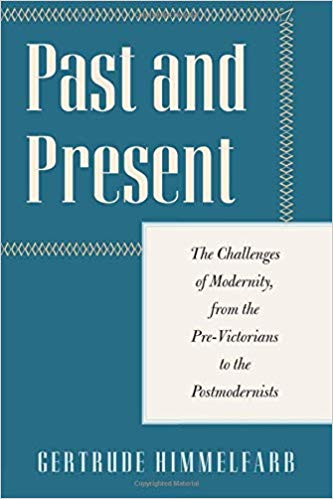
I was thinking this just now while reading the first essay in Himmelfarb’s latest and possibly last book of essays: Past and Present. It is about Strauss (another formative influence). What a paradise it would have been to be among the “Ivy Leaguers” of the post-War and ‘fifties; during a long-lost American adventure into the world of ideas. Himmelfarb was the last of that team of adventurers, I was thinking; the landscape now is, intellectually, barren. Even to participate in “high culture” — what Matthew Arnold innocently called, “the best that has been thought and said” — is to put a professor at physical risk.

Leo Strauss explained somewhere, or in several places, that the student of the past must be prepared to learn something — “not merely about the thinkers of the past, but from them.”

Today’s student (if any are left in the humanities), replies with incomprehension. What an affront it is, to a later academy, in which the only purpose for the past is to judge it, by the asinine prejudices of the present day.

Divine Caesar Augustus, Master of Propaganda – January 1, 2020 – TimeGhost of Christmas Past Day 9

Filed under: Europe, History, Religion — Tags: , , , — Nicholas @ 04:00

TimeGhost History
143K subscribers
Dissent This
Julius Caesar was already associated with the Divine during his life. But two years after his death, he was officially declared so by the Senate of Rome. Very much to benefit of his cousin, Octavian.

Join us on Patreon: https://www.patreon.com/TimeGhostHistory

Hosted by: Indy Neidell
Written by: Joram Appel
Directed and Produced by: Spartacus Olsson and Astrid Deinhard
Executive Producers: Bodo Rittenauer, Astrid Deinhard, Indy Neidell, Spartacus Olsson
Creative Producer: Joram Appel
Post-Production Director: Wieke Kapteijns
Research by: Joram Appel
Edited by: Karolina Dołęga
Sound design: Marek Kamiński

Sources:
Wellcome Library no. 42647i
Calendar by Lorena Salagre from the Noun Project

Music from Epidemic Sound Library:
“A Sleigh Ride Into Town” – Howard Harper-Barnes
“Ancient Saga” – Max Anson
“Thunder Storm 01” – Fredrik Ekstrom

A TimeGhost chronological documentary produced by OnLion Entertainment GmbH.

From the comments:

TimeGhost History
1 week ago
Happy New Year! We have some amazing videos coming up in the new year, but not before we publish the final instalment of our TimeGhost of Christmas Past episode. This one is my personal favourite, as I’m a huge fan of the late Roman Republic and early Empire as a historical study object. So when we were dividing the Christmas episodes among the research team, I fought for this one to be on the list. I had a blast writing it (surprisingly, I don’t get to write about Caesar that often for the WW2 Channel) and I hope you all enjoy watching it.
Cheers,
Joram

The 2010s … the best decade (so far) in human history

Matt Ridley explains why, despite all the doom and gloom in the daily headlines, the last ten years have been the best by almost any measure:

Let nobody tell you that the second decade of the 21st century has been a bad time. We are living through the greatest improvement in human living standards in history. Extreme poverty has fallen below 10 per cent of the world’s population for the first time. It was 60 per cent when I was born. Global inequality has been plunging as Africa and Asia experience faster economic growth than Europe and North America; child mortality has fallen to record low levels; famine virtually went extinct; malaria, polio and heart disease are all in decline.

Little of this made the news, because good news is no news. But I’ve been watching it all closely. Ever since I wrote The Rational Optimist in 2010, I’ve been faced with “what about …” questions: what about the great recession, the euro crisis, Syria, Ukraine, Donald Trump? How can I possibly say that things are getting better, given all that? The answer is: because bad things happen while the world still gets better. Yet get better it does, and it has done so over the course of this decade at a rate that has astonished even starry-eyed me.

Perhaps one of the least fashionable predictions I made nine years ago was that “the ecological footprint of human activity is probably shrinking” and “we are getting more sustainable, not less, in the way we use the planet”. That is to say: our population and economy would grow, but we’d learn how to reduce what we take from the planet. And so it has proved. An MIT scientist, Andrew McAfee, recently documented this in a book called More from Less, showing how some nations are beginning to use less stuff: less metal, less water, less land. Not just in proportion to productivity: less stuff overall.

This does not quite fit with what the Extinction Rebellion lot are telling us. But the next time you hear Sir David Attenborough say: “Anyone who thinks that you can have infinite growth on a planet with finite resources is either a madman or an economist”, ask him this: “But what if economic growth means using less stuff, not more?” For example, a normal drink can today contains 13 grams of aluminium, much of it recycled. In 1959, it contained 85 grams. Substituting the former for the latter is a contribution to economic growth, but it reduces the resources consumed per drink.

As for Britain, our consumption of “stuff” probably peaked around the turn of the century — an achievement that has gone almost entirely unnoticed. But the evidence is there. In 2011 Chris Goodall, an investor in electric vehicles, published research showing that the UK was now using not just relatively less “stuff” every year, but absolutely less. Events have since vindicated his thesis. The quantity of all resources consumed per person in Britain (domestic extraction of biomass, metals, minerals and fossil fuels, plus imports minus exports) fell by a third between 2000 and 2017, from 12.5 tonnes to 8.5 tonnes. That’s a faster decline than the increase in the number of people, so it means fewer resources consumed overall.

H/T to Damian Penny for the link.

Tank Chats #57 Churchill AVRE | The Funnies | The Tank Museum

Filed under: Britain, History, Military, WW2 — Tags: , , , — Nicholas @ 02:00

The Tank Museum
Published 20 Sep 2018

Another episode in the Tank Chats Funnies Specials, with David Fletcher looking at the weird and wonderful vehicles of 79th Armoured Division led by Major General Percy Hobart, known as “Hobart’s Funnies”.

The Churchill AVRE (Armoured Vehicle Royal Engineers). The Churchill was the basis for a number of Funnies. David Fletcher looks at the Fascine, Bobbin, Small Box Girder bridge, Bullshorn plough, Conger, the Churchill ARK and Bridgelayer.

Support the work of The Tank Museum on Patreon: ► https://www.patreon.com/tankmuseum
Or donate http://tankmuseum.org/support-us/donate

Visit The Tank Museum SHOP: ► https://tankmuseumshop.org/

Twitter: ► https://twitter.com/TankMuseum
Tiger Tank Blog: ► http://blog.tiger-tank.com/
Tank 100 First World War Centenary Blog: ► http://tank100.com/ #tankmuseum #tanks #tankchats

QotD: Anime

Filed under: Humour, Japan, Media, Quotations — Tags: — Nicholas @ 01:00

From a conversation elsewhere:

    Friend A: “Anime by itself isn’t supposed to be cringy. There’s lots of good anime out there.”

    Friend B: “Intentional or not, that’s the effect on me.”

    Friend A: “Well, what anime have you watched?”

    Friend B: “Let’s see… Pantyflash Crisis, Fanservice High School, and Animal-Eared Preteens, I believe.”

I laughed so hard I nearly lost continence.

Tamara Keel, “Overheard Online…”, View From The Porch, 2019-10-16.

« Newer PostsOlder Posts »

Powered by WordPress