Quotulatiousness

April 29, 2020

“The war on ultraviolet radiation because it might help Trump is an educational moment”

Arthur Chrenkoff on the sudden decision that the World Health Organization is the ultimate arbiter of what we’re allowed to say on social media platforms like Twitter and YouTube:

There is of course no evidence that the video represents any disinformation. It relates to legitimate scientific research by a medical company conducted in association with a respected hospital to develop a novel treatment of possibly crucial importance in the current conditions and into the future. The only problem with the video is that is indirectly supports Trump’s flight of fancy speculation about using light and chemicals to “disinfect” the body. Ergo, according to a NYT journalist it represents a problem and YouTube agrees. YouTube now has a standing policy of removing COVID information that goes against the World Health Organisation’s guidelines. Putting aside the question of the WHO’s credibility in the wake of the pandemic, we are not talking here about some guy in a tinfoil hat talking about 5G towers spreading the virus; this is a video relating to ongoing, respectable scientific research. Will it work? Probably not. But perhaps neither will any of the 150 or so COVID-19 vaccines being currently developed around the world. We won’t know until we know. But in the meantime, scientific news should not be censored, period.

[…]

Goldsmith and Woods are correct in pointing out not only the greater role that governments have been playing in regulating speech but more importantly how much of that effort has been embraced and driven by the big tech — and by the private individuals enabled and encouraged by the big tech — what I have previously called the “democratised censorship”. The difference is that people like Goldsmith and Woods think that’s a good thing.

The dirty little secret is that a great number of leftists, progressives and even centrist technocrats and activists look at China, with its authoritarian government, social credit score system, ubiquitous surveillance, and the ability to “get things done” and done quickly and supposedly efficiently (in China, bullet trains run on time, I hear), and pine for such a system to be applied in their own countries — as long as, of course, they are the ones in power and decide what is right, important and valuable. The left’s objections are rarely against authoritarianism and its means and methods per se, just with the possibility that someone else — like Trump — is the one behind the wheel, implementing their, not the left’s, agenda.

The war on ultraviolet radiation because it might help Trump is an educational moment. One could say, first they came for crazy conspiracy theorists and I said nothing because I’m not an anti-vaxxer or anti-5G activist — and so on. The problem with censorship is that it keeps creeping up on everyone else. And those who do the censoring — who decide what the ignorant masses should and shouldn’t be allowed to read — are not some detached and impartial spiritual beings but people with political agendas. People who think that ideas and beliefs of one half of the society are harmful and offensive. People who will censor news that doesn’t fit the agenda and support the narrative.

And then they came for ultraviolet radiation… You have been warned.

Curator’s Tour of The Tank Museum | Blitzkrieg | WW2: Part 1

Filed under: Britain, Europe, France, Germany, History, Military, Weapons, WW2 — Tags: , , , , — Nicholas @ 04:00

The Tank Museum
Published 25 Apr 2020

Join Curator David Willey as he takes you on a tour of The Tank Museum’s Tank Story Hall, which houses over 30 key vehicles from Little Willie to Challenger 2. In this section he looks at early Second World War vehicles and gives you a potted history of the Blitzkrieg.

Support the work of The Tank Museum on Patreon: ► https://www.patreon.com/tankmuseum
Visit The Tank Museum SHOP & become a Friend: ► https://tankmuseumshop.org/

Twitter: ► https://twitter.com/TankMuseum
Instagram: ► https://www.instagram.com/tankmuseum/
Tiger Tank Blog: ► http://blog.tiger-tank.com/
Tank 100 First World War Centenary Blog: ► http://tank100.com/
#tankmuseum #tanks #MuseumFromHome

“If it saves just one life…”

Filed under: Economics, Government, Health, Liberty — Tags: , , — Nicholas @ 03:00

Antony Davies and James R. Harrigan on the rallying cry of the Karens of all genders:

In times of crisis, politicians want to look like they’re doing something, and don’t want to hear about limits on their authority. In times of crisis, people want someone to do something, and don’t want to hear about tradeoffs. This is the breeding ground for grand policies driven by the mantra, “if it saves just one life.” New York Governor Andrew Cuomo invoked the mantra to defend his closure policies. The mantra has echoed across the country from county councils to mayors to school boards to police to clergy as justification for closures, curfews, and enforced social distancing.

Rational people understand this isn’t how the world works. Regardless of whether we acknowledge them, tradeoffs exist. And acknowledging tradeoffs is an important part of constructing sound policy. Unfortunately, even mentioning tradeoffs in a time of crisis brings the accusation that only heartless beasts would balance human lives against dollars. But each one of us balances human lives against dollars, and any number of other things, every day.

Five-thousand Americans die each year from choking on solid food. We could save every one of those lives by mandating that all meals be pureed. Pureed food isn’t appetizing, but if it saves just one life, it must be worth doing. Your chance of dying while driving a car is almost double your chance of dying while driving an SUV. We could save lives by mandating that everyone drive bigger cars. SUVs are more expensive and worse for the environment, but if it saves just one life, it must be worth doing. Heart disease kills almost 650,000 Americans each year. We could reduce the incidence of heart disease by 14 percent by mandating that everyone exercise daily. Many won’t want to exercise every day, but if it saves just one life, it must be worth doing.

Legislating any of these things would be ridiculous, and most sane people know as much. How do we know? Because each of us makes choices like these every day that increase the chances of our dying. We do so because there are limits on what we’re willing to give up to improve our chances of staying alive. Our daily actions prove that none of us believes that “if it saves just one life” is a reasonable basis for making decisions. Yet, when a threat like the coronavirus emerges, we go looking for an imaginary cure that will save lives without tradeoffs.

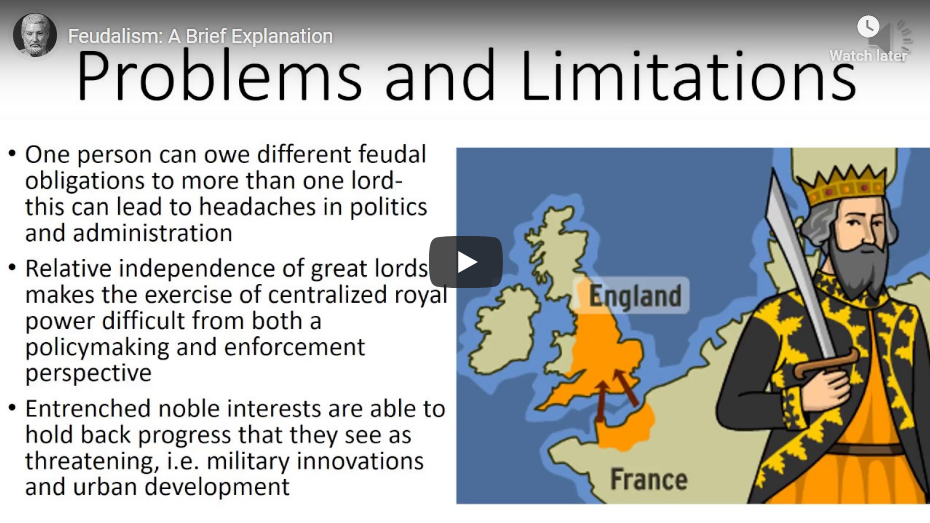
Feudalism: A Brief Explanation

Thersites the Historian
Published 26 Oct 2017

In this video, I try to bring order to the chaos that is feudalism and render it comprehensible.

QotD: “Ethical” ways to prevent scientific progress

Filed under: Bureaucracy, Health, Politics, Quotations, Science — Tags: , , , — Nicholas @ 01:00

The stigmatization of science is also jeopardizing the progress of science itself. Today anyone who wants to do research on human beings, even an interview on political opinions or a questionnaire about irregular verbs, must prove to a committee that he or she is not Josef Mengele. Though research subjects obviously must be protected from exploitation and harm, the institutional-review bureaucracy has swollen far beyond this mission. Its critics have pointed out that it has become a menace to free speech, a weapon that fanatics can use to shut up people whose opinions they don’t like, and a red-tape dispenser that bogs down research while failing to protect, and sometimes harming, patients and research subjects. Jonathan Moss, a medical researcher who had developed a new class of drugs and was drafted into chairing the research-review board at the University of Chicago, said in a convocation address, “I ask you to consider three medical miracles we take for granted: X-rays, cardiac catheterization, and general anesthesia. I contend all three would be stillborn if we tried to deliver them in 2005.” The same observation has been made about insulin, burn treatments, and other lifesavers.

The hobbling of research is not just a symptom of bureaucratic mission creep. It is actually rationalized by many bioethicists. These theoreticians think up reasons that informed and consenting adults should be forbidden to take part in treatments that help them and others while harming no one. They use nebulous rubrics like “dignity,” “sacredness,” and “social justice.” They try to sow panic about advances in biomedical research with far-fetched analogies to nuclear weapons and Nazi atrocities, science-fiction dystopias like Brave New World and Gattaca, and freak-show scenarios like armies of cloned Hitlers, people selling their eyeballs on eBay, and warehouses of zombies to supply people with spare organs. The University of Oxford philosopher Julian Savulescu has exposed the low standards of reasoning behind these arguments and has pointed out why “bioethical” obstructionism can be unethical: “To delay by 1 year the development of a treatment that cures a lethal disease that kills 100,000 people per year is to be responsible for the deaths of those 100,000 people, even if you never see them.”

Steven Pinker, “The Intellectual War on Science”, Chronicle of Higher Education, 2018-02-13.

April 28, 2020

Robber Barons and the Battle of the Tunnel

Filed under: Business, Government, History, Law, Politics, Railways, USA — Tags: , , , — Nicholas @ 04:00

The History Guy: History Deserves to Be Remembered
Published 1 Feb 2019

During the gilded age ruthless businessmen fought for control of railway lines. The Albany and Susquehanna railroad was another battlefield in the “Railroad wars.” In this episode, The History Guy remembers “the Battle of the Tunnel”.

This is original content based on research by The History Guy. Images in the Public Domain are carefully selected and provide illustration. As images of actual events are sometimes not available, images of similar objects and events are used for illustration.

All events are portrayed in historical context and for educational purposes. No images or content are primarily intended to shock and disgust. Those who do not learn from history are doomed to repeat it. Non censuram.

Patreon: https://www.patreon.com/TheHistoryGuy

The History Guy: History Deserves to Be Remembered is the place to find short snippets of forgotten history from five to fifteen minutes long. If you like history too, this is the channel for you.

Awesome The History Guy merchandise is available at:
teespring.com/stores/the-history-guy

Script by THG

#newyork #thehistoryguy #ushistory

ESR on “Lassie errors” in software

Filed under: Technology — Tags: , , , — Nicholas @ 03:00

I’d never heard this term before, but it’s an excellent description of the problem:

“Interactive UNIX Booting” by mrbill is licensed under CC BY 2.0

Lassie was a fictional dog. In all her literary, film, and TV adaptations the most recurring plot device was some character getting in trouble (in the print original, two brothers lost in a snowstorm; in popular memory “Little Timmy fell in a well”, though this never actually happened in the movies or TV series) and Lassie running home to bark at other humans to get them to follow her to the rescue.

In software, “Lassie error” is a diagnostic message that barks “error” while being comprehensively unhelpful about what is actually going on. The term seems to have first surfaced on Twitter in early 2020; there is evidence in the thread of at least two independent inventions, and I would be unsurprised to learn of others.

In the Unix world, a particularly notorious Lassie error is what the ancient line-oriented Unix editor “ed” does on a command error. It says “?” and waits for another command – which is especially confusing since ed doesn’t have a command prompt. Ken Thompson had an almost unique excuse for extreme terseness, as ed was written in 1973 to run on a computer orders of magnitude less capable than the embedded processor in your keyboard.

Herewith the burden of my rant: You are not Ken Thompson, 1973 is a long time gone, and all the cost gradients around error reporting have changed. If you ever hear this term used about one of your error messages, you have screwed up. You should immediately apologize to the person who used it and correct your mistake.

Part of your responsibility as a software engineer, if you take your craft seriously, is to minimize the costs that your own mistakes or failures to anticipate exceptional conditions inflict on others. Users have enough friction costs when software works perfectly; when it fails, you are piling insult on that injury if your Lassie error leaves them without a clue about how to recover.

Tank Chats #68 T-34 | The Tank Museum

Filed under: History, Military, Russia, Weapons, WW2 — Tags: , , , , , — Nicholas @ 02:00

The Tank Museum
Published 9 Mar 2019

The T-34 is an iconic Soviet Second World War tank. It was the most produced tank of WW2 and remains a symbol of Russian sacrifice in the Great Patriotic War.

David Willey talks about both the T-34/76 and T-34/85 variants, used in World War Two.

Many thanks to RecoMonkey for providing many of the modern images of the T-34 https://www.recomonkey.com/

Support the work of The Tank Museum on Patreon: ► https://www.patreon.com/tankmuseum

Visit The Tank Museum SHOP: ► https://tankmuseumshop.org/
Twitter: ► https://twitter.com/TankMuseum
Tiger Tank Blog: ► http://blog.tiger-tank.com/
Tank 100 First World War Centenary Blog: ► http://tank100.com/ #tankmuseum #tanks #tankchats

QotD: Rent control in Stockholm

Filed under: Bureaucracy, Economics, Europe, Quotations — Tags: , , , , , — Nicholas @ 01:00

Take Sweden, which introduced effective rents controls nationwide in 1947. They were supposed to be a temporary measure, yet they remain in place to this day, despite criticism from academics, think tanks and the OECD. While the intention to create a more socially dynamic society was laudable, the reality has been much bleaker.

Instead of a fairer rental market, where tenants can easily afford rent and live in high-quality housing, Sweden suffers from increased social segregation; eruptions of violence as a result of disagreements in its massive black market of sublet housing; and companies that face immense difficulties in recruiting talent, as potential workers are unable to find suitable accommodation.

Proponents of rent control often emphasise the fairness the measure: rent controls are meant to create a more egalitarian society, where individuals irrespective of their income live in the same neighbourhood and can afford similar quality housing. This could not be further from the truth.

The Swedish experiment shows that it is high-income, well-educated individuals who benefit from rent controls the most, whereas less-educated, or not as well-connected individuals such as younger renters or immigrants, are highly disadvantaged by the system.

In theory, housing stock that becomes available for rent is allocated through the Stockholm Housing Agency, which ensures the rental prices are kept on “an average level”. The average waiting time in Stockholm for such housing allocation is over 11 years. As tenants realise the true value of their contract — e.g. the money they can receive for their apartment on the secondary rental market — they are unwilling to return the property to the agency, even when they move out. Instead, they rent it out to someone in their extended circle of friends or exchange the flat for one in a different area — only in practice, not on paper of course. No wonder that only 0.5% of the housing is returned to the agency, resulting in a massive queue of 670,000 people on Stockholm’s housing waitlist — out of a total population of 970,000.

This system benefits the most well-connected individuals, but highly disadvantages people who lack broad social connections. These groups are often forced into the informal rental market, where the prices are on average double that of the official rent controlled numbers. One in five young Swedish renters face have admitted renting on the black market. Due to the lack of legal arbitration, disagreements between parties can lead to violence and in some cases even murder.

Another problem has been the inflexibility of rental contracts, which have made it difficult for people to move between cities, leading to a fifth of Swedish companies facing severe recruitment problems due to the lack of suitable housing.

Adam Bartha, “Rent controls have failed in cities throughout Europe”, Institute of Economic Affairs, 2020-01-23.

April 27, 2020

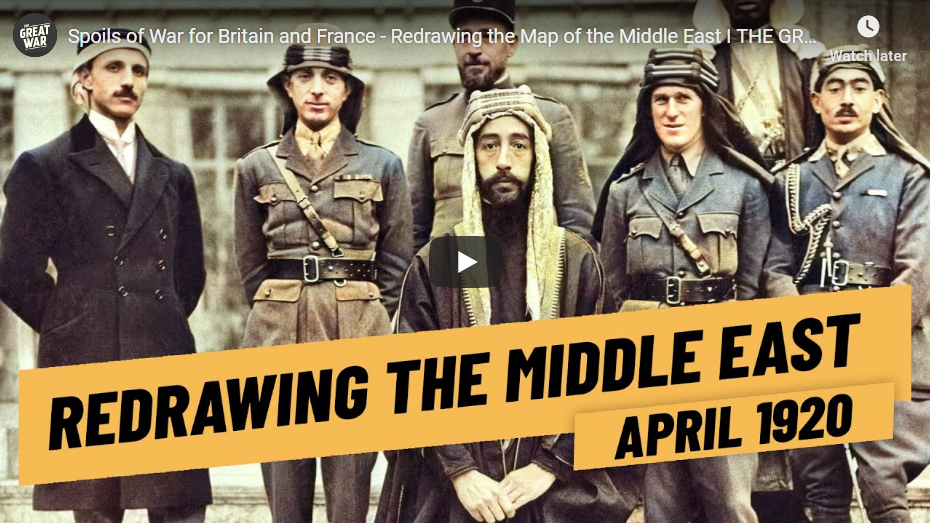
Spoils of War for Britain and France – Redrawing the Map of the Middle East I THE GREAT WAR 1920

The Great War
Published 25 Apr 2020

Sign up for Curiosity Stream and Nebula – and get 40% off annual plans right now: https://curiositystream.com/thegreatwar

100 years ago at the conference of San Remo, one thing became clear: Great Britain and France wanted control over the Middle East. Justified by the fighting in the previous years and painted as “liberators” of the Middle Eastern minorities, the new map of the Middle East emerged – under the cover of the League of Nations Mandate system.

» SUPPORT THE CHANNEL
Patreon: https://www.patreon.com/thegreatwar
Merchandise: https://shop.spreadshirt.de/thegreatwar/

» SOURCES
Karsh, Efraim & Karsh, Inari, Empires of the Sand: The Struggle for Mastery in the Middle East 1789-1923, (Cambridge, MA : Harvard University Press, 1999)

“Dans Le Levant” Le Temps, August 31, 1919 issue, https://gallica.bnf.fr/ark:/12148/bpt…

Lloyd George, David, Memoirs of the Peace Conference, (New Haven : Yale University Press, 1939) vol. 2

“Mounted Rifles Units” New Zealand History, https://nzhistory.govt.nz/war/aucklan…

Paris, Timothy J. Britain, The Hashemites and Arab Rule 1920-1925, (London : Frank Cass, 2003)

Provence, Michael, The Last Ottoman Generation and the Making of the Modern Middle East, (Cambridge : Cambridge University Press, 2017)

O’Neill, Robert, Official History of Australia in the War of 1914–1918, Volume VII – The Australian Imperial Force in Sinai and Palestine, 1914–1918, (Australian War Memorial, 1941)

“King-Crane Commission Digital Collection” Oberlin College Library. http://dcollections.oberlin.edu/cdm/s…

» SOCIAL MEDIA
Instagram: https://instagram.com/the_great_war
Twitter: https://twitter.com/WW1_Series
Reddit: https://reddit.com/r/TheGreatWarChannel

»CREDITS
Presented by: Jesse Alexander
Written by: Jesse Alexander
Director: Toni Steller & Florian Wittig
Director of Photography: Toni Steller
Sound: Toni Steller
Editing: Toni Steller
Mixing, Mastering & Sound Design: http://above-zero.com
Maps: Daniel Kogosov (https://www.patreon.com/Zalezsky)
Research by: Jesse Alexander
Fact checking: Florian Wittig

Channel Design: Alexander Clark
Original Logo: David van Stephold

A Mediakraft Networks Original Channel

Contains licensed material by getty images
All rights reserved – Real Time History GmbH 2020

The NFL may have a problem … everyone seems to have liked the virtual draft better than the “real” thing

Filed under: Business, Football, Media, Technology — Tags: , , , — Nicholas @ 05:00

It is usually difficult to muster much sympathy for the National Football League, but the record-setting popularity of the 2020 draft is a huge surprise:

The unique presentation of the 2020 NFL Draft established new all-time highs for media consumption in every category. With over 600 camera feeds from homes across the United States, all telecasts of the 2020 NFL Draft reached more than 55 million total viewers across Nielsen-measured channels over the three-day event, up +16% vs. 2019. An average audience of over 8.4 million viewers watched all three days of the 2020 NFL Draft across ABC, ESPN, NFL Network, ESPN Deportes, and digital channels easily breaking the previous high of 6.2 million viewers in 2019 (+35%).

Each day of the 2020 NFL Draft established new highs as an average audience of over 15.6 million viewers watched Round 1 on Thursday (+37% vs. 2019), over 8.2 million viewers watched Rounds 2 & 3 on Friday (+40% vs. 2019), and over 4.2 million viewers watched Rounds 4-7 on Saturday (+32% vs. 2019).

All seven rounds of the 2020 NFL Draft were presented across ABC, ESPN, and NFL Network – the second straight year that The Walt Disney Company partnered with the National Football League to offer a multi-network presentation of the entire Draft.

“I couldn’t be more proud of the efforts and collaboration of our clubs, league personnel, and our partners to conduct an efficient Draft and share an unforgettable experience with millions of fans during these uncertain times,” said NFL Commissioner Roger Goodell. “This Draft is the latest chapter in the NFL’s storied history of lifting the spirit of America and unifying people. In addition to celebrating the accomplishments of so many talented young men, we were pleased that this unique Draft helped shine a light on today’s true heroes – the healthcare workers, first responders, and countless others on the front lines in the battle against COVID-19. We are also grateful to all those who contributed to the NFL family’s fundraising efforts.”

“This year’s NFL Draft clearly took on a much greater meaning and it’s especially gratifying for ESPN to have played a role in presenting this unique event to a record number of NFL fans while supporting the league’s efforts to give back,” said ESPN President Jimmy Pitaro. “The success of this year’s Draft is a testament to the unprecedented collaboration across the NFL, ESPN, and The Walt Disney Co. in the midst of such a challenging time.”

The unique situation of having the vast majority of televised sports activities suspended clearly made a big difference — when you’re the only game in town, you can expect a wider audience — but the online draft seems to have been popular even among people who normally would have tuned in for the event anyway.

The Economy of Ancient Rome

Filed under: Economics, Europe, History — Tags: , , , , , — Nicholas @ 04:00

Economics Explained
Published 26 Apr 2020

Ancient Rome was perhaps the most significant ancient civilisation to have existed throughout history, the empire lived for over 1000 years and in that time, it gave us the foundations for our modern society. Democracy, a court based legal system, Latin languages and alphabet, three course meals, and perhaps it was one of the first modern economies to move beyond a simple agrarian empire and develop things like modern banking, lending, taxation and yes even financial crisis as we know them today.

In the same way that scholars study a dead language like Latin to discerned the foundation of meaning in our modern dialects economists can study the histories of ancient civilisations like Rome to determine basic economic functions in a time before modern financial systems could skew results and Rome was perhaps the most developed case study we could look at.

#rome #economics #recession

Patreon – https://www.patreon.com/EconomicsExpl…

Discord – https://discord.gg/7kM7Tw9

Enquiries – loungejita@gmail.com

References –

Morley, N., 2002. Metropolis and hinterland: the city of Rome and the Italian economy, 200 BC-AD 200. Cambridge University Press.

Temin, P., 2006. “The economy of the early Roman Empire”. Journal of Economic Perspectives

Temin, P., 2017. The Roman market economy. Princeton University Press.

Garnsey, P., Hopkins, K. and Whittaker, C.R. eds., 1983. Trade in the ancient economy

Brown, P., 2012. Through the Eye of a Needle: Wealth, the Fall of Rome, and the Making of Christianity in the West, 350-550 AD. Princeton University Press.

Braund, D.C., 1983. Gabinius, Caesar, and the publicani of Judaea. Klio

Articles

http://penelope.uchicago.edu/Thayer/E…

https://www.rug.nl/ggdc/historicaldev…

https://www.pwc.com.au/publications/a…

Entrepreneurs beyond the atmosphere

Filed under: Government, Law, Liberty, Space, USA — Tags: , , , , — Nicholas @ 03:00

Doug Bandow reacts to Donald Trump’s executive order that begins to clear the way for private enterprise in space:

Taken by Apollo 8 crewmember Bill Anders on December 24, 1968, at mission time 075:49:07 (16:40 UTC), while in orbit around the Moon, showing the Earth rising above the lunar horizon.

Despite the current chaos caused by the coronavirus, Washington still must consider the future. Which explains the president’s new executive order that would allow private resource development on the moon and asteroids. It clearly rejects the “common heritage of mankind” rhetoric deployed by the United Nations on behalf of the Law of the Sea Treaty, which four decades ago created a special UN body to seize control of seabed resources.

The Future of Space Exploration

The EO issued earlier this month explained that

    Successful long-term exploration and scientific discovery of the Moon, Mars, and other celestial bodies will require partnership with commercial entities to recover and use resources, including water and certain minerals, in outer space.

The measure began the process of revising an uncertain legal regime which currently discourages private sector development.

The administration pointed to the 1979 Agreement Governing the Activities of States on the Moon and Other Celestial Bodies (known as the Moon treaty) and the 1967 Treaty on Principles Governing the Activities of State in the Exploration and Use of Outer Space, including the Moon and Other Celestial Bodies (typically called the Outer Space Treaty). Neither is friendly to entrepreneurs or explorers with a commercial bent.

In response, the president announced that

    Americans should have the right to engage in commercial exploration, recovery, and use of resources in outer space, consistent with applicable law. Outer space is a legally and physically unique domain of human activity, and the United States does not view it as a global commons. Accordingly, it shall be the policy of the United States to encourage international support for the public and private recovery and use of resources in outer space, consistent with applicable law.

Space is a Long-Term Prospect

The document’s main directive is for the Secretary of State, in cooperation with other agencies, to “take all appropriate actions to encourage international support for the public and private recovery and use of resources in outer space.” The secretary is to “negotiate joint statements and bilateral and multilateral arrangements with foreign states regarding safe and sustainable operations for the public and private recovery and use of space resources.”

Obviously, the administration’s attention is directed elsewhere at the moment. However, the potential benefits of turning to space are significant. The value of scientific research is obvious and continues to drive government agencies such as NASA. Launch services and space tourism have caught the interest of private operators. Such activities offer fewer legal and practical difficulties than attempting to establish some sort of long-term presence in the great beyond.

More complex development of space is a longer-term prospect. However, that makes it even more imperative to encourage innovation by creating institutions and incentives that encourage responsible development of what truly is the “final frontier.”

Prehistory Summarized: Evolution

Filed under: History, Humour, Science — Tags: , , — Nicholas @ 02:00

Overly Sarcastic Productions
Published 5 Dec 2015

Third video in a week? Good lord, what have they been feeding us?

Anyway, Blue’s back, this time with more history! The exciting conclusion to the three-part video series! Our “Return Of The King”! Our “Return Of The Jedi”! Our… wow, a lot of “part three”s are the return of something or other, aren’t they? Let’s pretend this is “The Return Of Bruce”.

QotD: H.L. Mencken’s literary theory

Filed under: Liberty, Politics, Quotations, USA — Tags: , , , — Nicholas @ 01:00

As for me, my literary theory, like my politics, is based chiefly upon one main idea, to wit, the idea of freedom. I am, in brief, a libertarian of the most extreme variety, and know of no human right that is one-tenth as valuable as the simple right to utter what seems (at the moment) to be the truth. Take away this right, and none other is worth a hoot; nor, indeed, can any other long exist. Debauched by that notion, it follows necessarily that I can be only an indifferent citizen of a democratic state, for democracy is grounded upon the instinct of inferior men to herd themselves in large masses, and its principal manifestation is their bitter opposition to all free thought. In the United States, in fact, I am commonly regarded as a violent anti-patriot. But this is simply because most of the ideas upon which American patriotism bases itself seem to me to be obviously sentimental and nonsensical — that is, they have, for me at least, no intelligible relation to the visible facts. I do not object to patriotism when it is logically defensible. On the contrary, I respect it as a necessary corollary to the undeniable inequality of races and people. Its converse, internationalism, appears to me to be almost insane. What an internationalist says, stripping it of rhetoric, is simply that a lion is no more than a large rat.

H.L. Mencken, “Private Reflections”, The Smart Set, 1922-12.

« Newer PostsOlder Posts »

Powered by WordPress