
Rex Krueger
Publisheed 2 Sep 2020Take five tools and some construction furniture and make a REAL piece of furniture.
More video and exclusive content: http://www.patreon.com/rexkrueger
(more…)
September 3, 2020
Make a traditional milking stool. Limited tools. No Bench.
Comments Off on Make a traditional milking stool. Limited tools. No Bench.
Fallen Flag — The Great Northern Railway
 This month’s Classic Trains featured fallen flag is an American railway that definitely deserved to call itself “great”, James J. Hill’s Great Northern Railway. Hill was noteworthy as the only “Robber Baron” of that era who was scrupulous in avoiding government entanglements (including grants, loans, subsidies, and other forms of money-with-political-strings-attached), building his entire railway system using private funds and rational profit-oriented economic decision-making (the other transcontinental lines often over-built to claim higher subsidies or added money-losing branch lines to please powerful politicians). The result was that when economic hard times hit the railway business, his was the only transcontinental that never needed to declare bankruptcy.
In an earlier post, Dane Stuhlsatz summarized the GN’s engineering:
Hill’s line […] was methodically surveyed and built, on the shortest routes possible, with the least gradient possible, and using the best steel and other materials on the market at the time. Rather than political largess, Hill made his decisions based on profit and loss. But, for all the efficiency that Hill built into his line — he was able to transport across the country faster, cheaper, and with less maintenance costs than could the UP and CP — arguably the most important aspect for the viability of his business was the freedom to conduct business untethered by the strings that accompanied government subsidies.

Route map of the Great Northern Railway, circa 1920. Red lines are Great Northern trackage; dotted lines are other railroads.
Map by Elkman via Wikimedia Commons.
George Drury outlines the origins of the railway:
In 1857, the Minnesota & Pacific Railroad was chartered to build a line from Stillwater, Minnesota, on the St. Croix River, through St. Paul and St. Cloud to St. Vincent, in the northwest corner of the state. The company defaulted after completing a roadbed between St. Paul and St. Cloud, Minnesota, and its charter was taken over by the St. Paul & Pacific Railroad, which ran its first train between St. Paul and St. Anthony (now Minneapolis) in 1862.
For financial reasons the railroads were reorganized as the First Division of the St. Paul & Pacific. Both StP&P companies were soon in receivership, and Northern Pacific, with which the StP&P was allied, went bankrupt in the Panic of 1873.
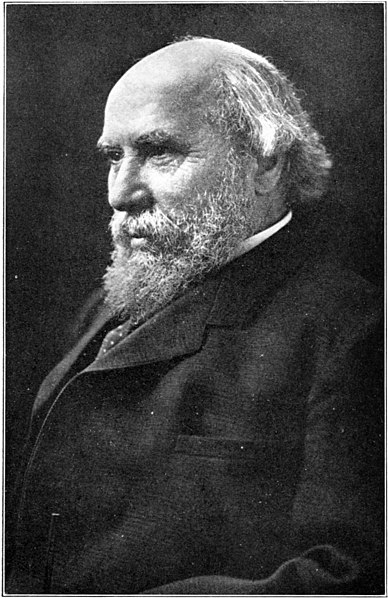
Canadian-born “Robber Baron” James J. Hill (1838-1916) in 1914.
In 1878 James J. Hill and an associate, George Stephen, acquired the two St. Paul & Pacific companies and reorganized them as the St. Paul, Minneapolis & Manitoba Railway (“the Manitoba”). By 1885 the company had 1,470 miles of railroad and extended west to Devils Lake, North Dakota. In 1886 Hill organized the Montana Central Railway to build from Great Falls, Montana, through Helena to Butte, and in 1888 the line was opened, creating in conjunction with the StPM&M a railroad from St. Paul to Butte.
In 1881 Hill took over the 1856 charter of the Minneapolis & St. Cloud Railroad. He first used its franchises to build the Eastern Railway of Minnesota from Hinckley, Minnesota, to Superior, Wisconsin, and Duluth. Its charter was liberal enough that he chose it as the vehicle for his line to the Pacific. He renamed the road the Great Northern Railway; it then leased the Manitoba and assumed its operation.
[…]
Even before completion of the route from St. Paul, the Great Northern opened a line along the shore of Puget Sound between Seattle and Vancouver, British Columbia, in 1891. In the years that followed, Hill pushed a number of lines north across the international boundary into the mining area of southern British Columbia in a running battle with Canadian Pacific. In 1912 GN traded its line along the Fraser River east of Vancouver to Canadian Northern for trackage rights into Winnipeg.
Great Northern gradually withdrew from British Columbia after Hill’s death. In 1909 the Manitoba Great Northern Railway purchased most of the property of the Midland Railway of Manitoba (lines from the U.S. border to Portage la Prairie and to Morden), leaving the Midland, which was jointly controlled by GN and NP, with terminal properties in Winnipeg. The Manitoba Great Northern disposed of its rail lines in 1927. They were later abandoned.

Postcard photo of the Great Northern Railway’s “Empire Builder” streamliner between Everett and Seattle, Washington, circa 1963.
Great Northern Railway postcard via Wikimedia Commons.
The Great Northern and Northern Pacific lines agreed to a merger in 1901 (both lines were controlled by Hill) but the plan was vetoed by the Interstate Commerce Commission. A second attempt in the 1920s after Hill’s death was again turned down by the regulator unless the combined company divested ownership of the Chicago, Burlington & Quincy which was both railways’ connection from Minneapolis to Chicago. It was only on the final attempt in 1970 that the deal gained the government’s grudging approval and the Great Northern, Northern Pacific, and CB&Q merged to form the Burlington Northern.
Comments Off on Fallen Flag — The Great Northern Railway
Britain and France vs. The World | The Suez Crisis | Part 2
TimeGhost History
Published 2 Sep 2020After much delay, Britain and France finally keep to their side of the bargain with Israel and begin their bombing campaign of Egypt. But the condemnation from America and the UN calls into question how long the invaders can keep this up.
Join us on Patreon: https://www.patreon.com/TimeGhostHistory
Hosted by: Indy Neidell
Written by: Francis van Berkel and Joram Appel
Director: Astrid Deinhard
Producers: Astrid Deinhard and Spartacus Olsson
Executive Producers: Astrid Deinhard, Indy Neidell, Spartacus Olsson, Bodo Rittenauer
Creative Producer: Joram Appel
Post-Production Director: Wieke Kapteijns
Research by: Francis van Berkel and Joram Appel
Image research by: Shaun Harrison & Karolina Dołęga
Edited by: Karolina Dołęga
Sound design by: Marek KamińskiColorizations by:
Mikołaj Uchman
Daniel Weiss
Norman Stewart – https://oldtimesincolor.blogspot.com/Visual Sources:
Israeli Defense Forces
National Photo Collection of Israel
Universal Studios
Tony Clarke Collection – David Whitworth from Wikimedia Commons
Abubiju from Wikimedia Commons
Fortepan Donor
Government Press Office (Israel)
National Archives NARA
Icons from The Noun Project by: Gilberto, Komkrit Noenpoempisut, Alice Design, SmalllikeMusic:
“As the Rivers Collapse” – Deskant
“Moving to Disturbia” – Experia
“March Of The Brave 10” – Rannar Sillard – Test
“Weapon of Choice” – Fabien Tell
“Disciples of Sun Tzu” – Christian Andersen
“London” – Howard Harper-Barnes
“Maze Heist” – Max Anson
“Descending Mount Everest” – Trailer WorxArchive by Screenocean/Reuters https://www.screenocean.com.
A TimeGhost chronological documentary produced by OnLion Entertainment GmbH.
From the comments:
TimeGhost History
2 days ago (edited)
This episode is pretty much the same as the last, only turned up to 11. Israel continues making gains in Sinai, but they are now aided by British and French air forces that have finally arrived.Meanwhile, Britain and France continue lying through their teeth about any collusion with Israel. The British Foreign Minister will lie to his own Parliament about military collaboration while French ships are supporting an Israeli offensive against the settlement of Rafah.
The economic costs of this also become very apparent in this episode. Nasser successfully closes the Canal, and with America in no mood to help, the whole of Europe faces oil shortages.
In short, the whole thing is a mess. Don’t worry though, Indy will guide you through it.

Comments Off on Britain and France vs. The World | The Suez Crisis | Part 2
“[L]ooting is a powerful tool to bring about real, lasting change in society.”
Not everyone on the progressive team is all-in on the “Loot your way to utopia”, as Graeme Wood (risking cancellation by his co-religionists) criticizes Vicky Osterweil’s paean to looters and looting:
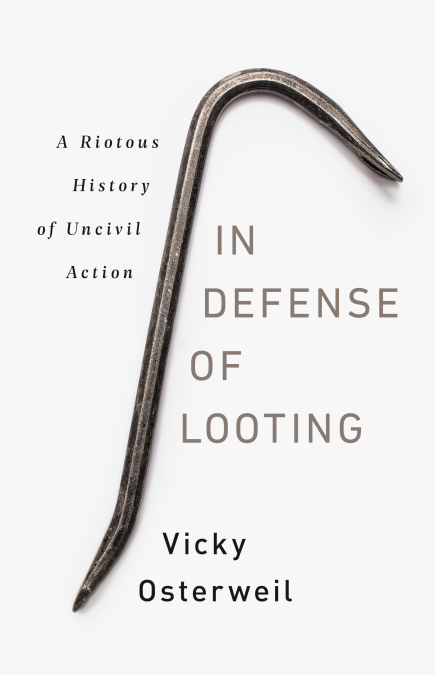
Last week, NPR’s Code Switch published an interview with Vicky Osterweil, the author of In Defense of Looting: A Riotous History of Uncivil Action. NPR summarizes the book as an argument that “looting is a powerful tool to bring about real, lasting change in society.” If the real, lasting change you wish to effect is burning society to cinders and crippling for a generation its ability to serve its poorest citizens, then I suppose I am forced to agree. Osterweil sees an upside. Looting is good, she says, because it exposes a deep truth about the great American confidence game, which is that “without police and without state oppression, we can have things for free.” She came to this conclusion six years ago, and in her book, which is written “in love and solidarity with looters the world over,” she defends this view as ably as anyone could.
Osterweil’s argument is simple. The “so-called” United States was founded in “cisheteropatriarchal racial capitalist” violence. That violence produced our current system, particularly its property relations, and looting is a remedy for that sickness. “Looting rejects the legitimacy of ownership rights and property, the moral injunction to work for a living, and the ‘justice’ of law and order,” she writes. Ownership of things — not just people — is “innately, structurally white supremacist.”
The rest of the remedy is more violence, which she celebrates as an underrated engine for social justice. The destruction of businesses is an “experience of pleasure, joy, and freedom,” Osterweil writes. It is also a form of “queer birth.” “Riots are violent, extreme, and femme as fuck,” according to Osterweil. “They rip, tear, burn, and destroy to give birth to a new world.” She reserves her most pungent criticism for advocates of nonviolence, a “bankrupt concept” primarily valuable for enlisting “northern liberals.” Liberal is pejorative in this book. Martin Luther King Jr. is grudgingly acknowledged as a positive figure, but not as positive a figure as he would have been if he had kicked some white-capitalist ass and put a few pigs in the ICU. The “I Have a Dream” speech was, Osterweil writes, “the product of a series of sellouts and silencings, of nonviolent leaders dampening the militancy of the grass roots” and “sapping the movement’s energy.” More to her taste is Robert F. Williams, who practiced armed resistance, and Assata Shakur, who murdered a New Jersey police officer and remains a fugitive in Cuba. The violence needn’t be in self-defense — Shakur’s certainly was not. Osterweil quotes the “wisdom” of Stokely Carmichael: “Responsibility for the use of violence by black men, whether in self-defense or initiated by them [emphasis mine], lies with the white community.”
By now you have guessed that I am not the audience for this book. I have a job, and am therefore invested in building a system where you get paid for your work and pay others for theirs, and then everyone pays taxes to make sure that if these arrangements don’t work out, you can still have a dignified life. (Easily my favorite line in the book was written not by the author but by her publisher, right under the copyright notice: “The scanning, uploading, and distribution of this book without permission is a theft of the author’s intellectual property,” it says. “Thank you for your support of the author’s rights.”) My job sometimes entails traveling to countries recently or currently destroyed by civil unrest, and that experience has made me appreciate the fragility of peace, and has not made me eager to conduct a similar experiment in my own city.
Comments Off on “[L]ooting is a powerful tool to bring about real, lasting change in society.”
Forging a sword: part five – completion
Lindybeige
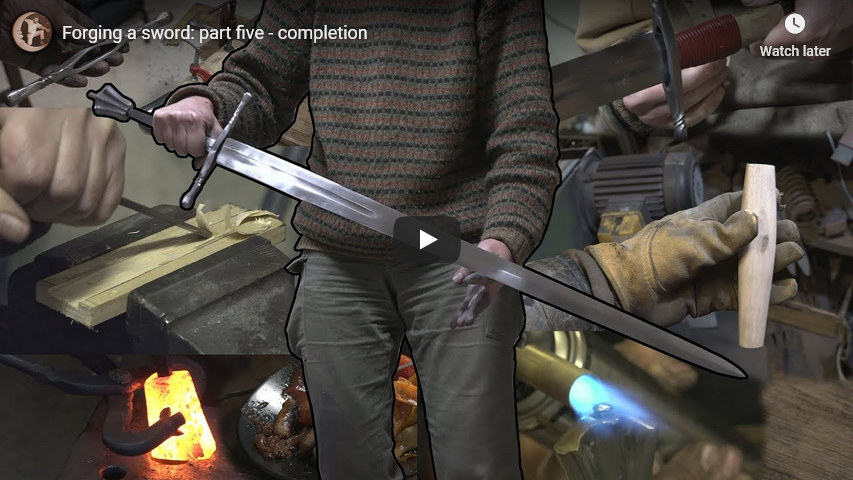
Published 5 Dec 2019I make the pommel and the grip, assemble the hilt, and polish it to a shine. Behold: ARNANDER!
Support me on Patreon: https://www.patreon.com/Lindybeige
Many thanks to The Cut And Thrust Collective for inviting me to Glastonbury to have a go at forging a sword.
My tutor: Thom Leworthy.
Music used in this video: “Siegfried’s Funeral March” by Wagner.
Buy the music – the music played at the end of my videos is now available here: https://lindybeige.bandcamp.com/track…
Buy tat (merch):
https://outloudmerch.com/collections/…Lindybeige: a channel of archaeology, ancient and medieval warfare, rants, swing dance, travelogues, evolution, and whatever else occurs to me to make.
▼ Follow me…
Twitter: https://twitter.com/Lindybeige I may have some drivel to contribute to the Twittersphere, plus you get notice of uploads.
My website:
http://www.LloydianAspects.co.uk
Comments Off on Forging a sword: part five – completion
QotD: Racism
Racism is stupid. Humans come in different shades for obvious biological reasons to do with the intensity of sunlight where their ancestors grew up. Apart from calculating intake of Vitamin D when living in cold climates, it shouldn’t matter. Yet people keep on making it matter — for all kinds of reasons; few if any of them good.
America’s race relations problems arise from its shameful history with slavery. Black Americans clearly feel a sense of solidarity based on that history. I can understand the magnificent language of the Declaration of Independence or the majestic ideas behind the US Constitution are tainted for black American students knowing, as they learn about them, that they didn’t apply to their ancestors. It must be hard for them to take the same pride in the foundation of their great nation as white classmates. I get that “Plymouth Rock landed on us” idea.
Many White Americans do feel a corresponding sense of shame but it’s daft to feel guilty for stuff people who share some random attribute with you did. Short people are not to blame for Napoleon and nor (fun though it is to tease them about him) are French people. No doubt we all do feel pride and shame about our ancestors’ achievements and sins, but it’s nuts to base law or policy on those irrational feelings or to allow them to taint relationships today.
Even if we were to go down the mad road of punishing people for the sins of the fathers, we’d have to find out what those “fathers” actually did, person by person. To do it skin tone by skin tone would itself be racist. It would involve, for example, some British people being heroes because their ancestors sailed with the Royal Navy squadron detailed to suppress the Slave Trade while others are villains because theirs crewed slave ships. There would be no way of knowing if you were hero or villain until you played that historical lottery.
As I told a Jewish American friend who teased me one Fourth of July about losing the American Revolutionary War, “That was a dispute between two sets of my ancestors — yours were in Germany at the time. Stay out of our family quarrels.” That’s a good joke but it would be dumb to base a social science on it. Yet America’s “grievance studies” types have done something remarkably similar in creating the wicked notion of “white privilege”.
Tom Paine, “Checking my privilege”, The Last Ditch, 2020-06-02.
Comments Off on QotD: Racism
September 2, 2020
Hitler’s Hangman and Himmler’s Protégé – Reinhard Heydrich – WW2 Biography Special
World War Two
Published 1 Sep 2020After being taken in by Himmler as a sort of apprentice, Reinhard Heydrich rapidly climbed the Nazi political hierarchy. With the outbreak of World War Two, he expands his political power by ruthlessly carrying out political repression on the home front and genocidal racial policies of the Third Reich.
Join us on Patreon: https://www.patreon.com/TimeGhostHistory
Or join The TimeGhost Army directly at: https://timeghost.tvFollow WW2 day by day on Instagram @ww2_day_by_day – https://www.instagram.com/ww2_day_by_day
Between 2 Wars: https://www.youtube.com/playlist?list…
Source list: http://bit.ly/WW2sources
Written by: Francis van Berkel
Hosted by: Spartacus Olsson
Director: Astrid Deinhard
Producers: Astrid Deinhard and Spartacus Olsson
Executive Producers: Astrid Deinhard, Indy Neidell, Spartacus Olsson, Bodo Rittenauer
Creative Producer: Joram Appel
Post-Production Director: Wieke Kapteijns
Research by: Wolfgang Seitz and Ian Sowden
Edited by: Karolina Dołęga
Sound design: Marek KamińskiColorizations by:
Jaris Almazani (Artistic Man), https://instagram.com/artistic.man?ig…
Spartacus Olsson
Carlos Ortega Pereira, BlauColorizations, https://www.instagram.com/blaucoloriz…Visual Sources:
Bundesarchive
Yad Vashem: 153DO9, 1014/3/42, 4613/360, 48AO4, 2798/2, 1068/17, 3521/134, 3AO1, 1014 5 52, 5138/98, 3227 27, 1014/5/54, 112GO7, 75EO4, 07 1941, 4613_982, 1605/1431, 4613/1055
Riksarkivet: Fo30141711030060
Narodowe Archiwum Cyfrowe
National Archives NARA
Icon from The Noun Project: carlotta zampini
pellethepoet from filckr.jpgMusic:
“Last Point of Safe Return” – Fabien Tell
“March Of The Brave 10” – Rannar Sillard
“Not Safe Yet” – Gunnar Johnsen
“Moving to Disturbia” – Experia
“Easy Target” – Rannar Sillard
“Deflection” – Reynard Seidel
“Please Hear Me Out”- Philip Ayers
“Last Minute Reaction” – Phoenix Tail
“Never Forget” – Fabien Tell
“Other Sides of Glory” – Fabien Tell
“Split Decision” – Rannar SillardArchive by Screenocean/Reuters https://www.screenocean.com.
A TimeGhost chronological documentary produced by OnLion Entertainment GmbH.

Comments Off on Hitler’s Hangman and Himmler’s Protégé – Reinhard Heydrich – WW2 Biography Special
Trust – the limiting factor on Chinese tech firms’ growth
Henrik Tiemroth on the “glass ceiling” that Chinese technology companies are struggling with:
The rise of Chinese technology firms has been one of the major developments of the last decade. As some of those companies expand their operations overseas, some observers see China laying the groundwork for a broader imperial project, using their growing digital might to project power and influence. By 2030, will we all be sending messages on WeChat, searching on Baidu, and shopping on Alibaba?
Probably not. As China’s major tech firms attempt to expand to global markets, they are running into a glass ceiling of their government’s own making: people don’t trust them. The recent ban on ByteDance’s popular social media app TikTok in the United States demonstrates the extent – and the limits – of China’s digital ambitions.
TikTok was the first Chinese internet product to have a mass following in the United States. As of 2020, the app has 100 million active users in the US – about a third of the population. But the popular and seemingly innocuous app for making, viewing and sharing quippy homemade music videos has been declared a national security threat.
In August, President Trump signed an executive order effectively banning the app, along with WeChat, unless their US operations are taken over by a domestic company. Given the close links between Chinese companies like ByteDance and the government, they argue, the data collected on American users of the app could be used by the Chinese state for espionage or other nefarious purposes.
The Trump administration is not the first government to take this step. In July, India banned TikTok, along with 59 other Chinese apps, amid rising tensions with China. The government cited similar concerns about the potential for mining and misuse of private data. Indonesia temporarily banned the platform in 2018, and Japan is reportedly considering following the US’s lead.
Across the world, people are becoming warier of who uses their data and how. Lawmakers are perking up, as the implications of data for national security are becoming more clear. In 2018, the European Union implemented landmark data privacy laws. In the US, tech CEOs are regularly dragged before congressional committees and a bipartisan movement for regulation is building.
Chinese internet companies face those same concerns and then some. It’s one thing to have your personal data used to promote conspicuous consumption. It’s another entirely to have it weaponized by a sophisticated digital surveillance state at the cutting edge of data-driven totalitarianism.

Comments Off on Trust – the limiting factor on Chinese tech firms’ growth
Mortising The Frame and Panel Door | The Cabinet Project #13 | Free Online Woodworking School
Matt Estlea
Published 1 Sep 2020In this video, I’ll show you the quick, accurate way to cut a mortise. While it’s perfectly ok to do this with just a chisel and mallet, it’s quite often quicker to drill the waste out first. Especially on small, delicate components like this that won’t take repeated beating very well!
See the FULL lesson here:
https://mattestlea.com/free-online-wo…
_________________________________________________________________Support what I do by becoming a Patron! This will help fund new tools, equipment and cover my overheads. Meaning I can continue to bring you regular, high quality, free content. Thank you so much for your support! https://www.patreon.com/mattestlea
Don’t want to commit to a monthly direct debit but still want to help out? That’s fine!
You can make a one time donation here: www.mattestlea.com/donate
You can donate us biscuits here: www.mattestlea.com/wishlist
_________________________________________________________________
BUY THE WOODWORKING BIBLE HERE:
www.mattestlea.com/the-woodworkers-manual
_________________________________________________________________SOCIAL MEDIA
Instagram: www.instagram.com/mattestlea
Twitter: www.twitter.com/mattestlea
Patreon: www.patreon.com/mattestlea
Pinterest: www.pinterest.com/mattestlea
LinkedIn: www.linkedin.com/in/matt-estlea-b6414b11a/
_________________________________________________________________
See what tools I use here: www.mattestlea.com/equipment
My Website: www.mattestlea.com
_________________________________________________________________My name is Matt Estlea, I’m a 24 year old Woodworker from Basingstoke in England and my aim is to make your woodworking less s***.
I come from 5 years tuition at Rycotewood Furniture Centre with a further 1 year working as an Artist in Residence at the Sylva Foundation. I now teach City and Guilds Furniture Making at Rycotewood as of September 2018.
If you’re interested in studying at Rycotewood, view their courses here:
www.mattestlea.com/rycotewoodI also had 5 years of experience working at Axminster Tools and Machinery where I helped customers with purchasing tools, demonstrated in stores and events, and gained extensive knowledge about a variety of tools and brands. I discontinued this at the start of 2019 to focus solely on video creation and teaching.
During the week, I film woodworking projects, tutorials, reviews and a viewer favourite ‘Tool Duel’ where I compare two competitive manufacturers tools against one another to find out which is best. I also have a Free Online Woodworking School which you should definitely check out!
www.mattestlea.com/school
I like to have a laugh and my videos are quite fast paced BUT you will learn a lot, I assure you.
Lets go make a mess.

Comments Off on Mortising The Frame and Panel Door | The Cabinet Project #13 | Free Online Woodworking School
Cold War 2.0 — you’re soaking in it
Ted Campbell responds to a recent article in Foreign Affairs by Nadia Schadlow:
Dr Schadlow posits that “A new set of assumptions should underpin U.S. foreign policy … [and, concomitantly, the foreign polices of the US led West, including Canada’s, because] … Contrary to the optimistic predictions made in the wake of the Soviet Union’s collapse, widespread political liberalization and the growth of transnational organizations have not tempered rivalries among countries. Likewise, globalization and economic interdependence have not been unalloyed goods; often, they have generated unanticipated inequalities and vulnerabilities [and] although the proliferation of digital technologies has increased productivity and brought other benefits, it has also eroded the U.S. military’s advantages and posed challenges to democratic societies.”
After outlining the rosy assumption made by leaders and policy makers from Richard Nixon through Bill Clinton to Barack Obama ~ assumption which I shared, Nadia Schadlow says that “China had no intention of converging with the West [because] The Chinese Communist Party never intended to play by the West’s rules; it was determined to control markets rather than open them, and it did so by keeping its exchange rate artificially low, providing unfair advantages to state-owned enterprises, and erecting regulatory barriers against non-Chinese companies. Officials in both the George W. Bush and the Obama administrations worried about China’s intentions. But fundamentally, they remained convinced that the United States needed to engage with China to strengthen the rules-based international system and that China’s economic liberalization would ultimately lead to political liberalization. Instead, China has continued to take advantage of economic interdependence to grow its economy and enhance its military, thereby ensuring the long-term strength of the CCP.” Of course, from a Chinese perspective it might, very reasonably, appear that the liberal, US made (in the late 1940s) “rules based international system” was, in fact, designed to strengthen the US economy and enhance its military and ensure America’s long term strength … and that is not, many would say, a totally unreasonable view.
[…]
America’s allies, including Canada, need to step up and help the USA (and India) with the containment of both China and Russia in several regions: in Asia, Africa, the Middle East and Europe, too. Canada is a G-7 nation. It needs to start acting like one.
Australians, Brits, Canadians and Danes need not share Dr Schadlow’s Trumpian view of the world and of Cold War 2.0 to understand that:
- It is here. We are in it, like it or not; and
- Like its predecessor, it can turn hot if we do not manage it with care.
Now, at this time, the conventional wisdom is that foreign and defence policy must take a back seat to beating COVID-19 and restarting the economy. But, the Chinese and the Russians are not putting their plans on hold while they deal with the pandemic. (Maybe that’s why Justin Trudeau admires China’s “basic dictatorship” so much.) They will both be moving ahead with plans that aim to put the US-led West, including Canada, at a disadvantage. Additionally, now is a good time to announce plans to build more new warships ~ two or three large helicopter carriers, another supply ship (for a total of four) 16 major surface combatants (the new Type 26 ships) and a dozen smaller corvettes … can be and politicians should say will be built here in Canada, by Canadian workers. Defence related projects, when well conceived and directed, can be great long-term job creators. Canada can do both: speed up our recovery from the pandemic and strengthen our global position by making defence procurement a priority for the recovery.

An artist’s rendition of BAE’s Type 26 Global Combat Ship, which was selected as the Canadian Surface Combatant design in 2019, the most recent “largest single expenditure in Canadian government history” (as all major weapon systems purchases tend to be).
(BAE Systems, via Flickr)
Comments Off on Cold War 2.0 — you’re soaking in it
Luger Model 1902 Carbine
Forgotten Weapons
Published 2 Sep 2016Failed to sell at auction.
With the advent of successful self-loading pistols, one of the additional markets that many companies tried to appeal to was the compact carbine. Self-loading rifles in proper rifle cartridges would not be developed as quickly as the pistols because their much greater chamber pressures represented a more difficult engineering problem. However by simply attaching a stock and long barrel to a pistol, many ambitious manufacturers hoped to sell a weapon as a sporting carbine. These were done by DWM with the Luger, as well as Mauser’s C96, Mannlicher 1894 pistol, and many others.
Model 1902 was the designation of the major batch of commercially made Luger carbines, although there were several small batches of prototypes prior. Only a couple thousand were made, and they ultimately took quite a long time to all sell — it turned out this type of firearm was simply not very popular for its cost. The same story was true with the other contemporary pistol-carbines — none would be very successful. DWM did make another group of carbines in the 1920s, although those were made from various leftover parts and are both not as nice as the original 1902 guns (which were mostly made in 1904 and 1905) and widely faked.

Comments Off on Luger Model 1902 Carbine
QotD: Prohibition
Vin Suprynowicz, “On Reporters Who Ask No (Unapproved) Questions”, Libertarian Enterprise, 2018-06-03.
Comments Off on QotD: Prohibition
September 1, 2020
Grooving The Door Frame | The Cabinet Project Part #12 | Free Online Woodworking School
Matt Estlea
Published 31 Aug 2020In this video, we begin grooving the door frame to accept the panel.
Get my plough plane here:
https://kit.co/MattEstlea/hand-planes…_________________________________________________________________
Support what I do by becoming a Patron! This will help fund new tools, equipment and cover my overheads. Meaning I can continue to bring you regular, high quality, free content. Thank you so much for your support! https://www.patreon.com/mattestlea
Don’t want to commit to a monthly direct debit but still want to help out? That’s fine!
You can make a one time donation here: www.mattestlea.com/donate
You can donate us biscuits here: www.mattestlea.com/wishlist
_________________________________________________________________
BUY THE WOODWORKING BIBLE HERE:
www.mattestlea.com/the-woodworkers-manual
_________________________________________________________________SOCIAL MEDIA
Instagram: www.instagram.com/mattestlea
Twitter: www.twitter.com/mattestlea
Patreon: www.patreon.com/mattestlea
Pinterest: www.pinterest.com/mattestlea
LinkedIn: www.linkedin.com/in/matt-estlea-b6414b11a/
_________________________________________________________________
See what tools I use here: www.mattestlea.com/equipment
My Website: www.mattestlea.com
_________________________________________________________________My name is Matt Estlea, I’m a 24 year old Woodworker from Basingstoke in England and my aim is to make your woodworking less s***.
I come from 5 years tuition at Rycotewood Furniture Centre with a further 1 year working as an Artist in Residence at the Sylva Foundation. I now teach City and Guilds Furniture Making at Rycotewood as of September 2018.
If you’re interested in studying at Rycotewood, view their courses here:
www.mattestlea.com/rycotewoodI also had 5 years of experience working at Axminster Tools and Machinery where I helped customers with purchasing tools, demonstrated in stores and events, and gained extensive knowledge about a variety of tools and brands. I discontinued this at the start of 2019 to focus solely on video creation and teaching.
During the week, I film woodworking projects, tutorials, reviews and a viewer favourite ‘Tool Duel’ where I compare two competitive manufacturers tools against one another to find out which is best. I also have a Free Online Woodworking School which you should definitely check out!
www.mattestlea.com/school
I like to have a laugh and my videos are quite fast paced BUT you will learn a lot, I assure you.
Lets go make a mess.

Comments Off on Grooving The Door Frame | The Cabinet Project Part #12 | Free Online Woodworking School
“John from America” and the South Pacific cargo cults
Steven W. Aunan responds to Vicky Osterweil’s recent book on the joy of looting (which was clearly informed by her almost total innocence of any economic understanding) and also tells the story of the perhaps mythical “John from America” and the cargo cults of islanders in the South Pacific during and after World War II:

Ceremonial cross of John Frum cargo cult, Tanna island, New Hebrides (now Vanuatu), 1967.
Photo by Tim Ross via Wikimedia Commons.
In 1940, or so goes the myth, a man who identified himself as “John from America” appeared in a native village in the New Hebrides Islands with a message: Rebel against the colonizers, their missions, their schools, their laws, and John would reward them with free housing, clothing, food, and transportation.
The result was the “John Frum Cargo Cult” that persists to this day in the modern-day South Pacific nation of Vanuatu.
Frum’s message was remarkably similar to Vicky Osterweil’s message: rebel against settler domination, against the history of whiteness, and someone will reward you with all the free stuff you need.
Like Osterweil’s chaotic myth of impossibly contradictory Marxist worlds, we can’t be sure who the mythical John Frum was, how or when he arrived, whether he was a man or a spirit-being, if he lived in the U.S. or in the island’s active volcano, or if he first appeared as a tiger on an island where no tigers live, as a black man with a moustache, or as a white man who magically spoke the native language.
You can pick your own truth about Frum, because Marxists will tell you it’s no better than anyone else’s truth.
And, like every other false promise spoken by the fork-tongued followers of the dead white male devil Karl Marx, John Frum brought with him a vision of the future in which the old social order is violently dismantled, a new world is born, and the people emerge with material wealth, happiness, hope, and success.
After Frum left the islands, large numbers of Americans in their flying machines immediately and miraculously followed, building military airstrips and bringing in enormous quantities of cargo. Everything came to pass just as John Frum had promised.
The residents of the islands, of course, did not understand modern manufacturing or transportation, or that World War II was underway. The cargo simply arrived at the airstrip in the jungle, apparently by magic.
Kind of like the Target stores around the country that are repeatedly looted only to be magically restocked by the invisible hand of an invisible genius named John Galt.
Comments Off on “John from America” and the South Pacific cargo cults
King Philip’s War: The Most Important American War You’ve Never Heard Of
[Update, 29 Dec 2022 – Andy has uploaded a new video to correct some of the errors he made in this presentation.]
Atun-Shei Films
Published 9 Jan 2019A generation after the first Thanksgiving, the sachem of the Wampanoag led a coalition of Native American tribes to battle against the ever-encroaching European colonists of New England.
(more…)
Comments Off on King Philip’s War: The Most Important American War You’ve Never Heard Of


