Quotulatiousness

June 17, 2021

Encouraging innovation by … rejigging the honours system

Filed under: Britain, History, Science, Technology — Tags: , , , , — Nicholas @ 05:00

In the latest Age of Invention newsletter, Anton Howes considers how one man’s efforts to encourage and reward innovation in the United Kingdom eventually led to “mere inventors” receiving honours that once were dedicated to military paladins and political giants:

Henry Brougham, 1st Baron Brougham and Vaux, by James Lonsdale (died 1839), given to the National Portrait Gallery, London in 1873.
Image from the National Portrait Gallery via Wikimedia Commons.

One of my all-time favourite innovation evangelists is the nineteenth-century barrister, journalist, and politician Henry Brougham. He was an innovator himself, in the late 1830s designing a form of horse-drawn carriage, and as a teenager even managed to get his experiments on light published in the Royal Society’s prestigious Transactions. But his main achievements were as an organiser. Clever, dashing, and articulate, the son of minor gentry, he was an evangelist extraordinaire. In the 1820s he helped George Birkbeck to found the London Mechanics’ Institute (which survives today as Birkbeck, University of London), was instrumental in the creation of University College London (to provide a university in England where you didn’t have to swear an oath to the Church of England), and founded the Society for the Diffusion of Useful Knowledge (to print reference works and textbooks cheaply and in bulk). They were all organisations intended to widen access to education, spreading science to the masses.

He also presided at the opening of many more worker-run mechanics’ institutions, libraries, and scientific societies. As a Member of Parliament who went out of his way to support workers’ efforts at self-education, even though none of them could vote, Brougham thus became something of a celebrity to working-class inventors. John Condie, born in Gorbals, Glasgow, to poor parents, and apprenticed to a cabinet maker, would become a prolific and successful improver of iron-making, locomotive springs, and photography, as well as an inspiring lecturer on scientific subjects in his own right — his students at the Eaglesham Mechanics’ Institution were reportedly so engrossed that they would attend his evening classes until midnight. Having once exhibited a model steam engine at the opening of the Carlisle Mechanics’ Institution, however, Condie was reportedly “not a little proud” that Brougham — who had presided at the opening — recalled the model over thirty years later. The detail comes from Condie’s obituary notice in the local papers; I like to think that it was a story upon which he frequently dined out.

Brougham’s celebrity, I suspect, made him appreciate the usefulness of status and prestige, and his influence only grew when in 1830 he was made a lord and appointed Lord High Chancellor — a high-ranking ministerial position, which he held for four years. Brougham was soon behind many efforts to increase the visibility of inventive role-models. The nineteenth-century mania for putting up statues — to people like Johannes Gutenberg, Isaac Newton, and James Watt — often had Brougham or his political allies behind them. Brougham even hoped that while the “temples of the pagans had been adorned by statues of warriors, who had dealt desolation … ours shall be graced with the statues of those who have contributed to the triumph of humanity and science”.

His hero-making extended to print, too, when in the 1840s his Society for the Diffusion of Useful Knowledge embarked on publishing a comprehensive biographical dictionary — an early forerunner to the Oxford Dictionary of National Biography, but with the extraordinary aim of covering notable individuals from all over the world. It managed to print seven volumes covering the letter “A” before financial considerations forced the whole society to cease, but in 1845 Brougham published Lives of Men of Letters and Science who Flourished in the Time of George III, in which he showcased a handful of eighteenth-century literati and scientists from whom readers were to draw inspiration.

And Brougham tried to raise the status of inventors who were still living. This was done by co-opting a Hanoverian order of chivalry, the Royal Guelphic Order (by this stage the kings of the United Kingdom of Great Britain and Ireland were also simultaneously the kings of Hanover). The order was generally used to recognise soldiers, but an interesting precedent had been set when the astronomer Frederick William Herschel, the discoverer of Uranus, had been made a knight of the order in 1816. So when Brougham rose to power in the 1830s, he envisaged using it more widely, to recognise inventors, scientists, and medical pioneers, as well as literary scholars like museum curators, archivists, antiquarians, historians, heralds, and linguists. Thanks to Brougham’s machinations, the knighthood of the order was offered to the mathematician James Ivory, the scientist and inventor David Brewster, and the neurologist Charles Bell (after whom Bell’s Palsy is named). It was later also awarded to serial inventors like John Robison, who improved the accuracy of metal screws, experimented with cast iron canal locks and the water resistance of boats, and applied pneumatic presses to cheesemaking.

One problem, however, was that the Royal Guelphic Order was considered second-rate. It was technically a foreign order, and did not actually entitle one to be called “Sir” in the UK. The mathematician and computing pioneer Charles Babbage was apparently insulted to have been fobbed off with the offer of a Guelphic knighthood instead of a British one. Although William Herschel had accidentally been called “Sir” during his lifetime, this was soon realised to be a mistake in protocol. When his son John — a scientific pioneer in his own right — was also made a knight of the order, he was also quietly knighted normally a few days later so that the rest of the family would be none the wiser. And regardless, the whole scheme came to an end with the accession of Queen Victoria in 1837 — as a woman, she did not inherit the throne of Hanover, and so appointments to the Guelphic order simply passed out of British control.


The Real Indiana Jones and his Jurassic Quests | BETWEEN 2 WARS I E.20 Summer 1923

Filed under: Asia, History, Japan, USA — Tags: , , , , , , , — Nicholas @ 04:00

TimeGhost History
Published 16 Jun 2021

On their search for the origins of humanity, the expedition led by Roy Chapman Andrews makes some amazing discoveries in the Gobi Desert, including the uncovering of dinosaur eggs and velociraptors. Who knew paleontology could be so cool?
(more…)

Canada’s most recent bout of mourning sickness

Filed under: Cancon, History, Religion — Tags: , , — Nicholas @ 03:00

In Wednesday’s NP Platformed, Colby Cosh reports on a shocking incident in Dunnville, Ontario where a Catholic priest discovered and threw away some shoes that had been deposited on a bench in front of his church. This ***obviously*** was some sort of hate crime by the priest personally and the entire hierarchy of the Catholic church collectively all the way up to the Pope which must now be tearfully acknowledged and repented of in multiple media appearances, because the items were part of an informal, unofficial memorial to the long-deceased children whose unmarked graves were discovered at a former residential school in British Columbia.

Kamloops Indian Residential School, 1930.
Photo from Archives Deschâtelets-NDC, Richelieu via Wikimedia Commons.

Ne Hiyawak seemingly didn’t ask permission to leave the shoes at the church, or give the pastor any notice; the next day, when others seeking to do the same thing explained what they were up to, the priest allowed an enormous pile of stuffed animals and handmade signs to be created on the front steps of the building.

A natural next question may be whether these mementoes will be allowed to obstruct the church door forever. Can it be that these items, too, are certain to end up in the garbage after sitting around amid the elements for a few days? (If you want to recycle an old stuffed animal and thereby guarantee that it finds its way into the hands of a child, actually finding such a child yourself is the only appropriate procedure.)

NP Platformed would like to suggest very gently that temporary “memorials” constructed by leaving stuff on common property, or on someone else’s property, should be discouraged by the press rather than encouraged. We have all driven past a mildewed or long-rotted bundle of plastic-wrapped flowers lying in a ditch or on a corner where someone died: this has somehow become the last acceptable form of littering, a vice our civilization once embraced, and had to work hard to mitigate.

Eventually, someone or other, probably a custodial professional paid peanuts, has to pick all that stuff up. We’re not sure how this isn’t obvious, or why it ought to be controversial. If you want to festoon a church with protest materials, and you do this precisely because you have a well-founded disrespect for the church, we are not sure anyone can justly complain when the materials are removed.

The Catholic Church may be monstrous, but the creation of memorials consisting of piles of items like shoes puts its stewards in an impossible position. If you remove the items too soon, you’re being disrespectful. If you leave them lying around long enough to become an eyesore, that’s surely no less disrespectful. There is a stubborn segment of the public that cannot resist this sociopathic behaviour, but it should be observed that in publicizing these stunning and brave makeshift memorials, the news media always photograph them at their very nicest (which is never all that nice) and walk away. Those who have to collect the detritus are never asked their opinion, nor are those unfortunates who merely live nearby.

MG-34: The Universal Machine Gun Concept

Filed under: Germany, History, Military, Weapons, WW2 — Tags: , , , , , — Nicholas @ 02:00

Forgotten Weapons
Published 7 Oct 2017

The MG34 was the first German implementation of the universal machine gun concept — and really the first such fielded by any army. The idea was to have a single weapon which could be used as a light machine gun, heavy machine gun, vehicle gun, fortification gun, and antiaircraft gun. The MG34 was designed to be light enough for use as an LMG, to have a high enough rate of fire to serve as an antiaircraft gun, to be compact and flexible enough for use in vehicles and fortifications, and to be mounted on a complex and advanced tripod for use as a heavy machine gun.

Mechanically, the MG34 is a recoil operated gun using a rotating bolt for locking. It is chambered for 8mm Mauser, and feeds from 50-round belt segments with a clever and unique quick-change barrel mechanism. The early versions were fitted with adjustable rate reducers in the grips allowing firing from 400 to 900 rounds per minute, and also had an option for a top cover which would fit a 75-round double drum magazine. Both of these features were rather quickly discarded, however, in the interest of more efficient production. However, the gun fulfilled its universal role remarkably well.

The MG34 was considered a state secret when first developed, and despite entering production in 1936 it would not be formally adopted until 1939 — by which time 50,000 or so had already been manufactured. It would comprise about 47% of the machine guns in German service when the Wehrmacht invaded Poland, but would be fully standardized by March of 1941. It was replaced by the MG42 later in the war, as that weapon was both faster and cheaper to produce and also required substantially less of the high-grade steel alloys that Germany had limited supplies of. However, it would continue to be produced through the war, particularly for vehicle mounts.

http://www.patreon.com/ForgottenWeapons​

Cool Forgotten Weapons merch! http://shop.bbtv.com/collections/forg…​

If you enjoy Forgotten Weapons, check out its sister channel, InRangeTV! http://www.youtube.com/InRangeTVShow

QotD: Declaring war on the Upper-Class Media

Filed under: Media, Politics, Quotations, USA — Tags: , , , , , , , , — Nicholas @ 01:00

This is your new term for “mainstream media”. Being against the “mainstream media” sounds kind of conspiratorial. Instead, you’re against the upper-class media, which gains its status by systematically excluding lower-class voices, and which exists mostly as a tool of the upper classes to mock and humiliate the lower class. You are not against journalism, you’re not against being well-informed, you’re against a system that exists to marginalize people like you. Tell the upper-class media that if they want your respect, they need to stop class discrimination.

67% of US families watch the Super Bowl — what percent of New York Times editors and reporters do? 20% of Americans go to religious services weekly — how many of those work for the New York Times? How come 96% of political donations from journalists go to Democrats? Your job is to take a page from the Democratic playbook and insist there is no reason any of this could be true except systemic classism, that any other explanation is offensive, and it’s the upper-class media’s moral duty to do something about this immediately. Until they do so you are absolutely justified in ignoring them and trusting less bigoted and exclusionary sources (I hear Substack is pretty good!)

Insist that working-class people have the right to communicate with each other without interference from upper-class gatekeepers. Make sure people know every single fact about @Jack and what a completely ridiculous person he is, and point out that somehow this is the guy who decides what you’re allowed to communicate with your Twitter friends. Every time tech companies censor social media, even if they’re censoring left-wing views, call their CEOs in for long and annoying Congressional hearings where you use the words “Silicon Valley elites” a lot.

Scott Alexander, “A Modest Proposal For Republicans: Use The Word ‘Class'”, Astral Codex Ten, 2021-02-26.

June 16, 2021

By Sea, By Land – A Global History of the Marines – WW2 Special

Filed under: Britain, History, Japan, Military, Russia, USA, WW2 — Tags: , , , , — Nicholas @ 04:00

World War Two
Published 15 Jun 2021

Naval infantrymen have long been a feature of warfare. In the build-up to 1939, they took on new functions and tactics. The Royal Marines, the US Marine Corps, Black Death, Kaiheidan, and more are ready for all-out amphibious warfare in the Pacific Theatre and beyond.
(more…)

“One nation, indivisible”?

Filed under: History, Politics, USA — Tags: , , — Nicholas @ 03:00

As a child in England and then in Canada, I was used to the relatively low-key acknowledgements of the Crown and the nation which may be why I was quite befuddled watching American TV portrayal of the in-your-face patriotic displays of the United States, especially the Pledge of Allegiance required of schoolchildren. It seemed oddly statist and even collectivist (although I didn’t know those terms at the time) for a country that constantly seemed to be patting itself on the back as the “home of the free”. I later learned that the Pledge hadn’t even been invented until nearly a century after the nation had been established (and the current version was devised and popularized by a noted utopian socialist, then adopted by Congress in 1942). Tom Mullen explores how the Pledge came about and considers the idea that it is time to drop it:

“American Flag” by JeepersMedia is licensed under CC BY 2.0

An Atlanta, Georgia, charter school announced last week its intention to discontinue the practice of having students stand and recite the Pledge of Allegiance during its schoolwide morning meetings at the beginning of each school day, opting to allow students to recite the pledge in their classrooms instead. Predictably, conservatives were immediately triggered by this “anti-American” decision, prompting the school to reverse its decision shortly after.

The uproar over periodic resistance to reciting the pledge typically originates with Constitution-waving, Tea Party conservatives. Ironically, the pledge itself is not only un-American but antithetical to the most important principle underpinning the Constitution as originally ratified.

[…]

Then, there’s “indivisible”. One would think a federation born by its constituent states seceding from the nation to which they formerly belonged would make the point obvious enough. But the Declaration makes it explicit:

    That whenever any Form of Government becomes destructive of these ends, it is the Right of the People to alter or to abolish it, and to institute new Government, laying its foundation on such principles and organizing its powers in such form, as to them shall seem most likely to effect their Safety and Happiness.

It would be impossible to exercise that right — that duty, as the Declaration later calls it — if the republic were indivisible. The strictest constructionists of the time didn’t consider the nation indivisible. Thomas Jefferson didn’t threaten to send troops to New England when some of its states considered seceding upon his election. Quite the opposite. And in an 1804 letter to Joseph Priestly, he deemed a potential split in the union between “Atlantic and Mississippi confederacies” not only possible but “not very important to the happiness of either part.”

The people advocating “one nation, indivisible” in those days were big government Federalists like Hamilton, whose proposals to remake the United States into precisely that were flatly rejected in 1787.

Proponents of absolute, national rule like to quip this question was “settled” by the American Civil War. That’s like saying Polish independence was “settled” by Germany and the Soviet Union in 1939.

In fact, it is precisely the trend towards “one nation” that has caused American politics to become so rancorous, to the point of boiling over into violence, over the course of the last several decades. This continent is inhabited by a multitude of very different cultures, which can coexist peacefully if left to govern themselves. But as the “federal” government increasingly seeks to impose a one-size-fits-all legal framework over people who never agreed to give it that power, the resistance is going to get more and more strident. If there is any chance to achieve peace among America’s warring factions, a return to a more truly federal system is likely the only way.

Getting rid of the un-American pledge to the imaginary nation would be a good, symbolic start.

Tank Chats #111 | Sherman M4A1 (76) W | The Tank Museum

Filed under: History, Military, USA, Weapons, WW2 — Tags: , — Nicholas @ 02:00

The Tank Museum
Published 20 Nov 2020

Join The Tank Museum’s Historian David Fletcher as he discusses the Sherman M4A1 (76) W, a late war variant of the Sherman M4A1 which was introduced into service in the summer of 1944. The M4A1 (76) W still had a cast hull, but improved frontal armour, a more powerful version of the Continental radial engine and was up-gunned from the original M4A1, with a 76mm gun.
(more…)

QotD: The Shah of Iran

Filed under: History, Middle East, Quotations — Tags: , , , , , — Nicholas @ 01:00

The Shah that emerges from these pages would be almost a tragic figure, if they gave us a better feel for him as a person, that is to say as a living being rather than a mere policy-maker. He was by nature a vacillator, thrust by inheritance and a destiny beyond his control into a position in which vacillation would eventually prove fatal. In addition to self-doubt, however, he was also inclined to vainglory, oscillating between the two, retreating from crises and ostentatiously parading himself, and boasting, when things seemed to be going well. He thought that he had both the right and the duty, genuinely for the sake of his country, to rule rather than reign, but while he had the ideas of an autocrat, he also had those of an ordinary decent person who baulked at the shedding of much blood, the only way, in the end, that he could have preserved his throne (and possibly not even then).

He was intelligent and wily, and his achievements were not negligible. He managed to wrest control of Iran’s oil first from the British and then from the international oil consortium that succeeded them. He played the oil market with great skill. He instituted an important land reform that genuinely benefitted the peasantry, expanded education, and had a full understanding of the importance of technology in the modernization of Iran necessary if it were to be anything other than a dependent state. His foreign policy was flexible, pragmatic, and shrewd. He needed the Americans but did not trust them (or anybody else, for that matter), realising that in politics there were no friendships, only common interests. This was to be borne out in the most terrible and tragic way during his last few years of exile, with which this book does not deal. Where there is no friendship, there is no gratitude for services rendered.

His failures were at least as great as his successes, and in the end more important from the point of view of his personal destiny. He so hollowed out political life in Iran, in order to exercise power as a true autocrat, that it came to have two poles: sycophancy and plotting against him. Sycophancy is a terribly addictive drug, no doubt a permanent temptation of the powerful (and therefore a good reason to restrict political terms of office); you can never have enough of it, nor can it ever be outrageous enough.

Unfortunately for the Shah, no one is sycophantic from principle, indeed sycophants tend (rightly) to despise themselves, fully aware that they are acting from the most naked of self-interest. There is no rat that leaves a sinking ship faster than a sycophant deserting a lost cause. A sycophant will take a risk to preserve his skin, but not to preserve his master.

Theodore Dalrymple, “Downfall of the House of Pahlavi”, The Iconoclast, 2021-03-03.

June 15, 2021

History Summarized: Persistence of Judaism

Overly Sarcastic Productions
Published 7 Apr 2017

Gooooood morning everybody! Today, Blue finishes the trilogy of Abrahamic religions with a video summarizing the history of the Hebrew people and the Jewish faith. There’s a lot of ground to cover, so fasten your seatbelts for a twenty-minute rundown of the facts, the theories, and the ever-so-popular misconceptions!

Look forward to next time, when Blue brings it all together to talk about Religious Wars and Religious Philosophy!

PATREON: www.patreon.com/user?u=4664797

MERCH LINKS:
Shirts – https://overlysarcasticproducts.threa…​
All the other stuff – http://www.cafepress.com/OverlySarcas…​

Find us on Twitter @OSPYouTube!

QotD: The destruction of the Great Library of Alexandria

The dramatic force of the New Atheist moral fable of the Great Library of Alexandria not only comes from the Library’s supposed size and unique nature, but also from its supposed cataclysmic and fiery end. The moral of this story has added impact if the Great Library ends in a violent catastrophe, so this is the story that tends to get told by those who use the tale as a stick with which to beat Christianity. The fact is, however, that libraries are delicate institutions and most decline slowly rather than ending in a sudden disaster, or – as in the Great Library’s case – decline slowly while suffering a series of disasters. Anyone who works in library services will tell you that the main enemy of a library’s continuation is a lack of funding. Ancient libraries in particular needed constant financial patronage from their founders and sponsors to survive. Papyrus scrolls decayed and fell apart from use, suffered damage from mice and other vermin and, in a period where artificial light tended to be from open oil lamps, were in constant danger from fires, great and small. The Mouseion, like all ancient libraries, needed a large staff to undertake the constant and unending task of repairing, replacing and recopying books and these staffs, even when made up of slaves, were expensive to maintain.

During the Mouseion‘s heyday in the third and second centuries BC the funding for this labour and the upkeep of the institution generally would have been regular and reliable. The Mouseion was, after all, one of the jewels in the crown of the Ptolemaic kingdom and it sat in the Broucheion or Royal Quarter where the Ptolemies themselves lived. By the first century BC, however, there is some indication that the prestige of the institution had begun to decline. In its first two centuries the Mouseion‘s directors were famous scholars, renowned for their intellects throughout the Greek-speaking world. By the time of the later Ptolemies, however, we find administrators, court favourites and even a former commander of the palace guard taking up the role, which seems to have become, as Lionel Casson puts it, “a political plum” to be awarded to flunkies rather than scholars. This continued under the Romans in the first century AD, with Tiberius Claudius Balbilus being awarded the post by Claudius, though he at least was something of a scholar if not a leading intellect. It is likely that the later Ptolemies began to neglect the institution and Roman imperial patronage of it was probably even less reliable.

But war has always been one of the main destroyers of libraries down the ages and the Great Library’s slow decline was marked by several sacks of the Broucheion which eventually led to the end of the Mouseion. The first and probably the most significant came in 47 BC when Julius Caesar took the side of Cleopatra in her claim on the Ptolemy’s throne and besieged her younger brother, the boy king Ptolemy XIII, in Alexandria. Caesar’s own account mentions that he burned a fleet in the docks of the city, but makes no mention of this fire destroying anything else (Civil Wars, III.11). His account was continued by his lieutenant Aulus Hirtius in his Alexandrine War and he too makes no mention of any fire damaging the city, but he does go out of his way to say “Alexandria is well-nigh fire-proof, because its buildings contain no wooden joinery and are held together by an arched construction and are roofed with rough-cast or tiling” (Alexandrine War, I.1) which could be read as an attempt at a defence against accusations of damage through fire, given his role in the siege. The earliest account of Caesar’s siege damaging Alexandria comes from a lost work by Livy via an epitome by Florus (Florus, II.13) which describes Caesar burning the area around the docks to deprive enemy archers of a position on which to fire on his troops, and this is echoed by Lucan (The Civil War, X.24). It is Plutarch who first depicts this fire destroying the Great Library in an almost casual mention that perhaps assumes this as common knowledge:

    In this war, to begin with, Caesar encountered the peril of being shut off from water, since the canals were dammed up by the enemy; in the second place, when the enemy tried to cut off his fleet, he was forced to repel the danger by using fire, and this spread from the dockyards and destroyed the Great Library, and thirdly, when a battle arose at Pharos, he sprang from the mole into a small boat and tried to go to the aid of his men in their struggle, but the Egyptians sailed up against him from every side, so that he threw himself into the sea and with great difficulty escaped by swimming. (Plutarch, Caesar, 49)

Aulus Gellius’ mention of the Great Library says that the collection numbered “nearly seven hundred thousand volumes” and then adds “but these were all burned during the sack of the city in our first war with Alexandria”, referring to Caesar’s siege (Gellius, Attic Nights, VII.17). Dio Cassius gives a slightly longer account:

    After this many battles occurred between the two forces both by day and by night, and many places were set on fire, with the result that the docks and the storehouses of grain among other buildings were burned, and also the library, whose volumes, it is said, were of the greatest number and excellence. (Dio Cassius, Roman History, XLII.36)

There is some debate about how literally we can take the reports that the whole Great Library was destroyed, especially given that the docks area of Alexandria were some distance from the Mouseion‘s likely location. The fact that so many writers agree that Caesar’s fire destroyed the Great Library simply can’t be ignored, however, and at the very least the fire seems to have destroyed a substantial portion of the book collection, probably stored in warehouses on the docks. It is clear that the losses were huge, as Plutarch also tells the (probably apocryphal) story of Mark Antony confiscating the whole collection of the Great Library of Pergamon and giving them to Cleopatra to replace the books lost in the fire (Plutarch, Antony, 58). While this was not the end of the Mouseion and not the end of its whole collection, writers from around the end of the reign of Caesar’s dynasty onwards tend to refer to the Great Library in the past tense and any surviving collection was probably greatly reduced after 47 BC.

Scholarship continued in the Mouseion, however, and the Roman emperors seem to have continued its funding under their patronage when the Ptolemaic dynasty came to an end with the death of Cleopatra. Claudius built a new wing or annex to the Mouseion, which was to house his works of history and see the public reading of them twice a year. But it was the calamitous third century AD that saw a succession of military disasters in Alexandria and seems to have seen the final end of the Mouseion.

In 215 AD Caracalla punished Alexandria for mockery of him with a wholesale massacre of its young men, after which his troops plundered parts of the city. It is not known if the Mouseion was sacked in this action, but John Malas records that its funding was stopped by Caracalla at this time (Delia, p. 1463). The real end probably came in 272 AD when Aurelian stormed the Broucheion with Ammianus noting “[Alexandria’s] walls were destroyed and she lost the greater part of the district called Bruchion.” (Ammianus, History, XII.15). If that sack didn’t mean the death blow for the institution, Diocletian probably finished the job when he too sacked the city in 295 AD, and it was later devastated by a major earthquake in 365 AD. The only mention of the Mouseion after this is found in a late source, the tenth century Byzantine encyclopaedia called the Suda, which describes the fourth century philosopher Theon as “the man from the Mouseion“, though it is hard to tell exactly what this means. Given that the Mouseion was most likely long gone by Theon’s time, it could be that some other successor “Mouseion” had been established and Theon studied there or it could be that “the man from the Mouseion” is stylised honorific or even a personal nickname – meaning “a scholar like one from the old days”.

The Mouseion and its library were almost certainly a memory by the late third century, destroyed in a series of calamities after a long period of decline. But what is missing from all this evidence is any howling, pyromaniacal Christian mob. If the Great Library ceased to exist in the century before Chrisitanity came to power in the Empire, how did Christians get stuck with the charge of destroying it? The answer lies not in the evidence about the Great Library, but in the history of its daughter library and annex in the Serapeum.

Tim O’Neill, “The Great Myths 5: The Destruction Of The Great Library Of Alexandria”, History for Atheists, 2017-07-02.

June 14, 2021

How To Defend A Star Fortress Forever

SandRhoman History
Published 13 Jun 2021

Thanks to Audible for sponsoring this video! Start listening with a 30-day Audible trial. Choose one audiobook and two Audible Originals absolutely free: http://audible.com/sandrhoman or text sandrhoman to 500-500.

In this video we will provide you with the most necessary knowledge to defend a star fortress forever.

Patreon (thank you): https://www.patreon.com/sandrhomanhis…
Paypal (thank you: paypal.me/SandRhomanhistory
We also have Twitter: https://twitter.com/Sandrhoman

#history #siege #sandrhoman

Sources:
Hoppe, S., s.v. “Festungsbau”, in: Enzyklopädie der Neuzeit.
Lynn, J. A., “States in Conflict 1661-1763”, in: Parker, G. (Ed.), The Cambridge History of Warfare, Cambridge 2005.
Lynn, J. A., “The trace itallienne and the Growth of Armies”, in: Rogers, C. J. (Ed.), The Military Revolution Debate. Readings on the Military Transformation of Early Modern Europe, Boulder / San Francisco / Oxford 1995.
Ortenburg, G., Waffe und Waffengebrauch im Zeitalter der Landsknechte (Heerwesen der Neuzeit, Abt. 1, Bd. 1) Koblenz 1984.
Parker, G., “The Limits to Revolutions in Military Affairs: Maurice of Nassau, the Battle of Nieuwpoort (1600), and the Legacy”, in The Journal of Military History, 71;2, 2007; S. 331 – 372.
Rogers, C.J. / Tallet F. (editors), European Warfare, 1350–1750, 2010.
Van Nimwegen, O., The Dutch Army and the Military Revolutions, 1588-1688.

Movies based on “classic literature”

Filed under: Books, Humour, Media, USA — Tags: , , , , , , — Nicholas @ 03:00

Severian considers the relative glut of movies more-or-less based on the classics of literature from his formative years:

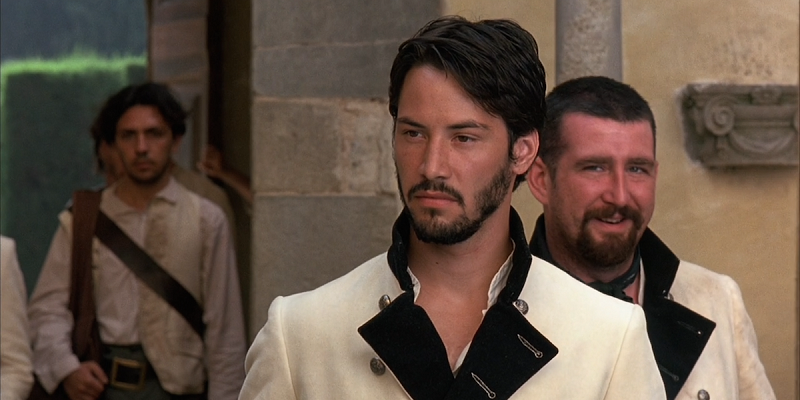
When I was a young buck, there was a fad for making movies out of “classic literature”. Scads of chick flicks, of course — Jane Austen’s complete works, the Brontës, and so on — but they also took a stab at Shakespeare. Mostly they stuck to the comedies — and trust me, watching Keanu Reeves trying to handle Much Ado About Nothing is hilarious, in all the wrong ways — but they’d occasionally give the tragedies a shot. Kenneth Branagh’s Hamlet is pretty good despite all the distracting cameos, his Othello is at least sincere (ye gods, imagine trying to make that today!), I think I’m forgetting a few. Mel Gibson gave Hamlet a go back in the early 1990s, and so on. Again, I’m pretty sure I’m forgetting a few.

It always struck me as odd. Unless they timed the theatrical releases to midterm and finals week, hoping to hoover up the dollars of desperate sophomores who didn’t do the homework, it didn’t make much sense, marketing-wise. We were a much more culturally literate people once, it’s true*, but there’s just not much of an audience for the Bard anymore. Nor was it a case of SJWs trying to destroy something good just on general principles. I’m sure Gwyneth Paltrow was bad as Emma, but the idea of retconning every single female in the Western Canon into a Strong, Confident Woman(TM) was still in its infancy. My only other guess was that, since college enrollments were skyrocketing, maybe the parents of all those first-gen college kids were feeling mal-educated and trying to catch up …? Lame, I know, but it was the best I could do.

Looking back on it now, I see my problem: I was looking at it from the demand side. Silly and naive as I was, I assumed that Hollywood’s primary concern was making money, so they went out and found what the people wanted to see, then gave it to them. For instance, I thought Titanic was going to be a huge flop. I mean, the boat sinks. We know that. How do you squeeze any dramatic tension out of it? I should’ve realized they’d be playing it as a doomed-lovers tragedy — girls love that shit, what with the big flouncy costumes and all. Once I realized that, I thought I had it all figured out — every girl I, personally, knew found the works of Jane Austen tedious, but that’s because (I reasoned) you have to supply the images for yourself. Put Hunky McBeef up there in breeches and a peruke, Waify Beecup in a Regency dress, and it’s chick crack …

Or so I thought. Looking back on it now, that’s as dumb as my opinion that Titanic would bomb. Hollywood doesn’t care what you want. I doubt if Hollywood has ever cared what you want, but if they ever did, that time probably ended in tandem with Clara Bow’s career. Hollywood wants what they want, and so will you, because whaddaya gonna do, not watch it? The reason they made all those “classic literature” films in the 1990s, then, wasn’t because they thought we wanted (or needed) some cultural uplift.

No, the reason was: By the 1990s, the last of the old guard in Hollywood was dying off, replaced by the new guard, the Baby Boomers. As we know, it’s not enough for Boomers to control everything while making a shitload of money. No no, for them everything has to be deep and meaningful. They thought of themselves as artistes, not entertainers, so they had to put out a bunch of highbrow stuff, and we had to watch it. This is the sole reason goofy-looking Kenneth Branagh and his horse-faced wife (at the time) were a big cultural force. They made Shakespeare sexy, by which I mean, they allowed the studio heads to think of themselves as the arbiters of culture, not the carny trash they were and are. That some decent movies got made because of it, is entirely incidental.**

    *Last summer, during the worst of lockdown mania, I introduced my little nephews to Bugs Bunny. The real ones, from the 40s and 50s, not the crap they put out ten, twenty years ago. I am an educated man by modern standards, but a lot of that stuff flew over my head … and they used to show these in front of popular movies, on military bases, etc.! There’s the classic Wagner one, of course — kill da wabbit!! — but another one involves The Barber of Seville, which I haven’t seen performed and had to look up. Even the “throwaway” music was classical — they could assume, in other words, that your average workaday guy or GI had a fairly large repertoire of classical pieces in his head, enough to recognize bits from Strauss, Chopin, Schumann, etc.

    **I do kinda regret bashing Sir Kenneth, as wiki tells me he now is. I enjoyed Hamlet (again, despite the annoying cameos), and some of his other work was pretty entertaining, even, in a limited way, visionary — a quirky little picture like Dead Again didn’t do much in 1991, but it would clean up now (a PoMo costume drama!). I’m one of the few people who liked Mary Shelley’s Frankenstein, which again despite terrible casting (Robert De Niro? Seriously?) was loads of fun. Shelley’s novel as written is ludicrous, therefore unfilmable, but Branagh admirably captured the spirit of it. It’s as Goth as can be, in the original sense of “Gothic”. Wonderful stuff.

The Welsh Flag: History and Meaning of The Red Dragon Flag

Filed under: Britain, History — Tags: , , — Nicholas @ 02:00

History With Hilbert
Published 16 May 2018

You may think it’s a bit odd that I’m making a video in the Union Flag Series about the Welsh flag, given that it’s the only part of the United Kingdom not represented on the country’s flag. However Wales is great, and its flag has some interesting history and symbolism so you’re just going to have to deal with it. In this one I’ll be look at the Welsh Dragon Flag, at the figures of Cadwalladr ap Cadwallon (and his dad), Owain Glyndŵr, Henry VII and many more.

Music Used:
“Sneaky Snitch” – Kevin MacLeod
“Teller of the Tales” – Kevin MacLeod
“Up and Away” – Holfix
https://www.youtube.com/watch?v=9YmM_…​
“Celtic Impulse” – Kevin MacLeod (incompetech.com)
Licensed under Creative Commons: By Attribution 3.0 License

All images are from the Public Domain of Wikimedia Commons and Pixabay with the following exception:

Owain Glyndŵr’s Flag – Hogyncymru:
https://creativecommons.org/licenses/…

QotD: Obsolescent carrier aircraft in the Pacific war

Filed under: Britain, History, Japan, Military, Quotations, USA, WW2 — Tags: , , , — Nicholas @ 01:00

The most obsolete first-line strike aircraft in any carrier force in 1942 was the American Douglas TBD Devastator torpedo bomber (206mph, 2 x.303 mg. 1,000lbs of a torpedo or bombs, range 716 miles). Despite — or because of — being the first monoplane on any carrier air-wing (1937!), it had never been a very good aircraft. Fully loaded with a torpedo (a much lighter torpedo than used by anyone else), it had a hard time getting off the deck, and had a much reduced speed and range. In fact its attack speed was actually slower than a [British Fairey] Swordfish, and it lacked the Swordfish’s maneouvrability or capacity to take damage. Used in daylight (the only way it could be used), it was an absolute death-trap if there was any airborne opposition at all. In fact the role played by the Devastators at the Battle of Midway was as [unintentional] kamikaze decoy targets to draw the Japanese fighter forces out of place. A point made even clearer by the fact that the few Devastators which had managed to attack at Coral Sea had usually seen their torpedoes fail to work anyway. (The American carrier fleet would not get a successful airborne torpedo until mid 1943!)

The next most obsolete was the Japanese Aichi D3A “Val” dive-bomber (266mph, 3 x 7.7 mg, 1 x 500lb and 2 x 60lb bombs, 970 mile range) which had also entered service in the mid 30’s. It was a fixed landing gear dive-bomber modeled on the famous Junkers Ju87 (183mph, 1 x 7.7mm mg, 1,000lb bomb load, 621 mile range), and was just as good a dive bomber … if there was no opposition. Unlike the Ju87 (and like the [British Blackburn] Skua) the Val also had the ability to defend itself as a second-rate fighter once the bombs had been dropped. Still, the Val relied for success on clear skies, and achieved excellent results under those conditions at Ceylon (cruisers Devonshire and Cornwall and unarmed old carrier Hermes) and Coral Sea (carrier Lexington). Under even moderate air pressure at Trincomalee and Midway the performance fell off markedly, and later in the war the phrase that comes to mind is “Great Marianas Turkey Shoot”. Nonetheless they had to soldier on because the replacement aircraft was too fast for the smaller carriers that were to become the majority of the Japanese carrier fleet after Midway.

Nigel Davies, “Comparing naval aircraft of World War II”, rethinking history, 2010-12-20.

« Newer PostsOlder Posts »

Powered by WordPress