
World War Two
Published 12 Jun 2021It’s a week of starts and stops. The Battle of Sevastopol kicks into high gear, and the Battle of Gazala enters its third phase. And what is going on in the Pacific just one week after Midway?
(more…)
June 13, 2021
Sevastopol Must Fall! – WW2 – 146 – June 13, 1942
Comments Off on Sevastopol Must Fall! – WW2 – 146 – June 13, 1942
Fundamentally unserious nation – “… for Canada’s leaders, all the world’s a ‘gram”
In the Friday wrap-up edition of The Line, a consideration of how shallow, insincere posturing, and performing became the hallmarks of Canadian government leadership:
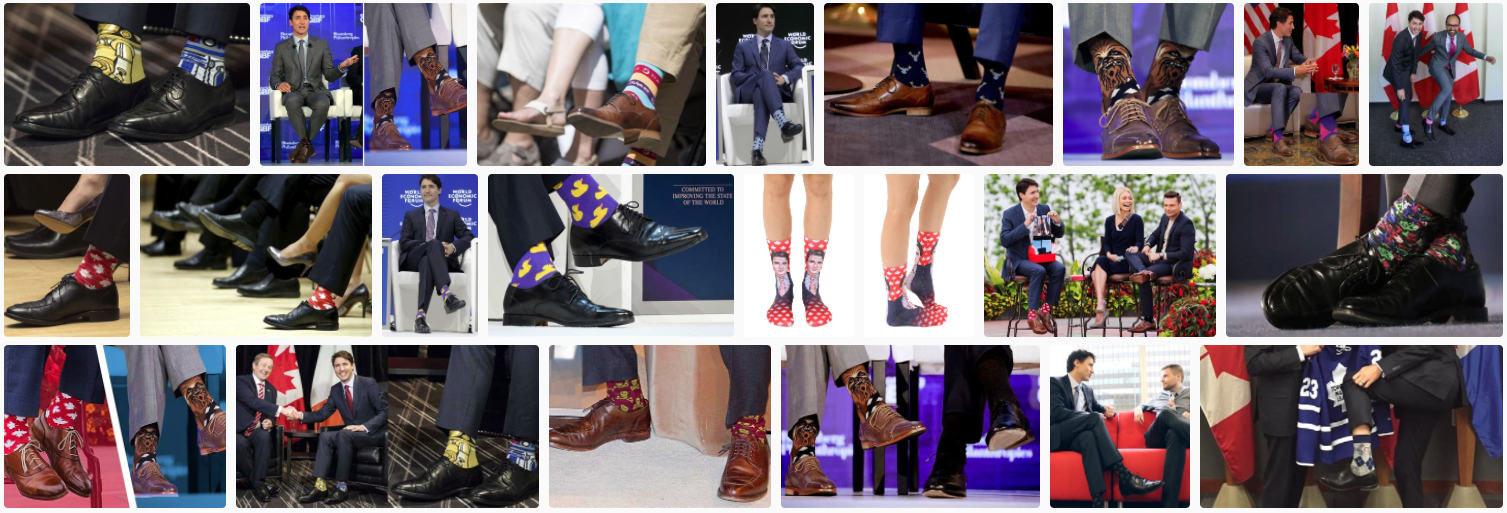
Typical image search results for “Justin Trudeau socks”
Look, we at The Line are as tired as you are about the more, shall we say, theatrical aspects of Justin Trudeau’s approach to being prime minister. Whether it was his Day One “because it’s 2015!” smirk, his obsession with showing off his socks to foreign dignitaries, his fashion sense while vacationing in India, and countless other Trudeauvian trips of the light fantastic, the man has always seemed more interested in performance than in the substance of governing.
But that’s not quite right. Because if there is one thing we’ve come to realize over the past five years and a bit, it is that for the Trudeau Liberals, the performance is the governing. For example, we used to wonder at the amount of time and energy that Cabinet ministers spent working on their Instagram accounts, since it went far beyond what would seem to be necessary for promoting and communicating policy. But once we understood that it was the job of policy to promote the Instagram account, and not the other way around, all of this proudly vacuous behaviour started to make a lot more sense.
But while we’ve gotten more or less used to it here in Canada (or maybe the right word is “numb”), we’ve always wondered how it looks through foreign eyes. Those abstract wonderings became a little more concrete over the past few weeks. Countries are opening up, people are starting to travel, politicians are going back to their old habits of holding regular meetings to make sure the world is still ticking along. And for Canada’s leaders, all the world’s a ‘gram.
So it was that at the G7 summit in Cornwall England this week, Prime-Minister-In-All-But-Name Chrystia Freeland was the only finance minster to wear a mask in a group photo taken outdoors. Ok, we thought, maybe she’s not fully vaxxed, maybe she has reason to be extra cautious. Except in a string of photos taken just before the official photo, Freeland was captured scrambling to put on her mask, not for safety, but for show.
Freeland was just getting the crowd warmed up for her nominal boss, Justin Trudeau. At his official G7 welcome on Friday, Trudeau was the only leader to put a mask on to give Boris Johnson the chummy elbow, only to remove it a few seconds later. We get it. It’s a version of the old “what lie did I tell?” problem, but for acting. Which audience am I playing to at this exact moment? It’s hard for even an old luvvie like Trudeau to keep track.
Once he’s back in Canada, Trudeau is going to hole up in a hotel for a few days, which the Globe‘s Cam Clark aptly referred to as “symbolic penance for a symbolic policy.” We agree with Clark that there’s some good fun in seeing someone get tied up in their own moral posturing. But while Clark is unhappy at the prospect of the prime minister cooling his heels for three days, we’re less fussed about Trudeau’s prospective stay in Hotel Q. Because while Clark thinks “there are real things” for the prime minister to be doing, we doubt that very much.
Comments Off on Fundamentally unserious nation – “… for Canada’s leaders, all the world’s a ‘gram”
Wartime Changes: The Bren MkI Modified and Bren MkII
Forgotten Weapons
Published 3 Mar 2021http://www.patreon.com/ForgottenWeapons
https://www.floatplane.com/channel/Fo…
Cool Forgotten Weapons merch! http://shop.bbtv.com/collections/forg…
The British lost some 90% of their stock of Bren light machine guns in the disastrous Dunkirk evacuation, and in the following months rushed to rearm. Part of this program was a two-tiered simplification of the Bren design. First was a MkI Modified Bren (which was not marked any differently than the original MkI), and this was followed by a MkII design. These patterns simplified many of the machining operation required to produce the Bren, significantly reducing the number of required machining operations. The most visually distinctive elements of the MkII pattern were the omission of the stainless steel flash hider assembly and the replacement of the original dial rear sight with a simple ladder sight. In addition, changes were made to the buttstock, buttplate, receiver profile, gas block, and bipod. Both Enfield and Inglis would produce the simpler MkII Brens by the middle of the war. Despite the many changes made, the core operating components (bolt, bolt carrier, etc) were left unchanged, so they could still interchange between all patterns of the gun in service.
Contact:
Forgotten Weapons
6281 N. Oracle #36270
Tucson, AZ 85740

Comments Off on Wartime Changes: The Bren MkI Modified and Bren MkII
QotD: Defending the undefendable – Brutalist architecture
I have recently collected quite a number of articles online and in the press in favor of brutalism. I did so without having made any special effort, and without finding anything like the same number of countervailing articles against it, albeit that the great mass of the population, in my view rightly, detests brutalism. The penultimate paragraph of one of the recent articles that I have seen in favor of brutalism — the employment of great slabs of concrete in the construction of buildings — goes as follows:
The newly-gained attractivity [of architectural brutalism] is growing by the day. In troubled times where societal divides are stronger than ever around the globe and in a world where instantaneous rhymes with tenuous, brutalism offers a grounded style. It’s a simple, massive and timeless base upon which one can feel safe, it’s reassuring.
It is rather difficult to argue with, let alone refute, the vague propositions of such a paragraph, which nevertheless intends (I imagine) to connote approval and judgment based upon sophisticated, wide, and deep intellectual considerations. But what exactly is a “grounded style” in contrast to a “world where instantaneous rhymes with tenuous”? This is verbiage, if not outright verbigeration, though it might serve to intimidate those with little confidence in their own judgment. The idea that brute concrete could create any kind of security rather than unease or fear is laughable.
When defenders of or apologists for brutalism illustrate their articles with supposed masterpieces of the genre, it is hardly a coincidence that they do so with pictures of buildings utterly devoid of human beings. A human being would be about as out of place in such a picture, and a fortiori in such a building, as he would be in a textbook of Euclidean geometry, and would be as welcome as a termite in a wooden floor or a policeman in a thieves’ kitchen. For such defenders and apologists of brutalism, architecture is a matter of the application of an abstract principle alone, and they see the results through the lenses of their abstraction, which they cherish as others cherish their pet.
Theodore Dalrymple, “The Brutalist Strain”, Taki’s Magazine, 2019-11-02.
Comments Off on QotD: Defending the undefendable – Brutalist architecture
June 12, 2021
Literate people who “never read books”
I recently added Kenneth Whyte’s SHuSH to my growing list of Substack blogs, and his latest entry considers people who can read but choose not to … and boast about it:
… I ran across a tweet by Neil Patel, a self-made marketing guru, explaining or, rather, bragging about how he doesn’t read books:
The only books I read are kids’ books and that’s to my daughter. People talk about reading books. You know what? I wrote a book and I was even a New York Times best-selling author, but here’s the thing: most books that you see in a book store, they’re written a year to two years before they were actually published and they go through this really long process. A lot of the times you’re reading outdated information. Even if the book has theories and strategies that aren’t outdated, heck, you can just go on YouTube and find that info in a five-minute clip. Why would you want to read 300 pages when you can just figure it out in five minutes. So I don’t spend my time reading books. Instead, I spend three hours a day reading blogs, Instagram, YouTube and all the other places where I can consume information faster, and you should, too.
It turns out Patel’s tweet was too dumb even for Twitter. Within hours, it had 87 retweets against 1,836 quoted retweets and 764 replies, indicating an extremely high ratio of people blasting him to people sharing his pensées.
Washington Post book critic Carlos Lozada had some of the best mockery: “Also do you realize that when you go in a bookstore, some of the books are so old that the authors are dead? How can you learn anything from a dead person? They can’t even tweet.”

I’ve found over the last few years that I’m spending less time reading books, although I still treasure my quiet reading time in the late evening. My tastes have changed a lot over the years, and I read almost no fiction works at all except for a few “unwoke” science fiction authors, and aside from books on hand tool woodworking almost everything else is history — and not much recently published history (for the same reason I avoid most modern SF novels … they’re far too woke for boring old fuddy duddy readers like me).
You’ve probably seen those internet ads that claim the average CEO reads a book a week. That’s bullshit marketed by Blinkist to flog fifteen-minute book summaries. There is no data to support it. The average American reads twelve books a year, and high-earners read fifteen, which is probably the best-case scenario for the average CEO.
Sure, Bill Gates and Mark Zuckerberg and Warren Buffett read a lot of books. I’ve run across a few lesser mortals in big offices who were enthusiastic readers. I was even part of a Bay Street book club for several years (I loved it). But most businessmen, in my experience, read very little, or not at all. Trump, who also had his name on a bestseller but never reads books, is far closer to the norm than Gates.
I was once at a dinner retreat with a dozen executives, all of whom had good university educations and generous salaries. They’d been asked by a moderator to come to the dinner with an example of something they’d read, a book or a poem or an essay that really spoke to them. Only three of the twelve mentioned books (and each mentioned a business book). Several mentioned newspaper or magazine articles they’d read. The rest relied on song lyrics, with two citing the same line from “Hotel California” as a commentary on their careers: “You can check out any time you like, but you can never leave.” None of us knew whether to laugh or cry.
Another thing I learned at that retreat, which struck me as related, was that all of the executives complained of having no time to think about the big picture: they were so busy doing their work that they seldom stopped to consider if there wasn’t a better way to do it, or if it was worth doing at all. They complained at this lack of perspective, but all were senior enough to be able to delegate day-to-day chores to others, leaving themselves time to think. I don’t believe they wanted to.
Comments Off on Literate people who “never read books”
Normandy – 1944 | Movietone Moment | 11 June 2021
British Movietone
Published 11 Jun 2021On this day in 1944, five days after the D-Day landing, the allied forces converged in Normandy. Here is a British Movietone report covering the event.
More and more reinforcements and supplies arrive in Normandy each day. In the skies Allied air power continues to bomb and strafe the enemy. Captured German film shows Rommel and von Rundstedt visiting the vast concrete fortifications on the coast which were thought to be impassable. Mr Churchill arrived onboard HMS Kelvin and was greeted by General Montgomery as he came ashore.
Cut story – Dusk or dawn shot of destroyer with sun rising or sinking in background. Sunrise with armada in fore. Yanks board LCIs. Shots of LCTs. Beached equipment unloaded. GV of activity on beach. British troops of LTC. CU Tedder on bridge of ship. GS of Ramsay & Vian. Tedder, Ramsay & Vian walk along raft into camera. Elevated shot of activity on beach, very good. Troops build airstrip, bulldozers etc. at work. Plane takes off. Camera gun – shooting up trains, transport, & other targets, several large explosions. British pass through street, Frenchmen look on. AFU – British soldiers at look-out with field glasses. Troops (Canadian or British) run through fields & wooded country. Troops through street, French clap. Army transport passes through street, directed by soldier. Yanks march through streets. POW along roads, & over beach, wade out to LCT, one attempts to pull up sock while walking. Captured German reel GS of Rommel & Rundstedt. CU Rommel. SCU of coastal guns, & various shots of fortifications, pillboxes etc. Rommel & Rundstedt walk round inspecting same, look at double barrel coastal gun. SCU of barrel of guns, & various shots of Atlantic Wall (AFU British troops knock part of “Wall” down which they have captured). Eisenhower, Marshall & Arnold on bridge of ship. GV of destroyer Kelvin at sea – very good. CU Churchill in Trinity House uniform, wearing glasses. Churchill assists Brooke with “Mae West” life jackets. Both seated on deck Kelvin at sea. CU Churchill. Kelvin passes Nelson, Ramillies & other warships also large part of armada. Churchill transfers … ships, sailors cheer as he leaves. CU Churchill. CU Smuts both very good. Churchill, Smuts & Brooke in “Duck” [DUKW]. Churchill leans over side talks to Montgomery, Churchill alights from “Duck”. Shakes hands with Monty. The above four in group on beach, walk through crowds of soldiers. AFU – Monty stands on raised platform addresses troops (silent) Monty & Churchill through crowds. Churchill with Monty & climbs into Jeep. SEE STORY NUMBER 44914/2 & 44914/3 FOR CUTS
AP Has HD copy – HD ProRes 422 4:3 – 24fpsDisclaimer: British Movietone is an historical collection. Any views and expressions within either the video or metadata of the collection are reproduced for historical accuracy and do not represent the opinions or editorial policies of the Associated Press.
You can license this footage for commercial use through AP Archive – the story number bm44914
#Normandy #WWII #DDay
Find out more about AP Archive: http://www.aparchive.com/HowWeWork
Twitter: https://twitter.com/AP_Archive
Tumblr: https://aparchives.tumblr.com/
Instagram: https://www.instagram.com/APNews/
Comments Off on Normandy – 1944 | Movietone Moment | 11 June 2021
Canadian “Conservatives” start listing their preferred pronouns
Mark Steyn surveys the “conservatives” in the UK, the US, and last-and-least, Canada:

Michelle Rempel Garner, Conservative MP for Calgary Nose Hill (preferred pronouns she/her).
Photo attributed to “Michelle Staff” via Wikimedia Commons.
So much for UK conservatism. What of Canada? The two most rock-ribbed “right-wingers” in the Dominion’s politics, Doug Ford of Ontario and Jason Kenney of Alberta, have taken the position that conservatism is an indulgence you can’t afford in a pandemic: Just as there are no atheists in foxholes, so there are no conservatives in lockdowns.
At the federal level, the cautious and eventually stalled incrementalism of Stephen Harper was followed by the unprincipled hollowness of Andrew Scheer and, after his predictable failure, the everything-must-go massive-storewide-clearances of Erin O’Toole. Even so, I was startled by a tweet from Michelle Rempel Garner, an Alberta MP whom I knew only as an occasionally lively thorn in the side of Justin & Co. Ms Rempel Garner was responding to the appalling killings of a Muslim family in London, Ontario, which within minutes had been seized on by the media-left alliance for the usual purposes, notwithstanding that the perp does not appear to fit the desired narrative. Nevertheless, the outbreak of vehicular “Islamophobia” was taken by Michelle Rempel Garner as the perfect opportunity for an express checkout:
I humble myself and ask forgiveness, and seek to make things right.
I have privilege; I am cis/straight/white. But I am also a woman who works in a system dominated by white maleness.
But no excuses. I will do what I can.
Seeing the above at the great Kate McMillan’s website, I assumed it was a giant leg-pull by Ms Rempel Garner, as did many other of Miss McMillan’s readers. So, as she clarified, no, sorry, it’s for real. The Tory member’s Twitter account now shows her pronouns: “she/her” (at the time of writing). In 2019 it was a big deal when Kamala Harris, at the start of a Democrat debate, announced her pronouns. Less than two years later, “conservative” politicians want a piece of the pronoun action too. Already a key player in O’Toole’s shadow cabinet, the she/her move could make Michelle a shoo-in for Deputy Prime Minister.
Except, of course, that that would require the Tories to win an election.
Guys, it was a joke that modern conservatism is just progressive policies on a five-year delay … please stop taking it seriously!
Comments Off on Canadian “Conservatives” start listing their preferred pronouns
Sail to Steam to Iron – Half a Century of Change
Drachinifel
Published 19 Dec 2018Today we look at the development of warships from 1815 to 1860.
Want to support the channel? – https://www.patreon.com/Drachinifel
Want to talk about ships? https://discord.gg/TYu88mt

Comments Off on Sail to Steam to Iron – Half a Century of Change
QotD: The assassination attempt(s) on Bismarck
Ferdinand Cohen-Blind, a Badenese student of pan-German sentiments, waylaid Bismarck with a pistol on the Unter den Linden. He fired five rounds. None missed. Three merely grazed his midsection, and two ricocheted off his ribs. He went home and ate a big lunch before letting himself be examined by a doctor.
But even the books that condescend to mention this triviality may not tell you about the other time a guy shot Bismarck: A young Catholic tried to kill him in July 1874, during the anti-Catholic Kulturkampf Bismarck had engineered, but only managed to score his right hand with a bullet.
The point is not that Bismarck was particularly hated, although he was. The point is that this period of European (and American) history was crawling with young, often solitary male terrorists, most of whom showed signs of mental disorder when caught and tried, and most of whom were attached to some prevailing utopian cause. They tended to be anarchists, nationalists or socialists, but the distinctions are not always clear, and were not thought particularly important. The 19th-century mind identified these young men as congenital conspirators. It emphasized what they had in common: social maladjustment, mania, an overwhelming sense of mission and, usually, a prior record of minor crimes.
[…]
Bismarck was not much of a democrat, but his example is instructive. He was so phlegmatic about being shot that he obtained both of the guns he had been shot with. He kept them in his desk, ready for use against a third guy with the same bright idea.
Colby Cosh, “Those old terrorist tendencies”, Maclean’s, 2014-12-07.
Comments Off on QotD: The assassination attempt(s) on Bismarck
June 11, 2021
The concept of philanthropy is another one with conflicting meanings to the left and to the right
In the Daily Chrenk, Arthur Chrenkoff has a bit of fun outlining the recent kerfuffle over Alexandria Ocasio Cortez’s attempt to use her grandmother’s situation in Puerto Rico for scoring political points, and then explains why the notion of philanthropy is a very different thing to progressives than it is to conservatives:
“Charity in the dictionary” by HowardLake is licensed under CC BY-SA 2.0


Well may we laugh about (and be disgusted by) the hypocrisy, corruption and indifference shown by prominent members of the left towards the very people they supposedly care about. But it would be to miss the broader point relating to how the left views the world, the role of politics, and the place of the individual.
It might surprise many that the caring and compassionate left isn’t actually all that big on philanthropy and charity, i.e. people helping other people. What could be wrong with that? Wouldn’t the world be a better place if even more people helped even more other people? Well, no, the left would say, because it’s not something that people should be doing in the first place; it’s not their responsibility. It is up to the state to solve all the social and economic problems; our role as citizens (as well as, thanks to the open borders advocates, non-citizens) is to be the grateful recipients of the government’s largesse. For the more elite group (no pun intended) – “the rich” – their role is to pay for all this with their taxes. Private initiative is by its very nature limited and patchy; only the all-seeing and all-powerful state can ensure that everyone who needs “free” assistance (and that’s literally everyone) gets it in a comprehensive, uniform and fair way. Hence, AOC won’t lift a finger to help her grandmother because it’s the state’s duty to help everyone rebuild their lives after a natural disaster. Occasional Cortex already contributes with her taxes on the hard-earned Congressional salary, and in any case, she’s not some billionaire, you know.
With that attitude, needless to say, you won’t be surprised to learn that much of what goes for the left-wing philanthropy does not actually go to help those in need to solve their problems and provide them what they are lacking. Instead, it is largely channels to finance political agitation by the activist-industrial complex to make the government (whether through lobbying, campaigning or helping elect sympathetic law-makers) take responsibility instead. That’s what people like Soros, Laurene Powell-Jobs (Steve Jobs’ widow) and MacKenzie Scott (Jeff Bezos’ ex) are all about – billions spent to create more activist jobs to agitate for the state to create more public sector jobs to run the “Big Daddy”.
But it goes deeper than that, back to Marx himself in fact and to his analysis of what’s wrong with the world and how to fix it. According to Marxism, both in its original class-based iteration and the more recent race/gender/sexuality variants, every society is divided into two mutually antagonistic groups: the powerful oppressors and the powerless oppressed, with the society structured in the interest of the former by facilitating in every possible way the exploitation and keeping down of the latter. Thus, all the problems, ills and injustices are “systemic” in nature; they are a feature, not a bug. To solve them and so to help the downtrodden you need to overthrow the entire old unjust system and build a new one that benefits the masses. Based on this sort of understanding of the world – to which, coincidentally, people like AOC and BLM founders all subscribe – any private charity is bound to be ineffectual and shortcoming. After all, what can a person, however generous with their money and time – even if there are multitudes of them – do to solve problems that are the direct (and intended) consequence of the way the society has been set up? Nothing, of course. You can’t mend it, you have to end it. But not only is it naïve and pointless to try, it’s actually counter-productive and therefore positively wrong. Because while no philanthropic effort can solve systemic problems, it can actually provide some limited and temporary relief. Such relief, however, by its very nature is a band-aid solution, i.e. not a solution at all. All it does it momentarily numbs the pain, and that is bad, because the oppressed masses need to feel the pain and feel it good in order to spur them into revolutionary action to overthrow their oppressors and on the ruins of the old build the utopian new society of equality and justice. This is the far-left’s accelerationism: the worse it gets, the better it gets (for the prospects of radical change).
Comments Off on The concept of philanthropy is another one with conflicting meanings to the left and to the right
Is Finland an Ally of Nazi Germany? – Carl Gustaf Mannerheim – WW2 Biography Special
World War Two
Published 10 Jun 2021Carl Gustaf Mannerheim is a national hero after his service in everything from the Finnish Civil War to the Winter War. But did he plan a war of aggression with Nazi Germany against the Soviet Union? And if so, did Hitler and Stalin even give him any choice in the matter?
(more…)
Comments Off on Is Finland an Ally of Nazi Germany? – Carl Gustaf Mannerheim – WW2 Biography Special
Latin and Greek are the next sacrifices to the great god Antiracism
In the latest edition of It Bears Mentioning, John McWhorter considers the Princeton University classics department decision to get rid of the requirement for students to read classic texts in the original languages:
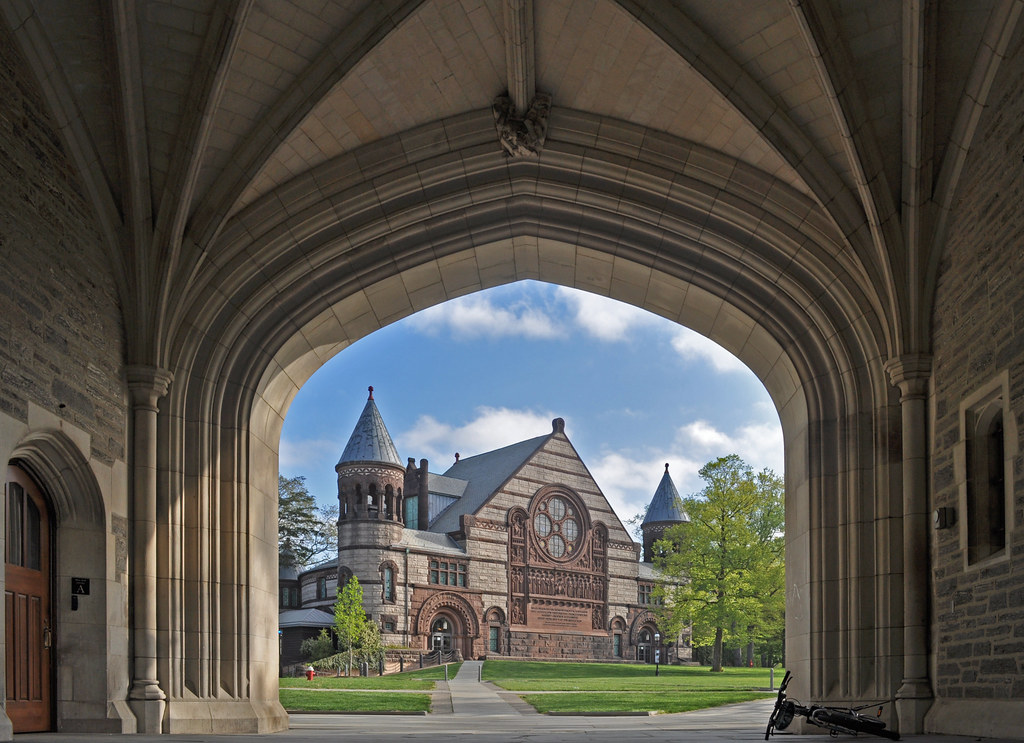
“USA – New Jersey – Princeton” by Harshil.Shah is licensed under CC BY-ND 2.0

I have written recently about the Princeton classics department’s decision to eliminate the requirement that students engaging closely with Latin and Greek texts be able to … read them in Latin and Greek. The new idea is that the department will attract more majors by opening up to ideas from students who may be full of beans but just not inclined to tackle complex, ancient languages. And sub rosa, the idea is clearly – as we can see from words in the official statement like underrepresented, perspectives, and experiences – that of especial interest will be black students, especially in light of today’s racial reckoning which the department openly acknowledges was the primary spur for this change.
My disappointment with this decision is because it is part of a tradition of arguments that we do black people a favor by exempting them from certain kinds of faceless, put-up-or-shut-up challenges to entry. Back in the aughts, the classic example was brilliant, fierce black lawyers confidently arguing that because black firefighter applicants don’t do as well on the entrance exams required for the job, the exams are racist and should be eliminated. More recently there has been the idea that if black kids are rare at top-ranked public schools in New York City like Stuyvesant because few excel on the standardized test one must ace to be admitted, then the solution is to eliminate the test as “racist”. The Princeton decision is a variation: to get black kids into classics, it’s supposedly immoral to expect them to master the intricacies of Latin and Greek, languages which I suppose we can see as foreign, “white” to them as well. Rather, they must be admitted in shining expectation that their class comments will be bracingly “diverse” in good old English.
My Atlantic colleague Graeme Wood is more sanguine about the Princeton decision. He argues sagely that a certain kind of student happens to enjoy working their way through languages like Latin as a kind of puzzle (I openly admit being that type), but that there are others who don’t go in for that particular task and yet are itching and well-equipped to engage and analyze classical texts regardless. Graeme notes that we do not consider it an educational tragedy that specialists in English history are not required to be able to read Old English. (Although I wonder if this analogy would hold if the idea were someone specializing in England of the first millennium, where all of the relevant linguistic matter was in Old English [and Latin].)
I can go with him here to an extent. On the one hand, as I have argued here, to engage work only in translation is, of course, to lose a lot. Yet, in making that argument here, I was referring to my own reading War and Peace in English, as I myself was not inclined to hack through it in Russian (although my being black was not the reason for this disinclination [couldn’t help it!]). The question is how important we consider that loss to be.
Having no facility in languages myself, I’m more sympathetic to the students’ viewpoint than I might otherwise be, but depending on someone else’s translation of the text being studied has unexpected risks, as Sarah Hoyt explained from her own translation studies:
The discussion […] reminded me of when I was sixteen and embarked on a class called “Techniques of Translation”.
Although I had studied French and English and German, the translations I’d done so far were of the “I took the pen of my neighbor” variety. I thought the class would teach me to smooth out the sentence to “I took my neighbor’s pen” and that would be that.
I was wrong. Oh, it taught that also, but that was a minor portion of it. The class mostly hinged on the moral, ethical and — most of all — professional dilemmas of being a translator. I know any number of you are translators, formal or informal, but any number of you are also not. So, for the ones who are not, let me break the news with my usual gentleness:
There is no such thing as translation.
The French have a proverb “to translate is to betray a little” — or at least that’s the closest meaning in English. It’s fairly close to the true meaning, but slightly askew, of course. Every language is slightly askew to other languages.
The idea that there exists in every language a word that is exactly the equivalent of other languages is sort of like assuming that aliens will — of course — live in houses, go to school, ride buses, understand Rebecca Black’s “Friday”. [This was originally written in 2011.]
Language is how we organize our thoughts, and each word, no matter how simple, carries with it the cultural freight and experience of the specific language. Oh, “mother” will generally mean “the one who gave birth to” — except for some tribal, insular cultures where it might mean “the one who calls me by her name” or “my father’s principal wife” — but the “feel” behind it will be different, depending on the images associated with “mother” in the culture.
So, when you translate, you’re actually performing a function as a bridge. Translation is not the straightforward affair it seems to be but a dialogue between the original language and the language you translate into. If you’re lucky, you meet halfway. Sometimes that’s not possible, and you feel really guilty about “lying” to the people receiving the translation. When on top of language you need to integrate different cultures and living systems (which you do when translating anything even an ad) you feel even more guilty, because you’re going to betray, no matter how much you try. At one point, a while back, I had my dad on one phone, my husband on the other, and I was doing rapid-fire translation about a relatively straight forward matter. And even that caused me pangs in conscience, because my dad simply doesn’t understand how things are done here. I had to approach his experience and explain our experience in a way he wouldn’t think I was insane or explaining badly. That meant a thousand minor lies.
Comments Off on Latin and Greek are the next sacrifices to the great god Antiracism
Tanks Chats #110 | T-72 | The Tank Museum
The Tank Museum
Published 13 Nov 2020Join David Willey as he discusses the T-72, a Soviet era main battle tank which first entered production in 1971. The T-72’s service life has proven to be extremely successful. With about 20,000 produced, it has seen service with over 40 countries, and thanks to refurbishment, is still in service to this very day.
With thanks to RecoMonkey for additional images https://www.recomonkey.com/
(more…)
Comments Off on Tanks Chats #110 | T-72 | The Tank Museum
QotD: Twitter
Clive Mansa (@clivemansa), Twitter, 2021-03-09.
Comments Off on QotD: Twitter
June 10, 2021
Build the Lightweight Traveler Workbench!
Rex Krueger
Published 9 Jun 2021Build this portable, inexpensive workbench from only 2 boards!
(more…)
Comments Off on Build the Lightweight Traveler Workbench!


