Quotulatiousness

June 10, 2021

“That’s a nice Pride flag you’ve got there. Be a shame if something were to happen to it …”

Filed under: Media, Politics, USA — Tags: , , , — Nicholas @ 03:00

In The Line, Allan Stratton argues against replacing the common “rainbow” Pride flag with a new “Progress” variant:

Two people at EuroPride 2019 in Vienna holding an LGBTQ+ pride rainbow flag featuring a design by Daniel Quasar; this variation of the rainbow flag was initially promoted as “Progress” a PRIDE Flag Reboot.
Photo by Bojan Cvetanović via Wikimedia Commons.

Question: What do the following have in common: A hammer and sickle, a Union Jack, five interlocked rings, a Black fist, a cross, a Star of David, and the Rainbow flag?

Answer: They are internationally recognized symbols. Not spring fashions. Not cool memes. No. Symbols that communicate across all languages and countries in the world.

That’s what’s so infuriating about the push by hashtag activists to replace the Rainbow flag with the so-called “Progress flag”. The Progress flag takes the pink, blue, and white stripes of the trans flag, adds black and brown stripes for race, turns those five stripes into a chevron tipped on its side, and ploughs it into the rainbow in an eleven-colour pile-up. It’s a regressive, ill-considered mess that looks like a child’s Crayola box.

Naturally, it’s the creation of a Portland designer who whipped it off one night while suffering insomnia. The story of Daniel Quasar (ze/them) and their flag is a real-life satire, featuring moxie, hustle, viral posts and a Kickstarter campaign. Ze and their (not surprisingly) all-white team have leveraged ze’s design into Quasar Digital, a company that sells Progress flags, pins, patches, T-shirts, tank tops, notebooks, clutch bags, coffee mugs, stickers, slappers, socks and more, individually and in bundles.

Marketed with the trendy buzzwords progress, diversity and inclusion, the Progress flag has been a viral hit with woke straights and nouveau queers as well as corporate PR departments at places like Goldman Sachs and TD Bank, who signal virtue while screwing customers of every gender. But by separating specific races and a single identity from the rainbow, the Progress flag creates divisions, hierarchies and exclusions. And it trashes the power and weight that a 43-year-old symbol of hope and strength gives to people worldwide who continue to be imprisoned, beaten and murdered for being LGBT+.

[…]

Slapping the “Progress” chevron on the Rainbow is like slapping the fleur de lys on the Maple Leaf. It creates resentment and division to the sole benefit of performative social climbers keen to wave their Alphabet status and cachet. Step outside the West to see what it really means to have people out to “deny your very existence”. To trade the Rainbow, the symbol of our suffering and resilience, for a viral craze is bourgeois privilege at its self-indulgent worst.


The odd history of Irish Cream as we make Irish Cream hard candy at Lofty Pursuits

Filed under: Europe, Food, History, USA — Tags: , , , , , — Nicholas @ 02:00

Lofty Pursuits
Published 25 Feb 2021

Jake makes Irish Cream green shamrock hard candy for St. Patrick’s day. We discuss the history of the weird flavor and how it has become a tradition even though it was invented in the 1970’s

A great article about the history of Irish Cream
https://www.irishtimes.com/culture/bo…​

Buy our candy: http://www.pd.net​
Listen to our podcast: http://loftypursuits.libsyn.com/website​
Join our Patreon at https://www.patreon.com/LoftyPursuits

QotD: “Defending” democracy using totalitarian methods

Filed under: Britain, History, Liberty, Media, Quotations, WW2 — Tags: , , , , — Nicholas @ 01:00

One of the peculiar phenomena of our time is the renegade Liberal. Over and above the familiar Marxist claim that “bourgeois liberty” is an illusion, there is now a widespread tendency to argue that one can only defend democracy by totalitarian methods. If one loves democracy, the argument runs, one must crush its enemies by no matter what means. And who are its enemies? It always appears that they are not only those who attack it openly and consciously, but those who “objectively” endanger it by spreading mistaken doctrines. In other words, defending democracy involves destroying all independence of thought. This argument was used, for instance, to justify the Russian purges. The most ardent Russophile hardly believed that all of the victims were guilty of all the things they were accused of: but by holding heretical opinions they “objectively” harmed the régime, and therefore it was quite right not only to massacre them but to discredit them by false accusations. The same argument was used to justify the quite conscious lying that went on in the leftwing press about the Trotskyists and other Republican minorities in the Spanish civil war. And it was used again as a reason for yelping against habeas corpus when Mosley was released in 1943.

These people don’t see that if you encourage totalitarian methods, the time may come when they will be used against you instead of for you. Make a habit of imprisoning Fascists without trial, and perhaps the process won’t stop at Fascists. Soon after the suppressed Daily Worker had been reinstated, I was lecturing to a workingmen’s college in South London. The audience were working-class and lower-middle class intellectuals — the same sort of audience that one used to meet at Left Book Club branches. The lecture had touched on the freedom of the press, and at the end, to my astonishment, several questioners stood up and asked me: Did I not think that the lifting of the ban on the Daily Worker was a great mistake? When asked why, they said that it was a paper of doubtful loyalty and ought not to be tolerated in war time. I found myself defending the Daily Worker, which has gone out of its way to libel me more than once. But where had these people learned this essentially totalitarian outlook? Pretty certainly they had learned it from the Communists themselves! Tolerance and decency are deeply rooted in England, but they are not indestructible, and they have to be kept alive partly by conscious effort. The result of preaching totalitarian doctrines is to weaken the instinct by means of which free peoples know what is or is not dangerous. The case of Mosley illustrates this. In 1940 it was perfectly right to intern Mosley, whether or not he had committed any technical crime. We were fighting for our lives and could not allow a possible quisling to go free. To keep him shut up, without trial, in 1943 was an outrage. The general failure to see this was a bad symptom, though it is true that the agitation against Mosley’s release was partly factitious and partly a rationalisation of other discontents. But how much of the present slide towards Fascist ways of thought is traceable to the “anti-Fascism” of the past ten years and the unscrupulousness it has entailed?

George Orwell, Unpublished Preface to Animal Farm, 1945.

June 9, 2021

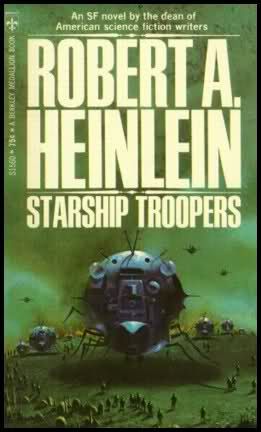
Charles Stross on Robert Heinlein’s Starship Troopers

Filed under: Books, Politics, USA — Tags: , , , , — Nicholas @ 05:00

In his first blog post in nearly a month, Charlie Stross opines on one of Heinlein’s most polarizing novels:

In the 1930s, Heinlein was a soft socialist — he was considered sufficiently left wing and “unreliable” that he was not recalled for active duty in the US Navy during the Second World War. After he married Virginia Gerstenfeld, his third and last wife, his views gradually shifted to the right — however he tended towards the libertarian right rather than the religious/paleoconservative right. (These distinctions do not mean in 2021 what they might have meant in 1971; today’s libertarian/neo-nazi nexus has mostly emerged in the 21st century, and Heinlein was a vehement opponent of Nazism.) So the surface picture is your stereotype of a socially liberal centrist/soft leftist who moved to the right as he grew older.

But to muddy the waters, Heinlein was always happy to pick up a bonkers ideological shibboleth and run with it in his fiction. He was sufficiently flexible to write from the first person viewpoint of unreliable/misguided narrators, to juxtapose their beliefs against a background that highlighted their weaknesses, and even to end the story with the narrator — but not the reader — unaware of this.

In Starship Troopers Heinlein was again playing unreliable narrator games. On the surface, ST appears to be a war novel loosely based on WW2 (“bugs” are Nazis; “skinnies” are either Italian or Japanese Axis forces), but each element of the subtext relates to the ideological awakening of his protagonist, everyman Johnny Rico (note: not many white American SF writers would have picked a Filipino hero for a novel in the 1950s). And the moral impetus is a discussion of how to exist in a universe populated by existential threats with which peaceful coexistence is impossible. The political framework Heinlein dreamed up for his human population — voting rights as a quid pro quo for military (or civilian public) service — isn’t that far from the early Roman Republic, although in Rico’s eyes it’s presented as something new, a post-war settlement. Heinlein, as opposed to his protagonist, is demonstrating it as a solution to how to run a polity in a state of total war without losing democratic accountability. (Even his presentation of corporal and capital punishment is consistent with the early Roman Republic as a model.) The totalizing nature of the war in ST isn’t at odds with the Roman interpretation: Carthago delenda est, anyone?

It seems to me that using the Roman Republic as a model is exactly the sort of cheat that Heinlein would employ. But then Starship Troopers became the type specimen for an entire subgenre of SF, namely Military-SF. It’s not that MilSF wasn’t written prior to Starship Troopers: merely that ST was compellingly written by the standards of SF circa 1959. And it was published against the creeping onset of the US involvement in the Vietnam War, and the early days of the New Wave in SF, so it was wildly influential beyond its author’s expectations.

The annoying right wing Heinlein Mil-SF stans that came along in later decades — mostly from the 1970s onwards — embraced Starship Troopers as an idealized fascist utopia with the permanent war of All against All that is fundamental to fascist thought. In doing so they missed the point completely. It’s no accident that fascist movements from Mussolini onwards appropriated Roman iconography (such as the Fasces): insecure imperialists often claim legitimacy by claiming they’re restoring an imagined golden age of empire. Indeed, this was the common design language of the British Empire’s architecture, and just about every other European imperialist program of the past millennium. By picking the Roman Republic as a model for a beleagured polity, Heinlein plugged into the underlying mythos of western imperialism. But by doing so he inadvertently obscured the moral lesson he was trying to deliver.

Do the Nazis Have Atomic Bombs? – WW2 – Spies & Ties 03 – Sam & Erwin part 2

Filed under: Germany, History, Military, USA, WW2 — Tags: , , , , , — Nicholas @ 04:00

World War Two
Published 8 Jun 2021

All belligerents are working hard to develop a powerful nuclear super-weapon. The Americans wonder how far along the Germans are, and send in their spies.
(more…)

Bill C-10 – “… what occurred yesterday was far worse than a blunder. It was a betrayal.”

In another country it might be a fascinating and amusing thing to watch Steven Guilbeault faff about pretending to understand what his own bill says and how it will cause havoc for ordinary Canadians, but being in Canada the humour is lacking as Michael Geist shows:

Canadian Heritage Minister Steven Guilbeault, 3 February 2020.
Screencapure from CPAC video.

Several weeks after Canadian Heritage Minister Steven Guilbeault introduced Bill C-10, I started a 20 part blog post series called the Broadcasting Act Blunder (podcast edition here). The series examined many of concerns with the bill, including issues such as over-broad regulation and discoverability requirements that would only garner public attention many months later. I thought about that series yesterday as I watched Guilbeault try in the House of Commons to defend the indefensible: a gag order on committee review of the bill, the first such order in two decades. While the bill is in dire need of fixing, what occurred yesterday was far worse than a blunder. It was a betrayal. A betrayal of the government’s commitment to “strengthen Parliamentary committees so that they can better scrutinize legislation.” A betrayal of the promise to do things differently from previous governments. A betrayal of Canada’s values as a Parliamentary democracy.

The 23 minute and 30 second question and comment period – the House Speaker ruled there could be no debate and that the period could not extend beyond 23 minutes and 30 seconds – notably featured NDP MP Peter Julian and Green MP Elizabeth May, two of the longer serving MPs in the House as among the first to speak. Julian was first elected in 2004, when Guilbeault was only a few years removed from activist stunts such as climbing the CN Tower. Meanwhile, May became the founding Executive Director of the Sierra Club in 1989, the same year Guilbeault started as a university student. It seemed to me that both had a message for an inexperienced cabinet minister elected less than two years ago, namely that some things are bigger than single bill. Bills come and go, but principles – or betrayal of those principles – endures.

Guilbeault clearly did not get it, wondering how the NDP could possibly reject the gag order and effectively support potential delays to his bill. Both the NDP and the Greens may ultimately vote for Bill C-10, but both understand that defending democracy and the freedom of expression of MPs (much less the freedom of expression of all Canadians) is far more important than a delay to any single bill. As May noted, the gag order will do real long term damage. One day it will be a different government on a different issue seeking to use the same procedure to cut short committee study. And the Liberals will have no credible response with no one to blame but themselves.

But we don’t need to look far into the future to see the consequences of the Guilbeault gag order. This past weekend, the Canadian government joined with other countries to criticize the Nigerian government for blocking Twitter and establishing registration requirements for social media. Yet calls for respecting freedom of expression rings hollow when you are shutting down Parliamentary debate on a bill with profound implications for freedom of expression. Indeed, Canada’s lost moral authority on Internet freedoms is an undeniable consequence of Bill C-10 and the Guilbeault gag order.

Very Rare and Mostly Pointless: the Bren Fixed Line Sight

Filed under: Britain, History, Military, Weapons, WW2 — Tags: , , — Nicholas @ 02:00

Forgotten Weapons
Published 25 Feb 2021

http://www.patreon.com/ForgottenWeapons​

https://www.floatplane.com/channel/Fo…​

Cool Forgotten Weapons merch! http://shop.bbtv.com/collections/forg…​

The very early production MkI Bren light machine guns were made with two dovetail brackets on the left side of the receiver. The rear one was for the standard rear sight, and the front one was to accommodate two types of optical sights. A mounting for the No.32 telescopic sight (the same one used on the No4(T) sniper rifle) was planned, but never produced. What was made in small numbers by the Plessey company was a “fixed line sight”. This was really more like a surveyor’s tool than a traditional sight, and it used the same optical element as the Vickers dial sight that was introduced alongside it in 1939. The purpose was to allow a tripod-mounted Bren to be set up with specific limits to its field of fire, and then for the gun to be removed, used on the bipod elsewhere, and returned to the tripod and confirm the field of fire, especially in the dark. This is a somewhat technically complex task, but not one that was actually needed very much for the Bren. As a result, production and use of the fixed line sights was very limited, and the sights are extremely rare today. The mounting bracket on the Bren receiver was rather quickly dropped from production as an unnecessary waste of machining time.

Contact:
Forgotten Weapons
6281 N. Oracle #36270​
Tucson, AZ 85740

QotD: Failing to account for mere “women’s work”

Filed under: Books, Economics, Health, Quotations — Tags: , , , , — Nicholas @ 01:00

“Oh, certainly, you could produce quantities of infants­ although it would take enormous resources to do so. Highly trained techs, as well as equipment and supplies. But don’t you see, that’s just the beginning. It’s nothing, compared to what it takes to raise a child. Why, on Athos it absorbs most of the planet’s economic resources. Food of course ­housing, ­education, clothing, medical care­ it takes nearly all our efforts just to maintain population replacement, let alone to increase. No government could possibly afford to raise such a specialized, non-productive army.”

Elli Quinn quirked an eyebrow. “How odd. On other worlds, people seem to come in floods, and they’re not necessarily impoverished, either.”

Ethan, diverted, said, “Really? I don’t see how that can be. Why, the labor costs alone of bringing a child to maturity are astronomical. There must be something wrong with your accounting.”

Her eyes screwed up in an expression of sudden ironic insight. “Ah, but on other worlds the labor costs aren’t added in. They’re counted as free.”

Ethan stared. “What an absurd bit of double thinking! Athosians would never sit still for such a hidden labor tax! Don’t the primary nurturers even get social duty credits?”

“I believe,” her voice was edged with a peculiar dryness, “they call it women’s work.”

Lois McMaster Bujold, Ethan of Athos, 1986.

June 8, 2021

The utter failure of political leadership in most countries during the pandemic

Jay Currie runs through some of the many reasons our political leadership and their “expert class” advisors in most western countries were utter shit almost from the starting gun of the Wuhan Coronavirus pandemic:

“Covid 19 Masks” by baldeaglebluff is licensed under CC BY-SA 2.0

The first response of most of our political class was to doggedly claim to be following the science, turn day to day decision making over to “public health experts”, follow the guidance of the WHO and the CDC – guidance which was, to be charitable, inconsistent – and to largely avoid questioning the experts. (Trump seemed to make some attempt to raise questions but made little headway in the face of his own public health bureaucracy.)

“Wipe everything” (which the CDC now concedes is pointless because the virus is rarely, if ever, transmitted by contact, “wash your hands” (good advice at any time), “social distance” (hilarious when in effect outdoors where there is next to no transmission), “walk this way” in the essential grocery and liquor stores, “wear a mask”, “wear two masks”, “stay home” (logical for two weeks, insane for six months), “curfew” (no known benefit, Quebec ended up being under curfew for five months), “no indoor dining” (despite next to no evidence that restaurants were significant sources of infection), “don’t travel” (with a vast list of exceptions), “don’t gather outdoors (unless BLM protest)” (ignoring entirely that the virus rarely spreads outdoors): it was all COVID theatre and, to paraphrase Dr. Bonnie Henry, “There’s no science to it.”

What the politicians did was simply to panic. They abdicated their responsibility to lead to “experts” who seemed to all be reading from the same “mass lockdown, masks everywhere, hang on for the vaccine, there is no treatment” script.

The key political failure was the acceptance of the “there is no treatment” story. Back in February/March 2020 there were suggestions that there might well be treatments of some sort. HCQ was trotted out and, partially because Trump mentioned it and partially because of very badly designed studies, dismissed. The very idea of a COVID treatment regime was, essentially, made illegal in Canada and much of the United States.

The idea of boosting immunity with things like Vitamin D and C and a good long walk every day did not come up at most of the Public Health Officer’s briefings across Canada. And, again, not very well done studies were cited showing that “Vitamin D does not cure COVID”. A claim which was not being made. A healthy immune system, to which Vitamin D can contribute, most certainly does cure COVID in the vast majority of cases.

Citing privacy concerns, public health officials were unwilling to give many details as to who was dying of or with COVID. Age, co-morbidities, race, and the socio-economic status of the dying were disclosed reluctantly and long after the fact.

I don’t think most of this can be blamed on the public health officials. They had their jobs to do and, to a greater or lesser degree, managed to do them. They are hired to apply current best practices – often mandated on a world wide basis by the WHO – to the situation before them. Public Health officials are not expected to be imaginative nor innovative.

Imagination, leadership, thinking outside the proverbial box is what we elect politicians for.

But, hey! Doesn’t Justin wear cool socks? Totally worth flushing decades of economic growth down the toilet for those nice socks! Canada’s back! (Back to 1974, approximately.)

Midway pt.2 – A New War? – WW2 – 145c – June 7, 1942

Filed under: History, Japan, Military, Pacific, USA, WW2 — Tags: , , , , , , — Nicholas @ 04:00

World War Two
Published 7 Jun 2021

We left off last time with several burning behemoths. Watch today to see the action that follows, not just on the high seas, but also in Alaska. We also turn to Washington DC and Tokyo and follow the reaction to the Battle of Midway there. The Japanese one may surprise you.
(more…)

If you were trying to destroy American cities from within … what would you be doing differently?

Sarah Hoyt’s latest Libertarian Enterprise post considers the state of US urban areas after more than a year of Wuhan Coronavirus lockdowns, social controls, and medically “justified” repression:

“Homeless encampment above the 101 @ Spring” by Steve Devol is licensed under CC BY-NC-SA 2.0

Look, I’m sure this was suggested by China, and the dunderheads are totally buying it under their Compleate Illusions system.

Sure climate change. Climate change can justify anything. If we told them they needed to burn people alive to prevent climate change, they’d already been building the pyres.

But that’s just sort of a reflexive thing, like a Moslem saying “Insh Allah“. It’s not actually involved in their thinking as such. Or their thinking is not involved in it. whichever.

The truth is that they realized that the Covidiocy has destroyed the cities.

You see they had everything planned. They were going to force more and more of us into the city, because they were going to make running an internal combustion engine so hard. So if you had a job, you’d live in the city. Where you’re more easily controlled. And where they could make you believe bullshit like overpopulation and that — look at all the homeless — we needed more and more welfare. Their idea of their perfect world is the 1930s version of the future. Just megalopolisis, isolated, with people completely controlled. It has the bonus of leaving pristine wilderness outside that, for the elites to build their dachas.

And part of the problem is that they never understand other people have agency and respond to circumstances.

I don’t know what they expected when they went full fashboots and — in the case of Polis, and I bet not the only one — gave homeless the right to camp in every public land, and defecate in public as well as freeing a bunch of felons.

Did they expect this would just scare people more, and they’d lock themselves in, in fear and trembling, allowing the idiots to design society.

Instead, people left. Americans are on the move. I swear half of my friends are moving from more locked to less locked, from bluer to redder. Some demographers have caught on, seeing through the smoke and mirrors, and are confused — most of them being leftist — because Americans are in the middle of a full migration. As full and as all pervading as the movement west. Or after the civil war the movement of black people North.

Some of this must have penetrated the granite-like heads of the ruling left. Or at least the planning left.

They somehow didn’t expect—possibly because they don’t really get technology. I mean, I have my moments, but I swear most democrats were disappointed when laptops started being made with no “cup holders”. They’re at that level of stupid — that a tech that hasn’t been fully implemented, giving us the ability to work from home, would be kicked into high gear from the covidiocy.

I guess they expected people who work mostly from their computers to sit at home watching panic porn on TV and not work?

More importantly, I don’t think they expected people who have to work in person to follow that migration because, well … if you owned a restaurant that the covidiocy killed, you might, for instance, pay heed to the fact people are driving everywhere because, duh, masks on planes, and therefore build a roadside diner or perhaps find a small town that’s underserved and start anew there.

Oh … a lot of people are changing jobs too, and the jobs are no longer binding them to big cities.

Honestly, the only way for big cities to save themselves is to become touristic centers. NYC was halfway there when the covidiocy hit. Only not fully there because lefty governance sucks at making a city safe.

If I were a lefty governor or mayor right now, I’d aim the fashboots at crime and disorder, get rid of the homeless, spruce up the place, and go all out in courting tourism. Then people would move in to cater to the tourists, and eventually other businesses would move in, because that’s where people are.

But leftists don’t think that way. Carrot and incentive is beneath them (of course.) Their idea is rather that they will force those unwashed peasants to do what they want.

History Summarized: Ancient Egypt

Filed under: Africa, History, Humour, Religion — Tags: , , , , , — Nicholas @ 02:00

Overly Sarcastic Productions
Published 3 Feb 2017

This video was commissioned by our loyal Patron Karl Erik L. Hoftaniska! To become our Patron and get access to sweet rewards, hop on over to PATREON.COM/OSP

I must say, I was pleasantly surprised about the things I learned about Egypt in the process of making this video. The feeling of learning cool new things never gets old.

Coming soon in Blue’s History Summarized line-up will be the next part of his Abrahamic Religion series: Judaism!
In the meantime, WOO EGYPT!

Have a question about anything mentioned or not mentioned? Leave a comment! Blue will do his best to answer.

PATREON: www.patreon.com/user?u=4664797

MERCH LINKS:
Shirts – https://overlysarcasticproducts.threa…​
All the other stuff – http://www.cafepress.com/OverlySarcas…​

Find us on Twitter @OSPYouTube!

QotD: Magna Carta

Filed under: Britain, History, Humour, Law, Quotations — Tags: , , , , — Nicholas @ 01:00

There also happened in this reign the memorable Charta, known as Magna Charter on account of the Latin Magna (great) and Charter (a Charter); this was the first of the famous Chartas and Gartas of the Realm and was invented by the Barons on a desert island in the Thames called Ganymede. By congregating there, armed to the teeth, the Barons compelled John to sign the Magna Charter, which said:

  1. That no one was to be put to death, save for some reason (except the Common People).
  2. That everyone should be free (except the Common People).
  3. That everything should be of the same weight and measure throughout the Realm (except the Common People).
  4. That the Courts should be stationary, instead of following a very tiresome medieval official known as the King’s Person all over the country.
  5. That “no person should be fined to his utter ruin” (except the King’s Person).
  6. That the Barons should not be tried except by a special jury of other Barons who would understand.

Magna Charter was therefore the chief cause of Democracy in England, and thus a Good Thing for everyone (except the Common People).

After this King John hadn’t a leg to stand on and was therefore known as `John Lackshanks’.

W.C. Sellar & R.J. Yeatman, 1066 And All That, 1930.

June 7, 2021

Dude, where’s my (flying) car?

Filed under: Books, Economics, Government, History, Technology — Tags: , , , , , — Nicholas @ 05:00

The latest of the reader-contributed book reviews at Scott Alexander’s Astral Codex Ten looks at Where is my Flying Car? by J. Storrs Hall:

What went wrong in the 1970s? Since then, growth and productivity have slowed, average wages are stagnant, visible progress in the world of “atoms” has practically stopped — the Great Stagnation. About the only thing that has gone well are computers. How is it that we went from the typewriter to the smartphone, but we’re still using practically the same cars and airplanes?

Where is my Flying Car? by J. Storrs Hall, is an attempt to answer that question. His answer is: the Great Stagnation was caused by energy usage flatlining, which was caused by our failure to switch to nuclear energy, which was caused by excessive regulation, which was caused by “green fundamentalism”.

Three hundred years ago, we burned wood for energy. Then there was coal and the steam engine, which gave us the Industrial Revolution. Then there was oil and gas, giving us cars and airplanes. Then there should have been nuclear fission and nanotech, letting you fit a lifetime’s worth of energy in your pocket. Instead, we still drive much the same cars and airplanes, and climate change threatens to boil the Earth.

I initially thought the title was a metaphor — the “flying car” as a standin for all the missing technological progress in the world of “atoms” — but in fact much of the book is devoted to the particular question of flying cars. So look at the issue from the lens of transportation:

    Hans Rosling was a world health economist and an indefatigable campaigner for a deeper understanding of the world’s state of development. He is famous for his TED talks and the Gapminder web site. He classifies the wealthiness of the world’s population into four levels:

    1. Barefoot. Unable even to afford shoes, they must walk everywhere they go. Income $1 per day. One billion people are at Level 1.

    2. Bicycle (and shoes). The $4 per day they make doesn’t sound like much to you and me but it is a huge step up from Level 1. There are three billion people at level 2.

    3. The two billion people at Level 3 make $16 a day; a motorbike is within their reach.

    4. At $64 per day, the one billion people at Level 4 own a car.

    The miracle of the Industrial Revolution is now easily stated: In 1800, 85% of the world’s population was at Level 1. Today, only 9% is. Over the past half century, the bulk of humanity moved up out of Level 1 to erase the rich-poor gap and make the world wealth distribution roughly bell-shaped. The average American moved from Level 2 in 1800, to level 3 in 1900, to Level 4 in 2000. We can state the Great Stagnation story nearly as simply: There is no level 5.

Level 5, in transportation, is a flying car. Flying cars are to airplanes as cars are to trains. Airplanes are fast, but getting to the airport, waiting for your flight, and getting to your final destination is a big hassle. Imagine if you had to bike to a train station to get anywhere (not such a leap of imagination for me in New York City! But it wouldn’t work in the suburbs). What if you had one vehicle that could drive on the road and fly in the sky at hundreds of miles an hour?

Before reading this book, I thought flying cars were just technologically infeasible, because flying takes too much energy. But Hall says we can and have built them ever since the 1930s. They got interrupted by the Great Depression (people were too poor to buy private airplanes), then WWII (airplanes were directed towards the war effort, not the market), then regulation mostly killed the private aviation industry. But technical feasibility was never the problem.

Hall spends a huge fraction of the book on pretty detailed technical discussion of flying cars. For example: the key technical issue is takeoff and landing, and there is a tough tradeoff between convenient takeoff/landing and airspeed (and cost, and ease of operation). It’s interesting reading. But let’s return to the larger issue of nuclear power.

Germany to Strike Strongest Fortress in the World – WW2 – 145b – June 6, 1942

World War Two
Published 6 Jun 2021

Midway isn’t the only fight right now. Germany is trying to crack the mighty fortress of Sevastopol and take the whole Crimea. In North Africa, Rommel is routing the Allies, but in Malta the arrival of ever more fighter planes bodes well for the Allies.
(more…)

« Newer PostsOlder Posts »

Powered by WordPress