Bernadette Banner
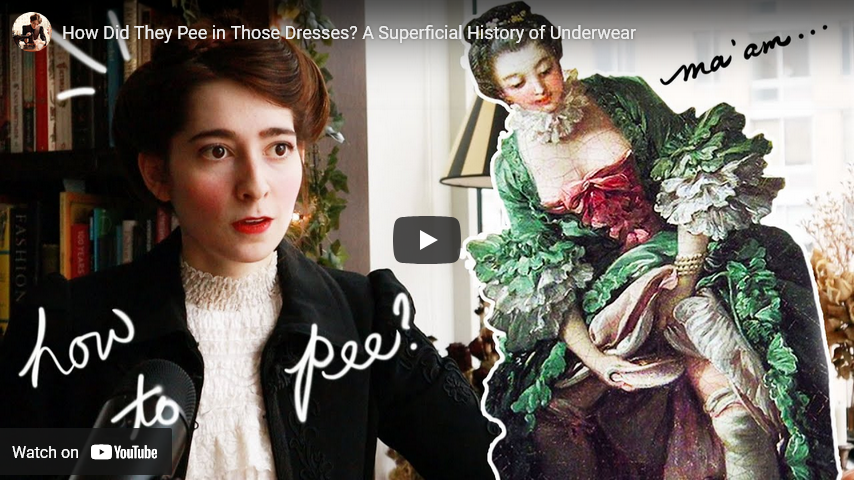
Published 28 Nov 2020*[2:19] In the English-written sources I’ve found so far. Unfortunately I can’t presently speak for primary accounts written in other languages.
FURTHER READING:
Portraits of ladies not wearing underwear but that I couldn’t include in the video for Proprietary Reasons, lol
Mid-18th century: https://commons.wikimedia.org/wiki/Fi…
Mid-18th c, “La Jupe Relevée” Francois Boucher https://p6.storage.canalblog.com/68/0…
Full analysis of the 15th century Lengberg Castle finds: https://www.academia.edu/27335143/The…
Extra special thanks to Izabela at Prior Attire for permission to use her demonstration video! She has also just put out a video discussing how Victorians dealt with needing to pee: https://www.youtube.com/watch?v=ED-wK…
Abby Cox on 18th Century periods: https://www.youtube.com/watch?v=iV2Tg…
Karolina Żebrowska on Victorian periods: https://www.youtube.com/watch?v=2d_QP…Footnotes and image credits can be found at: http://www.bernadettebanner.co.uk/how…
Want to get started with hand sewing?
🧵
🕯Check out my Skillshare original course, “Hand Sewing Basics: Working Wonders with Fabric, Needle & Thread”. To sign up for a free trial and take the class, visit https://skl.sh/bernadettebanner1This channel is made possible through the generous support of Patreon members. To become a patron, visit https://www.patreon.com/bernadettebanner (although videos will remain free for you here regardless).
Beyond YouTube:
IG @bernadettebanner http://www.instagram.com/bernadetteba…
Management contact for business enquiries:
bernadette@helmtalentgroup.com
March 31, 2022
How Did They Pee in Those Dresses? A Superficial History of Underwear
QotD: Nixon’s 1971 gamble to win re-election also tanked the economy for a full decade
[In 1971, economist Herb] Stein was saying aloud what they all knew. Prettifying a political grab by dressing it as an economic rescue was precisely the kind of action against which eminences like Burns warned foreign governments when they made grand speeches abroad. Nixon was indeed now preparing to do what Harold Wilson had done in 1967: disingenuously pretend that devaluing a currency would not affect the consumer. Stimulating the economy in this way might win Nixon the election, but inflation would eventually explode, as Friedman sometimes said, like a closed pot over high heat. Wage and price controls and taxes on imports could make the kind of growth America was accustomed to, the old bonanza, disappear for years, even a decade. True scarcity of key goods might suddenly become the rule. And that was true no matter how many times that cowboy Connally went around bragging about tariffs and telling others that America was “the strongest economy on earth”.
[…]
The 1971 run on American gold also, however, reflected foreigners’ insight. Outsiders knew a tipping point when they saw one. America had moved closer to Michael Harrington’s socialism than even Harrington understood. The United States had locked itself into social spending promises that might never be outgrown. Today, interest in Bitcoin and other cryptocurrencies serves as a measure of markets’ and individuals’ distrust of the U.S. dollar. In those days there was no Bitcoin, but gold played a similar role. The dollar was the common stock of America, and foreigners used gold to short it.
The disastrous performance of the U.S. economy in the following years proved the foreigners’ 1971 wager correct. To pay for its Great Society commitments, the U.S. government in the next decade found itself forced to set taxes so high that it further suppressed the commercialization of innovation. Products that could have been developed from patents awarded in the 1960s remained on the researchers’ shelves. Today we assume all markets will rebound given a decade. But there was to be no 1970s rebound for the Dow Jones Average. The Dow flirted with the 1,000 level throughout the decade, but did not cross the line definitively until 1982, an astonishingly long period to stagnate, nearly a generation. While markets languished, unemployment for all Americans rose. High prices, high interest rates, and federal budget deficits plagued the nation. “Guns and butter” had proved too expensive, but so indeed had butter alone. The 1960s commitments required spending that, then and down the decades, would be far greater than for Vietnam or most other wars. Those on the far left who had originally pushed for aggressive public-sector expansion had achieved what they sought, to subordinate the private sector. In 1977, Harrington actually titled a new book The Twilight of Capitalism.
Those who had counted on the private sector to sustain prosperity saw they had expected too much. The nation’s confidence evaporated. Indeed, by the late 1970s, President Jimmy Carter felt the need to undertake a national campaign to restore confidence, the kind of campaign Franklin Roosevelt had launched in response to the Great Depression. From being a nation that could afford everything, America morphed into a country that could afford nothing, a place where the president warned citizens to set their living room thermostats to sixty-five in January, or face catastrophe.
In a supreme irony, many of the people who caused the economic damage found themselves mired in the dirty work of reversing what they had wrought. The task of reducing inflation through punishing interest rates fell to Paul Volcker, who as a junior official aided leaders in the 1971 decisions that triggered the 1970s inflation in the first place. Mortgage rates rose to today incredible-sounding levels, over 15 percent. In the 1980s, the same John Connally who as treasury secretary in 1971 pounded on Nixon’s desk for populist measures that ensured an economic quagmire, went bankrupt, a casualty of the mess he had helped to create.
Amity Schlaes, Great Society: A New History, 2019.
March 30, 2022
The RCAF’s long, sad F-35 story
In The Line, Mitch Heimpel tries (without either laughing or crying) to tell the story of how the Canadian government finally got around to admitting they should have bought the F-35 fourteen years ago (when the RCAF told them it was the best fit for our national requirements):
If you’re looking for a simple meta-explanation for all of us, it would be this: Canadian politicians refuse to tell the public one simple truth — military procurement is expensive. There isn’t an inexpensive version of this. That doesn’t mean we should accept any and all costs just because it’s going to be expensive. It does mean that politicians have to stop trying to sell us on there being an inexpensive, or perfect, version of this. There is no MacGyver version of military procurement. No amount of rubber bands and paper clips replaces jet engines and submarines, no matter how many times we pretend it will. Indeed, the longer you delay, the more it’ll cost — the weapons generally get more expensive, and you end up spending more money to wring every last bit of use out of what equipment you already have, instead of replacing it in an efficient, orderly way.
So, let’s recap: We are, in fact, so bad at procurement that we ran a process for years, and then cancelled it. And then pledged not to buy the jets we’d originally pleged to buy. We then bought seven old Australian F-18s so we could keep our elderly and dwindling CF-18 fleet from experiencing a “capability gap” caused mostly by not just buying the F-35 in the first place. Then, almost 12 years after announcing we were going to buy the F-35, after all the drama above, we’ve announced we’ll buy the F-35, after all. Eighty eight of them, in fact. So there’s that, I guess.
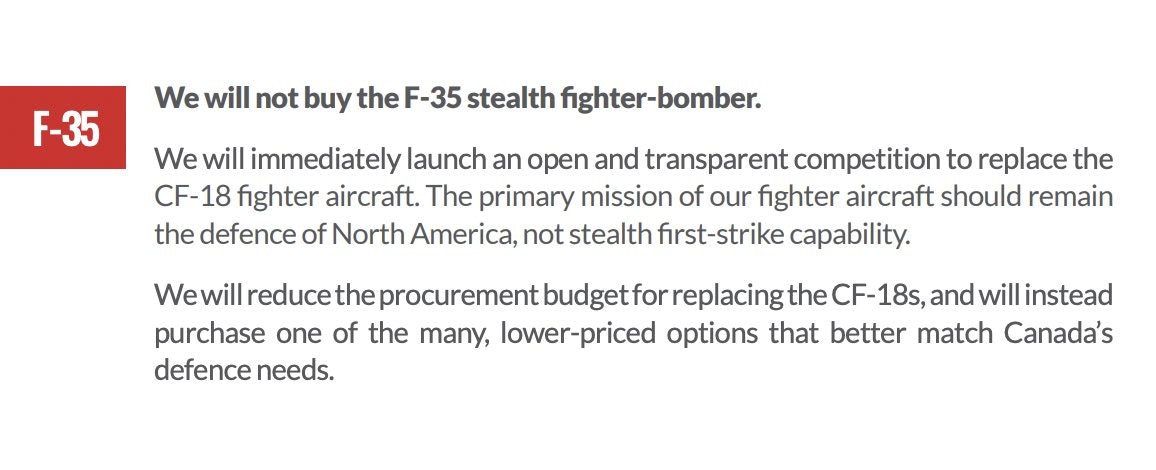
In so many ways, the F-35 saga is another symbol of seven years of Trudeau governance. In 2015, the Liberals could not have been more clear in their campaign platform, which included a whole section titled “We will not buy the F-35 stealth bomber-fighter.”
What were Ministers Anand and Tassi out saying when the F-35 announcement was made this week? “Best plane” and “best price.” Which was true in 2008 when we were first told it was the only fighter that met our needs. It was still true when the Harper government blinked in 2012, and still true when Justin Trudeau was accusing the government of “whipping out” our CF-18s while on the opposition benches in 2014. Remained true in 2015 when the Liberals campaigned against it, too, and every year since.
We have no reason to believe that what is supposed to be a $19-billion announcement for 88 planes to begin delivery in 2025 will actually end up being any of those things. Don’t be surprised if we spend more money to get fewer jets at a later date. But we are now well past the point of being able to blame anyone other than ourselves for cost overruns or late deliveries. The Canadian government failed the Royal Canadian Air Force in this procurement. That is beyond dispute. These guys need the planes. They have for years.
Let’s hope we’ve at least been sufficiently embarrassed by this experience to be more serious when we have to talk about submarines, which is now, come to think of it.
But I doubt it.
Combat Boots Save Lives – WW2 Special
World War Two
Published 29 Mar 2022Boots on the ground! Despite all the mobility provided by tanks, trucks and planes, the infantryman had to rely on his own two feet above all else. To march, run and fight, soldiers needed sturdy and comfortable footwear. Choosing between ankle-boots, service-shoes and jackboots, the warring nations were looking for the perfect combat-boot for their soldiers.
(more…)
Italy’s Sleeper Submachine Gun: The Beretta 38A
Forgotten Weapons
Published 16 Mar 2018The Beretta 38A is not a gun that comes to mind for many people today when discussing World War Two submachine guns, but at the time it was one of the most desirable guns of its type. So — does it live up to that reputation?
http://www.patreon.com/ForgottenWeapons
Cool Forgotten Weapons merch! http://shop.bbtv.com/collections/forg…
If you enjoy Forgotten Weapons, check out its sister channel, InRangeTV! http://www.youtube.com/InRangeTVShow
QotD: Orwell on political writing
A scrupulous writer, in every sentence that he writes, will ask himself at least four questions, thus: What am I trying to say? What words will express it? What image or idiom will make it clearer? Is this image fresh enough to have an effect? And he will probably ask himself two more: Could I put it more shortly? Have I said anything that is avoidably ugly? But you are not obliged to go to all this trouble. You can shirk it by simply throwing your mind open and letting the ready-made phrases come crowding in. They will construct your sentences for you — even think your thoughts for you, to a certain extent — and at need they will perform the important service of partially concealing your meaning even from yourself.
George Orwell, “Politics and the English Language”, 1946.
March 29, 2022
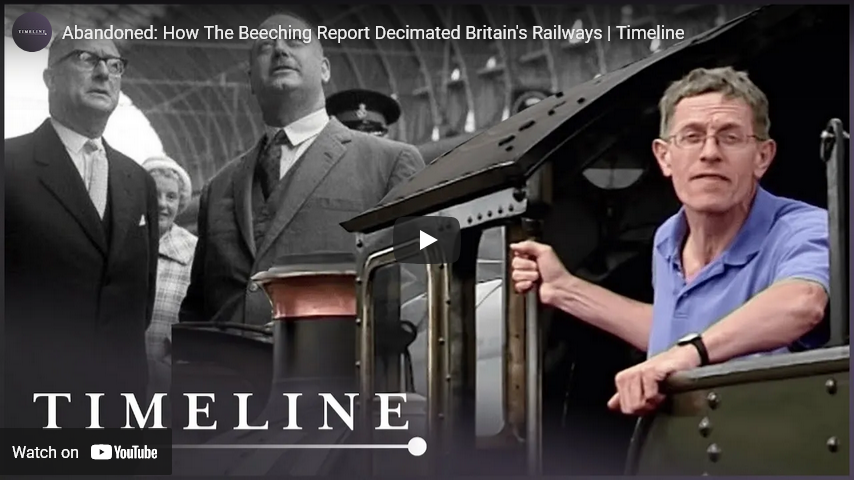
Abandoned: How The Beeching Report Decimated Britain’s Railways | Timeline
Timeline – World History Documentaries
Published 15 May 2019Travel journalist Simon Calder takes a journey from across the south of England — by bike, rail and car. In this documentary film, Simon explores the legacy of the Beeching railway cuts. He examines the arguments for reopening some of the branch lines axed in the 1960s.
It’s like Netflix for history … Sign up to History Hit, the world’s best history documentary service, at a huge discount using the code ‘
TIMELINE‘ —ᐳ http://bit.ly/3a7ambuYou can find more from us on:
https://www.instagram.com/timelineWH
This channel is part of the History Hit Network. Any queries, please contact owned-enquiries@littledotstudios.com
Giving up vegetables for Lent
Felipe Fernández-Armesto on updating the traditional Christian observance of Lent for our virtue-signalling, social media age:

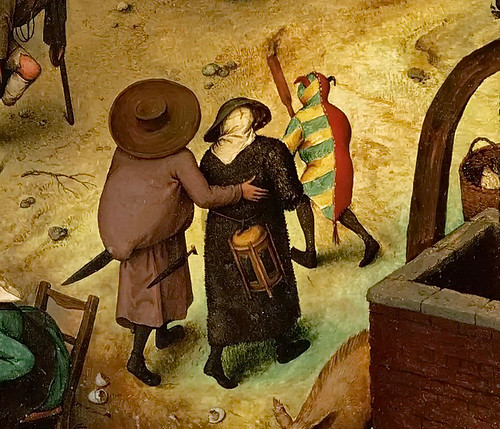
“Bruegel the Elder, Fight between Carnival and Lent, detail 6” by f_snarfel is licensed under CC BY-NC 2.0
For Lent, I am abstaining from vegetables. It may seem counter-intuitive, because “Carnival” or “Carni Vale” — which the English in their glum way call “Shrove Tuesday” and the French, more cheerfully, call “Mardi Gras” — means “Goodbye to Meat”.
The worldly, historic purpose of Lent is to eke out deficient livestock, doomed, unless slaughtered, to die, emaciated and inedible, on sparse or frozen pastures. Nowadays, however, vegetables seem a sacrifice both reasonable and pious.
If I wanted to be lampooned in Private Eye, I’d say that vegetables are the new meat: marketed as dietetically superior, and flattering to a moral form of snobbery.
Like meat in the old days, they are the preferred food of people who want to look down on the rest of us. Flesh and fish are now humbling meals, consumed in self-abasement. “Veganuary” and “Dry January” — wicked, secularist attempts to subvert the sanctity of Lent — repel me from conventional kinds of penance.
I want to defy the absurd propaganda of meat-haters, who try to shame the ill-informed into vegetarianism with mendacious allegations about the environmental cost of carnivorism. Scientifically, they’re on a par with Pythagoras’s denunciation of “passion proteins” and the meat-phobic campaigns of the nineteenth-century evangelists who hawked joyless, overpriced breakfast cereals.
I also want to expose the folly of people who, in flight from the butcher’s shop, grab textured soy concentrate from supermarket shelves: theirs is the idiocy of the ersatz. If you want something like meat, have meat. If you don’t want meat, have something unlike it. My sacrifice would be greater, of course, if I disliked rare steaks and juicy roasts. But I like vegetables, too. So that’s all right.
Roman Battle Tactics
Historia Civilis
Published 9 Jul 2015Patreon | http://historiacivilis.com/patreon
Donate | http://historiacivilis.com/donate
Merch | http://historiacivilis.com/merch
Mailing List | http://historiacivilis.com/mailinglist
Twitter | http://historiacivilis.com/twitter
Website | http://historiacivilis.comMusic is Beethoven’s Sonata 8, ‘Pathetique’ – II. Adagio cantabile, performed by Daniel Veesey
March 28, 2022
Republic to Empire: Catiline, Cicero, Crassus, Pompey, Caesar the Death Spiral
Update 6 Feb 2024: Dr. Gabb replaced the original part 7 which discussed the cultural impact of Ancient Greece on the rising Roman Republic.
seangabb
Published 20 Feb 2021
In 120 BC, Rome was a republic with touches of democracy. A century later, it was a divine right military dictatorship. Between January and March 2021, Sean Gabb explored this transformation with his students. Here is one of his lectures. All student contributions have been removed.Here is the seventh lecture, which discusses the Catiline Conspiracy and the rise and disintegration of the First Triumvirate of Caesar, Pompey and Crassus. There is a digression on Eastern politics and the Parthian Empire.
(more…)
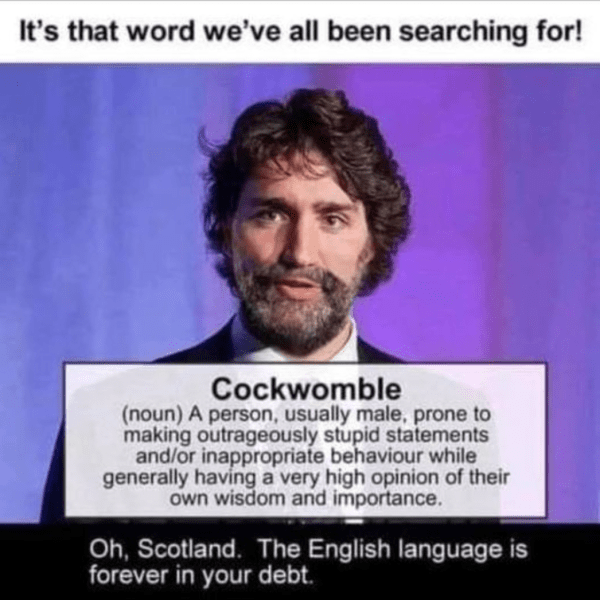
The only question in my mind is why the NDP thought they’d benefit from propping up Trudeau the Lesser
The editors at The Line, having taken last week off to look after kids on March break, sent out a brief round-up post on the deal Jagmeet Singh made with the Devil Justin Trudeau to keep the Liberals comfortably in power for (potentially) the full term:
The key question here that we can’t really think up an answer for is what this deal changes. In big picture terms, the NDP is going to keep the Liberals alive for a while, and the Liberals will serve up some goodies the NDP base will like. That’s what the parties have agreed to, distilled to the most basic essence.
And this is new how? This has changed what?
The NDP doesn’t want an election right now. The Liberals don’t want an election right now. The Liberals are led by a guy who has already moved the party toward the left and seemed quite happy to do it. The Liberals were getting along just fine with NDP support until they rolled the electoral dice and tried to secure a majority in summer of 2021; they fell short, and now they’ll continue getting along just fine with NDP support.
Well, gee. Stop the presses.
Yes, yes, there’s more specific commitments. The parties have put on paper what they’ll work jointly to achieve. But look at those commitments. Anything surprising? Is this not precisely what any random collection of reasonably bright high schoolers in a mandatory civics class could have guessed when their teacher told them to write a five-paragraph essay on things the NDP and Liberals agree on?
We aren’t particularly swayed by arguments, largely from angry Conservatives, that this deal suddenly leaves the Liberals immune from accountability. Again, the NDP was already playing ball to avoid an election. A week ago, the Liberals were going to be held precisely as accountable as Singh found convenient, and that’s just as true now as it was then. It’s not that the angry Conservatives are wrong about the Liberals being immune from accountability. It’s just that they essentially already were, NDP protestations aside. The NDP will tighten the screws enough to make Trudeau uncomfortable but not enough to trigger an election. They won’t be an opposition, but they’ll play one on TikTok. This sucks, but it is what it is, folks.
Nor do we expect the deal to last the full four years. Hey, it could happen. Both parties could find reasons to keep it going. But remember: this is a gentlemen’s agreement between gentlemen that don’t like each other. Gentlemen who are both pursuing different personal and political agendas. This deal will last right up until the moment one of them sees more advantage in stabbing the other guy than in continuing to play nice-nice.
We admit we really aren’t sure what the Liberals are thinking here. Trudeau had a largely free hand already. This is, to us, baffling.
And as for the NDP, well, gosh, all we can say is good luck, fellers. An old grizzled political observer your Line editors once knew liked to joke that being the junior partner in these kinds of arrangements is like being the mistress of a rich, married man. If you don’t know that you will be dumped while your former lover runs back to his family — the base voters, the caucus, the donors — well, sorry, sweetheart, but that’s on you. We saw a version of this play out in Ontario just a few years ago: the provincial NDP propped up the minority Liberals in exchange for a pledge to cut auto-insurance premiums. The Liberals failed to deliver, ran another election, won another majority and shrugged off the NDP’s complaints. The auto-insurance promise? Meh. That was just a stretch goal.
The Battle of Taranto: When Biplanes Crippled a Fleet
Historigraph
Published 23 Feb 2019If you enjoyed this video and want to see more made, consider supporting my efforts on Patreon: https://www.patreon.com/historigraph
#BattleOfTaranto #Historigraph
► Twitter: https://twitter.com/historigraph
► Instagram: https://www.instagram.com/historigraph
► My Gaming Channel: https://www.youtube.com/c/Addaway
► My Twitch: https://www.twitch.tv/addaway