
Therapism has caused a decline in the quality of our culture. People are now engaged in a kind of arms race, feeling obliged to express their emotions ever more extravagantly to prove to themselves and other just how much and how deeply they feel. This leads to the peculiar shrillness, shallowness, and lack of subtlety of so much of our culture.
Theodore Dalrymple, “Bad counsel”, The New Criterion, 2005-06-23.
November 18, 2022
QotD: Therapism
Comments Off on QotD: Therapism
November 17, 2022
TikTok (aka “Digital Fentanyl”)
Geoffrey Cain at Common Sense on the malign influence of the massively popular Chinese social media platform on US politics and culture:

The midterm elections of 2022 were many things — a shocker for Republicans, the possible end of Donald Trump, a win for centrist Democrats. Overlooked is the fact that they were also a big turning point for TikTok, the Chinese social-media platform.
TikTok is not only the most trafficked news app for Americans under 30. It was also a major political force this year. Exhibit A: the Senate race in Pennsylvania, in which both Democrat John Fetterman and his Republican rival, Mehmet Oz, deployed TikTok, with Oz railing against the cost of vegetables in one video, and Fetterman slamming Oz for saying “crudité” in a highly effective response. Other candidates who took to TikTok this cycle include Tim Ryan, who ran for Senate in Ohio, and Val Demmings, who ran for Senate in Florida. (Both are Democrats.) The Democratic National Committee, early this year, launched its own TikTok channel.
Now, there are calls to shut it down. Just yesterday, FBI Director Christopher Wray said the bureau has “national-security concerns” about TikTok. Last Friday, the top Republican on the Federal Communications Commission, Brendan Carr, called TikTok “China’s digital fentanyl”. The day before, Senator Marco Rubio and Rep. Mike Gallagher, both Republicans, introduced legislation banning the social-media platform, noting that the data of millions of Americans is “effectively controlled” by the Chinese Communist Party. Earlier in the month, Carr also said the U.S. government should ban TikTok.
It’s about time.
Ever since TikTok began expanding into the United States, more than four years ago, we’ve known that it was a disaster waiting to happen. What’s shocking is that it’s taken this long to get serious political attention.
I know all about this. I used to be an investigative reporter in China. In December 2017, I first heard from friends on social media that a Chinese tech unicorn called ByteDance was planning on entering the American market with a new app. It was called TikTok.
Alongside its sibling app, Douyin, which operates only in China, TikTok was poised to sweep up the Gen Z audience in America, with its preference for video snippets of dancing celebrities, DIY projects, cooking demonstrations, skincare routines and other Gen Z’ers singing and dancing in their parents’ kitchens. As the fastest growing social media app ever, it rankled American competitors Facebook and YouTube, which were banned in China.
By October 2018, ByteDance was the world’s most valuable startup, with a valuation of $75 billion.
Four years later, ByteDance is worth $300 billion. TikTok is expected to reach 1.8 billion users globally by the end of the year. And a quarter of American adults under 30 get their news from the social-media app.
There’s a good reason for this success. TikTok has developed one of the most powerful machine-learning algorithms ever — one that is able to reveal people’s unknown desires to themselves.
Every day, every hour, every waking minute, TikTok is hoovering up seemingly infinite bits of information about its users — their tastes, hobbies, political views, sexual preferences, their facial structure, the sound of their voice. Ostensibly, all this is meant to provide a better product. It should also be noted that this information can be used for spying, influencing millions of users — even waging war. Every time we swipe for the next video, every time we post videos of our own, we are helping the world’s most sophisticated police state learn more about us.
Comments Off on TikTok (aka “Digital Fentanyl”)
The Pornstars of World War Two – Pin-Ups – On the Homefront 017
World War Two
Published 16 Nov 2022How do you motivate men to leave home and go fight in a foreign land? Send them packing with Betty Grable, Rita Hayworth, and Irene Manning, of course! It helps if you include an Esquire magazine and girlie cartoons from the infamous Alberto Vargas.
(more…)
Comments Off on The Pornstars of World War Two – Pin-Ups – On the Homefront 017
“The most disturbing concept Freud ever invented – and he had a few, that bloke – is Thanatos, or the ‘death instinct'”
Ted Gioia on the apparent death wish of the academic publishing industry:
The most disturbing concept Freud ever invented — and he had a few, that bloke — is Thanatos, or the “death instinct”. This is an alleged drive among living organisms to destroy themselves.
Many have disputed that such a thing exists. Instincts preserve life — that’s their evolutionary purpose. The idea of a death instinct is impossible, so the critics claim. It’s like that Peacekeeper Missile or soft rock or marijuana initiative or any of those other two-word combinations of things that don’t belong together.
I’ve often criticized Freud, but I’ve come to accept this Thanatos notion, at least as a sociocultural concept. It explains so many otherwise inexplicable happenings in our society.
Take, for example, academic publishers. They are clearly imbued with a death instinct, no? How else can you explain their self-destructive behavior?
Universities have been publishing books for almost 500 years — dating back to 1534 A.D. when King Henry VIII allowed Cambridge University to set up a printing press. Running one of these publishing outfits is almost a requirement if a college wants to rise in the rankings, but I wonder how much longer this can last. After all, how can you succeed as a publisher if you put so little energy into selling books?
I know one academic publisher that previously sent out two hundred or more review copies of each new book — because they obviously wanted publicity for these titles. Those days are gone. Nowadays their preferred strategy is to send out zero physical copies to reviewers. I’m not exaggerating — I’ve heard it straight from their mouths: their goal is to distribute absolutely no hard copies to media outlets and book critics.
College students are spending 26% less on textbooks this year. That’s a bloodbath for the publishers. But this is the inevitable result whenever you assume the customer has no choice — because, sooner or later, they actually do.
Okay, I don’t blame the publishers entirely — just consider how rarely the New York Times reviews books from academic presses. You might think the cultural elites in New York would give some support to their fellow travelers in idea-mongering, but no dice. They treat those academic books like they’re toxic.
(By the way, I’m grateful to the Times Literary Supplement over in London, which still takes time to tell me about important scholarly works, most of them ignored in US media. But even that last holdout in Britain feels precarious — I fear they’ve been too contaminated by Yankee values.)
Yankee values? That’s up there with the Peacekeeper Missile.
But the lack of review copies is just one symptom among many. Let’s look at a few others.
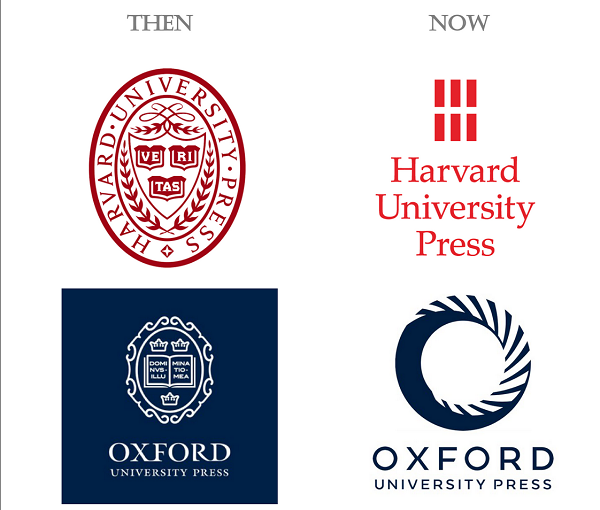
Just consider the flurry of rebranding efforts in academic publishing. As I’ve explained elsewhere, successful organizations rarely redesign their logos or “refresh” their brands. They don’t have time for such nonsense. But even more to the point, when you’re thriving, your logo is part of that success — it’s a sign of your strength, and you just don’t mess with it.
But that’s clearly not the case in academia nowadays.
I could give you countless examples from college campuses — where “rebranding” is more popular than a hot high school football prospect on a recruiting visit. But I’ll settle for two instances:
My only disappointment is that these brand redesigns didn’t come packaged with a new slogan. May I suggest something along the lines of: Information Solutions for a Changing World.
Or maybe, if we can be a bit more boastful: The Ultimate in Handheld Data Storage.
Does anybody still believe in this rebranding malarkey? Surely any reasonable person can see it’s all smoke and mirrors? But that hardly matters, because the brand redesign has tremendous symbolic value.
That’s why they do it.
The road to hell was once paved with good intentions — but nowadays we settle for symbolic gestures. They’re much cheaper than good intentions. And there’s no shortage of symbolic gestures nowadays — more than enough to pave that whole damned highway to hell.
It’s a shame that symbolism doesn’t pay the bills. Or fix problems. And it certainly won’t sell books.
Comments Off on “The most disturbing concept Freud ever invented – and he had a few, that bloke – is Thanatos, or the ‘death instinct'”
A History of Tacos
Tasting History with Max Miller
Published 5 Jul 2022
(more…)
Comments Off on A History of Tacos
QotD: The Dummies’ Guide to Meditations by Marcus Aurelius
Who: Marcus Aurelius, Roman Emperor in the mid-late 2nd century AD. The last of the “Five Good Emperors”, Marcus spent much of his time dealing with barbarian incursions and plague. There are some good biographies of the man, but Wiki covers the high points.
What: Because of the above, the Meditations were something like Marcus’s private self-help manual. He’s reminding himself to remain literally Stoic in the face of serious, seemingly unsolvable problems.
When: Late 2nd century AD. Greco-Roman philosophy was well-developed at this point; Stoicism was part of the classical tradition.
Where: In general, the European part of the Roman Empire. Specifically, on campaign against the barbarians – Marcus wrote a lot of the Meditations at the front.
Why: Because this man was the richest, most powerful individual in his world … and hated it. As a Stoic, he believed that virtue was its own — and, indeed, the only — reward, but as Roman Emperor he was forced to do un-virtuous things all day every day. It’s good instruction for how to live with yourself — how to be a man in a world that so often forces you to act like a snake.
Essential Background: Not much beyond the above.
Nice to have: The basics of Stoic doctrine. Specifically, their belief that “living virtuously” and “living according to nature” were basically synonymous, and that they were the only way to true happiness. A little Stoic epistemology, too — as their way of life depends on seeing the true nature of things, their standards for knowledge (what we’d call “justified true belief”) are extremely high. A statement like “pain is indifferent” is clear, and useful, on its own, but knowing the Stoic view of knowledge helps one appreciate just how prevalent the “indifferents” are, and how tough being truly indifferent is. Also nice to know: The wholesale adoption of Marcus by medieval Christians. There’s a very strong Stoic streak in Christianity’s first 1500 years; Marcus is always up there with the very best of the “virtuous pagans”.
None of these are necessary, though — you could lightly edit the Meditations (taking out the “thank you’s” at the start of Book One, explaining a few allusions) — and publish it today as a self-help manual. Also not necessary: Any real background in ancient philosophy. Back then, “philosophy” meant “a way of living”, not “a system for investigating the world”. Since Marcus is convinced of Stoicism’s truth, he doesn’t spend any time engaging the doctrines of other schools.
Severian, “Reading the Classics: An Illustration”, Rotten Chestnuts, 2020-02-14.
Comments Off on QotD: The Dummies’ Guide to Meditations by Marcus Aurelius
November 16, 2022
C.S. Lewis and J.R.R. Tolkien … arch-dystopians?
In The Upheaval, N.S. Lyons considers the literary warnings of well-known dystopian writers like Aldous Huxley and George Orwell, but makes the strong case that C.S. Lewis and J.R.R. Tolkien were even more prescient in the warnings their works contain:
Which dystopian writer saw it all coming? Of all the famous authors of the 20th century who crafted worlds meant as warnings, who has proved most prophetic about the afflictions of the 21st? George Orwell? Aldous Huxley? Kurt Vonnegut? Ray Bradbury? Each of these, among others, have proved far too disturbingly prescient about many aspects of our present, as far as I’m concerned. But it could be that none of them were quite as far-sighted as the fairytale spinners.
C.S. Lewis and J.R.R. Tolkien, fast friends and fellow members of the Inklings – the famous club of pioneering fantasy writers at Oxford in the 1930s and 40s – are not typically thought of as “dystopian” authors. They certainly never claimed the title. After all, they wrote tales of fantastical adventure, heroism, and mythology that have delighted children and adults ever since, not prophecies of boots stamping on human faces forever. And yet, their stories and non-fiction essays contain warnings that might have struck more surely to the heart of our emerging 21st century dystopia than any other.
C.S. Lewis and J.R.R. Tolkien
The disenchantment and demoralization of a world produced by the foolishly blinkered “debunkers” of the intelligentsia; the catastrophic corruption of genuine education; the inevitable collapse of dominating ideologies of pure materialist rationalism and progress into pure subjectivity and nihilism; the inherent connection between the loss of any objective value and the emergence of a perverse techno-state obsessively seeking first total control over humanity and then in the end the final abolition of humanity itself … Tolkien and Lewis foresaw all of the darkest winds that now gather in growing intensity today.
But ultimately the shared strength of both authors may have also been something even more straightforward: a willingness to speak plainly and openly about the existence and nature of evil. Mankind, they saw, could not resist opening the door to the dark, even with the best of intentions. And so they offered up a way to resist it.
Subjectivism’s Insidious Seeds
The practical result of education in the spirit of The Green Book must be the destruction of the society which accepts it.
When Lewis delivered this line in a series of February 1943 lectures that would later be published as his short book The Abolition of Man, it must have sounded rather ridiculous. Britain was literally in a war for its survival, its cities being bombed and its soldiers killed in a great struggle with Hitler’s Germany, and Lewis was trying to sound the air-raid siren over an education textbook.
But Lewis was urgent about the danger coming down the road, a menace he saw as just as threatening as Nazism, and in fact deeply intertwined with it, give that:
The process which, if not checked, will abolish Man goes on apace among Communists and Democrats no less than among Fascists. The methods may (at first) differ in brutality. But many a mild-eyed scientists in pince-nez, many a popular dramatist, many an amateur philosopher in our midst, means in the long run just the same as the Nazi rulers of Germany. Traditional values are to be “debunked” and mankind to be cut into some fresh shape at will (which must, by hypothesis, be an arbitrary will) of some few lucky people …
Unfortunately, as Lewis would later lament, Abolition was “almost totally ignored by the public” at the time. But now that our society seems to be truly well along in the process of self-destruction kicked off by “education in the spirit of The Green Book“, it might be about time we all grasped what he was trying to warn us about.
This “Green Book” that Lewis viewed as such a symbol of menace was his polite pseudonym for a fashionable contemporary English textbook actually titled The Control of Language. This textbook was itself a popularization for children of the trendy new post-modern philosophy of Logical Positivism, as advanced in another book, I.A. Richards’ Principles of Literary Criticism. Logical Positivism saw itself as championing purely objective scientific knowledge, and was determined to prove that all metaphysical priors were not only false but wholly meaningless. In truth, however, it was as Lewis quickly realized actually a philosophy of pure subjectivism – and thus, as we shall see, a sure path straight out into “the complete void”.
In Abolition, Lewis zeros in on one seemingly innocuous passage in The Control of Language to begin illustrating this point. It relates a story told by the English poet Samuel Taylor Coleridge, in which two tourists visit a majestic waterfall. Gazing upon it, one calls it “sublime”. The other says, “Yes, it is pretty.” Coleridge is disgusted by the latter. But, as Lewis recounts, of this story the authors of the textbook merely conclude:
When the man said This is sublime, he appeared to be making a remark about the waterfall … Actually … he was not making a remark about the waterfall, but a remark about his own feelings. What he was saying was really I have feelings associated in my mind with the word “sublime”, or shortly, I have sublime feelings … This confusion is continually present in language as we use it. We appear to be saying something very important about something: and actually we are only saying something about our own feelings.
For Lewis, this “momentous little paragraph” contains all the seeds necessary for the destruction of humanity.

Comments Off on C.S. Lewis and J.R.R. Tolkien … arch-dystopians?
The Real Reason for Hitler’s War – WW2 Specials
World War Two
Published 15 Nov 2022The murder of the Jews of Europe is not simply conducted alongside the military and political war aims of the Third Reich. For Hitler and the Nazis, the murder of the Jews of Europe is the military-political aim of the war. It confounds all logic, but in the twisted worldview of Nazi ideology, it makes perfect sense. This is a war on the Jewry.
(more…)
Comments Off on The Real Reason for Hitler’s War – WW2 Specials
“Angertainment is unlikely the sole cause of US political polarisation, but it certainly hasn’t helped”
At Quillette, Claire Lehmann rounds up the rising distrust/disgust among the American public in their views of the legacy media:
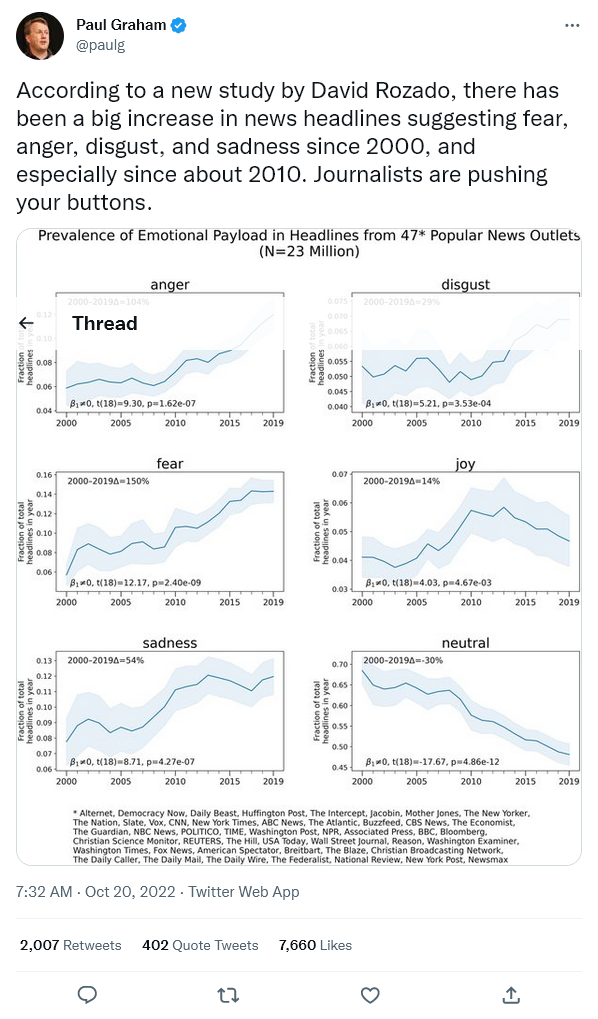
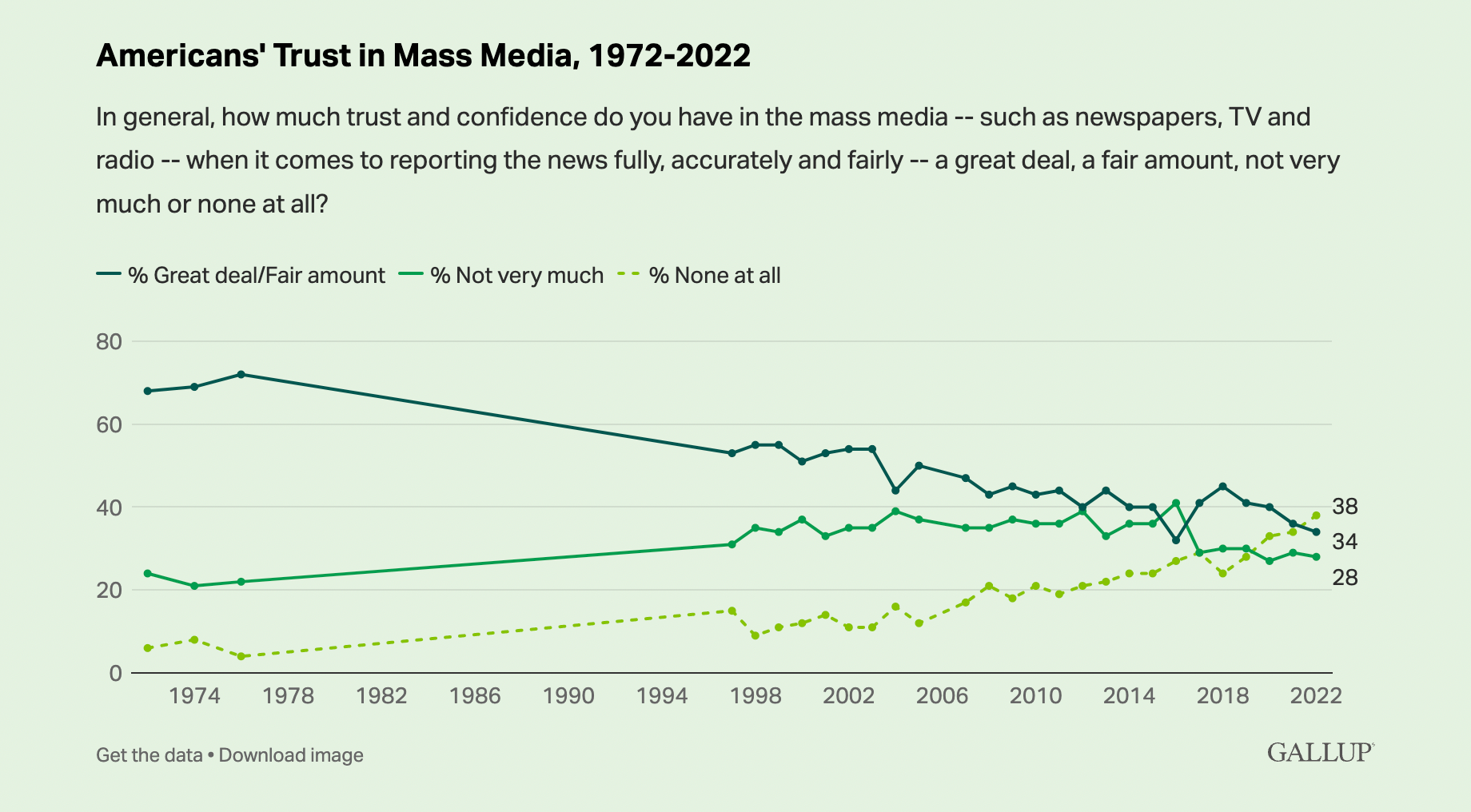
In October, a study published in PLOS One provided some fresh insight into how and why American media has become so dysfunctional. Over the past 20 years, the study reported, headlines that convey anger, fear, sadness, and disgust have been increasing, while headlines conveying neutrality or joy have been in decline. These trends have coincided with a massive drop in trust in news journalism, particularly in the US.
According to Gallop polling, seven percent of Americans say they have “a great deal” of trust in the media, while 38 percent say they have none at all. As angertainment has increased, trust has decreased. As one political tribe provides angertainment for its loyal readers and viewers, the other becomes increasingly alarmed and disgusted. Angertainment may be profitable for journalism in the short-term but over the long-term it trashes the integrity of the profession.
Angertainment is unlikely the sole cause of US political polarisation, but it certainly hasn’t helped. Just as mad cow disease was caused by feeding bovine-meal to cows, angertainment feeds on polarisation which in turn feeds on angertainment. It’s a cannibalistic cycle.
[…]
The incentives for journalism are broken. This is not always the fault of individual journalists, although some strive for truth and accuracy with more sincerity than others. Nor is it solely the fault of media companies, although many of them prioritise profit and engagement over rigour and fairness. It is not even the fault of “Big Tech”, even though social media companies have built the machine on which these broken incentives run.
It’s the fault of all of us. We are the ones who devour angertainment and get high on watching our enemies suffer. We are the ones who want to see various idiots eviscerated and dismembered by the bayonets of Twitter. We are the ones who clamour after content which makes us feel virtuous, complacent, and like we belong. The 20-year incline in headlines denoting fear, anger, disgust, and sadness in American media would not have occurred if audiences had not been rewarding it. In a competitive eco-system, media organisations must adapt to their audiences, feed them what they want, or die. But like the cows feeding on the meat-and-bone meal of other cows, this feedback loop creates the cultural equivalent of a neurodegenerative disease.
I have been just as guilty of this as any other publisher, consumer, or creator of media. But in recent months I’ve largely stepped back from social media, stood outside this machine, and have watched it whir and whizz from the sidelines. It is possible to disengage and reconsider the machine from a safe distance, starving it of fuel. And every day at Quillette I am reminded by my writers and readers and subscribers that it is possible to publish and create journalism that is appreciated for its analytical and aesthetic value, rather than for the artillery it provides in a never-ending culture war. It’s a war in which facts and reputations exist merely as cannon fodder, and where truth is less important than tribe. The media’s incentives may be broken, but we as individuals do not have to be.
Comments Off on “Angertainment is unlikely the sole cause of US political polarisation, but it certainly hasn’t helped”
Can Plant Identification Apps Be Used for Foraging?
Atomic Shrimp
Published 8 Jul 2022There are numerous smartphone apps that assist with identification of plants. A lot of people have proposed these for use in identification of plants to forage for the table. Just how good are these apps, and is it safe to use them in that way?
(more…)
Comments Off on Can Plant Identification Apps Be Used for Foraging?
QotD: Did Sparta actually aspire to supremacy in Greece?
Given Sparta’s inherent resources, the goal was not unrealistic: Sparta was by land area, if not by population, the largest polis in Greece. But Spartan hegemony lasted less than a decade, primarily because of the ineptness of Spartan diplomacy. While victory over Athens in 404 BC made Sparta the preeminent Greek state, the mistakes started almost immediately: the occupation/collaboration government (the “Thirty Tyrants”) in Athens was so cruel and unpopular that Sparta was forced to acquiesce to its removal after just eight months. Meanwhile, Spartan imperiousness – including a refusal to share the spoils of victory, as well as military activity against little Elis and big Persia unsanctioned by the Peloponnesian League – turned Sparta’s allies against them. Sparta’s efforts to restore their alliance militarily led to the Corinthian War in 395, which would prove that while Sparta was still strong, it was not strong enough to enforce its alliances by force of arms. If any of the Spartans ever aimed for hegemony or preeminence among the Greeks, it is safe to say they failed.
Bret Devereaux, “Collections: This. Isn’t. Sparta. Part VII: Spartan Ends”, A Collection of Unmitigated Pedantry, 2019-09-27.
Comments Off on QotD: Did Sparta actually aspire to supremacy in Greece?
November 15, 2022
How Was The Soviet Union Founded?
The Great War
Published 11 Nov 2022Vladimir Lenin had led the Bolshevik movement through the October Revolution and the Russian Civil War but by 1922 his health was failing and infighting among Bolshevik leadership caused friction. In the end Josef Stalin was able to prevail over Leon Trotsky and lead the newly founded Soviet Union until his death in 1953.
(more…)
Comments Off on How Was The Soviet Union Founded?
New Zealand’s “splintered reality”
Earlier in 2022, when most of us were distracted by the Freedom Convoy in Ottawa, New Zealand was having its own populist protest moment, as Chris Bray recounts:
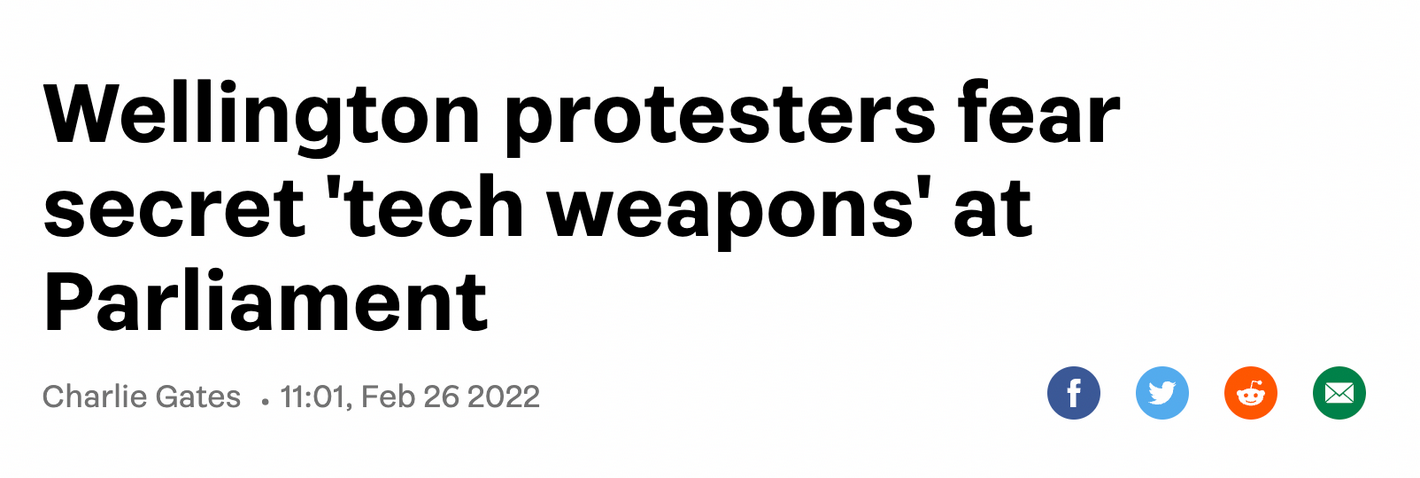
Back in February, protesters gathered outside New Zealand’s parliament began warning that police were using LRAD sound cannons to disrupt their protest. To the news media, it was evidence of how stupid and crazy the protesters had become, and still more proof of the obvious silliness of the anti-vaccine mandate protests in general.
Here are the first three paragraphs of that news story, laying it on thick with baseless claims and tinfoil hats:
Wellington anti-mandate protesters have been seen wearing tin foil hats, as some baselessly claim they are being targeted by “tech weapons” directed at them.
A video posted on Facebook on Thursday under the name Carlene Louise has attracted attention on social media.
In the video, the protester said people at the occupation site in Wellington are getting ill and claims without any evidence that the cause is “EMF machines”, “radiation machines” and “technological weapons” being directed at the occupation.
Four months later, police confirmed that they had used LRAD cannons against the protesters, though they claimed they didn’t use them until March. See, so it totally was a baseless conspiracy theory. Tinfoil hatted morons! Falsely claiming that the police did … what they … did. Hold on a second.
This nice bookending of claims and facts, and many other extraordinarily insightful juxtapositions, comes from a short documentary that, unfortunately, appears to only be available on YouTube:
In just half an hour, this is the whole thing, a perfect depiction of the “disinformation” project as it works everywhere. Note the moment when a news anchor and New Zealand’s bizarre prime minister are having an exchange about the viciousness and terrifying blood thirst of the far-right anti-government protesters, and the camera cuts away to show the protest, undercutting the description in real time. Note the moment when the disinformation expert tells an interviewer that she has determined that the protests are violent and dangerous, and then explains that people inside the protest believe that they’re engaged in a project of peace and love — a frightening example, she explains, of the splintered reality these people occupy inside their echo chamber. Note the moment when a member of parliament warns that anti-mandate protests are “fascist”.
And note, above all, how confused the news media figures are as they discuss the way their accurate and factual reporting from the perimeter of the protest, responsibly informed by experts and authorities, is being irresponsibly contradicted by livestreaming from inside the protest.

Comments Off on New Zealand’s “splintered reality”
Look at Life — Moving Day (1967)
PauliosVids
Published 20 Nov 2018How the headquarters of NATO was moved from France to Belgium.
Comments Off on Look at Life — Moving Day (1967)
QotD: Second-wave feminism
Camille Paglia, “Prominent Democratic Feminist Camille Paglia Says Hillary Clinton ‘Exploits Feminism’”, Washington Free Beacon, 2017-05-15.
Comments Off on QotD: Second-wave feminism


