
World War Two
Published 12 Oct 2023Since the earliest days of humanity, where there has been war, there has been rape. This war is no different. As vast armies battle across Europe, the chaos in their wake breeds an epidemic of rape. In its action and its punishment the European rape wave is also highly racialised. It adds up to a storm of suffering.
(more…)
October 16, 2023
The Allied Rape Wave of 1944 – War Against Humanity 116
Comments Off on The Allied Rape Wave of 1944 – War Against Humanity 116
After the attacks, Hamas proudly shared photos and videos of the victims
In UnHerd, David Patrikarakos describes what he calls “the week Hamas reinvented horror”:

Israel and Gaza are a Pathé newsreel of violence. Atrocity mounts upon atrocity. Blood smeared on gristle. Festivals mottled with corpses. Women dragged off to be raped and killed. And, now, perhaps the ultimate taboo. “This is the most difficult image we’ve posted”, ran the Daily Telegraph’s front page, reprinting a tweet from the State of Israel’s official account. “As we are writing this we are shaking. We went back and forth about posting this. But we need each and everyone of you to know. This happened.”
The images were of the charred and blackened corpses of babies. Dead bodies are a fixture of my professional life, and I have never seen anything like it. I have never felt that level of nausea. Nothing is beyond the sadism of Hamas. Nothing, now, might be beyond the response — comes the reply from Israel.
Clearly, nothing now is beyond being live-streamed, uploaded, posted, tweeted or shared. Amid the horror and disgust, one thing has struck me above all: the footage has overwhelmingly come from the perpetrators. Yes, there is video shot by terrified and fleeing victims, but scroll through Twitter, Telegram and Instagram and what do you see? Hamas filming themselves barking at cowering Israeli families on the ground; parents covering their children’s eyes, desperate to banish reality; Hamas yanking soldiers off tanks and throwing them into the dirt; Hamas grinning as they parade an elderly woman around in a golf cart.
This conflict has lasted for almost a century, yet what we have seen this week has never been seen before. It is a nasty and brutal war fought over land where ideology and the interminable cycle of reprisals has made its resolution impossible. But it is something else, too. It is perhaps the world’s longest running geopolitical media spectacle. Nothing, not Kashmir nor the Balkans nor any of the other enduring conflicts largely created by empire, has received anywhere near this level of coverage. The depths plumbed by Hamas are unprecedentedly low.
Several factors explain the brutality. First is a perennial of human nature: old-fashioned rage and bloodlust. No one, least of all it seems Hamas, expected the attacks to be so successful. Coming upon hundreds of unarmed Israelis was obviously too much of a temptation for many of these incontinent fanatics.
Then there is the desire to provoke. To get Israel to overreact, but also its neighbours. Broadcast images of dead Palestinian babies onto those feeds and then maybe your Arab allies will start to wonder about the wisdom of their various normalisation agreements with Israel. History is turning away from Hamas. The warming of relations between Israel and Saudi Arabia threatens to destroy them forever. If the “Custodian of the Two Holy Places” decides the “Zionist Entity” is actually ok, then it’s only the politically impotent and half-witted Bashar al-Assad beside you, and the Iranians, who are formidable but largely alone.
It’s a basic strategy but a generally successful one. Don’t forget that one of the reasons bin Laden struck the World Trade Center was to get the Leviathan to lash out, which it did. Hamas has limited options. This is perhaps the one card it can play with any real efficacy.
Comments Off on After the attacks, Hamas proudly shared photos and videos of the victims
Remington Model 8 (in .25 Remington)
Forgotten Weapons
Published 23 Feb 2014The Remington Model 8 (and the 81, which is mechanically identical) was an early self-loading rifle design by John Browning, and was produced from 1906 into the 1950s. It was available in 4 calibers initially, all of them being rimless, bottlenecked proprietary jobs — the .25, .30, .32, and .35 Remington. The .35 was the most effective on game and was the most popular seller, with the .25 being the least popular. When the Model 81 was introduced (with a heavier forestock and semi pistol grip), it was also made available in .300 Savage. At that time, the Remington factory also offered to rebarrel existing Model 8s for the .300 Savage cartridge.
The Model 8 was a long-recoil design, something that saw little further development and remains one of the least-common types of action. It is interesting to compare the Remington 8 to the Winchester 1905/07/10 series of rifles that came on the market at almost the same time. Both were well-made and effective self-loaders, but with much different target markets and mechanical systems. Winchester opted to make a replacement for the pistol-caliber lever action saddle rifle, and did so using a simple and somewhat brute-force operating system: direct blowback with a heavy bolt and recoil spring. Remington, on the other hand, wanted to make a big-game rifle with very fast follow-up shot capability, and used the far more complex long recoil locked breech system. Both guns are largely forgotten by the gun-owning public today, although they both were widely used and appreciated by hunters for decades.
(more…)
Comments Off on Remington Model 8 (in .25 Remington)
QotD: Differentials of “information velocity” in a feudal society
[News of the wider world travels very slowly from the Royal court to the outskirts, but] information velocity within the sticks […] is very high. Nobody cares much who this “Richard II” cat was, or knows anything about ol’ Whatzisface – Henry Something-or-other – who might’ve replaced him, but everyone knows when the local knight of the shire dies, and everything about his successor, because that matters. So, too, is information velocity high at court – the lords who backed Henry Bolingbroke over Richard II did so because Richard’s incompetence had their asses in a sling. They were the ones who had to depose a king for incompetence, without admitting, even for a second, that
a) competence is a criterion of legitimacy, and
b) someone other than the king is qualified to judge a king’s competence.Because admitting either, of course, opens the door to deposing the new guy on the same grounds, so unless you want civil war every time a king annoys one of his powerful magnates, you’d best find a way to square that circle …
… which they did, but not completely successfully, because within two generations they were back to deposing kings for incompetence. Turns out that’s a hard habit to break, especially when said kings are as incompetent as Henry VI always was, and Edward IV became. Only the fact that the eventual winner of the Wars of the Roses, Henry VII, was as competent as he was as ruthless kept the whole cycle from repeating.
Severian, “Inertia and Incompetence”, Founding Questions, 2020-12-25.
Comments Off on QotD: Differentials of “information velocity” in a feudal society
October 15, 2023
“… officials gesture and perform with a constant focus on the optics. The act of governing becomes the act of calculated sloganeering”
Chris Bray explains how politicians and government officials have so damaged their own credibility that significant portions of the population greet each and every news story as pre-calculated propaganda to advance this or that cause. Thanks to their breathtaking cynicism, the swivel-eyed conspiracy theorist of old has more credibility than a high-ranking government official:
The moral and intellectual sickness of the global governing class is infecting us all. They’ve poisoned the public sphere.
In the society of the spectacle, authority has become a display; officials gesture and perform with a constant focus on the optics. The act of governing becomes the act of calculated sloganeering: This vaccine is safe and effective. The use of evidence is a conspiracy theory; disagreement is disinformation. What we learned from the discovery process in Missouri v. Biden is that, yes, the government has manipulated what you’ve been allowed to read and to know. Everyone who gets vaccinated against COVID-19 becomes a dead end for the virus, and don’t you dare say otherwise.
The British journalist Laura Dodsworth told us, with considerable evidence, that governments were using nudge units of social scientists to deliberately crank up public terror over the pandemic, embracing mask mandates as a way of planting a symbol of fear on our faces. We wake up every morning knowing that governments lied for the purpose of manipulating our behavior.
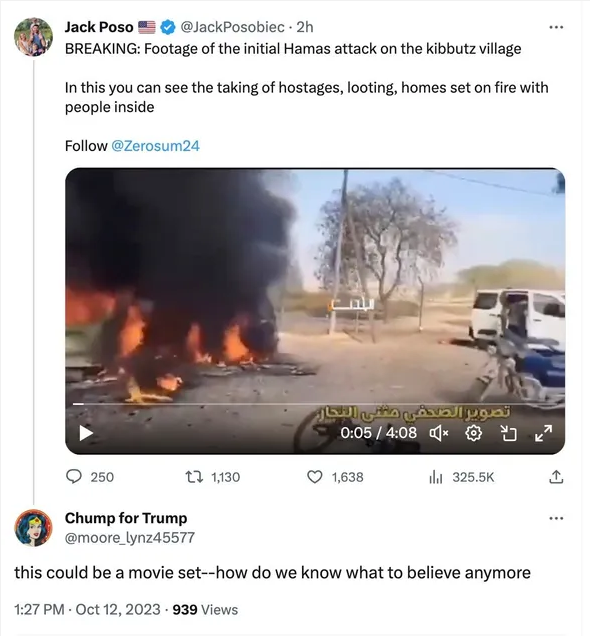
And now we see the devastating cost. I wrote on Substack this week about video of the Hamas attacks on Israel and quickly began seeing the themes of a low-trust society in the comment thread, comments that were echoed all over social media: Why do the authorities want us to see this footage? What’s their game? How did they pull off this psyop? What’s causing them to launch this false flag attack at this exact moment?
The repeated message was about the importance of being skeptical: The war machine is trying to propagandize us into another stupid war!
But what I began seeing — what we all began seeing — wasn’t skepticism, the diligent search for clear evidence, but a wholesale refusal at the political margins to believe anything at all.
The certainty that all images are lies is the psychological mirror of the reflex to believe the news, identically displaying the refusal to parse evidence and make choices. It’s all one thing or the other: Oh, right, Hamas attacked Israel, moron! I GUESS THE SHEEPLE JUST BELIEVE WHATEVER THEY’RE TOLD!
It’s scorched-earth nihilism, the blanket rejection of inconvenient reality. And I understand it. People who’ve been lied to assume that they’re being lied to.
Comments Off on “… officials gesture and perform with a constant focus on the optics. The act of governing becomes the act of calculated sloganeering”
The Isolation of Army Group North – WW2 – Week 268 – October 14, 1944
World War Two
Published 14 Oct 2023Churchill, Stalin, and Roosevelt meet at the Moscow Conference and talk about future “spheres of influence” in the Balkans. They also make plans for the future of Poland. In the field the Soviet Red Army completes the isolation of Army Group North and also advances in Hungary and Yugoslavia. The Allies enter Aachen in the west and cross the Rubicon in Italy. The Americans are still fighting the Japanese on Peleliu, and this week also make raids against Japanese airfields ahead of next week’s invasion of the Philippines.
01:00 Recap
01:22 The Moscow Conference begins
03:43 Isolating Army Group North
06:29 Soviet advances toward Belgrade
08:14 The Debrecen Operation
13:20 Horthy and Hungary
14:30 Chiang Kai-shek accuses Joe Stilwell
16:19 American raids on Formosa
19:29 The fight for Peleliu continues
20:01 Antwerp and Aachen
22:01 The Allies cross the Rubicon
(more…)
Comments Off on The Isolation of Army Group North – WW2 – Week 268 – October 14, 1944
Training and educating for unseriousness
Theophilus Chilton on the many ways our education and entertainment industries inculcate trivial and easily distracted habits in both children and young adults:

Any thinking American has surely observed that our culture and society are growing more and more immature, childish, and unthinking with each passing year. In previous articles, I’ve noted this immaturity, as well as the tendency (neither coincidental, nor accidental) to make Americans more and more dependent upon the Regime for even the most basic needs of life. There are several interrelated cultural and political agendas at work which have systematically worked to create this state of affairs among the American people – and these are largely the work of social and political “progressivism”, the handiwork of the Left. Let’s face it – it is to the benefit of left-wingers to cause as many people as they possibly can to be dumb, distracted, and therefore destitute of the ability to think for themselves or to successfully reason their way into informed opinions about complex social and economic issues.
One of the major ways in which the Left dumbs down the American population is through the public education system. What people need to understand is that progressives are not genuinely interested in our children receiving a thorough and useful education, no matter how much they may squawk about “funding” and whatnot. For the Left, publik skoolz are merely a means by which to propagandize children to a progressive worldview while simultaneously rendering them unable to question the unreality they have been taught. At the same time, additional funding “for schools” is basically just a way for personnel in the managerial superstructure to divide the spoils. The Left has absolutely no desire for children to grow up into college students, and then into full-fledged adults, who can think for themselves, using logic and reason to assess what they see and hear and to come to their own conclusions.
Along these lines, I was reminded of Pascal-Emmanuel Gobry’s article from 2014 in Forbes magazine about the need to put the liberal arts back into the centre of American educational curricula. By this, he means the restoration of the great books of Western civilization, the accumulated wisdom in the sciences and humanities that our culture has built, and the ideological underpinnings upon which Western notions of citizenship, responsibility, and the rule of law are based. In other words, all of the things that the cultural Marxists have spent the last five decades systematically expunging from the American educational system, from top to bottom. Things like Cicero, Plato, the Church Fathers, Shakespeare, Herodotus, Montesquieu, the Founding Fathers, and so much more that I could not possibly list in full. No – these have been purged, replaced by Heather Has Two Mommies and Why Are the Ice Caps Melting?: The Dangers of Global Warming. Progressives want young people (who will then grow up to be old people) who are in the dark about the whats, hows, and whys of our cultural underpinnings and what they all mean for our heritage and traditions. They want your kids to be more interested in emasculating themselves with hormones than they are in reading dusty old books about their own history and heritage. This explains why progressives are so irate about the proposals such as those which remove diversity and LGBT propaganda from classrooms, just to give a couple of examples.
However, I don’t believe we can place the blame solely on the educational system. It surely has not escaped the attention of intelligent Americans that most of what constitutes our entertainment and media establishment is, shall we say, less than cerebral. In fact, much of what is on television, in the movies, and on the radio waves is downright stupid and distracting. It is literally distracting. The content of these media, as well as the advertising regimen by which television viewers are presented with five minutes of show, then three minutes of ads, then another five minutes of show, then another three minutes of ads … it is all designed to train people toward short attention spans that are easily distracted by shiny baubles and other mindlessness. A person who has their brain trained by modern television programming is going to be someone who will not have the patience to sit down with a book and read it. They’ll literally be uneducable beyond simple repetition and mindless obedience.
The state of American journalism is no better. This is illustrated by Gobry’s article above, in which he addressed the attacks upon Republican congressman (nominee at the time it was written) Dave Brat of Virginia, an economics professor who overturned Eric Cantor in the 2014 GOP primary, and who is a genuine constitutionally-minded intellectual who stands on the fundamental principles of our society and constitutional system (meaning, of course, that he’s still a turbonormie but at least his heart’s in the right place). In the course of some statements he made, Brat remarked that government has “a monopoly on the use of force”. For this, he was attacked by nimrods in the news media as some kind of crazy, wacko extremist. There’s just one problem, as Gobry points out,
What’s wrong with this picture, America, is that the concept of the state having “a monopoly on the [legitimate] use of force” is a quotation from the highly reputed and important German sociologist Max Weber, and is a concept that is absolutely basic to our modern understanding of the State. Anyone who has taken polisci 101 or sociology 101 or political philosophy 101 or history of ideas 101 ought to have encountered the phrase. It is about as offensive as saying that donuts have holes …
In other words, journalists – who are supposed to be educated, and who, if they are dealing with the political circuit, should have at least some sort of basic education in political science to go with their typewriting skills – had no clue what Brat was talking about. They didn’t recognize Weber’s (very commonly quoted) dictum; most of them probably don’t even know who Max Weber was. All they saw was what they thought was an opportunity to play the “Tea Party wacko extremist” card because somebody used the words “force” and “government” in the same sentence.
The sad part is that it probably worked with a lot of the low-information voters out there.
A paper in the Journal of Pediatrics by Peter Gray, David F. Lancy, and David F. Bjorklund points to the ever-declining ability of children and teens to engage in independent activity away from direct adult supervision from a very early age:
It is no secret that rates of anxiety and depression among school-aged children and teens in the US are at an alltime high. Recognizing this, the American Academy of Pediatrics, American Academy of Child and Adolescent Psychiatry, and Children’s Hospital Association issued, in 2021, a joint statement to the Biden administration that child and adolescent mental health be declared a “national emergency.”
Although most current discussions of the decline in youth mental health emphasize that which has occurred over the past 10-15 years, research indicates that the decline has been continuous over at least the last 5 or 6 decades. Although a variety of causes of this decline have been proposed by researchers and practitioners (some discussed near the end of this Commentary), our focus herein is on a possible cause that we believe has been insufficiently researched, discussed, and taken into account by health practitioners and policy makers.
Our thesis is that a primary cause of the rise in mental disorders is a decline over decades in opportunities for children and teens to play, roam, and engage in other activities independent of direct oversight and control by adults. Such independent activities may promote mental well-being through both immediate effects, as a direct source of satisfaction, and long-term effects, by building mental characteristics that provide a foundation for dealing effectively with the stresses of life.
With few, if any, opportunities to explore and engage with the world away from parental supervision, it isn’t a surprise that young adults today suffer much higher rates of mental illness, especially anxiety-related afflictions.
Comments Off on Training and educating for unseriousness
History Summarized: The Castles of Wales
Overly Sarcastic Productions
Published 23 Jun 2023Every castle tells a story, but when one small country has over 600 castles, the collective story they tell is something like “holy heck ouch, ow, oh god, why are there so many arrows, ouch, good lord ow” – And that’s Wales for you.
(more…)
Comments Off on History Summarized: The Castles of Wales
QotD: The two eras of Jazz
Dylan Jones, “The 100 best jazz albums you need in your collection”, GQ, 2019-08-25.
Comments Off on QotD: The two eras of Jazz
October 14, 2023
Lessons the Israelis must learn from the Hamas attacks
CDR Salamander finishes off his short series on the Hamas terror attacks on southern Israel last week by highlighting some of the things the Israeli military and intelligence organizations must take away from the failure to anticipate and parry or repel the attackers:

- Complacency Born from Excellence:
Israel is one of the richest, most educated and advanced societies on the planet. Their social capital is almost unmatched. Gaza is one of the poorest, miseducated, and dependent societies on the planet. On paper, one would think there would be no way what happened over the weekend could have happened. No, belay my last. I can very much see this scenario being on paper — and probably was — but it was not “the paper” that drove policy. The overconfident and optimistic won the argument. Like in 1973, if you spend most of your brief talking about how great you are and discussing how weak your opponent is, you might be missing something … or a lot of things.
- Technology Briefs Better Than it Performs:
How many times must this be learned? High tech solutions to human problems brief well when not properly cross examined or wargamed by skeptics. Tech seems clean, effective, and affordable — but it is not robust outside its planning assumptions. They work wonderfully in narrowly scoped vignettes, and not much more. Remote control machine guns on towers seem much more exciting than soldiers on patrol in an APC … but which one is more resilient to the unexpected? There is always compromise and risk. Sometimes well meaning and smart people make the wrong call.
- Coddling Useful Idiots is a False Economy:
In times of peace when facing very ugly truths, it is human nature to a large percentage of the population to defer to emotion, desire, and aspiration as opposed to reason, reality, and capabilities. It is easy to project your best intentions and world view on your enemy in the hope that their motivations are the same as yours. The fact remains, well meaning people can be wrong. Hate is irrational and as such, immune to reason. Well meaning but wrong people cannot be allowed to drive policy when there is no backup plan.
- Doomsday Cults Sometimes Take Over Entire Cultures:
Two people or two million people can become part of and enablers to a death cult. Humans are capable of the most wonderful things, and the most horrible things. This duality of mankind is what brought us to our advanced stage of civilization. When these death cults are closer to two million than two — more Hamas than Heaven’s Gate — you need to be prepared to respond in what ever way removes that threat should it cross over in to your reason-based society. They cannot be ignored. They grow until they take a nap to Hale-Bopp or fly in to a music festival.
- Evil Waits While Good is Impatient and Forgetful:
A free people can get distracted by their own pursuits that can only exist in a free society. Evil is hard to counter, uncomfortable to think about, and easy to avert your eyes when it is “over there” and forgotten and not “in here” trying to kick in the door. Too many people will make excuses, and ask you to accept their excuses, to avoid the unending and hard work of keeping evil away. Evil will exist always, the key is to not just keep it contained but to make sure it is small, isolated, and socially unacceptable. If you don’t do the last two, the first one will grow.
- F=MA:
How hard have you actually wargamed your defenses? In hindsight it is easy to second guess the border around Gaza, but at some time there had to be someone warning it was not enough. If you can run a bulldozer through a wall, it isn’t a wall — it is an aspiration. That, I hope, will be part of the post-war investigation.
There is the quick look so far this Thursday. In that Top-6 there are lessons for every nation to hoist onboard — especially the U.S.A.
In his Friday Q&A, Severian answers a question about what Hamas expected to gain from launching these attacks:
Which brings us, at long last, to Hamas. I too am baffled by this, because it seems so very Tet-like. NOT that the Mullahs are trying to “get rid of” their version of the Viet Cong, as the question suggests, but because it really seems like a big mistake. Bare minimum, it reveals the catastrophic failure of Israeli / AINO intelligence. If they have an ounce of Seriousness left anywhere in their government, they will have to massively clean house. Which would be terrible for Hamas – the guys who were asleep at the switch, allowing huge shipments of first-rate arms and etc. to be smuggled into Gaza, are now wide awake.
Same deal with training and financing. As incompetent as the Intel services were, I’m pretty sure even they would’ve noticed that hey, the Gaza Hang Gliding Club sure has a lot of new members! Where in Gaza could they possibly have practiced this stuff? It’s a sophisticated operation that betrays high levels of strategic and tactical coordination, with well-trained commandos doing something really innovative. I mean, parasailing? That’s some Otto Skorzeny shit right there. Whether or not Hamas dreamed it up on their own, or they had help with the operational concept, they surely had to train somewhere other than Gaza. Now, where could that possibly be?
You don’t roll the dice that way unless you really think you’ve got a strong chance of winning. But … win what? Unless they seriously thought Hamas could defeat the Israeli Army straight up … which, maybe they did. History’s full of that kind of thing. The Japanese at Pearl Harbor. Hitler in the Ardennes. America ended up beating those guys, so it’s ok to acknowledge that they made dumb mistakes based entirely on wishcasting. But Ho won, so it was brilliant 4D chess. Something similar might be happening here. It’s not very satisfying, but … there it is. We’ll have to wait and see.
Comments Off on Lessons the Israelis must learn from the Hamas attacks
Why Did the Vietnam War Break Out?
Real Time History
Published 10 Oct 2023In 1965, US troops officially landed in Vietnam, but American involvement in the ongoing conflict between the Communist North and the anti-Communist South had started more than a decade earlier. So, why did the US-Vietnam War break out in the first place?
(more…)
Comments Off on Why Did the Vietnam War Break Out?
A Jacobite spy for Bonnie Prince Charlie
In the latest Age of Invention newsletter, Anton Howes talks about the career of John Holker of Manchester, cloth manufacturer, who joined the army of Prince Charles Edward Stewart in 1745, and eventually became an expert in industrial espionage:
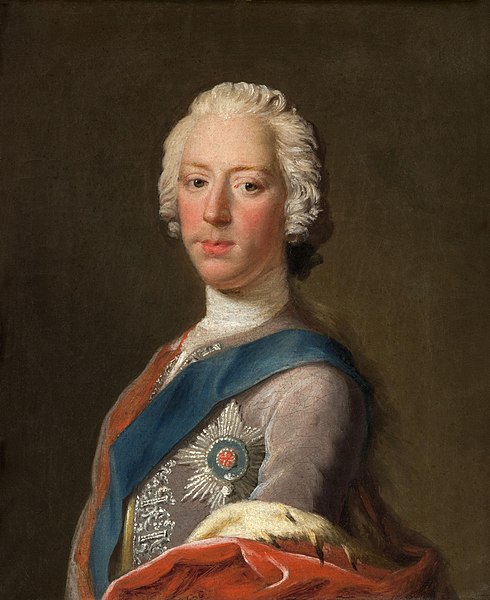
Prince Charles Edward Stuart, 1720 – 1788. Eldest Son of Prince James Francis Edward Stuart.
Portrait by Allan Ramsay, National Galleries Scotland via Wikimedia Commons.
I’ve lately been reading about one of history’s greatest spies — not a James Bond-like agent with licence to kill, but a master of industrial espionage, John Holker.1
Holker was originally from Manchester, in Lancashire, where he was a skilled cloth manufacturer in the early eighteenth century, his specialty being calendering — a finishing process to give cloth a kind of sheen or glazed effect. But Holker was also a Catholic and a Jacobite — a believer in the claim of the Catholic descendants of the deposed king James II to be the rightful rulers of Great Britain, instead of the Hanoverian George I and George II who had only succeeded to the throne because they were Protestants. In 1745 James II’s grandson Charles, also known as Bonnie Prince Charlie — likely the “Bonnie” who lies over the ocean in the famous song — landed in the Scottish Highlands and raised the royal standard. Charles’s uprising defeated the British troops stationed in Scotland, captured Edinburgh, and then marched down the west coast of England, capturing Carlisle and entering Lancashire.
To Holker, who had been born in the same year as the last Jacobite rebellion in 1719, the arrival of Charles in Manchester must have seemed like a once-in-a-generation opportunity. He and his business partner instantly joined Charles’s troops and he was appointed a lieutenant. But Manchester was the last place to provide many eager volunteers for the uprising, and when Charles reached Derby he lost heart and turned around. Holker and his business partner ended up being left to garrison Carlisle as Charles and his force retreated into Scotland to hunker down, and they were soon captured by the British troops sent to quash the uprising. They were then, as officers, sent to Newgate prison in London to sit with their legs bound in irons and await trial and certain execution.
But they never made it to trial. In the first demonstration of Holker’s extraordinary talent for espionage, they escaped. Holker had been allowed visitors in prison, so had drawn on London’s crypto-Jacobite circle to smuggle in files, ropes, and information about the prison and its surroundings. They managed to file through the leg-irons and window bars, climbed up the gutters onto the prison roof, and then used planks from the cell’s tabletop to cross onto the roof of a nearby house. In the event, they disturbed a dog guarding the house, and so Holker hid in a water-butt and became separated from the others. He eventually found refuge at a crypto-Jacobite’s house, then escaped into the countryside before managing to make his way to France.
In France, Holker joined his fellow veterans of the failed uprising of ‘45, becoming a lieutenant in a Jacobite regiment of the French army. He fought for the French in the Austrian Netherlands — present-day Belgium — against the Hapsburgs, the Hanoverians, the Dutch, and the British. Even more extraordinary, however, was that when Bonnie Prince Charlie wanted to go in secret to England in 1750, it was Holker who went with him as his sole companion and guide. Although Charles failed to persuade his supporters in England to rise up in rebellion on their own, Holker managed to get the prince secretly and safely to London and back.
By the time Holker reached his early thirties he had been an industrialist, rebel, prisoner, fugitive, soldier, undercover agent, and even spy-catcher: he successfully identified a spy for the British in Charles’s circle, even if Charles failed to heed his warning. But in 1751 Holker’s career took yet another turn when he was recruited by the French government as an industrial spymaster.
Holker’s chief task was to steal British textile technologies.
1. Unless otherwise stated, I’ve drawn much of my information on Holker and the industries that the French attempted to copy from John R. Harris, Industrial Espionage and Technology Transfer: Britain and France in the 18th Century (Taylor & Francis, 2017), particularly chapter 3.
Comments Off on A Jacobite spy for Bonnie Prince Charlie
Ray Manzarek – “Riders On The Storm”
EliasIak2011
Published 30 Nov 2012“The Doors: Mr. Mojo Risin’ — The Story of LA Woman“
Comments Off on Ray Manzarek – “Riders On The Storm”
QotD: Horses and sheep on the Eurasian Steppe
Now it is worth noting right now that Steppe Nomads have, in essence, two conjoined subsistence systems: there is one system for when they are with their herds and another for purely military movements. Not only the sheep, but also the carts (which are used to move the yurt – the Mongols would call it a ger – the portable structure they live in) can’t move nearly as fast as a Steppe warrior on horseback can. So for swift operational movements – raids, campaigns and so on – the warriors would range out from their camps (and I mean range – often we’re talking about hundreds of miles) to strike a target, leaving the non-warriors (which is to say, women, children and the elderly) back at the camp handling the sheep. For strategic movements, as I understand it, the camps and sheep herds might function as a sort of mobile logistics base that the warriors could operate from. We’ll talk about that in just a moment.
So what is the nomadic diet like? Surely it’s all raw horse-meat straight off of the bone, right? Obviously, no. The biggest part of the diet is dairy products. Mare’s and sheep’s milk could be drunk as milk; mare’s milk (but not sheep’s milk) could also be fermented into what the Mongolians call airag but is more commonly known as qumis after its Turkish name (note that while I am mostly using the Mongols as my source model for this, Turkic Steppe nomads are functioning in pretty much all of the same ways, often merely with different words for what are substantially the same things). But it could also be made into cheese and yogurt [update: Wayne Lee (@MilHist_Lee) notes that mare’s milk cannot be made into yogurt, so the yogurt here would be made from sheep’s milk – further stressing the importance of sheep!] which kept better, or even dried into a powdered form called qurut which could then be remixed with water and boiled to be drunk when it was needed […] The availability of fresh dairy products was seasonal in much of the steppe; winter snows would make the grass scarce and reduce the food intake of the animals, which in turn reduced their milk production. Thus the value of creating preserved, longer-lasting products.
Of course they did also eat meat, particularly in winter when the dairy products became scarce. Mutton (sheep meat) is by far largest contributor here, but if a horse or oxen or any other animal died or was too old or weak for use, it would be butchered (my understanding is that these days, there is a lot more cattle in Mongolia, but the sources strongly indicate that mutton was the standard Mongolian meat of the pre-modern period). Fresh meat was generally made into soup called shulen (often with millet that might be obtained by trade or raiding with sedentary peoples or even grown on some parts of the steppe) not eaten raw off of the bone. One of our sources, William of Rubruck, observed how a single sheep might feed 50-100 men in the form of mutton soup. Excess meat was dried or made into sausages. On the move, meat could be placed between the rider’s saddle and the horse’s back – the frequent compression of riding, combined with the salinity of the horse’s sweat would produce a dried, salted jerky that would keep for a very long time.
(This “saddle jerky” seems to gross out my students every time we discuss the Steppe logistics system, which amuses me greatly.)
Now, to be clear, Steppe peoples absolutely would eat horse meat, make certain things out of horsehair, and tan horse hides. But horses were also valuable, militarily useful and slow to breed. For reasons we’ll get into a moment, each adult male, if he wanted to be of any use, needed several (at least five). Steppe nomads who found themselves without horses (and other herds, but the horses are crucial for defending the non-horse herds) was likely to get pushed into the marginal forest land to the north of the steppe. While the way of life for the “forest people” had its benefits, it is hard not to notice that forest dwellers who, through military success, gained horses and herds struck out as steppe nomads, while steppe nomads who lost their horses became forest dwellers by last resort (Ratchnevsky, op. cit., 5-7). Evidently, being stuck as one of the “forest people” was less than ideal. In short, horses were valuable, they were the necessary gateway into steppe life and also a scarce resource not to be squandered. All of which is to say, while the Mongols and other Steppe peoples ate horse, they weren’t raising horses for the slaughter, but mostly eating horses that were too old, or were superfluous stallions, or had become injured or lame. It is fairly clear that there were never quite enough good horses to go around.
Bret Devereaux, “That Dothraki Horde, Part II: Subsistence on the Hoof”, A Collection of Unmitigated Pedantry, 2020-12-11.
Comments Off on QotD: Horses and sheep on the Eurasian Steppe
October 13, 2023
Elvira, the Party Girl Double Agent
World War Two
Published 11 Oct 2023She’s the gambler with a hotline to the Abwehr. The party girl tearing up the London social scene. Now she’s doing her bit to hold back the Panzer divisions and pave the way for D-Day. This is the story of Elvira Concepcion Josefina de la Fuente Chaudoir, Double Cross’s most flamboyant double agent.
(more…)
Comments Off on Elvira, the Party Girl Double Agent


