
Rex Krueger
Published 18 Oct 2023Building TWO traditional sawbenches. Construction lumber. Simple build.
(more…)
October 19, 2023
Build a saw-bench: transform your woodwork
Comments Off on Build a saw-bench: transform your woodwork
The evisceration of Bill C-69 (aka the Impact Assessment Act)
The decision of the Supreme Court of Canada to strike down large parts of the federal Impact Assessment Act caught a lot of people by surprise. The court hasn’t made much of a habit of rejecting the federal government’s ever-increasing encroachments on provincial jurisdiction, so this ruling is a bit of a black swan. It’d be nice if the Supremes were going to be more vigilant in future, but that’s unlikely. Colby Cosh explains why this is a “remarkable political moment”:
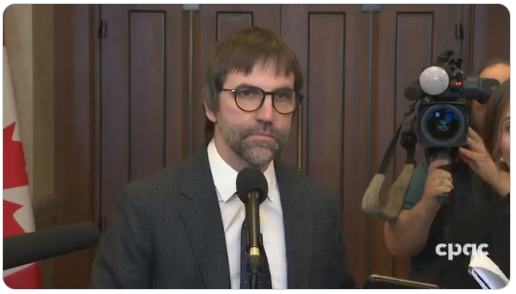
Environment Minister Steven Guilbeault, 3 February 2020.
Screen capture from CPAC video.
To hear the Liberals talk now, you would think that the Supreme Court’s 7–2 rebuke of C-69 was a mere bump in the road. Steven Guilbeault, the federal environment minister, appeared on CTV’s Question Period to reassure the public that the law can be “redefined” to accomplish its grandiose intentions; it’s just a matter of “course-correct(ing)” the text a smidgen in order to “comply with the spirit” of the ruling.
Here’s an idea for the minister: maybe just go ahead and comply with the ruling, period?
Comply with the spirit, he says. Having taken the trouble to decrypt the ruling, which is not exactly a masterpiece of lucid clarity, I wonder at the environment minister’s priorities. Rather than appearing on television with a bunch of happy talk, he ought to have been mopping up the seas of blood left by the court’s evisceration of his Impact Assessment Act.
In essence, the Liberals created an apparatus whereby a federal panel would perform environmental and social assessments of major infrastructure projects based on the possibility that they might “cause adverse effects within federal jurisdiction”.
The underlying pretext is that the federal government’s powers are sometimes engaged by the creation of mines, wells, roads and other such projects — even when they are confined within one province’s borders — because they can conceivably affect federal matters such as fisheries, migratory birds, Aboriginal welfare, treaty obligations and other “national concerns”.
This is true as far as it goes, but the court majority’s finding was that this constitutional pretext for creating a federal assessment scheme isn’t actually reflected in the scheme itself. The Liberals, asserting a right to investigate hypothetical infringements on the federal sphere of power, created a law that essentially allows them to veto anything that a province might want to permit.
As the law is written, the initial assessment-agency decision to “designate” a project for assessment can be based on just about anything, including “any comments received … from the public” and “any other factor the Agency considers relevant”. In the final decision-making phase, which is to be based on the “public interest”, specific federal heads of power are also cast aside: whoever makes the final call at the cabinet level is to evaluate a project for “sustainability”, for example.
Comments Off on The evisceration of Bill C-69 (aka the Impact Assessment Act)
Chiappa Triple Threat at the Range
Forgotten Weapons
Published 29 Mar 2014I had the chance to play with a friend’s new Chiappa Triple Threat at the range last week, so I took the opportunity to put together a video. It was intended for a different website, but they already have someone reviewing the gun — so I figured I might as well post it here. It’s not a forgotten weapon yet, but I suspect it will be before too long. Not because the gun is bad — it’s actually quite nice as far as I could tell. But it is definitely a niche market item, and way overpriced.
(more…)
Comments Off on Chiappa Triple Threat at the Range
QotD: Revolutionary terrorism in Tsarist Russia
The Russian Revolution should not have been a surprise. For decades leading up to it, Russia was gripped by an ever-rising wave of sadistic revolutionary terrorism. Gary Saul Morson describes it like this:
Country estates were burnt down and businesses were extorted or blown up. Bombs were tossed at random into railroad carriages, restaurants, and theaters. Far from regretting the death and maiming of innocent bystanders, terrorists boasted of killing as many as possible, either because the victims were likely bourgeois or because any murder helped bring down the old order. A group of anarchocommunists threw bombs laced with nails into a café bustling with two hundred customers in order “to see how the foul bourgeois will squirm in death agony”.
Instead of the pendulum’s swinging back — a metaphor of inevitability that excuses people from taking a stand — the killing grew and grew, both in numbers and in cruelty. Sadism replaced simple killing. As Geifman explains, “The need to inflict pain was transformed from an abnormal irrational compulsion experienced only by unbalanced personalities into a formally verbalized obligation for all committed revolutionaries”. One group threw “traitors” into vats of boiling water. Others were still more inventive. Women torturers were especially admired.
What do you think was the response of “moderate” Russians to all of this? Academics and journalists and liberal politicians and forward-thinking businessmen, that sort of people. If your guess is that it horrified them and caused them to grudgingly support the forces of order, you would be … wrong. In fact, quite the opposite: making excuses for terrorism became trendy. Lawyers and teachers and doctors and engineers held fundraisers for terrorists, donated to charities that supported insurrectionary behavior, and turned their offices into safe houses. Apparently chaos and death were one thing, but it was much, much scarier for your friends and neighbors to think you might be a reactionary. Naturally this same class of people were the first to be herded into the camps, or into the cork-lined cellars in the basement of the Lubyanka. Despite all my boundless cynicism about human nature, I still can’t quite believe that this all actually happened.
Dostoevsky predicted it 50 years beforehand.
John Psmith, “REVIEW: Demons, by Fyodor Dostoevsky”, Mr. and Mrs. Psmith’s Bookshelf, 2023-07-17.
Comments Off on QotD: Revolutionary terrorism in Tsarist Russia
October 18, 2023
The greatest sin of Twit-, er, I mean “X” is that it allowed us hoi polloi to peek behind the curtains of governments, universities, and major corporations
The latest book review at Mr. and Mrs. Psmith’s Bookshelf begins with a brilliant explanation for the coming fall of western civilization at the hands of Twit-, er, I mean “X”:

The greatest gift bestowed by admittance to elite institutions is that you stop being overawed by them. For instance, there was a time when upon hearing “so-and-so is a Rhodes Scholar”, I would have assumed that so-and-so was a very impressive person indeed. Nowadays I know quite a lot of former Rhodes Scholars, and have seen firsthand that some of them are extremely mediocre individuals, so meeting a new one doesn’t phase me much. My own cursus honorum through America’s centers of prestige has been slow and circuitous, which means I’ve gotten to enjoy progressive disenchantment with the centers of power. Trust me, you folks aren’t missing much.
I have a theory that this is why Twitter has been so destabilizing to so many societies, and why it may yet be the end of ours. Twitter offers a peek behind the curtain — not just to a lucky few,1 but to everybody. We’re used to elected officials acting like buffoons, but on Twitter you can see our real rulers humiliating themselves. Tech moguls, four-star generals, cultural tastemakers, foundation trustees, former heads of spy agencies, all of them behaving like insane idiots, posting their most vapid thoughts, and getting in petty fights with “VapeGroyper420.” There’s a reason most monarchies have made lèse-majesté a crime, there’s a level at which no regime can survive unless everybody pretends that the rulers are demigods. To have the kings be revealed as mere men who bleed, panic, and have tawdry love affairs is to rock the monarchic regime at its foundations. But Twitter is worse than that, it’s like a hidden camera in the king’s bedroom, but they do it to themselves. Moreover it seems likely that regimes like ours which legitimate themselves with a meritocratic justification are especially fragile to this form of disenchantment.
This is also why the COVID pandemic was so damaging to our government’s legitimacy. I’ve been inside elite institutions of many different sorts, and discovered the horrible truth that most of the people in them are just ordinary people making it up as they go along, but one place I hadn’t quite made it yet was the top of our disease control agencies.2 So in a bit of naïveté analogous to Gell-Mann amnesia, I just assumed that there was some secret wing of the Centers for Disease Control which housed men-in-black who would rappel out of helicopters and summarily execute everybody in Wuhan who had ever touched a bat. And I was genuinely a little bit surprised and disappointed when instead they were caught with their pants down, and a bunch of weirdos on the internet turned out to be the real experts (the silver lining to this is that now we all get to be amateur scientists).
So much for public health. But if there’s one institution which still manages to shroud itself in mystery while secretly pulling all the strings, surely it’s the Federal Reserve. You can tell people take it seriously because of all the conspiracy theories that surround it (conspiracy theories are the highest form of flattery). And there’s a lot to get conspiratorial about — the Fed manages to combine two things that rarely go together but which both impress people: technocratic mastery and arcane ritual. The Fed employs a research staff of thousands which meticulously gather and analyze data about every aspect of the economy, and they have an Open Market Committee whose meeting minutes are laden with nuanced double-meanings that would make a Ming dynasty courtier blush, and which are accordingly parsed with an attention to detail once reserved for Politburo speeches.
And they also control all of our money! Is it any wonder that people go a little bit crazy whenever they think about the Fed? I can’t think of a more natural target for the recurring cycles of ineffectual populist ire that characterize American politics. So it is with great regret that I’m here to report that they, too, are making it all up as they go along.
1. And that lucky few have much to gain by maintaining the charade. A stable ruling class is one that has much to offer potential class traitors, so they don’t get any ideas. It’s when the goodies dry up, whether due to elite overproduction or to a real reduction in the spoils available, that things fall apart.
2. That’s not quite true: I did once attend an invite-only conference at the United States Army Medical Research Institute of Infectious Diseases. The food was awful, and I wasn’t even able to find the lab where they created crack cocaine, HIV, and Lyme disease.
Comments Off on The greatest sin of Twit-, er, I mean “X” is that it allowed us hoi polloi to peek behind the curtains of governments, universities, and major corporations
George Orwell’s views on Rudyard Kipling’s worldview
David Friedman comments on Orwell’s essay “Rudyard Kipling“, published a few years after the poet’s death in Horizon, September 1941:
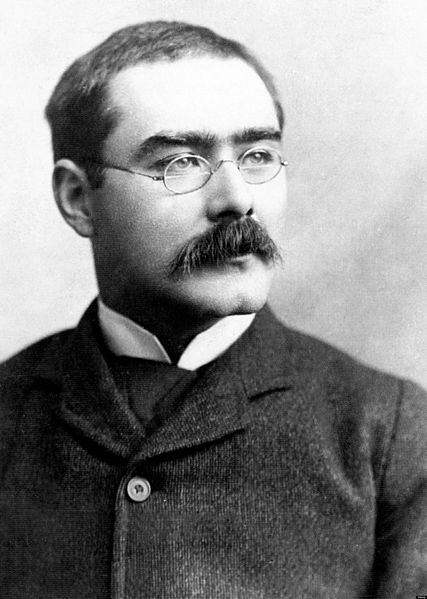
Portrait of Rudyard Kipling from the biography Rudyard Kipling by John Palmer, 1895.
Photo via Wikimedia Commons.
During five literary generations every enlightened person has despised him, and at the end of that time nine-tenths of those enlightened persons are forgotten and Kipling is in some sense still there.
Orwell’s essay on Rudyard Kipling in the Letters and Essays is both more favorable and more perceptive than one would expect of a discussion of Kipling by a British left-wing intellectual c. 1940. Orwell recognizes Kipling’s intelligence and his talent as a writer, pointing out how often people, including people who loath Kipling, use his phrases, sometimes without knowing their source. And Orwell argues, I think correctly, that Kipling not only was not a fascist but was further from a fascist than almost any of Orwell’s contemporaries, left or right, since he believed that there were things that mattered beyond power, that pride comes before a fall, that there is a fundamental mistake in
heathen heart that puts her trust
In reeking tube and iron shard,
All valiant dust that builds on dust,
And guarding, calls not Thee to guard,But while there is a good deal of truth in Orwell’s discussion of Kipling it is mistaken in two different ways, one having to do with Kipling’s view of the world, one with his art.
Orwell writes:
It is no use claiming, for instance, that when Kipling describes a British soldier beating a ‘nigger’ with a cleaning rod in order to get money out of him, he is acting merely as a reporter and does not necessarily approve what he describes. There is not the slightest sign anywhere in Kipling’s work that he disapproves of that kind of conduct — on the contrary, there is a definite strain of sadism in him, over and above the brutality which a writer of that type has to have.
There are passages in Kipling, not “Loot“, the poem Orwell quotes but bits of Stalky and Company, which support the charge of a “strain of sadism”. But the central element which Orwell is misreading is not sadism but realism. Soldiers loot when given the opportunity and there is no point to pretending they don’t. School boys beat each other up. Schoolmasters puff up their own importance by abusing their authority to ridicule the boys they are supposed to be teaching. Life is not fair. And Kipling’s attitude, I think made quite clear in Stalky and Company, is that complaining about it is not only a waste of time but a confession of weakness. You should shut up and deal with it instead.
A more important error in Orwell’s essay is his underestimate of Kipling as an artist, both poet and short story writer. Responding to Elliot’s claim that Kipling wrote verse rather than poetry, Orwell claims that Kipling was actually a good bad poet:
What (Elliot) does not say, and what I think one ought to start by saying in any discussion of Kipling, is that most of Kipling’s verse is so horribly vulgar that it gives one the same sensation as one gets from watching a third-rate music-hall performer recite ‘The Pigtail of Wu Fang Fu’ with the purple limelight on his face, AND yet there is much of it that is capable of giving pleasure to people who know what poetry means. At his worst, and also his most vital, in poems like ‘Gunga Din’ or ‘Danny Deever’, Kipling is almost a shameful pleasure, like the taste for cheap sweets that some people secretly carry into middle life. But even with his best passages one has the same sense of being seduced by something spurious, and yet unquestionably seduced.
I am left with the suspicion that Orwell is basing his opinion almost entirely on Kipling’s best known poems, such as the two he cites here, both written when he was 24. He was a popular writer, hence his best known pieces are those most accessible to a wide range of readers. He did indeed use his very considerable talents to tell stories and to make simple and compelling arguments, but that is not all he did. There is no way to objectively prove that Kipling wrote quite a lot of good poetry and neither Orwell nor Elliot, unfortunately, is still alive to prove it to, but I can at least offer a few examples …
Comments Off on George Orwell’s views on Rudyard Kipling’s worldview
Why the Canadian Surface Combatant (CSC) program will cost so much more than equivalent US or British ships
In The Line, Philippe Lagassé outlines the Canadian Surface Combatant (CSC) program — the next-generation front-line combat ships for the Royal Canadian Navy intended to replace the current Halifax-class frigates and the already retired Iroquois-class destroyers:

Building warships is an expensive business, especially if you’re getting back into it after a few decades. Take the Canadian Surface Combatant (CSC). Fifteen CSCs will be built at Halifax’s Irving Shipbuilding to replace Canada’s current frigates and decommissioned destroyers. According to a 2022 study by the Parliamentary Budget Officer (PBO), the CSC acquisition will cost $80.2 billion. Given that defence inflation is well above regular inflation, and that regular inflation is running hot, that number isn’t going to go down.
Canada’s CSC will be a variant of the Type 26 Global Combat Ship originally designed for the Royal Navy. The Canadian variant includes significant changes to the original Type 26 design, notably to the combat systems. With the estimated per unit cost of each ship topping $5.6 billion, the National Post‘s John Ivison warns that the CSC is out of control. Ivison notes that the United States Navy (USN) acquired its Constellation-class frigates for $1.66 billion. Why, he understandably asks, is Canada paying so much for the CSC, and to what end?
The Canadian government always views major military purchases for the Canadian Armed Forces primarily as regional economic development projects and always attempts to get all or at least a major part of the construction done in Canada. To most people this sounds sensible: big military equipment acquisitions mean a lot of money being spent, so why shouldn’t most of that money be spent inside Canada? The answer, in almost every case, is that it will be significantly more expensive because Canadian industry doesn’t regularly produce these ships/planes/helicopters/tanks, so a lot of money will need to be spent to construct the factories or shipyards, import the specialized equipment, hire and train the workforce, etc., and no rational private industry will spend that kind of money unless they’re guaranteed to be repaid (plus profit).
Ordinary items for the Canadian military like clothing, food, non-specialized vehicles (cars, trucks, etc.) may carry a small extra margin over run-of-the-mill stuff, but it will generally be competitive with imported equivalents. Highly specialized items generally won’t be competitively priced exactly because of those specialized qualities. The bigger and more unusual the item to be purchased, the less economic sense it makes to buy domestically.
There are also the conflicting desires of the elected government (who generally want to target the spending to electoral districts or regions that benefit “their” voters), the permanent bureaucracy (who want to ensure that programs last a long time to ensure jobs within the civil service), and the military procurement teams (who have a tendency to over-optimistically estimate up-front and long-term costs because they want to get the procurement process underway … it’s tougher to stop something already in-process than one that still needs formal approval).
Once there’s a budget and capabilities are identified, the requirements for individual projects are prepared. It’s here that the comparison with lower cost, off-the-shelf alternatives runs into difficultly. The USN has lots of different types of ships that do lots of specific things. The above-mentioned Constellation-class is one of many different types of warships that the USN will sail, each with specific mission sets and roles. The Canadian military has only been directed to acquire fifteen CSCs, but the government expects the CAF to do a variety of missions at sea — not as many as the USN, of course, but still a good number. Canada has other military ships, including the Arctic Offshore Patrol Vessels (AOPS) also being built by Irving, but the CSC will be Royal Canadian Navy (RCN)’s primary expeditionary platform. Canadian defence planners, therefore, need those 15 ships to be capable of undertaking various missions and roles. Compounding this challenge are technological changes and the ever-evolving threat. The requirements for the CSC need to be continuously updated, and in some cases expanded, to keep pace with these developments, too.

An artist’s rendition of BAE’s Type 26 Global Combat Ship, which was selected as the Canadian Surface Combatant design in 2019, the most recent “largest single expenditure in Canadian government history” (as all major weapon systems purchases tend to be).
(BAE Systems, via Flickr)
On purely economic grounds, it would often make sense to add Canada’s order on to existing US, British, or other allied military orders to benefit from the economies of scale … but pure economic benefits don’t rank highly on the overall scale of importance. There’s also the understandable desire of the government to buy fewer items with wider capabilities as the government’s requirements for the military change with time and circumstance.
Were Canadian defence planners too cavalier in their requirements and design modifications? Maybe. Looking at it from their perspective, though, we should appreciate that they thinking about capabilities for a ship that Canada will use until the 2100s.
Doubts about the CSC are going to keep multiplying. The per unit costs can only increase so much before people start seriously discussing reducing how many of them will be built. You can be sure that some within government are already asking “Why 15? Why not 12?” Serious concerns are also being raised about whether the defence budget can afford to maintain CSC and keep them technologically up to date after the fleet is introduced. Given the CAF’s personnel recruitment troubles, moreover, it’s unclear if the RCN will have enough sailors to operate the full fleet. The first CSC that hits the water, furthermore, will have all sorts of kinks and problems that will need to be sorted out. That’s standard for first ships off the line, but you can be sure that every failing will be met with handwringing and charges of incompetence.
To address these concerns, the government must let DND/CAF better explain what the CSC is designed to do and why it needs to do it. Simply telling Canadians that it’s the right ship isn’t enough when it’s easy to point to lower-cost alternatives. As well, the government needs to be far more transparent about estimates of costs and what’s driving them. Political and public support for the CSC shouldn’t be taken for granted, and growing concerns about the program can’t be simply brushed away.
Comments Off on Why the Canadian Surface Combatant (CSC) program will cost so much more than equivalent US or British ships
Sharpening a Chisel in under a Minute | Paul Sellers
Paul Sellers
Published 15 Jun 2023I see more and more options for sharpening a chisel and yet, with no mechanical means at all, I go from a chisel I have dulled to surgically sharp in about a minute or less.
The fact is I never need to use a grinding wheel, and I was taught to sharpen by the masters of sharpening in my apprenticeship days 58 years ago which I have never strayed from because I found every other option too slow and, dare I say it, DULL and time consuming no matter which method or which machine!
Watch the video and see what you feel.
(more…)
Comments Off on Sharpening a Chisel in under a Minute | Paul Sellers
QotD: The role of violence in historical societies
This is true even in historical societies that glorified war! Taking, for instance, medieval mounted warrior-aristocrats (read: knights), we find a far more complex set of values and social bonds. Military excellence was a key value among the medieval knightly aristocracy, but so was Christian religious belief and observance, so were expectations about courtly conduct, and so were bonds between family and oath-bound aristocrats. In short there were many forms of authority beyond violence even among military aristocrats. Consequently individuals could be – and often were! – lionized for exceptional success in these other domains, often even when their military performance was at best lackluster.
Roman political speech, meanwhile, is full of words to express authority without violence. Most obviously is the word auctoritas, from which we get authority. J.E. Lendon (in Empire of Honor: The Art of Government in the Roman World (1997)), expresses the complex interaction whereby the past performance of virtus (“strength, worth, bravery, excellence, skill, capacity”, which might be military, but it might also be virtus demonstrated in civilian fields like speaking, writing, court-room excellence, etc) produced honor which in turn invested an individual with dignitas (“worth, merit”), a legitimate claim to certain forms of deferential behavior from others (including peers; two individuals both with dignitas might owe mutual deference to each other). Such an individual, when acting or especially speaking was said to have gravitas (“weight”), an effort by the Romans to describe the feeling of emotional pressure that the dignitas of such a person demanded; a person speaking who had dignitas must be listened to seriously and respected, even if disagreed with in the end. An individual with tremendous honor might be described as having a super-charged dignitas such that not merely was some polite but serious deference, but active compliance, such was the force of their considerable honor; this was called auctoritas. As documented by Carlin Barton (in Roman Honor: Fire in the Bones (2001)), the Romans felt these weights keenly and have a robust language describing the emotional impact such feelings had.
Note that there is no necessary violence here. These things cannot be enforced through violence, they are emotional responses that the Romans report having (because their culture has conditioned them to have them) in the presence of individuals with dignitas. And such dignitas might also not be connected to violence. Cicero clearly at points in his career commanded such deference and he was at best an indifferent soldier. Instead, it was his excellence in speaking and his clear service to the Republic that commanded such respect. Other individuals might command particular auctoritas because of their role as priests, their reputation for piety or wisdom, or their history of service to the community. And of course beyond that were bonds of family, religion, social group, and so on.
And these are, to be clear, two societies run by military aristocrats as described by those same military aristocrats. If anyone was likely to represent these societies as being entirely about the commission of violence, it would be these fellows. And they simply don’t.
Bret Devereaux, “Collections: The Universal Warrior, Part III: The Cult of the Badass”, A Collection of Unmitigated Pedantry, 2021-02-05.
Comments Off on QotD: The role of violence in historical societies
October 17, 2023
Those problematic “AI girlfriends” – men suck and women suffer because of it
Janice Fiamengo discusses a recent CNN program that woman-splained why young men paying for “AI girlfriends” are yet another way that misogynistic men are harming women:

Last week, CNN aired a must-watch episode with the somber headline, “AI girlfriends are here and they’re posing a threat to a generation of men”. If that sounds as if the show might possibly express some compassion for young men and for the “epidemic of loneliness” referred to in the show, it was not to be. Even an expert, Scott Galloway, profiled briefly on how society is “failing men”, felt the need to express contempt for their alleged conspiracy theories, online misogyny, and even (gasp!) climate change denial. With friends like these …
The segment is fascinating, however, for its revelation of some pundits’ uneasy awareness of male discontent.
[…] The expert is Liberty Vittert, a statistician and professor of data science at Washington University’s Olin Business School. But she might as well be an AI feminist, so predictable was her analysis of the male entitlement allegedly driving the turn to AI girlfriends. Though a statistician, Vittert gave no data about the numbers of men who are paying to access AI content. While the CNN host, Michael Smerconish, seemed open to the possibility of exploring men’s points of view, the expert could only emphasize male failure.
She condemned young men for “choosing AI girlfriends over real women”. The choice means, according to Vittert, that “they don’t have relationships with real women, don’t marry them and then don’t have and raise babies with them”.
But wait, aren’t marrying and raising babies a patriarchal imposition on women — part of the “comfortable concentration camp” that Betty Friedan so memorably indicted?
Professor Vittert says nothing about the decreasing number of young women willing to marry and procreate. Her (botoxed) mouth turns down in disapproval as she explains that the increasing realism of AI is “enabling this entire generation of young men to continue in this loneliness epidemic”. It seems that men prefer sterile self-pleasuring and facile scopophilia to the “hard work” of relationships with real women. Like Joaquin Phoenix’s hapless character, these men, she says, are so fixated on perfection that they “are not able to deal with ups and downs, not only in a relationship, but in life in general”. The glibness of the condemnation is remarkable, though far from unusual.
It’s not clear if Professor Vittert has ever talked to actual men about why some of them (not “an entire generation”) might choose an AI relationship. Does she know any young men who have tried for years without success to find a marriageable girlfriend? Many discover that such prizes are remarkably thin on the ground, many of them unsuitable to be considered as future mothers. Even worse, perhaps, does Vittert know anything about what can happen to an inexperienced young man who pursues the wrong woman or women (there are a couple of heartbreaking examples in Sons of Feminism)? How many times does a young man who has failed repeatedly need to hear that no woman owes him love or sex before he starts thinking that giving up on them might not be a bad idea? Meanwhile, women laugh at his loneliness and drink “I bathe in male tears” mugs.
To give him credit, CNN’s Smerconish asks a few questions about the male point of view: “What’s going on with the women?” Has the power dynamic shifted in their favor? Are they less approachable than formerly? These only scratch the surface, but he’s chosen the wrong expert for such a conversation.
Vittert freely admits that there are now many more women than men at university (thanks, affirmative action!) and that far more women than formerly are choosing career over homemaking (thanks, feminist propaganda!). But those are good things, and young men simply need to adapt. Calling any of this debacle women’s fault, she declares, would not be “the right way to go”.


Why WW1 Cavalry Was Essential On The Battlefield
The Great War
Published 13 Oct 2023The First World War was a catalyst for modern warfare with tanks, poison gas, flamethrowers and more. Cavalry didn’t have a place anymore on the modern battlefield – or so the common misconception goes. In this video we show how useful cavalry still was in WW1.
(more…)
Comments Off on Why WW1 Cavalry Was Essential On The Battlefield
An appropriate task for AI – reading the Herculaneum scrolls
Colby Cosh discusses the possibility of finally being able to read the carbonized scolls found in the buried remains of a wealthy Roman’s country villa in 1750:

Unrolled papyrus scroll recovered from the Villa of the Papyri.
Picture published in a pamphlet called “Herculaneum and the Villa of the Papyri” by Amedeo Maiuri in 1974. (Wikimedia Commons)
From the standpoint of fragile human life, a volcanic eruption is the worst possible thing that can happen anywhere in your general vicinity, up to and probably including the detonation of a nuclear weapon.
It goes without saying that pyroclastic flows are also bad for animals or buildings or vegetation … or documents. And yet: as a consequence of the eruption of Vesuvius, there exists a near-complete library of papyrus scrolls retrieved from the buried ruins of a splendid Roman villa.
The “Villa of the Papyri” in Herculaneum was found in 1750 by farmers and was quickly subjected to archeological excavation, an art then in its infancy.
These scrolls, which today number about 1,800 in all, are often described as the only known library to have physically survived from antiquity. The problem, of course, is that they have all been burned literally to a crisp, with only a few easily readable fragments here and there.
The incinerated scrolls are so sensitive that they tend to explode into a cloud of ash at the slightest touch. Occasional attempts to unravel the scrolls — which were rolled very tightly for storage in the first place — have been made over the past 300 years; the chemist Sir Humphry Davy (1778-1829), for example, gave it a shot using newfangled stuff called chlorine. But none of these projects ever came especially close to success, and they typically involved destruction of some of the “books” in the library.
In recent years 3D imaging techniques for “reading” documents like this in a non-invasive way have been making great headway. The leader in the field is a University of Kentucky computer scientist named Brent Seales, who in 2015 led efforts to read a fragile, desiccated Hebrew Bible parchment scroll dating to the third or fourth century AD.
The text was from the book of Leviticus, and proved to be a letter-for-letter match with the Torah of today — which is a disappointment to scholars from one point of view, and a finding of awesome significance from another. (It goes without saying that this scroll came from the territory of Israel, near a kibbutz: this is a fact that would, in any other political context, be regarded as a supreme affirmation of indigeneity.)
Seales has been able to “unroll” some Herculaneum scrolls and detect the presence of inks using CT scanning, but reading the pages is a profound challenge. Roman ink was carbon-based, meaning researchers are trying to “read” traces of carbon on carbonized pages rolled up into three dimensions.
Comments Off on An appropriate task for AI – reading the Herculaneum scrolls
Sherry Wine of Andalucía
The Culinary Institute of America
Published 13 Nov 2012Andalucía is well known for its sherry, a fortified wine made near the town of Jerez. Sherry is a protected designation of origin; and in Spanish law, all wine labeled as “Sherry” must come from the Sherry Triangle, an area between Jerez de la Frontera, Sanlúcar de Barrameda, and El Puerto de Santa María.
For recipes, please visit http://www.ciaprochef.com/andalucia.
Comments Off on Sherry Wine of Andalucía
QotD: Representations of sex work in SF
Maybe it’s a relic from when SF was just another facet of Men’s Adventure magazines, or maybe it’s capitalizing on the stereotypical basement-dwelling Geek’s desire to have high quality women to command at the wave of a few credits or gold pieces. Or, more cynically, it’s the desire of Hollywood producers who actually DO have high quality women at their mercy, career-wise, to further normalize the idea that “Sex work is real work” to help smooth away the resistance to their hamfisted efforts on the casting couch.
TV Tropes has a number of entries about this, from “Unproblematic Prostitution” to “High Class Call Girl”. Writers like to call up the imagery of the Geisha, and make their Space Hookers come across as brilliant sexual artists, with additional talents that help the protagonists, such as advanced degrees or connections to corporate executives and high ranking government officials. (Funny how they are not corporate movers and shakers or government officials themselves …). They forget, of course, that Geisha were not actually prostitutes, and only rarely took lovers. There were still actual brothels in Japan for that sort of thing.
Science Fiction has gotten a lot more difficult to write as the frontiers of reality have pushed back against the flights of fantasy. We have had to accept that you can’t get to the moon inside a Victorian upholstered artillery shell, or set foot on the Jungles of Venus. And maybe that’s why a lot of SF in recent decades has turned towards the softer sciences where theories are more prominent than scientific facts, making it simpler to speculate.
However, even in our understanding of society, there are some realities that can’t be ignored. A few of them are listed in the aforementioned “Unproblematic Prostitution” entry. The primary social reality that undermines all of the tropes is that when you commodify sex, you are putting women on sale. Maybe it’s just fractionally, for a few hours out of her lifetime, but when your fantasy/SF hero comes along and waves a few C-notes to get a woman to do what he wants, it’s not the “Combination of Sex and Capitalism” (“… which are you against?” the excuse goes) but the sublimation of Sex TO Capitalism.
“Sex work is real work,” they like to say, but when you turn sex INTO work, it strips it of all of its better qualities. “Do what you love and you’ll never work another day in your life,” is another lie. I’ve known too many artists who go from having a fun hobby to chasing unsatisfying commissions, eventually burning out from endless requests by cretins for illustrations of their vilest fantasies. So the idea that our happy Space Hookers are having fun and getting paid, and what’s wrong with that, turns into burnout in pretty short order, because the kind of guys who go out looking for “That kind of girl” are not interested in the parts of sex that make it as enjoyable as it is for a compatible couple. They don’t have girlfriends for a reason. So the trope that Prostitution is just Sexy Fun Time falls by the wayside in the face of human nature.
SF also likes to postulate that science will make sex consequence free with perfect contraception and cures for all diseases. Writers and Producers fail to see the actual social costs and secondary effects, some of which we are finally running afoul of today, as women are aging out of their “Hookup culture” days and finding themselves alone and with few prospects for a lasting relationship, while at the same time human reproduction is falling below the replacement rate worldwide. And of course, nature being what it is, there will always be new diseases from new planets or new alien races or who knows WHAT our horny young space cadets have been sticking their dicks into. Human biology has less security in its OS than a Commodore 64.
Dr. Mauser, “Space Hookers Must Die!”, Shoplifting in the Marketplace of Ideas, 2023-07-16.
Comments Off on QotD: Representations of sex work in SF
October 16, 2023
In ?praise? of the “spoils system”
Glenn Reynolds on the way the US government’s structure changed from the “spoils system” of the early republic to the modern “professional” civil service of today:

Andrew Jackson sitting on a hog on top of a tomb with the inscription “To the victors belong the spoils”.
Political cartoon by Thomas Nast, Harper’s Weekly, 28 April, 1877.
America’s institutions need structural reform. We need it in academia, we need it in the corporate world, and we need it in government. In all of these fields, the structures, incentives, and institutions that have grown up over time have been destructive, and need to be fundamentally transformed.
I’ll be writing about all of these things down the line, but for now let’s start with government. Though you don’t hear a lot about it on the right, the left is all bent out of shape over the prospect that a Republican administration elected in 2024 might partially deconstruct the existing protected civil service. I, on the other hand, am excited about that prospect, and only wish they’d go farther.
Prior to the adoption of the Pendleton Act in 1883, government employment operated according to the “spoils system”, which meant that hiring in the executive branch was controlled by the Executive. When a new administration came in, everyone’s job was up for grabs, at least potentially. This “rotation in office” had several advantages, which were widely appreciated at the time, and propounded by presidents from Jefferson to Jackson to Lincoln.
Jackson argued that one serving in government for too long would inevitably lose sight of the public interest and come to use office for personal gain. He also maintained that government was or could be made simple enough for men of ordinary ability and experience, so ‘more is lost by the long continuance of men in office than is generally to be gained by their experience’.1
Contrary to popular belief, though, the arrival of a new president didn’t mean that everyone left. Even Andrew Jackson, upon taking office, replaced only about 10% of the federal work force with his own people. Every president understood the value of continuity, and hiring new people is hard work.
But under the spoils system, the fact that the president could replace anyone mean that everyone worked for him. And that meant both that everyone was responsible to the president, and that the president was responsible for everyone in the government, and everything the government did. This is consistent with the Constitution’s vesting clause, which provides that “The executive Power shall be vested in a President of the United States of America.” If the executive branch does it, it’s an executive power, and if it’s an executive power it should be controlled by the president.
Contrast this to a “professional” civil service, in which the president does neither the hiring nor the firing, except with regard to a comparatively small number of senior officials. The civil service doesn’t think of itself as working for the president, really, and will happily drag its feet when it doesn’t like the president’s priorities. And when the bureaucracy misbehaves, or fails to perform, the president can, at least to a degree, blame its recalcitrance for the trouble or lack of results that occurs.
Congress is also let off the hook, yet simultaneously weirdly empowered. Congress can blame “the bureaucracy” for bad things, even when those things result from laws that Congress has passed. Then it can turn around and “help” constituents by intervening with the bureaucracy it has rendered dysfunctional, earning gratitude that may be deserved in a narrow sense, but not in terms of the big picture.
Under a spoils system, on the other hand, nobody gets off the hook. If the bureaucracy misbehaves, the president can fire the misbehavers. If Congress is unhappy with what bureaucrats do, they can demand that the president fire them, and make an election issue out of it if they want.
So why did we wind up with a civil service? As is typical, the fantasy of a neutral, efficient, expert civil service was laid next to the reality of a messy functioning government. But, as is also typical, the fantasy in practice turned out to be considerably less appealing than as proposed.
1. Robert Maranto, Thinking the Unthinkable in Public Administration: A Case for Spoils in the Federal Bureaucracy, Administration & Society, January 1998, 623,625.
Comments Off on In ?praise? of the “spoils system”


