
The current meritocratic system began as an effort to open up a hereditary WASP elite to outsiders — and for a while, as immigrants, minorities, and women earned their way into America’s legacy campuses, writes Markovits, it looked like it was working more or less as intended. In the last few decades, however, the system has morphed into a do-or-die tournament for the prize of an Ivy League degree and a bonus-rich job at a swanky address. Instead of being democracies of talent, Harvard and Yale and their elite cronies are now quasi-exclusive clubs for the children of wealth. Money gives rich parents the means to groom their kids for these clubs as early as infancy with classes, books, and trips to museums meant to enhance kids’ development. They move to wealthy neighborhoods, where schools offer a vast array of (ahem) “enrichment” activities, including test prep and college-essay tutoring. Alternatively, they put their kids through 12 years of $40,000-a-year-plus private schools, whose administrators just happen to be chummy with Princeton admission officers.
Their efforts pay off for their progeny, but in the harsh competition that is the contemporary economy, they leave everyone else in the dust. Nourished in the hothouse of elite homes and communities, rich children have pulled away from their middle-class counterparts when it comes to academic performance, outscoring them on the SAT by twice as much as middle-class kids outscore poor students. The most elite colleges enroll more students from households in the top 1 percent than from the entire bottom half of the income scale. Those students are first in the pipeline to elite jobs. Top banks go only to the Ivy League, MIT, and Stanford for their recruiting. Top Five law schools are the training grounds for partners at the poshest firms. Meantime, middle-class kids are not only a rare sight on elite campuses; they’re also far less likely to get any college degree. Poor kids do worse still.
The result, says Markovits, is precisely the sort of dynastic elite that the putatively unbiased SAT was supposed to put out of business. To the dismay of his critics on the left, Markovits is not entirely unsympathetic to the winners of the tournament. The rich used to be indolent, he reminds us. The whole point of wealth was to be freed from toil, while peasants sweated in fields and manor kitchens to serve their betters and eke out a living for their undernourished families. These days, by contrast, the rich work 16-hour days and weekends under immense competitive pressure to close the deal, make partner, and take a conference call with Japanese businessmen. “No prior elite has ever been as capable or as industrious as the meritocratic elite that such training produces. None comes close,” Markovits asserts. Yes, a few actresses and real estate barons try to bribe and cheat their children into the palaces of learning, but most Ivy Leaguers have used their privileged upbringing to make their way into these bastions according to the rules of achievement. Given the expensive grooming required to make it to the top campuses, he implies, a squeaky-clean meritocracy would still favor the rich.
Kay S. Hymowitz, “Meritocrats versus Meritocracy”, City Journal, 2019-10-11.
January 25, 2024
QotD: How Meritocracy morphed into “Meritocracy”
January 24, 2024
Poor Novak …
Chris Bray explains how vaccines provide complete immunity … but with a catch:
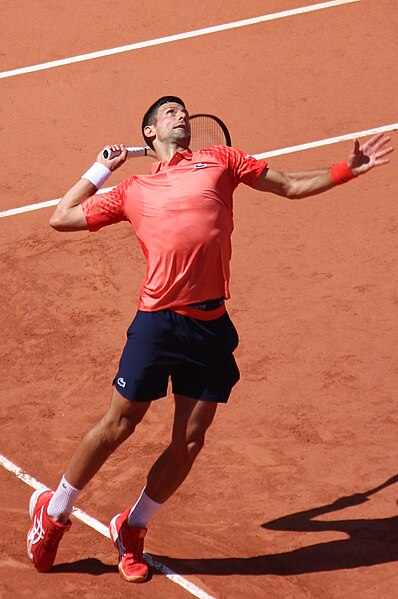
Novak Djokovic during his fourth round match at Roland Garros in June, 2023.
Detail of a photo by 350z33 via Wikimedia Commons.
Three years ago, Novak Djokovic refused to save his own life. Threatened by a deadly virus, he refused the lifesaving vaccines. And now you see the terrifying result. Djokovic is so obviously crippled by Covid-19, a virus he unnecessarily chose to face unprotected, that he’s … well, one of the most shockingly fit human beings on the planet, an absolute beast of a professional athlete who dominates a remarkably difficult one-on-one sport so completely that no one else in the game comes close to consistently playing at his level. I don’t follow tennis closely enough to be sure about any of that, so I Googled — to get the commissariat-approved answer — and found this statement: “Djokovic has been ranked No. 1 for a record total of 409 weeks in a record 13 different years.” NOW DO YOU SEE WHAT HAPPENS WHEN YOU DON’T GET VACCINATED!?!?!?!?
But what I can’t get over, the thing that just keeps churning in my mind, is that some jackass watched Djokovic play a match, in person, saw how completely he dominated, saw how absurdly healthy and fit he is, and then — at match point, at the end — shouted at him to get vaccinated, like he was rebuking someone for an appalling failure. Why won’t you protect your health, you stupid … most powerful and dominant professional athlete in the world.
Djokovic responded by drilling the very next serve for an ace to win the match, slamming it across the court so brutally hard that his much younger opponent couldn’t even get his racket on it and had to just watch it go by.
But the person in the crowd: To do that, to shout that thing at that person at that moment, requires a total immunity to information. You have to have a mind that can’t notice physical reality in any way, no matter how obvious it becomes. I guess you have to be the Novak Djokovic of stupidity, the best in the world at the game of making your own head fit inside your ass.
So, yes: Vaccines induce immunity. To information. In case you’re looking for a way to protect yourself from that.
Update: One of the journalists who mocked Djokovic for not being vaccinated reportedly died suddenly the other day.
The father of the “Green Revolution”
In the latest review at Mr. and Mrs. Psmith’s Bookshelf, Jane Psmith reviews The Wizard and the Prophet by Charles C. Mann:
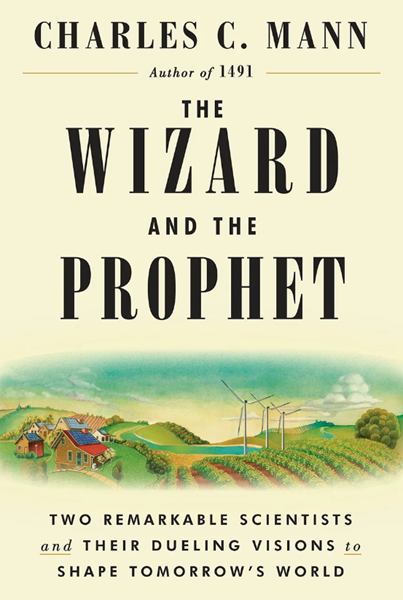
Norman Borlaug is generally estimated to have saved the lives of about a billion people who would otherwise have starved to death.
Yet despite all this — and Borlaug’s is a great story, which Charles Mann tells better and in far more detail than I do above — his book isn’t really a biography of Borlaug or of its other framing figure, early environmentalist William Vogt.1 Rather, it’s a compellingly-written and frankly fascinating overview of various environmental issues facing humanity, and of two different sorts of approaches one can take to addressing them. Mann opens by introducing the two men, but as soon as he’s done that they function mostly as symbols, examples and stand-ins, for these two schools of thought about the world and its problems.
Borlaug is the Wizard of the title, the avatar of techno-optimism: with hard work and clever application of scientific knowledge, we can innovate our way out of our problems. Vogt is the Prophet, the advocate of caution: he points to our limitations, all the things we don’t know and the complex systems we shouldn’t disturb, warning that our constraints are inescapable — but also, quietly, that they are in some sense good.
It’s not hard to identify the Wizards all around us. Inventors and innovators, transhumanists and e/acc, self-driving cars and self-healing concrete … every new device or technique for solving some human problem — insulin pumps! heck, synthetic insulin at all! — is a Wizardly project.
It’s a little more difficult to pin down what exactly the Prophets believe, in part because they spend so much time criticizing Wizardly schemes as dangerous or impractical that it’s easy to take them for small-souled enemies of human achievement.2 That isn’t fair, though — there’s a there there, a holistic vision of the world as an integral organic unity that we disturb at our peril, because the constraints are inextricably linked to the good stuff.
If that seems too abstract, here’s an example. Imagine for a moment (or maybe you don’t have to imagine) that you have a friend who subsists entirely on Soylent. It’s faster and easier than cooking, he says, and cheaper than eating out. He’s getting all his caloric needs met. And he’s freed up so much time for everything else! Now, anyone might express concern for his physical health: does Soylent actually have the right balance of macronutrients to nourish him? Is he missing some important vitamins or other micronutrients that a normal diet might provide? Is the lack of chewing going to make his jaw muscles atrophy? And those are all reasonable concerns about your friend’s plan, but they all have possible Wizardly solutions. (A multivitamin and some gum would be a start.)
If you’re a Prophet sort, on the other hand, you’re probably going to start talking about everything else your friend is missing out on. There’s the taste of food, for one, but also the pleasures of color and texture and scent, the connection to the natural world, the role of community and tradition in shared meals, the way cooking focuses thought and attention on incarnate reality. You might throw around words like “lame” and “artificial” and “sterile” and “inhuman”. Your friend’s Soylent-only plan assumes that the whole point of food is to consume an appropriate number of calories as quickly and easily as possible, hopefully in a way that doesn’t meaningfully degrade his health, but a Prophet rejects his premise entirely. Instead, a Prophet argues that your friend’s food “problem” is actually part of the richly textured beauty of Creation. Yes, feeding yourself and your loved ones delicious, healthful, and economical meals takes time and effort, but that’s simply part of being human.5 You should consider that a challenge to be met rather than a threat to be avoided.
Unfortunately, Mann does the Prophets a disservice by choosing William Vogt as their exemplar. Yes, he was an important figure in the history of the modern environmental movement. Yes, he wrote a very influential book.4 And yes, his careful attention to the integrity of the ecosystems he studied was quintessentially Prophet. But he saw human beings mostly as disruptions to the integrity of those ecosystems, and pretty much every one of his specific predictions — not to mention the predictions of his many followers, most famously Paul Erlich in The Population Bomb5 — have simply failed to come true. Compared to Borlaug’s obvious successes, Vogt’s dire warnings that humanity will soon exhaust the Earth’s capacity and doom ourselves to extinction (unless we abort and contracept our way there first; his second act was as director of Planned Parenthood) seem laughable. Reading about his life can leave you with the impression that Prophets are just people who are more worried about a spotted owl than a starving child, and frankly who cares what those people think?
1. They were roughly contemporaries, but this is emphatically not the story of a pair of rivals; they encountered each other in person only once, in passing, after which Vogt wrote an angry letter to the Rockefeller Foundation demanding they cease Borlaug’s Mexican project at once.
2. And, to be fair, a lot of the language and arguments pioneered by Prophets does get employed by a sclerotic managerial class opposed to anything they can’t fit neatly into their systems and processes and domain-agnostic expertise. But more on that later.
3. Incidentally, this is more or less the argument between the Wizards and the Prophets when it comes to soil. Wizards are delighted with the Haber-Bosch process and artificial fertilizers; Prophets decry the “NPK mentality” that sees the soil as a passive reservoir of chemicals and instead laud composting, manure, and other techniques that encourage the complex interactions between soil organisms, plant roots, and the physical characteristics of humus. This is the origin of the fad for “organic”, a label that doesn’t mean much when applied to industrial-scale food production and is often more trouble than it’s worth for small-time farmers and ranchers. Still, Mann’s story of the movement’s birth is interesting.
4. You’ve probably never heard of it, but it was influential!
5. Apparently out of print! Good.
France’s Final Battle Rifle Iteration: The MAS 49-56
Forgotten Weapons
Published 24 May 2019While the development of the MAS 49 had given France a very utilitarian rifle that could serve as both for both marksmen and grenadiers, it could still be made better. In large part, the change to the 49-56 pattern was motivated by the move to adopt NATO-compatible 22mm rifle grenades. With the new muzzle hardware, several other changes were made. A gas cutoff was added, to prevent wear and tear on the action from grenade use (something that was found to be a real problem on the MAS 49). The gas port was also moved farther down the barrel, and the hand guard and barrel were both shortened to make the rifle a bit lighter and handier.
Production began in 1957, and about 175,000 of the rifles were made, seeing service as France’s standard front-line infantry rifle until the adoption of the FAMAS in 1979.
(more…)
QotD: Boomer hypocrisy
Severian, “Hoist on Their Own Petard”, Rotten Chestnuts, 2021-04-19.
January 23, 2024
The battle of Sangshak, 1944
Dr. Robert Lyman discusses a new book by David Allison that covers one of the many small battles that made up the large Imphal-Kohima campaign:
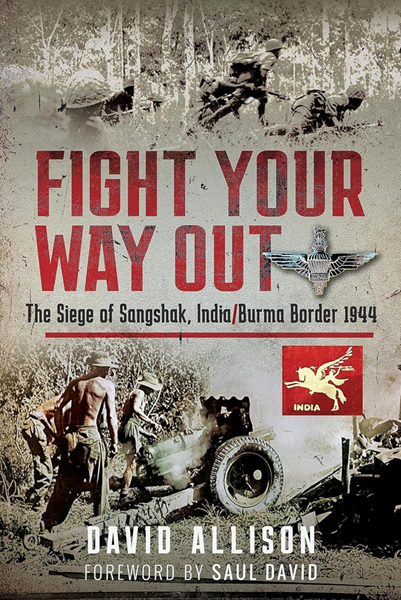
When Wavell, by then Viceroy of India, visited Imphal after the battle in October, to bestow knighthoods on the four victors — Lieutenant Generals Bill Slim (14 Army), Montagu Stopford (33 Corps), Geoffrey Scoones (4 Corps) and Philip Christison (15 Corps) — he admitted to Slim that he found the battle hard to follow, as it seemed to have been fought in “penny-packets”. In professing his ignorance of Slim’s great triumph, Wavell nevertheless hit the nail on the head. Sangshak was one of those penny-packet fights which cumulatively determined the outcome of Japan’s audacious invasion of India.
Like many battles in insufficiently examined wars, Sangshak has suffered over the years from a paucity of rigorous examination. Louis Allen’s magisterial The Longest War gave it short treatment in 1984, and very little else. Until now. I’m delighted to say that a Hong Kong-based Australian lawyer with a military background — David Allison — has produced a new account of this crucial battle, and it is absolutely outstanding. It can be purchased here. I recommend it very strongly. It’s not long: at 159-pages of text you can make your way through this in a couple of days, but it is diligently researched, well written and judiciously argued. For those who know something of the battle, the big arguments in the past about the state training of the 50 Indian Parachute Brigade, the temporary breakdown of its commander, Hope-Thomson and the supposed loss of the captured Japanese map and orders by HQ 23 Indian Division, are calmly and satisfyingly explained.
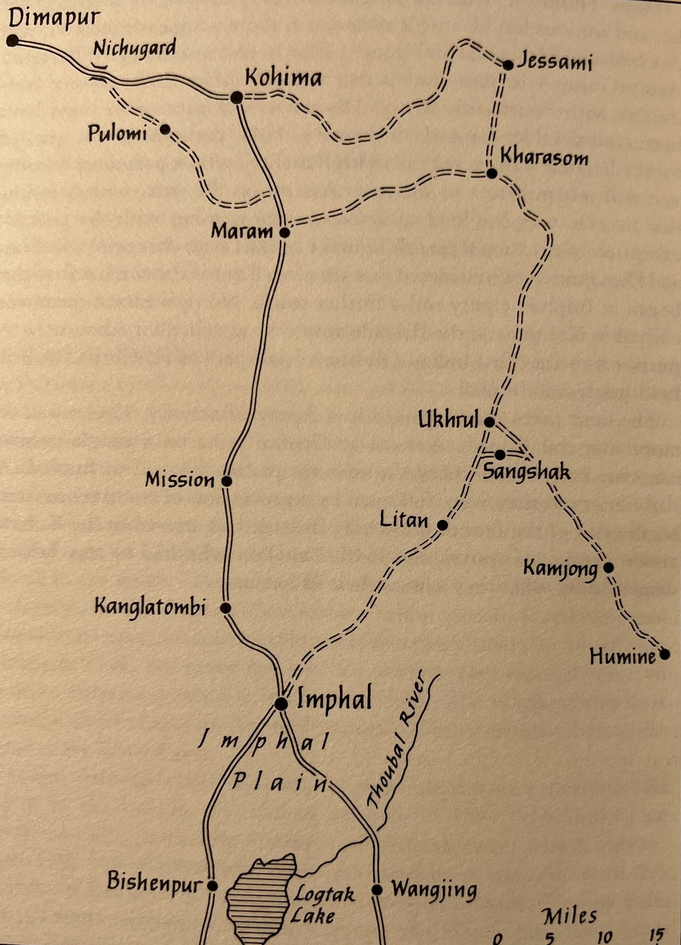
The story can be briefly told. The territory to the north-east of Imphal (centring on the Naga village of Ukhrul) had only the lightest of garrisons and no real defences. Until 16 March it was home to 49 Brigade, which was then despatched to the Tiddim Road to deal with the advance in the south of Lieutenant General Yanagida’s 33 Division. The brigade had considered itself to be in a rear area, and, extraordinarily, no dug-in and wired defensive positions had been prepared. It was one of the most serious British planning failures of the campaign. The entire north-eastern portion of Imphal lay effectively undefended. The gap left by the brigade’s departure had been filled in part by the arrival of the first of the two battalions of the newly raised 50 Indian Parachute Brigade (comprising the Gurkha 152 Battalion and the Indian 153 Battalion), whose young and professional commander, 31-year-old Brigadier M.R.J. (“Tim”) Hope-Thomson, had persuaded New Delhi to allow him to complete the training of his brigade in territory close to the enemy. The area north-east of Imphal was regarded as suitable merely for support troops and training. At the start of March, the brigade HQ and one battalion had arrived in Imphal and began the leisurely process of shaking itself out in the safety of the hills north-east of the town. To the brigade was added 4/5 Mahrattas under Lieutenant Colonel Trim, left behind when 49 Brigade was sent down to the Tiddim Road. To Scoones and his HQ, the area to which Hope-Thomson and his men were sent represented the lowest of all combat priorities. Sent into the jungle almost to fend for themselves, it was not expected that they would have to fight, let alone be on the receiving end of an entire Japanese divisional attack. They had little equipment, no barbed wire, and little or no experience or knowledge of the territory. No one considered it worthwhile to keep them briefed on the developing situation. To all intents and purposes, 50 Indian Parachute Brigade was an irrelevant appendage, attached to Major General Ouvry Roberts’ 23 Indian Division for administrative purposes but otherwise left to its own devices.
Before long, information began to reach Imphal that Japanese troops were advancing in force on Ukhrul and Sangshak. Inexplicably, however, this information appeared not to ring any warning bells in HQ IV Corps in Imphal, which was preoccupied with the developing threat in the Tamu area where the main Japanese thrust was confidently predicted. On the night of 16 March, the single battalion of 50 Parachute Brigade took over responsibility for the Ukhrul area from 49 Brigade, which was hastily departing for the Tiddim Road. They had no idea that an entire Japanese division of 20,000 men was crossing the Chindwin in strength opposite Homalin. On 19 March, large columns of Japanese infantry were reported advancing through the hills.
No one had expected them to be where they were. But the first shock came to the Japanese 3/58 battalion (Major Shimanoe), part of Lieutenant General Sato’s 31 Division – troops whose objective was Kohima, and not Imphal – who were bloodily rebuffed by the determined opposition of the young Gurkha soldiers at an unprepared position forward of Sheldon’s Corner. The 170 Gurkha recruits refused to allow the 900 men of 3/58 to roll over them and inflicted 160 casualties on the advancing Japanese. In the swirling confusion of the next 36 hours, Hope Thomson and his staff kept their heads, attempting to concentrate what remained of the dispersed companies of 152 Battalion and 4/5 Mahrattas back to a common position at the village of Sangshak, which dominated the tracks southwest to Imphal.
It was at this now-deserted Naga village that Hope-Thomson, on 21 March, decided to group his brigade for its last stand, his staff desperately attempting to alert HQ 4 Corps in Imphal to the enormity of what was happening to the north-east. The Japanese columns infiltrated quickly around and through the British positions, heading in the direction of Litan. The Japanese now began days of repeated assaults on the position in a battle of intense bravery and sacrifice for both sides. Hope Thomson’s men could only dig shallow trenches, which provided no protection from Japanese artillery.
The Korean War: The First Year
Army University Press
Published Jan 22, 2024Created for the Department of Command and Leadership and the Department of Military History at the US Army Command and General Staff College, The Korean War: The First Year is a short documentary focused on the major events of the Forgotten War. Designed to address the complex strategic and operational actions from June 1950 – June 1951, the film answers seven key questions that can be found in the timestamps below. Major events such as the initial North Korean invasion, the defense of the Pusan Perimeter, the Inchon landing, and the Chinese intervention are discussed.
Timestamps:
1. Why are there Two Koreas? – 00:25
2. Why did North Korea Attack South Korea? – 02:39
3. How did the UN stop the Communist invasion? – 06:30
4. Why did MacArthur attack at Inchon? – 10:24
5. Why did the UN attack into North Korea? – 14:27
6. Why did China enter the Korean War? – 18:51
7. How did the UN stop the Communist invasion … again? – 21:44
Sometimes the deciding factor in success really is just “dumb luck”
Virginia Postrel doesn’t disparage the role of quality, but as one of her own experiences clearly illustrates, you can’t discount the sometimes disproportionate role of luck:
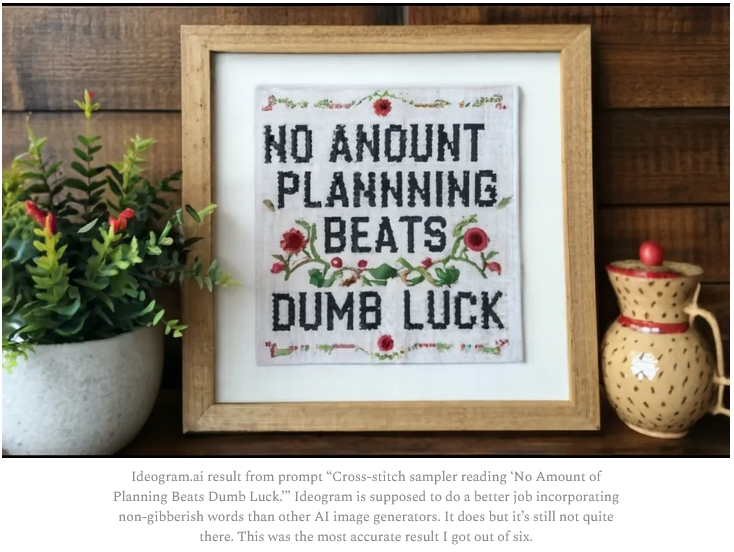
AI is coming along … but it ain’t there yet.
Image by Virginia Postrel, using Ideogram.ai
No amount of planning beats dumb luck. That saying, which I will always associate with the gubernatorial campaign of South Carolina’s James Edwards1, occurred to me while reading Damon Linker’s latest Substack post. His praise of Martin Gurri’s book The Revolt of the Public reminded me of a corollary: When it comes to books, no amount of intellectual quality is enough without dumb luck. It’s an absolute miracle Martin Gurri’s book, which is excellent, has become well known.
I know because I gave The Revolt of the Public a crucial boost — and I only discovered it because my own book, The Power of Glamour, was languishing in obscurity (where it remains). Frustrated with the lack of attention, I spent an evening Googling “visual persuasion” in hopes of finding smart people who might find my analysis interesting enough to mention to others. My search led me to a 2010 article for the Army War College, co-authored by Gurri, titled “Our Visual Persuasion Gap“. I sent him a note: “I read your article on the visual persuasion gap and would like to send you a copy of my book. Could you send me your mailing address? Are you related to Adam?” He responded that he preferred to think that Adam was related to him — his son — and that we should trade books.
To review: 1) I wrote a book related to visual persuasion. 2) Martin Gurri has a long-standing interest in visual persuasion. 3) Gurri wrote a book relevant to visual persuasion. 4) I knew Gurri’s son. And neither of us knew the other existed.
I was impressed by his book. So when Cato Unbound invited me to write an essay on “visual persuasion and politics” and to suggest people to write responses, I recommended him. That was in July 2014. The symposium came and went. Still The Revolt of the Public didn’t break into public consciousness, even among the kind of people who read Cato Institute publications.
Then, in December 2015, I wrote a Bloomberg Opinion column on The Revolt of the Public. I’m sure many people read the column, but only one of them mattered to the book’s public profile: Arnold Kling, who wrote about it on his blog in January 2016. The timing was perfect and Arnold proved an effective, well-connected evangelist. In 2018 Stripe Press issued an updated version in print, audio, and electronic formats. Since then, the book has become a touchstone for understanding the rise of populist movements. Agree or disagree, people trying to figure out our political moment have to consider Gurri’s analysis — which they know about because of dumb luck.
1. Edwards, an oral surgeon by profession, was a Republican party activist who ran in the 1974 primary against the much better known General William Westmoreland. Then, as now, South Carolina did not have party registration. Any voter could vote in either primary, but if you voted in one party’s primary you couldn’t vote in the other party’s runoff election. The Democratic primary was where the action was that year, with multiple candidates. Only the most stalwart Republicans voted in that primary and they preferred the guy they knew to the celebrity general. The Democratic primary went to a runoff between young post-Watergate reformer Charles “Pug” Ravenel and old guard Congressman William Jennings Bryan Dorn. Ravenel, a South Carolina native who’d only recently moved from New York, won the runoff, only to have his candidacy disqualified for not meeting residency requirements. The Democrats put Dorn in his place, but he was a weakened candidate and voters went with Edwards, making him the first Republican governor since Reconstruction. Edwards used to have a sign with this motto, or some version of it, on his desk.
T-34: The tank that won WWII
The Tank Museum
Published 27 Oct 2023The Soviet T-34 was the most prolifically produced tank of WWII. Basic and austere in design, it was highly effective and capable of being mass-produced. In this video we take a close look inside and out at the tank that made victory over Nazi Germany possible.
(more…)
QotD: Shakespeare was apparently a terrible writer, according to Bayesian analysis
First there is the dull, seemingly steady, respectable type, instantiated by Bernie Madoff, who had just the kind of personal gravitas that inspired confidence in the cautious. “Yes,” the cautious type thought as he gazed into Madoff’s calm and wise face, “he is just the type to whom I can safely entrust my money. He knows, if anyone knows, how to make money fruitful and multiply.”‘ His very dullness obscured from the cautious man the fact that he, the cautious man, was as motivated by greed and lust for painless enrichment as the most reckless gambler; and no man wants to think that he is motivated by greed. That is a vice that motivates others, not oneself.
Second there is the flamboyant genius type. For more adventurous investors in search of quick returns, a man like SBF is just the one to follow. His refusal to comply with elementary social conventions, even his wild hair, stood guarantor of his genius. Those who followed SBF as the children followed the pied piper deluded themselves by the following false syllogism:
Geniuses are unconventional.
SBF is unconventional.
Therefore, SBF is a genius.(Actually, even his unconventionality was conventional. Convention is that from which no man can ever fully escape.)
The nature of SBF’s “genius” has come to light in his thoughts of Shakespeare, against whose genius he applies statistical reasoning:
I could go on and on about the failings of Shakespeare … but really I shouldn’t need to: the Bayesian priors are pretty damning. About half the people born since 1600 have been born in the past 100 years, but it gets much worse than that. When Shakespeare wrote, almost all Europeans were busy farming and very few people attended university; few people were even literate — probably as low as ten million people. By contrast there are now upwards of a billion literate people in the Western sphere. What are the odds that the greatest writer would have been born in 1564? The Bayesian priors aren’t very favourable.
One could have a great deal of fun with this argument, for example by proving statistically that Isaac Newton was not one of the greatest physicists who ever lived, and indeed could never really even have existed, because the number of people in his time who could do simple arithmetic was so exiguous. How could he, then, together with Leibniz (another impossibility), have invented the calculus?
By contrast, we could also prove that we are living through a golden age of literature (as of every art) because there are now so many people who know how to write. Of course, our painting must be best because, comparatively speaking, our materials are so cheap and within the range of most people, all of whom have the time to take up painting. Think of how poor Spain was when Velasquez was painting! In Vermeer’s day they didn’t even have flush toilets! How, then, could his paintings be beautiful? Basquiat’s paintings must be much better because now we have electric light.
How could Dickens have been so funny when the infant mortality rate was so high and the life expectancy so low? Therefore, he was not funny. As for Mozart, he didn’t even have an electronic amplifier to his name, so how could his music have been any good? He hadn’t even heard of rap.
One swallow doesn’t make a summer, of course, or one vulture a flock, but one cannot help but remark that SBF was not some poor child who managed, by hook or by crook, to crawl out of a noisome slum, but the child of two professors at Stanford University (admittedly of law) who was himself expensively educated and who was, by the standards of 99.999 percent of all previously existing humanity (to use an SBFian type of statistic), extremely privileged. He was of the elite. His immortal thoughts on Shakespeare would not have been possible without his education, for they certainly would not have occurred to — shall we say — an illiterate illegal immigrant from El Salvador or Honduras.
No, it requires many years of training to come up with arguments such as his. And this in turn raises the question of what is going on in schools and universities (if, that is, SBF is not completely sui generis) that their alumni end up by saying things that make the pronouncements of Azande witch doctors look like those of the latest science. Perhaps — and let us hope that — SBF is not typical of his breed.
Theodore Dalrymple, “The Literary Financier”, New English Review, 2023-10-21.
January 22, 2024
NATO at 75
In The Critic, Peter Caddick-Adams considers the role of NATO as the alliance enters its 75th year:

In addition to NATO’s 12 founding countries, four others joined during the Cold War: Greece and Turkey (1952), West Germany (1955) and Spain (1982). Afterwards, the Czech Republic, Hungary and Poland (1999), Bulgaria, Estonia, Latvia, Lithuania, Romania, Slovakia, and Slovenia (2004), Albania and Croatia (2009), Montenegro (2017), and North Macedonia (2020) were all ushered safely into the NATO fold. Prompted by Russia’s aggression in Ukraine, Finland joined last year, while Sweden (currently held up by Hungary and Turkey), Bosnia-Herzegovina, Georgia, and Ukraine have applications pending. In every case the lure has been one of collective security against precisely what Russia is doing to Ukraine at present, and future procurement collaboration.
NATO standards of training and equipment are the envy of the world. When I was last in Lviv, before the 2022 invasion, I found a sticker affixed to the front door of the apartment block in which I was staying. It was placed there by a dodgy private military company seeking to recruit unemployed Ukrainians for foreign military adventures. Apart from modern kit and high rates of pay, it advertised Стандартная подготовка НАТО (NATO-standard training). Yes, even Russian mercenaries then regarded the alliance as the gold standard of military expertise.
NATO further reinvented itself in 1994 with the still-current Partnership for Peace (PfP) programme, aimed at creating trust and cooperation between members and (currently 19) others, mostly the remaining post-Soviet states, plus nations like Austria, Bosnia, Ireland, Malta, Serbia and Switzerland. It also engages with 7 other countries through its Mediterranean Dialogue initiative. During this era, NATO extended its activities into political and humanitarian situations that had not formerly been its concern, notably intervening during the breakup of Yugoslavia. Its first ever military deployment since establishment was to Bosnia in 1995, for which I was the official historian, headquartered a few hundred metres away from where the Austrian Archduke met his fate 81 years earlier, in Sarajevo.
For a seventy-five-year-old institution, NATO has shown itself remarkably resilient in taking on new roles, reflecting the concerns of the post-Soviet era. Since 1997, it has fostered the Euro-Atlantic Partnership Council, comprising all 31 NATO members and the 19 PfP countries. The same year saw the establishment of a NATO-Russia Permanent Joint Council, though Moscow’s mission to NATO was suspended in October 2021, along with that of the alliance in Moscow. With Finland becoming the 31st member state on 4 April 2023, and the application of Sweden pending, NATO is bigger than ever. Yet it is not cumbersome or ossified; its thinking and doctrine are regarded as world-beatingly agile. However, as Grant Shapps outlined on 15 January, the challenges are bigger than at any period during its life. This was the same day that Steve Rosenberg, the BBC’s Moscow correspondent, spotted an electronic billboard in the Russian capital. Next to Putin’s face, it read “Russia’s borders do not end anywhere”.
Although the “peace dividend” effectively ended with Russia’s annexation of the Donbass and Crimea in March-May 2014, it has taken ten years for a UK government minister to formally acknowledge that the world has changed irrevocably. In this election year there is one elephant in the room which neither party will address in any detail. Defence spending. Currently standing at 2.3 per cent of GDP, the national credit card is already maxed out on the NHS, transport, police, education, local government, justice and the rest. There is no more money in the pot, and although £50 billion may sound a lot, it isn’t. According to the World Bank, in 1960, we spent just over 7 per cent of GDP on defence; by 1970 this had declined to 5.2, and in 1990, to 4 percent. In 2017-18, we hit a low of 1.9 per cent of GDP. The largest chunk is spent on its workforce, military and civil service.
The combined militaries of all NATO members include around 3.5 million personnel, with much standardised equipment and logistics. More than enough to take on any global competitor. Yet, such protection and its main headquarters in Brussels, with various cutting edge command centres around Europe, do not come cheap. NATO’s requirement is that all member states contribute a minimum of 2 per cent of their GDP on defence. Only ten member states do this, including Britain, the USA, Greece, Croatia, Estonia, Latvia, Poland, Lithuania, Romania and France. Of these, America spends vastly far more ($811 billion) than the rest of the alliance put together. This imbalance feeds directly into the Republican narrative that Europe is freeloading on American muscle and goodwill. Not even the prospect of a Trump presidency seems to have shaken the non-compliant member states out of their somnolence. If this eventuality arises in Washington DC, and America starts to renege on its commitments to Europe and Ukraine, it will fall to Britain to lead NATO in Europe.
“He lied. That was what he had to say at the time.”
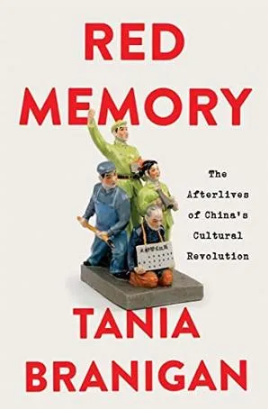
At First Things, Robert Carle reviews Tania Brannigan’s Red Memory: The Afterlives of China’s Cultural Revolution:
At a 1979 White House dinner, actress Shirley MacLaine told Deng Xiaoping, China’s new leader and the guest of honor that evening, about a Chinese scientist she had met. He said that he’d been happier and more productive when he worked on a Chinese farm. Deng cut her short: “He lied. That was what he had to say at the time.” Deng spent three years working in a tractor factory during the Cultural Revolution, and he refused to romanticize it. The memoirs of Cultural Revolution survivors written in the 1980s echo Deng’s view that it was a brutal and pointless experiment.
Today, there is widespread nostalgia in China for the Cultural Revolution. President Xi Jinping has reflected positively on the time he spent exiled in the remote town of Liangjiahe in Shaanxi province, living in a cave, hauling coal carts, carrying manure, building dikes, enduring bitter winters, flea bites, and hunger. This experience, Xi claims, bonded him with China’s common people and prepared him to be an empathetic ruler. Liangjiahe is now a “red tourist” attraction where students can visit Xi’s old home and admire the well he built.
Xi’s glamorization of the Cultural Revolution is reflected in Beijing’s chic dining scene. In Red Classics Restaurant, for example, waitresses in Red Guard uniforms serve meat and vegetables in plain style to invoke an era of stark living. You can have a fully themed wedding in this restaurant, posing for photos in matching Mao suits on a tractor parked in one corner.
In her new book, Red Memory, Tania Branigan describes the clashing memories of the Cultural Revolution. Those who suffered under the brutality of the Red Guard describe an infernal decade when Mao turned his murderous paranoia on his own people, leading them to tear each other to pieces. Children denounced their parents, and students murdered their teachers. In Mao’s campaign against the four “olds” (Old Ideas, Old Culture, Old Customs, and Old Habits), traditional Chinese culture and morality became targets for destruction.
But Branigan also tells stories of people who are nostalgic for a time when life was more austere and when people lived for a cause other than individualism and materialism. Some former Red Guards have set up a bookstore and website called Utopia. Others organize trips to North Korea to admire society as it should be, or set up rural communes for students. One Utopia co-founder, a professor, made headlines for slapping an eighty-year-old “traitor” who had dared to criticize Mao.
Red Memory is full of chilling stories of brutality and betrayal. Fang Zhongmou witnessed the torture and beating of her husband by adolescent Red Guards. She endured years of interrogations at her workplace because her father had been a landowner. One night in 1970, while doing laundry at home, she launched into a tirade against Mao. Her son told her, “If you go against my dear Chairman Mao, I will smash your dog head in”. He reported her to officials. After two months of violent “struggle sessions”, Fang was executed. The son grew up to be a guilt-ridden adult who agonizes over his mother’s gravesite.
Song Binbin was eighteen when she viciously denounced her school’s deputy principal, Bian Zhongyun. Bian had told the students that they should run out of the building in the event of an earthquake. Because she did not instruct the students to take Mao portraits with them, Red Guards hunted her down and beat her to death with nailed clubs. As the Cultural Revolution swept China, beatings and executions became increasingly baroque. Students poured boiling water over teachers’ heads and made them swallow excrement, crawl over embers, drink ink and glue, and beat one another.
Nationalization of British Railways: What Went Wrong?
Railways Explained
Published 22 Oct 2023In today’s video we continue uncovering the story of railway development in Great Britain, as part of a special trilogy marking the Railways Explained’s achievement of 100,000 subscribers!
This is actually the second video in series, and it covers a period from the aftermath of World War II to the momentous era of rail privatization, which was quite challenging period for British railways, full of ups and downs, but it is mostly marked by the formidable challenges.
We talked about the pivotal moments, such as the birth of British Railways, the ambitious Modernisation Plan, the influential Beeching Report, structural reforms, and the eventual transition to rail privatization, which all defined the British railways during this transformative period.
This insightful journey through time illuminates the intricacies and milestones of a railway system that has left an indelible mark on the United Kingdom’s transportation history.
(more…)
QotD: Mao’s theory of “protracted war” as adapted to Vietnamese conditions by Võ Nguyên Giáp
Giáp was facing a different set of challenges in Vietnam facing either France or the United States which required the framework of protracted war to be modified. First, it must have been immediately apparent that it would never be possible for a Vietnamese-based army to match the conventional military capability of its enemies, pound-for-pound. Mao could imagine that at some point the Red Army would be able to win an all-out, head-on-head fight with the Nationalists, but the gap between French and American capabilities and Vietnamese Communist capabilities was so much wider.
At the same time, trading space for time wasn’t going to be much of an option either. China, of course, is a very large country, with many regions that are both vast, difficult to move in, and sparsely populated. It was thus possible for Mao to have his bases in places where Nationalist armies literally could not reach. That was never going to be possible in Vietnam, a country in which almost the entire landmass is within 200 miles of the coast (most of it is far, far less than that) and which is about 4% the size of China.
So the theory is going to have to be adjusted, but the basic groundwork – protract the war, focus on will rather than firepower, grind your enemy down slowly and proceed in phases – remains.
I’m going to need to simplify here, but Giáp makes several key alterations to Mao’s model of protracted war. First, even more than Mao, the political element in the struggle was emphasized as part of the strategy, raised to equality as a concern with the military side and fused with the military operation; together they were termed dau tranh, roughly “the struggle”. Those political activities were divided into three main components. Action among one’s own people consisted of propaganda and motivation designed to reinforce the will of the populace that supported the effort and to gain recruits. Then, action among the enemy people – here meaning Vietnamese who were under the control of the French colonial government or South Vietnam and not yet recruited into the struggle – a mix of propaganda and violent action to gain converts and create dissension. Finally, action against the enemy military, which consisted of what we might define as terroristic violence used as message-sending to negatively impact enemy morale and to encourage Vietnamese who supported the opposition to stop doing so for their own safety.
Part of the reason the political element of this strategy was so important was that Giáp knew that casualty ratios, especially among guerrilla forces – on which, as we’ll see, Giáp would have to rely more heavily – would be very unfavorable. Thus effective recruitment and strong support among the populace was essential not merely to conceal guerrilla forces but also to replace the expected severe losses that came with fighting at such a dramatic disadvantage in industrial firepower.
That concern in turn shaped force-structure. Giáp theorized an essentially three-tier system of force structure. At the bottom were the “popular troops”, essentially politically agitated peasants. Lightly armed, minimally trained but with a lot of local knowledge about enemy dispositions, who exactly supports the enemy and the local terrain, these troops could both accomplish a lot of the political objectives and provide information as well as functioning as local guerrillas in their own villages. Casualties among popular troops were expected to be high as they were likely to “absorb” reprisals from the enemy for guerrilla actions. Experienced veterans of these popular troops could then be recruited up into the “regional troops”, trained men who could now be deployed away from their home villages as full-time guerrillas, and in larger groups. While popular troops were expected to take heavy casualties, regional troops were carefully husbanded for important operations or used to organize new units of popular troops. Collectively these two groups are what are often known in the United States as the Viet Cong, though historians tend to prefer their own name for themselves, the National Liberation Front (Mặt trận Dân tộc Giải phóng miền Nam Việt Nam, “National Liberation Front for South Vietnam”) or NLF. Finally, once the French were forced to leave and Giáp had a territorial base he could operate from in North Vietnam, there were conventional forces, the regular army – the People’s Army of Vietnam (PAVN) – which would build up and wait for that third-phase transition to conventional warfare.
The greater focus on the structure of courses operating in enemy territory reflected Giáp’s adjustment of how the first phase of the protracted war would be fought. Since he had no mountain bases to fall back to, the first phase relied much more on political operations in territory controlled by the enemy and guerrilla operations, once again using the local supportive population as the cover to allow guerrillas and political agitators (generally the same folks, cadres drawn from the regional troops to organize more popular troops) to move undetected. Guerrilla operations would compel the less-casualty-tolerant enemy to concentrate their forces out of a desire for force preservation, creating the second phase strategic stalemate and also clearing territory in which larger mobile forces could be brought together to engage in mobile warfare, eventually culminating in a shift in the third phase to conventional warfare using the regional and regular troops.
Finally, unlike Mao, who could envision (and achieve) a situation where he pushed the Nationalists out of the territories they used to recruit and supply their armies, the Vietnamese Communists had no hope (or desire) to directly attack France or the United States. Indeed, doing so would have been wildly counter-productive as it likely would have fortified French or American will to continue the conflict.
That limitation would, however, demand substantial flexibility in how the Vietnamese Communists moved through the three phases of protracted war. This was not something realized ahead of time, but something learned through painful lessons. Leadership in the Democratic Republic of Vietnam (DRV = North Vietnam) was a lot more split than among Mao’s post-Long-March Chinese Communist Party; another important figure, Lê Duẩn, who became general secretary in 1960, advocated for a strategy of “general offensive” paired with a “general uprising” – essentially jumping straight to the third phase. The effort to implement that strategy in 1964 nearly overran the South, with ARVN (Army of the Republic of Vietnam – the army of South Vietnam) being defeated by PAVN and NLF forces at the Battles of Bình Giã and Đồng Xoài (Dec. 1964 and June 1965, respectively), but this served to bring the United States more fully into the war – a tactical and operational victory that produced a massive strategic setback.
Lê Duẩn did it again in 1968 with the Tet Offensive, attempting a general uprising which, in an operational sense, mostly served to reveal NLF and PAVN formations, exposing them to US and ARVN firepower and thus to severe casualties, though politically and thus strategically the offensive ended up being a success because it undermined American will to continue the fight. American leaders had told the American public that the DRV and the NLF were largely defeated, broken forces – the sudden show of strength exposed those statements as lies, degrading support at home. Nevertheless, in the immediate term, the Tet Offensive’s failure on the ground nearly destroyed the NLF and forced the DRV to back down the phase-ladder to recover. Lê Duẩn actually did it again in 1972 with the Eastern Offensive when American ground troops were effectively gone, exposing his forces to American airpower and getting smashed up for his troubles.
It is difficult to see Lê Duẩn’s strategic impatience as much more than a series of blunders – but crucially Giáp’s framework allowed for recovery from these sorts of defeats. In each case, the NLF and PAVN forces were compelled to do something Mao’s model hadn’t really envisaged, which was to transition back down the phase system, dropping back to phase II or even phase I in response to failed transitions to phase III. By moving more flexibly between the phases (while retaining a focus on the conditions of eventual strategic victory), the DRV could recover from such blunders. I think Wayne Lee actually puts it quite well that whereas Mao’s plan relied on “many small victories” adding up to a large victory (without the quick decision of a single large victory), Giáp’s more flexible framework could survive many small defeats on the road to an eventual strategic victory when the will of the enemy to continue the conflict was exhausted.
Bret Devereaux, “Collections: How the Weak Can Win – A Primer on Protracted War”, A Collection of Unmitigated Pedantry, 2022-03-03.
January 21, 2024
The Duke of Wellington, perhaps best known as the inventor of the Wellington boot …
Weaver Sheridan expresses some surprise that His Grace’s main source of fame is the credit for the invention of the Wellington, rather than his other, uninteresting achievements:
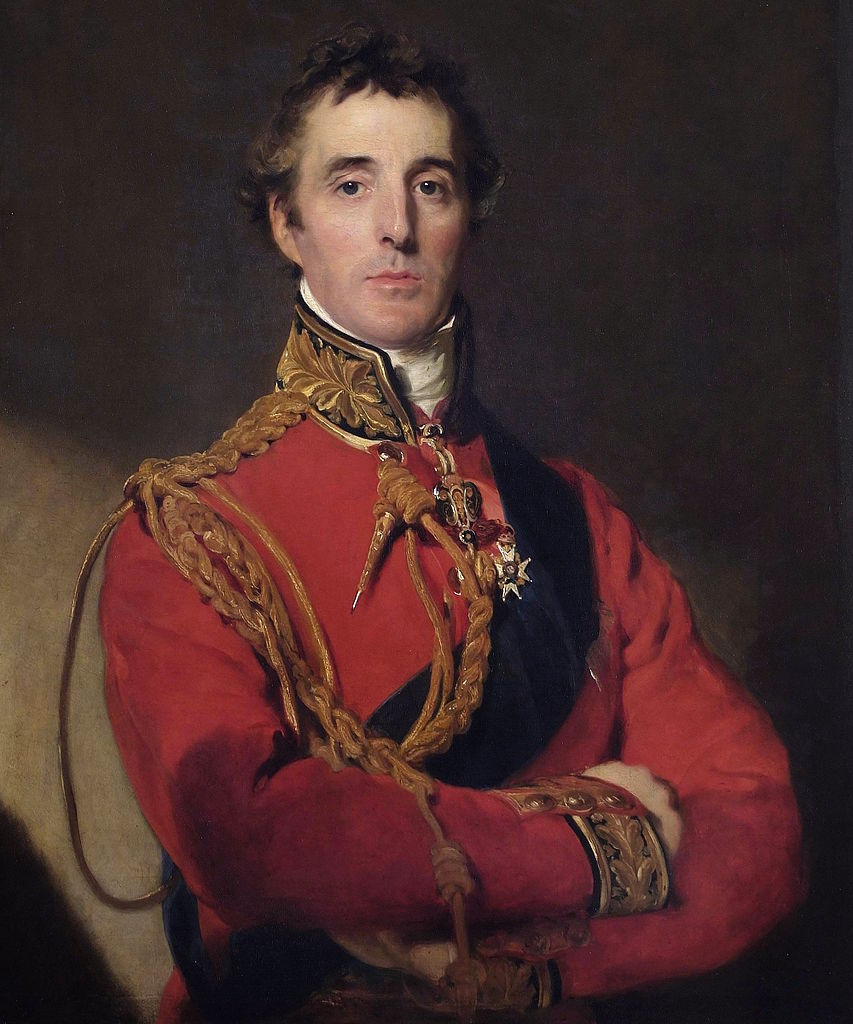
Arthur Wellesley, 1st Duke of Wellington (1769–1852) by Thomas Lawrence, circa 1815-1816.
Wikimedia Commons.
I know nothing should surprise us these days about dumbed-down Britain. But an article on the moronic Mail Online website the other day had me choking on my cornflakes.
It read: “In 2020, Mandy Lieu, 38, bought 935-acre Ewhurst Park in Hampshire, once owned by the inventor of the wellington boot, the Duke of Wellington, and vowed to turn it into a world-class organic farm and nature reserve.”
The inventor of the wellington boot!
Good grief, I know teaching of British history is nowadays outrageously skewed and bowdlerised, but I didn’t realise things had got this bad.
The article’s author obviously thinks the Iron Duke’s main claim to fame was the welly. Does she know nothing about him being a soldier and statesman, victor of the Peninsular War, victor of Waterloo, nemesis of Napoleon, twice Prime Minister? Or is the wellington boot reference made simply to get equally thick readers to relate to the story? Who cares about fusty old battles and boring politics? It is all so yesterday, isn’t it? But everyone knows what wellies are, don’t they?
To anyone with a modicum of interest in this country’s past, such ignorance is deeply depressing, to say the least. But I suppose it could be worse. Think what would happen if some Mail Online know-nothing hack was able to interview other historical figures …
“Sir Winston Churchill, tell us how you came up with the idea of a nodding bulldog to promote your insurance company.”
“Napoleon, having invented a popular type of brandy, was it perhaps rather egotistical to name it after yourself?”
“Pablo Picasso, as a car designer you must be thrilled to see your Citroën Grand C4 Picasso being crowned “Best Used MPV” in the Auto Express Used Car Awards 2023.”


