
World War Two
Published 20 Jan 2024The huge new Soviet offensives charge ahead this week, taking Warsaw and Krakow; in the west the Battle of the Bulge is officially called over … though there is still fighting there. On Luzon, the Americans push out of their beachhead, though there is heavy fighting to secure their flank.
(more…)
January 21, 2024
The Red Army Overruns Poland! – WW2 – Week 282 – January 20, 1945
Comments Off on The Red Army Overruns Poland! – WW2 – Week 282 – January 20, 1945
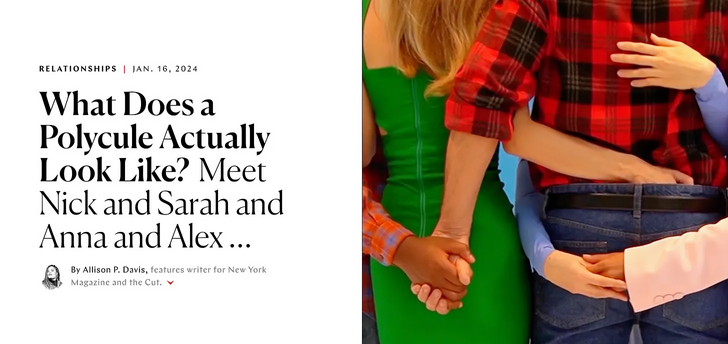
Polycules – “Reading about this shit is like watching paint dry. It’s astoundingly sexless.”
One of the first times I encountered the term “polycule” was in joking reference to the pre-prison lifestyle of SBF and his intimate (?) circle and a photo of the seven diverse individuals from the Disney Snow White cast, but as Chris Bray says, it’s suddenly becoming a popular topic in the legacy media:
Sex is a lagging indicator. As the historians John D’Emilio and Estelle Freedman have written, sexual behaviors reflect everything that happens around them: “Political movements that attempt to change sexual ideas and practices seem to flourish when an older system is in disarray and a new one forming.” Radical changes in sexual practices tell you that significant social change is already well advanced, and sex is trying to catch up.
It appears that an older system is in disarray. Polyamory litters the media landscape, suddenly, like a memo went out.
See if you can spot a trend, because the last week has brought big features on polycules and their enthusiasts from New York magazine, the New York Times, and the New York Post. If you live in Brooklyn, have hand sanitizer and a reliable source of Valtrex.
As the Times notes, television and publishing are similarly rushing to join in:
Along with novels, TV shows and movies that depict throuples, polycules and other permutations of open relationships, there is a growing body of nonfiction literature that explores the ethics and logistical hurdles of polyamory. Recent titles include memoirs like the journalist Rachel Krantz’s 2022 book Open: An Uncensored Memoir of Love, Liberation, and Non-Monogamy, and self-help and inspirational books like The Anxious Person’s Guide to Non-Monogamy, The Polyamory Paradox and A Polyamory Devotional, which has 365 daily reflections for the polyamorous.
I’m begging you: read some of this stuff, because you’re not going to believe what I say about it. At least skim the thing in New York; here’s the link again. Here’s a link to the Amazon preview of A Polyamory Devotional, with daily thoughts about mindfulness and relationship structures. Now, armed with evidence, here’s my Big Conclusion:
Reading about this shit is like watching paint dry. It’s astoundingly sexless.
Polyamory turns out to be a front for therapeutic culture and a neurotic love of mirrors. The sexy thing with Alice and Anna and Nick and Sarah involves a lot of checking in and managing expectations and maintaining supportive dialogue. Actual quote from Nick: “Some people like to run marathons. We like to do polyamory, complex relationship stuff. Sarah’s favorite activity for the two of us to do is couples therapy.” You’re jealous of all that heat and pleasure, right? It’s so sexy that it’s like running a marathon. Of talking. With a therapist.
Comments Off on Polycules – “Reading about this shit is like watching paint dry. It’s astoundingly sexless.”
A Book and a Rifle: The Vercors Resistance in WWII
Forgotten Weapons
Published 20 May 2018One of the single largest actions of the French Resistance during World War Two was Operation Montagnards — the plan to drop about 4,000 Allied paratroops onto the Vercors Massif when the resistance was activated in support of the Allied landings in Normandy and Provence. If you are scratching your head trying to figure out why you don’t remember that operation, it is because it never actually happened. The two Allied landings were originally intended to take place simultaneously, but logistical limitations forced the southern landings to be delayed about two months. In an deliberate decision to prevent the Germans from immediately understanding the nature of the Allied attack, the whole of the French Resistance was activated to support the Normandy landings in June 1944. The internal attacks in the south would force the Germans to keep significant forces in that area in expectation of a second landing, which would increase the chances of the Normandy landings succeeding. Unfortunately, the other result of this decision was that Resistance cells would come into the open in anticipation of imminent military support, which would not be coming. The southern elements of the Resistance were basically sacrificed in this gambit.
The Vercors Massif is a large geographical feature near Lyon and Grenoble which comprises basically a triangular sheer-walled plateau rising well above the surrounding plains. It offers a fantastically defensible redoubt, and that is what it was planned to be. Paratroops dropped onto the top of the massif would reinforce a substantial force of Maquis fighters, and create a serious strong point behind the German lines to aid in the fight inland from the landing beaches. The plan was organized in Algiers by Resistance representatives from the Vercors and Free French officers earlier in the war. Some have argued that the lack of support was simply due to the compromises of the single-landing plan, while others fault de Gaulle for deliberately abandoning the men and women on Vercors as part of a strategy to consolidate post-war political support — but that debate is beyond the scope of today’s discussion.
The fighters and civilians on the massif ultimately held out for about 6 weeks — only just too little to still be there when the Allied armored columns reached Grenoble. The German commander in the area spent several weeks making small probing attacks before the final assault with about 10,000 veteran Wehrmacht soldiers, glider-borne infantry, and tanks. Once that attack came, the fate of the Vercors was sealed. With proper military backing they could have defended their redoubt, but instead they had only a smattering of small arms and no heavy weaponry at all. It was a fight that was gloriously courageous but hopelessly doomed to failure.
I am privileged to have in my own collection a Berthier carbine tied to the Vercors Resistance, as evidenced by the brass embellishments on its stock. While I cannot conclusively prove it came from the Resistance, it was sold to me without any premium attached to them, and I have no reason to believe it is fake. And, of course, since I have no plans to sell it, I am not really concerned about conclusively proving its veracity to others. For me, it is a poignant icon of a tremendously heroic group. I hope I would live up to the bar they set should I ever be in a comparable situation!
(more…)
Comments Off on A Book and a Rifle: The Vercors Resistance in WWII
QotD: The life-cycle of bureaucracies
… a large bureaucracy will, in approximately 100 percent of cases, become extremely wasteful, and essentially corrupt. It will perpetuate the “problem” that it was founded to solve, and at its most creative, invent new and quite imaginative evils. It will become a vested interest — an “economic player” in its own right — and spread, like a cancer, well beyond the flesh it first inhabited. Any attempt to restrain it will then engender new bureaucracies. The idea of a “humane” bureaucracy is a contradiction of terms. There is no such thing.
Gentle reader must understand that I am not speaking only of “guvmint”, but of bureaucracy, at large. The thing is not necessarily a government department. Any big corporation will quickly show symptoms. The only difference between “public” and “private” is in longevity. A private bureaucracy will kill its host, but thanks to the power of taxation, a public bureaucracy can be long sustained. It is also backed by law and police action, which even today is more effective than mere pointless rules and regulations. The latter, however, are more nimble in expansion, and prepare the ground for law — the full spiritual stasis.
David Warren, “Austrian schoolboy”, Essays in Idleness, 2019-09-17.
Comments Off on QotD: The life-cycle of bureaucracies
January 20, 2024
The British Empire would have failed a proper cost-benefit analysis
At the Institute of Economic Affairs, Kristian Niemietz is working on a paper on the economics of empire that, as he shows in this article, indicates that the empire was never a winning economic proposition for Britain as a whole, no matter how well certain well-connected individuals and companies benefitted:
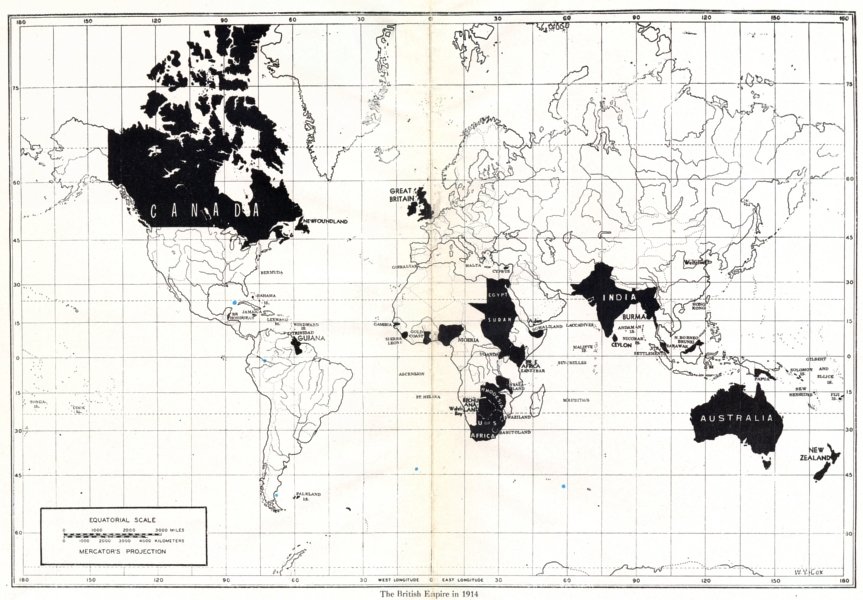
The British Empire in 1914 (via antiquaprintgallery.com)
But is it actually true that imperialism makes countries richer? Does imperialism make economic sense?
This question was already hotly debated at the heyday of imperialism. Adam Smith believed that the British Empire would not pass a cost-benefit test:
The pretended purpose of it was to encourage the manufactures, and to increase the commerce of Great Britain. But its real effect has been to raise the rate of mercantile profit, and to enable our merchants to turn into a branch of trade, of which the returns are more slow and distant than those of the greater part of other trades, a greater proportion of their capital than they otherwise would have done […]
Great Britain derives nothing but loss from the dominion which she assumes over her colonies.
He believed that Britain would be better off if it dissolved its Empire:
Great Britain would not only be immediately freed from the whole annual expense of the peace establishment of the colonies, but might settle with them such a treaty of commerce as would effectually secure to her a free trade, more advantageous to the great body of the people, though less so to the merchants, than the monopoly which she at present enjoys.
The liberal free-trade campaigner Richard Cobden agreed:
[O]ur naval force, on the West India station […], amounted to 29 vessels, carrying 474 guns, to protect a commerce just exceeding two millions per annum. This is not all. A considerable military force is kept up in those islands […]
Add to which, our civil expenditure, and the charges at the Colonial Office […]; and we find […] that our whole expenditure, in governing and protecting the trade of those islands, exceeds, considerably, the total amount of their imports of our produce and manufactures.
If imperialism was a loss-making activity – why did Britain and other European colonial empires engage in it for so long?
Smith and Cobden explained it in terms of clientele politics (or Public Choice Economics, as we would say today). Somebody obviously benefited, even if the nation as a whole did not. And the beneficiaries were politically better organised than those who footed the bill.
This proto-Public Choice case against imperialism was not limited to political liberals. Otto von Bismarck, the Minister President of Prussia and future Chancellor of the German Empire, hated liberals in the Smith-Cobden tradition, but he rejected colonialism in terms that almost make him sound like one of them:
The supposed benefits of colonies for the trade and industry of the mother country are, for the most part, illusory. The costs involved in founding, supporting and especially maintaining colonies […] very often exceed the benefits that the mother country derives from them, quite apart from the fact that it is difficult to justify imposing a considerable tax burden on the whole nation for the benefit of individual branches of trade and industry [translation mine].
In his writing about the economics of imperialism, even Michael Parenti, a Marxist-Leninist political scientist (who is, for obvious reasons, popular among Twitter hipsters), sounds almost like a Public Choice economist:
[E]mpires are not losing propositions for everyone. […] [T]he people who reap the benefits are not the same ones who foot the bill. […]
The transnationals monopolize the private returns of empire while carrying little, if any, of the public cost. The expenditures needed […] are paid […] by the taxpayers.
So it was with the British empire in India, the costs of which […] far exceeded what came back into the British treasury. […]
[T]here is nothing irrational about spending three dollars of public money to protect one dollar of private investment – at least not from the perspective of the investors.”
This leads us to a curious situation. Today’s woke progressives disagree with their comrade Parenti on the economics of empire, but they do agree with Britain’s old imperialists, who argued that the Empire was vital for Britain’s prosperity.
Looking for some kind of consistency in political commentary
In The Line, Matt Gurney notes that the reactions to a former National Post columnist seeking the nomination for the Conservatives in a 905-area seat fall into depressingly predictable patterns on partisan lines:

Anyone have a standard they can apply consistently in each of these cases? If so, should we maybe write it down or something?
Here’s my take: Each of these cases posed some problems, but none of them fatal, because I think the fear of influence peddling and favour currying actually has the flow reversed: media figures don’t skew their on-air or in-print work to seek political opportunities, but political parties absolutely actively recruit like-minded people with large media profiles.
Maybe I’m wrong. Okay. Just tell me the rule, then, and I’ll go with it.
And then, oh Lord, there’s the rest of it.
Maddeaux’s announcement was met with some, uh, interesting responses. Liberal MP Pam Damoff went right after Maddeaux over a column she’d written on gun control; Fisheries Minister Diane Lebouthillier took umbrage with Maddeaux’s comments on bilingualism. This is fine; Maddeaux has stepped into the political arena and political attacks on her are fair game. But what was stupid was how Conservatives and their numerous social media proxies rushed to play the misogyny card.
Check out this, by long-time CPC staffer and now comms professional Laura Kurkimaki. Kurkimaki tweeted “[S]everal Liberal ministers attacked a young woman today on social media who had just announced she’s running for a @CPC_HQ nomination … Interesting, the same people who say add women change politics, feminist government, sunny ways etc. Embarrassing. Desperate.”
I hope Kurkimaki doesn’t feel picked on here; I chose her comment as a representative example of the eye-rolling array of responses for two reasons: it’s one of the less gross examples of the rush to portray Maddeaux as a victim of sexism; I’d rather not link to the dumber ones. Further, I actually mostly agree with Kurkimaki’s broader point: the Liberals do seem really rattled by Maddeaux’s announcement, and that’s interesting.
But back on topic: is Maddeaux a fair target for reasonable criticism, or does she get some kind of protected status because she’s a woman?
I vote the former! And I suspect that her Liberal critics, from cabinet ministers right on down to the #IStandWithTrudeau crowd on X, would agree. The problem, of course, is that those very same people, again from the cabinet right on down to Trudeau’s social media proxies, are probably mostly — all? — guilty of reacting with exaggerated outrage and cries of misogyny when certain other women are attacked. Chrystia Freeland, Mélanie Joly, Maryam Monsef … I can tell you from personal experience that if you make even reasonable and narrow criticisms of the policies and political performance of those three women, or other prominent Liberals who tick at least one DEI box, you will be swiftly informed that you are, in fact, simply a prejudiced white man.
Oh.
Of course there is sexism in our politics. And other forms of prejudice. And social media is absolutely flooded with rank misogyny and every other disgusting societal cancer you can imagine. Freeland, Joly and Monsef have all been, and will continue to be, targeted with absolutely appalling stuff. Just as Maddeaux has been, and will continue to be. All of it is disgusting.
But for all that, some of what people have to say about these women and their professional performance will be fair, or at least reasonable, and it is incumbent on all to not fake being idiots who cannot tell these two things apart. It’s dumb when it’s Conservatives pretending that Maddeaux is being attacked because she’s a woman, it’s dumb when the Liberals do the same to protect Freeland et al, and, in what I think was the uber-example of this kind of brainrot, it was really dumb when Trudeau responded to credible reports of Chinese electoral interference in Canada, which his government had basically ignored, by lecturing everyone about anti-Asian racism.
Comments Off on Looking for some kind of consistency in political commentary
“This ruling is definitely going to embolden the already tyrannical regulatory boards”
Jordan Peterson’s reaction to the Ontario court decision that sided with the College of Psychologists of Ontario to order him to undergo re-education at his own expense until some non-specified goals have been reached:
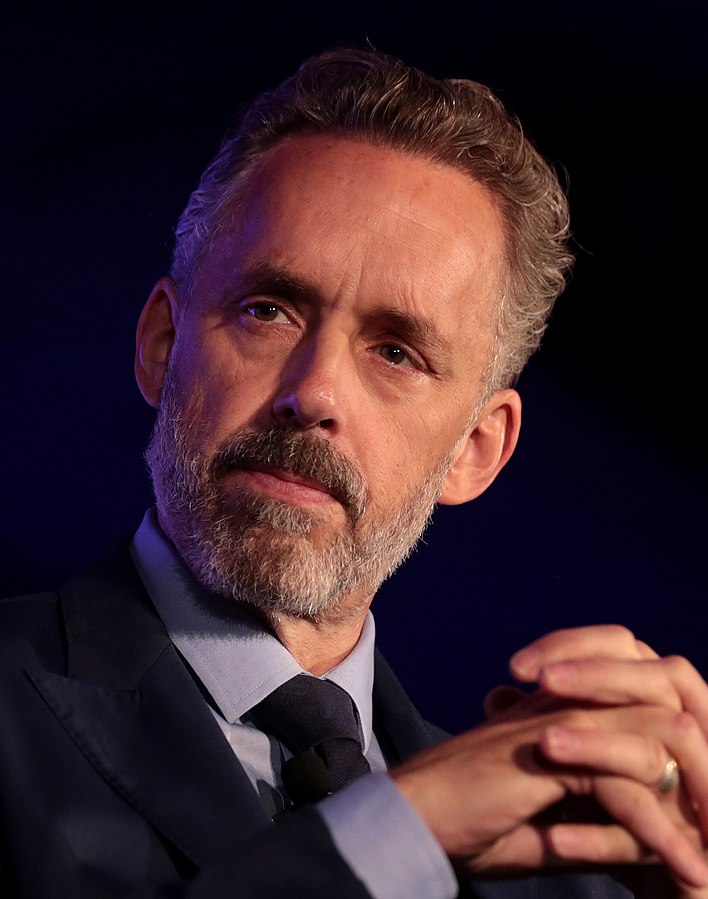
Jordan Peterson speaking at an event in Dallas, Texas on 15 June, 2018.
Detail of a photo by Gage Skidmore via Wikimedia Commons.
[National Post interviewer Tyler Dawson] What was your reaction when you found out the Ontario Court of Appeal had dismissed your challenge?
Oh, well, I’d already factored that into account as a high probability, so it actually didn’t affect me very much.
I’m upset because of what it signifies. This might be hard for people to believe, but I don’t believe that this is about me. I don’t want to claim some sort of capacity to transcend mere egotism, but there isn’t anything the college can really do to me, except they can take a hit out on my professional reputation to some degree.
Practically speaking, I’m beyond their purview, because I’m not dependent on them financially. I don’t even need my licence. I’m not practising. I have a reputation that’s going to withstand this regardless, and perhaps even be enhanced by it.
The reason that I’m fighting for this is because, well, first of all, I didn’t want them to take my damn licence. I worked hard on that and there’s no — I’ve done nothing to deserve that, quite the contrary. I think I’ve helped millions of people.
This ruling is definitely going to embolden the already tyrannical regulatory boards. But also Canadians don’t understand that if they can’t trust their professionals to tell them the truth, then they don’t have professionals anymore.
You know, this country is in rough shape. It’s in far rougher shape than people understand. So the reason I’m fighting this is to try to bring that to public attention, like I’ve been trying since 2016. You know, now a cynic would say well, you know, look at all the success you’ve had with it. It’s like, wow, yeah, believe me, man, it took a lot of dancing in place to turn the cataclysm of negative public opinion and pillorying by the press into success. That wasn’t a foregone conclusion.
What options does this leave you specifically with regards to the college? Do the training or resign?
The status is crystal clear. I’ve already been sentenced to a course of re-education, of indeterminate origin, at my expense, until I comply. And all they have to do now is tell me when to do it and where — that’s where we’re at.
There’s nothing that I know of now that I can do to stop that from happening. I just cannot understand how that’s going to work, because the probability that they’re going to re-educate me in some manner they deem successful, there’s no universe in which that can occur.
Or I can reject it, in which case I’ll fail, which is the outcome that’s desired anyways. Or I can tell them to go directly to hell and just refuse to do it, in which case they can say, well, we gave Dr. Peterson every opportunity to maintain his professional licence, but when push came to shove, he was unwilling to abide by our dictates. So those are my options.
Could you just register in another province?
It’s not that easy to switch registration jurisdictions. It should be easier than it is, because there are bureaucratic impediments in the way that make it very difficult for professionals to move and there’s no excuse for that.
It’s certainly an option I will and have to some degree explored. But it’s not just like rolling over in bed.
Comments Off on “This ruling is definitely going to embolden the already tyrannical regulatory boards”
Why Tyrian Purple Dye Is So Expensive | So Expensive | Insider Business
Insider Business
Published 21 Jan 2023Making authentic Tyrian purple dye starts with extracting a murex snail gland. After a series of painstaking steps, Tunisian dye maker Mohamed Ghassen Nouira turns as much as 45 kilograms of snails into a single gram of pure Tyrian purple extract. When he’s done, he can sell it for $2,700. Some retailers sell a gram of the pigment for over $3,000. In comparison, 5 grams of synthetic Tyrian purple costs under $4.
So, why is real Tyrian purple so hard to make? And is that why it’s so expensive?
(more…)
Comments Off on Why Tyrian Purple Dye Is So Expensive | So Expensive | Insider Business
QotD: 19th Century techno-optimism
They had a point, those intellectual Luddites. If you haven’t read up on the later 19th century in a while, it’s almost impossible to convey their boundless optimism, their total faith that “science” could, would, and should solve every conceivable problem. The best I can do is this: Back when they were still allowed to be funny, The Onion published a book called Our Dumb Century, which purported to be a collection of their front pages from every year of the 20th century. The headline for 1903 was something like: “Wright Brothers’ Flyer Goes Airborne for 30 Seconds! Conquest of Heaven Planned for 1910.”
That’s the late 19th century, y’all.
Severian, “Digital Infants”, Rotten Chestnuts, 2021-04-16.
Comments Off on QotD: 19th Century techno-optimism
January 19, 2024
Music journalism, RIP
Ted Gioia explains why music journalism is collapsing and who committed the murder:
Just a few weeks ago, Bandcamp laid off 58 (out of 120) employees — including about “half of its core editorial staff“.
And Bandcamp was considered a more profitable, stable employer than most media outlets. The parent company before the recent sale (to Songtradr) and subsequent layoffs, Epic Games, will generate almost a billion dollars in income this year — but they clearly don’t want to waste that cash on music journalism.
Why is everybody hating on music writers?
Many people assume it’s just the same story as elsewhere in legacy media. And I’ve written about that myself — predicting that 2024 will see more implosions of this sort.
Sure, that’s part of the story.
But there’s a larger problem with the music economy that nobody wants to talk about. The layoffs aren’t just happening among lowly record reviewers — but everywhere in the music business.
- Universal Music announced layoffs two days ago.
- YouTube announced layoffs yesterday.
- Soundcloud announced last week that the company is up for sale — after two rounds of layoffs during the last 18 months.
- Spotify announced layoffs five weeks ago.
- That same week, Tidal announced layoffs.
- A few weeks earlier, Amazon Music laid off employees on three continents.
Meanwhile, almost every music streaming platform is trying to force through price increases (as predicted here). This is an admission that they don’t expect much growth from new users — so they need to squeeze old ones as hard as possible.
As you can see, the problem is more than just music writers — something is rotten at a deeper level.
What’s the real cause of the crisis? Let’s examine it, step by step:
- The dominant music companies decided that they could live comfortably off old music and passive listeners. Launching new artists was too hard — much better to keep playing the old songs over and over.
- So major labels (and investment groups) started investing huge sums into acquiring old song publishing catalogs.
- Meanwhile streaming platforms encouraged passive listening — so people don’t even know the names of songs or artists.
- The ideal situation was switching listeners to AI-generated tracks, which could be owned by the streaming platform — so no royalties are ever paid to musicians.
- These strategies have worked. Streaming fans don’t pay much attention to new music anymore.
I’ve warned about each of these — but we are now seeing the long-term results.
This is why Pitchfork is in deep trouble. If people don’t listen to new music, they don’t need music reviews.
And they don’t need interviews with rising stars. Or best of year lists. Or any of the other things music writers do for their readers.
But this problem will get much, much worse. Even the people who made these decisions will suffer — because living in the past is never a smart business strategy.
If these execs were albums, they’d deserve a zero score on the Pitchfork scale.

Comments Off on Music journalism, RIP
Canada “as a white supremacist genocidal settler state” also somehow has an immigration problem
In The Line, Jen Gerson documents what she characterizes as a collapse of the pro-immigration consensus that has been a major part of Canadian political affairs for generations:
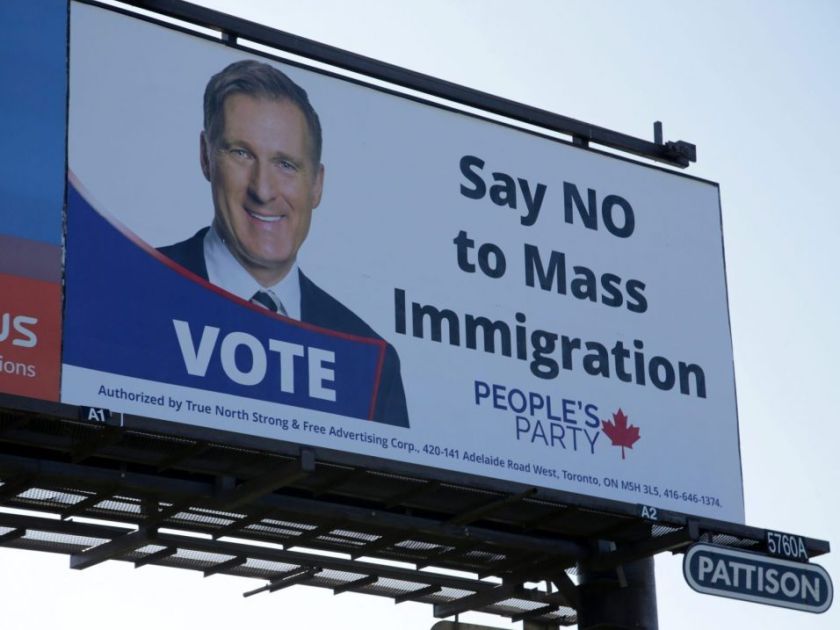
A billboard in Toronto in 2019, showing Maxime Bernier and an official-looking PPC message.
Photo from The Province.
Canada created a durable and lasting consensus on immigration by leaning on a shared national mythology: that from a colonial past, we forged a principled multicultural nation in which people from around the world are able to honour their heritage and traditions while building a prosperous and successful life for themselves and their descendants. This narrative requires that all of us — regardless of our divergent ideologies or religious views — cohere around a shared set of post-enlightenment principles: the equality of man, the rule of law, tolerance, and the rest. We take this highly abstract concept of nationhood so for granted that we’ve forgotten how historically rare it is.
This is not to say Canada ever imagined itself to have an unblemished history, but rather that this is a nation that saw itself as a fundamentally good and noble project, and therefore some place worth immigrating to, and a culture worth integrating with.
The last nine years of Liberal government have undermined that vision. Under the Trudeau Liberals, instead what we have been regularly subjected to Canada as a white supremacist genocidal settler state. And, hey, to what extent that historical reckoning is good or necessary is not for me to say: but if “Canada is bad, actually” is the starting position, by what delusion do any of us presume to perpetuate it?
A post-modern nation state that has no sense of itself, and no belief in its own inherent value, is not an experiment worth continuing, now is it? How do we expect to welcome and integrate 500,000 new Canadians annually into a corrupt national project? If “Canadian” isn’t something worth being, why should anyone sublimate their ethnic or religious grievances into this vicious national identity?
I think this is the tension that lies at the heart of this growing unease around immigration, and it’s going to be the most difficult one for the Conservatives to navigate. There will be those within the party that follow this thread directly into white grievance and conspiracies like great replacement theory, the xenophobic fear that “elites” are trying to demographically and culturally replace white people through mass migration.
I think that theory is insane, to be clear, but I’m also noticing it wend its way into politics in weird and destructive ways.
A small example: before the holidays, certain conservative social media circles were put into a state of high uproar over the construction of a 55-foot statue of the Hindu deity Hanuman on a private temple complex in Brampton.
Initially, I was baffled and confused and even a bit amused by the upset. After all, this wasn’t a publicly funded monument. It was on private property, and isn’t respect for private property a sacrosanct value for conservatives? This wasn’t rational.
The controversy was only explicable when we examine the emotional subtext of the complaints: that there was something deeply menacing about Hanuman to these people. They saw him overlooking the suburbs of Brampton with a colonial intent. (Irony abounds!) One of the most telling tweets came from one angry individual who said something to the effect: “They tore down our John A. Macdonald statues, but, sure, Hanuman is great.”
To this gentleman: the fine devout Hindus of Brampton did not tear down your John A. Macdonald statues — and I highly doubt they would any pick bones with historic or civic monuments.
We, Canadians, tore down our own statues (or allowed them to be torn down) as part of an internal process of historical reckoning. Again, immigrants are not doing anything to Canada. They are Canada, and as such, they share in this country’s problems, which are largely self created.
Those passionate Houthi and the Blowfish fans
Chris Selley wonders why the rest of the Canadian legacy media are being so careful to proactively curate and “contextualize” the violent and hateful message of the pro-Hamas and pro-Houthi protesters in our cities:

The Houthi Ansarullah “Al-Sarkha” banner. Arabic text:
الله أكبر (Allah is the greatest)
الموت لأمريكا (death to America)
الموت لإسرائيل (death to Israel)
اللعنة على اليهود (a curse upon the Jews)
النصر للإسلام (victory to Islam)
Image and explanatory text from Wikimedia Commons.
The record will show I had little sympathy for the Ottawa convoy crowd, especially once they had made their point and refused to go away. You can’t occupy the downtown of a G7 capital for a month. Sorry, you just can’t.
At the same time, I cringed at the media’s fevered attempts to cast the entire crowd as neo-Nazi oafs, based on what seems to have been two observed flags — one Confederate, one Nazi.
I recalled this while watching video footage of protesters in Toronto over the weekend chanting “Yemen, Yemen, make us proud! Turn another boat around!” Because the Houthis, who control Yemen’s Red Sea coast and have been waging war on commercial shipping, are about as neo-Nazi as it gets in the world nowadays.
The movement’s official slogan: “Allahu Akbar! Death to America! Death to Israel! Curse the Jews! Victory for Islam!” As if to drive home the point, there is ample video evidence of Houthi fighters chanting that slogan with their hands raised skywards in a Nazi salute.
The Houthis use child soldiers (as video evidence also makes horrifyingly plain). They are literally slavers. I have seen it suggested, by way of context, that they really don’t have that many slaves. Just a few slaves. It’s so hard to get good help.
But I haven’t seen anyone try to “contextualize” the Houthi slogan, the way Palestinian supporters will tell you “from the river to the sea” isn’t a call for Israel’s destruction and cheering for “intifada” doesn’t mean further terrorist attacks against Jews. Perhaps it’s just too big a job for even the most dedicated and creative of apologists.
Outside of the Postmedia empire, so far as I can see, not a single Canadian media outlet has seen fit to mention the chanting in Toronto streets in support of a rabidly antisemitic death cult. You can read several articles, however, about how Canadian media are terribly biased against the Palestinian cause. It’s ludicrous.
A nice little illustration, as the National Post‘s Tristin Hopper noted in November: When the convoy crowd appropriated Terry Fox’s statue, just opposite Parliament Hill, for their “mandate freedom” message, the Laurentian bubble nearly burst with righteous fury. When pro-Palestinian protesters draped a keffiyeh over Fox’s shoulders and had their kids pose with him, there was all but total silence.
Of course, flamboyant media double-standards aren’t the worst of our problems.
Comments Off on Those passionate Houthi and the Blowfish fans
Vienna’s Iconic Chocolate Cake
Tasting History with Max Miller
Published 17 Oct 2023
(more…)
Comments Off on Vienna’s Iconic Chocolate Cake
QotD: How the internet changed the dating world
First, preferences get formalized. 90% of swipes by women are for men over 6’0, which does not reflect the importance women place on height in the real world. This also makes sense: When people only spend 2-3 seconds per app, superficial qualities rise to the top.
Online dating also changes our expectations regarding relationships more broadly. Since we now date outside of our circles, it’s now easier to cheat or ghost or just otherwise leave if the relationship isn’t perfect. Why stay in a non-perfect relationship, the logic goes, when there are millions of other potential matches at your fingertips?
This perhaps explains why breakup rates for couples who meet via apps are twice as high as couples who meet via friends and family. Friends and family not only refer better, but there’s a higher incentive to stay in a relationship when there’s the social encouragement of family and friends.
What online dating does is enable hypergamy at a massive scale. Hypergamy is the tendency for women to want to date the best men, no matter where the woman is in the hierarchy. Men also want top women of course, but they’re on average willing to settle for any woman, at least for casual sex, whereas women are much more discerning, which makes sense given women have a much bigger risk than men when it comes to sex, since women can get pregnant. It’s basic biology: Sperm is cheap, eggs are expensive.
What we see with algorithmic online dating isn’t a mechanism to assign the perfect match to each person of the opposite sex. Instead, we’ve created a machine where the top 20% of men mate with many different partners and the top 80% of women try to get the top 20% of men to date and ultimately marry them (and not just have sex with them).
Algorithmic dating conflates two markets, the market for relationships and the market for sex under the ambiguous banner of “dating”. What happens then is men on apps try to match with as many women as possible and women try to match with a small selection of higher status men. That leads to the situation where a dating app’s natural equilibrium is that a narrow set of men have “dating” access to almost all the women if they choose to, and they typically do. Even with the best intentions, these men aren’t interested in long-term relationships with all these women. The more options a man has, the less inclined he is to want one single relationship.
To put some numbers on it:
- Men swipe right on 60% of women, women swipe right on 4.5% of men.
- The bottom 80% of men are competing for the bottom 22% of women and the top 78% of women are competing for the top 20% of men.
- A guy with average attractiveness can only expect to be liked by slightly less than 1% of females. This means one “like” for every 115 women that see his profile.
And if the majority of women are vying for these men and ignoring the rest of them, that creates both a large amount of lonely women and men. Indeed: 28% of men under 30 have reported no sex in the last year, which has doubled in the last decade. This celibacy level is reminiscent of feudal medieval times. In the old days these men would have become monks or cannon fodder for the war. But these days, they just watch porn and play video games (don’t give up, guys!).
Erik Torenberg, “The Matching Problem in Dating”, Erik Torenberg, 2023-09-23.
Comments Off on QotD: How the internet changed the dating world
January 18, 2024
Understanding the Spanish Civil War
Niccolo Soldo offers an introduction to the context in which the Spanish Civil War took place, with emphasis on one side’s uneasy coalition of interests:

Picasso’s “Guernica” in mural form in the town of Guernica.
Photo by Papamanila via Wikimedia Commons.
At a crossroads in his life, [Ernest Hemingway] decided to go to Spain to cover the conflict for a newspaper chain. Out of his experiences in that war came For Whom the Bell Tolls (1940), one of his most celebrated novels. In this excerpt, he uses the female character “Pilar” to relate the story of how Republican forces massacred a group of people in a small town who were opposed to the government and supported the Spanish Generals seeking to overthrow it. Derided as “fascists”, each of the men were forced to pass a line of pro-government peasants who would beat them with flails before throwing them off of a cliff. Civil wars are indeed the most vicious, even in fictional depictions like this one.
The Spanish Civil War is odd for two reasons, the first one being that more than any other war that I can think of, historians have placed a much stronger focus on the politics of the conflict to the detriment of its military aspects. The second reason is much more important overall, and particularly germane to the subject of this essay: it is the only war that I can think of where the histories have been overwhelmingly written by the losers.1
If you ask a random, somewhat educated person in the West about the Spanish Civil War, they will generally say that “Franco was a fascist who allied himself to Hitler and Mussolini and won the civil war in the most brutal fashion possible. He was a dictator who hated democracy and killed thousands upon thousands of innocent people.” Beyond that, they might make mention of Hemingway and his novel, or even Pablo Picasso’s painting entitled “Guernica”2, that depicts the victims of the German Luftwaffe bombardment of that small Basque town in the north of Spain. Others still will relay the fact that the term “Fifth Column” came out of the Spanish Civil War.3 Added up all together, the most simplified take becomes “Franco bad, Republicans good”.
Of course this take is wrong, as this conflict was too complex to arrive at such a ridiculous reductionist conclusion no matter which side you sympathize(d) with. To give you a quick illustration of just how complex this conflict was, here is a list of the major domestic factions that took part in it:
Spanish Republican Side:
- People’s Army (the armed forces of the Spanish Republic)
- Popular Front (left-wing electoral alliance of communists, socialists, liberals, anarchists)
- UGT (very large trade union affiliated with the Spanish Socialists)
- CNT-FAI (massive trade union of anarchist militants)
- POUM (anti-Stalinist communists, including some Trotskyites)4
- Generalitat de Catalunya (Catalonian Autonomists)
- Euzko Gudarostea (Army of the Basque Nationalists)
Spanish Nationalist Side:
- Spanish Renovation (monarchists supporting the Bourbon claimant to the throne, Alfonso XIII, who abdicated in 1931)
- CEDA (the main conservative party, Catholic conservatives)
- Requetés (traditionalist Catholic monarchist militants who supported the Carlist Dynasty, mainly from the region of Navarre)
- Falange Española de las JONS (Spanish Fascists)
- The Army of Africa, including the Spanish Legion (Spanish Army in Spain’s then-colony of Morocco, with many Moroccans serving in it)
Add to this mix the International Brigades5 that fought on the side of the government, and the German and Italian forces who backed the rebels. To list off all the political groupings that participated in the war is a mouthful, but necessary to hammer home the point of the complexity of this conflict. So here goes: nationalists, monarchists (from two competing royal houses), fascists, conservatives, liberals, social democrats, socialists, communists (from two competing camps), anarchists, and regional autonomists. In short, this war had something for everyone, which is why it caught the attention of so many foreigners (especially famous ones) at the time. But before we dive into the run up to the civil war, we need to understand some of the history of Spain that lead up to this “world war in miniature”.
1. “History will be kind to me, for I intend to write it” – falsely attributed to Winston Churchill, but it makes for a good quote to illustrate the point. From the International Churchill Society: “‘Alas poor Baldwin. History will be unkind to him. For I will write that history.’ And another version often repeated is ‘History will be kind to me. For I intend to write it.’
What Churchill actually said, in the House of Commons in January 1948, was in response to a speech by Herbert Morrison, the Labour Lord Privy Seal, which attacked the Conservatives’ foreign policy before the war:
“For my part, I consider that it will be found much better by all parties to leave the past to history, especially as I propose to write that history myself.”
2. In January of 1937, Picasso was commissioned by the Spanish Republican government to create a work of art to display at the upcoming World’s Fair in Paris in order to draw international attention to their cause. At the time, Picasso was living in the French capital. It wasn’t until he read reports of the bombing of Guernica on April 26 of that same year that he felt inspired enough to create something that he felt was worthwhile for audiences to see.
3. In September 1936, General Francisco Franco supposedly claimed that there were “four nationalist columns approaching Madrid, and a fifth column inside of it ready to attack”.
4. Leon Trotsky did not support POUM and went on to disassociate himself from them and their actions. George Orwell joined POUM when he went to Spain to volunteer to fight against the Spanish nationalists.
5. Formed by volunteers from outside of Spain and almost entirely Stalinist in leadership and political orientation.
Comments Off on Understanding the Spanish Civil War


