
D&D was invented in 1974 by one Gary Gygax, whose father was a violinist for the Chicago Symphony Orchestra. (This strikes me as significant, somehow.) Gary moved at an early age to Lake Geneva, Wisconsin, where he founded TSR Hobbies, the maker of D&D.
Although Gygax left the company in the mid-1980s, TSR today continues to crank out D&D rule books, D&D miniature playing pieces, and all sorts of other D&D paraphernalia in quantities that make one wonder about the nation’s mental health. By means of a cunning stratagem (I asked somebody at the office), I managed to get my hands on a couple of those sacred rule books, and let me tell you, R. buddy, this game is weird.
The basic idea in your run-of-the-mill Go Fish-type game is to get all your opponent’s cards or all his checkers or some other readily grasped commodity. Not so with D&D. Here is a quote from Mr. Gygax on the subject: “The ultimate aim of the game is to gain sufficient esteem as a good player to retire your character — he becomes a kind of mythical, historical figure, someone for others to look up to and admire”. If what you’ve been playing up till now is Parcheesi you ain’t ready for this.
To play D&D you need at least two acolytes, who play under the guidance of a vaguely Mansonesque personage called the Dungeon Master (DM). By means of various murky protocols involving the use of charts and dice, each player establishes the persona of the “character” he or she will manipulate in the game, who typically ends up (if male) being an antisocial cutthroat of some sort, or (if female) possessed of large, grapefruit-like breasts. I deduce the latter from studying the illustrations in the book. Admittedly I was looking at a very old edition. Perhaps the newer ones are more PC. It’s always the way. Apart from predictable characteristics like strength and intelligence, players also have to determine such baffling minutiae as their likelihood of contracting communicable diseases or becoming infested by parasites. Why these things are important I have no clue. I’m just telling you what the rule book says.
The preliminaries having been dealt with, the players are led through an imaginary dungeon devised by the DM in search of treasure or some such. On the way, they will encounter various obstacles and evil creatures, which they will have to defeat or evade.
The concept seems simple enough. It’s the application that throws me. There are two main problems: (1) there are one billion rules, and (2) the game requires nonstop mathematical finagling that would constipate Einstein. The rule book is laden with such mystifying pronouncements as the following: “An ancient spell-using red dragon of huge size with 88 hits points has a BXPV of 1300, XP/HP total of 1408, SAXPB of 2800 (armor class plus special defense plus high intelligence plus saving throw bonus due to h.p./die), and an EAXPA of 2550 (major breath weapon plus spell use plus attack damage of 3-30/bite) — totalling 7758 h.p.” Here we have a game that combines the charm of a Pentagon briefing with the excitement of double-entry bookkeeping. I don’t get it.
If you want to know more about Dungeons & Dragons, you can find D&D paraphernalia at many hobby and game stores. For the location of the outlet nearest you call 1-800-384-4TSR. Contrary to what you might think, all calls to this number are NOT immediately reported to the police.
Cecil Adams, “What’s the deal with Dungeons and Dragons?”, The Straight Dope, 1980-09-26.
November 17, 2024
November 16, 2024
You say you want a referendum …
In the above-the-paywall portion of his latest column, Paul Wells discusses the chances that we’re going to go into another maple-flavoured Groundhog Day marathon separation referendum in Quebec:

I’ve been thinking this for a while, but I haven’t written it down. We may be only a couple of years away from a national-unity crisis.
And the dwindling number of people with a working memory of the last crisis have retained instincts that will be useless if there’s another one. Any future Quebec sovereignty referendum campaign would be unrecognizably different from the first two, more chaotic and inherently unpredictable.
I’ve been doing some public speaking in Quebec lately, and it’s pretty clear from the Q&A sessions that even many francophone Quebecers haven’t thought through the ways in which a future sovereignty referendum might play out. So it’s time to start contemplating ghosts of Christmas yet to come.
The Trudeau Liberals aren’t the only political party in Canada that’s fallen and can’t get up. It’s looking grim for Quebec’s governing Coalition Avenir Québec too: Wednesday’s monthly Léger poll was the worst for Quebec’s governing party in eight years. Premier François Legault, who sailed to re-election in 2022 on the general impression that he had a unique sightline into the heart of the average Quebecer, has lumbered from crisis to crisis ever since. It’s rough when a leader whose intuition is his brand loses his touch.
What might make all of this a national story is the identity of the challenger who’s settling into Poilievre-esque polling dominance: Paul Saint-Pierre Plamondon, the young leader of the Parti Québécois. Yes, that Parti Québécois.
Plamondon can be a charming and agile political performer. His PQ is at 35% in the latest Léger, up three points from last month. Legault’s CAQ is at 24%, down three points. Liberals and the urban lefty francophone Québec Solidaire are under 20%. Checking the last Qc125 projection, we see these numbers suggest a solid PQ majority for the first time since — wow, since Lucien Bouchard’s only victory as PQ leader in 1998.
A new PQ leader would have the option — would, in fact, be under harsh pressure from his party members — to call a referendum on Quebec’s secession from Canada. Younger readers may be surprised to learn this has happened before, in 1980 and again in 1995. Forests have been felled and ink lakes drained to tell the tale of how those two campaigns went. Short version: Quebec’s still in Canada.
Support for sovereignty is at a relatively low 37% in the Léger poll, and it hasn’t risen in pace with the PQ’s increasing popularity. That makes it possible, perhaps even likely, that Saint-Pierre Plamondon could join a list of PQ leaders who’ve become premier but didn’t hold referendums — a list that includes Pierre Marc Johnson, Bouchard, Bernard Landry and Pauline Marois.
But the instruction manual for politics in the 21st century is a single page, on which is written, DON’T ASSUME THE BEST. On my list of no-referendum PQ premiers above, I note that Johnson, Bouchard and Landry simply inherited power from their predecessors. Marois had only a minority of seats in the National Assembly.
Based on a small sample — René Léveque, elected 1976, referendum 1980; Jacques Parizeau, elected 1994, referendum 1995 — we can propose this hypothesis: when the PQ takes power with a majority government after a long period in opposition, it holds a secession referendum.
Support for sovereignty was around 40% when Parizeau called the 1995 referendum. It climbed to nearly 50%.
So here’s a plausible future. A federal election a year from now produces a majority Conservative government led by Pierre Poilievre as prime minister. A Quebec election a year later, in 2026, produces a majority PQ government led by PSPP. He calls a referendum a year later on a relatively clear question.
Let’s consider the challenges for those who’d like Canada to continue with Quebec in it. The first one is obvious. The rest, based on my recent conversations in Quebec, apparently really aren’t.
As has been noted many, many times … if any of the referenda had been extended to the whole country, Quebec would have been an independent nation since 1995, if not 1980. To non-Quebec residents, it sometimes seems as if the federal government is actually an organization devoted to placating Quebec’s loud demands, rather than governing for all Canadians.
The 1980 Iterated Prisoner’s Dilemma Tournament
At Astral Codex Ten, Scott Alexander starts a post titled “The Early Christian Strategy” with some relevant back-story (fore-story?) involving game theory and the famous Prisoner’s Dilemma:
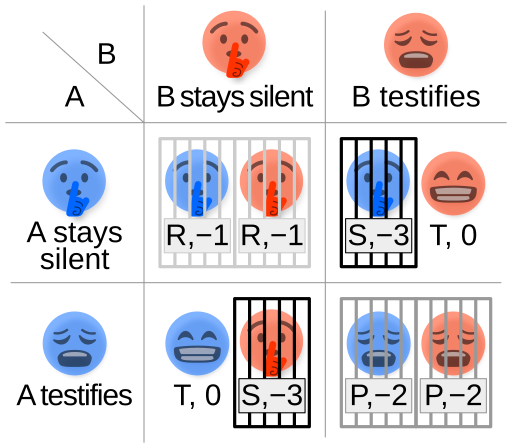
An example prisoner’s dilemma payoff matrix drawn by CMG Lee using emojis from Wikimedia Commons.
In 1980, game theorist Robert Axelrod ran a famous Iterated Prisoner’s Dilemma Tournament.
He asked other game theorists to send in their best strategies in the form of “bots”, short pieces of code that took an opponent’s actions as input and returned one of the classic Prisoner’s Dilemma outputs of COOPERATE or DEFECT. For example, you might have a bot that COOPERATES a random 80% of the time, but DEFECTS against another bot that plays DEFECT more than 20% of the time, except on the last round, where it always DEFECTS, or if its opponent plays DEFECT in response to COOPERATE.
In the “tournament”, each bot “encountered” other bots at random for a hundred rounds of Prisoners’ Dilemma; after all the bots had finished their matches, the strategy with the highest total utility won.
To everyone’s surprise, the winner was a super-simple strategy called TIT-FOR-TAT:
- Always COOPERATE on the first move.
- Then do whatever your opponent did last round.
This was so boring that Axelrod sponsored a second tournament specifically for strategies that could displace TIT-FOR-TAT. When the dust cleared, TIT-FOR-TAT still won — although some strategies could beat it in head-to-head matches, they did worst against each other, and when all the points were added up TIT-FOR-TAT remained on top.
In certain situations, this strategy is dominated by a slight variant, TIT-FOR-TAT-WITH-FORGIVENESS. That is, in situations where a bot can “make mistakes” (eg “my finger slipped”), two copies of TIT-FOR-TAT can get stuck in an eternal DEFECT-DEFECT equilibrium against each other; the forgiveness-enabled version will try cooperating again after a while to see if its opponent follows. Otherwise, it’s still state-of-the-art.
The tournament became famous because – well, you can see how you can sort of round it off to morality. In a wide world of people trying every sort of con, the winning strategy is to be nice to people who help you out and punish people who hurt you. But in some situations, it’s also worth forgiving someone who harmed you once to see if they’ve become a better person. I find the occasional claims to have successfully grounded morality in self-interest to be facile, but you can at least see where they’re coming from here. And pragmatically, this is good, common-sense advice.
For example, compare it to one of the losers in Axelrod’s tournament. COOPERATE-BOT always cooperates. A world full of COOPERATE-BOTS would be near-utopian. But add a single instance of its evil twin, DEFECT-BOT, and it folds immediately. A smart human player, too, will easily defeat COOPERATE-BOT: the human will start by testing its boundaries, find that it has none, and play DEFECT thereafter (whereas a human playing against TIT-FOR-TAT would soon learn not to mess with it). Again, all of this seems natural and common-sensical. Infinitely-trusting people, who will always be nice to everyone no matter what, are easily exploited by the first sociopath to come around. You don’t want to be a sociopath yourself, but prudence dictates being less-than-infinitely nice, and reserving your good nature for people who deserve it.
Reality is more complicated than a game theory tournament. In Iterated Prisoners’ Dilemma, everyone can either benefit you or harm you an equal amount. In the real world, we have edge cases like poor people, who haven’t done anything evil but may not be able to reciprocate your generosity. Does TIT-FOR-TAT help the poor? Stand up for the downtrodden? Care for the sick? Domain error; the question never comes up.
Still, even if you can’t solve every moral problem, it’s at least suggestive that, in those domains where the question comes up, you should be TIT-FOR-TAT and not COOPERATE-BOT.
This is why I’m so fascinated by the early Christians. They played the doomed COOPERATE-BOT strategy and took over the world.
RT20: Croatia’s Insane Kludged 20mm Anti-Materiel Rifle
Forgotten Weapons
Published Jul 31, 2024During its Homeland War, Croatia manufactured a wide variety of ad-hoc firearms including a number of anti-materiel rifles. The RT-20 was the largest of these, and its development began with the discovery of a stash of Yugoslav M55 anti-aircraft cannon barrels chambered for 20mm Hispano in a warehouse. These barrels were cut down, fitted with single-shot bolt actions, bipods, and bullpup stock assemblies and became the RT-20s. The most unusual element of the design is the use of gas vents about halfway down the barrel which open into a hollow tube which vents over the shooter’s shoulder. This creates a gas exhaust jet upon firing to help counteract recoil (and also reducing the muzzle velocity by about 25%). The recoil from firing is still pretty brutal, but the guns can be used — and were during the war for Croatia’s independence. A few remain in Croatian police inventory today …
A big thanks to the Croatian Police Museum (Muzej Policije) in Zagreb for giving me access to film this rare piece for you! Check them out at: https://muzej-policije.gov.hr
(more…)
QotD: Mao Zedong’s strategy of “protracted war” is a “strategy of the weak”
First, the party trying to win a protracted war accepts that they are unable to win a “war of quick decision” – because protracted war tends to be so destructive, if you have a decent shot at winning a war of quick decision, you take it. I do want to stress this – no power resorts to insurgency or protracted war by choice; they do it out of necessity. This is a strategy of the weak. Next, the goal of protracted war is to change the center of gravity of the conflict from a question of industrial and military might to a question of will – to make it about mobilizing people rather than industry or firepower. The longer the war can be protracted, the more opportunities will be provided to degrade enemy will and to reinforce friendly will (through propaganda, recruitment, etc.).
Those concerns produce the “phase” pattern where the war proceeds – ideally – in stages, precisely because the weaker party cannot try for a direct victory at the outset. In the first phase, it is assumes the stronger party will try to use their strength to force that war of quick decision (that they win). In response, the defender has to find ways to avoid the superior firepower of the stronger party, often by trading space for time or by using the supportive population as covering terrain or both. The goal of this phase is not to win but to stall out the attacker’s advance so that the war can be protracted; not losing counts as success early in a protracted war.
That success produces a period of strategic stalemate which enables the weaker party to continue to degrade the will of their enemy, all while building their own strength through recruitment and through equipment supplied by outside powers (which often requires a political effort directed at securing that outside support). Finally, once enemy will is sufficiently degraded and their foreign partners have been made to withdraw (through that same erosion of will), the originally weaker side can shift to conventional “positional” warfare, achieving its aims.
This is the basic pattern that ties together different sorts of protracted war: protraction, the focus on will, the consequent importance of the political effort alongside the military effort, and the succession of phases.
(For those who want more detail on this and also more of a sense of how protracted war, insurgency and terrorism interrelate as strategies of the weak, when I cover this topic in the military history survey, the textbook I use is W. Lee, Waging War: Conflict, Culture and Innovation in World History (2016). Chapter 14 covers these approaches and the responses to them and includes a more expensive bibliography of further reading. Mao’s On Protracted War can be found translated online. Many of Giáp’s writings on military theory are translated and gathered together in R. Stetler (ed.), The Military Art of People’s War: Selected Writings of General Vo Nguyen Giáp (1970).)
Bret Devereaux, “Collections: How the Weak Can Win – A Primer on Protracted War”, A Collection of Unmitigated Pedantry, 2022-03-03.
November 15, 2024
“OK, you’re here to accuse me of causing offence but I’m not allowed to know what it is. Nor can I be told whom I’m being accused by? How am I supposed to defend myself, then?”
At the current rate, future generations will have to be persuaded that Franz Kafka wasn’t actually and Englishman:

Franz Kafka’s The Trial opens with the novel’s protagonist, Josef K., being arrested early in the morning by two officers of the law. When he asks them to explain their reasons, one of the men tells him: “That’s something we’re not allowed to tell you. Go into your room and wait there. Proceedings are underway and you’ll learn about everything all in good time.” He never finds out, of course. Even after the story’s abrupt and chilling end, the reader is none the wiser as to why any of this has occurred.
And so it is hardly surprising that Telegraph columnist Allison Pearson described it as “Kafkaesque” that she was visited by two police officers on the morning of Remembrance Sunday. She was informed that she had been accused of “stirring up racial hatred” by means of an unspecified social media post from a year ago. Anyone who is familiar with Allison’s writing will understand just how improbable this is. Her account of the discussion that followed could have been lifted directly from The Trial itself:
“What did this post I wrote that offended someone say?” I asked. The constable said he wasn’t allowed to tell me that.
“So what’s the name of the person who made the complaint against me?”
He wasn’t allowed to tell me that either, he said.
“You can’t give me my accuser’s name?”
“It’s not ‘the accuser’,” the PC said, looking down at his notes. “They’re called ‘the victim’.”
Ah, right. “OK, you’re here to accuse me of causing offence but I’m not allowed to know what it is. Nor can I be told whom I’m being accused by? How am I supposed to defend myself, then?”
The term “Kafkaesque”, like “Orwellian”, has become something of a cliché, precisely the kind of writing that Orwell continually urged us to avoid. But what else are we to call it? I am reminded of Christopher Hitchens’s account of his visit to Prague in 1988 to report on the Communist regime. He had decided in advance that he would be “the first visiting writer not to make use of the name Franz Kafka”. As it transpired, this resolution was impossible to fulfil. During one of Václav Havel’s “Charter 77” committee meetings, police burst into the building, threw Hitchens against a wall, and arrested him. When he asked for the details of the charge, he was told that he “had no need to know the reason”. How else could he describe this other than “Kafkaesque”? As he was later to say at a lecture at the University of Western Ontario: “They make you do it”.
This is all very well for the Státní bezpečnost, but I’m not sure even Hitchens could have imagined that such behaviour would become routine in the United Kingdom in the twenty-first century. I have written previously on my Substack about the phenomenon of “non-crime hate incidents” (NCHIs), but it’s worth repeating here the key points. Estimates suggest that the police in England and Wales have recorded over a quarter of a million NCHIs since the practice began in 2014. Those who are so branded are often not informed, and these can show up on DBS (Disclosure and Barring Service) checks, thereby impeding their employment prospects. According to the Times, three thousand people are arrested each year in the UK for offensive comments posted online, even in cases where a joke had clearly been intended. This is because Section 127 of the Communications Act 2003 criminalises online speech that can be deemed “grossly offensive”. Whatever that means.
The Final Solution to the German Question
World War Two
Published 14 Nov 2024Millions of Germans continue to be expelled from their homes in Central and Eastern Europe. They run a gauntlet of violence, robbery, and even murder before arriving in the shattered remains of Berlin. By the end of 1945, the Allied Powers have at least agreed that further expulsions must be “orderly and humane”. But isn’t that a contradiction in terms?
(more…)
Lysistrata updated for 2024
Tom Knighton recognizes the right of progressive women to take whatever actions they feel are appropriate to show their dissatisfaction with the election of Donald Trump, but suggests that the Lysistrata strategy may not be the answer for them:
From the moment Donald Trump was declared the victor in the 2024 presidential election, some started trying to figure out not how they could convince people to vote differently in the midterms but to try and punish people who disagreed.
There’s a reason people are cutting off family members right before the holidays, among other things.
But one of the more…interesting things is that it seems progressive women are going on a sex strike.
In response to Donald Trump’s election victory, some women in the US are joining a radical feminist movement that seeks to “decentralize” men in their lives. The movement, called 4B, originated in South Korea about a decade ago in response to broader dissatisfaction with gender discrimination and sexual violence online. Now thousands of Americans are tuning in to the movement on social media as Trump — who appointed the Supreme Court justices who helped overturn national abortion rights, and has been found liable for sexual abuse—prepares to return to office. While the movement has yet to show signs of gaining traction offline, its resurgence reflects a growing sense of frustration among women who fear that Trump’s second term will be characterized by unchecked misogyny and the continued rollback of bodily autonomy in the US.
…
Now the 4B movement appears to be booming on social media in the US: at time of writing, there were over a hundred thousand videos about the movement on TikTok; Google registered a massive surge in the search for “4B” starting on Election Day. “I’ve been waiting for everyone to catch up to speed for a while,” Alexa Vargas, a 4B adherent, said in a TikTok video posted last week. In a less restrictive interpretation of the movement’s tenets, Vargas encouraged women not to engage in “hookup culture” and to wait at least three months before considering having sex with new romantic partners. “Decenter men from your life,” she advised. “Get off the dating apps.” Another TikTok user said that she’d been keeping her participation in the movement private but decided to speak about her experiences publicly after the election: “As somebody who’s been 4B for two years now … at thirty-six years old, it is the best thing I’ve ever done for my mental health,” she said. “We are not alone in this.”
It’s too early to tell whether the movement will have much staying power, but it has already sparked a debate, both online and in more traditional media. Sex strikes are about as old as male-dominated societies: the practice has been an anti-war measure for centuries — it was central to the plot of the Ancient Greek comedy Lysistrata, in which women on both sides of the Peloponnesian War denied their husbands sex as a way of forcing peace talks — and more recently has returned to the discourse in the US following the introduction of a strict anti-abortion measure in Georgia and the repeal of Roe v. Wade. (Lysistrata was also adapted, in late 2015, into Spike Lee’s Chi-Raq.) Such movements “rarely result in widespread support,” Helen Morales, a cultural critic and classicist, told The Guardian in 2022, but they can be a powerful tool for building awareness. “Women tend to protest with their bodies when they don’t have a voice,” Morales added.
Of course, women do have a voice. They can speak freely and petition the government for the redress of grievances. They have full access to every mechanism of free speech men have.
A voice, they don’t lack.
But that said, they’re free to go this route if they want. However, when it doesn’t actually do anything, I’m going to laugh.
First, as was noted above, these kinds of things don’t really go anywhere. Why? Women like sex too. Especially since feminists have said for decades that women being able to be sexual beings is an act of empowerment, only now they seem to want women to turn that off in order to drive a political movement that will do … what?
Convince men that everything they believed was wrong because they want to actually have a relationship with a woman?
I hate to break it to you ladies, but most single men on the right are looking at this right now and thinking, “Thank you, God”.
Three Ways to Cut a Housing Dado | Paul Sellers
Paul Sellers
Published Jul 5, 2024At least half of my woodworking life has been dedicated to demystifying the art of hand tool woodworking, and this video proves the truth of it.
The simplicity is this though; with just a handful of hand tools, I create three housing dadoes in 4″ wide hard maple, and the watch strapped to my wrist tells it all. I hope you enjoy seeing this video as much as we had making it.
We wanted to show you exactly how hand tools are still current technology at its best, and it’s available for everyone, including your kids!
——————–
(more…)
QotD: Battles are over-rated
Start with theory. States fight to impose their will on another state in pursuit of some political goal. To do that requires that they achieve sufficient local military superiority that the other state can’t stop them from achieving their political goal.
Nazi Germany wanted to be the new administrators of the agricultural area of the western Soviet Union. To do that, they had to evict the Soviet military, whether through direct destruction or forcing the Soviet government to withdraw their armed forces. Individual battles for control of a localized area only matter if they are a means to that end.
Does the occupation or non-occupation of that point on the map affect the ability of a combatant to keep fighting?
In some limited cases, yes. Battlefield victory enabled Germany to overrun France before France could really focus its productive effort on the war. After their surrender, the French could not produce weapons, and they functionally could not organize their manpower to fight the Germans. But if the German army conquered, say, a random city in the Soviet Union, like Stalingrad, Soviet production and manpower was barely affected. The war goes on.
In theory, the German army could destroy so much of the Soviet military in one battle (or even a few discrete battles) that the Soviets run out of men or weapons. If there was ever a time this could have happened, it would have been the German invasion of the Soviet Union in 1941, when the Germans basically won a series of crushing victories.
The problem for the Germans was that by World War II, people in the combatant countries were good at building stuff in vast quantities, and the major combatants of World War II generally had access to sufficient natural resources. Even massive armies could not destroy produced weapons systems (e.g., tanks, airplanes) on the battlefield fast enough to remove the other side’s ability to continue fighting. What could (and did) happen was the destruction of the other side’s ability to produce and distribute weapons.
Sure enough, if you look at the actual data from even the largest battles, neither side really destroys a hugely significant amount of stuff. Take the Battle of Kursk — the largest tank and air battle of World War II. Wikipedia will dazzle you with the numbers of soldiers involved (millions), tanks deployed (in the ballpark of 10,000), and aircraft in the sky (in the ballpark of 5,000).
In this entire vast battle that supposedly dictated the outcome of the Eastern Front, the Germans lost approximately 350 armored fighting vehicles (AFVs) during the most intense 10 days of fighting. In the two months around when the battle took place, the Germans lost 1,331 AFVs on the entire Eastern Front. In the year of the battle, 1943, the Germans built more than 12,000 AFVs. Also worth noting: they disproportionately lost older, obsolete tanks at Kursk, and built new, capable tanks. The Germans lost a very manageable amount of equipment at Kursk — less than a month’s worth of AFV production.
If modern war means you cannot realistically destroy enough weapons in one battle to matter — if the largest battle of all time didn’t really matter — what did?
Anonymous, “Your Book Review: How the War Was Won“, Astral Codex Ten, 2024-08-09.
November 14, 2024
Germans are perfectly free to post anything to the internet as long as it doesn’t criticize politicians
Once again, eugyppius helpfully illustrates the broad range of freedoms German citizens enjoy in their online activities and the totally reasonable and not-at-all-insane restrictions to those rights:



It’s been a while since I last wrote about the highly advanced democratic freedoms that we enjoy in Germany. Here in the Federal Republic, the police will never fine you or harass you or raid your house for criticising the government – except, of course, when they do all of these things, because you happened not even to tweet, but merely to retweet, the wrong image.
Stefan Niehoff is a 64 year-old retiree who lives in the small town of Burgpreppach in Lower Franconia. He runs an X account with 1,200 followers, where he occasionally expresses his dissatisfaction with the present state of German politics and with the Greens in particular.
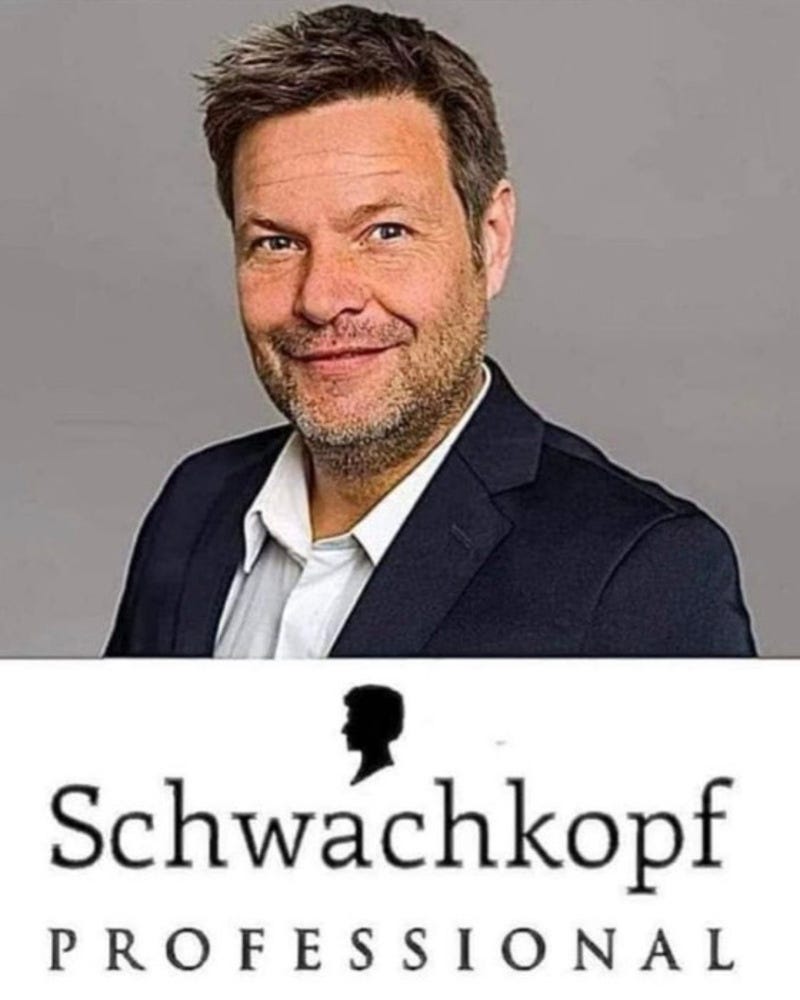
In June 2024, he retweeted this image …
… which appropriates the logo of a popular cosmetic brand to suggest that Robert Habeck, our Green Minister of Economic Affairs, might be a “professional moron”.
Habeck and his associates are notorious for pursuing internet users who share highly illegal content of this nature. They brought Niehoff’s retweet to the attention of authorities, and the Bamberg public prosecutor’s office decided that Niehoff was indeed guilty of a criminal speech offence. The Bamberg District Court then issued an order permitting the police to search Niehoff’s residence and confiscate his electronic devices.
In this order, reproduced by NiUS, the judges explained their rationale as follows:
On the basis of the investigations to date – in particular the screenshots of the posts and the investigations into the user of the X-account “IchbinFeinet” – there exists the following suspicion of a criminal offence:
The accused is the user of the account “IchbinFeinet” on the internet platform X with approx. 901 followers.
At a time that cannot now be determined more precisely, in the days or weeks before 20 June 2024, the accused published an image file using his account that showed a portrait of the Federal Minister of Economic Affairs with the words “professional moron” … in order to defame Robert Habeck in general and to make his work as a member of the federal government more difficult.
The public prosecutor’s office affirms the public interest in criminal prosecution.
This is punishable as defamation directed against persons of political life in accordance with §§ 185, 188 para. 1, 194 StGB. …
The measures ordered are proportionate to the severity of the offence and the strength of the suspicion and are necessary for the investigation …
Armed with this document, Schweinfurt police showed up at Niehoff’s house at 6:14am yesterday morning and took his tablet. Police later told the press that the raid was one in a series of enforcement actions – part of something called “an action day against cybercrime”. By harassing a lot of cybercriminals all at once, police and prosecutors hope to send a message to the people of Germany that they cannot just retweet anything, and that they may only retweet the right things.
Trump’s position and likely options on Ukraine
In his weekly commentary, Niccolo Soldo considers what the incoming Trump administration might do about the war in Ukraine:
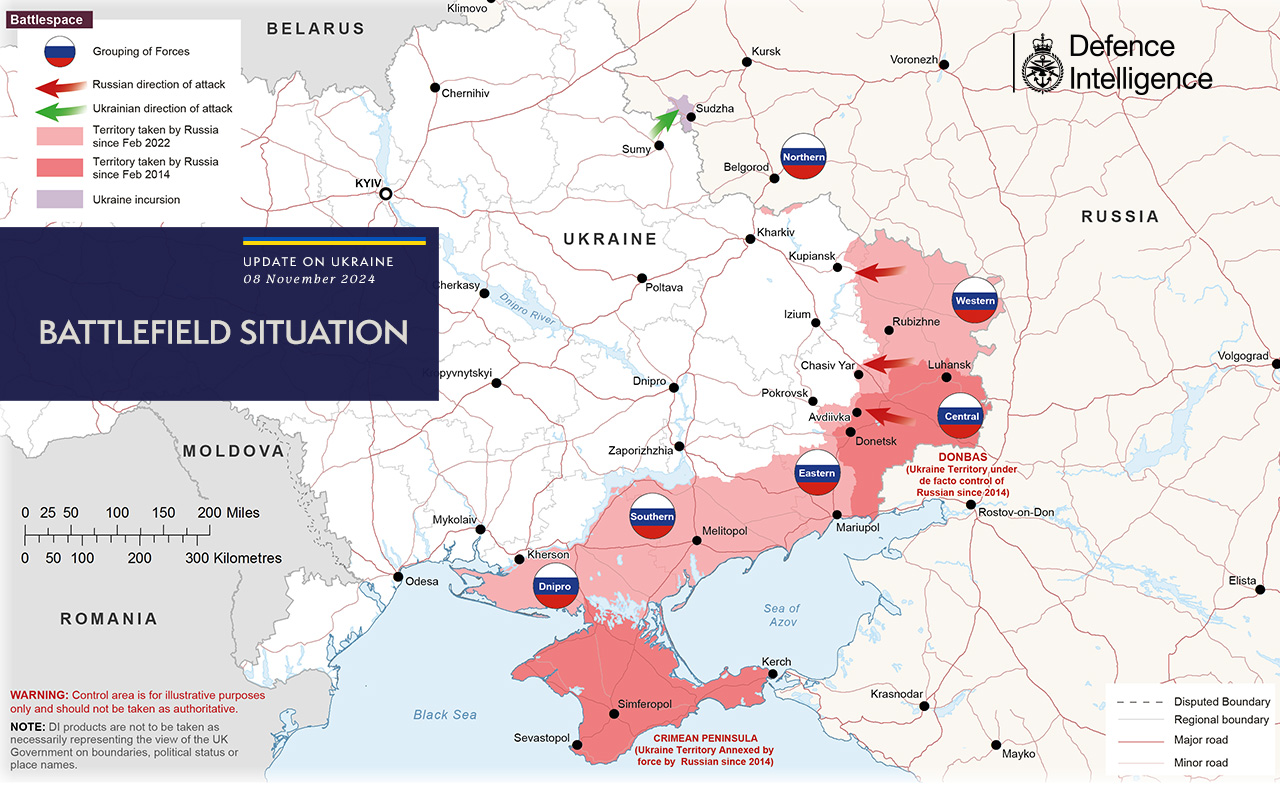
The situation in Ukraine as of 8 November, 2024.
Map from the UK Ministry of Defence via X.
… Ukraine is losing the war, and is losing it at a faster pace than before. Time is not on Kiev’s side, and there is no magic wand that anyone can wave to turn the tide in its favour. The question is: how much is Kiev willing to give up in order to save as much as it can?
The foreign policy blob is on tenterhooks, waiting to see what Trump will do regarding this conflict:
Like in Trump’s first term, different factions are set to compete to influence the Republican’s foreign policy. More traditionally minded allies such as Mike Pompeo, the former secretary of state now in contention to lead the Pentagon, are likely to push for a settlement that doesn’t appear to give a major win to Moscow. Other advisers, particularly Richard Grenell, a top candidate to lead the State Department or serve as national-security adviser, could give priority to Trump’s desire to end the war as soon as possible, even if it means forcing Kyiv into significant concessions.
Pompeo is out, but that doesn’t mean that those like him are entirely out either, as he has DoD officials sharing his views. No doubt that there are certain elements in the State Department, CIA, and in Congress as well who take the same position.
The proposals all break from Biden’s approach of letting Kyiv dictate when peace talks should begin. Instead, they uniformly recommend freezing the war in place — cementing Russia’s seizure of roughly 20% of Ukraine — and forcing Ukraine to temporarily suspend its quest to join the North Atlantic Treaty Organization.
One idea proposed inside Trump’s transition office, detailed by three people close to the president-elect and not previously reported, would involve Kyiv promising not to join NATO for at least 20 years. In exchange, the U.S. would continue to pump Ukraine full of weapons to deter a future Russian attack.
Under that plan, the front line would essentially lock in place and both sides would agree to an 800-mile demilitarized zone. Who would police that territory remains unclear, but one adviser said the peacekeeping force wouldn’t involve American troops, nor come from a U.S.-funded international body, such as the United Nations.
“We can do training and other support but the barrel of the gun is going to be European,” a member of Trump’s team said. “We are not sending American men and women to uphold peace in Ukraine. And we are not paying for it. Get the Poles, Germans, British and French to do it.”
“Pumping” Ukraine full of weapons would be attractive to Trump, as it means steady cash flow. He is a businessman after all.
The last bit is the most important, as it conforms to US policy trends in which the dumpster fire that they started is left to the Europeans to extinguish while the Americans go deal with the Chinese.
That proposal in some respects echoes comments made by Vice President-elect JD Vance during a September interview, when he suggested a final agreement between Ukraine and Russia could involve a demilitarized zone “heavily fortified so the Russians don’t invade again.” Russia, Vance continued, would get to keep the land it has taken and be assured of Ukraine’s neutrality.
“It doesn’t join NATO, it doesn’t join some of these sort of allied institutions,” he said on “The Shawn Ryan Show,” a podcast.
“No NATO, no stealth NATO”, is music to Moscow’s ears. The problem here is that the Russians do not trust the Americans to keep up their end of any deal. Russian Foreign Minister Lavrov has famously described the Americans as “agreement non-capable”.
Also, why would the Russians even agree to negotiate at this point?
For one, Ukraine and Russia still have vastly differing war aims and little desire to alter them. With Russian troops advancing slowly but steadily in Ukraine, the Kremlin has shown little inclination to negotiate, and has shown its willingness to escalate the conflict with hybrid attacks outside its borders, such as sabotage operations in Europe.
“The objectives of the special military operation remain unchanged and will be achieved,” Dmitry Medvedev, a top Russian official, posted Wednesday to X after learning of Trump’s victory over Vice President Kamala Harris, the Democratic presidential nominee.
Zelensky is over a barrel:
Zelensky, whose country is heavily dependent on the U.S. for military and financial assistance, could — more easily than Putin — be forced by Trump to negotiate, but the Ukrainian leader would have to contend with a public that views ceding territory as capitulation to Moscow.
Trump has said that Ukraine’s survival is important to the U.S., but has repeatedly criticized Zelensky, calling him the “greatest salesman”, a stance that has worried some officials in Kyiv that a Trump-led U.S. might push for a settlement that favors Russia.
Zelensky on Wednesday congratulated the president-elect on his victory, appealing to their September meeting in New York and praising his “‘peace through strength’ approach in global affairs”.
Forcing Zelensky to concede land would open up the possibility of a coup d’etat in Kiev, and even civil war. Even if a deal were hammered out, Zelensky would be forced to try to sell it at home. There are may factions in Ukraine that have no desire to budge even one inch, and would happily take his head off of the rest of his body to make sure that no one signs away any Ukrainian land.
Early Christianity – from ~1,000 to 40 million believers in the Roman Empire
The latest book review at Astral Codex Ten is Rodney Stark’s The Rise of Christianity:
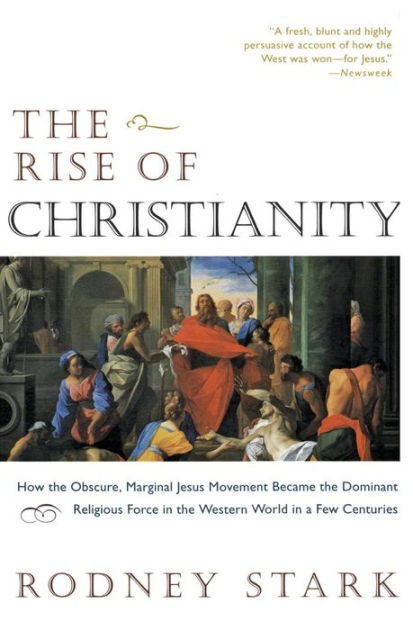
The rise of Christianity is a great puzzle. In 40 AD, there were maybe a thousand Christians. Their Messiah had just been executed, and they were on the wrong side of an intercontinental empire that had crushed all previous foes. By 400, there were forty million, and they were set to dominate the next millennium of Western history.
Imagine taking a time machine to the year 2300 AD, and everyone is Scientologist. The United States is >99% Scientologist. So is Latin America and most of Europe. The Middle East follows some heretical pseudo-Scientology that thinks L Ron Hubbard was a great prophet, but maybe not the greatest prophet.
This can only begin to capture how surprised the early Imperial Romans would be to learn of the triumph of Christianity. At least Scientology has a lot of money and a cut-throat recruitment arm! At least they fight back when you persecute them! At least they seem to be in the game!
Rodney Stark was a sociologist of religion. He started off studying cults, and got his big break when the first missionaries of the Unification Church (“Moonies”) in the US let him tag along and observe their activities. After a long and successful career in academia, he turned his attention to the greatest cult of all and wrote The Rise Of Christianity. He spends much of it apologizing for not being a classical historian, but it’s fine — he’s obviously done his homework, and he hopes to bring a new, modern-religion-informed perspective to the ancient question.
So: how did early Christianity win?
Following the Longest Roman Aqueduct
Scenic Routes to the Past
Published Jul 19, 2024Tunisia’s Zaghouan Aqueduct, built to serve Carthage in the second century, is among the longest and most impressive of all Roman aqueducts. This video follows the aqueduct from the monumental fountain at its source to the grandiose baths at its terminus.
Historic tours with toldinstone: https://toldinstone.com/trips/
Check out my other channels, @toldinstone and @toldinstonefootnotes
QotD: The tragedy of the commons in North London
One fact about those bathing ponds on the Heath:
Honesty boxes for bathers to pay to swim were introduced in 2005. There were plans for a compulsory charge in 2012, but they came to nothing.
We have open access to a resource, Marxian access. We also have one other fact:
It was once a well-kept secret. Now the bathing ponds on Hampstead Heath are among the most crowded parts of London on a hot summer’s day.
We have – by one measure at least – excessive use of that resource, use that needs to be limited in some manner.
This is a problem that has been noted before, it’s called the Tragedy of the Commons. As Garrett Hardin points out there are only two ways of restricting such access, capitalist – charge for it – or socialist – regulate.
The third option, Elinor Ostrom’s, does not work with this number of people. That communal agreement tops out at about 3,000 peeps, not 10 million.
Which of the two solutions works depends upon the specific circumstance and isn’t the point to be made here. Rather, the lesson to learn is that Marxian access just doesn’t work when demand is at or above capacity. A useful thing to think about when contemplating other areas of the economy.
Tim Worstall, “Hampstead Heath Ponds And The Tragedy Of The Commons”, Continental Telegraph, 2020-01-19.


