
The Tank Museum
Published 3 Dec 2021Tune in to our weekly YouTube content today with David Fletcher as he details the AEC Armoured Car!
00:00 – Intro
00:25 – History of the AEC
04:46 – Key Features
(more…)
March 22, 2022
Tank Chats #141 | AEC Armoured Car | The Tank Museum
Comments Off on Tank Chats #141 | AEC Armoured Car | The Tank Museum
March 21, 2022
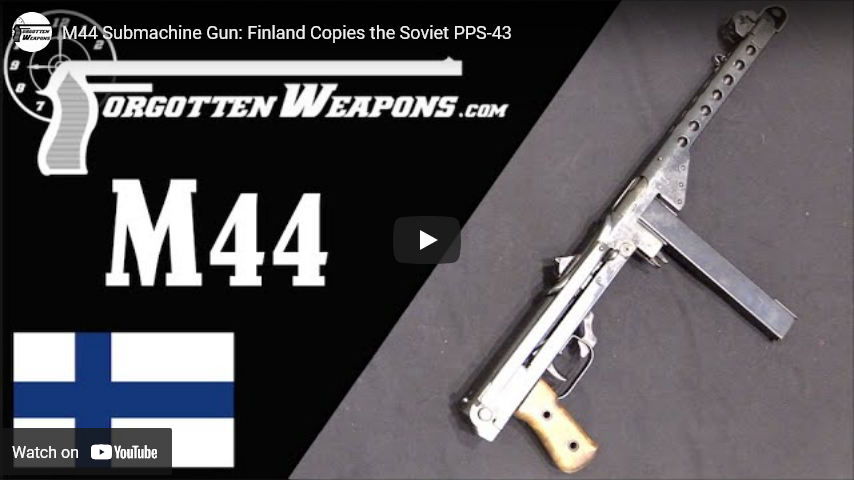
M44 Submachine Gun: Finland Copies the Soviet PPS-43
Forgotten Weapons
Published 17 Nov 2021http://www.patreon.com/ForgottenWeapons
https://www.floatplane.com/channel/Fo…
Cool Forgotten Weapons merch! http://shop.forgottenweapons.com
The kp/31 Suomi submachine gun in Finnish service was an outstanding weapon, but it was slow and expensive to manufacture. When Finnish forces began capturing Soviet PPS-42 and PPS-43 submachine guns from the Soviets in the Continuation War, it was very quickly decided that Finland should copy the design. This was a far simpler, far cheaper stamped sheet-metal design that was not as refined as the Suomi, but much more efficient to make.
The Sudayev design was changed only minimally; primarily to fit the Finnish cartridge (9x19mm Parabellum) and magazines. The guns were originally designed to use the 50-round quad-stack boxes and 71/72 round drums of the Suomi, but also used the Swedish Carl Gustaf m/45 magazine that was adopted by Finland after WW2.
Two companies were approached to produce the M44; Tikkakoski and Ammus Oy. Ammus was unable to source raw materials for the project, and only Tikka put the guns into production. Marshal Mannerheim initially wanted 50,000, but the order was reduced to 20,000 — of which only 10,000 were actually made, due to limited material availability before the end of the war led to production ending. Another 400 were assembled from remaining parts after the war.
In the 1950s, a plan was begun to resume M44 production in order to completely replace the Suomi in Finnish inventory. However, this plan was interrupted when Sam Cummings of InterArms made a deal to trade Finland about 75,000 surplus Sten guns for Finland’s supply of 7.35mm Carcano rifle (received as aid from Italy during the war) along with a melange of old machine guns. This was a sufficient quantity of Stens to handle the duties of the Suomi, and so the Sten went into Finnish service and M44 production was never resumed.
Those Carcano rifles were in turn imported into the United States, and this is why the majority of 7.35mm Carcano here bear Finnish “SA” property stamps. The same is true for the significant number of Chauchat automatic rifles in the US with Finnish property marks, which were also part of the deal.
Contact:
Forgotten Weapons
6281 N. Oracle 36270
Tucson, AZ 85740
Comments Off on M44 Submachine Gun: Finland Copies the Soviet PPS-43
March 20, 2022
Kharkov Falls Once Again – WW2 – 186 – March 19, 1943
World War Two
Published 19 Mar 2022The British are attacking the Mareth Line in North Africa while the Americans hit the Axis flank, but the Allies are withdrawing in Burma. It’s the Germans who are pulling back in the USSR, though, and there is another attempt from within German command to assassinate Adolf Hitler.
(more…)
Comments Off on Kharkov Falls Once Again – WW2 – 186 – March 19, 1943
Canada Carries On — The Fighting Sea Fleas (1944)
PeriscopeFilm
Published 24 Dec 2012Support Our Channel: https://www.patreon.com/PeriscopeFilm
World War 2 propaganda film narrated by Lorne Greene about Canadian Motor Torpedo Boats crews and their actions. Shows life aboard Motor Torpedo Boats during the Battle of the Atlantic, fending off attacks by German U-Boats and commerce raiders. Motor Torpedo Boat (MTB) was the name given to fast torpedo boats by the Royal Navy and the Royal Canadian Navy. The “Motor” in the formal designation, referring to the use of petrol engines, was to distinguish them from the majority of other naval craft that used steam turbines or reciprocating engines. Produced & Directed by Sydney Newman, and released in 1944.
This film is part of the Periscope Film LLC archive, one of the largest historic military, transportation, and aviation stock footage collections in the USA. Entirely film backed, this material is available for licensing in 24p HD. For more information visit http://www.PeriscopeFilm.com
Comments Off on Canada Carries On — The Fighting Sea Fleas (1944)
March 18, 2022
Schindler’s First Rescue Mission – WAH 054 – March 1943, Pt. 1
World War Two
Published 17 Mar 2022In the weeks after Goebbels’ Sportpalast speech, we realize that Total War might mean an apocalyptic end for Germany, with Hitler’s blessing. No wonder that some Germans are looking to end Hitler before he ends them, and what a blessing that at least one Nazi with influence on the fate of thousands of Jews turns out to have a heart and soul.
(more…)
Comments Off on Schindler’s First Rescue Mission – WAH 054 – March 1943, Pt. 1
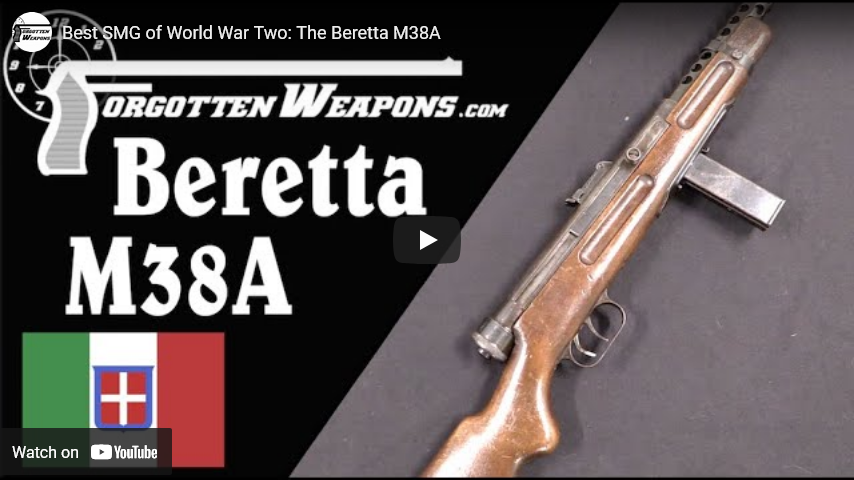
Best SMG of World War Two: The Beretta M38A
Forgotten Weapons
Published 15 Nov 2021http://www.patreon.com/ForgottenWeapons
https://www.floatplane.com/channel/Fo…
Cool Forgotten Weapons merch! http://shop.forgottenweapons.com
The Beretta Model 38A was one of the very best submachine guns of World War Two. Designed by veteran Beretta engineer Tullio Marengoni (who designed most of Beretta’s pistols as well as the Beretta M1918 SMG and 1918/30 carbine), it was the first Italian weapon to use a cartridge equivalent to 9x19mm Parabellum instead of 9mm Glisenti. Development began in 1935, and the final version entered production in January 1938.
The change from the Model 38 to 38A is unclear, but seem most likely to be the change from the top ejection of the prototypes to the left-side ejection of the production model. The 38A was formally adopted by the Italian Army in July 1938, but issue was delayed until 1940/41 because Beretta first produced a 20,000-unit order for the Romanian military.
By 1941, the basic design had been significantly simplified, and the Model 38/42 would significantly reduce production cost by removing the magazine well cover, barrel shroud, and removable firing pin. Simplified 38/42, 38/43, and 38/44 models would enter production, but original 38As were also manufactured until 1944 (this particular example is dated 1943). The gun was very popular with both Italian and German troops, and production continued under German occupation late in the war. Total numbers are unavailable, but are probably in excess of 500,000. The gun was so popular that Beretta was able to restart production after the war and continue selling them until the early 1960s.
Contact:
Forgotten Weapons
6281 N. Oracle 36270
Tucson, AZ 85740
Comments Off on Best SMG of World War Two: The Beretta M38A
March 13, 2022
Rommel Leaves Africa – WW2 – 185 – March 12, 1943
World War Two
Published 12 Mar 2022Erwin Rommel loses his command and leaves Tunisia, while change in American command there puts George Patton in charge. On the ground the Axis lose the Battle of Medenine, but in the Soviet Union, Axis forces are on the move and heading for Kharkov.
(more…)
Comments Off on Rommel Leaves Africa – WW2 – 185 – March 12, 1943
March 11, 2022
A Life Between Shells and Shelter – On the Homefront 015
World War Two
Published 10 Mar 2022Right from the start of World War Two, there has been little distinction between combatant and civilian. While bombs keep falling, people in Great Britain and in Germany are sitting in bunkers, basements and underground tunnels. We are taking a look at life inside those shelters.
(more…)
Comments Off on A Life Between Shells and Shelter – On the Homefront 015
Anti-Tank Chats #3 | Boys Anti Tank Rifle | The Tank Museum
The Tank Museum
Published 26 Nov 2021Our Patreons have already enjoyed Early Access and AD free viewing of our weekly YouTube video! Consider becoming a Patreon Supporter today: https://www.patreon.com/tankmuseum
Join Archive and Supporting Collections Manager Stuart Wheeler with his next instalment of Anti-Tank Chats on the “Boys Anti-tank Rifle”. It was a British anti-tank rifle in use during the Second World War.
0:00 – Intro
0:23 – Creation of the Boys Anti-Tank Rifle
4:43 – Features of the Rifle
(more…)
Comments Off on Anti-Tank Chats #3 | Boys Anti Tank Rifle | The Tank Museum
QotD: In 1939, Stalin never imagined Finland would refuse his demands
The one thing Stalin had not reckoned on was that any of these neighbors might object. Certainly he did not expect resistance from the Baltic states. As early as September 24th, 1939, three days before Warsaw surrendered to Germany, Soviet Foreign Minister Vyacheslav Molotov had advised the Estonian foreign minister, Karl Selter, to “yield to the wishes of the Soviet Union in order to avoid something worse.” Latvia was next in line. When Lithuania’s foreign minister, Juozas Urbšys, objected that Soviet occupation would “reduce Lithuania to a vassal state,” Stalin replied brutally, “You talk too much.”
[…]
When Molotov summoned a Finnish delegation to the Kremlin on October 12th, 1939, Stalin made a personal appearance to heighten the intimidation factor, and he handed the Finns a brutal ultimatum demanding, among other things, “that the frontier between Russia and Finland in the Karelian Isthmus region be moved westward to a point only 20 miles east of Viipuri, and that all existing fortifications on the Karelian Isthmus be destroyed.” Stalin made it clear that this was the price that Finland had to pay to avoid the fate of Poland.
Aggressive and insulting as the Soviet demands on Finland were, Stalin and Molotov fully expected them to be accepted. As the Ukrainian party boss and future general secretary Nikita Khrushchev later recalled, the mood in the Politburo at the time was that “all we had to do was raise our voice a little bit and the Finns would obey. If that didn’t work, we could fire one shot and the Finns would put up their hands and surrender.” Stalin ruled, after all, a heavily armed empire of more than 170 million that had been in a state of near-constant mobilization since early September. The Red Army had already deployed 21,000 modern tanks, while the tiny Finnish Army did not possess an anti-tank gun. The Finnish Air Force had maybe a dozen fighter planes, facing a Red Air armada of 15,000, with 10,362 brand-new warplanes built in 1939 alone. Finnish Army reserves still mostly drilled with wooden rifles dating to the 19th century. By contrast, the Red Army was, in late 1939, the largest in the world, the most mechanized, the most heavily armored, and the most lavishly armed, even if surely not — because of Stalin’s purges — the best led.
One can imagine, therefore, Stalin’s shock when the Finns said no. Stunned by this unexpected resistance, Stalin and Molotov did not, at first, know quite what to do. With his highly placed spies in London, Stalin must have known that the mood in foreign capitals was becoming agitated by Soviet moves in the Baltic region. On October 31st, 1939, the British war cabinet took up the question of “Soviet Aggression Against Finland or Other Scandinavian Countries”. And earlier in the month, FDR had written to Moscow, demanding clarification of the Soviet posture on Finland. At this point, the Finnish cause seemed to have the potential to transform the so-far desultory and hypocritical British-French resistance to Hitler alone into a principled war against armed aggression by both totalitarian regimes.
On November 3rd, after yet another encounter in the Kremlin had gone sour with the Finns, Molotov warned the delegates that “we civilians can’t seem to do any more. Now it seems to be up to the soldiers. Now it is their turn to speak.” However, the truth was that, in November 1939, neither side was ready to wage war. Having expected the Finns to come around, Stalin had issued no orders to begin invasion preparations until after talks had finally broken down.
Sean McMeekin, “Stopped Cold: Remembering Russia’s Catastrophic 1939 Campaign Against Finland”, Quillette, 2021-04-20.
Comments Off on QotD: In 1939, Stalin never imagined Finland would refuse his demands
March 10, 2022
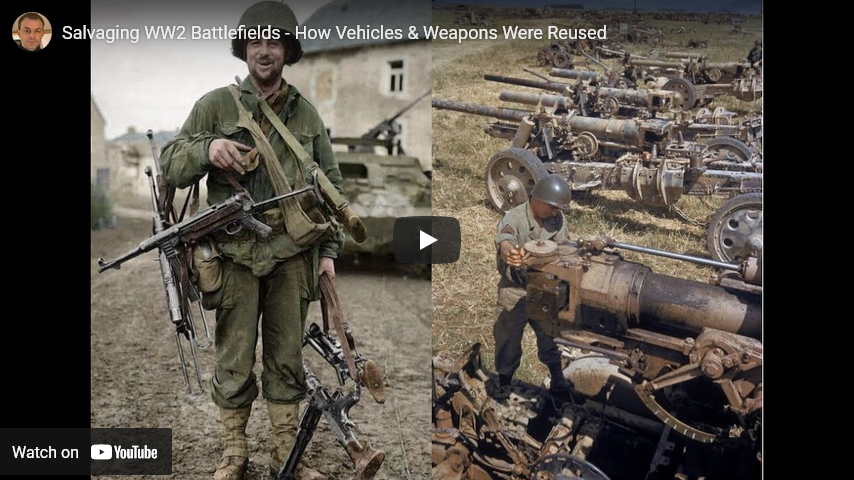
Salvaging WW2 Battlefields – How Vehicles & Weapons Were Reused
Mark Felton Productions
Published 25 Nov 2021After the wounded and dead had been removed from a battlefield, what happened to all the military vehicles and weapons left lying around? Find out here.
Dr. Mark Felton is a well-known British historian, the author of 22 non-fiction books, including bestsellers Zero Night and Castle of the Eagles, both currently being developed into movies in Hollywood. In addition to writing, Mark also appears regularly in television documentaries around the world, including on The History Channel, Netflix, National Geographic, Quest, American Heroes Channel and RMC Decouverte. His books have formed the background to several TV and radio documentaries. More information about Mark can be found at: https://en.wikipedia.org/wiki/Mark_Fe…
Help support my channel:
https://www.paypal.me/markfeltonprodu…
https://www.patreon.com/markfeltonpro…Disclaimer: All opinions and comments expressed in the ‘Comments’ section do not reflect the opinions of Mark Felton Productions. All opinions and comments should contribute to the dialogue. Mark Felton Productions does not condone written attacks, insults, racism, sexism, extremism, violence or otherwise questionable comments or material in the ‘Comments’ section, and reserves the right to delete any comment violating this rule or to block any poster from the channel.
Credits: US National Archives; Library of Congress
Thumbnail colorisation (left image) by Paul Reynolds
Comments Off on Salvaging WW2 Battlefields – How Vehicles & Weapons Were Reused
QotD: Orwell on Capitalism, Socialism, and Fascism
However, it has become clear in the last few years that “common ownership of the means of production” is not in itself a sufficient definition of Socialism. One must also add the following: approximate equality of incomes (it need be no more than approximate), political democracy, and abolition of all hereditary privilege, especially in education. These are simply the necessary safeguards against the reappearance of a class-system. Centralized ownership has very little meaning unless the mass of the people are living roughly upon an equal level, and have some kind of control over the government. “The State” may come to mean no more than a self-elected political party, and oligarchy and privilege can return, based on power rather than on money.
But what then is Fascism?
Fascism, at any rate the German version, is a form of capitalism that borrows from Socialism just such features as will make it efficient for war purposes. Internally, Germany has a good deal in common with a Socialist state. Ownership has never been abolished, there are still capitalists and workers, and – this is the important point, and the real reason why rich men all over the world tend to sympathize with Fascism – generally speaking the same people are capitalists and the same people workers as before the Nazi revolution. But at the same time the State, which is simply the Nazi Party, is in control of everything. It controls investment, raw materials, rates of interest, working hours, wages. The factory owner still owns his factory, but he is for practical purposes reduced to the status of a manager. Everyone is in effect a State employee, though the salaries vary very greatly. The mere efficiency of such a system, the elimination of waste and obstruction, is obvious. In seven years it has built up the most powerful war machine the world has ever seen.
But the idea underlying Fascism is irreconcilably different from that which underlies Socialism. Socialism aims, ultimately, at a world-state of free and equal human beings. It takes the equality of human rights for granted. Nazism assumes just the opposite. The driving force behind the Nazi movement is the belief in human inequality, the superiority of Germans to all other races, the right of Germany to rule the world. Outside the German Reich it does not recognize any obligations. Eminent Nazi professors have “proved” over and over again that only Nordic man is fully human, have even mooted the idea that non-Nordic peoples (such as ourselves) can interbreed with gorillas! Therefore, while a species of war-Socialism exists within the German state, its attitude towards conquered nations is frankly that of an exploiter. The function of the Czechs, Poles, French, etc., is simply to produce such goods as Germany may need, and get in return just as little as will keep them from open rebellion. If we are conquered, our job will probably be to manufacture weapons for Hitler’s forthcoming wars with Russia and America. The Nazis aim, in effect, at setting up a kind of caste system, with four main castes corresponding rather closely to those of the Hindu religion. At the top comes the Nazi party, second come the mass of the German people, third come the conquered European populations. Fourth and last are to come the coloured peoples, the “semi-apes” as Hitler calls them, who are to be reduced quite openly to slavery.
However horrible this system may seem to us, it works. It works because it is a planned system geared to a definite purpose, world-conquest, and not allowing any private interest, either of capitalist or worker, to stand in its way. British capitalism does not work, because it is a competitive system in which private profit is and must be the main objective. It is a system in which all the forces are pulling in opposite directions and the interests of the individual are as often as not totally opposed to those of the State.
George Orwell, “The Lion And The Unicorn: Socialism and the English Genius”, 1941-02-19.
Comments Off on QotD: Orwell on Capitalism, Socialism, and Fascism
March 9, 2022
Switzerland – The Heart of European Spying – WW2 – Spies & Ties 14
World War Two
Published 8 Mar 2022As a neutral country surrounded by occupied and axis countries, Switzerland was a major spy hub during World War Two. Surrounded by the Swiss Alps, the Axis and Allies fought a parallel spy war to get the upper hand.
(more…)
Comments Off on Switzerland – The Heart of European Spying – WW2 – Spies & Ties 14
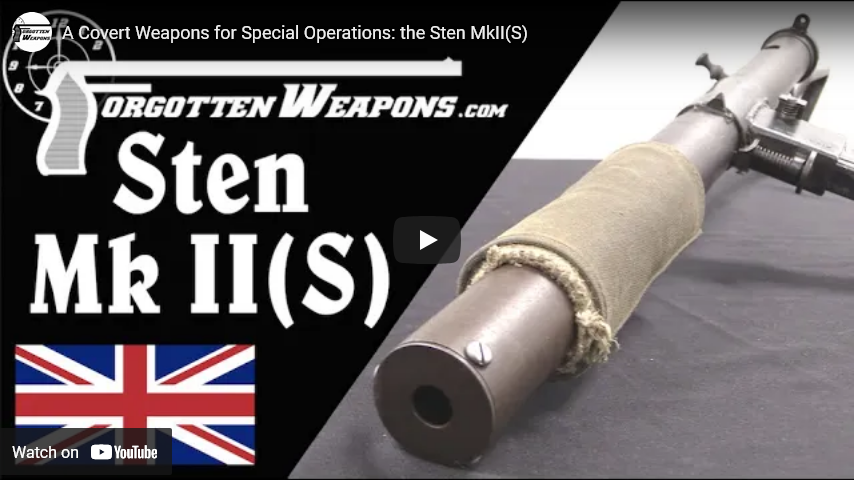
A Covert Weapons for Special Operations: the Sten MkII(S)
Forgotten Weapons
Published 5 Nov 2021http://www.patreon.com/ForgottenWeapons
https://www.floatplane.com/channel/Fo…
Cool Forgotten Weapons merch! http://shop.forgottenweapons.com
There are a fairly wide variety of silenced Sten guns that were made during World War Two, because many were needed for small Special Operations Executive missions. However, the British Army did also formally develop and adopt such a weapon. It was initially requested in 1942, with the first trials in November of that year. After two years of tinkering and deliberating, a pattern was finally put into production in February 1944. This was a Sten MkII with an integrally suppressed barrel. The barrel was just 3.75 inches long, with six vent holes drilled just in front of the chamber to reduce muzzle velocity below the speed of sound. The silencer itself was about 12 inches long, with an initial expansion chamber and 18 baffles.
Since the vented barrel reduced recoil energy of the cartridge, the bolt was reduced in weight by about 15% and the recoil spring shortened just slightly as well, to ensure proper cycling. The result was formally designated the Sten MkII(S). It retained the selective fire capability of the Sten, but was not to be used in automatic mode, as doing so could compress the baffles together and damage them. In total, 5,776 of these silent submachine guns were made. The design was followed by a more sophisticated Sten Mk6 (essentially a silenced Mk5), but remained in active use with the British military into the early 1970s.
Finding completely original and intact examples of the MkII(S) is extremely difficult today, and this one is a rare privilege to examine!
Contact:
Forgotten Weapons
6281 N. Oracle 36270
Tucson, AZ 85740
Comments Off on A Covert Weapons for Special Operations: the Sten MkII(S)
March 7, 2022
Henning Wehn’s Rant About “The War” | QI
QI
Published 15 Nov 2021Follow QI on Twitter ▶ http://twitter.com/qikipedia
Follow QI on TikTok ▶ https://www.tiktok.com/@theqielves
Follow QI on Instagram ▶ http://instagram.com/theqielves
For more visit ▶ http://qi.comThis clip is from QI Series I, Episode 8, “Inequality” with Stephen Fry, Alan Davies, Clive Anderson, Sandi Toksvig and Henning Wehn.

Comments Off on Henning Wehn’s Rant About “The War” | QI


