
History Undone with James Hanson
Published 13 Dec 2024James Hanson is joined by Rear Admiral Dr Chris Parry and the YouTuber and naval historian @Drachinifel to discuss the Battle of Jutland. It was the largest naval battle of the First World War and the only time the British and German fleets went head to head.
So just how significant was it and should it have ended differently? This is History Undone.
May 31, 2026
The Battle Of Jutland: How Britain Should Have “ANNIHILATED” Germany’s Fleet & Won EASILY
Comments Off on The Battle Of Jutland: How Britain Should Have “ANNIHILATED” Germany’s Fleet & Won EASILY
May 30, 2026
Buying W.W. Greener: Tales from the Golden Age of Surplus
Forgotten Weapons
Published 7 Jan 2026I am joined today by Val Forgett III of Navy Arms for the first in a series of videos telling some of his stories form growing up in the golden age of surplus, with a father who was one of the largest arms dealers in the US. Today, we are talking about how his father ended up owning the W.W. Greener company for five days, and taking a look at a sniper rifle from the Greener museum collection — a .280 Ross fitted with a Zeiss optic used by Greener’s nephew to significant effect in the First World War.
Minor correction: The guns Val still has were duplicates for Edward VII, not Edward VI.
In addition, Mr Bailey’s story has a happy ending. Val’s father gave him the machine tools from the Greener shop and prepaid for six months lease on a nearby building for him to start his own business. He eventually partnered with a former Greener employee named Leonard Onions and they formed Bailons Gunmakers Ltd, which was in business for many years.
(more…)
Comments Off on Buying W.W. Greener: Tales from the Golden Age of Surplus
May 23, 2026
Beretta M1918: Italy’s Semiauto 9mm Carbine from WWI
Forgotten Weapons
Published 31 Dec 2025Italy adopted the Villar Perosa in 1915, a gun that is sometimes considered the first submachine gun. Despite being fully automatic and chambered for pistol ammo (9mm Glisenti/Parabellum), it was actually not a submachine gun in practice. It was actually a twin gun, fired usually from a bipod using spade grips. It had some very specific applications, but was generally not very useful, and Italy set about looking for alternative uses for them. The solution they found was to split the guns into single receivers and fit them with buttstocks and traditional triggers. This led to the first true Italian submachine gun — the OVP-1918 — and also the Beretta 1918, which was originally a semiauto-only carbine.
The Beretta was made using Villar Perosa magazines, magazine latches, receivers, and bolt assemblies. The stocks came from Vetterli rifles and the bayonets from Carcano carbines. Only a few parts like the trigger assembly and ejection port housing were made from scratch. Beretta was given a contract late in the war to convert 5,000 Villar Perosas into these carbines, but was unable to complete the work before the war ended and the contract was cancelled. Of the guns that were completed, many were later converted into Beretta M1918/30 carbines and others were sold as surplus. A bunch of them went to Ethiopia, where some were ironically recaptured by Italian forces in the 1930s and put back into service in World War Two in North Africa. This example is one of a few recently found intact in Ethiopia.
Villar Perosa: • M1915 Villar Perosa
Shooting the Villar Perosa: • WW1 Villar Perosa SMG at the Range
OVP-1918: • OVP 1918: Italy’s first WW1 Submachine Gun
Beretta M1918/30: • Beretta Model 1918/30
(more…)
Comments Off on Beretta M1918: Italy’s Semiauto 9mm Carbine from WWI
May 15, 2026
Bloodier Than Verdun? Winter Battles on the Eastern Front 1915
The Great War
Published 16 Jan 2026The first four months of 1915 witnessed a titanic struggle on the Eastern Front, in East Prussia, the Carpathians, Bukovina, and at Przemysl. Both sides suffered staggering casualties that surpass those of the Somme or Verdun the following year. Ironically, the Austro-Hungarians lost far more men trying to save Przemysl than there were in the fortress.
(more…)
Comments Off on Bloodier Than Verdun? Winter Battles on the Eastern Front 1915
April 27, 2026
UOTCAF – EP 003 – PPCLI (Patricias)
Stormwalker Group
Published 5 Dec 2025Join Mario Gaudet, former Army Reservist and military brat, in Episode 3 of “Units of the CAF” as we delve into the legendary Princess Patricia’s Canadian Light Infantry (PPCLI).
Discover their early history, unique uniform quirks and cap badge story, plus their valor in WW1, WW2, the Cold War, and Afghanistan — featuring the most decorated soldiers from each era.
Sources:
•General PPCLI History: https://www.canada.ca/en/department-n…
•Sgt. George Harry Mullin VC (WW1): https://vcgca.org/our-people/profile/…
•Maj. John Keefer Mahony VC (WW2): https://veterans.gc.ca/en/remembrance…
•Sgt. Tommy Prince MM (Cold War/Korea): https://en.wikipedia.org/wiki/Tommy_P…
•WO Patrick Tower SMV (Afghanistan): https://en.wikipedia.org/wiki/Patrick…
•Additional Regimental Details: https://ppcliassn.ca/ppcli-the-regime…#PPCLI #CanadianArmy #MilitaryHistory #CAF #WW1 #WW2 #KoreanWar #Afghanistan #VictoriaCross #Veterans #CanadianForces
Comments Off on UOTCAF – EP 003 – PPCLI (Patricias)
April 25, 2026
Steyr M1912/16 Automatic “Repetierpistole“
Forgotten Weapons
Published 8 Dec 2025In the latter half of World War One the Austro-Hungarian military experimented with a number of select-fire pistol type weapons. One of these was the Steyr Repetierpistole M1912/16, an automatic adaptation of the regular M1912 pistol. It was given a 16-round fixed magazine (loaded via two 8-round stripper clips) and a selector switch. A total of 200 were produced, each supplied with a shoulder stock to help make the blistering 1200 rpm rate of fire somewhat usable. The design was not made from scratch, but rather adapted form the existing 1912 fire control system, which makes for a rather unorthodox system.
In addition to 200 of these pistols, the Austro-Hungarian military also acquired 50 twin-gun systems, which two of these pistols were attached to a frame with a single shoulder stock between them (no surviving examples of those are known today).
Frommer Pistolen-MG Model 1917 video:
• Frommer Pistolen-MG Model 1917: A Crazy Vi…Many thanks to the VHU — the Czech Military History Institute — for giving me access to these two fantastic prototypes to film for you. The Army Museum Žižkov is a part of the Institute, and they have a 3-story museum full of cool exhibits open to the public in Prague. If you have a chance to visit, it’s definitely worth the time! You can find all of their details (including their aviation and armor museums) here:
Comments Off on Steyr M1912/16 Automatic “Repetierpistole“
April 23, 2026
They put out propaganda because it works
I often find myself commenting on social media posts that the Canadian government’s direct subsidies to most of the mainstream media in Canada has created one of the most effective propaganda machines since 1930s Germany. “eLbOwS uP!” They keep doing it because it clearly is working fantastically well on a large enough share of Canadian voters that the polls (which may or may not be biased) keep touting that Dear Leader Carney and the Natural Governing Party are ever more popular. And most of the people consuming the propaganda message have their preferences re-inforced and the cycle starts again.
At Cracking Defence, Matthew Palmer discusses wartime propaganda during the 20th century, emphasizing that it’s the use to which it is put rather than the mechanism itself that has a moral value:
Propaganda is an absolute favourite subject of mine — probably not surprising considering that one of my roles in the military was psychological operations.1 Despite its very negative connotations thanks to the work of interwar writers like Frederick Ponsonby,2 propaganda really should be seen as a neutral term, perhaps best defined as “the deliberate attempt to persuade people to think and behave in a desired way”.3 Nor does it need to be state-driven; propaganda can come be generated from below as much as being driven top-down from the state or elites.
Some of the best propaganda comes out of wartime, and the First and Second World Wars were absolute goldmines. I also have a particular weakness for propaganda drawn up in early modernist and art deco styles, for which the first half of the 20th century was the high watermark. As such, here are a few of my all-time favourites for your delectation.4
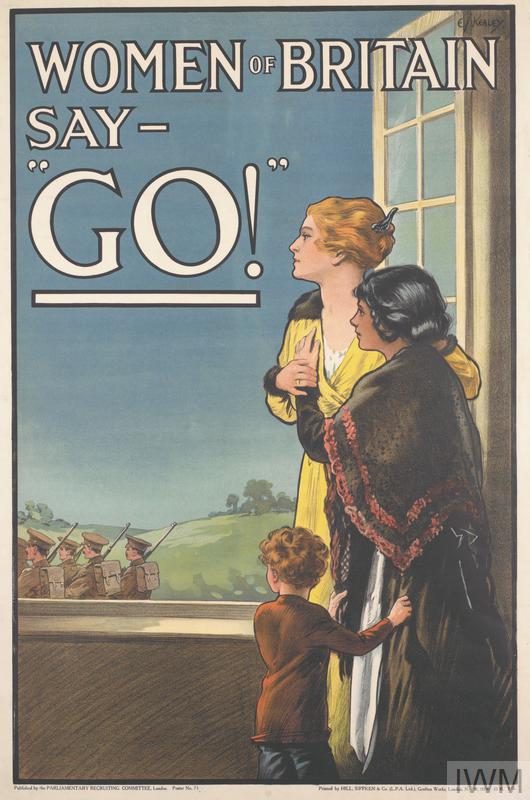
Women of Britain Say — Go!
Women of Britain Say ‘Go!’
Copyright: © IWM. Original Source: http://www.iwm.org.uk/collections/item/object/14592A true classic that has reverbrated through the ages. Despite First World War propaganda having the reputation of being crudely jingoistic, much of it was in fact consciously aware of the pain and sacrifice being endured by the warring population, and did not try to hide it. This one acknowledges the sacrifice undertaken by the women and children left behind, while the background reminds the viewer of the green and pleasant land of ‘old England’ that they are fighting for.
[…]
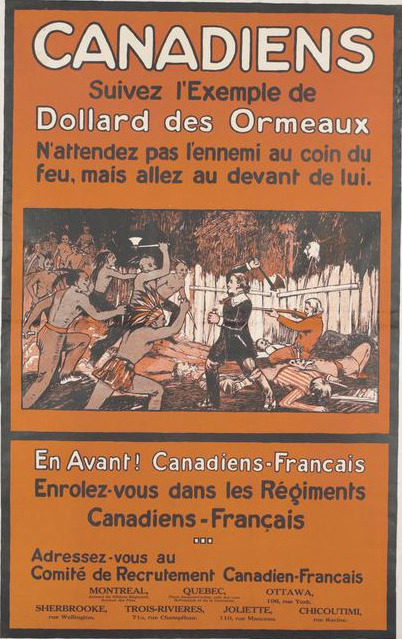
Canadiens, Suivez l’Exemple de Dollard des Ormeaux
Canadiens, Suivez l’Exemple de Dollard des Ormeaux [Canadians, Follow the Example of Dollard des Ormeaux] a depiction of Adam Dollard resisting an attack by Iroquois tribesmen. Dollard’s dead comrades lie at his feet.
Copyright: © IWM. Original Source: http://www.iwm.org.uk/collections/item/object/31027I find this one intriguing, not because I think it is actually a brilliant poster but for what it tells you about historical context and how propaganda was often tailored explicitly for local sensibilities. While Canadian support for the Allies in the First World War was generally fierce, the major exception was Quebec, which saw relatively poor levels of recruitment for overseas service. As such, propaganda aimed at Quebecois often tapped deeply into local traditions, in this case the (extremely dodgy!) myth of Adam Dollard, venerated in the period as a Catholic martyr who died defending Quebec from native Iroquois.5
[…]
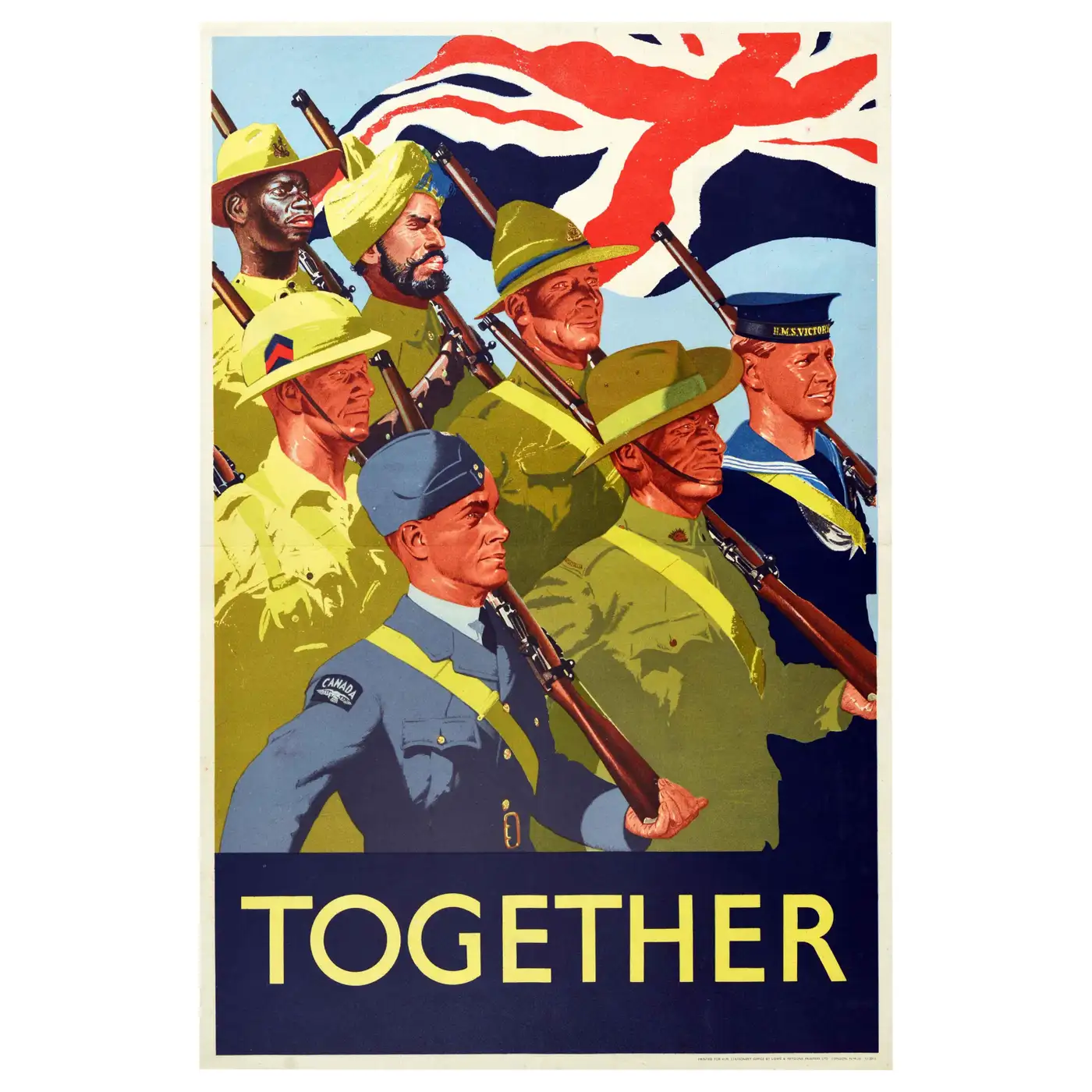
Together
Image courtesy of the IWM.
One can of course criticise the imperialism inherent in this poster, but I think it still works exceptionally well as a bold call for unity between the different nations of the British Empire. It shows how British propagandists took pains to highlight the Second World War as a global conflict against fascism.
- A job which, if I do say so myself, I was pretty bloody good at.
- Ponsonby wrote Falsehood in Wartime in which ironically he basically made up stories about British propagandists in a book supposedly about manufactured atrocity propaganda!
- Phillip Taylor, Munitions of the mind: A history of propaganda (Manchester University Press, 2013).
- I’m only going to present Allied propaganda. Because, frankly, fuck fascism.
- The story of Dollard is mostly myth, and he was more likely an idiot fur-trapper who got himself killed through stupidity.
April 16, 2026
UOTCAF – EP 002 – Royal 22e Régiment (R22R)
Stormwalker Group
Published 11 Nov 2025Units of the CAF: Episode 2 – R22R
Join your host, Mario Gaudet, as he confuses his brain by talking about French stuff in English, and dive into the epic saga of the Royal 22e Régiment, Quebec’s legendary “Van Doos”, in Episode 2 of “Units of the CAF”.
From their 1914 founding as the first French-speaking battalion in WWI and their heroic stand at Vimy Ridge, and at Ortona in WWII, to Korea’s Hill 355 raids and Afghanistan’s dusty patrols, we spotlight decorated heroes like Joseph Kaeble (VC, WWI), Paul Triquet (VC, WWII), Léo Major (DCM, Korea), and modern heroes aswell. Explore their iconic cap badge featuring the motto “Je me souviens” adopted in 1925.
Whether you’re a veteran, history buff, or just a fan of military trivia, this one’s for you.
#Royal22eRegiment #VanDoos #CanadianArmy #MilitaryHistory #CAF #QuebecPride #WWI #WWII #KoreaWar #AfghanistanWar
April 11, 2026
Aussies & Tanks: The Story of Australian Armour
The Tank Museum
Published 30 Jan 2026Australia has always been an outlier when it comes to tanks. The first time Australians fought alongside tanks, it was such a disaster they almost gave up on the whole idea. And the first time they fought IN tanks, they were pinched from the enemy.
They’re the only Allied nation to reject the M4 Sherman. More than once, they’ve used their tanks very differently to how they were designed. Yet somehow, they’ve almost always been successful.
So, why do the Australians use tanks so differently to everybody else?
Join James and Fam as they explore the weird and wonderful ways that our Australian cousins have used their tanks. From captured tanks in the desert, to heavy metal in the jungle, the Aussie methods of armoured warfare have always seemed a little upside down from the outside.
While Australian interest in tanks has come and gone, when the need has arisen, the Australian tank force has been up to the challenge. Simply put, Australian soldiers usually use tanks differently because they usually fight differently. And despite long periods of neglect, tanks in the Australian Army always seem to find a way to bounce back.
00:00 | Introduction
00:36 | A Bad Start
03:44 | Tanks of their Own
06:19 | Welcome to the Jungle
11:07 | Lessons Relearned
13:53 | Defence of Australia
(more…)
Comments Off on Aussies & Tanks: The Story of Australian Armour
March 30, 2026
UOTCAF – EP 001 – The Royal Canadian Regiment – SWG
Stormwalker Group
Published 24 Oct 2025Dive into the rich legacy of the Royal Canadian Regiment (RCR) in the premiere episode of “Units of the CAF”, hosted by ex-reservist Mario Gaudet.
This 15-minute narration explores the RCR’s origins in 1883 as Canada’s first permanent infantry unit, the symbolism of their iconic “VRI” cap badge, unique uniform features, and their heroic battles from the North-West Rebellion to Afghanistan. We also spotlight some of the regiment’s most decorated soldiers.
Whether you’re a history buff, military enthusiast, or proud Canadian, this series honors the sacrifices and traditions of the Canadian Armed Forces.
(more…)
March 29, 2026
Adventures in Surplus! Finnish M28 “Ski Trooper”
Forgotten Weapons
Published 10 Nov 2025Today we are going to take a look at just how much historical [information can] be read from the features and markings of an individual rifle. This is an early production Finnish M28 “ski trooper” Mosin Nagant that can be traced from Russian manufacture to WW1 Russian use, Austro-Hungarian capture, rechambering to 8x50mm Mannlicher, concession to Italy as war reparations, sale to Finland, rebuilding as a Civil Guard M28, use in the Winter War and Continuation War, transfer to the Finnish Army, and finally importation into the United States.
(more…)
Comments Off on Adventures in Surplus! Finnish M28 “Ski Trooper”
March 9, 2026
The FIRST Tank Battle – Villers-Bretonneux, 1918: Mark IV v A7V
The Tank Museum and Queensland Museum
Published 14 Nov 2025By spring 1918, the British Mark IV tank has been in service for almost a year. It had proved itself during the Battle of Cambrai – the males attacking concrete emplacements, and the females fending off the infantry. But the Mark IV has never been tested against another tank …
The German A7V hasn’t served on the battlefield very long. While it has mobility and stability issues, it does have thicker armour than the British tanks – and is more heavily armed. On paper, this looks like it will be a close call.
Villers-Bretonneux is the first time in history that a tank fought another tank. It’s a day that would change the face of warfare forever.
00:00 | Introduction
00:50 | The Mark IV
02:57 | The A7V
05:30 | The Battle of Villers-Bretonneux
06:44 | Mark IV vs A7V
09:09 | Who won?
(more…)
Comments Off on The FIRST Tank Battle – Villers-Bretonneux, 1918: Mark IV v A7V
February 25, 2026
Bommarito: America’s First Toggle-Locked Battle Rifle
Forgotten Weapons
Published 1 Oct 2025Designed by Giuseppe Bommarito, this was one of the many independent rifle designs submitted to the US War Department in the 1910s hoping for military adoption. It is a short recoil operated, toggle-locked system chambered for .30-06 and using detachable 20-round magazines. It was tested (without much success) at Springfield and remained in development until 1918.
See a more complete article including original disassembly photos here:
https://www.forgottenweapons.com/m1-g…Thanks to the Springfield Armory National Historic Site for giving me access to this truly unique specimen from their reference collection to film for you! Don’t miss the chance to visit the museum there if you have a day free in Springfield, Massachusetts:
https://www.nps.gov/spar/index.htm
(more…)
Comments Off on Bommarito: America’s First Toggle-Locked Battle Rifle
February 19, 2026
Hotchkiss Model 1886 3-pounder Quick Firing Gun
Forgotten Weapons
Published 26 Sept 2025Small fast boats with torpedos (or other explosives) have always been a threat to large warships. One of the weapons the British Royal Navy adopted to counter that threat was the Hotchkiss Model 1886 “Quick Fire” gun. This meant that it was a breech-loaded gun that used self-contained cartridge ammunition, instead of separate powder bags and projectiles. Mounted on a recoil-adsorbing soft mount with a wide range of movement and steep depression angle, guns like this could fire at small mobile torpedo boats that a capital ship’s main armament couldn’t handle.
This particular model is a 47mm bore, or 3-pounder as described in British service. It uses a vertically-traveling breech block, and more than 3,000 or them were acquired by the British. Two of them were employed as part of the Falkland Islands coastal defenses at one time. This example is one of two brought down from Gibraltar fairly recently and refurbished for ceremonial use on the Islands. Thanks to the FIDF for setting it up on its mount so I could film it for you!
(more…)
Comments Off on Hotchkiss Model 1886 3-pounder Quick Firing Gun
February 15, 2026
WW1: The Siege of Przemyśl: Austria-Hungary’s Horror Story | EP 6
The Rest Is History
Published 11 Sept 2025After endeavouring to wreak their revenge on Serbia, what would be the greatest hammer blow to the Austro-Hungarian Empire during the First World War? With Leviv having fallen apocalyptically to the Russian hordes, what had gone so wrong? How might the war have been brought to an end before Christmas of 1914? And, with the darkness gathering around the Austrian defences, could the great fortress of Przemyśl hold out against the Russian barrage for a second time?
Join Dominic and Tom as they discuss the fall of the Austro-Hungarian Empire and the Russian advance, on the brutal Eastern front, as the first year of the First World War grinds bloodily on…
Alexander Watson’s The Fortress, the book heavily referenced in this episode, is available to purchase here: http://bit.ly/41NKRrq
______00:00 – Cold open: “intricacies of war” reading
01:13 – Adobe
01:51 – Nick Lloyd & the Tyrolean Kaiserjäger
03:26 – Austria-Hungary’s coming unraveling: setting the stakes
06:50 – Why Przemyśl is a fortress; garrison & geography
08:31 – August 1914: Conrad’s plan and its unraveling
17:48 – Catastrophe for the Habsburg army
18:32 – The siege begins
24:50 – Pendulum swings back; Russians advance again
27:01 – Civilian exodus chaos; encircled again (8 Nov)
28:10 – Uber
28:50 – Folio Society
30:17 – Russian occupation & pogroms in Galicia (1914)
31:39 – War aims: Russification under Count Bobrinsky
33:00 – Russian antisemitism context; pogroms & deportations
37:05 – Second siege strategy: starve them out; General Kusman
38:04 – Early aerial bombing of civilians (Dec 1)
39:10 – Christmas Eve gestures; brief humanity, then darkness
41:04 – Conrad’s Carpathian rescue bid (23 Jan): campaign from hell
42:02 – Carpathian horrors; Tyrolean memoir; morale collapses
47:10 – POW fate: officers vs men; camps & Murmansk railway
49:01 – Austria-Hungary reels from the disaster
50:17 – Germany’s opinion of Austria Hungary
51:13 – Italy cuts a deal, joins war; the Italian Front beckons
53:38 – Tsar’s visit; enforced Russification in Przemyśl
55:14 – Mackensen’s offensive; Germans “liberate” Przemyśl; Austria eclipsed
56:10 – Foreshadowing WW2?
(more…)
Comments Off on WW1: The Siege of Przemyśl: Austria-Hungary’s Horror Story | EP 6


