
You’ve heard me say quite often that the nicest car in the faculty lot always belongs to the wildest-eyed Marxist. Given what we know about the stiffness of the “most insane Marxist” competition among eggheads, it seems to follow that the faculty lot must look like a rap video — Bugattis and Bentleys and Maybachs everywhere. But that’s not the case, comrades.
Not because academics are worried about anything so prole as hypocrisy — as we know, cognitive dissonance only affects the Dirt People — but because eggheads operate on a different scale of values. Bentleys etc. are what those people drive … so professors have to kick it bobo style. Thus the faculty lot is filled with Priuses (Prii?), Teslas, and so forth. Back when The Simpsons was funny, it had a throwaway joke about Ed Begley Jr. driving a car so eco-friendly, it was powered entirely by his own sense of self-regard. If they actually marketed those, every professor in America would have one … but since they don’t, the “eco-pimp my ride” competition continues unabated.
Which is hilarious for two reasons. First, there isn’t — there won’t be, there can’t be — sufficient infrastructure to support more than a token few electric vehicles (EVs). Flyover State is nothing if not eco-friendly, though, and so they fell all over themselves giving the faculty charging stations … but see above: All they could manage was one charging station per level, in one parking garage. Which naturally led to much agonizing in the Faculty Senate, not to mention the student newspaper, the town newspaper, and every boutique coffee place and head shop in College Town. How can charging station time be most equitably distributed? Does the Lesbian Negress outweigh (supply your own joke here, please) the White FTM tranny? What about the genderfluid hemophiliac Inuit? Where does the wingless golden-skinned dragonkin rank?
Severian, “Luxury Beliefs”, Rotten Chestnuts, 2021-06-03.
April 5, 2024
QotD: When the faculty lounge turned nasty over the electric vehicle charging stations
April 4, 2024
Boeing and the ongoing competency crisis
Niccolo Soldo on the pitiful state of Boeing within the larger social issues of collapsing social trust and blatantly declining competence in almost everything:

“Boeing 521 427”by pmbell64 is licensed under CC BY-SA 2.0


By now, most of you have heard of the increasingly popular concept known as “the competency crisis”. For those of you who haven’t, the competency crisis argues that the USA is headed towards a crisis in which critical infrastructure and important manufacturing will suffer a catastrophic decline in competency due to the fact that the people (almost all males) who know how to build/run these things are retiring, and there is no one available to fill these roles once they’re gone. The competency crisis is one of the major points brought up by people when they point out that America is in a state of decline.
As all of you are already aware, there is also a general collapse in trust in governing institutions in the USA (and all across the West). Cynicism is the order of the day, with people naturally assuming that they are being lied to constantly by the ruling elites, whether in media, government, the corporate world, and so on. A competency crisis paired with a collapse in trust in key institutions is a vicious one-two punch for any country to absorb. Nowhere is this one-two combo more evident than in one of America’s crown jewels: Boeing.
I’m certain that all of you are familiar with the “suicide” of John Barnett that happened almost a month ago. John Barnett was a Quality Control Manager working for Boeing in the Charleston, South Carolina operation. He was a “lifer”, in that he spent his entire career at Boeing. He was also a whistleblower. His “suicide” via a gunshot wound to the right temple happened on what was scheduled to be the third and last day of his deposition in his case against his former employer.
In more innocent and less cynical times, the suggestion that he was murdered would have had currency only in conspiratorial circles, serving as fodder for programs like the Art Bell Show. But we are in a different world now, and to suggest that Barnett might have been killed for turning whistleblower earns one replies like “could be”, “I’m pretty sure that’s the case”, and the most common one of all: “I wouldn’t doubt it”. No one believes that Jeffrey Epstein killed himself. Many people believe the same about John Barnett. The collapse in trust in ruling institutions has resulted in an environment where conspiratorial thinking naturally flourishes. Maureen Tkacik reports on Boeing’s downward turn, using Barnett’s case as a centre piece:
“John is very knowledgeable almost to a fault, as it gets in the way at times when issues arise,” the boss wrote in one of his withering performance reviews, downgrading Barnett’s rating from a 40 all the way to a 15 in an assessment that cast the 26-year quality manager, who was known as “Swampy” for his easy Louisiana drawl, as an anal-retentive prick whose pedantry was antagonizing his colleagues. The truth, by contrast, was self-evident to anyone who spent five minutes in his presence: John Barnett, who raced cars in his spare time and seemed “high on life” according to one former colleague, was a “great, fun boss that loved Boeing and was willing to share his knowledge with everyone,” as one of his former quality technicians would later recall.
Please keep in mind that this report offers up only one side of the story.
A decaying institution:
But Swampy was mired in an institution that was in a perpetual state of unlearning all the lessons it had absorbed over a 90-year ascent to the pinnacle of global manufacturing. Like most neoliberal institutions, Boeing had come under the spell of a seductive new theory of “knowledge” that essentially reduced the whole concept to a combination of intellectual property, trade secrets, and data, discarding “thought” and “understanding” and “complex reasoning” possessed by a skilled and experienced workforce as essentially not worth the increased health care costs. CEO Jim McNerney, who joined Boeing in 2005, had last helmed 3M, where management as he saw it had “overvalued experience and undervalued leadership” before he purged the veterans into early retirement.
“Prince Jim” — as some long-timers used to call him — repeatedly invoked a slur for longtime engineers and skilled machinists in the obligatory vanity “leadership” book he co-wrote. Those who cared too much about the integrity of the planes and not enough about the stock price were “phenomenally talented assholes”, and he encouraged his deputies to ostracize them into leaving the company. He initially refused to let nearly any of these talented assholes work on the 787 Dreamliner, instead outsourcing the vast majority of the development and engineering design of the brand-new, revolutionary wide-body jet to suppliers, many of which lacked engineering departments. The plan would save money while busting unions, a win-win, he promised investors. Instead, McNerney’s plan burned some $50 billion in excess of its budget and went three and a half years behind schedule.
There is a new trend that blames many fumbles on DEI. Boeing is not one of those. Instead, the short-term profit maximization mindset that drives stock prices upward is the main reason for the decline in this corporate behemoth.
April 3, 2024
Man of his era, indeed – “we think too much of Thomas Jefferson, because we don’t see his cultural context”
Chris Bray on the sudden discovery of his dissertation topic in a quite unexpected venue:

Thomas Jefferson, 1800.
Oil portrait by Rembrandt Peale via Wikimedia Commons.
Fifteen years ago, more or less, I stumbled into a topic for a dissertation when I got frustrated and took a walk. I was in Worcester, Massachusetts, working in the archives at the American Antiquarian Society and finding just absolutely nothing at all that answered my question. So I wandered, and passed a decommissioned armory with a sign over the door that said MASSACHUSETTS MILITARY ARCHIVES. They let me poke around, and by the end of the day I was running around with my hair on fire and shouting at everybody that my dissertation was about something else, now.
State militia courts-martial in the opening decades of a new republic recorded every word, in transcripts that could run to hundreds of pages — frequently interspersed with a line that said something like, “Clerk again reminded witnesses to speak slowly.” The dozen officers who made up a militia court weren’t military professionals, but were instead the prominent farmers and craftsmen who were elected to militia office by their townsmen. So transcripts of state military trials were verbatim discussions among something like the most respected farmers of a county, or of this county and the next one over. They were not recorded debates between the great statesmen of the era. And they needed a big room where a dozen men could sit at a long table in front of the parties and the spectators, so state courts-martial tended to convene in taverns.
One more important thing: The formalization of military courts was way in the future, and there wasn’t a professional JAG Corps in the militia to run trials. State courts-martial were a lawyer-free forum. The accuser was expected to “prosecute” his case — to show up and prove the wrongdoing he had claimed to know about. And defendants were expected to personally defend themselves, questioning witnesses and presenting arguments to the court. At the end of testimony, the “prosecutor” and the defendant personally went home to write their own closing statements, and we still have these documents, tied into the back of the trial transcripts with a ribbon. Courts would stop in the evening and resume in the morning, and men accused of military offenses would show up with twenty-page closing statements in their own handwriting, with holes in the page where the pen poked through.
So: a panel of farmers, serving as local militia officers, listening to an argument between farmers who served as local militia officers, in a tavern, and we have a detailed record of every word they said.
They were magnificent. They were clear, thoughtful, fair, and logical. They had no patience at all for dithering or innuendo; they expected a man who accused another man of wrongdoing to get to it, in an ordered and serious way. Witnesses who fudged or evaded ran into a buzzsaw. The officers on the courts would interject with their own questions: Look, captain, did he say it or didn’t he? And then they wanted a serious summary of the evidence, with a consistent argument. Their thinking was structured, and they expected the same of others.
We distinguish between talking and doing, and between talkers and doers. But these men were doers in the hardest sense. Their families starved or thrived because of their work with tools and the skill in their hands. Their food came from their dirt, outside their front door. They mostly weren’t formally educated; they didn’t spend their young lives going to school. They worked, from childhood. And yet they could talk, meaningfully and carefully. They could address a controversy with measured discourse, gathering as a community to assess an institutional failure and organize a logical response. Their talking was another way of doing.
The historian Pauline Maier has written that we think too much of Thomas Jefferson, because we don’t see his cultural context. The Declaration of Independence looks to us like a startling act of political creativity, systematically describing a set of grievances and proposing an ordered response based on a clear philosophy of action. But Jefferson showed up after years of disciplined and thoughtful local proclamations on the crisis, Maier says. He was the national version of a hundred skillful town conventions, standing on the foundation of an ordered society that knew what it believed and what it meant to do about it.
The Flying Saucer Designed To Ram Soviet Bombers | Avro Canada Silver Bug
Rex’s Hangar
Published Dec 29, 2023Today we’re taking a look at a concept “aircraft” developed in the 1950s, the Avro Canada Silver Bug — part of a long line of flying discs drawn up by designer John Frost.
(more…)
April 1, 2024
The most likely outcome of a 2nd US Civil War isn’t two successor states, but a modern version of the Holy Roman Empire
Kulak, at the start of a very long post on historical eras of centralization and decentralization, touches on the most likely outcome of a second US civil war, and it’s not a rump USA and a neo CSA:
Every time the subject of a possible US civil war or national divorce comes up I hear the same micron deep takes. America couldn’t break up because the division isn’t by state, its Urban Vs. Rural. Or that Urban vs. Rural isn’t the divide, even then people of different politics are mixed up together. Or that for every clear red or blue state there’s a purple state. None of which is in any way relevant to anything until you recognize the naïve mental model many of these people are working on …
These takes betray a belief that a second civil war would be some kind of conflict between coherent independent states who’ve started identifying with/against the idea of union such as happened in the 1860s … or that somehow there’d be a series of tidy Quebec style referendums resulting in a clean division such as exists in so many meme maps:
The truth is any post-breakup map of America would not resemble an electoral map following state lines, nor even a redrawing of state boundaries, such that the fantastical greater Idaho or Free State of Jefferson might exist as part of a wider Confederation of Constitutional Republics, or a Breakaway Philadelphia city-State join a Union of Progressive Democracies …
No. It’d be nothing so comprehensible or easily mapped to modern politics.
A post breakup America would probably look closer to this:
If you’re a sane person and your immediate reaction is: WHAT THE HELL AM I LOOKING AT!?
… Well that’s kinda the point.
(I really do apologize for all I’m going to have to digress)
For our purposes we can broadly divide history into 2 types of period … Periods of Centralizing trends, and periods of Decentralizing trends.


“The loss of capacity for memory or real experience is what makes people susceptible to the work of cartoon pseudo-intellectuals”
Matt Taibbi strongly encourages his readers to exercise their brains, get out of the social media scroll-scroll-scroll trap, and stay sane:

After a self-inflicted wound led to Twitter/X stepping on my personal account, I started to worry over what looked like the removal of multiple lanes from the Information Superhighway. Wikipedia rules tightened. Google search results seemed like the digital equivalent of a magician forcing cards on consumers. In my case, content would often not even reach people who’d registered as social media followers just to receive those alerts.
I was convinced the issue was political. There was clear evidence of damage to the left and right independents from companies like NewsGuard, or the ideologically-driven algorithms behind Google or Amazon ad programs, to deduce the game was rigged to give unearned market advantages to corporate players. The story I couldn’t shake involved video shooter Jon Farina, whose footage was on seemingly every cable channel after J6, but which he himself was barred from monetizing.
Now I think differently. After spending months talking to people in tech, I realize the problem is broader and more unnerving. On top of the political chicanery, sites like Twitter and TikTok don’t want you leaving. They want you scrolling endlessly, so you’ll see ads, ads, and more ads. The scariest speech I heard came from a tech developer describing how TikTok reduced the online experience to a binary mental state: you’re either watching or deciding, Next. That’s it: your brain is just a switch. Forget following links or connecting with other users. Four seconds of cat attacking vet, next, five ticks on Taylor Ferber’s boobs, next, fifteen on the guy who called two Chinese restaurants at once and held the phones up to each other, next, etc.
Generations ago it wasn’t uncommon for educated people to memorize chunks of The Iliad, building up their minds by forcing them to do all the rewarding work associated with real reading: assembling images, keeping track of plot and character structure, juggling themes and challenging ideas even as you carried the story along. Then came mass media. Newspapers shortened attention span, movies arrived and did visual assembly for you, TV mastered mental junk food, MTV replaced story with montages of interesting nonsensical images, then finally the Internet came and made it possible to endlessly follow your own random impulses instead of anyone else’s schedule or plot.
I’m not a believer in “eat your vegetables” media. People who want to reform the press often feel the solution involves convincing people that [they] just should read 6,000-word ProPublica investigations about farm prices instead of visiting porn sites or watching awesome YouTube compilations of crane crashes. It can’t work. The only way is to compete with spirit: make articles interesting or funny enough that audiences will swallow the “important” parts, although even that’s the wrong motive. Rolling Stone taught me that the lad-mag geniuses that company brought in in the nineties, who were convinced Americans wouldn’t read anything longer than 400 words in big type, were wrong. In fact, if you treat people like grownups, they tend to like a challenge, especially if the writer conveys his or her own excitement at discovery. The world is a great and hilarious mystery and if you don’t have confidence you can make the story of it fun, you shouldn’t be in media. But there is one problem.
Inventions like TikTok, which I’m on record saying shouldn’t be banned, are designed to create mentally helpless users, like H addicts. If you stand there scrolling and thinking Next! enough, your head will sooner or later be fully hollowed out. You’ll lose the ability to remember, focus, and decide for yourself. There’s a political benefit in this for leaders, but more importantly there’s a huge commercial boon. The mental jellyfish is more susceptible to advertising (which of course allows firms to charge more) and will show less and less will over time to walk out of the Internet’s various brain-eating chambers.
A cross of Jimmy Page and Akira Kurosawa probably couldn’t invent long-form content to lure away the boobs-and-cat-video addicts these sites are making. The loss of capacity for memory or real experience is what makes people susceptible to the work of cartoon pseudo-intellectuals like Yuval Noah Harari, who seem really to think nothing good or interesting happened until last week. The profound negativity of these WEF-style technocrats about all human experience until now reminds me of Ray Bradbury’s Fahrenheit 451, whose dystopian characters feared books because “They show the pores of the face of life”.
How Railroad Crossings Work
Practical Engineering
Published Jan 2, 2024How do they know when a train is on the way?
Despite the hazard they pose, trains have to coexist with our other forms of transportation. Next time you pull up to a crossbuck, take a moment to appreciate the sometimes simple, sometimes high-tech, but always quite reliable ways that grade crossings keep us safe.
(more…)
March 31, 2024
Allies Charge Forward from the Rhine! – WW2 – Week 292 – March 30, 1945
World War Two
Published 30 Mar 2024All along the Western Front the Allies break out in force, invading German territory and receiving German surrenders by the thousands. In the east, the Soviets take Danzig and Gdynia, and rout the Germans in Hungary. There’s a new Japanese offensive in China, though the fight on Iwo Jima ends with a Japanese defeat.
Chapters
00:45 Recap
01:08 Big Advances all over the West
05:48 Soviets take Gdynia and Danzig
07:09 Zhukov’s forces take Kustrin
10:39 The War in China
12:21 Iwo Jima Ends
14:30 Preliminaries for Okinawa
18:46 More Landings in the Philippines
19:23 Slim focuses on Rangoon
20:12 Notes to end the week
20:48 Summary
21:28 Conclusion
24:47 Call To Action
(more…)
March 30, 2024
QotD: Multiculturalism, in theory and practice
Victor Davis Hanson, Ripples of Battle, 2003.
March 29, 2024
“TamponGate” at Vanderbilt
Suzy Weiss at The Free Press relates a story that’s just too weird not to share:

No one is ever going to let me guest-host this digest again, so I might as well tell you about some Vanderbilt girl’s tampon. This all started yesterday morning, when a wave of undergrad students rushed Kirkland Hall, where Vanderbilt’s chancellor’s office is located. Thus began their sit-in — a response to the college administration shutting down a student government vote over whether the school should divest funds from Israel.
The protesters remained there for nearly 21.5 hours — blowing Harvard’s 12-hour “hunger strike“, also known as a good night’s sleep — out of the water, before police began removing and arresting students, some of whom have since been suspended.
There are many dumbfounding moments from this latest campus frenzy — for example, when the students, arms linked, called the black police officers protecting the chancellor “puppets”. When food was brought in from Panera Bread by the administration for the officers but not the students, it was treated like a human-rights abuse.
But the tampon takes the cake. (Major props to Steve McGuire for compiling the best episode of the internet since yesterday.)
Here’s what went down: during one of those 21.5 hours of the protest, probably at an ungodly one, a few of the student demonstrators decided to call 911. That’s because their friend, who was part of the sit-in, had to change her tampon.
Specifically, she was “being denied the right to change her tampon that has been in for multiple hours, which leads to an increased risk of toxic shock syndrome.”
The frankly Zen-like 911 operator, who deserves a raise, was understandably confused. “Ma’am, do you have an emergency?”
Um, yes?! The student on the phone requests urgent medical assistance.
“You’re telling me your friend in Kirkland needs an ambulance. Is that what you’re telling me?”
Then in another video, one of the protesters—in a keffiyeh and a mask—approaches the police and an administrator, who was indeed in a sweater vest, demanding to know WHAT. WILL. HAPPEN. to her friend, should she leave the sit-in to change the tampon in question. The adults calmly explain that she won’t be arrested if she leaves the building. But can they confirm that she will never be arrested, ever?!
“She does not feel safe,” someone says off-screen, punctuating it with claps.
This whole thing makes the Nick Christakis Halloween costume struggle session look like a teachable moment. It must be seen to be believed. Watch all the videos in Steve’s thread here.
For starters, if having a tampon in for “multiple hours” is grounds to call for an ambulance, I should have been dead years ago. Second, this student was being denied no such right. All she had to do was get up, leave the protest, and find one of the hundreds of bathrooms that she had access to elsewhere on campus. Pro tip: wear a pad to the all-night protest. The First Amendment doesn’t come with a heating pad.
It’s all very Karen, to borrow a trope from 2020, especially when a protester demands the administrator find someone who can get them some answers. Just like middle-aged women who think dressing down the manager will somehow earn them a full refund, these students have convinced themselves that by linking arms and screaming “shame” at their college’s chancellor, they are stopping a war in the Middle East.
Don’t these authority figures realize they are standing in the way of a global intifada, which is also — obviously — a totally good thing?
We find out in a subsequent video that indeed the tampon was removed, though not in any bathroom. Reader, it came out at the sit-in, like so much urine in so many plastic water bottles. A woman on the microphone calls it “the most depraved shit I’ve seen in my entire life”.
Hard agree.

QotD: Pay no attention to the empty suit behind the social media curtain!
Given all that, why not censor? Why not let your freak flag fly? Just as being innovative actually counts against you in the music biz these days — sure, sure, y’all might be the next Beatles, but we know Taylor Swift’s lab-grown replacement will move fifty million units — so there are considerable drawbacks, in the social media moguls’ minds, to letting just any old schmoe post anything he wants up on their platforms. What if Faceborg’s ad-generation algorithm decides to put a #woke company’s ad on a badthinker’s page? Faceborg’s entire business model rests on getting #woke companies to keep buying ads, since those ad buys are the only thing that keep the stock price up. And since those #woke corporations have made it abundantly clear that they don’t want those people’s business …
Swing it back to the top. Faceborg et al have figured out a surefire way to “make money” by manipulating their stock price. They don’t need a physical product to do it, but what they absolutely must have, the one thing from which all others flow, is “clicks”. Eyeballs. Whatever you want to call it, the whole house of cards is built on the premise that there are actual users out there — real, physical people, who exist in meatspace — who might theoretically buy the advertisers’ products. But … what if there aren’t?
Zuck et al have been pretty good at faking it so far, but as everyone knows, they are faking. For one thing, they keep getting caught. For another, even academics — the dumbest critters in captivity, Commodore 64-level NPCs who can be counted on to swallow the SJW narrative hook line and sinker — keep publishing studies showing that some huge number of all social media accounts, on all platforms, are bogus.
Indeed, you can test it for yourself. I know, I know, FED!!!!, but hear me out: Get a VPN. Sign up for a burner email. Rejigger the VPN, then use the burner email to sign up for Faceborg, Twitter, whatever. Don’t actually post anything; just sign up. It’s 1000 to 1 that even with no activity whatsoever, you’ll still be deluged with friend requests. The algorithms will take care of that, because as we’ve noted, they have to push the illusion that people are using these platforms, that eyeballs are landing on pages, that fingers are clicking on ads. You’ll get a whole list of “suggestions” of which accounts to follow, all of which — surprise surprise — are never more than a click away from some big advertiser.
Severian, “Own Goals”, Rotten Chestnuts, 2021-07-21.
March 28, 2024
QotD: Honest scholarship … and whatever passes for scholarship these days
Equally distressing as these (and an increasing number of other) examples of scholarly utter shoddiness or execrable dishonesty is the complete incredulity of many people in accepting the “findings” of such “scholars”.
A perverted form of amusement can be had by imagining what sort of “scholarly” output you might offer to the world were you to operate according to the standards used by “scholars” such as Nancy MacLean. Free to present fiction as fact, you might, say, claim that because Dr. MacLean studied at the University of Wisconsin, and because Wisconsin was once home to the serial killer Jeffrey Dahmer – and because in her book Democracy in Chains she did not explicitly denounce serial killing – that Dr. MacLean’s work is a surreptitious attempt to justify serial killing.
Of course, any such conclusion would be both preposterous and inexcusably unethical. Anyone who (unlike me here) seriously offered such a wacky, detached-from-all-reality, ideologically motivated thesis to the public should lose not only any claim to scholarly respect, but any claim to respect of any sort. And yet the bases for the conclusions reached by “scholars” such as Dr. MacLean are no more realistic than are those in my previous, satirical paragraph.
Don Boudreaux, “The Wisdom of Bob Higgs”, Café Hayek, 2019-08-29.
March 27, 2024
As the kids will be taught, pre-Columbian culture was feminist, egalitarian, non-violent, etc.
The way history will be taught in future will distort historical facts to flatter modern sensibilities, especially with regard to First Nations history:

Linguistic groups of pre-contact North America.
Wikimedia Commons
In my previous missive of this series, I outlined the socio-economic problems facing Indigenous people in Canada and identified the official narrative, promoted by the federal government, Indigenous leaders, and their non-Indigenous allies. This narrative is basically that colonialism, racism, and oppression are the sole (or at least the major) causes of the long list of socio-economic difficulties so many Indigenous people are suffering from today. The narrative focuses on colonialism, oppression, as well as “intergenerational trauma” and “genocide”, neither of which claims stand up to the slightest bit of objective scrutiny and analysis. The genocide claim is particularly laughable in that the Indigenous population has increased from about 100 thousand in 1900 to nearly 2 million today, which is at least four times the pre-contact Indigenous population.
Pre-contact living conditions for Indigenous people
In order to blame all the problems on European settlers and their descendants, the narrative starts out by implying that life in pre-contact Canada was idyllic. Students are led to believe that this was a time of peace, cooperation, and prosperity based on teachings and knowledge systems that were superior to what we have now (the Western enlightenment-based ethos and the scientific method). Students are told that people lived well- sustainably, with little environmental impact, and with a respect for each other and the land, with which their relationship was one of stewardship and symbiotic coexistence.
This is presented in contrast to the purported European world view, which kids are told was, and still is, characterized by exploitation and a belief in European superiority. Europeans are described as ruthless and greedy people who just wanted to enrich themselves by maximally extracting any and all resources without regard for impacts on the environment or Indigenous people. It is presented as a case of good vs. evil.
But what was life really like for pre-contact Indigenous people? Certainly their stone age way of living combined with their small, scattered population was eco-friendly, but was their standard of living, on balance, better than that of modern Canada? Were they more moral, or wiser than modern non-Indigenous Canadians? An honest answer to these questions demands a hard look at the available evidence and a willingness to draw conclusions wherever that evidence may lead.
And that evidence shows that pre-contact indigenous people demonstrated the full range of behaviors we find in all stone age hunter gatherer/horticulturalist societies. While there is much to admire about these people, who were able to survive in a challenging environment with only the most rudimentary of wooden, stone, and bone tools, the evidence is clear that, compared to modern times
- life expectancy was very low
- child mortality was very high
- warfare was endemic
- slavery was a common practice
- violence of all kinds was common
- people suffered a great deal from simple health problems which would now be easily treatable with antibiotics and surgical techniques.
It should also be pointed out that while the allegation that Indigenous people were the victims of genocide at the hands of the government of Canada is ridiculous, it is a well-established (but rarely mentioned) fact that Indigenous people carried out genocides against one another on a regular basis, for example the genocide of the Hurons by the Iroquois.
March 26, 2024
Why the USN isn’t using their “Littoral Combat Ships” in the Red Sea littoral zone
CDR Salamander explains why the US Navy has chosen not to deploy the ships specifically designed and built to operate in environments like the Red Sea:
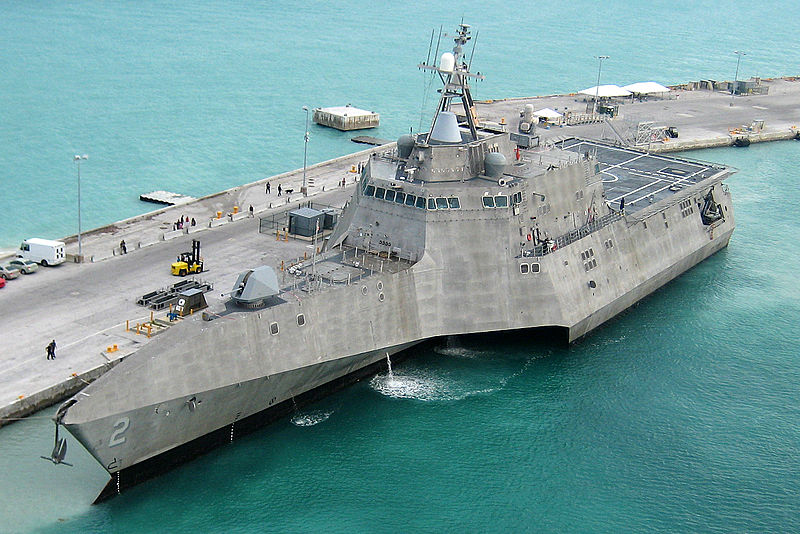
LCS USS Independence (LCS-2)
On yesterday’s Midrats, my co-host mentioned that recently in the Red Sea our Navy has seen the most littoral combat it has in a very long time, but our Littoral Combat Ships are not to be seen. Why? Simple. They cannot conduct combat on the littorals.
This AM, fellow “First LCS Critic” Chapomatic sent me a link to an article from September of last year that I think at the time I made a passing comment on over at X, but did not bring here. Well, let’s fix that.
Why do we need to periodically drag LCS out of the gimp box and hoist her up for all to behold? Simple; as an example to others. We simply cannot afford another CG(X) or DDG-1000 situation with DDG(X) or any other ship we have in the design phase. We have already lost one generation of ship design due to the Age of Transformationalism.
With the Constellation Class FFG we now have building, we are at last taking the course I first suggested in 2006 to correct the error of LCS. That is our version of FREMM that was first commissioned by the French in 2012, a dozen years ago.
LCS was not a problem with our shipbuilding industry or even our design people – though there are areas to critique there. No, this was a people problem, a mindset problem, a culture problem.
It needs to be dragged up regularly. I last did a dedicated post on it back in August 2023. It is time.
As we dive into the details remember this; since the disaster of LCS no senior personnel have yet been held to public account. We have the same acquisition system. We have the same incentives and disincentives as before. Critics of LCS were pushed over to the off-ramp; its most NORK-like advocates promoted.
There is no guarantee this won’t happen again.
Joaquin Sapien at ProPublica and his extensive almost novella – not just an article – on LCS that even opens with a quote of the phrase that first came into the general conversation here on CDR Salamander; The Inside Story of How the Navy Spent Billions on the “Little Crappy Ship”.
Sadly, we did not even get a mention or link – though most of the arguments are the same ones we’ve been making here and on the OB Blog since 2004 – if you spot me six months or so, two decades ago.
Some people have critiques of ProPublica, especially from the right side of the spectrum, but I’m sorry – their critique here is spot on.
It starts right in center mass;
The USS Freedom had its own special place within the armada. It was one of a new class of vessels known as littoral combat ships. The U.S. Navy had billed them as technical marvels — small, fast and light, able to combat enemies at sea, hunt mines and sink submarines.
In reality, the LCS was well on the way to becoming one of the worst boondoggles in the military’s long history of buying overpriced and underperforming weapons systems. Two of the $500 million ships had suffered embarrassing breakdowns in previous months. The Freedom’s performance during the exercise, showing off its ability to destroy underwater mines, was meant to rejuvenate the ships’ record on the world stage. The ship was historically important too; it was the first LCS built, the first in the water, commissioned just eight years prior.
The summary of their findings in spot on, especially the last sentence;
Our examination revealed new details on why the LCS never delivered on its promises. Top Navy leaders repeatedly dismissed or ignored warnings about the ships’ flaws. One Navy secretary and his allies in Congress fought to build more of the ships even as they broke down at sea and their weapons systems failed. Staunch advocates in the Navy circumvented checks meant to ensure that ships that cost billions can do what they are supposed to do.
Both inside and outside the Navy, LCS critics warned two decades ago that 2024 would find the Little Crappy Ship roughly where it wound up
What Makes a Good Book
Lost Art Press
Published Nov 26, 2023✅ Read and subscribe to the Lost Art Press Blog: https://blog.lostartpress.com/
🏪 Visit Our Store: https://lostartpress.com


