
[T]he Nazis’ focus on the threats that risky habits pose to “public health” makes perfect sense in light of their collectivist ideology. “Brother national socialist,” said one bit of Nazi propaganda, “do you know that your Führer is against smoking and thinks that every German is responsible to the whole people for all his deeds and missions, and does not have the right to damage his body with drugs?”
Smith adds: “Clearly there were considerable links between the promotion of particular lifestyles and the racial hygiene movement. Tobacco and alcohol were seen as ‘genetic poisons,’ leading to degeneration of the German people.”
The point, I hasten to add, is not that today’s “public health” paternalists are Nazis. I am not suggesting that everyone who hates smoking is just like Hitler. But there is an unmistakable totalitarian logic to the notion that the government has a responsibility to promote “public health” by preventing us from engaging in activities that might lead to disease or injury. The implication is that we all have a duty to the collective to be as healthy as we can be, an idea the Nazis embraced but one that Americans ought to find troubling.
Jacob Sullum, “So What If Hitler Was an Anti-Smoker?”, Reason Hit and Run, 2004-12-17.
December 5, 2019
QotD: [Literal] Health Nazis
December 2, 2019
A bad IDEA for classroom peace
In Quillette, Max Eden discusses the rise of “room clears” as teachers resort to evacuating classrooms to prevent harm to students from one disruptive one:

Last month, NBC Nightly News aired a segment on the latest classroom-management technique to sweep America’s schools: “room clears”: When a child throws a tantrum that could physically endanger his peers, teachers evacuate all of the other students from the classroom until the troublemaker has vented his rage upon empty desks, tables and chairs. The technique was virtually unheard of five years ago. But 56 percent of surveyed teachers and parents in Oregon now report having experienced a room clear in their or their child’s classroom over the last year.
Surrendering the classroom to a single student: The average reader might well ask why anyone thinks this would be a good idea. Yet the policies that make this approach inevitable have been applauded by a wide range of authorities, from the Southern Poverty Law Center to the Trump-administration’s Department of Education.
The emergence of room clears is a product of several fashionable education-policy trends designed to protect the rights of troubled students, often with little regard for the rights of their classmates. These include the provisions contained in the federal Individuals with Disabilities Education Act (IDEA), which mandates that special-education students be subject to the “least restrictive environment” possible. When it comes to students who are hard of hearing, dyslexic or developmentally delayed, this policy likely has done a great deal of good. But many schools also label disruptive or violent students as having an “Emotional and Behavioral Disability” (EBD). Rather than provide these students specialized attention in separate settings, schools often funnel them into traditional classrooms.
In a national poll, two thirds of surveyed teachers at high-poverty schools reported that there is a student in their classroom who they believed shouldn’t be there; and 77 percent of surveyed teachers report that a small number of disruptive students cause other students to suffer. Unfortunately, IDEA’s provisions don’t adequately account for the rights and interests of general-education students, and teachers typically have little say over who is in their classroom.
Once they are assigned to a traditional class, EBD students can become virtually untouchable as far as discipline goes. Schools are discouraged by federal policy and activist groups alike from disproportionately disciplining students with disabilities — the effect of which is that principals are required to overlook many otherwise unacceptable transgressions. (Two thirds of teachers say that special-education students are treated more leniently than general-education students for the same offenses.) The worst-behaved students effectively are taught that the rules don’t apply to them in the same way they apply to others. Even when misbehavior edges toward violence, EBD students are becoming physically untouchable.
November 18, 2019
“I can’t help but wonder if a large majority of men won’t opt for the conflict-free humanoid over the real thing, with all of our baggage and hormones and mothers-in-law”
In the (US) Spectator, Bridget Phetasy reports on her visit to the factory where Realdolls are made:

One of the sex dolls on offer at Aura Dolls in Mississauga, the first “sex doll brothel” in the Toronto area.
Photo originally published by BlogTO – https://www.blogto.com/city/2019/11/sex-doll-brothel-mississauga/.
The floor is slippery. I guess I shouldn’t be surprised, I’m taking a tour of Abyss Creations, the factory where the “Ferraris of love dolls”, RealDoll and Realbotix, are made. A thin layer of silicone coats almost every surface. A (real) woman in her late twenties, the PR coordinator, Catherine, shows me round. She has the attitude of a hostess at a theme-park restaurant: bored or stoned or maybe both. I’m sure she’s given hundreds of these tours, heard the same dumb jokes a million times and watched us all slap the ass of a doll reluctantly yet instinctively.
[…]
The employees look at the “love dolls” as more than just sexbots. They know their customers want a couch buddy. They want someone to cuddle at night. Perhaps they’ve lost a spouse and don’t feel like dating.
Whitney Cummings logged on to a forum for men who own the sex robots and monitored their conversations for months. “I thought they were going to be creeps, psychopaths,” she says. “I don’t know what to tell you. They’re very lovely men. They’re lovely. They adore their dolls. They marry their dolls. That is happening.”
What strikes me amid the body parts, the rows of eyes, the wall of nipples and the robot “brains”: these aren’t your weird uncle’s sex dolls. With the introduction of AI, these dolls are offering something their predecessors couldn’t: intimacy and affection.
“I always looked at them as art and I always found it funny that because it’s a sexually usable thing, it’s disqualified as art in the higher sense in a lot of people’s minds. They go, ‘Oh that’s not art, that’s just nasty'”, says McMullen. “And what’s funny about that is now we’re doing this serious engineering, artificial intelligence and robotics and now people aren’t so quick to dismiss it.”
Realbotix is the natural evolution of Abyss Creations, the company McMullen started in 1997 (in fact, Abyss Creations made the doll for Lars and the Real Girl). What began as just “real dolls” now has a robotic component, an AI team and an app.
McMullen talks about how he’s always wanted to break free of the sex toy stigma. “Yes people use them sexually, but they also get this huge sense of companionship from having a doll and a robot.”
Fungus rock – the great placebo treasure (and the Mujahideen)
Lindybeige
Published 5 Jun 2015Support me on Patreon: https://www.patreon.com/Lindybeige
The things that people valued and fought over in the past were not as they are now. You might not guess the tremendous significance of one tiny island off the coast of Gozo.
NEWS FLASH (March 8th 2017): the Azure Window, featured in this video, has collapsed into the sea.
More videos from Malta to follow.
Lindybeige: a channel of archaeology, ancient and medieval warfare, rants, swing dance, travelogues, evolution, and whatever else occurs to me to make.
▼ Follow me…
Twitter: https://twitter.com/Lindybeige I may have some drivel to contribute to the Twittersphere, plus you get notice of uploads.
website: http://www.LloydianAspects.co.uk
Fungus rock – the great placebo treasure

November 9, 2019
QotD: British Cookery
Generalising further, one may say that the characteristic British diet is a simple, rather heavy, perhaps slightly barbarous diet, drawing much of its virtue from the excellence of the local materials, and with its main emphasis on sugar and animal fats. It is the diet of a wet northern country where butter is plentiful and vegetable oils are scarce, where hot drinks are acceptable at most hours of the day, and where all the spices and some of the stronger-tasting herbs are exotic products. Garlic, for instance, is unknown in British cookery proper: on the other hand mint, which is completely neglected in some European countries, figures largely. In general, British people prefer sweet things to spicy things, and they combine sugar with meat in a way that is seldom seen elsewhere.
Finally, it must be remembered that in talking about “British cookery” one is referring to the characteristic native diet of the British Isles and not necessarily to the food that the average British citizen eats at this moment. Quite apart from the economic difference between the various blocks of the population, there is the stringent food rationing which has now been in operation for six years. In talking of British cookery, therefore, one is talking of the past or the future – of dishes that the British people now see somewhat rarely, but which they would gladly eat if they had the chance, and which they did eat fairly frequently up to 1939.
George Orwell, “British Cookery”, 1946. (Originally commissioned by the British Council, but refused by them and later published in abbreviated form.)
November 7, 2019
Blanchard’s transsexualism typology
At Quillette, Louise Perry interviews Dr. Ray Blanchard about transsexualism, and his controversial-in-the-LGBT-community typology of transsexualism:

Ray Blanchard, PhD.
Image from his Twitter profile.
Ray Blanchard is an adjunct Professor of Psychiatry at the University of Toronto who specialises in the study of human sexuality, with a particular focus on sexual orientation, paraphilias, and gender identity disorders. In the 1980s and 1990s he developed a theory around the causes of gender dysphoria in natal males that became known as “Blanchard’s transsexualism typology“. This typology — which continues to attract a great deal of controversy — categorizes trans women (that is, natal males who identify as women) into two discrete groups.
The first group is composed of “androphilic” (sometimes termed “homosexual”) trans women, who are exclusively sexually attracted to men and are markedly feminine in behaviour and appearance from a young age. They typically begin the process of medical transition before the age of 30.
The second group are motivated to transition as a result of what Blanchard termed “autogynephilia”: a sexual orientation defined by sexual arousal at the thought or image of oneself as a woman. Autogynephiles are typically sexually attracted to women, although they may also identify as asexual or bisexual. They are more likely to transition later in life and to have been conventionally masculine in presentation up until that point.
Although Blanchard’s typology is supported by a wide range of sexologists and other researchers, it is strongly rejected by most trans activists who dispute the existence of autogynephilia. The medical historian Alice Dreger, whose 2015 book Galileo’s Middle Finger included an account of the autogynephilia controversy, summarises the conflict:
There’s a critical difference between autogynephilia and most other sexual orientations: Most other orientations aren’t erotically disrupted simply by being labeled. When you call a typical gay man homosexual, you’re not disturbing his sexual hopes and desires. By contrast, autogynephilia is perhaps best understood as a love that would really rather we didn’t speak its name. The ultimate eroticism of autogynephilia lies in the idea of really becoming or being a woman, not in being a natal male who desires to be a woman.
I interviewed Blanchard over email and Skype. The text has been lightly edited for clarity.
QotD: Evolved sexual differences
Women co-evolved to try to make themselves look reproductively hot, though that’s not how we think of it. […] Because men are turned on by disembodied photos of boobs, butts, and coochies, they’re quick to pull down their pants, click their cameraphone, and text some woman they just met a close-up of their zipperwurst. Really bad idea.
Men who’ve done this should pick up a Harlequin romance, which is basically porn for women (from the ravishing by some hot gazillionaire to the final commitment-gasm).
See any photo spreads of male crotch shots tucked in there anywhere, boys?
This is not an error of omission. Women aren’t fantasizing about seeing your willy; they’re fantasizing that somebody in the royal family will pluck them out of suburbia and marry them in Westminster Abbey.
Amy Alkon, Good Manners for Nice People Who Sometimes Say F*ck, 2014.
November 6, 2019
Whitewashing the Vikings
Sarah Hoyt notices the way history is being presented to subtly (or not-so-subtly) denigrate the recent past and idealize (some of) the distant past:

Europe According to the Vikings (1000) from Atlas of Prejudice 2 by Yanko Tsvetkov.
Their distortion of history so that everything America ever did is wrong and evil-bad is designed to make our own kids hate their own country and imagine themselves as “citizens of the world” which is to say citizens of nowhere.
Which in turn allows for wide open borders which bring in the population of 3rd world serfs the statists count on to keep them in power forever.
For the last ten years I’ve been disquieted and disturbed by the persistent myth of: Our ancestors were far more cleanly, happy and prosperous than we think. Yep. Your foot-in-the-mud ancestor didn’t suffer under the lash of his feudal overlord. Oh, no. He had hot running water, regular baths, religious holidays off and–
Spits. And the girls sang as they wove garlands on Mayday, I suppose.
Most of these myths are arrant nonsense. Some are arrant nonsense on stilts with a dash of oikophobia thrown in.
I’ve mentioned here that I went to the Viking exhibit at the museum some years back, and it was all about how free and egalitarian the Vikings were, male and female. Which I suppose was true, if you miss the large component of slavery. And the fact that they raided foreign shores for slaves and loot. And that almost every skilled artisan was a slave. And–
Then there is the continuous “The Vikings were much cleaner than the Christians and women preferred them.”
First let’s cut the crap. We have zero clue if women preferred them. When the raiders come to town, they don’t stop to ask thee fleeing women to sign “affirmative consent” forms.
Second, yeah, I’m sure in some Viking villages they were cleaner. We do have have reason to suspect some areas had functioning saunas. But then some of the areas raided had functioning Roman baths still extant.
I’m sure for some times and places, that was true. I’m also absolutely sure that for most times and places the Vikings were about as clean as everyone else, which is to say not very, due to the lack of easy-accessible soap (yes, it existed. In certain times and places. NOT everywhere and not of a kind you’d want to use on your skin) of easily accessible acceptable-temperature water, and/or of warm enough places to bathe in.
No, medieval people weren’t as utterly filthy as it’s imagined (though there were some, I’m sure) but I’m also utterly sure, having experienced this in a temperate climate, that washing in winter would be limited, careful, and therefore maybe not as thorough as we imagine. Or to put it another way, when the Victorians went on about catching a chill, they weren’t just blowing smoke, guys. People didn’t willingly strip down and dip in lukewarm water in the dead of winter and when clothes would take forever to dry, unless they had other clothes, and facilities for getting warm right after.
In other words, Vikings and the rest of the Middle Ages were, from our POV a little wiffy. As were most places until the late 20th century.
So why the cleanly and perfumed Vikings (Particularly since the records of the time don’t support this view, except in very few, highly publicized circumstances?)
Oh, that’s the “don’t go imagining Christians were better” wing of the oikophobe chorus. They will tell us Christians were filthy. The pagans, on the other hand, were cleanly and perfumed.
Weirdly the one people we know were cleaner than Christians, also more literate and prone to less domestic violence never come in for praise in these comparisons. I suspect being part of the foundational build of the West, the Jews aren’t considered “wonderfully other” enough. Or given some of the recent bs on the left and the people they embrace, perhaps it’s a hate thing.
BTW that Christians being filthy is bullshit. Later on, in defense of “but medieval people weren’t that filthy” they’ll bring in the injunction to change your underwear daily. Which is more than a little confusing when you researched the heck out of “underwear use” in various places in the renaissance and know most women at least wore none. Eventually you find out the injunction to change underwear was in monasteries. Monk’s orders in fact, also had various guidelines on cleanliness which, for their time, were amazingly enlightened. Even if, yes, by our standards, they were all a bit wiffy.
The same applies to a ton of other things. These revisionists tell us they ate better than we think, oh, and by the way, except for infant mortality they lived as long as we do.
All this is insanity on stilts.
October 15, 2019
QotD: Over-protected children become insecure adults
Jonathan Haidt, quoted by Naomi Firsht, “The Fragile Generation”, Spiked, 2017-08-31.
October 4, 2019
“Economics is … the science of not being able to have your cake and eat it”
Philip Booth on Greta Thunberg’s message and its economic over-simplifications:
In many senses, economic problems are more complex than scientific problems and Thunberg is, implicitly at least, pronouncing on economic matters. Whilst knowledge about climate science is uncertain, a judgement has to be and can be made on the balance of evidence. But economic decisions involve trade-offs. Economics is, as Lionel Robbins put it, the science of not being able to have your cake and eat it. We cannot both decrease carbon emissions hugely and enjoy standards of living increasing at the rate that would have been possible if emissions were not reduced.
It is tempting the believe the green rhetoric that we will all have fluffy green jobs and a green standard of living without any hardship from reducing emissions. We cannot. Reducing carbon emissions quickly to zero means that we will have much less of everything else. We might prefer decarbonisation to other goods and services, but it is not a cost-free choice. We considering this, we should remember that the average income in the UK is ten times the average income in the rest of the world. When other people face these trade-offs the sacrifice of decarbonisation is that much greater.
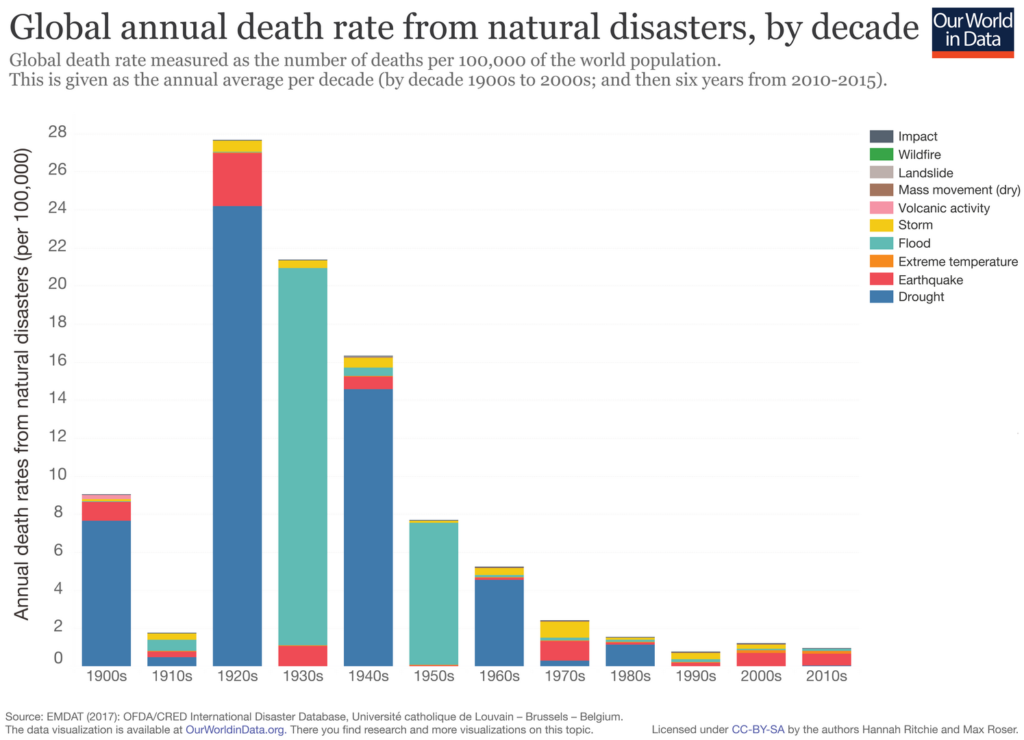
One of the advantages of being richer is that we are more resilient to natural disasters. It follows from this that there is a trade-off between decarbonisation, which might lead to fewer natural disasters, and our ability to cope with them, which might reduce if we become less rich. As we have become richer, deaths from natural disasters have plummeted. The figure shows the fall in deaths in natural disasters over the last century – they have reduced by, perhaps, 90 per cent.
The use of air conditioning illustrates this trade-off in a rather stark way. In a letter on the environment written by Pope Francis in 2015 called Laudato si, the pontiff strongly criticised the adoption of air conditioning in the strongest terms. An academic paper on air conditioning in the US produced such remarkable results that the abstract is worth quoting at length:
“the mortality effect of an extremely hot day declined by about 80% between 1900-1959 and 1960-2004. As a consequence, days with temperatures exceeding 90°F were responsible for about 600 premature fatalities annually in the 1960-2004 period, compared to the approximately 3,600 premature fatalities that would have occurred if the temperature-mortality relationship from before 1960 still prevailed. Second, the adoption of residential air conditioning (AC) explains essentially the entire decline in the temperature-mortality relationship. In contrast, increased access to electricity and health care seem not to affect mortality on extremely hot days.”
Air conditioning leads to higher carbon emissions and, most likely, higher global temperatures. But the increase in resilience arising from air conditioning is astonishing – it has led to an 80 per cent drop in deaths from heat.
September 11, 2019
QotD: Male versus female social structure
Female social structure is more fluid. It’s based more on group identity than on individual characteristics. You tend to have one woman who is kind of in charge, your queen bee as it were. Those in her favor circle around her, and the circles continue outward until you have the women who are not part of the group. They aren’t at the bottom of the pile, they pretty much don’t exist. At least, if they’re lucky they don’t. One’s position in the social hierarchy can change at any time, to include who the queen bee is. Remember the scene in Mean Girls where Regina tries to sit at the lunch table with the other plastics but isn’t wearing the right color clothes? She was just knocked out of her position in the social hierarchy.
In a social structure like this, there’s no room for difference of opinion or people who stand out too much. If an individual, even by noncompliance, threatens the group identity; she will gain the ire of the entire group. They will hunt her without mercy until she complies with the demands of the group, is removed from their reach by either death or physical distance (which is getting much harder with the internet), or manages to win enough females to her side to either form a new group around her or replace the existing leader. The last option allows her to push her standard on the group as a whole. There is no option to live and let live. In other words, female social structure is closer to the Borg than the complex world we currently enjoy.
I can already hear the cries of, “But women aren’t violent!” If you’re talking about direct violence, you’re mostly right. Women are not men, and we don’t hunt in the way that men do. Our weapons are usually words and emotions, not direct violence. Instead of a brawl in which two people fight it out and determine which is the strongest, you’re looking at extreme emotional abuse for anyone who is outside the group and unlucky enough to have their attention. Emotional abuse attacks a person in the most deeply personal of ways, and the scars it creates are more damaging than the physical scars of a beating. We wonder why girls who stand out grow so bitter, but if you’re a little too pretty or a little too different, other girls swarm on you and rip you apart with constant emotional abuse. They attack who you are at the base of your being, your very self-perception. This is why you see truly beautiful women who struggle to see their worth. Other girls have been ripping into them since the nursery, and it only gets worse as they get older. Boys court you and try in their awkward boyish way to get your attention, but you’re mostly convinced that it’s a cruel joke they’re playing on you, because of course you aren’t pretty or smart or special. The scars run deep and never fully heal.
“outofthedarkness”, guest posting at According to Hoyt, 2017-08-09.
September 10, 2019
We’ve noticed this too…
Sarah Hoyt on the increasing “green-ness” of her appliances — and the increasing uselessness of same:
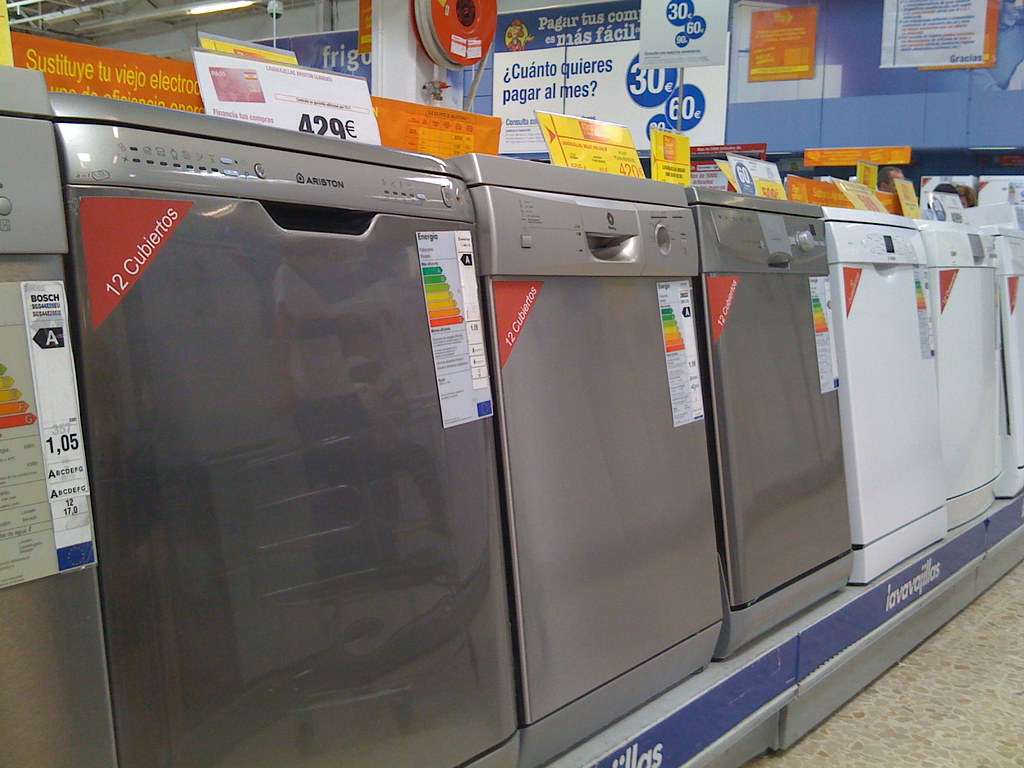
“A-rated energy appliances” by Tom Raftery is licensed under CC BY-NC-SA 2.0


For years we got expensive front loaders, and yet our clothes kept smelling, there were stains that would not come out, and these things seemed to last only 5 years, on the outside. And I knew it wasn’t our problem, as such, because at the same time we started noticing we couldn’t get our clothes clean, the detergent aisle of the supermarket sprouted an entire section of odor removing things, Febreeze got added to detergents, and, in general, people smelled odd …
Then the washer broke while we were also very, very broke (we were paying mortgage and rent in the run up to buying this. I saw an ad for, I THINK a $300 washer, and we went to look. What we found, instead, was a $200, not advertised washer. As we’re looking at it the saleswoman hurries over and tells us we don’t want it. This washer, she says, uses lots of water. For those who don’t know I suffer from an unusual form of eczema. While it’s triggered mostly by stress with a side of carbs, it can also, out of the blue, take offense at a slight trace of detergent left on the clothes. I’ve found that the eczema got markedly worse the less water the washer used. And it required me to run the washer three times, once with soap and two without to avoid major outbreaks. The idea of using lots and lots of water was great, so I was all excited. Which shocked the poor saleswoman halfway to death. I will point out, though, though that this washer washes well enough I can get away with only one extra rinse cycle and if I forget it it’s usually survivable. Also, our clothes don’t smell. Unfortunately, we’ve not found that [type] of washer any of the times we’ve walked through the appliance aisle, so I think that choice has been eliminated.
Certainly the choice of dishwashers that use “lots” (i.e. what they used 20 years ago) of water and electricity was never offered to us. And since we seemed to have really lousy luck with dishwashers, I found every time we replaced one over the last 20 years, they had less space for dishes (more insulation, to allow for less electricity) to the point that I needed to do 3 or even 4 loads for a family of four. I mean, I cook from scratch, but I really don’t use that much stuff. And it ran slower than before. Right now our dishwasher actually washes (a bonus) but it takes four hours to run a cycle. I rarely do more than one wash a day, though, because it’s just Dan and I, and we … well … the kids used a lot more glasses and little plates, and frankly meals get more complicated for four people.
All the same, there was a time there, for like 10 years, where we were running all this “green” approved stuff, and not only was I running the washer and drier more or less continuously, but to make things more “interesting” I was using MORE water and electricity, in the sense that I was running the appliances a ton more.
This of course is what I also found with the “low flush” toilets. We had them in our previous house, and we found that we spent an inordinate amount of time flushing the toilet. Also, since it took four or five flushes to do the job or one, the fact we were actually only using half the water per flush didn’t save any water. We spent instead twice to three times the amount of water the “high flush” toilets had spent.
All this, btw, to appease Paul Ehrlich — the prophet of wrong. As in, if he foresees something it will be wrong — and his ridiculous idea we’d run out of potable water in 1978. Apparently none of these people have noticed that 1978 has come and gone with no problems. And as for electricity, if they stop their idiocy about nuclear, it’s not even a consideration. (And no, Chernobyl isn’t a caution about nuclear energy. It’s a caution about stupid communist regimes. They can’t run anything — not even a nuclear plant — without destroying it.)
Lightbulbs are another favourite … several years back, our provincial government was pushing us all to get rid of our old incandescent bulbs and replace them with these great new energy-efficient compact fluorescent bulbs. The new CFLs cost roughly ten times as much as the old bulbs, but we were assured up and down that they’d last twenty times longer, so we’d not only save money on electricity, but also have to replace the bulbs so infrequently. Of course, the CFL bulbs were pathetically bad — not only were they expensive, the light they gave was (at best) marginal and they didn’t even last as long as typical incandescent bulbs.
So now, of course, we’re being encouraged to use LED bulbs. Sure, they’re more expensive than the old incandescent bulbs, but they save on electricity and last many times longer! Except, of course, they don’t. The old incandescent bulbs in my office started to fail one after another, so when I was down to only one working bulb, I gave in and bought four replacement LED bulbs … they were on sale for only 2-3 times as much as the old bulbs! That was in March. I’ve already had to replace two of the LED bulbs. This is starting to feel familiar…
On the bright side (pun unintentional), the LED bulbs don’t provide the entertainment of a toxic waste cleanup in your home the way the CFL bulbs did when they were broken.
July 24, 2019
Wait, you mean there might be a downside to cannabis legalization?

As a libertarian of long standing, I’m on the record as being in favour of legalizing cannabis since long before it was cool (geeky and perpetually uncool libertarians probably helped keep it from being cool for at least a few years longer). I’m not enthused to hear that we may have been undersold on the risks of cannabis use … not that the government didn’t try telling is it was deadly, deadly poison (they did, repeatedly, and at great length), but they institutionalized the role of the boy who cried wolf, and every illegal narcotic got basically the same description. I’m actually not kidding here: the first health class I got in middle school included a lecture and a pamphlet on the dangers of pot; the second class covered the dangers of cocaine; the third warned against LSD; and so on … but they used a copy/paste to discuss the physical and mental risks of the different drugs, and they all read the same way. All those evil drugs are evil, bad, and rot your brain. Knowing that the pothead (“Hi, Gary!”) at the back of the class hadn’t suddenly had a psychotic break and tried to fly off the top of the school was the first hint that we were being oversold on the real world risks of (some) illegal drug use. The declared fact that some illegal narcotics actually are deadly, deadly poison ran up against the observed fact that a significant majority of people over the age of fifteen had tried cannabis and found it somewhat less scary than advertised.
Along with the beginnings of doubt that the government was being honest with us, and the clear understanding that even if using drugs wasn’t as dangerous as we were told, we shared a growing awareness that being caught with drugs by the police was significantly more dangerous and possibly deadly. Officer Friendly would shoot you down like a mad dog if he thought you were one’o’them drug-crazed hippies. It certainly changed the social dynamics of any interaction with Officer Friendly’s fellow heavily armed co-workers…
In the National Post, Barbara Kay suggests that not all the dangers of cannabis use were mere government propaganda:
Some years ago, in conversation with his wife, a forensic psychiatrist specializing in mentally ill criminals, former New York Times reporter Alex Berenson observed that the perpetrator of a recent violent crime had been high at the time, and had smoked pot regularly all his life. Her response — “Yeah, they all do” — jolted him. The result was his book, Tell Your Children: The Truth About Marijuana, Mental Illness and Violence.
Much of the referenced material in Berenson’s book had not yet been published a decade ago. But more recent studies only confirm what a few intrepid researchers were already warning about then.
Indeed, as I noted in a 2008 column, the head of the Medical research Council in the U.K., Professor Colin Blakemore, who in 1997 had been the moral authority behind a pot-legalization campaign, unequivocally reversed his pot-friendly stance in 2007, stating: “The link between cannabis and psychosis is quite clear now; it wasn’t 10 years ago.”
If you haven’t energy for a whole book, but would invest in 16 pages on the subject, you will be well rewarded by Steven Malanga’s in-depth article, “The Marijuana Delusion,” in City Journal‘s June issue. Here you will find debunked the blithe claim, still received as gospel by progressives and libertarians, that pot is virtually harmless and even therapeutic.
Unlike marijuana, real medications are deeply researched before coming on the market, and may attest to proven benefits, but are obligated to admit potential harms. Is pot a medicinal drug or a placebo? Nobody really knows. One may argue “who cares, as long as it works” (anecdotally I hear that pot works, and also that it doesn’t work), but that isn’t the point, since the legalization movement made medical claims for pot in order to bring the public onside politically. There was no will on the movement’s side to discover even radically fortified pot’s downsides.
The knowledge was out there for those interested. In 1987 a study of nearly 50,000 Swedish military conscripts followed for drug use over 15 years found that frequent pot use in teenhood was linked to a six-fold risk of schizophrenia as compared with non-usage. A 2004 meta-analysis of studies on pot use came to a similar conclusion. These studies, and others, are suggestive that heavy marijuana consumption, particularly in youth, may cause serious mental health problems. Yes, it is possible that the link isn’t entirely causal; people with mental health issues may be more likely to use marijuana heavily. But at the very least, this ought to be an issue of ongoing concern, particularly now that marijuana is legal in Canada and in an increasing number of U.S. states.
July 21, 2019
The humble egg – wonder food or deadly poison?
If you’ve paid any attention to popular reporting on nutrition studies over the years, you’ll have noticed how just about any advice on food has not only changed, but has often been completely the opposite of advice offered just a few years earlier. During my teenage years, the egg was pushed (thanks in part to the “Egg Marketing Board”, one of Canada’s supply management bureaucracies) as “the perfect food”. During the next decade, as newer nutrition studies were published, suddenly the wonderful, nutritious egg was now a huge risk to your cardiovascular health and even one egg per week might be enough to kill you. Rinse and repeat for so many other foods and you either stop eating altogether or, more sensibly, stop paying any attention at all to mainstream media interpretations of nutrition studies.

It’s been a tortuous path for the humble egg. For much of our history, it was a staple of the American breakfast — as in, bacon and eggs. Then, starting in the late 1970s and early 1980s, it began to be disparaged as a dangerous source of artery-clogging cholesterol, a probable culprit behind Americans’ exceptionally high rates of heart attack and stroke. Then, in the past few years, the chicken egg was redeemed and once again touted as an excellent source of protein, unique antioxidants like lutein and zeaxanthin, and many vitamins and minerals, including riboflavin and selenium, all in a fairly low-calorie package.
This March, a study published in JAMA put the egg back on the hot seat. It found that the amount of cholesterol in a bit less than two large eggs a day was associated with an increase in a person’s risk of cardiovascular disease and death by 17 percent and 18 percent, respectively. The risks grow with every additional half egg. It was a really large study, too — with nearly 30,000 participants — which suggests it should be fairly reliable.
So which is it? Is the egg good or bad? And, while we are on the subject, when so much of what we are told about diet, health, and weight loss is inconsistent and contradictory, can we believe any of it?
Quite frankly, probably not. Nutrition research tends to be unreliable because nearly all of it is based on observational studies, which are imprecise, have no controls, and don’t follow an experimental method. As nutrition-research critics Edward Archer and Carl Lavie have put it, “‘Nutrition’ is now a degenerating research paradigm in which scientifically illiterate methods, meaningless data, and consensus-driven censorship dominate the empirical landscape.”
Other nutrition research critics, such as John Ioannidis of Stanford University, have been similarly scathing in their commentary. They point out that observational nutrition studies are essentially just surveys: Researchers ask a group of study participants — a cohort — what they eat and how often, then they track the cohort over time to see what, if any, health conditions the study participants develop.
H/T to Marina Fontaine for the link.
July 20, 2019
QotD: Spices
Several lines of evidence indicate that spicing may represent a class of cultural adaptations to the problem of food-borne pathogens. Many spices are antimicrobials that can kill pathogens in foods. Globally, common spices are onions, pepper, garlic, cilantro, chili peppers (capsicum) and bay leaves. Here’s the idea: the use of many spices represents a cultural adaptation to the problem of pathogens in food, especially in meat. This challenge would have been most important before refrigerators came on the scene. To examine this, two biologists, Jennifer Billing and Paul Sherman, collected 4578 recipes from traditional cookbooks from populations around the world. They found three distinct patterns.
1. Spices are, in fact, antimicrobial. The most common spices in the world are also the most effective against bacteria. Some spices are also fungicides. Combinations of spices have synergistic effects, which may explain why ingredients like “chili power” (a mix of red pepper, onion, paprika, garlic, cumin and oregano) are so important. And, ingredients like lemon and lime, which are not on their own potent anti-microbials, appear to catalyze the bacteria killing effects of other spices.
2. People in hotter climates use more spices, and more of the most effective bacteria killers. In India and Indonesia, for example, most recipes used many anti-microbial spices, including onions, garlic, capsicum and coriander. Meanwhile, in Norway, recipes use some black pepper and occasionally a bit of parsley or lemon, but that’s about it.
3. Recipes appear to use spices in ways that increase their effectiveness. Some spices, like onions and garlic, whose killing power is resistant to heating, are deployed in the cooking process. Other spices like cilantro, whose antimicrobial properties might be damaged by heating, are added fresh in recipes.
Thus, many recipes and preferences appear to be cultural adaptations adapted to local environments that operate in subtle and nuanced ways not understood by those of us who love spicy foods. Billing and Sherman speculate that these evolved culturally, as healthier, more fertile and more successful families were preferentially imitated by less successful ones. This is quite plausible given what we know about our species’ evolved psychology for cultural learning, including specifically cultural learning about foods and plants.
Among spices, chili peppers are an ideal case. Chili peppers were the primary spice of New World cuisines, prior to the arrival of Europeans, and are now routinely consumed by about a quarter of all adults, globally. Chili peppers have evolved chemical defenses, based on capsaicin, that make them aversive to mammals and rodents but desirable to birds. In mammals, capsicum directly activates a pain channel (TrpV1), which creates a burning sensation in response to various specific stimuli, including acid, high temperatures and allyl isothiocyanate (which is found in mustard or wasabi). These chemical weapons aid chili pepper plants in their survival and reproduction, as birds provide a better dispersal system for the plants’ seeds than other options (like mammals). Consequently, chilies are innately aversive to non-human primates, babies and many human adults. Capsaicin is so innately aversive that nursing mothers are advised to avoid chili peppers, lest their infants reject their breast (milk), and some societies even put capsicum on mom’s breasts to initiate weaning. Yet, adults who live in hot climates regularly incorporate chilies into their recipes. And, those who grow up among people who enjoy eating chili peppers not only eat chilies but love eating them. How do we come to like the experience of burning and sweating — the activation of pain channel TrpV1?
Research by psychologist Paul Rozin shows that people come to enjoy the experience of eating chili peppers mostly by re-interpreting the pain signals caused by capsicum as pleasure or excitement. Based on work in the highlands of Mexico, children acquire this gradually without being pressured or compelled. They want to learn to like chili peppers, to be like those they admire. This fits with what we’ve already seen: children readily acquire food preferences from older peers. In Chapter 14, we further examine how cultural learning can alter our bodies’ physiological response to pain, and specifically to electric shocks. The bottom line is that culture can overpower our innate mammalian aversions, when necessary and without us knowing it.
Joseph Henrich, The Secret of Our Success: How Culture Is Driving Human Evolution, Domesticating Our Species, and Making Us Smarter, 2015.


