Quotulatiousness

October 10, 2014

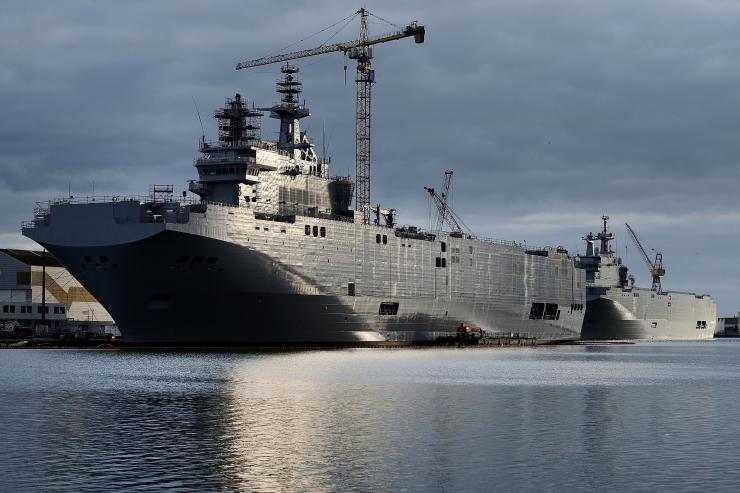
Russian Mistral-class ships still on schedule for delivery from French shipyard

Filed under: Europe, France, Military, Russia — Tags: , , — Nicholas @ 09:24

In the Guardian, Ariane Chemin reports from the Saint Nazaire dockyard where the Mistral-class helicopter assault ships Vladivostok and Sebastopol are still being readied for transfer to Russian control:

The contract to built the ships was signed by President Nicolas Sarkozy in 2011, long before Putin showed any signs of attacking Ukraine, annexing Crimea or encouraging secession by the predominantly Russian-speaking self-styled republics of Donetsk and Luhansk, well before a ground-to-air missile brought down a Malaysia Airlines plane in July. But Hollande has no wish to go back on a contract worth €1.2bn ($1.5bn). At the beginning of September, on the eve of the Nato summit in Wales, Hollande announced France could not go ahead with the Vladivostok’s delivery to Russia, citing Moscow’s actions in eastern Ukraine. However the partial ceasefire in mid-September meant the French permitted the ship to begin its sea trials.

At the Nato headquarters in Brussels, member states are flabbergasted that France should be selling warships to a country that is threatening their security. In Washington Barack Obama is furious too.

Only in Saint Nazaire, Brittany, do they seem happy about the presence of the “Sebass” and “Vladi”, nicknames that reflect the locals’ attachment to their cumbersome guests. Russian sailors arrived at the end of June. They boarded the Smolny, their training ship, at Kronstadt, and it remains moored near the lock gates. Prefabricated huts on the quayside serve as classrooms for the cadets. Nets have been strung along the port side of the Smolny, to stop divers coming too close to the old ship, built in Szczecin, Poland, in 1976. “That thing wouldn’t be seaworthy in a gale,” says a naval veteran on the port.

[…]

In town, the cadets stand out on account of their extreme youth, blond hair and unbranded T-shirts. They buy cigarettes, have a couple of beers in a bar, pick up a six-pack at the supermarket near the shipyard, but avoid anything stronger. “Vodka here is an outrageous price,” says Mykola, a Ukrainian boilermaker building a cruise liner. At Le Skipper, the nearest brasserie, the sailors go online and Skype their girlfriends back home. Krystof, the Polish proprietor, speaks Russian. He acts friendly but there is “never any mention of the boats”. Even over a drink the Sebass and the Vladi are no-go areas when talk in Saint Nazaire turns to politics. The priority is jobs. “Without the shipyard, Saint Nazaire would just be a dilapidated suburb of [nearby seaside resort] La Baule,” says Jean Rolin, a local writer.

One Sunday in September, a small crowd of about 50 demonstrators gathered on the quay at the stern of the Vladivostok, waving Ukrainian flags and sporting badges marked “#No Mistral for Putin”. They were led by Bernard Grua, a businessman from Nantes, who has been campaigning, almost single-handed, against the sale of the assault ships to Moscow. His supporters know the capabilities of the vessel off by heart. A Mistral can carry 750 soldiers, 16 helicopters, Leclerc tanks, amphibious assault and landing craft, they recite. With Google maps they explore, one by one, Ukraine’s strategic ports. “The Germans flattened your town,” says Grua, for the benefit of the people of Saint Nazaire. “But when the Mistrals attack Mariupol, with Made in France written all over them, the people who didn’t protest will count as collaborators.”

If only we could call it what it really is – a “police action”

Filed under: Cancon, Middle East, Military — Tags: , , , , — Nicholas @ 08:03

In Maclean’s, Colby Cosh laments the fact that once again we can’t call something by its obvious name, thanks to criminal misuse of the correct description in previous, ah, “kinetic actions”:

It seems to me the PM would have an easier time pitching the fight against Islamic State if he could call it what it really is: a police action. Politicians abused that term as a legalistic euphemism in the previous century, and now it cannot credibly be used to describe a military intervention. War is war is war. And war really does have a tendency to behave that way — to turn nations into that little old lady who unexpectedly finds herself having to scarf down an entire horse.

But a little policing by the world hegemon and its allies is recognizably just what is needed here. Islamic State calls itself a “state,” but it is really a gang attempting to become a state, a gang that has developed vast, nihilist ambitions.

Thomas Mulcair babbled in the House of Commons about how Islamic State is really just the same buncha jerks that Americans and their Iraqi client government have been jostling with for a decade. He is right, in the narrow sense that some of the people are the same. But he appears not to have noticed that these particular jerks have captured an astonishing amount of advanced military hardware, obtained a monopoly of force within thousands of square miles of territory, and recruited dozens of Canadians and hundreds of Westerners, some of them not even Muslim.

They have accomplished most of this by means of sheer bravado and imagemaking, and it is easy to imagine the regret this moment might inspire later, if it is missed. The Canadian opposition’s argument is that if we cannot in some sense subject Islamic State to total defeat or annihilation, we should not be putting lives at risk at all — even if the lives are few and the risk quite small. There is an unfortunate pro-war/anti-war binariness to all this, particularly since Canada is not proposing to go to war against another state, but is assisting allies in suppressing glorified banditry. Activity like this has become hard for us to comprehend, even though it is the stuff of our own imperialist history.

If you polled Canadians under 25, you’d probably discover that many of them honestly believe Canada has never been a warmaking country, and that blue-helmet-wearing Canadian soldiers were only in Europe in 1914-18 and 1939-45 as peacekeepers (if they even know Canada was involved in the two world wars).

October 8, 2014

Russia’s oldest warship being moved to shipyard for restoration work

Filed under: History, Military, Russia, WW1 — Tags: , , , , — Nicholas @ 08:56

From the Wikipedia page:

Aurora (Russian: Авро́ра, tr. Avrora; IPA: [ɐˈvrorə]) is a 1900 Russian protected cruiser, currently preserved as a museum ship in St. Petersburg. Aurora was one of three Pallada-class cruisers, built in St. Petersburg for service in the Pacific Far East. All three ships of this class served during the Russo-Japanese War. The Aurora survived the Battle of Tsushima and was interned under U.S. protection in the Philippines, eventually returned to the Baltic Fleet. The second ship, Pallada, was sunk by the Japanese at Port Arthur in 1904. The third ship, Diana, was interned in Saigon after the Battle of the Yellow Sea. One of the first incidents of the October Revolution in Russia took place on the cruiser Aurora.

[…]

During World War I Aurora operated in the Baltic Sea performing patrols and shore bombardment tasks. In 1915, her armament was changed to fourteen 152 mm (6 in) guns. At the end of 1916, she was moved to Petrograd (the renamed St Petersburg) for a major repair. The city was brimming with revolutionary ferment and part of her crew joined the 1917 February Revolution. A revolutionary committee was created on the ship, with Aleksandr Belyshev elected as captain. Most of the crew joined the Bolsheviks, who were preparing for a Communist revolution.

At 9.45 p.m on 25 October 1917 (O.S.) a blank shot from her forecastle gun signaled the start of the assault on the Winter Palace, which was to be the beginning of the October Revolution. In summer 1918, she was relocated to Kronstadt and placed into reserve.

October 7, 2014

Israel’s “Battlefield Internet” at work

Filed under: Middle East, Military, Technology — Tags: , , , , — Nicholas @ 14:49

Strategy Page talks about the Israeli deployment of the first reliable Battlefield Internet for ground, sea, and air combat:

The July-August 2014 war in Gaza created some very unpleasant surprises for Hamas, which thought it could risk another war with Israel and come out the winner (to the Arab world at least). Hamas knew that Israel had been working at discovering and countering Hamas tactics, but Hamas was confident they had enough new tricks to stay ahead of the Israelis. Hamas quickly discovered that the Israelis were a lot quicker and better coordinated than in the past. This time around the Israelis learned more from their earlier clashes with Hamas and Hezbollah.

This has happened before, to both the Israelis but mainly to the Arabs. It was only after that war ended that Hamas learned details of what they were up against. It turned out that Israel had managed to create an effective and reliable “Battlefield Internet”. This has been the goal of military communications experts for over a decade. The United States was long the leader, but in mid-2014 Israel was the first to demonstrate a Battlefield Internet that consistently worked under combat conditions. This breakthrough development was largely ignored by the media but military leaders worldwide are paying attention.

[…]

What the Israelis have done with the Battlefield Internet is link everyone involved (pilots, UAV operators, tank commanders and infantry unit commander, plus people at C4i Teleprocessing Branch that managed the flow of data) so all can all see was what each other was seeing of the Hamas commandos. These multiple views eliminated the uncertainty often present when only one view was available. It made all the Israelis involved more confident and that led to speedier interpretation of the situation and decisive action to deal with it. This capability also reduces the risk of friendly fire.

October 5, 2014

RCAF deployment to Iraq

Filed under: Cancon, Middle East, Military — Tags: , , , , — Nicholas @ 09:38

In the Toronto Star, Bruce Campion-Smith and Les Whittington report on the debate in the Commons over sending RCAF aircraft to join the coalition against ISIS:

Canadian fighter pilots will be in combat for the second time in three years after Prime Minister Stephen Harper announced CF-18 jets are being dispatched to the region to battle Islamic State militants.

Political lines were quickly drawn over the planned six-month mission, with the New Democrats and Liberals telling the Commons in a dramatic standoff Friday that they would oppose the military operation when MPs debate and vote on it Monday.

But the government’s motion to deploy the Royal Canadian Air Force as part of the United States-led coalition confronting Islamic State fighters is expected to be approved by the Conservative majority in Parliament.

Speaking to a hushed Commons, Harper laid out the case for war against Islamic State — or Islamic State of Iraq and the Levant (ISIL), an Al Qaeda splinter group — for “unspeakable atrocities” and which has threatened Canada.

“Let me be clear on the objectives of this intervention. We intend to significantly degrade the capabilities of ISIL,” Harper said.

Up to six CF-18 fighter jets will be deployed to the region to join in coalition airstrikes against Islamic State targets in Iraq and possibly Syria. As well, Canada will contribute one CC-150 Polaris air-to-air refuelling aircraft and two CP-140 Aurora surveillance aircraft. In all, 320 aircrew and other personnel will take part in the mission.

The opposition NDP and Liberal leaders quickly spoke against the action.

NDP Leader Tom Mulcair said the Conservatives have not given Canadians adequate information on how this war would be conducted.

“Will Canada be stuck a decade from now mired in a war we wisely avoided entering a decade ago?” he asked in the Commons.

“The tragedy in Iraq and Syria will not end with another western-led invasion in that region. . . . Canada, for our part, should not rush into this war.”

Liberal Leader Justin Trudeau said his party — which had backed military action in Afghanistan and Libya — would not support the motion endorsing combat.

Trudeau was dismissive of Canada’s contribution, saying the country could do more than sending what he branded “aging warplanes.”

“Whether they are strategic airlifts, training or medical support, we have the capabilities to meaningfully assist in a non-combat role in a well defined international mission,” Trudeau said.

Update: Lieutenant General Yvan Blondin responds indirectly to Trudeau’s dismissive description of the CF-18 (republished at the Ottawa Citizen).

As the Commander of the Royal Canadian Air Force (RCAF) and CF-18 pilot, I wish to dispel any questions pertaining to the relevance of the CF-18. I am completely confident in the ability of the aircraft and personnel to extend Canadian air power anywhere in the world, such as in support of the current air operations underway in Iraq.

The aircraft we fly today have been continuously upgraded throughout their lifespan, ensuring that our crews can fly into harm’s way with the confidence that they have the equipment they need to complete missions safely. Our RCAF personnel and aircraft have proven that they can fight alongside our Allies — they are battle hardened, and the capabilities of our CF-18s today certainly enable them to effectively serve alongside the fighter aircraft being flown by Allies in the fight against ISIL.

October 4, 2014

Venerable Carl Gustav gets a major upgrade

Filed under: Military, Technology, Weapons — Tags: , , — Nicholas @ 00:02

Nicholas de Larrinaga reports for Janes 360 on the latest version of my favourite recoilless rifle:

Saab debuted a new variant of its Carl Gustaf 84 mm shoulder-fired recoilless rifle, the M4, during a series of demonstration firings at the Bofors Test Center at Karlskoga, Sweden, on 24 September.

The latest version of the nearly 70-year-old weapon system has been designed to offer significant weight savings over its predecessors, as well as improvements to other aspects of the system.

The M4 weighs 6.7 kg, some 3 kg lighter than the earlier Carl Gustaf M3 and half the weight of the 14.2 kg M2 version still in service with many nations. This has been achieved by constructing the recoilless rifle’s barrel out of titanium, saving 1.1 kg (compared to the M3’s steel barrel), building its outer casing our of carbon fibre (saving 0.8 kg), and by redesigning the weapon’s venturi to save a further 0.9 kg. The redesign has also served to decrease the size of the Carl Gustaf, bringing the M4’s total length down to under 1,000 mm.

Saab Dynamics Carl Gustaf M4 84 mm recoilless rifle (Saab)

Saab Dynamics Carl Gustaf M4 84 mm recoilless rifle (Saab)

There are currently 11 different ammunition types available for the Carl Gustaf weapon system, providing considerable operational flexibility. Programmable ‘smart’ ammunition types for use with the M4 are expected to be the next to reach the market. Saab officials also disclosed they are working on a new concept of ammunition for the Carl Gustaf: and ‘Ultra-Light Missile’ that would feature lock-on before launch guidance, feature several attack modes, and have a range of 1,500-2,000 m – approximately doubling the range of the existing Carl Gustaf ammunition types.

October 3, 2014

Tour the only surviving WW2 Royal Navy destroyer with Google Maps

Filed under: Britain, History, Military — Tags: , , — Nicholas @ 00:02

This is rather cool:

HMS Cavalier virtual tour (via Google Maps)

HMS Cavalier virtual tour (via Google Maps)

CInsideMedia has done it again with exclusive access to the Royal Navy destroyer HMS Cavalier at the Historic Dockyard, Chatham.

The class C/A destroyer celebrated her 70th anniversary on 5th April 2014, having served during World War II and then subsequently being refitted in 1957 to remove the mid-ship torpedoes and replacing them with anti-submarine squid mortars.

Following on from the massive success of CInsideMedia’s Google Maps Business View tour of HMS Ocelot, The Historic Dockyard Chatham is making it possible for anyone in the world to ‘virtually visit’ this National Destroyer Memorial and last surviving Royal Navy Second World War Destroyer.

Over two days of exclusive access, the CInsideMedia team were guided around the destroyer by the Dockyard’s Scott Belcher (Duty Manager: Visitor Operations, Security and Health and Safety) and Chris Tutt (Marketing).

The team captured over 350 panoramas meticulously capturing almost every deck of the 363 ft, 1.7 ton former Arctic Convoy vessel, including the gear room and engine room which are normally only accessible on special request due to Health & Safety and limited accessibility.

October 2, 2014

On national defence, don’t listen to Harper’s words – watch his actions

Filed under: Cancon, Government, Military — Tags: , , , , — Nicholas @ 09:28

At The 3Ds Blog, Jack Granatstein explains why the Canadian Forces are once again being starved of funding:

A few years ago I wrote that no government since that of Louis St Laurent in the 1950s had done more to improve the defence of Canada than Stephen Harper’s Conservatives. The St Laurent Liberals built up the armed forces to deal with the war in Korea and with the defence of North America and western Europe in the face of Soviet expansionism. At its peak, the defence budget took more than seven percent of Canada’s Gross Domestic Product, and the army, navy, and air force had as many as 120,000 men and women in the regular forces.

No one could expect any government in this century to spend on that scale, but the Conservative government did treat defence well in its first years in power. The commitment to the Afghan War, never very popular, was handled capably, and the troops received everything they needed — helicopters, new artillery, upgraded armoured personnel carriers, and tanks, not to mention new transport aircraft. The number of regulars rose slowly and slightly toward 65,000, and the government presented a schematic Canada First Defence Policy in 2008 that listed a range of objectives and equipment acquisitions. The budget projections were colossal, almost $500 billions to be spent over the next 20 years.

But that was then, this is now:

The result was that the defence budget was cut, in substantial part because deficit reduction and a budget surplus were more important than “toys for the boys.” From a peak of $21 billion in 2009-10, the defence budget in this fiscal year is $18.2 billion, about a 13 percent reduction in dollars made worse by inflation. The percentage of GDP spent on defence is now hovering at one percent, the lowest since the 1930s. In 2009, it was 1.3 percent. Making matters even worse, the Department of National Defence somehow cannot spend all the money it gets, returning almost $10 billion to the Treasury since 2006.

Despite Harper’s tough talk on the international stage, his government’s active neglect of the needs of the armed forces means we can’t back up his pugnacious rhetoric with any serious military effort: a frigate in the Black Sea, four CF-18s in the Baltic, a couple of transport aircraft shuttling supplies into Erbil, and a small special forces contingent helping the Kurds … and that’s about our current limit for overseas deployment. The Royal Canadian Air Force is still waiting for new helicopters (after more than 20 years of stop-go-stop procurement disasters) and a decision on replacing the CF-18. The Royal Canadian Navy just announced the immediate retirement of four ships, with no replacements available for years (if ever), and the Canadian Army is struggling to maintain equipment and keep up training schedules due to budget constraints.

And, as Granatstein points out, if the Liberals or NDP win the next federal election, the situation will get worse, not better, as neither party sees the military as any kind of priority — quite the opposite.

Update: Speaking of cheeseparing “economies”, here’s the Department of National Defence’s most recent “saving”.

National Defence slashed its annual order of ammunition this year to save money — a revelation that raised fresh questions Wednesday about just how prepared Canada is to do battle with militants in the Middle East, Murray Brewster of the Canadian Press writes.

More from his article:

The 38 per cent cut was large enough to cause other government departments, Public Works and Industry Canada in particular, to sit up and take stock of the impact, internal documents obtained by The Canadian Press show.

One such document, a memo to Public Works Minister Diane Finley dated Feb. 5, 2014, indicates her department tried to convince defence officials to either abandon the cut or at least spread it out over a couple of years.

Defence officials said that would be impossible, because “they would not allow the department to meet its financial targets.”

As a result, the 2014 ammunition budget was reduced to $94 million from $153 million.

During the early phases of the Afghan war, National Defence was caught similarly flat-footed and had to rush an order through General Dynamic Ordnance, particularly for artillery shells.

The memo surfaced on the same day Prime Minister Stephen Harper told the House of Commons that the cost of deploying special forces to northern Iraq is being taken out of the department’s current budget.

October 1, 2014

German Air Force pushed “to the very limits of its capacities”

Filed under: Europe, Germany, Middle East, Military — Tags: , , , , — Nicholas @ 08:22

German magazine Der Spiegel reports on the sad state of readiness in the German military:

Last week, a single person pushed Germany’s air force to the very limits of its capacities: Ursula von der Leyen, the country’s defense minister. Von der Leyen requested that two Transall military transport aircraft with missile defense systems be transferred to Amman, the Jordanian capital. The defense minister and a pool of reporters then flew for eight hours on Thursday morning in one of the aircraft to Erbil in Iraq’s Kurdish region. Back in Germany, the military had but a single additional Transall at its disposal.

After her arrival in Erbil, von der Leyen proceeded to the palace of the Kurdish regional government’s president. Her visit was to be concurrent with the delivery of German weapons, intended to aid the Kurds in their fight against Islamic State jihadists. Unfortunately, the machine guns and bazookas got stuck in Germany and the trainers in Bulgaria because of a dearth of available aircraft. One had been grounded because of a massive fuel leak. What could have been a shining moment for the minister instead turned into an embarrassing failure underscoring the miserable state of many of the Bundeswehr‘s most important weapons systems.

[…]

Against that backdrop and pressure from the international community, the ramshackle state of the Bundeswehr is no laughing matter in Berlin. At the moment, if Germany’s allies were to ask it to step up its participation in deployments in the Baltic states or Iraq, for example, Chancellor Merkel would likely have to politely pass, creating a highly embarrassing situation for the country. For the moment, though, most pressure related to the Bundeswehr‘s ailments has been directed at von der Leyen. Her critics argue that she has pursued a foreign and security policy vision that goes beyond the Bundeswehr‘s actual capabilities. Now she faces additional criticism that she tried to play down the military’s problems to members of parliament even though senior officials in her ministry were well aware of major shortcomings in the armed forces.

“Contrary to her own list of needed equipment, she created the impression in parliament that anything that could drive, fly or float was capable of full deployment,” said Rainer Arnold, the defense policy spokesman for the center-left Social Democrats (SPD). “But we members of parliament will not be taken for idiots.”

The defense minister hasn’t exactly been blind-sided by the criticism either — she’s known about the problems since before entering office almost a year ago. On Friday, she summoned the heads of the German army, navy and air force as well as the Inspector General of the Bundeswehr to her office for five hours of questioning, much of it centering on events in parliament last Wednesday.

H/T to Mark Collins for the link.

September 28, 2014

The “Live Bait Squadron” in the Broad Fourteens

Filed under: Britain, History, Military, WW1 — Tags: , , — Nicholas @ 12:20

Antoine Vanner recounts the tragic story of the sinking of three Royal Navy armoured cruisers (HMS Aboukir, HMS Hogue, and HMS Cressy) early in the First World War:

Despite this “wake up call” regarding vulnerability of warships at low speed the Royal Navy initiated a patrol of the northern entrance of the English Channel with five obsolete Cressy class armoured cruisers. This group was known as “Cruiser Force C” and the patrol area they were assigned to was in the shallow waters off the Dutch coast known as the “Broad Fourteens”. The logic of maintaining a patrol in the area was unassailable as a fast German raiding force of destroyers could wreak havoc on British maritime supply lines between the English Coast and Northern France should they enter the Channel. Though destroyers and light cruisers would have been more suited to the task it was believed that destroyers would be unable to maintain the patrol in bad weather and insufficient modern light cruisers were available. The solution was to deploy old armoured cruisers which had at least got the necessary station-keeping capability. This was perhaps their only positive attribute.

The vulnerability of these cruisers was recognised by many senior officers, not only because of their obsolescence but because of their manning. Taken hastily from reserve – which meant they had been unmanned and poorly, if at all, maintained – on outbreak of war they were quickly overhauled and put back in service. Originally capable of 21 knots they now found it hard to make 15. Crews were in short supply, leading the ships to be manned by reservists, many middle-aged, many of them pensioners, who had not previously served or exercised together as units. In addition, nine naval cadets, some as young as 15, were allocated to each ship, being taken directly from the Royal Naval College. The general view of Cruiser Force C’s fighting potential was summed up in the nickname it quickly acquired – the “Live Bait Squadron”.

HMS Aboukir at Malta - note 6" weapons in casemates along sides

HMS Aboukir at Malta – note 6″ weapons in casemates along sides

Britain’s armoured cruisers can be fairly described as the most unsuccessful and unfortunate type of warship ever employed by the Royal Navy. The 34 vessels of this type that were in service at the outbreak of war had entered service between 1902 and 1908 – they were not old ships. Of these 34, a total of 13 were to be lost in the next four years. Intended to form part of the battle fleet, they had been rendered obsolete by the advent of the almost equally-disastrous battle-cruiser concept. The earlier classes – the six ships of the Cressy class being the oldest – had very limited offensive capability, especially in rough weather. They were large – and expensive – ships and they needed large crews.

[…]

At dawn on September 22nd U-9 surfaced to find the storm over, the sea calm but for a slow swell. Smoke was seen on the horizon and the U-9’s engines were immediately shut down to get rid of their exhaust plume. A quick appraisal led Weddingen to order diving but he continues to observe through his periscope. Three vessels were approaching – the Aboukir, Cressy and Hogue – and Weddingen steered on his electric motors towards the central vessel, Aboukir.

Undetected, U-9 came within 600 yards of Aboukir’s port bow before firing a torpedo. As this was still running Weddingen took his craft down to 50 feet, then heard “a dull thud, followed by a shrill-toned crash”. Cheering erupted on U-9.

Aboukir sinking - as depicted by the famous British maritime painter Norman Wilkinson the Hogue dropping boats to pick up survivors

Aboukir sinking – as depicted by the famous British maritime painter Norman Wilkinson
the Hogue dropping boats to pick up survivors

Foreigners in the RCAF – nothing to see here, business as usual, move along

Filed under: Cancon, Media, Military — Tags: , , , — Nicholas @ 11:21

Strategy Page looks at a recent mini-scandal when it was noted by Canadian media types that the Royal Canadian Air Force was — shock! horror! — actually recruiting foreign pilots:

Canada has a long history of allowing foreigners to join its armed forces. This happened on a large scale with Americans in the years before the United States entered World War I and World War II. But Australians and British recruits continue to be welcomed, as well as those from other parts of the old British Empire.

The big advantage of recruiting foreign pilots in the last five years was the need to obtain experienced personnel with lots of flying time in aircraft (like transports) Canada was operating all over the world. Canada has lost a lot of their experienced pilots for these aircraft to retirement or more attractive offers from commercial airlines. The incentive for British military pilots was keeping some of the high rank and credit for time already served in the British military. The British recruits will also be able to become Canadian citizens quickly, which is what many British citizens have been doing regularly since Canada became independent in 1867.

The RCAF also reminded the media that it has long used foreign pilots, often as instructors, on a “loan” program. The foreign country continued to pay the salary of their pilot but the RCAF picked up all other expenses while the foreign (often American) pilot was working in Canada. The loaner pilots are most frequently used when Canada is buying a new type of aircraft and needs pilots experienced with the new aircraft in order to speed the training of Canadian pilots.

September 23, 2014

HMCS Bonaventure (CVL 22) – Majestic Class Aircraft Carrier

Filed under: Cancon, History, Military — Tags: , , — Nicholas @ 12:00

Published on 14 Apr 2013

HMCS Bonaventure (CVL 22) was a Majestic class aircraft carrier. She served in the Royal Canadian Navy and Canadian Forces Maritime Command from 1957 to 1970 and was the third and the last aircraft carrier to serve Canada. The ship was laid down for the British Royal Navy as HMS Powerful in November 1943. At the end of World War II, work on the ship was suspended in 1946. At the time of purchase, it was decided to incorporate new aircraft carrier technologies into the design. Bonaventure never saw action during her career having only peripheral, non-combat roles. However, she was involved in major NATO fleet-at-sea patrol during the Cuban Missile Crisis. – https://en.wikipedia.org/wiki/HMCS_Bonaventure (CVL_22)

September 22, 2014

A Canadian Mistral? What’s the maritime equivalent of “pie in the sky”?

Filed under: Cancon, France, Military, Russia — Tags: , , — Nicholas @ 17:30

A few months back, the French amphibious assault ship Mistral took part in joint exercises with Canadian troops from the Royal 22e Régiment (the “Van Doos”). I wondered at the time if it might be an opportunity for the RCN to “kick the tires” of the Mistral with an eye to eventually adding that to their theoretical shopping list (if they ever manage to get anything built this decade). At USNI News an opinion piece by Jim Dorschner looks at the benefits to NATO if the RCN leased one of the Mistrals being built for Russia while NATO itself took on the other one:

The September decision by France to withhold delivery of two Mistral-class Landing Platforms Helicopter (LPH) building for Russia is an opportunity for NATO, the Royal Canadian Navy (RCN) and for the French shipbuilding industry and economy. France should not suffer economically for taking a stand against Russia’s aggression toward Ukraine. Rather, NATO, France and Canada can benefit if a little mutually beneficial creativity is applied.

While France desperately wants to complete the two amphibious warships — and get paid for them — NATO and Canada need the capabilities these ships can provide.

For Canada, an LPH would help buttress logistic support for the upcoming Canadian Joint Support Ship (JSS). The replacement to Canada’s fleet oilers originally required a level of expeditionary capabilities which were ultimately not included in the final ship design.

Furthermore, while one of the Russian Mistrals is already undertaking sea trials and the second is scheduled for completion in 2016, the first of three new Queenston-class JSS for the RCN will not even begin building in Vancouver until 2017 or 2018 at best, with delivery by 2019 or 2020.

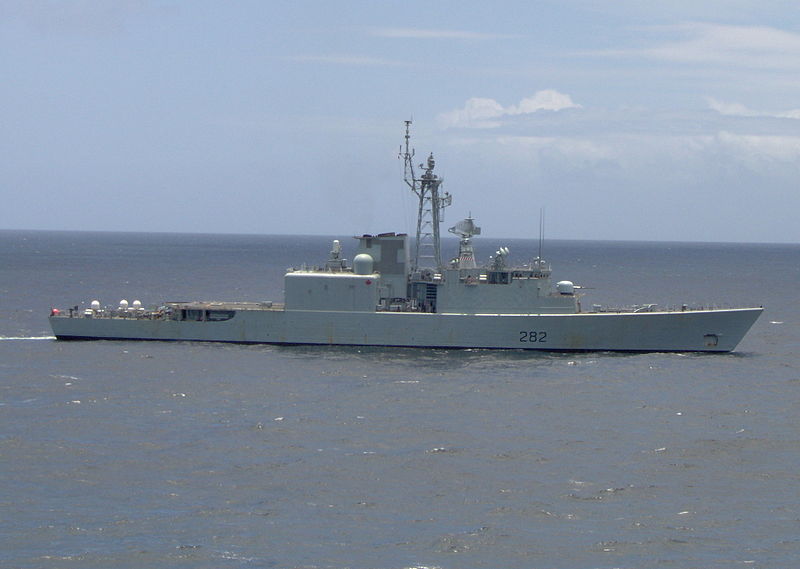
It was just announced that one of the two the current support ships HMCS Protecteur and the three Tribal-class destroyers HMCS Algonquin, HMCS Athabaskan, and HMCS Iroquois will be withdrawn from service immediately, and the Queenston-class are not going to be built any sooner.

Mistral-class ship, ‘Sevastopol’ configured as a NATO/Canadian Navy ship. CASR Image

Mistral-class ship, Sevastopol configured as a NATO/Canadian Navy ship. CASR Image

A RCN Mistral could operate the full range Canadian helicopters, including CH-148 Cyclones and CH-147F Chinooks. Ideally, Canada should obtain 6-8 additional Cyclones configured for the Commando Helicopter role as part of a financial settlement with Sikorsky over the Maritime Helicopter Program (MHP). Commando Cyclones would be optimized for Special Operations, tactical assault, medical evacuation and utility missions, with troop seats in place of maritime sensors, though retaining the CH-148’s FLIR system.

The make-up of a Tailored Air Group (TAG) for the RCN LPH would depend on the mission. A mix of Commando Cyclones, Griffons and Chinooks for amphibious, SOF, Arctic support and humanitarian operations. Cyclones for maritime security and ASW task forces. Exchange aircrew from the US Marine Corps, the Royal Navy Commando Helicopter Force and the Royal Danish and Norwegian Air Forces should be embedded within the Cyclone squadron forming the core of the TAG. This is critical for building expertise and interoperability among Arctic and NATO partners. By way of building a more direct partnership, Resolute could regularly embark RDAF EH-101 Merlin tactical helicopters and MH-60S Seahawk maritime helicopters.

Not least of the challenges facing the RCN would be manning. Fortunately, Mistral was designed from the beginning to operate with a small crew – just 20 officers, 80 petty officers and 60 sailors.

The foremost challenge for Canada may be convincing the government and the public that obtaining a Mistral LPH for the RCN is sensible and affordable, despite being outside the NSPS construct. Given the challenges now emerging for NATO member states and for Canada itself, the answer is surely a resounding ‘Yes’.

Given the current government’s allergy to spending actual money on military priorities (as opposed to nice-but-cheap uniform changes for photo ops), this grand notion is probably dead in the water with no hopes of success … but it’d be a nice boost for the RCN, and nearly as useful for the Canadian Army and RCAF. But it wouldn’t win key voting blocks in Halifax or Vancouver.

September 21, 2014

New uniforms for the Royal Canadian Air Force

Filed under: Cancon, Military — Tags: , — Nicholas @ 12:37

Oddly, the announcement posted to Facebook doesn’t include any pictures yet…

The Honourable Rob Nicholson, PC, QC, MP for Niagara Falls and Minister of National Defence and Lieutenant-General Yvan Blondin, Commander of the Royal Canadian Air Force (RCAF), unveiled the new RCAF uniform today at the Battle of Britain ceremony in Ottawa.

Main aspects of the new uniform, are drawn from pre-unification rank insignia while the design also maintains the modern elements and terminology familiar to serving members and militaries around the world. The insignia for most ranks will be recognizable as the symbols that air force personnel have worn for nearly half a century.

In recognition of the 90th anniversary of the founding of the RCAF, rank insignia and national shoulder titles for both officers and non-commissioned members will return to a distinctive pearl-grey stitching, the original colour worn by RCAF non-commissioned members until 1968. Dress tunic buttons will not change in design but their colour will switch from gold to silver. General officers headdress piping (embroidery) will also change from gold-coloured to pearl-grey.

The rumoured rank insignia and name changes have not been decided upon yet, except that the new rank “Aviator” will replace the current “Private”, “Airman”, and “Airwoman”. The rank insignia is a single stitched propeller.

Update:

Dramatic Footage of British Troops Preparing for Operation Market Garden

Filed under: Britain, History, Military, WW2 — Tags: , , — Nicholas @ 11:00

Nearly ten minutes of both British and German footage of the launch of Operation Market — the airborne assault on the Netherlands by British and American troops in September, 1944 (Operation Garden was the corresponding ground attack by Montgomery’s troops to reach the landings by one British and two American airborne divisions.

Rows-of-Dakota-Aircraft-prior-to-take-off-for-Arnhem,-Sept-17th-1944_0

Paratroopers descend enmasse at the DZs near Arnhem, September 1944 Uploaded by: Mac Magreehan. (via Forces.TV)

Paratroopers descend enmasse at the DZs near Arnhem, September 1944 Uploaded by Mac Magreehan. (via Forces.TV)

More photos of the operation can be viewed at Forces.TV.

« Newer PostsOlder Posts »

Powered by WordPress