
Published on 6 Feb 2016
Check out War History Online and their excellent coverage: http://warhistoryonline.com
Indy sits in the Chair of Wisdom again and this week we talk about a strange story in which Germany and Britain actually traded goods during wartime.
February 7, 2016
Did Germany and Britain Trade Rubber And Optics in WW1? I OUT OF THE TRENCHES
Comments Off on Did Germany and Britain Trade Rubber And Optics in WW1? I OUT OF THE TRENCHES
February 6, 2016
Germany Aims For Verdun – Russia Goes South I THE GREAT WAR Week 80
Published on 4 Feb 2016
The preparations for the huge German offensive at Verdun are almost complete. Thousands of artillery pieces are moved, millions shells brought to the front. Erich von Falkenhayn would soon unleash is offensive on the Western Front. At the same time, Russia headed south to the Caucasus once more in search for a desperately needed victory against the Ottomans.
Comments Off on Germany Aims For Verdun – Russia Goes South I THE GREAT WAR Week 80
February 5, 2016
Military discipline
Retired Colonel Ted Campbell has some thoughts on the Canadian military:
Nothing in what follows is, in any way at all, intended to minimize the importance of quantities ~ quantities of people, quantities of dollars and quantities of ships, tanks and aircraft ~ but it is intended to stress that there IS a qualitative measure to national defence: how much must, always, be balanced with how well. Indeed, sometimes, “not really well” can be offset by “lots of men (and women), money and materiel” and, equally, often “not enough people or equipment” can be offset by “able to get 100% out of every person and every bullet.”
For many years I have preached that we, Canadian sailors, soldiers and air force personnel need to be four things ~ we need to have four attributes ~ and we need to be those four things in a specific order.
WeThey, now, need to be:
- Tough;
- Superbly disciplined;
- Very well trained; and
- Adequately equipped.
Now, a few years ago some friends suggested, and I agreed, that I needed to “bookend” those four things with two more; they also need to be:
- Well led; and
- Properly organized
I agreed and revised my list accordingly […]
And on the differences between a “typical” military organization and a properly disciplined one:
Discipline starts on the parade square, and Canadian military men and women take a back seat to no-one when it comes to pomp and circumstance, but “real” military discipline is self discipline and it comes from doing what needs to be done when one is near exhaustion, in the dark, in the cold, and when no one is looking … I remember, some
yearsdecades ago, when I was a junior officer, I was escorting a foreign visitor into our unit. As we drove in the main gate a trumpet call sounded over the loudspeakers; “what’s that?” our guest asked. “The lunch signal,” I replied, “we’re just in time for lunch.” As we drove past the transport lines we both observed many soldiers washing vehicles, loading stores, repairing armoured personnel carriers and so on … “why aren’t they breaking for lunch?” our guest asked. “They’re not finished yet,” I answered, “they’ll be off for their lunch as soon as they’re done their work.” “In our army,” he said, “they would have just dropped their tools and run for the lunch line.” “Oh, ” I responded, “not here. This is our army and these fellows know what has to be done and they’ll do it without being told or watched.” We were, in fact, discussing the fundamental difference between a very large, very well equipped and very average army, on the one hand, and a small, adequately equipped but very well disciplined Canadian army on the other. Discipline certainly starts with sergeants bellowing orders on the parade square, but in a good army it is exemplified by individual soldiers doing the hardest jobs, in the worst of circumstances, alone and without supervision. It doesn’t really matter if the task is “square bashing,” a lonely, dangerous, standing patrol at night, or the loneliness, even in a crowd, of command at sea; whatever the task, a tough, superbly disciplined Canadian sailor, soldier or aviator can do it, and do it right, the first time.
Comments Off on Military discipline
February 2, 2016
Edith Cavell – Not A Martyr But A Nurse I WHO DID WHAT IN WW1?
Published on 1 Feb 2016
The execution of British nurse Edith Cavell by German soldiers in 1915 was instrumental to British propaganda at that time and the story became legend. But who was Edith Cavell really? Find out more about the humble nurse in Brussels and if she was really a spy after all.
Comments Off on Edith Cavell – Not A Martyr But A Nurse I WHO DID WHAT IN WW1?
February 1, 2016
What Happened After A Trench Was Captured? I OUT OF THE TRENCHES
Published on 30 Jan 2016
It’s time for the chair of wisdom again and this week we talk about the trenches, balloon observers and well, Emilio Esteves.
Comments Off on What Happened After A Trench Was Captured? I OUT OF THE TRENCHES
January 30, 2016
Tanks – WW1 Uncut: Dan Snow – BBC
Published on 17 Apr 2014
Tanks were invented by the British during the First World War. Historian Dan Snow traces their development, from prototype to battlefield fixture.
Comments Off on Tanks – WW1 Uncut: Dan Snow – BBC
January 29, 2016
The Kaiser’s Birthday – Hypocrisy in Greece I THE GREAT WAR – Week 79
Published on 28 Jan 2016
Even though Britain went to war over the violation of the Belgian neutrality by the Germans, the neutrality of Greece seems to be of no concern to the Entente. The military presence on Corfu and Salonika is growing and growing. And even though there is no fighting there, the soldiers have to suffer since general Malaria is taking his toll. In the week of the Kaiser’s birthday, the diplomatic tensions between the USA and Germany are increasing and on the Western Front Trench Foot is becoming a real problem.
Comments Off on The Kaiser’s Birthday – Hypocrisy in Greece I THE GREAT WAR – Week 79
January 26, 2016
The Entente On The Run I THE GREAT WAR WW1 Summary Part 4
Published on 25 Jan 2016
The end of the year 1915 and early 1916 don’t look good for the Entente powers. Stalemate on the Western Front, no progress on the Eastern Front, Serbia overrun, defeat after defeat at the Isonzo, under siege at Kut, Gallipoli evacuated and even a new war zone in Libya. How would they turn the tide against the Central Powers?
Comments Off on The Entente On The Run I THE GREAT WAR WW1 Summary Part 4
January 24, 2016
What was the Food like at the Front?I OUT OF THE TRENCHES
Published on 23 Jan 2016
Indy sits in the chair of wisdom again to answer your questions. This time we tell you how the food was like in the trenches and what role Andorra and Iceland had in World War 1.
Comments Off on What was the Food like at the Front?I OUT OF THE TRENCHES
Arming the Royal Navy’s new aircraft carriers
Last month, Save the Royal Navy looked at the aircraft that will fly off the decks of HMS Queen Elizabeth and HMS Prince of Wales:
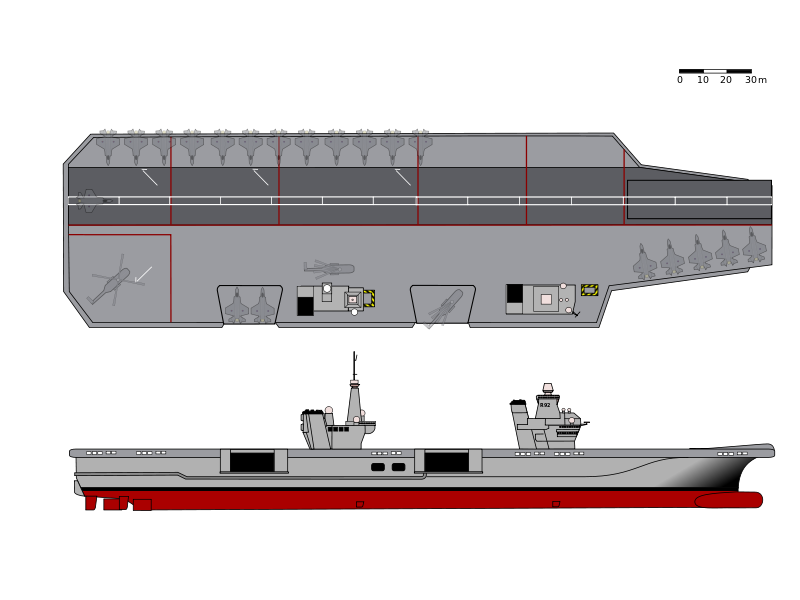
Queen Elizabeth class side and overhead views
The SDSR stated that 42 F35-B Lightning aircraft will be delivered by 2023. These 42 aircraft form the carrier’s main armament. A foolish political fudge has given the RAF control of the Lightnings, to be jointly manned and operated with the RN. For Government, this conveniently boosts the RAF’s ORBAT while allowing the same aircraft to be counted again as part of the carrier’s equipment. Although the RAF may not like it, the needs of the carriers will have to dictate their operation. There is simply no place for the “part time carrier aviator” The aircrew need as much time at sea as possible to develop their own skills, the skills of aircraft handlers, the ship’s company and the fleet as a whole. Like all RN vessels the carriers will operate at a demanding operational tempo and need aircraft embarked for much of the time. Any RAF inclination to use the aircraft in the land-based deep strike role will have to be second priority.
The initial 42 Lightnings will be split between 2 frontline squadrons. 809 Naval Air Squadron and RAF 617 Squadron with around 15-20 aircraft each, building up to the full strength of 24 per squadron. There will also be a requirement for at least 5 aircraft to form an OCU (Operational Conversion Unit for training). An OEU (Operational Evaluation Unit for testing and trials) will also require a few aircraft. Allowing for a sustainment fleet of aircraft in deep maintenance etc, then it is clear that many more than 42 aircraft are needed to form just 2 full-strength squadrons. Between 2010 and 2014 the received wisdom was that the UK would only ever purchase a maximum of 48 F35-B but the SDSR announced a planned eventual purchase of as many as 138. This is good news which should give some strength-in-depth, potentially providing 2 more squadrons. Both the RN and the RAF should be able to fulfil their ambitions for the Lighting. Whether the RAF will push for a purchase of the conventional F35-A which would not be compatible with the carrier, but has slightly better range and performance than the VSTOL variant is a discussion for the future.
Of course the caveat to all this good news is the actual performance of the F35. There are armies of armchair F-35 critics and many of their concerns are valid. Although it may prove to be a poor “within visual range” fighter, its networking, sensors, stealth and strike capabilities will be a giant advance over any previous UK military aircraft. Furthermore the RN has a fine track record of taking equipment with many apparent deficiencies and turning them into a great success. (Fairy Swordfish anyone?)
On the other hand, Ben Ho Wan Beng argues that the carriers will not actually be able to project much power:
A tactical combat aircraft complement of 12, or even 15-20, is rather small for traditional carrier operations, especially force-projection ones that are likely to predominate considering the SDSR’s expeditionary-warfare slant. Indeed, it is worth considering the fact that the two British small-deck carriers involved in the Falklands War carried 20-odd Harrier jump jets each, and they were about three times smaller than the Queen Elizabeth-class ships.
In fact, each new carrier might even be operating with a much fighter complement fewer than 15-20 in the years leading up to 2023, giving lie to the phrase “in force” used by George Osborne when he spoke of equipping the carriers with significant airpower.
In any case, the small fighter constituent means that if the Queen Elizabeth carrier were to get involved in a conflict with an adversary with credible anti-access/area-denial (A2/AD) capabilities, the vessel would be hard-pressed to protect itself, let alone project power. With a displacement of over 70,000 tons and costing over three billion pounds each, the new British carriers will be the crown jewels of the Royal Navy; indeed, HMS Queen Elizabeth is slated to be the RN’s flagship when she comes into service. The protection of the ship would hence be of paramount importance in an era that has witnessed the proliferation of A2/AD capabilities even to developing nations. Hence for a Queen Elizabeth carrying 20 or less Lightnings in such circumstances, it remains to be seen just how many of the aircraft will be earmarked for different duties.
Should a F-35B air group of that size put to sea, at least half of them will be assigned to the Combat Air Patrol (CAP), leaving barely 10 for offensive duties. It is worth noting that of the 42 Harrier VSTOL jets deployed on HMS Hermes and HMS Invincible during the Falklands War, 28 of them – a substantial two-thirds – had CAP as their primary duty. It is also telling that of the 1,300-odd sorties flown in all by the Harriers, about 83 per cent of them were for CAP.
Faced with modern A2/AD systems such as stand-off anti-ship missiles, how likely then would the carrier task force commander devote more resources to offense and risk having a vessel named after British royalty attacked and hit? Having said that, having too many planes for defense strengthens the argument made by various carrier critics that the ship is a “self-licking ice cream cone,” in other words, an entity that exists solely to sustain itself.
The task force commander would thus be caught between a rock and a hard place. Allocate more F-35Bs to strike missions and the susceptibility of the task force to aerial threats increase. Conversely, set aside more aircraft for the CAP and its mother ship’s ability to project power decreases. All in all, with a significantly understrength F-35B air wing, the Queen Elizabeth flat-top would be operating under severe constraints, making it incapable of the traditional carrier operations it could have carried out with a larger tactical aircraft complement. Indeed, one naval commentator is right on the mark when he argues that two squadrons with a total of 24 aircraft should be a “sensible minimum standard” for each carrier.
Comments Off on Arming the Royal Navy’s new aircraft carriers
January 23, 2016
World of Warships – How To Not Suck
Published on 20 Jun 2015
If I said to you “What’s Port?” and your answer is “A fortified wine from Portugal served by the Wardroom Steward at Mess Dinners” you’re either a Royal Naval Officer or someone who could probably benefit from watching this video. There’s no cure for being a Royal Naval Officer, but the cure for sucking at World of Warships is just one click away.
Comments Off on World of Warships – How To Not Suck
January 22, 2016
The Fight for Montenegro & The Disaster Of Kut I THE GREAT WAR Week 78
Published on 21 Jan 2016
The Russians try to take Czernowitz, the Capital of Austrian Bukovina but thousands upon thousands of Russians were killed in action. While in Montenegro, Austro-Hungarian troops under commander in chief Franz Conrad von Hotzendorf take control of the Balkan state of Montenegro. A relief force led by Lieutenant-General Fenton Aylmer had to return to base after a big loss against the Turks, while in South Cameroon, so the Germans retire into Spanish territory.
Comments Off on The Fight for Montenegro & The Disaster Of Kut I THE GREAT WAR Week 78
January 21, 2016
Roles for Canada’s armed forces
Ted Campbell outlines the most likely tasks and approximate organization of the Canadian Armed Forces, regardless of the political or ideological stripe of the government of the day:
Thus far, in two posts: Establishing Some Baselines and Defence of Canada I have developed four “baseline” roles or tasks for the Canadian Department of National Defence:
- To maintain active military forces to share in the continental defence of the North American homelands, of the maritime approaches to them and of the airspace over both.
- To maintain a global, blue water fleet, supported by air forces, that is able to, simultaneously, maintain a constant Canadian presence in at least two different theatres.
- To maintain trained, disciplined military units that can, on very short notice, give effective “aid to the civil power” here in Canada.
- To maintain combat naval, land and air forces and a full range of strategic and tactical support services, able to conduct low to mid intensity operations anywhere in Canada on short notice.
Those tasks, both explicitly and implicitly, call for:
- A surveillance and warning system ~ which, I think, to be really useful must cover all of the Canadian landmass, the maritimes approaches to it and the airspace over both and, probably, needs to have terrestrial, underwater, airborne (aircraft mounted) and space based (satellite) sensors.
- A command and control communications (C³) system to interconnect all those sensors and the various command agencies ~ Canadian, US and combined.
- A full fledged Navy able to operate in 9and under) coastal waters and anywhere in the world.
- A full fledged Air Force able to conduct air and joint operations in Canada and to conduct joint naval-air operations anywhere in the world.
- An Army for domestic, territorial defence of Canada.
- The full fledged Navy and Air Force and limited Army also, in their turn, call for medical, logistical, administrative and financial support systems: hospitals, supply depots and warehouses, and people working away in offices, far away from the action, keeping services flowing to the people who need them.
What about forces for the next Afghanistan or UN peacekeeping mission or Korea or, heaven forbid, another world war?
That would be an Expeditionary Force.
Comments Off on Roles for Canada’s armed forces
January 20, 2016
German Uniforms of World War 1 I THE GREAT WAR Special
Published on 18 Jan 2016
From the iconic Pickelhaube to the almost legendary Stahlhelm and the field grey colour, German military uniforms of World War 1 are instantly recognisable. But there is more to them than just the spiky leather helmet that was often used in enemy propaganda. In our new special episode we are talking about the details of the German uniforms in the First World War.
Comments Off on German Uniforms of World War 1 I THE GREAT WAR Special
January 18, 2016
Battle of Mojkovac & The Biggest Artillery Gun in World War 1 I Out Of The Trenches
Published on 16 Jan 2016
Check out War History Online: https://www.warhistoryonline.com/
Indy sits in the chair of wisdom again to answer your questions about World War 1. This week we are talking about the Battle of Mojkovac and the Paris Guns.
Comments Off on Battle of Mojkovac & The Biggest Artillery Gun in World War 1 I Out Of The Trenches


