
Published on 14 Jan 2016
It already started around Christmas but this week the evacuation of Gallipoli is complete. While the evacuation was a success, the overall defeat is inarguable for the British. On top of that the Ottomans can now send 40.000 soldiers to the siege of Kut in Mesopotamia where the British are still awaiting relieve. At the same time the Austro-Hungarian Army starts its invasion of Montenegro and the Western Front is still quietly awaiting the offensive at Verdun.
January 15, 2016
The Invasion Of Montenegro – The End of Gallipoli I THE GREAT WAR – Week 77
Comments Off on The Invasion Of Montenegro – The End of Gallipoli I THE GREAT WAR – Week 77
Defence minister Harjit Sajjan announces full defence review for 2016
Marie-Danielle Smith on the recent DND announcement:
Defence Minister Harjit Sajjan says he plans to complete a thorough defence policy review by the end of 2016—and the public will be asked to participate.
In an interview with Embassy Jan. 12, Mr. Sajjan confirmed that Department of National Defence officials are already identifying how the review, or Defence White Paper, will be conducted.
Public consultation will be involved and foreign allies will be consulted, he said. The review is expected to set a road map for the next 10 to 20 years.
“I want to make sure that we get the ‘How’ part. It’s so important,” he said. “If we don’t get that right then the quality’s not going to be there at the end.”
[…]
“The British just did a defence review,” he said, referring to the Strategic Defence and Security Review 2015 released by the Cameron government on Nov. 23. “Australia is about to release theirs, and especially it’s important for us to be able to learn from those lessons.”
He said he recently spoke with UK Defence Secretary Michael Fallon in London. “It is helping me to shape how Canada can look at doing [the defence review],” he said, noting the UK had used an interactive website to get public input.
“I’ve got some really key ideas that Fallon provided, and I’m looking forward to reading the Australian review when it comes out as well,” Mr. Sajjan said.
The minister said the credibility and relevancy of the review was important. “We can do a white paper of everything on the wishlist, but if you don’t have the budget to support it it really doesn’t matter.”
Defence officials declared the previous Harper government’s military wishlist, the Canada First Defence Strategy, unaffordable in 2011, but no updated document was ever released.
Comments Off on Defence minister Harjit Sajjan announces full defence review for 2016
January 14, 2016
A Soldier’s Kit – WW1 Uncut: Dan Snow – BBC
Published on 17 Apr 2014
An army is as good as the kit its soldiers use. In 1914, which army was the best equipped? Historian Dan Snow finds out.
Comments Off on A Soldier’s Kit – WW1 Uncut: Dan Snow – BBC
QotD: The introduction of the steel helmet for British troops in WW1
They were not, as The Times correspondent claims, there to protect the wearer from rifle or machine-gun bullets. Indeed, as I understand it, even modern helmets are not always proof against high-velocity rounds. What they were there to do was to protect soldiers from shrapnel. Shrapnel, in case you didn’t already know, is the collective noun for steel balls being expelled from an air-bursting (or Shrapnel) shell. It was a huge killer in the First World War and the steel helmet did a great deal to save lives.
One of the good things about the Brodie helmet – as it sometimes known – is that it had an internal harness. This meant that if the helmet was dented the dent was not necessarily reproduced in the wearer’s skull.
On the shape, however, with a wide brim and no neck protection, I have always been in two minds. On the one hand, if the threat is from above you would have thought the shape was a good thing as it covers a large part of the wearer’s body. It is also easy to make. On the other hand, British helmets over the last 100 years have progressively given more neck protection which sounds like the British Army’s way of saying they got it wrong.
By the way, in my limited experience both steel and more modern Kevlar helmets are a pain in the arse to wear. You either can’t see anything from a prone position or you can’t see anything from a prone position and get a headache.
Patrick Crozier, “The British army gets steel helmets”, Samizdata, 2015-12-02.
Comments Off on QotD: The introduction of the steel helmet for British troops in WW1
January 13, 2016
One Of the Capable Generals of WW1 – Arthur Currie I WHO DID WHAT IN WW1?
Published on 11 Jan 2016
Arthur Currie is one of the few universally acclaimed generals of World War 1. His refusal to send is troops into battle as canon fodder and his detailed planning and training made the Canadian Corps a force to be reckoned with on the Western Front. Find out all about the man who was only serving in the militia before the war.
Comments Off on One Of the Capable Generals of WW1 – Arthur Currie I WHO DID WHAT IN WW1?
January 12, 2016
Prelude to Verdun And The Road To the Somme I THE GREAT WAR – Week 76
Published on 7 Jan 2016
1915 was a year in favour of the Central Powers. But in early 1916, the Russians, British and French were sending more fresh troops into battle than ever before – and better equipped too. French General Joseph Joffre was confident that a huge combined offensive at the Somme in summer would turn the tide. But German Chief of Staff Erich von Falkenhayn had his own plans to bleed the French dry at Verdun.
Comments Off on Prelude to Verdun And The Road To the Somme I THE GREAT WAR – Week 76
January 11, 2016
Dancer, Lover, Spy – Mata Hari I WHO DID WHAT IN WW1?
Published on 4 Jan 2016
Mata Hari or Margaretha Geertruida Zelle is one of the most fascinating women of the 20th century. Not only did the Dutch woman charm half or Paris with her exotic and erotic dancing. After several up and downs she ended up as a spy for love gathering intelligence for the German secret service. When she was caught by the French, her live ended as unglamorous as it started.
Comments Off on Dancer, Lover, Spy – Mata Hari I WHO DID WHAT IN WW1?
January 10, 2016
The aircraft carrier as status symbol
While I was offline, Colby Cosh discussed the status signalling power of the modern aircraft carrier:
Aircraft carriers are such fascinating objects. With the exception of manned spacecraft, there is probably nothing that signifies national prestige quite as boldly as a flattop. It is almost the best single marker you can identify of the difference between states properly called “powers” and those that are just — well, will I be forgiven for saying “Canadas”? They attract enormous amounts of attention and analysis from military experts and amateur opinionators.
And, in a sense, this is disproportionate nearly to the point of self-evident unreason. The age of battles between aircraft carrier groups began with the commencement of the fight in the Coral Sea: May 4, 1942. It pretty much ended when the Americans sent four Japanese carriers to the bottom at Midway, 30 days later.
Since that abbreviated epoch, the countries capable of operating aircraft carriers have mostly avoided hot wars with each other. American ones have the run of the seas and find no trouble. Others constantly leave their owners wondering if they are worthwhile.
Perhaps this means that on the whole carriers have done their job. But a constant theme in their history is the fear that they make nice fat targets for the weaker side in a conflict. India’s carrier Vikrant played a key role in blockading Bengal during the 1971 war over Bangladeshi independence, but the Indian Navy was nervous about a seemingly foreordained single combat with Pakistan’s diesel submarine Ghazi (formerly USS Diablo), and got lucky when it sank in an apparent accident. The U.K., whose remaining scraps of empire pose a unique defence problem, sent a carrier, HMS Hermes, to the Falklands — and then the Royal Navy held it off, wincing all the while, at the edge of the theatre, barely within Harrier range of the islands.
Hermes is still on duty today as INS Viraat, a successor to Vikrant; one of the interesting things about carriers is that, as with submarines, their lives will often have two acts in different navies. That is the case with China’s existing, first aircraft carrier, the Liaoning. She was christened Riga in Soviet days and inherited by independent Ukraine as Varyag. A Hong Kong travel agency bought the hull, claiming it intended to turn it into a floating casino. (Getting the ship out of the Black Sea under the nose of Turkey might otherwise have been tricky, and wasn’t easy anyway.)
Comments Off on The aircraft carrier as status symbol
How Accurate Is Blackadder Goes Forth? I OUT OF THE TRENCHES
Published on 2 Jan 2016
Indy is answering your questions about the First World War again and this time we are talking about the neutrality of Greece, the accuracy of Blackadder Goes Forth and the contribution of Asia and Africa.
Comments Off on How Accurate Is Blackadder Goes Forth? I OUT OF THE TRENCHES
January 9, 2016
Preparing for 1916 – The Year of Battles I THE GREAT WAR – Week 75
Published on 31 Dec 2015
1915 was a year for the Central Powers except on the Western Front where the stalemate continues. But plans are being made on both sides to gain an advantage. Preparations for huge offensives are on the way and one French fortress is the focus of the German Army: Verdun.
Comments Off on Preparing for 1916 – The Year of Battles I THE GREAT WAR – Week 75
December 30, 2015
German Pistols of World War 1 feat. Othais from C&Rsenal I THE GREAT WAR Special
Published on 28 Dec 2015
In the second part of our German weapons special, Othais introduces us to pistols. Among them are oddities like the Reichsrevolver but also iconic pieces of German engineering like the Luger including the rare Trommelmagazin.
Comments Off on German Pistols of World War 1 feat. Othais from C&Rsenal I THE GREAT WAR Special
December 29, 2015
Nicknames in the British army
Forces TV on the widespread practice of renaming recruits when they report to their unit:
It’s common enough in civvy street, but it seems that it’s definitely standard issue in the British military. For decades, service personnel have had their names changed the moment they’ve arrived at their first military unit. Usually by a smart-alec superior.
Of course the fresh-faced recruit is too junior to protest, if s/he even understands the black humour behind their re-christening. The nickname may stick with them for the rest of their career, and will be used all the more if it particularly upsets the poor soldier / sailor / airman lumbered with it. It may stick with them for the rest of their life: I’ve heard many tales of only mothers still persisting in calling their sons by the name they chose for them; to everyone else they have become what the Army redesignated them. For good.
[…]
Former members of the military like to reminisce about these days in online forums. One of the more repeatable tales on the Army Rumour Service’s website goes like this:
“Best I ever met was a Sergeant Kennedy nicknamed EDY. Legend had it that he had rocked up at the regiment as a shiny new Trooper and presented himself to the guardroom. The Guard Sergeant had looked at the scrawny young man and asked
“name?”
“Kennedy, Sergeant” came the reply
“last three?” asked the Sgt
long pause, followed by
“E-D-Y, Sgt?”
20 years later, he’s still known as EDY.”
Military nicknames frequently replace a person’s Christian name for that of a famous person, with whom they share a last name. Someone called Black becomes “Cilla”(especially if they’re male); Barker is “Ronnie”; Gordon attracts “Flash”.
Further examples include “Nobby” for anyone named Clark or Hall; “Buck” if your last name is Rogers, “Perry” if it’s Mason and either “Burt” or “Debbie” if it’s Reynolds. Not forgetting Dicky Bird, Chalky White, Smudge Smith, Dinger Bell, Swampy Marsh, Grassy Meadows, Snowy Winter and Happy Day.
Comments Off on Nicknames in the British army
December 27, 2015
Why Was Franz Ferdinand A Horrible Person? I OUT OF THE TRENCHES
Published on 26 Dec 2015
It’s time for the Chair of Wisdom again. This time Indy explains why he deems Franz Ferdinand a horrible person, why the soldier did not mutiny all the time and what the Philippines did in World War 1.
Comments Off on Why Was Franz Ferdinand A Horrible Person? I OUT OF THE TRENCHES
The refit and modernization program for the RCN’s Halifax class frigates
In the Chronicle Herald, Andrea Gunn reports on the Royal Canadian Navy’s refit program for the twelve ships in the HMCS Halifax class, being done in Victoria and Halifax:
A $4.3-billion, decade-long life extension and modernization of Canada’s Halifax-class frigates has now been completed on more than half the fleet.
Work started in 2010 on the mid-life refit and modernization process, which has been concluded on HMCS Halifax, Fredericton, Montreal and Charlottetown at the Irving-owned Halifax Shipyard, and on HMCS Calgary, Winnipeg and Vancouver at Seaspan in Victoria.
The other five vessels, HMCS St. John’s, Ottawa, Ville de Quebec and Toronto, have all entered refit and are at various stages of completion and testing. All major work for the program, which is on schedule and on budget, is set to be finished by 2019.
The project’s aim is to extend the lifespan of the fleet to sustain Canada’s naval operations during the design and construction phase of the new fleet of Canadian surface combatants, set to be delivered by 2033. The Halifax-class frigates have been in operation since 1992, and planning and preparation for the modernization project began in 2002.
Royal Canadian Navy Commodore Craig Baines, commander of the Atlantic fleet, recently returned from two months of major multinational exercises that utilized three of the modernized vessels. HMCS Halifax, Montreal and Winnipeg participated in Joint Warrior, and Winnipeg and Halifax participated in Trident Juncture, the largest NATO military exercise since the Cold War.
“From where we were previously to where we are now, it’s like you have a brand new ship,” Baines told The Chronicle Herald.
The modernized vessels are equipped with a new radar suite and have had major upgrades to the communications and warfare systems. But it’s the $2-billion upgrade to the fleet’s combat management systems — a completely redesigned command and control centre with plenty of new features — that is largely responsible for that new ship feel.
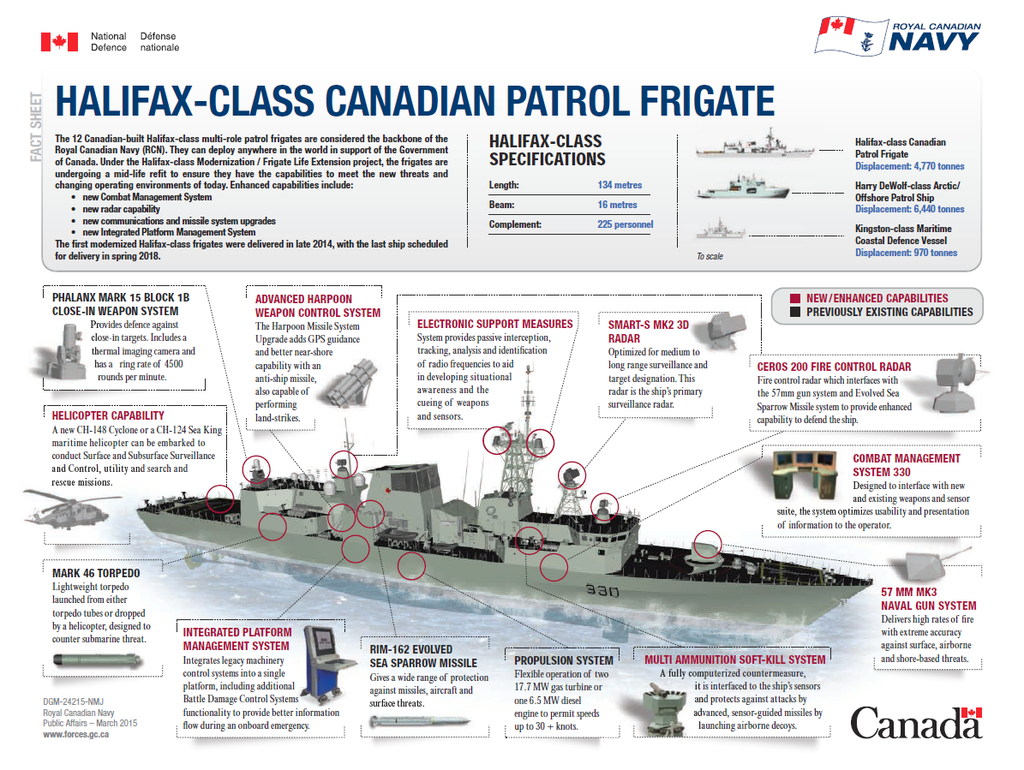
Click image to see full-sized. H/T to @RUSI_NS for the link.
Comments Off on The refit and modernization program for the RCN’s Halifax class frigates
December 26, 2015
The Story Of The SMS Emden I THE GREAT WAR – Special
Published on 25 Dec 2015
The SMS Emden was a light cruiser serving in Asia when World War 1 broke out. Instead of fleeing with the rest of the German East Asia Squadron under Maximilian von Spee, captain Karl von Müller stayed behind and waged a devastating cruiser war against the Entente effectively crippling the supply lines. But the luck of the Emden could not hold out forever. Find out more about the incredible story of the SMS Emden.
Comments Off on The Story Of The SMS Emden I THE GREAT WAR – Special


