
The Great War
Published on 17 May 2018The summer of 1918 saw many ethnic and political groups within the warring empires to openly rebel. The Austro-Hungarian Army saw open mutiny every week, the Irish rebelled against the British, the situation in the newly annexed Eastern European territories that were now part of the German Empire was a powder keg. And in France civilians were sentenced to death for treason.
May 18, 2018
Rebellion I THE GREAT WAR Week 199
Comments Off on Rebellion I THE GREAT WAR Week 199
May 16, 2018
Crusader Tank | Animated History
The Armchair Historian
Published on 25 Jun 2016
Comments Off on Crusader Tank | Animated History
May 15, 2018
Evolution of French Infantry During World War 1 I THE GREAT WAR Special
The Great War
Published on 14 May 2018The French soldier in 1914 was already very different from the one in 1918 if you looked at his uniform or equipment. Also the combat tactics evolved considerably in four years of war. The Battle of Verdun, the Nivelle Offensive or the Battle of La Malmaison were important steps during that evolution in which the Poilu became a modern French soldier.
Comments Off on Evolution of French Infantry During World War 1 I THE GREAT WAR Special
French protests over new British submarine in three, two, one…
Gareth Corfield helpfully sums up the reasons for the French to take offence after the Royal Navy chose to name the next Astute-class nuclear submarine HMS Agincourt:
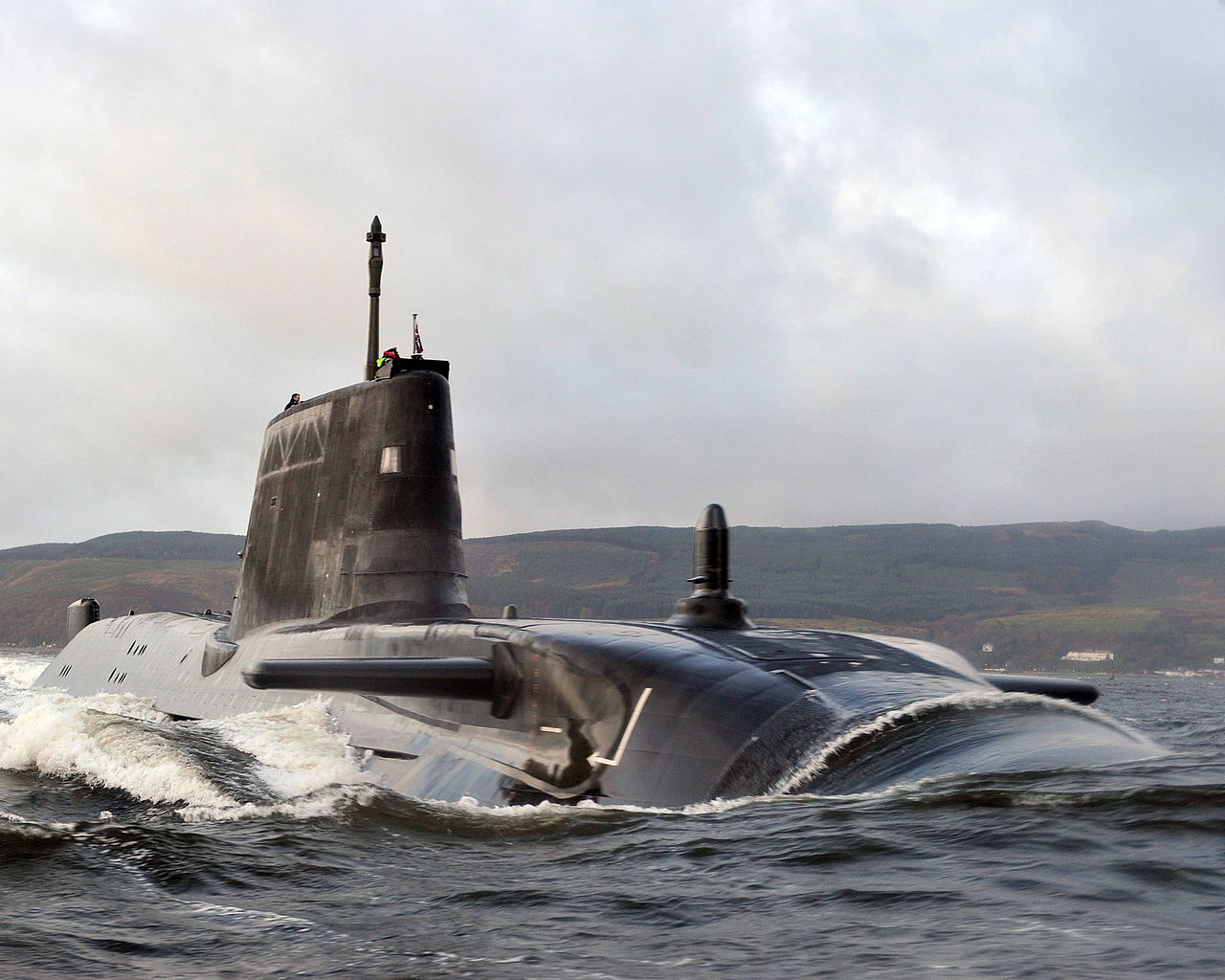
HMS Astute (S119), lead ship of her class, sails up the Clyde estuary into her home port of Faslane, Scotland.
MOD photo, via Wikimedia Commons.
The Royal Navy, always keeping up with the times, has named its newest attack submarine HMS Agincourt, after the 1415 battle where an English army beat French troops led by its nobility.
Agincourt the boat is the seventh and final Astute-class attack sub. The nuclear-powered vessels are used primarily to defend British interests from underwater, including seeing off marauding Russian vessels near British waters and also for sneaky-beaky missions of their own into foreign waters.
The £1.5bn submarine is under construction at BAE Systems’ yard in Barrow-in-Furness, Cumbria. Defence equipment minister Guto Bebb joyously declared: “Today’s announcement includes a £60m contract for Rolls-Royce, supporting over 700 jobs here in Derby as the factory continues to make the reactors that will power our state-of-the-art Dreadnought subs into the 2060s.”
And just to rile up any sensitive French souls, he also gives a thumbnail history of the battle the ship will be named for:
The name Agincourt is mildly controversial, inasmuch as it brings to mind the famous victory of King Henry V over France at a time where the English army, which was blundering around the Pas-de-Calais countryside, was largely thought to be on its last legs and cut off from its chances to retreat back home. In the words of the king’s (fictional, thanks to Shakespeare) eve-of-battle speech, it was “we few, we happy few, we band of brothers” up against the very best France had to offer.
Through “yew bow and cloth yard shaft”, as the chroniclers of the day put it, the English and Welsh longbowmen shot a torrent of arrows into the heavily armoured French knights. The arrows’ steel points penetrated the plate armour of the French nobles and the lightly equipped English then set about the bogged-in Frenchmen, whose weighty suits of armour were totally unsuited to the heavy mud of the battlefield.
In today’s world, where the UK and France are close allies and England has given way to the United Kingdom, naming the submarine Agincourt may be seen by some as a bit of an unintentional snub, bringing to mind Henry V’s slaughter of French prisoners of war and the failed negotiations that preceded the battle over Henry’s disputed claim to the title of King of France.
Comments Off on French protests over new British submarine in three, two, one…
May 14, 2018
China launches the second Type 001 aircraft carrier (Type 001A)
In the New York Times, Steven Lee Myers reports on the newest People’s Liberation Army Navy (PLAN) aircraft carrier departing from Dalian to undergo its initial sea trials:
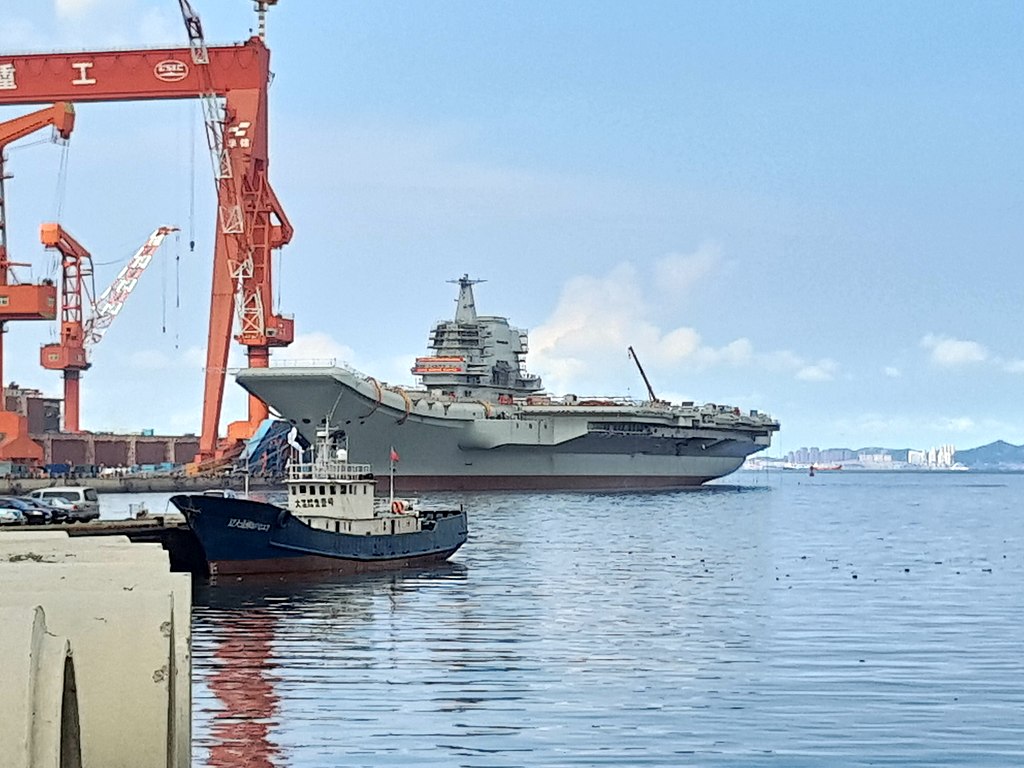
China’s Type 001A aircraft carrier shortly after launch, 17 August 2017.
Photo via Wikimedia Commons
China launched its first domestically built aircraft carrier to begin sea trials on Sunday, reaching another milestone in the expansion of the country’s navy.
The aircraft carrier, as yet unnamed, left its berth at a shipyard in the northeastern port of Dalian after a blow of its horn and a display of fireworks, according to reports in state news media.
The Chinese Navy — officially the People’s Liberation Army Navy — already has one operational carrier, the Liaoning, which it bought unfinished from Ukraine after the collapse of the Soviet Union. That ship joined the Chinese fleet in 2012 and began its first operations four years later, putting China in the small group of seafaring powers that maintain aircraft carriers, led by the United States, which has 11.
The Liaoning, which appears to serve as a training vessel as much as a combat ship, was the centerpiece of a naval parade of 48 ships attended last month by China’s leader, Xi Jinping. The following week, it led a carrier battle group in live-fire exercises in the Taiwan Strait and in the East China Sea.
Since taking office, Mr. Xi has driven an ambitious effort to modernize the country’s military, reducing the traditional focus on readying the ground forces of the People’s Liberation Army to defend against an invasion of the mainland and increasing the emphasis on technology-dependent naval, air and missile forces.
The new carrier, built by the Dalian Shipbuilding Industry Company, has a similar design to the Liaoning but has been modified and expanded, according to Chinese and foreign experts.
Comments Off on China launches the second Type 001 aircraft carrier (Type 001A)
The Austro-Prussian War
Epic History
Published on 28 Dec 2015The Austro-Prussian War or Seven Weeks’ War (also known as the Unification War, Prussian–German War, German Civil War, or Fraternal War and in Germany as German War) was a war fought in 1866 between the German Confederation under the leadership of the Austrian Empire and its German allies on one side and the Kingdom of Prussia with its German allies and Italy on the other, that resulted in Prussian dominance over the German states.
Comments Off on The Austro-Prussian War
May 13, 2018
Marie Curie in WW1 – Who Killed The Red Baron? I OUT OF THE TRENCHES
The Great War
Published on 12 May 2018Chair of Wisdom Time!
Comments Off on Marie Curie in WW1 – Who Killed The Red Baron? I OUT OF THE TRENCHES
May 11, 2018
The Ostende Raid – Peace of Bucharest I THE GREAT WAR Week 198
The Great War
Published on 10 May 2018Even though the first raid on Ostende and the Raid on Zeebrugge were not entirely successful, the Royal Navy is still determined to block access to the German submarine ports in Belgium. And this week they attack Ostende again. Meanwhile, the Germans are planning their next offensives for late May 1918 even though ten percent of the Western Front army has become a casualty in the offensives this year alone.
Comments Off on The Ostende Raid – Peace of Bucharest I THE GREAT WAR Week 198
May 9, 2018
Royal Navy buys the Terminator … of mines
At The Register Gareth Corfield updates us on the latest step towards Skynet, uh, Seanet:
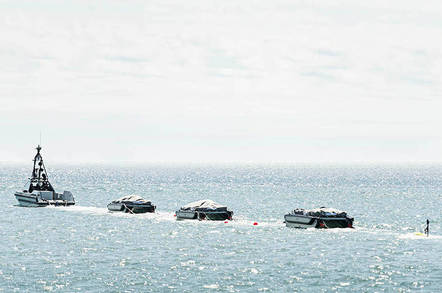
The Navy’s latest robot minesweeper. It’ll blow things up but leave your pint alone, thankfully
The Royal Navy has acquired a search-and-destroy robot boat intended for destroying mines.
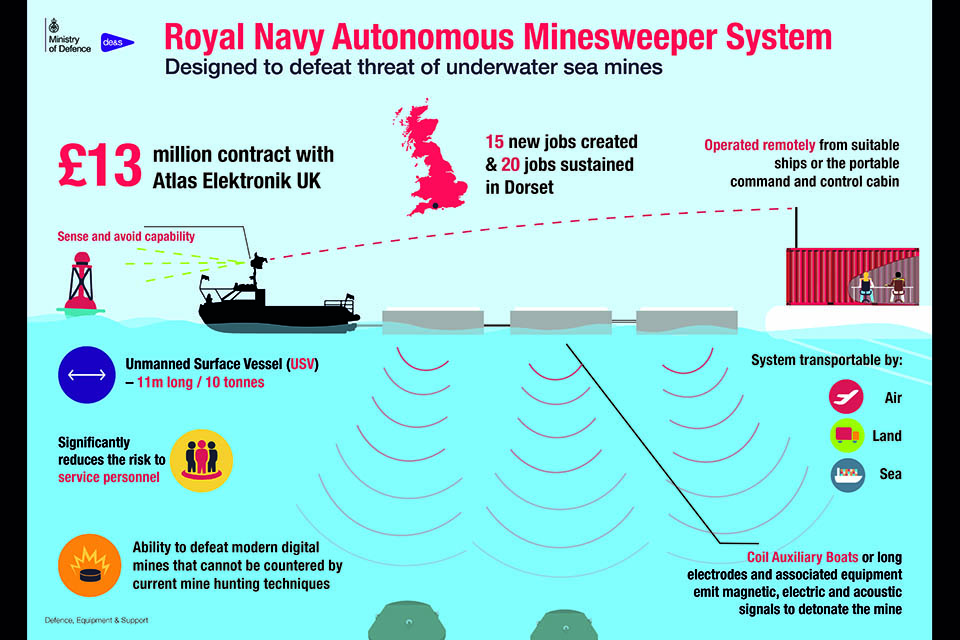
A first for Britain’s naval service, the roboat, built by German firm Atlas Elektronik’s UK subsidiary, drives itself around the high seas towing three auxiliary boats fitted with electro-acoustic transmitters. The transmitters generate pings that trigger modern digital mines at a safe distance from either the roboat flotilla or actual human-carrying shipping.
So far the MoD’s £13m contract with Atlas has netted it one complete boat-with-gear system on an R&D basis, with options available to buy more. The trials boat has just been handed over to the RN following proving of the design’s detect-and-avoid algorithms in what appears to be a live training data-versus-AI comparison exercise.
In maritime terms, the roboats comply with the International Regulations for the Prevention of Collisions at Sea (known as the Colregs – they’re the seagoing version of the Highway Code), though The Register would be most intrigued to see how they cope with scenarios that end up invoking rule 2(b).*
“This autonomous minesweeper takes us a step closer to taking our crews out of danger and allowing us to safely clear sea lanes of explosives, whether that’s supporting trade in global waters and around the British coastline, or protecting our ships and shores,” said defence procurement minister Guto Bebb in the usual canned quote.
* Rule 2, as published (PDF) by the Department for Transport, states: “Construing and complying with these Rules due regard shall be had to all dangers of navigation and collision and to any special circumstances, including the limitations of the vessels involved, which may make a departure from these Rules necessary to avoid immediate danger.”
Update, 14 May: UK Armed Forced Commentary has more information on the unmannned minesweeper system.
12 October 2005 was an historic day for the Royal Navy, because the Hunt class minesweepers HMS Middleton and HMS Ledbury conducted the last evolution at sea involving sweep gear, both the Oropesa mechanical wire system and the combined influence sweep equipment. The Royal Navy at that point had already operated unmanned, remotely controlled sweep systems in 2003 during waterway clearance work in Iraq, notably the opening of Umm Qasr. Under a UOR, a number of Combat Support Boats with remote controls were used to tow the Mini Dyad System (MDS) produced by Australian Defence Industries (ADI) and Pipe Noise Makers. Called Shallow Water Influence Minesweeping System (SWIMS), they were sent ahead of the RN minehunters as precursor sweeps against ground influence mines. The future of MCM was taking the path of stand-off action through unmanned systems and it was felt that the more than 100 years of manned ships sweeping were at an end.
The replacement for the sweep equipment was to come through the Flexible Agile Sweeping Technology, or FAST. The idea was to put two unmanned surface vehicles on the Hunt class vessels by modifying their open, capacious stern area. FAST, however, proved anything but fast, and even though a contract was signed in 2007 by the MOD with the Atlas-QED consortium, comprising Atlas Elektronik UK, QinetiQ and EDO Corporation, the resulting Technology Readiness Demonstrator never made it on the Hunt class. FAST became a test platform that spent the following years doing all sort of trials and demonstrations. Initially intended only for towing sweep kit, it ended up testing remote deployment and recovery of Sea Fox unmanned underwater vehicles, demonstrating that stand off clearance of minefields was possible.
Atlas Elektronik UK continued to work with the MOD and on its own, and eventually developed in-house the ARCIMS (ATLAS Remote Combined Influence Minesweeping System) system, which has enjoyed a first export success in an unnamed Middle East navy and has gone on to become the much delayed replacement for the Hunt’s sweeping capability within the Royal Navy.
An ARCIMS seaframe, but manned, was delivered to the Royal Navy in 2014 for trials and development purposes, and remains in service with the Maritime Autonomous System Trials Team (MASTT) of the Royal Navy as RNMB Hazard.
On 6 march 2015, Atlas received a 12.6 million pounds order from the MOD for a first ARCIMS-derived system, in the unmanned configuration, configured to tow sweeping equipment. The system has now been accepted, and according to MASTT, which has already trialed it extensively, the new boat is called RNMB Hussar.
Comments Off on Royal Navy buys the Terminator … of mines
May 8, 2018
The Western Front Awakens – Peace In The East I THE GREAT WAR Summary Part 13
The Great War
Published on 7 May 2018The spring of 1918 brought huge shifts to the fronts of World War 1. The Eastern Front went quiet after the Treaty of Brest-Litovsk and the Western Front returned to a war of movement with the German Spring Offensive 1918.
Comments Off on The Western Front Awakens – Peace In The East I THE GREAT WAR Summary Part 13
Charge of the Light Brigade | Animated History
The Armchair Historian
Published on 28 Dec 2017The Charge of the Light Brigade, Animated History
Comments Off on Charge of the Light Brigade | Animated History
May 7, 2018
DicKtionary – J is for Junk – Ching Shih
TimeGhost History
Published on 6 May 2018J is for Junk, boat of the Chinese,
For trade and for pleasure, they sailed the blue seas
Some junks were pirates, that ain’t a good thing,
And the queen of them all, was one Madame ChingJoin us on Patreon: https://www.patreon.com/TimeGhostHistory
Written and Hosted by: Indy Neidell
Based on a concept by Astrid Deinhard and Indy Neidell
Directed by: Spartacus Olsson
Produced by: Astrid Deinhard
Executive Producers: Bodo Rittenauer, Astrid Deinhard, Indy Neidell, Spartacus Olsson
Edited by: Bastian BeißwengerA TimeGhost format produced by OnLion Entertainment GmbH
Comments Off on DicKtionary – J is for Junk – Ching Shih
The Chinese Civil War – Blood for Unity l HISTORY OF CHINA
IT’S HISTORY
Published on 5 Sep 2015After the fall of the Qing dynasty China fell apart and both, forces loyal to Chiang Kai-shek’s National Kuomintang Party and as Mao Zedong’s Communist Party of China, fought to rule the country. This bloody struggle would ultimately result in the Chinese Civil War. It would take more than 22 years but would come to a halt during the 2nd Sino-Japanese War. After Japan’s defeat, Mao’s troops grew strong quickly and soon after they were able to force Chiang Kai-shek and his followers out of China. They sought refuge in Taiwan. Shortly after, Mao Zedong called out the People’s Republic of China. Learn all about the Chinese Civil War in this episode of Battlefields with Indy Neidell.
Comments Off on The Chinese Civil War – Blood for Unity l HISTORY OF CHINA
May 6, 2018
Our Trip To Turkey Recap I THE GREAT WAR
The Great War
Published on 5 May 2018Indy and Flo give you a small recap of our amazing trip to Turkey. Cool special episodes coming soon.
Comments Off on Our Trip To Turkey Recap I THE GREAT WAR
Tank Chats #29 Daimler Dingo Scout Car | The Tank Museum
The Tank Museum
Published on 21 Dec 2016The wheeled armoured scout car was the British Army’s principal reconnaissance vehicle from the beginning of World War II until the 1980s.
Scout cars were small and much quieter than a tracked vehicle; units equipped with scout cars relied on stealth to obtain information, rather than fighting for it. The Daimler Dingo entered service with the British Army in 1939 and served until the middle 1960s as a reconnaissance and liaison vehicle used by armoured and infantry divisions.
It was so versatile that a multitude of uses were found for it: medical officers used them to search for casualties in the battle field while one unit even issued a Dingo to its chaplain!
Comments Off on Tank Chats #29 Daimler Dingo Scout Car | The Tank Museum


