Forgotten Weapons
Published on 18 Jan 2015http://www.forgottenweapons.com
The No.5 MkI Enfield, commonly called the “jungle carbine” is nearly the shortest-lived rifle in British military service. Introduced in 1944, they were declared obsolete in 1947 as the result of insoluble accuracy problems. The guns were originally developed from regular No4 Enfield rifles with the goal of producing a shorter and lighter variant for paratroops. This was done by shortening the barrel, adding a flash hider, and making lightening cuts in several places on the barrel and receiver (which were the cause of the problems that doomed the gun).
Not all No.5 rifles produced developed problems, and they were certainly handier than the regular Enfield rifles. They are noted for kicking harder, of course, and this is not really helped by the narrow rubber buttpad they came with (most of which are nice and hard today).
Theme music by Dylan Benson – http://dbproductioncompany.webs.com
May 31, 2018
No5 MkI Enfield “Jungle Carbine”
May 30, 2018
Decisive Weapons S02E04 – U-Boat Killer: The Anti-Submarine Warship
erana19
Published on 25 Jan 20161996-1997 BBC documentary series. Series 2, Episode 4.
May 29, 2018
Allied Defense During Spring Offensives 1918 I THE GREAT WAR Special
The Great War
Published on 28 May 2018MHV about Stormtrooper tactics: https://www.youtube.com/watch?v=BNqmA-if-4g
The French and British defenses during the German Spring Offensive 1918 were put to a real test when the Germans attacked. The carefully built defenses had to be abandoned and new lessons had to be learned.
May 28, 2018
Naval Operations In The Dardanelles Campaign 1915 I THE GREAT WAR On The Road
The Great War
Published on 25 May 2018In our first episode filmed on the former Gallipoli battlefields, Indy and our guide Can Balcioglu explore the naval campaign that preceded the landings at Gallipoli in early 1915.
Leopard tanks in Afghanistan – “When the legend becomes fact, print the legend”
There’s a story that’s been told for more than a decade and — given the Canadian government’s legendary unwillingness to spend money on the military — widely believed. David Pugliese does his best to debunk it here:
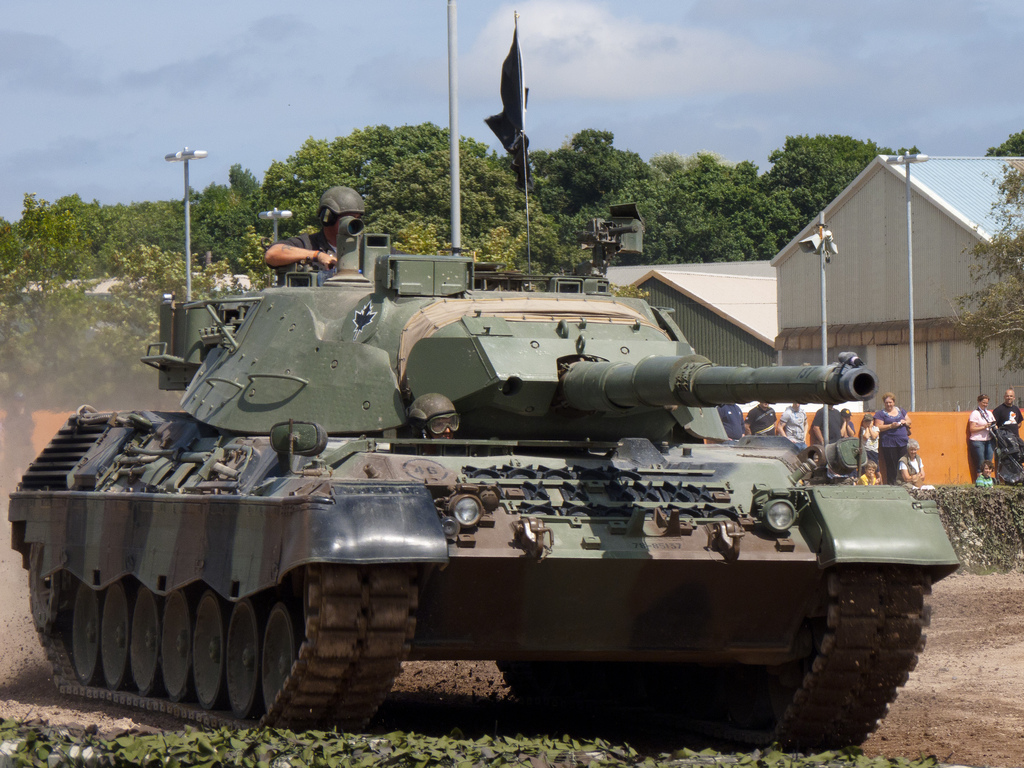
Canadian Leopard 1A3 (Leopard C1) at the Bovington Tank Museum.
Photo by Chris Parfeniuk, via Flickr.
As stories go it’s a pretty good one.
The Canadian Army was up against a tough enemy – the Taliban – in Afghanistan. Commanders called for Leopard tanks to join the battle but those armored vehicles had been mothballed and made into monuments.
So the ever resourceful Canadian Army crews jumped in the Leopard tanks mounted on concrete pads outside bases as monuments and drove them off those platforms, making sure they were shipped to their comrades in Afghanistan.
This myth has been around since 2007 and has once again resurfaced in a new book by retired Maj.-Gen. David Fraser about Operation Medusa.
Fraser also repeated the story in a recent CBC interview with Anna-Maria Tremonti, noting that he knew of at least one Leopard tank pulled off its concrete pad and brought back to serviceability and then shipped to Afghanistan.
In the 2008 book Kandahar Tour by Lee Windsor, David Charters and Brent Wilson the story gets even better. The tanks were driven off the concrete pads and then sent to Afghanistan, according to those authors.
A similar claim is made at the museum devoted to telling the story of the “Essex Regiment (Tank).” On its website the museum claims multiple numbers of Canadian Leopard tanks were taken from monuments (“A mad scramble to retrieve tanks from monuments and prepare them for war,” it claims).
Again, a great story.
But the Canadian Army says it never happened.
The Army points out that Leopard tanks, positioned on the concrete pads as monuments, had already been demilitarized so no one was driving them anywhere.
So what did happen?
May 26, 2018
Sir Humphrey debunks the notion of maintaining a “reserve fleet”
The US Navy keeps a lot of ships around after they’ve been retired from active service (sometimes for decades), and some in the UK are asking if the Royal Navy should do something like that with the soon-to-be-retired Type 23 frigates. Sir Humphrey explains in great detail why this shouldn’t happen:
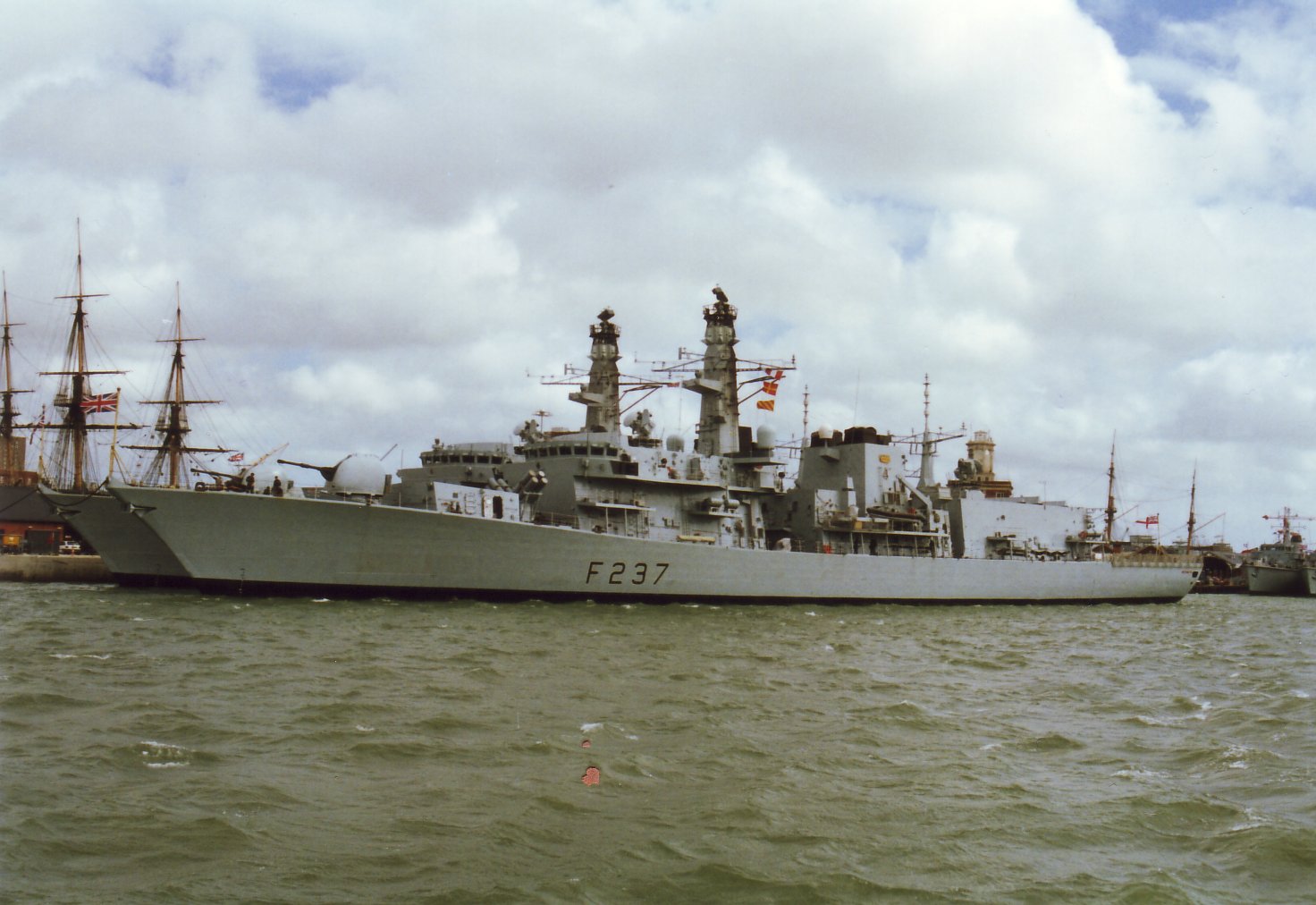
HMS Westminster (foreground) and HMS Iron Duke, Type 23 frigates of the Royal Navy, in the naval base of Portsmouth, August, 2000.
Image via Wikimedia Commons.
The subject of ‘Reserve Fleets’ is something that often comes up across the internet whenever naval forces are discussed. To many casual observers there is an innate draw to the idea of holding ships back as a contingency against a potential threat. No matter how appealing this idea seems on the surface though, there are a multitude of good reasons why keeping complex warships in reserve at the end of their life is usually a very bad idea.
In broad terms these reasons boil down to four key areas – Maintenance & Material and People & Training. Each of these areas poses a challenge which brought together makes it extremely difficult to consider keeping a ship credible once she has paid off.
Maintenance & Material
The Royal Navy has historically not maintained a large reserve fleet since the 1950s, when the combination of the loss of conscript manpower, the increasing complexity of warships adding to reactivation times and the reality that any global conflict would go nuclear quickly meant that reserve fleets were relatively worthless.After the late 1950s the RN maintained a ‘Standby Squadron’ that usually comprised several vessels that while not fully active, were kept in reasonable running order. For many years Chatham dockyard functioned as the home of the Squadron, which usually comprised ships drawn from classes still in service, that could be brought up to readiness quickly to replace other vessels at sea. This occurred during both the Cod War and the 1982 Falklands War.
It is not clear when the Standby Squadron was formally discontinued, but it played a key part in the RN force structure into the 1980s. For instance, the 1981 defence review foresaw a number of escorts (possibly 7-8 out of 50) being held in quasi-active status. The RN also maintained other ships in full reserve – such as during the lifetime of the Invincible class when usually one of the three was placed into reserve for a year or two ahead of deep refits.
The key distinction here is that this sort of set up required a heavy investment of resources and manpower to keep the ships maintained and fit for sea. A modern warship is never truly alone during her active life – there are always people onboard to maintain systems and keep watch over her. By contrast ships that decommission and pay off will progressively see less and less people onboard until one day they have been stripped down and become ‘dead ships’, and they will be left to rot until the scrappers take them.
To keep a ship in a salvageable condition, able to be made ready for sea requires a significant amount of maintenance and upkeep. This is something that is costly, requiring regular dockings, inspections and repairs, as well as the cost of keeping the ship preserved and vaguely usable. To put a ship into Reserve with the intention of using her again does not mean she can be forgotten about – quite the contrary, they require regular care and maintenance.
To put a ship into reserve at the end of her life and be certain of using her again would require an additional refit to rectify defects. It would also require regular inspections, support and attention throughout the period in reserve.
For a ship that is likely to be used again, it makes reasonable sense to do this as every pound spent on preventative maintenance is likely to save many more in reactivation costs. For a ship likely to pay off, this makes far less sense – you are spending a lot of money to park a ship and wait for it to be scrapped.
May 25, 2018
Bombs Away – German Thirst For Caucasian Oil I THE GREAT WAR Week 200
The Great War
Published on 24 May 2018In the 200th week of the war, the total nature of modern warfare is truly showing its face. The warring nations escalate their bombing campaigns and the German troops in the Caucasus are so thirsty for Caucasian oil, that they are considering to double cross their own allies.
May 24, 2018
Medieval tank – The 13th Century Knight I IT’S HISTORY
IT’S HISTORY
Published on 23 May 2018This time we will take you back to middle ages. It’s 13th century – what did medieval armor look like?
Tank Chats #30 M3 Grant | The Tank Museum
The Tank Museum
Published on 27 Jan 2017The thirtieth in a series of short films about some of the vehicles in our collection presented by The Tank Museum’s historian David Fletcher MBE.
Tanks of this type were first used in Western Desert in 1942. The M3’s were mechanically reliable, but soon superseded by Sherman.
May 22, 2018
The Fightinest Marine – Dan Daly I WHO DID WHAT IN WW1?
The Great War
Published on 21 May 2018Dan Daly was one of only two Marines to be awarded Medals of Honor in two separate conflicts. The first, for his actions in 1901 during the China relief. His second, for his actions during the U.S. invasion and occupation of Haiti in 1915. But he wasn’t done yet and after the U.S. entry into WW1 in April 1917, he was close to receiving his third one on the battlefield of Belleau Wood in France.
May 21, 2018
“Civil War Uniforms of Blue & Grey – The Evolution” Volume 2
LionHeart FilmWorks
Published on 29 Apr 2018http://www.lionheart-filmworks.com
Volume 2 of 4… A display of some of the more unique and important uniforms to represent the evolution of the American Civil War “Blue and Grey” from just before the spark of the war in 1861 to Union victory and occupation in 1865.
This project is meant to honor men from both the north and the south — now together forever in eternity — who served their countries, their states and their comrades while wearing these uniforms, weapons, and accouterments — during some of the most brutal battles Americans have ever faced. Shot in 4K and featuring nine of the best Living Historians in the country.
As accurately as we possibly could, and one uniform at a time.… telling the story of the 2.75 Million soldiers who once wore these sacks coats, shell jackets and kepis with pride — each soldier earning a debt we should all be duty-bound to continue to honor.
Directed/Produced: Kevin R. Hershberger
Cinematography: Hugh Burruss
Costumers & Featuring: Tyler Grecco, Nathan Hoffman, Connor Timony, Brennan Wheatley, Guy Gane, Eric Smallwood… as well as Mark Aaron, Tr’waan Coles & Justin Young.
Grip / Electric: Brian Lyles
Costumes & Props: Historical Wardrobe – Richmond, VA
May 20, 2018
Black Army of Ukraine – Togoland in WW1I OUT OF THE TRENCHES
The Great War
Published on 19 May 2018Chair of Wisdom Time!
May 19, 2018
“Don’t cry for Gaza. Gaza is a failed state and a failed society, marinated in hatred rather than aspiration”
Barbara Kay on the impossible situation Israeli troops find themselves in, with the media acting as cheerleaders and active propagandists for the Palestinian terrorists:
Optics play a huge role in any asymmetric war Israel is involved in. The media tend to favour the “underdog,” and seize on every incident that casts Israel in an inhumane light. In one story about the death of a baby, allegedly at IDF hands, an image in the news showed a group of Palestinian women comforting a mother holding her shrouded infant. The message conveyed was that of a heartless machine that kills indiscriminately. A closer look at the story reveals that it was a combination of tear gas and a pre-existing heart condition that killed the baby, with no direct intention on the part of the IDF. Rather than reflexive condemnation of Israel, the takeaway from the story should be: who brings an infant to a battle site? Children are purposefully being used as human shields. This is a tactic routinely deployed by Hamas, but rarely called out for the despicable war crime it is.
Israel’s critics point to the mounting death toll of Gazans with indignation, failing to distinguish between actual civilians and Hamas terror foot soldiers. But even Hamas has stated that the overwhelming majority of fatalities were their own fighters. Israel is killing mostly bad actors, and even then, relatively few in number. No army in the world can do better than “mostly.” No other army in the world would act as prudently as the IDF. The IDF uses rubber bullets when it can, but they only work at short range. They are using tear gas when they can, but that’s no good when it’s windy. They have senior commanders stationed at every confrontation point. Every single hit is reportedly documented and investigated in Excel spreadsheets. The collateral damage of actual non-combatants is around 20 deaths or fewer. It doesn’t get more humane than that in war.
Some critics ask why they don’t just “arrest” the invaders. That’s not feasible. If soldiers came near the crowds, they would be swarmed and a bloodbath could ensue. They use live ammunition as a last resort, but use it they must, for they cannot allow hundreds or thousands of Gazans to infiltrate their territory and imperil adjoining Israeli communities.
The Macedonian phalanx – structure and organization
Syntagma
Published on 19 Feb 2018A description of the Macedonian phalanx structure during the Alexander and Diadochi age, based on later written Asclepiodotos and Aelian infantry manuals.
QotD: Operation “keeping up appearances”
It’s hard to blame the Army, and even if it wasn’t not all of even most of the blame can be laid at the Army’s doorstep.
Government, both Conservative and Liberal kept repeating Pierre Trudeau’s lie that “we’re here and we’re doing our full, fair and agreed upon share.” Kudos to Prime Minister Mulroney who, when faced with irrefutable and embarrassingly public evidence that we simply could not deploy and sustain two small brigades in war, cancelled the North Norway brigade commitment and pulled the Germany-based brigade back to Canada.
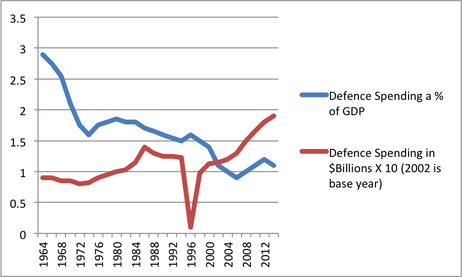
This graph, which is only rough, being drawn from three different sources and “rounded” for ease of plotting, shows, essentially, what happened between 1964 (Prime Minister Pearson) and 2014 Prime Minister Harper). As you can see defence spending as a percentage of Gross Domestic Product ~ a fair measure of our national, political commitment to our defence of Canada and of our allies and neighbours, has declined steadily even though, generally, with one “blip” in the Chrétien era, when he was trying to wrestle with the deficit, the actual dollars spent on defence have grown in number. What it really shows is that our GDP grew a lot in the past 50 years ~ it’s now almost $2.5 Trillion (that’s $2,500,000,000,000.00) ~ but our political willingness (or appreciation of the necessity) to spend 2% of GDP, as we did in about 1970s and as we have, sort of, agreed (in NATO) do aspire to do again, has not kept pace with our increasing prosperity. In fact, while the dollars spend on defence have doubled, in 50 years, the % of GDP spent of defence has fallen to ⅓ of its 1964 level. But ministers’ desires to “talk good fight” remain at historically high levels and even as resources shrink admirals and generals are told to “keep up appearances”. That, keeping up appearances, was what the admirals and generals wanted to do … no one really wanted to go into various international military fora and say “as our resources decline we’re going to have to do less,” instead they went out and said “we’re learning new ways to do more with less,” which is, of course, utter nonsense. Meanwhile more and more quite senior officers came back from tours of duty in the USA and brought with them some very American ideas about organization and management. Now American organizational models might work very well for armies with 1,000,000+ soldiers, or even for those with 495,000, like South Korea’s perhaps, even for those with 100,000+ like the French army, but they are not always or even often suitable for an army with 20,000± regulars and 25,000± reservists. The new organizations might make us look bigger, on paper, but they hide the fact the army has been hollowed out since 1970.
The Army of 1964, the one that consumed its fair share of the 3% of GDP that Canada spent on defence had four brigades, the largest had about 6,500 soldiers in it, the smaller ones had about 5,000 each. That was more men and women in combat units than we have in the entire, top heavy, Canadian Army today in total. But we still have three of the four brigades, we have nine instead of 13 battalions of infantry and three instead of four regiments of artillery … but how? Simple: it’s the Potemkin village, again, battalions that should have 950 soldiers have 500 … if their lucky. In fact there are no combat ready infantry battalions. Any battalion being readied for operations must be reinforced from other infantry battalions … we have nine battalion commanders and nine regimental sergeants major and so on but we only have enough soldiers in rifle platoons to staff five battalions … maybe only four if the battalions are properly equipped with mortars and heavy assault weapons. Why? Because no one, not ministers, not senior civil servants and not the generals want to “cut his coat according to his cloth.”
Ted Campbell, “A Canadian Potemkin Village”, Ted Campbell’s Point of View, 2016-09-15.