
Forgotten Weapons
Published 16 Feb 2026After World War One, the Italian military spent some time studying the effectiveness of reduced-power cartridges, including both pistol calibers semiautomatic carbines and submachine guns as well as intermediate-caliber rifles. One of the rifles developed for the subsequent testing was the Terni Arsenal model 1921, of which 200 appear to have been made in total during the 1920s. This rifle used a surprising advanced 7.35x32mm cartridge, firing a 135 grain bullet at 1970 fps. It was a short recoil design and used a Fiat-Revelli style cube magazine. Ultimately the concept was not adopted (probably for reasons of cost), and some of the surviving rifles ended up in Ethiopia — where this example was found a few years ago.
(more…)
July 5, 2026
Terni Model 1921: Italian Interwar Assault Rifle with a Cube Mag
QotD: Battlefield communication in the pre-modern world
Let us assume, picking up our discussion of information last time, that our army is formed up into its battle array (pre-planned the night before, recall) and is advancing and our general has just now noticed something that demands a change in the plan. It could be a dangerous enemy attack (perhaps on the flank) or an opportunity to split the enemy line. Whatever it is, our general needs to make some alteration to the battle plan. It is almost certainly a fairly minor alteration, as with a battle line anywhere from a kilometer to several kilometers long, it would, for instance, take far too long to shuffle the right-to-left order of the line just due to the marching time involved. Nevertheless, the general needs to issue an unplanned, on-the-spot command; how does he do it?
The first option, of course, is shouting. The problem here is obvious: how is the commander’s command to be heard? Interestingly, there has been a fair bit of research by ancient historians looking at the question of how many people can possibly hear a short address unaided by modern loudspeakers and the like; figures vary but generally a few thousand if they are reasonably compact and quiet. That might work for a general’s pre-battle speech, delivered before the army advances, but it will not do for an army that is already in motion, much less once the chaos of battle has begun. Thousands of men marching (let alone fighting!) are noisy!
The modern solution to this problem is radio, but of course that’s hardly available to our pre-modern commander. Instead, to judge by films, the mind quickly jumps to signal flags. I am reminded of Braveheart (1995)’s rendition of the Battle of Falkirk, where Edward I uses signal flags to order his archers forward. HBO’s Rome also does this in its version of the Battle of Philippi, with flags being jostled and then pointed forward to signal the advance. Unfortunately, signal flags – as distinct from unit flags (which we’ll come back to in a moment) – have a few key problems, the most notable of which is that no one will be looking at them: after all the army is advancing, the soldiers are looking forward but signal flags (again, as opposed to unit flags) are going to be behind them, not placed out in the middle of No Man’s Land between the armies. As a result, signal flags are useful for sending information long distances (in a chain of stations or operators), for instance from one commander at distance to another, but not in battle; operational, rather than tactical tools. In practice, the use of signal flags like this is confined to the modern era; the first successful “optical telegraphs” (as iterations on things like smoke signals and fire relays) date to the late 18th century.
Unit flags – a banner or other big, obvious symbol (like a statue of an eagle on a stick) – are more useful. These can be positioned at the front of a unit, typically at its center. If it advances, then the soldiers in the unit also know to advance, following the standard they can see (because it is elevated, large and visible) even if they cannot hear the orders. There are two complications here though: first, the unit banner or flag is a relatively late innovation in antiquity, really only coming into its own with the Romans. The Achaemenids may have used some kinds of ensigns or standards, but the Greeks do not seem to have done. Instead our first really good documentation of something like a battle flag comes from the Romans: each legion had a signa (eventually standardized to the legionary eagle, the aquila), which was a shiny metal statue mounted on a pole so it could be easily seen. Units of the legion broken off to do other things might instead follow a less impressive cloth banner, a vexillum, by which such detachments became known as vexillationes. But the broader problem is that of course your general may not be particularly close to your flags (or other standards) which are generally at the front-center of each component unit of your army. The flags may allow a subordinate officer to “drive” the unit over the battlefield – and that’s good – but it doesn’t let the general tell that officer what to do.
A better option is music, but once again development seems to come fairly late in antiquity. Greek hoplites seem to have advanced to the music of the aulos, a double-reeded flute-like instrument; given the limitations of the instrument it is generally assumed it was used to keep time (so everyone marched in step) not transmit orders. Once again, a more complex system of musical signalling seems to come with the Romans, at least as detailed by Vegetius. Vegetius (2.22) notes three different kinds of horn instruments used by a legion: the tubicen was used to sound charge and retreat, the cornicen regulated the movement of the signa (so “advance” or “halt”), while the buccina was used mostly for camp signals: sounding watches or assemblies. It’s a system that is akin to later bugle calls, but note that the orders it can give are limited to a relative handful of prearranged signals: advance, halt, charge, retreat, assemble, change shift and so on.
The attentive reader here may have already noticed how developed Roman command and control is and may suspect that ties in with the Romans having a more “command” oriented culture of generalship; if so you are ahead of the game!
Of course if those instruments are sounding on a per-unit basis (and they are) that means you still have the problem of getting the order from the general to the instruments for the unit in question. And fundamentally here, the technology is – as I tell my students – man-on-horse. The particular fellow on the horse may be a dedicated messenger (if your military organization has those) or a subordinate officer or it may be the general himself.
But it is important to note now the limitations of this sort of system and we can use what we know of the Roman command and control system (as noted, one of the more developed of such systems prior to gunpowder) to get a sense of them. Let’s say the general realizes there is a problem on his flank and he needs a unit (probably here we’re talking a cohort or a maniple, not a legion) to change what it is doing. First off, the order needs to get within shouting range of the unit’s commander (in this case a senior centurion). The general can either go themselves or send a messenger; both options have their downsides. If the general goes himself he is essentially removing himself from observing or commanding the rest of the battle, but a common problem with sending a junior subordinate is that the unit commander may not respect or feel the need to obey that subordinate (written orders can help with this, but now we’re bringing in questions of literacy). Of course both a messenger or a general in transit may also well be killed, which will prevent the order from being received!
In either case, the message is going to move at galloping speed, which is around 40km/h, meaning that it may take several minutes for the general or messenger to navigate to the spot. That doesn’t sound so bad, but battles with contact weapons do not typically go for hours and hours; Pydna (168) was, as noted last week, decided in about an hour total! Of course a battle might be longer (or shorter!) than this, though much of that extra time is likely pre-battle skirmishing – the actual direct press of infantry formations in shock rarely lasts long because of the terror of it (and to a lesser extent its lethality; we’ll return to the balance of terror and lethality next time). Imagine if you were playing a Total War game and your input delay was, say, five minutes long in a battle that might only last an hour or two.
But of course galloping time isn’t the end of it. The message now has to be conveyed to the unit. In the Roman system, that means the messenger needs to find the appropriate centurion, explain the order to him and then ideally that fellow will then signal the instruments and signa to act accordingly – but even then, those instruments and signa only have a handful of prearranged signals available. Anything more complicated will need to be shouted down the line the old fashioned way (as we know, for instance, the Spartans did for lack of almost any of the rest of this apparatus of command, Xen. Lac. 13.9). Needless to say that means that giving any complex order to a unit already engaged or about to be engaged is going to mean starting by signalling retreat and then attempting to regroup the unit; regrouping an already retreating unit is one of the most difficult tasks on a battlefield and is rarely performed successfully in an unplanned fashion (even in a planned fashion it goes wrong as often as it goes right).
(This is, by the by, why reserves are so important. An unengaged unit hanging behind the lines can be given new orders far, far easier than a unit that is already engaged or about to be. And indeed, those familiar with the Roman system of fighting with its three lines of heavy infantry will note that it is a system heavy on reserves. Indeed, the manipular legion essentially assumes it will be necessary to retreat and regroup the first line of heavy infantry (the hastati) behind the second (the principes) and plans and drills for that. Note how the Roman command culture, the Roman fighting method and the actual apparatus of messengers, signa, instruments and junior officers all align here – that’s common because these sort of institutions tend to co-evolve.
By contrast we may compare a Greek hoplite army in the Classical Period. It has no battle flags or ensigns and the general is expected to fight on foot. In the past I’ve described the resulting phalanx as an “unguided missile” and this is a big reason why. That’s not to say hoplite generals never exerted command on the battlefield – better generals might keep a reserve to be rushed to important points (as Pagondas does at the Battle of Delium in 424 BC). But for the most part, once a hoplite general formed up the army and hit “go”, they had very little control over the army.
Bret Devereaux, “Collections: Total Generalship: Commanding Pre-Modern Armies, Part II: Commands”, A Collection of Unmitigated Pedantry, 2022-06-03.
July 4, 2026
The Dark Truth Behind America’s National Anthem
The Rest Is History
Published 8 Jun 2026How did the War of 1812 result in America’s national anthem, The Star Spangled Banner? Who came up with it? And, why does this origin story make the anthem so controversial?
Join Dominic and Tom as they launch into the first episode of their Football World Cup special, with the story behind America’s national anthem, and its secret story.
0:00 – Lloyd’s
01:21 – The Star-Spangled Banner
02:43 – A World Cup Series on National Anthems
04:08 – America’s Most Controversial Anthem
05:00 – The Forgotten War of 1812
09:10 – Britain Strikes Back
11:39 – Francis Scott Key Boards the British Fleet
15:27 – The Bombardment of Fort McHenry
18:14 – The Giant Flag That Inspired the Anthem
20:41 – Francis Scott Key Writes the Poem
23:28 – Why the Anthem Used an Old English Tune
26:13 – The Anacreontic Song
29:07 – How the Song Became a Hit
30:37 – The Times
31:48 – Is The Star-Spangled Banner About Slavery?
36:08 – Escaped Slaves and the British Army
40:55 – The People Who Found Freedom Under the Union Jack
42:29 – Francis Scott Key’s Complicated Legacy
47:06 – The Song Spreads Across America
51:39 – Why America Took So Long to Get a National Anthem
56:42 – How It Finally Became the Anthem
57:06 – Controversial Performances
1:00:17 – Colin Kaepernick and Taking the Knee
1:02:39 – Can You Separate the Anthem from the Author?
1:03:03 – The Abolitionist Version of the Anthem
1:04:13 – Coming Next: God Save the King
1:06:33 – The Rest Is History ClubVideo Editors: Jack Meek, Harry Swan + Adam Thornton
Social Producer: Harry Balden
Producers: Tabby Syrett & Aaliyah Akude
Senior Producer: Callum Hill
Executive Producer: Dom Johnson
Chief Digital Officer: Sam Oakley
July 2, 2026
PBS-1 Soviet AK Silencer (the Original, not the Dead Air One)
Forgotten Weapons
Published 13 Feb 2026The Soviet Union had made fairly extensive use of silencers on Mosin Nagant rifles during World War Two, as tools for snipers and recon scouts among others. In the mid 1950s a new silencer was put into development for the new 7.62x39mm family of weapons, called the PBS (Прибор Бесшумной Стрельбы; Pribor Besshumnoi Strelyby; Silent Shooting Device). This was originally intended to be a multi-weapon silencer, but the abandonment of the SKS and reliability problems with the RPD led to it being limited to just the AK. Compared to the Mosin Nagant silencers, this new design was much more difficult, as it had to allow the rifle to cycle reliably using specialized subsonic ammunition, and also continue to run reliably with the silencer removed and standard ammunition used. This led to the most unusual element of its design; a thick rubber wipe just in front of the muzzle to help boost back pressure.
The remainder of the design was pretty simple, with 12 plain flat plate baffles. The first production PBS model used a clamshell main body, but this was replaced by a solid tube on the PBS-1 improved model in 1962. These suppressors were used until the late 1970s, when the 9x39mm cartridge was developed for better subsonic effectiveness, along with a number of unique new firearms designed for it.
Bramit Suppressor for Mosin Nagant: • Soviet WW2 Bramit Silencer for the M91/30
(more…)
July 1, 2026
The Korean War Week 106 – The Battle of Old Baldy – June 30, 1952
The Korean War by Indy Neidell
Published 30 Jun 2026On the ground, the fight for the hilltop they call “Old Baldy” really heats up this week, and it’s a bloody one. In the air, the bombing campaign to destroy the North Korean hydro-electrical complex continues, and the Suiho dam, one of the world’s largest, is put out of action and the power is out across much of the country.
00:00 Intro
00:45 Recap
01:14 Suiho Dam
05:22 Old Baldy
09:04 Army Budgets
14:29 Planning a coup?
16:08 Summary
16:22 Conclusion
17:10 Call to Action
June 29, 2026
Stupid Super Heavies: Germany’s Biggest Tanks
The Tank Museum
Published 27 Feb 2026By late 1943 Germany was losing the war …
They needed tanks, and lots of them, if they were going to wrestle back the initiative. Instead, they became obsessed with wonder weapons they hoped could change their fate
From the logistical paralysis of King Tiger, growing ever bigger and more unwieldy with the Maus, ultimately reaching the madness of the thousand tonne Ratte.
Like Augustus Gloop, German tank development in the Second World War greedily ate up more and more resources.
While an absolute boon for historians working at The Tank Museum, it made no logical sense … What were they thinking?
This is the bewildering story of the “Super Heavies”
00:00 | Introduction
00:48 | The Panther Problem
02:27 | Bigger is Better
05:42 | Pushing the Limits
09:19 | Gigantic Fantasies
12:03 | Losing the War (and the Plot)
(more…)
QotD: Roman Imperial frontiers and “defensive barbarism”
Here’s another one — why is Hadrian’s Wall where it is? There’s a much shorter and more defensible alternate location to the north, where the Firth of Forth and the Firth of Clyde create a natural bottleneck. In fact at one point the Romans did build a wall there and claimed all the intervening territory. On paper, the Antonine Wall looks better in every way than Hadrian’s Wall. [Image from original post] It’s shorter, so requires less military “output” to defend. And it encloses more area, so brings to the “inputs” of the machine of state both additional arable land and additional people who can be taxed and conscripted. But as it happened, the Antonine Wall was quickly abandoned, and the empire retreated to Hadrian’s Wall. Why?
It all had to do with the people living between the two walls. They were … hill people who had perfected the art of not being governed. They managed to be so thoroughly intractable, so impossible to control or corral, so very unpleasant to be around, that the Romans eventually threw up their hands in disgust and left them alone. It’s important to understand that this means they must have been true outliers, because the Roman Empire had “unit economics” like an enterprise SaaS business, where “customer acquisition costs” are financed on the assumption that they’ll be paid back in the distant future. Every Roman bureaucrat understood that newly conquered territories would be a drain on fiscal and military resources for a while, until a generations-long process of pacification and Romanization slowly made them net contributors in both departments. But in the case of the lands between the two walls, the payback timeline was so long, and the implied interest rates so high, that even a people as meticulous and relentless as the Romans decided there were better opportunities elsewhere. I count this as a serious victory for the theory of defensive barbarism.
John Psmith, “REVIEW: The Grand Strategy of the Roman Empire by Edward Luttwak”, Mr. and Mrs. Psmith’s Bookshelf, 2023-11-13.
June 28, 2026
How to Steal a Country Without a European War – Death of Democracy 21 – Q1 1938
World War Two and Spartacus Olsson
Published 27 Jun 2026In early 1938, Adolf Hitler turned a military scandal into personal control over the Wehrmacht — and within weeks used that power to pressure, invade, and annex Austria in the Anschluss. This episode follows the Blomberg-Fritsch crisis, Hitler’s February 4 command takeover, the Berchtesgaden ultimatum, Schuschnigg’s failed plebiscite gamble, the German invasion of March 12, and the terror that followed in Vienna.
This was not just a border crisis. It was the moment Nazi Germany moved from internal dictatorship to open territorial expansion. Britain and France did not intervene, Austria was erased as a sovereign state, and Hitler’s next target — Czechoslovakia — was already coming into view.
This historical documentary examines Nazi Germany, the Anschluss of Austria, the Wehrmacht, appeasement, antisemitic terror, propaganda, and the collapse of the post-1919 European order.
Educational documentary. Nazi symbols and imagery are shown only in a historical, critical, and anti-fascist context.
June 27, 2026
Destroyed In Four Minutes – The Battle of Cape Matapan
TimeGhost Cartographic
Published 26 Jun 2026March 1941. As British troops sail to reinforce Greece ahead of the expected German invasion, the Italian Navy sees a chance to strike. A powerful battlefleet puts to sea, hoping to intercept the convoys and seize back the initiative in the Mediterranean.
But the British know something is coming.
With the Mediterranean Fleet stretched to its limits, Admiral Andrew Cunningham must make a critical decision. Relying on intelligence and naval aviation in a race against time, the Royal Navy heads out to meet the tide headed their way.
What follows is one of the most dramatic naval engagements of the Second World War, culminating in a brutal conclusion that would leave a lasting mark on the Mediterranean campaign.
June 26, 2026
Sparta vs Athens 2(c): Spartan Childhood – The Agōgē, Infant Inspection, and State Brutality
seangabb
Published 8 Feb 2026Greece: A Brief History, c.700 BC – 500 AD
This segment goes straight to the ancient evidence. Using Plutarch’s Life of Lycurgus (with the passages shown on-screen), I explain how Sparta understood itself: infant inspection and exposure, the collective upbringing of boys in the agōgē, deliberate hunger and deprivation, enforced endurance, and the suppression of private loyalties in favour of loyalty to the state.
This is not presented as scandal. Plutarch often writes admiringly, which is precisely why the text is so revealing. The system is coherent. It is also terrifying. Sparta did not merely train soldiers. It manufactured them, beginning at birth.
QotD: The submarine war against Japan
The success of the American submarine campaign was genuinely astonishing, and created a near perfect asphyxiation of the Japanese war economy, with imports of virtually every vital industrial input plummeting to near zero by 1944. Admiral Charles Lockwood, who commanded the Submarine Force Pacific Fleet, was probably only slightly boasting when he later told an instructor at the Naval Academy:
Now don’t teach those midshipmen that the submariners won the war. We know there were other forces fighting there, too. But if they kept the surface forces and the flyboys out of our patrol areas we would have won the war six months earlier.
Despite the phenomenal success of America’s submarine operations against Japan, the American war on Japanese shipping generally receives scant attention. To take just one example, Francis Pike’s magisterial and colossal tome on the Pacific War relegates American submarine operations to an appendix. In contrast, there is an astonishing volume of literature devoted to the war’s other grand submarine campaign: the so-called Battle of the Atlantic. Germany’s famous U-boats attempted a similarly strategic interdiction war against shipping to the British home isles. Unlike the American submarine force in the Pacific, however, the U-boats failed.
Big Serge, “Wolf Packs: Battle of the Atlantic”, Big Serge Thought, 2025-12-12.
June 25, 2026
Coenders’ Bolt-Less Last Ditch Bolt Action Rifle
Forgotten Weapons
Published 4 Feb 2026When the German Army tested last-ditch Volkssturm rifles late in World War Two, one of the particularly obscure submissions was August Coenders’ Coenders-Rochling Volkssturmkarabiner. This was a bolt-action rifle chambered for 8mm Mauser with a 5-round magazine. However, instead of using a traditional bolt action system it had a fixed breechblock and the handle was attached to the barrel. Cycling the action meant unlocking the barrel and sliding it forward, while the breechblock held the fired case in place. When the barrel was fully forward, the next round in the magazine would kick out the empty case, and pull the barrel rearward seated the next cartridge, ready to fire. In testing, the rifle was, frankly, terrible.
Thanks to the Springfield Armory National Historic Site for giving me access to this unique specimen from their reference collection to film for you! Don’t miss the chance to visit the museum there if you have a day free in Springfield, Massachusetts: https://www.nps.gov/spar/index.htm
(more…)
June 24, 2026
The importance of proper maps on strategic thinking
CDR Salamander considers the use of maps — appropriate maps — to be critical for both military and civilian strategists. And the most common kind of map most people encounter is one of the worst, because it conceals more than it reveals:
If I am ever invited into someone’s personal study, office, or library — especially someone who puts themselves forward as a national security type — one of the things I not-so-subtly look for is maps, charts, or better yet, a globe.
Yes, I will judge you. It matters.
I have seen exceptionally credentialed and powerful uniformed and civilian leadership here and in Europe have an almost comical ignorance of the world in which they hold access to levers of almost unimaginable power. From a complete disinterest bordering on criminal unawareness of the bottom topography of the Baltic and Taiwan Strait, to not knowing where the Cape of Good Hope is, or even what a Great Circle Route is.
That kind of ignorance gets people killed.
They got their positions of power and influence for a whole host of reasons, but an understanding of geography and the ability to read a map was probably not one of them.
[…]
If someone says, “When you look at a map of the world …”, more likely than not, what will pop into your mind will be what is at the top of the post, the Mercator Projection.
That may be one of the contributing factors to inadequate strategic thinking in the modern age.
Of course, any attempt to represent a three-dimensional object on a two-dimensional format is going to create some problems.
You need multiple perspectives, and often the one that best serves in helping you understand the challenge of the moment.
As we continue to argue the point here, we don’t need a new force design, or national strategy, we need a national understanding.
We need to understand the fact we are a maritime and aerospace power, and those are the two domains where the majority of fighting in any war against the People’s Republic of China is going to take place.
It has a unique set of challenges that have nothing to do with politics, people, culture or anything from man; it has to do with the interface of land, water, time, and distance.
As we learned and then forgot from WWII, any war in the far reaches of the Pacific requires range, scale, and the logistics system that appreciates both and can sustain the fight forward.
[…]
What are the top-5 even the novice should get?
- AUKUS is a must-succeed. Don’t balk. Don’t stutter. Don’t be difficult. Make it work. It reinforces our left flank. Australia and the Philippines are our shield and redoubt.
- Taiwan is the stopper that keeps the PRC relatively contained. If you lose that, Guam is your new front line.
- A strong Japan and South Korea must be made stronger and closer. They are our right flank.
- What does the PRC want? Once you accept that they want everything from the line drawn from Alaska to New Zealand to their coast under their uncontested control, but are more than happy to let us have everything on the other side, then you understand what they have been doing for decades in the small island nations in the Southwest Pacific.
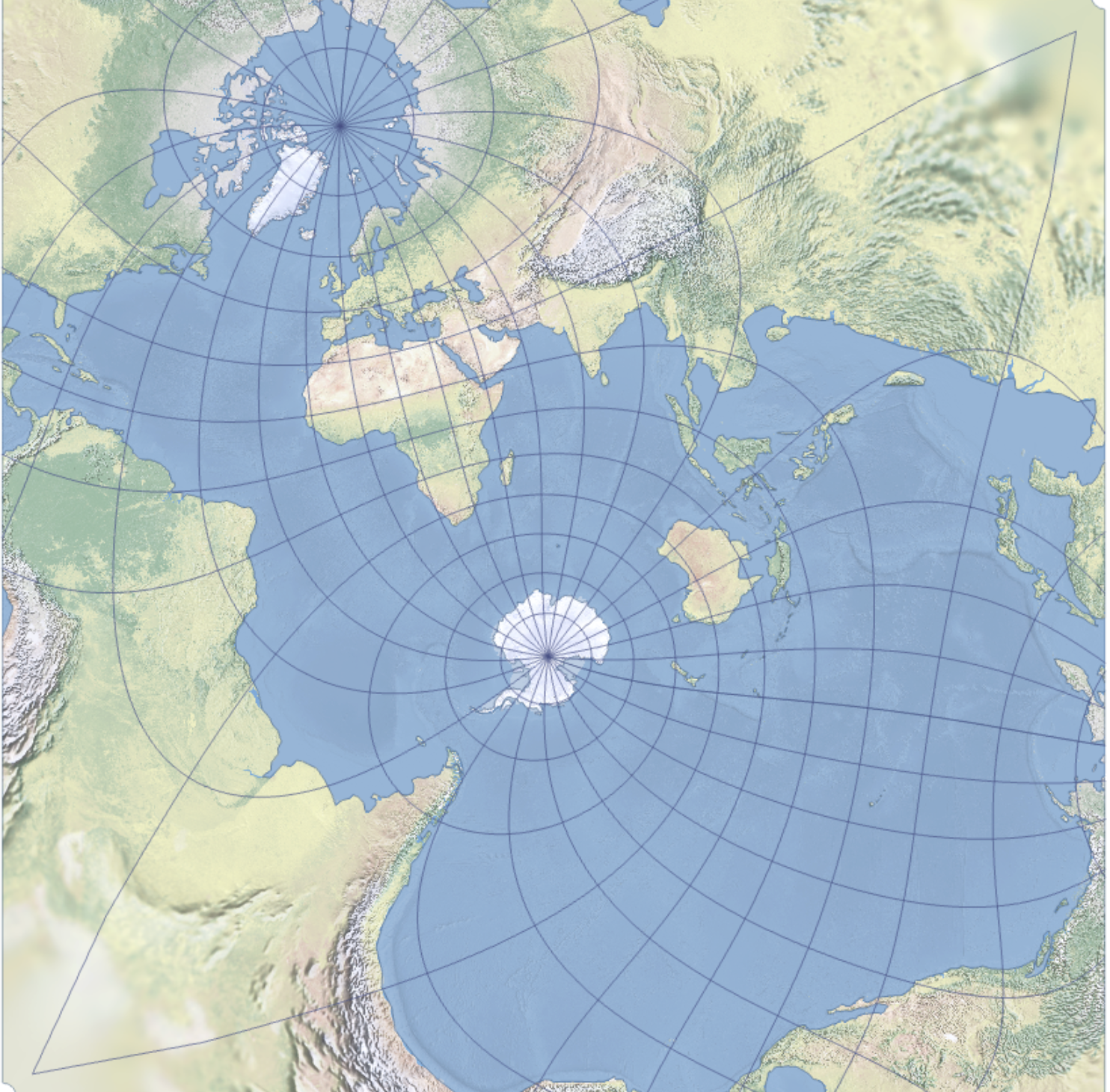
- People grow up with maps that emphasize Europe and the North Atlantic. This projection breaks that mental fixation, putting Europe and the North Atlantic in a minor corner of the map, almost an afterthought that barely catches the eye.
A slightly more recognizable version [of the Spilhaus Projection] is below.

The Korean War Week 105 – Destroy Suiho Dam! – June 23, 1952
The Korean War by Indy Neidell
Published 23 Jun 2026Since the beginning of the war UN air power has studiously avoided hitting North Korea’s hydro-electric complex, since the power the dams provide is mainly for civilian use, but that changes this week! Meanwhile on the ground, the focus has turned to capturing Communist POWs for information, but that task has suddenly proved impossible now that the UN POW camps are firmly back in UN control, and it seems the Communists now prefer even death to capture.
00:00 Intro
00:29 Recap
00:59 Taking Prisoners
03:18 The Shropshires
05:54 Ammunition Shortage
08:41 Targeting Power Plants
14:55 Summary
15:10 Conclusion
15:58 Call to Action
Feeding A Roman Centurion – Pork & Puls
Tasting History with Max Miller
Published 30 Dec 2025Farro cooked in wine sauce topped with stewed pork, leeks, and dill
City/Region: Rome
Time Period: 1st CenturyWhile the common Roman foot soldier didn’t often have access to fresh meat, a Roman centurion did. A centurion was in charge of 80 fighting men and 20 servants, and holding such a rank meant that their meals were prepared for them and might include ingredients like garum, defrutum (reduced grape must), and fresh herbs and meat.
The dill and defrutum come through in the pork, and the wine isn’t overpowering. The puls, or wheat porridge, is wonderfully flavorful, and the whole dish is made up of lots of different textures (don’t skip the chopped leek garnish; it adds a wonderful crunch). If you like your puls to be thicker and more porridge-like in consistency, go ahead and crush the farro before cooking it.
… small pieces of meat and fine wheat flour or cooked groats you also season with [oenococti], and serve with small morsels of pork prepared with the same sauce.
Frontinian Piglet [oenococti sauce]:
You bone it, brown, and truss. Put into a pot garum and wine, and tie together a bundle of leek and dill. Halfway through the cooking, add defrutum. When it is cooked, wash it and dry. Sprinkle with pepper and serve.
— Apicius de re coquinaria, 1st century


