Quotulatiousness

April 24, 2012

Is your boss a baboon? You’re quite correct

Filed under: Media, Science — Tags: , , — Nicholas @ 09:07

Matt Ridley reviews a new book, Games Primates Play by Dario Maestripieri:

Generally, junior professors write long and unsolicited emails to senior professors, who reply with short ones after a delay; the juniors then reply quickly and at length. This is not because the seniors are busier, for they, too, write longer and more punctually when addressing their deans and funders, who reply more briefly and tardily. The asymmetry in length and speed of reply correlates with dominance.

When a subordinate chimpanzee grooms a dominant one, it often does so for a long time and unsolicited. When it then requests to be groomed in turn, it receives only a brief grooming and usually after having to ask a second time.

[. . .]

He observes two university colleagues in a coffee shop and notes how the senior one takes the chair with the back to the wall (the better to spot attacks by rivals or leopards), is less attentive to her colleague’s remarks than vice versa, stares down her colleague when a contentious issue comes up and takes the lead on walking out the door at the end-all of it neatly corresponding to the behavior of two baboons when one is dominant.

(A new member of a committee on which I served once asked me why a senior colleague was being so horrible to him. I replied: “Oh, it’s because when a new male baboon joins a troop, it’s traditional for the alpha male to beat him up before becoming his best friend — soon he’ll think the world of you.” I was right.)

It includes a fascinating insight into the benefits and problems of peer review.

Colby Cosh on the “Alberta surprise”

Filed under: Cancon, Media, Politics — Tags: , , , — Nicholas @ 08:53

From his most recent column at Maclean’s:

An Alberta astronaut returning from Titan and seeing the result of last night’s election would say “Meh, so what else is new? The PCs carried 61 of 87 seats? Kind of an off year for them, I guess.” Yet the ostensibly boring, familiar outcome wrong-footed much of the media and absolutely all the pollsters. Even PC insiders, correctly detecting a last-minute shift away from the Wildrose Party heirs-presumptive, envisioned a much smaller vote share than the 44 per cent Alison Redford’s party achieved. The public polling firms all botched the job, with none forecasting anything but a Wildrose majority even on the final weekend.

The Wildrose Party’s final count of 17 seats must surely leave its braintrust, heavily stocked with Conservative Party of Canada veterans, obliterated with horror. The CPC has built a pretty good electoral machine, but as old Ralph Klein hand and Wildrose supporter Rod Love reminded CBC, the Alberta PC brand is the most successful in the country. He probably could have gone even further afield if he wanted to. (On August 24, 2014, the PCs will officially become the longest continuously serving government in the annals of Confederation.) In 1993 the PCs were in trouble late, but succeeded in outflanking a popular Liberal opposition and running against their own record. They did it again in 2012. Redford succeeded in making herself the “change” candidate — though not without help from the Wildrose insurgents, who suffered late “bozo eruptions” of the sort the CPC itself has long since succeeded in extinguishing.

Update: Even Colby can’t seem to avoid the “Ten things” meme:

1. Proportional representation just won itself a whole passel of new right-wing fans.

2. Alberta Liberal morale remained high throughout an election in which pollsters warned continually of disaster. And the pollsters proved to be almost exactly right about this (if nothing else). Yet even as the mortifying results rolled in, Alberta Liberal morale still remained high. Then their egomaniac not-really-Liberal disaster of a leader, Raj Sherman, won his seat by the skin of his teeth. This means he will not have to be replaced unless an awful lot of people smarten up fast. Alberta Liberal morale after this event? Easily, easily at its highest point in ten years. “Please, sir, may I have another?”

[. . .]

5. Those who did boycott the Senate election seem awfully proud of themselves, because it was a “meaningless” election. Why, one wonders, does it have to be meaningless? The “progressive” parties could have agreed on a single Senate candidate in advance; if they had done so, that candidate would certainly have ended up first in the queue, and provided an excellent test of Stephen Harper’s integrity, which I am told is much doubted.

The problem is that Harper might pass the test, you say? Then what’s the harm? You get some smart, popular left-wing independent speaking for Alberta in the Senate? That’s bad for “progressives” how?

I’m still waiting for the definitive post-election analysis of why all the polls were so far off: I didn’t see a single poll in the last two weeks of the election that didn’t have Danielle Smith’s Wildrose Party in clear majority territory. Nobody was predicting another PC victory in that time period (or if they were, the national media wasn’t picking it up).

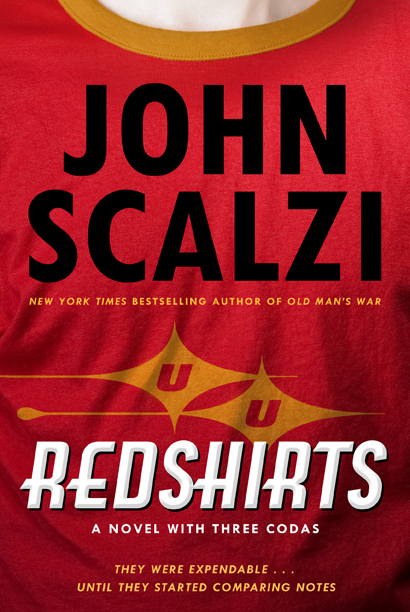
An excerpt from John Scalzi’s latest novel, Redshirts

Filed under: Books, Humour, Media — Tags: — Nicholas @ 08:15

John Scalzi felt some sympathy for the poor lads and lasses who wear the Redshirt … the ones who only show up for the first few minutes of the show and die gruesomely, leaving the heroes to carry on. His latest novel is a bit of payback for all the members of the “away teams” who never came back.


Click the image to see the first five chapters at the Tor.com website

April 23, 2012

More from the Bahrain protests

Filed under: Government, Liberty, Media, Middle East — Tags: , , , , , , — Nicholas @ 09:25

Marc Lynch on what he terms as Bahrain’s “Epic Fail”:

This week’s Formula One-driven media scrutiny has ripped away Bahrain’s carefully constructed external facade. It has exposed the failure of Bahrain’s regime to take advantage of the breathing space it bought through last year’s crackdown or the lifeline thrown to it by the Bahrain Independent Commission of Inquiry. That failure to engage in serious reform will likely further radicalize its opponents and undermine hopes for its future political stability.

Bahrain’s fierce, stifling repression of a peaceful reform movement in mid-March 2011 represented an important watershed in the regional Arab uprising. Huge numbers of Bahrainis had joined in street protests in the preceding month, defining themselves as part of the broader Arab uprising and demanding constitutional reforms and political freedoms. Bahrain’s protest movement began as a reformist and not revolutionary one, and the Bahrain Independent Commission of Inquiry found no evidence that the protests were inspired or supported by Iran.

[. . .]

A ferocious battle over how to understand the events in Bahrain has unfolded in the months since the crackdown, as anyone who has attempted to report on or discuss it can attest. Supporters of the regime have argued that they did what they must against a dangerously radical, sectarian Shi’a movement backed by Iran, and fiercely contest reports of regime abuses. The opposition certainly made mistakes of its own, both during the protests leading up to the crackdown and after. But fortunately the facts of Bahrain’s protest movement and the subsequent crackdown have been thoroughly documented by Bahrain’s Independent Commission of Inquiry.

The BICI report established authoritatively that the Bahraini regime committed massive violations of human rights during its attempts to crush the protest movement. Hundreds of detainees reported systematic mistreatment and torture, including extremely tight handcuffing, forced standing, severe beatings, electric shocks, burning with cigarettes, beating of the soles of the feet, verbal abuse, sleep deprivation, threats of rape, sexual abuse including the insertion of items into the anus and grabbing of genitals, hanging, exposure to extreme temperatures, forced nudity and humiliation through acts such as being forced to lick boots of guards, abuse with dogs, mock executions, and being forced to eat feces (BICI report, pp.287-89). Detainees were often held for weeks or months without access to the outside world or to lawyers. This, concluded the BICI, represented “a systematic practice of physical and psychological mistreatment, which in many cases amounted to torture, with respect to a large number of detainees in their custody” (Para 1238, p.298). And then there was the demolition of Shi’a mosques, widespread dismissals from public and private sector jobs and from universities, sectarian agitation in the media, and so much more. No political mistakes made by the opposition could possibly justify these acts.

Shakespeare’s plays as Soviet samizdat

Filed under: History, Liberty, Media — Tags: , , , — Nicholas @ 08:58

An interesting bit of Soviet history in the BBC’s post on Shakespeare in the former Soviet Union:

In Soviet-era Lithuania, there were productions of Shakespeare for which people queued through the night for tickets. Shakespeare was culture with official approval, but as one of the few alternatives to tales about earnest Soviet heroes, it was also a way for theatre directors to symbolically address forbidden issues. Going to the theatre had an excitement it perhaps lacks nowadays, says Mamontovas.

“I miss those secret messages… there were always little secret messages from the artist to the audience. But there’s no need for that now because you can say what you want openly — it’s more entertainment now.”

[. . .]

Then there is the history of Hamlet in the Soviet Union. An early landmark of Lithuania’s professional theatre was a production of Hamlet by Mikhail Chekhov, nephew of the playwright Anton.

But Hamlet then fell out of favour. Stalin, it was understood, had turned against the indecisive Prince of Denmark. The uncomfortable comparisons between the setting of Hamlet, the dark world of Elsinore and the Kremlin, was perhaps too close.

Hamlet’s uncle, Claudius, had usurped the throne, depriving the young Hamlet himself, and there were parallels — for those who wished to see them — in Stalin’s seizure of Lenin’s leading role and his demolition of rivals such as Trotsky.

There was also another layer of symbolism. Stalin, a keen theatregoer, took against the renowned director Vsevolod Meyerhold and had him arrested and tortured, and executed.

Meyerhold dreamed all his life of staging Hamlet, his favourite play, but somehow never managed it. He was renowned for having said, with bitter irony, that he wanted his tombstone to read: “Here lies a man who never played or directed Hamlet“. From the day he was killed in 1940, Hamlet and the death of Meyerhold became intertwined in the public imagination.

Stalin’s death in 1953 prompted a series of new Hamlet productions that tested the boundaries of how far the post-Stalin thaw had gone, and so the play gained a symbolic status of freedom of expression.

April 22, 2012

Earth Day: 42 years of crying “wolf”

Peter Foster piles on the scorn for the 42nd anniversary of Earth Day:

For more than 40 years, Earth Day has both reflected genuine environmental concern and mirrored the UN’s attempted eco power grab. Sunday’s Earth Day comes two months ahead of the vast, but significantly brief, UN Rio+20 conference. Both are pale reflections of their original radical aspirations. Earth Day is still celebrated, but 42 years of crying wolf have inevitably had an effect. The event has also been corporatized, greenwashed and taken over by such announcements as that of the “50 sexiest environmentalists.” Rio+20 will represent the graveyard of aspirations for all prospective — and inevitably less sexy — Captains of Spaceship Earth, Global Saviours, and High Priests of Gaia.

That Earth Day has gone Happy Face, and Rio+20 will be a farce, reflects the fact that their apocalyptic assumptions have turned out to be so wrong. In Canada, as in other developed countries, we can celebrate significant improvements in air quality, and success in coping with industrial impacts on water. The Great Lakes have been cleaned up, forest cover has been maintained, and the amount of “protected” land doubled. The use of toxic chemicals in industrial production has been slashed. Some credit must obviously go to activism, but the more radical end of the movement has always had a lot more than just the environment in mind.

[. . .]

That misunderstandings and misrepresentations were at the root of radical environmental thinking was exemplifed by an “equation-of-doom” hatched in the 1970s by two prominent radicals, Paul Ehrlich and John Holdren (President Obama’s current senior science and technology advisor). The equation was I=P x A x T: Human Impact (I) equals Population (P) times Affluence (A) times Technology (T). The formula was vague, but it clearly suggested that population, wealth and technology were all “bad” for Mother Earth.

Such thinking was based on a primitive, static, zero-sum view of economic development and a demonization of business. Since resources were “finite,” all development was claimed by definition to be “unsustainable.” Advancing technology merely chewed up resources faster and accelerated us down the road to exhaustion. All this came with biblical overtones. On the first Earth Day, Prof. Ehrlich thundered that “In ten years all important animal life in the sea will be extinct. Large areas of coastline will have to be evacuated because of the stench of dead fish.”

April 21, 2012

Lazy reporting, ignorance, and an agenda to advance: Breivik and computer gaming

Filed under: Gaming, Media — Tags: , , , — Nicholas @ 00:05

John Walker points out how many headline writers and reporters seem to be gleefully eager to pin Breivik’s horrific crimes on computer games:

It’s pretty relevant to note much of what the killer said in his opening statements, in which he described secret societies, battles for purity, global conspiracy, and refused to recognise the jurisdiction of the courts. Very few press outlets took his comments at face value nor reported them as fact, strangely enough, but rather pointed out that he was either mad, or trying to appear mad. Now he has told the courts that he played World Of Warcraft for apparently 16 hours a day for a year, and saw Modern Warfare 2 as a police-shooting simulator, and not only is the press at large taking it as fact, but most are twisting Breivik’s words to their own interests. Something has gone very wrong when the horror of his actions is being used to fuel irrelevant agenda.

Yesterday Britain’s Daily Telegraph spoke to Oslo University professor of sociology, Thomas Hylland Eriksen, who believes that one factor that “hasn’t sufficiently been taken into account” was Breivik’s so-called “fascination” with World Of Warcraft. Because Breivik likes order and doesn’t like chaos, erm, something something, it’s gaming’s fault.

[. . .]

Then comes Modern Warfare. This he told the courts he played between November 2010 and February 2011, and described it as “a simple war simulator”. He explained that it was helpful for learning about “aiming systems”, and then described in some detail how he had used the game to practice killing policemen.

So, well, an immediate thought. That’s not what Modern Warfare is, or lets you do. The scripted corridors, nor the multiplayer, offer no useful practice for any such actions, and don’t allow you to simulate practising killing policemen in the manner Breivik describes. There is of course the infamous No Russian airport level, in which you play as an undercover agent with terrorists, and are able to shoot (or not shoot) civilians and policemen, but I think it’s unreasonable to suggest that it offers what Breivik claims. Of course there are many other shooters out that that would let you create your own specific scenarios, attempt to rehearse escaping from armed forces, and so on. But Breivik, in keeping with much else of his rhetoric, doesn’t make much sense here. It is very unfortunate that while a sceptical press has been enjoying picking over his comments about being a member of the Knights Templar, and disproving them, they see no need to question his remarks on using Call Of Duty as a simulator for combating armed police in real life. Instead here it’s assumed he’s being honest and clear-headed. It’s also important to note that Breivik’s memoir makes it clear that he only played MW2 after he had entirely planned the attacks, and it was in no way influential on his decision to kill anyone.

April 20, 2012

Reason.tv: Too Much Copyright

Filed under: Law, Liberty, Media — Tags: , , , , , , , — Nicholas @ 07:45

“This disconnect between the public’s view of copyright and fair use and what should and should not be prosecuted, versus the ‘copyright maximist’ view of the law, is our generation’s Prohibition,” says Ben Huh, CEO and founder of Cheezburger and a loud voice in the recent backlash to SOPA and PIPA, two congressional bills aimed at curbing internet piracy.

Copyright exists to “promote the useful arts” according to the Constitution. But is it still doing that? And should the government protect so-called “intellectual property” in the same way it protects other forms of property? Reason.tv posed these questions to Ben Huh, as well as a professor and a movie studio representative.

Tom Bell, a law professor specializing in property law, has serious reservations about attempts by groups like the Motion Picture Association of America (MPAA) to equate property and copyright through ad campaigns admonishing viewers with messages like, “You wouldn’t steal a car. Downloading pirated movies is stealing.”

“As soon as we start using [the word] ‘copyright’ for ‘property,’ we start taking less seriously our property rights for things like cars and houses,” says Bell. “When you steal a candy bar or a car, you’ve left somebody without something to eat or something to drive.”

April 19, 2012

The (richly deserved) end of the Tory era in Alberta

Filed under: Cancon, Media, Politics — Tags: , , , — Nicholas @ 09:53

Unless all the polls are way off, the election in Alberta will see the eternal rule of the Progressive Conservatives finally come to an end. But as desperate times call for desperate measures, the Tories have unleashed the last of their secret weapons to hold back the Wildrose barbarians — perhaps the most embarrassing political video ever posted. David J. Climenhaga saves you the pain of watching the video:

If you have any doubts left there are only four more sleeps before the end of the Progressive Conservative Era in Alberta, look no further than the video and website called “I never thought I’d vote PC.”

Whether or not the PCs under Alison Redford had anything to do with this vain effort to encourage hip, edgy young people to vote for the clapped out Conservative party in a last-ditch effort to prevent a Wildrose Apocalypse, there could be no surer sign of the imminent demise of the once mighty Tory dynasty.

I mean, really, telling young voters you understand why they’d “rather gouge their eyes out than vote Conservative” in an effort to get them to vote Conservative is just … embarrassing.

[. . .]

After this pathetic excuse for a Tory campaign, the tattered remnants of the Alberta Conservatives have less dignity left than Saddam Hussein when he was hauled out of his hidey-hole in Tikrit by the soldiers of the U.S. Fourth Infantry Division! This little video squib is just the final excruciating evidence before our eyes notice that the moribund Conservatives’ best-before date has passed.

I’m not kidding about the quality of the video — I couldn’t make it past the first minute before feeling too humiliated on behalf of the folks who made it and I had to shut it off. If you want to watch it in all its cringe-inducing glory, David has it embedded on his site.

The Bahrain Formula One: it’s just a car race

Filed under: Liberty, Media, Middle East, Politics — Tags: , , , , — Nicholas @ 08:58

Tim Black writes about the real reasons for protests against the Formula One race in Bahrain:

The way some politicians and commentators are talking, you would think that the fate of Bahrain hinged on whether or not this weekend’s Formula One (F1) grand prix goes ahead. Cancel it, and Bahrain’s repressive monarchs, the Al Khalifa family, will have to face up to the failings of their autocratic reign. But proceed with it and F1 might as well have crushed the Bahraini people’s democratic aspiration itself.

[. . .]

Ecclestone’s assessment of the state of Bahrain is certainly questionable. While life does go on for the 600,000 people of this tiny gulf state, there is little calm beneath the surface. Instead, the conflict between a politically and economically disenfranchised Shia majority and the ruling Sunni monarchy continues to simmer. Saudi troops may have helped Bahrain’s own security forces to quell the most explosive manifestation of this conflict last spring, but the arrests, torture and sometimes killing has continued. In the past fortnight alone, three teenagers were shot dead.

Yet as Panglossian as Ecclestone’s view of Bahraini society is, his larger point still stands: ‘it is not [F1’s] business running the country.’ And that’s the problem: too many commentators and politicians are so ‘wrapped up in their own bubble’, to quote Webber, that they believe that the question of whether or not a car race is staged in Bahrain is incredibly important; it is their business running the country. The grand prix is no longer just a car race: it has become a vehicle for exhibiting one’s moral credentials.

[. . .]

This seems to be the prevailing rationale behind the calls to cancel the grand prix: it is all about showing disapproval, striking a moral pose. Bahrain, a country increasingly seen, thanks to the press offices of Amnesty International and Human Rights Watch, as a photo-essay in state brutality, is little more than a convenient background against which to act righteous. Of course, the calls for F1 to boycott the Bahrain grand prix are not recognised for their essential vainglory; they are presented as compassionate. For the advocates of a Bahrain boycott, those willing for the grand prix to go ahead are the callous, self-interested ones. By staging the grand prix, they are tacitly approving of, and legitimating, the rule of the Al Khalifa family.

But who does this disapproval benefit? Who is this display of moral opprobrium for? It’s certainly not those in whose name the grand prix could be cancelled: the disenfranchised majority in Bahrain. After all, if the grand prix does go ahead, it won’t legitimate or validate the regime in their eyes. For those indulging in running-street battles, for those with no political freedom, for those who experience life under the al-Khalifa autocracy on a daily basis, the presence or absence of F1 will make little or no difference. Their lives will still be marked by a ruthlessly enforced unfreedom.

The Limits to Growth scorecard, 40 years on

Filed under: Books, Economics, Environment, Food, History, Media — Tags: , , , — Nicholas @ 08:00

Ronald Bailey tots up the hits and misses from that 1972 dystopia manual, The Limits to Growth:

Industrial development: World GDP stood in real 2010 dollars at about $19 trillion in 1972 and has tripled to $57 trillion today. Average per capita incomes rose in real dollars from $5,000 to $8,100 today. Just to explore how incomes might evolve between 1972 and 2000, the researchers simply extrapolated the current growth, investment, and population growth rates to calculate GDP per capita for 10 large countries. They stressed these were not “predictions” but added that if one disagreed then one was obligated to specify which factors changed, when and why. A comparison of their extrapolations with actual GDP per capita (in 2010 dollars) finds U.S. GDP per capita $56,000 versus actual $44,000; Japan’s per capita GDP was projected to be $120,000 versus actual $46,000; the now defunct USSR would be $33,000 versus Russia’s $2,200; and China’s per capita income was supposed to grow to $500, but was instead $1,200.

Population: The Limits researchers noted, “Unless there is a sharp rise in mortality, which mankind will strive mightily to avoid, we can look forward to a world population of around 7 billion persons in 30 more years.” In addition, they suggested that in 60 years there would be “four people in the world for everyone living today.” In fact, average global life expectancy rose from 60 to nearly 70 years. On the other hand, the global fertility rate (the average number of children a woman has during her lifetime) fell from about 6 per woman in 1970 to 2.8 today and continues to fall.

[. . .]

Food supplies: According to the data from the Food and Agriculture Organization, global food production has more than tripled since 1961, while world population has increased from 3 billion to 7 billion. This means that per capita food has increased by more than a third. The latest figures from the United Nations show that as world population increased by a bit over 10 percent between 2000 and 2009, global food production rose by 21 percent.

[. . .]

Nonrenewable resources: Probably the most notorious projections from the MIT computer model involved the future of nonrenewable resources. The researchers warned: “Given present resource consumption rates and the projected increase in these rates, the great majority of currently nonrenewable resources will be extremely expensive 100 years from now.” To emphasize the point they pointed out that “those resources with the shortest static reserve indices have already begun to increase.” For example, they noted that the price of mercury had increased 500 percent in the last 20 years and the price of lead was up 300 percent over the past 30 years. The advent of the “oil crises” of the 1970s lent some credibility to these projections.

To highlight how dire the situation with nonrenewable resources was, the MIT researchers calculated how quickly exponential consumption could deplete known reserves of various minerals and fossil fuels. Even if global consumption rates didn’t increase at all, the MIT modelers calculated 40 years ago that known world copper reserves would be entirely depleted in 36 years, lead in 26 years, mercury in 13 years, natural gas in 38 years, petroleum in 31 years, silver in 16 years, tin in 17 years, tungsten in 40 years, and zinc in 23 years. In other words, most of these nonrenewable resources would be entirely used up before the end of the 20th century.

[. . .]

Environment: In most of the Limits model runs, the ultimate factor that does humanity in is pollution. In their model pollution directly increases human death rates and also dramatically reduces food production. In fact, as the world economy has grown, global average life expectancy has increased from 52 years in 1960 to 70 years now. It must be acknowledged that globally, pollution from industrial and agricultural production continues to rise. But the model assumed that pollution would increase at exponential rates. However, many pollution trends have not increased exponentially in advanced countries.

Consider that since 1970, the U.S. economy has grown by 200 percent, yet the levels of air pollutants regulated by the federal government have fallen by nearly 60 percent. For example, in both the U.S. and the European Union sulfur dioxide emissions have dropped by nearly 70 percent since 1990. Recent data suggests that sulfur dioxide emissions even from rapidly industrializing China peaked in 2006 and have begun declining. Earlier studies cite evidence for a pollution turning point income threshold (purchasing power parity) of around $10,000 for demands to reduce this form of air pollution.

April 18, 2012

A guerilla war is fought in two primary theatres: in the field and in the media

Filed under: History, Media, Military, Politics, USA — Tags: , , , , , — Nicholas @ 08:57

A survey of US experiences in guerilla fighting over the years at Strategy Page:

After a decade of fighting Islamic terrorists the U.S. Department of Defense finally realized, at the most senior levels, that the nature of, and progress in this war was being poorly presented to the national leadership and the public. Actually, from the very beginning, there was a reluctance to reveal the masses of data collected and how it was analyzed. Partly this was to prevent the enemy from realizing how much information on terrorist operations it possessed. But another reason was the fact that such a large mass of data could be interpreted many different ways, some of them unfavorable to the United States. Thus there was no “body count” or any other type of measure released by the Department of Defense. Internally, there were various metrics (measurements) presented to senior military and political leadership. The big problem was the use of aggregation (combining a lot of data together that should not have been combined). That was a problem that slowly became obvious over the last decade.

It’s now recognized that the wars in Iraq and Afghanistan (and elsewhere, like Yemen, Somalia, North Africa and so on) were all somewhat different and that context for each of them was crucial if you were going to analyze them. For example; al Qaeda is more of an idea than a centralized organization. Thus the al Qaeda found in each country, or part of a country, usually has different means and motivations. The war in Iraq was actually several separate wars going on at the same time, and occasionally interacting with other “wars” nearby. Same thing in Afghanistan and places like Somalia. Measuring progress is more accurate if you show the unique trends in all the different wars. Some of them ended early, some escalated and some are still in progress while others evolve into new kinds of conflicts. In other words, the military should use contextual assessment in reporting what is going on with guerilla conflict (or “irregular warfare” in general.)

[. . .]

When the United States first got involved with Vietnam in the late 1950s, there was good reason to believe American assistance would lead to the defeat of the communist guerilla movement in South Vietnam. That was because the communists had not been doing so well with their guerilla wars. In the previous two decades, there had been twelve communist insurgencies, and 75 percent of them had been defeated. These included Greek Civil War (1944-1949), Spanish Republican Insurgency (1944-1952), Iranian Communist Uprising (1945-1946), Philippine Huk War (1946-1954), Madagascan Nationalist Revolt (1947-1949), Korean Partisan War (1948-1953), Sarawak/Sabah “Confrontation” (1960-1966), Malayan Emergency (1948-1960), Kenyan Mau-Mau Rebellion (1952-1955). The communists won in the Cuban Revolution (1956-1958), the First Indochina War (1945-1954) and the Chinese Civil War (1945-1949). The communists went on to lose the guerilla phase of the Second Indochina War (1959-1970). Guerillas make great copy for journalists. You know, the little guy, fighting against impossible odds. What we tend to forget (and the record is quite clear, and easily available), is that these insurgent movements almost always get stamped out. That does not make good copy, and the dismal details of those defeats rarely make it into the mass media, or the popular consciousness.

Summing up the career of Hunter S. Thompson, graphically

Filed under: Books, History, Media, USA — Tags: , , , , , — Nicholas @ 00:03

At BoingBoing, Mark Frauenfelder reviews Gonzo: A Graphic Biography of Hunter S. Thompson by Will Bingley and Anthony Hope-Smith:

180 pages isn’t much room to examine a life in minute detail. Instead, Bingley tells a story (as if it were written, quite convincingly, by Thompson himself) of Thompson’s frantic search to find meaning in the turbulent era he lived in. Bingley’s story is about a passionate, rebellious genius who sprinted too fast at the beginning of a long-distance race, collapsed early, and spent his remaining decades burnt-out, crawling bewilderedly.

The book’s forward, written by Thompson’s longtime editor, Alan Rinzler, is especially revealing. Rinzler believes that Thompson could have been the “heavyweight champion of American letters,” but his self-destructive behavior, which got worse with each passing year, ruined that opportunity.

[. . .]

After Lono, says Rinzler, “Hunter’s substance abuse, writer’s block and brief attention span were increasing exponentially. He’s slip out to see his dealer and come back so tanked he couldn’t think straight.” Thompson’s work became a series of “repetitious, mediocre, regurgitated articles and books and collections he allowed to be issued and reissued over the last 30 years of his life.”

The Curse of Lono was the last book by Thompson I read, but I don’t doubt Rinzler’s assessment of the quality of Thompson’s books that followed. (Thompson’s awful “Hey Rube!” columns for an ESPN website were enough to keep me uninterested in his newer books). But his earlier work, especially Hell’s Angels, is so good that I will always admire Thompson as a heavyweight contender who showed a very promising start.

I eagerly read much of Thompson’s early work (Fear and Loathing in Las Vegas, Fear and Loathing on the Campaign Trail, The Great Shark Hunt, Hell’s Angels, and The Curse of Lono) in the early-to-mid 80’s, but tapered off soon after that. Several years ago, I picked up a remaindered copy of Hey Rube: Blood Sport, the Bush Doctrine, and the Downward Spiral of Dumbness Modern History from the Sports Desk and it was the literary equivalent of Rome after too many Goth and Vandal sackings: you could still see some great bits and pieces, but everything else had been broken, burned, hacked, and slashed.

April 17, 2012

Chateauguay Magazine: a clear and present danger to the integrity of the French language in Quebec

Filed under: Cancon, Law, Liberty, Media — Tags: , , , — Nicholas @ 13:45

Because it publishes with both French and English contents, the Quebec government’s language police have launched an investigation:

A monthly newsletter in the city of Chateauguay, Quebec, has caused a stir and it has nothing to do with its content. A resident complained there was too much English in the newsletter and now, Quebec’s language watchdog has launched an investigation.

The Office Quebecois de La Langue Francaise is looking into why the newsletter, called the “Chateauguay magazine,” is written in both French and English. The office says that’s a clear violation of the Charter of the French language, or Bill 101.

The office wants to ensure that the all the city’s communication with citizens is done only in the official language of French.

The folks in Chateauguay are apparently being oppressed because the magazine includes content addressed to the 26% of the population that speaks English.

April 15, 2012

Sarkozy reaps media benefit from video conference with Obama

Filed under: Europe, France, Government, Media, Politics — Tags: , , , — Nicholas @ 11:24

It’s often said that there’s no such thing as bad media exposure during an election campaign, and Nicolas Sarkozy is trying to take advantage of this in the run-up to the first round of voting:

Nicolas Sarkozy has been accused of using a video conference with Barack Obama to boost his election campaign. In an unprecedented move in French diplomacy, newscasts on several TV channels showed the first few minutes of a video link-up between the French president and his Washington counterpart.

Days before the 22 April first-round vote in the French presidential election, the rare glimpse of banter between world leaders shows Obama saying of the campaign, “It must be a busy time.” He adds: “I admire the tough battle you are waging.” Sarkozy replies, grinning and with arms folded: “We will win, Mr Obama. You and me, together.” The cameras leave before the presidents talk about Syria, Iran and oil.

The benefits to Sarkozy are quite clear: it allows him to appear presidential (always a trick the incumbent can use and the ambitious opponent is denied) and gives a subtle boost to French pride — their president is clearly on good personal terms with the American president. France’s representative is seen as being the equal of the superpower’s representative (it doesn’t have to be stated, but it’s a useful subliminal message in an election).

It’s not quite as beneficial to Obama, although this may be a marker put down to be redeemed later in the US presidential cycle. The same trick can be played for the benefit of Obama’s east coast voting base: look how well he deals with foreign dignitaries.

« Newer PostsOlder Posts »

Powered by WordPress


