Quotulatiousness

April 18, 2023

“People who pivot this quickly need to make sure their pants are securely buckled”

Filed under: Health, Media, Politics, USA — Tags: , , , — Nicholas @ 04:00

We’ve apparently reached the “Republicans Pounce” stage of yet another progressive crusade:

The memo has gone out, and the pivot has arrived.

Ten days ago, you may remember, the suddenly high-profile Nebraska Senator Machaela Cavanaugh went on NPR to play make-believe, expressing consternation over this weird new focus on transgender issues over on the political right: “I don’t know why, as a nation, as policymakers, there is this newfound focus on trans children… And all of the sudden, there is a decision by policymakers that we need to do something about them. It doesn’t make any sense to me.” It’s the why are you guys so obsessed with this DARVO maneuver, spun with bald-faced shamelessness by people who’ve been talking for years about the thing that they suddenly want you to know it’s creepy to talk about.

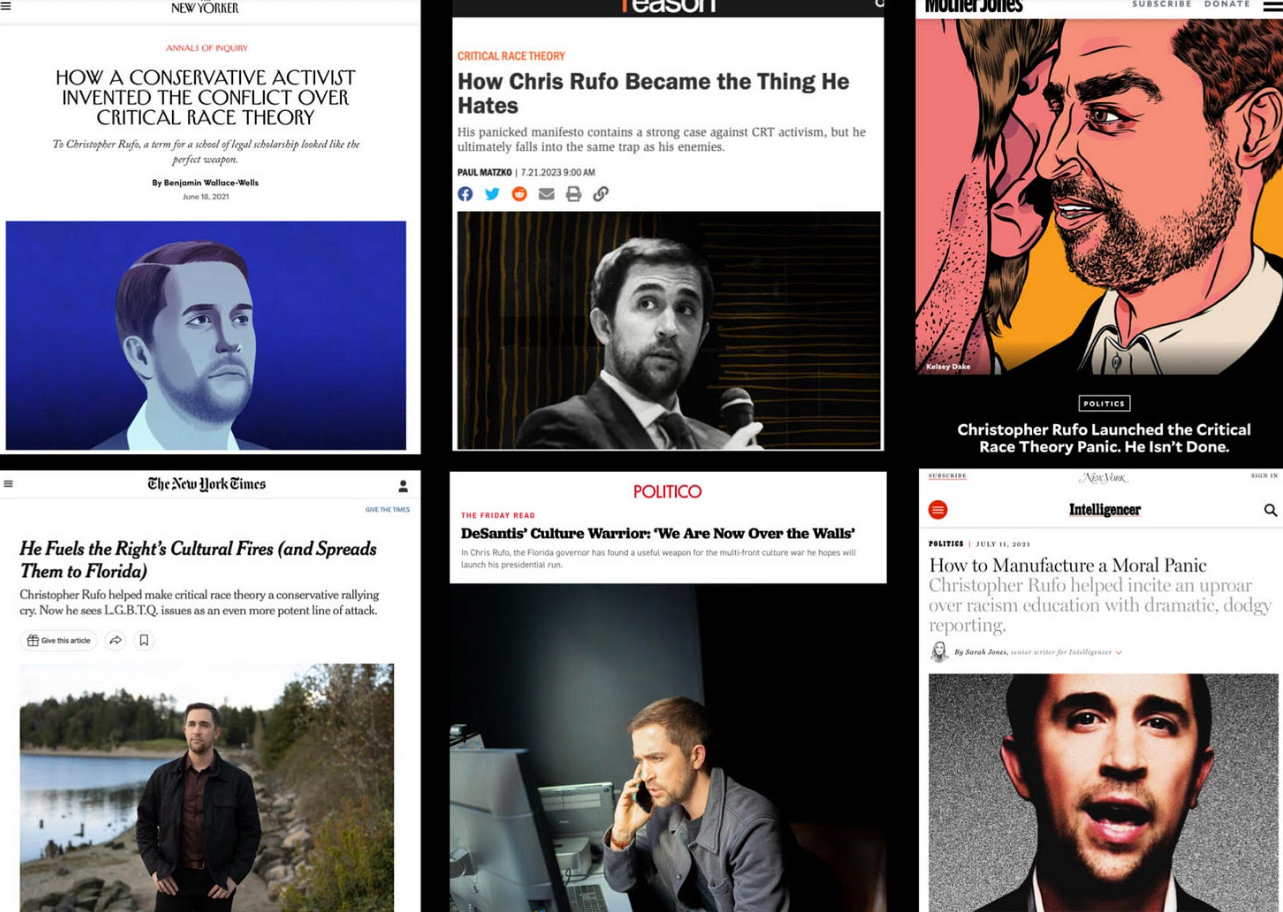
Now the New York Times explains the same thing in a similar way, writing that transgender issues have suddenly become a big deal in America because scheming right-wingers decided to cook it up as a fake wedge issue:

“The religious right went searching for an issue.” To get donors to write some checks, see. They just made it up, in a cynical act of invention. A bunch of social conservatives were sitting around the office, lamenting how no one gives them money anymore because everybody stopped hating the gays, so they decided, tactically, to pretend that transgender rights was a thing, now, so that they could trick people into giving them money again. Completely out of left field! Trans rights was just sitting there watching some Netflix with a tub of Cherry Garcia when suddenly the doorbell rang.

There’s no pouncing, but you’ve heard this descriptive maneuver before:

    Nadine Smith, the executive director of Equality Florida, a group that fights discrimination against L.G.B.T.Q. people, said there was a direct line from the right’s focus on transgender children to other issues it has seized on in the name of “parents’ rights” — such as banning books and curriculums that teach about racism.

“Seized on”. The story also says that the issue of men participating in women’s sports “was accelerated by a few influential Republican governors who seized on the issue early”. There’s a lot of seizing on, and it’s all mysterious. Why did the seizers seize the seized thing? Dunno. They just suddenly, for no apparent reason at all, seized on the issue of women’s sports. Weird. Similarly, that paragraph about “banning books” and forbidding “curriculums that teach about racism” is presented as a given, not as a thing that requires explanation or illustration. It’s tactical murk: half-accusations as smoke and chaff, designed to leave you with the general outlines of a thing that it’s convenient to have you believe. The right-wingers are something something something, and it’s scary.

Canada Council for the (decolonized) Arts

Filed under: Cancon, Media, Politics — Tags: , , , — Nicholas @ 03:00

In the latest SHuSH newsletter, Kenneth Whyte follows up on an earlier report on the mission of the Canada Council for the Arts, as outlined by Simon Brault:

… the founders of the Canada Council felt so strongly about the dangers of bureaucratic and political impositions on the arts — officials using federal money to force artistic and cultural activities in one direction or another — that they built checks and balances into its founding legislation.

The checks and balances haven’t checked or balanced. The Canada Council is now fully dedicated to teaching, censoring, and directing artistic endeavour.

The occasion for last year’s piece was a decision by Simon Brault, chief executive of the Canada Council, to halt funding for any “activity involving the participation of Russian or Belarusian artists or arts organizations … This includes partnerships, direct and indirect financing of tours, co-productions, participation in festivals or other events held in Russia.”

The outcome of Brault’s edict was that Canadians last summer weren’t able to enjoy a variety of planned tours by performers who had the misfortune to be born in Moscow, even if they loathed Putin like the rest of us.

It wasn’t the extremity of Brault’s position that set me off — he reserved to himself the right to ban artistic interaction with artists from any country whose government was involved in a conflict he considered unjust — so much as his implication that the arts community was too stupid to have noticed what was happening in Ukraine or to have known how to respond without his guidance.

A few months ago, Brault upped the ante, speaking at the council’s annual general meeting of his “vision for a decolonized future of the arts”.

    To actualize this vision, we must also decolonize the Council itself by questioning our own assumptions and convictions.

    It is important to acknowledge that decolonization is a complex, evolving, and open concept and journey.

    There’s no definitive guide on how to undertake this work.

    And it has different implications for different organizations and sectors in our society.

    So far, our understanding is that to decolonize the Council, we must agree to reframe our understanding of what constitutes art, which is a big thing for an arts council.

    We need also to question the notion of professionalism and artistic disciplines, which are deeply rooted in a very specific time in history, mostly Eurocentric, and often from a very colonialist perspective.

    So, we need to challenge the notion of “artistic excellence”, again a concept that upholds hierarchies of good taste and values that confirm and perpetuate the status of the dominant culture.

    We also need to move beyond limited notions of artistic expertise because those notions are often the direct product of an education system built to reproduce power relations and safeguard the privilege of a dominant colonial discourse on arts and culture.

There you have it. Brault committed the leading funding agency for the arts in Canada to “challenging” the prevailing understandings of art, artistic professionalism, artistic disciplines, artistic excellence, good taste, artistic values, and artistic expertise.

He’s not quite clear on what he’s going to replace it all with — he’s just sure that the way you think about art is wrong and that Keynes statement that the work of the artist is by nature individual and free, undisciplined, unregimented, uncontrolled, etc., is colonialist claptrap.

Let the regimentation and control begin.

QotD: The worldview of the fanatic

Filed under: History, Media, Politics, Quotations, Religion, USA — Tags: , , , , — Nicholas @ 01:00

More importantly, though, this is the logical endpoint of “democracy”, and now everyone gets to see it firsthand. In theory, democracy works by channeling competing vices. If men were angels, no government would be necessary, James Madison said, but since they’re not the best we can do is incentivize bad people to do good things in pursuit of their own selfish interest. It’s a nice thought, but it can only work (if, indeed, it can work) in a culture like Madison’s, in which public men are concerned about their dignity, honor, and posthumous reputation.

Obviously none of those hold in Current Year America, since they were all invented by the Pale Penis People, and even if they weren’t, they can’t matter to atheists anyway — one only defends one’s dignity and honor if one believes he’ll be called to account for them, and who’s going to do the accounting? There is no God, and as for the bar of History, what could that possibly matter to a cultural marxist? To them, as to their Puritan forbears, “history” is really soteriology. The past is nothing but a catalog of freely chosen error. For the fanatic, “history” begins anew each dawn, because why study endless iterations of Error when you already have the Truth?

Severian, “The Stakeholder State”, Rotten Chestnuts, 2020-01-22.

April 17, 2023

The lingering pandemic of fear

Filed under: Government, Health, Media — Tags: , , , , , — Nicholas @ 03:00

Liz Hodgkinson on the pattern of fear that the state, media, and public health messaging instilled into so many people during the Wuhan Coronavirus pandemic:

“Covid 19 Masks” by baldeaglebluff is licensed under CC BY-SA 2.0

The Stoics of ancient times believed that in many cases it was possible to control pain by thought alone. To achieve this, they stoically, as it were, accepted painful or unpleasant sensations, viewing them with studied indifference. As such, the pain often went away of its own accord, although to be fair they did use a painkiller known as theriac, which contained opium.

The opposite is also true, in that you can induce pain or disease by thought alone, causing acute and sometimes lasting physical symptoms. Although ancient and tribal societies understood that the power of suggestion can be so strong that it may make people well or ill, this seems to have been forgotten in modern, mechanistic medicine with its insistence on tests, scans, screens and so on.

Because of this, I am now wondering whether as many people would have gone down with Covid (or what passed for it) if, instead of a flu-like illness being ramped up as the worst and most dangerous disease ever to affect humankind, it had been ignored.

As it was, around 80 per cent – and it may have been more – of the world’s population were gripped by such a fear of the bug that they actually thought themselves into illness. Once the PCR test was introduced, people began testing themselves, sometimes hourly, and if the test showed positive they waited for symptoms to appear. More often than not, they obliged.

Then people became terrified to step out of the house without wearing a mask, even though all the evidence showed that these muzzles were more or less ineffective and that even the surgical-quality ones lasted only a couple of hours, at most. People were also nervous of getting close to anybody else, edging away if somebody came within a few feet of them. Only the other day, as I was in a queue waiting to pay for an item, a masked woman in front of me turned round and said crossly: “Do you mind not standing so close to me?” I wondered about making a quick riposte but decided that there was no way I could penetrate this kind of stupidity.

There was also the handwashing ritual where shops, doctors’ surgeries, solicitors’ and estate agents’ offices, for instance, forced hand sanitiser on to you, and sometimes took your temperature as you walked in.

The cleaning nonsense went even further, with hotels, gyms and other places where people gathered announcing “enhanced cleaning”. This may or may not have halted the virus in its tracks but it certainly increased fear. I still see people in the gym furiously scrubbing down bikes, treadmills and other equipment in case a germ from a previous user has had the audacity to linger on the machine.

April 16, 2023

Do Foucault and Derrida deserve the blame for PoMo excesses?

Filed under: Books, France, History, Media, Politics, USA — Tags: , , , , — Nicholas @ 03:00

In Spiked, Patrick West says that it’s a misunderstanding of Foucault and Derrida to blame them for the rise of wokeness:

Michel Foucault speaking at the Hospital das Clínicas of the State University of Guanabara in Brazil, 1974.
Public domain image from the Arquivo Nacional Collection via Wikimedia Commons.

It has become common to blame wokeness on its supposed philosophical parent: postmodernism. As the standard narrative goes, postmodernism is the ideology that entrenched itself in Anglophone universities in the 1980s and 1990s. It talked of relativism, of the absence of objective truth, of the spectre of a pervasive, invisible power, and it was generally anti-Western. A whole generation of professors, writers, journalists and a fair few activists have subsequently been raised on this diet of postmodern thinking. And the result is a cultural elite that is wedded to wokeness.

[…]

For these critics of woke, Foucault’s influence, in particular, is seemingly everywhere. According to [Douglas] Murray [in The War on The West], it’s through the “anti-colonial” philosophy popularised by the Foucault-inspired scholar, Edward Said, that Foucault and therefore postmodernism have filtered down into woke philosophy, which holds that Western society is uniquely racist and to blame for all of today’s ills. Equally, right-wing critics of wokeness will claim that the trans movement has sprung from the postmodern contention that sexuality and gender are entirely socially constructed and therefore plastic and malleable.

If Foucault is regarded as the father of wokeness then 19th-century philosopher Friedrich Nietzsche tends to be regarded as the grandfather. After all, Foucault was profoundly influenced by Nietzsche and even proudly declared himself to be “Nietzchean”. Nietzsche, like Foucault, also saw all human behaviour stemming from the desire for power. And he conceived of morality – good and evil, right and wrong – as the mere manifestation of the will to power. As he wrote of the “origin of knowledge”, in The Joyous Science (1883): “Gradually, the human brain became full of such judgements and convictions, and a ferment, a struggle, and lust for power developed in this tangle. Not only utility and delight but every kind of impulse took sides in this fight about ‘truths’.” One can see this Nietzschean sentiment at work in Foucault’s Discipline and Punish (1975): “Power produces knowledge … power and knowledge directly imply one another.”

So, according to this largely right-wing narrative, wokeness is the product of a 20th-century philosophical assault on truth, objectivity and the West. And it was inspired by Nietzsche and led by several “cultural Marxist” thinkers.

There are several problems with this rather neat story. The first error is to use the phrase “cultural Marxism” to talk of postmodernism or wokeness. This term doesn’t really make sense. Marx himself conceived of his work as a historical materialism. It was focussed on class and the means of production, not on culture. Yes, in the 1940s and 1950s, some Frankfurt School thinkers, who sometimes presented themselves as Marxist, did focus on culture rather than class. But as Joanna Williams writes in How Woke Won (2022), their thinking “represented less a continuation of Marxism and more a break with Marx”.

Moreover, postmodern thinkers were broadly opposed to Marxism. Many may have been signed-up Communists in their youth (the French Communist Party dominated left-wing politics at the time), but by the 1960s they had become highly critical of Marxist politics. They rejected the idea that history was progressing “dialectically” towards a communist future, or “telos”. And they were often hostile to the scientific objectivity and “Enlightenment” values so central to Marxism. Foucault wrote that history was not the story of progress; it was but a series of non-linear discontinuities and contingencies. And Jean-François Lyotard (1924-1998), in his highly-influential The Postmodern Condition (1979), announced and celebrated the end of “grand narratives”, and with it the end of the Marxist “grand narrative” of progress. Lyotard’s writings from the 1970s onwards were violently antithetical to Marxism, especially its claims to objective truth.

As for wokeness itself, it has nothing to do with Marxism. With their myopic focus on race and gender, woke activists are utterly blind to the material, class-structure of society. Today, bizarrely, it’s often conservatives who are more attuned to the plight of the working class than woke “radicals”. As Williams writes, “critics who insist that woke is simply Marxism in disguise are wide of the mark”.

April 15, 2023

QotD: When the pick-up artist became “coded right”

Filed under: Books, Health, Media, USA — Tags: , , , , , , — Nicholas @ 01:00

When did pickup artistry become criminal? Relying on online sex gurus for advice on persuading women into bed used to be seen as a fallback for introverted, physically unprepossessing “beta males”. And for this reason, in the 2000s, the discipline was promoted by the mainstream media as a way of instilling confidence in sexually-frustrated nerds. MTV’s The Pickup Artist shamelessly broadcast its tactics, with dating coaches encouraging young men to prey upon reluctant women, hoping to “neg” and “kino escalate” them into “number closes“. Contestants advanced through women of increasing difficulty (picking-up a stripper was regarded as “the ultimate challenge”) with the most-skilled “winning” the show.

Today, the global face of pickup artistry is Andrew Tate: sculpted former kickboxing champion, self-described “misogynist”, and, now, alleged human trafficker. Whatever results from the current allegations, his fall is a defining moment in the cultural history of the now inseparable worlds of the political manosphere and pickup artistry, and provides an opportunity to reflect upon their entangled history.

Pickup artistry burst onto the scene in the 2000s, propelled by the success of Neil Strauss’s best-selling book The Game. More a page-turning potboiler cataloguing the mostly empty lives of pickup artists (PUAs) than a how-to guide (though Strauss wrote one of those too), the methods in the book had been developed through years of research shared on internet forums. The “seduction underground”, as the large online community of people doing this research was called, then became the subject of widespread media attention. Through pickup artistry, the aggressive, formulaic predation of women was normalised as esteem boosting, and men such as those described in Strauss’s The Game could be viewed in a positive light: they had transformed from zero to hero and taken what was rightfully theirs.

The emergence of PUAs generated a swift backlash. The feminist blogs of the mid-to-late 2000s internet, of which publications like Jezebel still survive as living fossils, rushed to pillory them. The attacks weren’t without justification, but the world of PUAs during this period, much like the similarly wild-and-woolly bodybuilding forums, had no obvious political dimension beyond some sort of generic libertarianism. It was only after these initial critiques that it began to be coded as Right-wing by those on the Left. Duly labelled, PUAs and other associated manosphere figures drifted in that direction. MTV’s dating coaches were not part of the political landscape, merely feckless goofballs and low-level conmen capable of entertaining the masses. But their successors would be overtly political actors.

Oliver Bateman, “Why pick-up artists joined the Online Right”, UnHerd, 2023-01-08.

April 14, 2023

The trust deficit is getting worse every day

Filed under: Media, Politics, Technology, USA — Tags: , , , , , — Nicholas @ 05:00

Ted Gioia provides more evidence that the scarcest thing in the world today is getting ever more scarce:

Here are some news stories from recent days. Can you tell me what they have in common?

  • Scammers clone a teenage girl’s voice with AI — then use it to call her mother and demand a $1 million ransom.
  • Millions of people see a photo of Pope Francis wearing a goofy white Balenciaga puffer jacket, and think it’s real. But after the image goes viral, news media report that it was created by a construction worker in Chicago with deepfake technology.
  • Twitter changes requirements for verification checks. What was once a sign that you could trust somebody’s identity gets turned into a status symbol, sold to anybody willing to pay for it. Within hours, the platform is flooded with bogus checked accounts.
  • Officials go on TV and tell people they can trust the banking system—but depositors don’t believe them. High profile bank failures from Silicon Valley to Switzerland have them spooked. Over the course of just a few days, depositors move $100 billion from their accounts.
  • ChatGPT falsely accuses a professor of sexual harassment — and cites an article that doesn’t exist as its source. Adding to the fiasco, AI claims the abuse happened on a trip to Alaska, but the professor has never traveled to that state with students.
  • The Department of Justice launches an investigation into China’s use of TikTok to spy on users. Another popular Chinese app allegedly can bypass users’ security to “monitor activities on other apps, check notifications, read private messages and change settings.”
  • The FBI tells travelers to avoid public phone charging stations at airports, hotels and other locations. “Bad actors have figured out ways to use public USB ports to introduce malware and monitoring software onto devices,” they warn.

The missing ingredient in each of these stories is trust.

Everybody is trying to kill it — criminals, technocrats, politicians, you name it. Not long ago, Disney was the only company selling a Fantasyland, but now that’s the ambition of every tech empire.

The trust crisis could hardly be more intense.

But it’s hidden from view because there’s so much information out there. We are living in a culture of abundance, especially in the digital world. So it’s hard to believe than anything in the information economy is scarce.

Whatever you want, you can get — and usually for free. You can have free news, free music, free videos, free everything. But you get what you pay for, as the saying goes. And it was never truer than right now — when all this free stuff is starting to collapse in a fog of fakery and phoniness.

    Tell me what source you trust, and I’ll tell you why you’re a fool. As B.B. King once said: “Nobody loves me but my mother — and she could be jivin’ too.”

Years ago, technology made things more trustworthy. You could believe something because it was validated by photos, videos, recordings, databases and other trusted sources of information.

Seeing was believing — but not anymore. Until very recently, if you doubted something, you could look it up in an encyclopedia or other book. But even these get changed retroactively nowadays.

For example, people who consult Wikipedia to understand the economy might be surprised to learn that the platform’s write-up on “recession” kept changing in recent months — as political operatives and spinmeisters fought over the very meaning of the word. It got so bad that the site was forced to block edits on the entry.

There’s an ominous recurring theme here: The very technologies we use to determine what’s trustworthy are the ones most under attack.

Trust used to be a given in most western countries … it was a key part of what made us all WEIRD. Mass immigration from non-WEIRD countries dented it, but conscious perversion of trust relationships by government, media, public health, and education authorities has caused far more — and longer lasting — damage to our culture. Trust used to be given freely, but now must be earned. And that’s difficult for organizations that have proven repeatedly that they can’t be trusted.

From “cash for access” it’s a very short step to “cash for influence”

Filed under: Cancon, China, Government, Media, Politics — Tags: , , , , — Nicholas @ 04:00

Ted Campbell shut down his blog some time ago — unfortunately for those of us interested in Canadian military affairs — but he’s still active on Twitter. Here he responds to a tweet from Sam Cooper of Global News:

Andrew Coyne highlights some of the boggling details in this thread:

Twists and turns in the “Twitter Files” narrative

Filed under: Business, Government, Media, Politics, Technology, USA — Tags: , , , , — Nicholas @ 03:00

Matt Taibbi recounts how he got involved in the “Twitter Files” in the first place through the hysterical and hypocritical responses of so many mainstream media outlets up to the most recent twist as Twitter owner Elon Musk burns off so much of the credit he got for exposing the information in the first place:

I was amazed at this story’s coverage. From the Guardian last November: “Elon Musk’s Twitter is fast proving that free speech at all costs is a dangerous fantasy.” From the Washington Post: “Musk’s ‘free speech’ agenda dismantles safety work at Twitter, insiders say.” The Post story was about the “troubling” decision to re-instate the Babylon Bee, and numerous stories like it implied the world would end if this “‘free speech’ agenda” was imposed.

I didn’t have to know any of the particulars of the intramural Twitter dispute to think anyone who wanted to censor the Babylon Bee was crazy. To paraphrase Kurt Vonnegut, going to war against a satire site was like dressing up in a suit of armor to attack a hot fudge sundae. This was an obvious moral panic and the very real consternation at papers like the Washington Post and sites like Slate over these issues seemed to offer the new owners of Twitter a huge opening. With critics this obnoxious, even a step in the direction of free speech values would likely win back audiences that saw the platform as a humorless garrison of authoritarian attitudes.

This was the context under which I met Musk and the circle of adjutants who would become the go-betweens delivering the material that came to be known as the Twitter Files. I would have accepted such an invitation from Hannibal Lecter, but I actually liked Musk. His distaste for the blue-check thought police who’d spent more than a half-year working themselves into hysterics at the thought of him buying Twitter — which had become the private playground of entitled mainstream journalists — appeared rooted in more than just personal animus. He talked about wanting to restore transparency, but also seemed to think his purchase was funny, which I also did (spending $44 billion with a laugh as even a partial motive was hard not to admire).

Moreover the decision to release the company’s dirty laundry for the world to see was a potentially historic act. To this day I think he did something incredibly important by opening up these communications for the public.

Taibbi and the other Twitter File journalists were, of course, damned by the majority of the establishment media outlets and accused of every variant of mopery, dopery, and gross malfeasance by the blue check myrmidons. Some of that must have been anticipated, but a lot of it seems to have surprised even Taibbi and company for its blatant hypocrisy and incandescent rage.

But all was not well between the Twitter Files team and the new owner of Twitter:

We were never on the same side as Musk exactly, but there was a clear confluence of interests rooted in the fact that the same institutional villains who wanted to suppress the info in the Files also wanted to bankrupt Musk. That’s what makes the developments of the last week so disappointing. There was a natural opening to push back on the worst actors with significant public support if Musk could hold it together and at least look like he was delivering on the implied promise to return Twitter to its “free speech wing of the free speech party” roots. Instead, he stepped into another optics Punji Trap, censoring the same Twitter Files reports that initially made him a transparency folk hero.

Even more bizarre, the triggering incident revolved around Substack, a relatively small company that’s nonetheless one of the few oases of independent media and free speech left in America. In my wildest imagination I couldn’t have scripted these developments, especially my own very involuntary role.

I first found out there was a problem between Twitter and Substack early last Friday, in the morning hours just after imploding under Mehdi Hasan’s Andrey Vyshinsky Jr. act on MSNBC. As that joyous experience included scenes of me refusing on camera to perform on-demand ritual criticism of Elon Musk, I first thought I was being pranked by news of Substack URLs being suppressed by him. “No way,” I thought, but other Substack writers insisted it was true: their articles were indeed being labeled, and likes and retweets of Substack pages were being prohibited.

April 13, 2023

Old and tired – “Conspiracy Theories”. The new hotness – “Coming Features”

Kim du Toit rounds up some not-at-all random bits of current events:

So Government — our own and furriners’ both — have all sorts of rules they wish to impose on us (and from here on I’m going to use “they” to describe them, just for reasons of brevity and laziness — but we all know who “they” are). Let’s start with one, pretty much picked at random.

They want to end sales of vehicles powered by internal combustion engines, and make us all switch to electric-powered ones. Leaving aside the fact that as far as the trucking industry is concerned, this can never happen no matter how massive the regulation, we all know that this is not going to happen (explanation, as if any were needed, is here). But to add to the idiocy, they have imposed all sorts of unrealistic, nonsensical and impossible deadline to all of this, because:

There isn’t enough electricity — and won’t be enough electricity, ever — to power their future of universal electric car usage. Why is that? Well, for one thing, they hate nuclear power (based on outdated 1970s-era fears), are closing existing ones and will not allow new ones to be built by dint of strangling environmental regulation (passed because of said 1970s-era fears). Then, to add to that, they have forced the existing electricity supply to become unstable by insisting on unreliable and variable generation sources such as solar and wind power. Of course, existing fuel sources such as oil. coal and natural gas are also being phased out because they are “dirty” (they aren’t, in the case of natgas, and as far as oil and coal are concerned, much much less so than in decades past) — but as with nuclear power, the rules are being drawn up as though old technologies are still being used (they aren’t, except in the Third World / China — which is another whole essay in itself). And if people want to generate their own electricity? Silly rabbits: US Agency Advances New Rule Targeting Portable Gas-Powered Generators. (It’s a poxy paywall, but the headline says it all, really.)

So how is this pixie dust “new” electricity to be stored? Why, in batteries, of course — to be specific, in lithium batteries which are so far the most efficient storage medium. The only problem, of course, is that lithium needs to be mined (a really dirty industry) and even assuming there are vast reserves of lithium, the number of batteries needed to power a universe of cars is exponentially larger than the small number of batteries available — but that means MOAR MINING which means MOAR DIRTY. And given how dirty mining is, that would be a problem, yes?

No. Because — wait for it — they will limit lithium mining, also by regulation, by enforcing recycling (where have we heard this before?) and by reducing battery size.

Now take all the above into consideration, and see where this is going. Reduced power supply, reduced power consumption, reduced fuel supply: a tightening spiral, which leads to my final question:

JUST HOW DO THEY THINK THIS IS ALL GOING TO END?

If there’s one thing we know, it’s that increased pressure without escape mechanisms will eventually cause explosion. It’s true in physics, it’s true in nature and it’s true, lest we forget, in humanity.

Of course, as friend-of-the-blog Severian often points out, these people think Twitter is real life. Of course there’ll be enough pixie dust to sprinkle over all their preferred solutions to make them come true. Reality is just a social construct — they learned that in college, and believe it wholeheartedly.

April 12, 2023

“Stunning and brave” or “deliberately constructed misogyny”?

Filed under: Health, Media, Politics, USA — Tags: , , , , , — Nicholas @ 05:00

In The Critic, Jean Hatchet points out how well Dylan Mulvaney’s act is working to both maximize Mulvaney’s career and to actively denigrate women:

If a man seeks to humiliate a woman he encounters, nothing is easier than reducing her appearance to a mere caricature. Men do this directly in front of the woman they are targeting: lifting their voice to a squeak, exaggerating hand gestures, pushing out pretend breasts, wiggling their bum, pouting and fiddling with their hair. Most of these men confine the taunt to the woman in front of them, and the woman often feels and displays a righteous rage. However, when it comes to Dylan Mulvaney, the Tik Tok user who has become famous for his grotesque parody of women, women are not supposed to react critically. They are seen as cruel or “transphobic” if they express annoyance at being so grossly insulted.

In March 2022 Dylan Mulvaney saw a way to take his barely-concealed disdain for women up a level, with predictable success. After his career as a musical actor had stalled due to the Covid pandemic, with people finding solace daily on Tik Tok, wily Dylan invented a new role that guaranteed his future wealth and success. He announced he was embarking on a journey of “being a girl” and began a series of videos documenting this ludicrous notion.

Shortly before this year-long, very public “transition”, Mulvaney performed a pilot video for his current lucrative act. In it he told the viewer that he “had trouble finding roles” so a friend had invented one for him, a “femme character”. His character wears a pink dress and pearls, white gloves and ankle socks. At this point Mulvaney must have been delighted to glimpse a potential new career path. It was a very savvy move for him to extend and develop this caricature of a 1950s woman. Now, just over a year later, Dylan Mulvaney has highly paid “partnerships” with a number of companies including Budweiser, Kate Spade and — during the past week, to great objection — the Sportwear giant Nike.

In an inflammatory paid partnership video with Nike, an inanely grinning, barefoot Mulvaney wears a Nike sports bra and leggings. He performs a series of ridiculous moves including comedic side stretches, a theatrical run kicking his heels up nonsensically and failed chorus-line high kicks. He almost runs backwards into a hedge at one point and pulls a comedy expression of shock. It all looks ridiculous and slapstick. It mocks women by suggesting they exercise trivially and ineffectively, but smiling throughout.

The media seems unwilling to focus on the actual reasons many women are angry about this. It has focused instead on stating that objections to the sponsorship are because Dylan is trans. This is not why women are outraged. When a man “performs woman” in front of women to such a humiliating degree, when he waggles and jiggles and implies that weakness and silliness are inherent to being a woman who plays sport, women appropriately see this for the deliberately constructed misogyny it is. Ria Chapman, a London PE teacher, told me why she finds this act so irritating and offensive:

    Girls are still routinely bullied and mocked for being sporty and or breaking stereotypes, their achievements and ambitions not being celebrated and valued like those of their male peers. For a sports company the size of Nike to use a male performing a parody of what he believes women behave like during sport only adds to the ammunition that boys will use to put girls down.

Utilising female stereotypes is the foundation of Mulvaney’s role. On his “Day 1 of being a girl” video debut, he said:

    I’ve already cried three times, written a scathing email I didn’t send, ordered dresses online that I couldn’t afford and when someone asked me how I was, I said “I’m fine” but I wasn’t fine. How did I do, ladies?

All of this encapsulates the stereotype of women as emotionally fragile, frivolous spendthrifts, imprudent around clothes and financially inept. In the stereotype Dylan performs, women routinely suppress our emotions and focus on being polite at all times. It is an archaic depiction of requisite female behaviour which was seared into women’s consciousness over decades in the past. This view of “girlhood” took further decades for feminist women to dismantle. Dylan Mulvaney is building it back up before our eyes and we refuse to stay quiet about it.

Bud Light’s latest brand ambassador, Dylan Mulvaney

Omnipolitization, the scourge of the western world

Theophilus Chilton, reposting from 2018 (!), explains why the inexorable spread of government everywhere in the west has led us to a situation where every election is “the most important election in history”, and every government decision can infringe upon or even ruin the lives of millions of people as mere side-effect:

The western front of the United States Capitol. The Neoclassical style building is located in Washington, D.C., on top of Capitol Hill at the east end of the National Mall. The Capitol was designated a National Historic Landmark in 1960.
Photo via Wikimedia Commons.

Politics in the United States have become an all-encompassing nightmare from which the average American cannot hope to escape. As American democracy (you know, the “freedom” form of government) expands the reach of the managerial state into every area of modern life, the stakes involved in the political process have mushroomed, with control over the lives of hundreds of millions of people hanging in the balance. It’s little surprise that each election season stretches out over a year, and (as Florida and Georgia recently showed us) doesn’t end once the voting is “officially” over.

It’s reached the point where literally everything is involved in some way with politics. Your choice of restaurant now signals your political inclinations, and thus who will harass you while eating there. Businesses themselves feel compelled to virtue signal, usually in a leftward direction, lest they bring upon themselves threats of boycott, bad publicity, or worse. It has escalated to the point where being the public face of the “wrong” side earns you harassment and menace to your physical health, as Tucker Carlson and several Republican members of Congress have found out. Expressing the “wrong” opinions in the workplace or online can get you reprimanded or fired.

How did we reach that point?

It hearkens back to something I wrote about earlier concerning the tyranny of the technical society. In our particular case, we are seeing a situation playing out in real time whereby “political techniques” first pioneered by Lenin in establishing and maintaining Soviet control over Russia are being used to bring every facet of modern life into the political realm. Every action and attitude has a political ramification which can affect your employment, your access to social amenities, and even (eventually) your freedom from the gulag.

This omnipolitisation leads inevitably into a dichotomy between formal and informal power in the US governing system. Formal power is exactly as it sounds – the “constitutional” (written or otherwise) distribution of decision and policy-making authority in a government, i.e. which entity or body gets to legally do what. This usually involves theoretical limits on the roles or extent of governing authority, which sets it in opposition to the principle of omnipolitics. Conversely, informal power is also exactly as it sounds – it is power wielded extra-constitutionally (yet in a very real sense) by those who “shouldn’t” be exercising it, but nevertheless are.

QotD: Karen

Back in March, I was certain this whole thing [the pandemic] would blow over in a matter of weeks. It’s a Karen-driven phenomenon, I argued, but unlike everything everything else they do, this time Karen’s going to have to shoulder the burden herself. She’ll have fun berating the manager of the local Starbucks for not closing down … until she realizes there’s no place to get a half-caff, triple-foam, venti soy latte frappuccino. Nor is there any place to dump her self-propelled lifestyle accessories kids while she gets exalted at hot yoga and the nail salon, now that school’s out. Give her a week without Starbucks, I said, locked in her house with Kayden, Brayden, Jayden, and Khaleesi, and she’ll demand we never mention the word “flu” again.

In other words, I misunderstood the essence of Karen. Karen is — first, foremost, and always — a victim. I of all people should’ve known better, because I was surrounded by Karens all the time in my personal and professional life. I’ve mentioned this story before, but bear with a quick repeat: At one of my first teaching gigs, at the big directional tech that makes up a lot of “Flyover State”, the department’s women got it into their vapid little heads that they — women — were being systematically excluded from positions of power. The fact that the department chair was a woman, and in fact the whole department, emeritus through first year grad student, was something like 65% female should’ve been their first clue, but nevertheless, they persisted. They got together a blue-ribbon commission, as one does, and studied the shit out of the problem. The much-ballyhooed report revealed …

… that all the positions of authority in the department, every blessed one, was held by a female. At which point, without missing a single fucking beat, they started complaining that being forced to hold all these positions of authority was keeping them from making adequate career progress.

I shit you not.

That’s Karen, my friends.

Severian, “The Civil War That Wasn’t”, Rotten Chestnuts, 2020-09-09.

April 11, 2023

The amplifier may have been the key technological innovation that let vocalists and guitarists become stars

Filed under: History, Media, Technology, USA — Tags: , — Nicholas @ 04:00

Chris Dalla Riva, guest-posting at Ted Gioia’s Honest Broker, considers how instrumental hits used to be far more popular before (among other factors) microphone technology let vocalists compete with orchestras and guitar amplifiers let the strings dominate the pop music market:

Clarinet players aren’t sex symbols. I say this with no disrespect for those that play the single-reeded woodwind. But if you asked a random person on the street to name a clarinet player, I suspect most people couldn’t come up with one, let alone one known for their good looks. Then again, this isn’t a particular indictment of clarinetists. If you asked that same person to name a sexy musician, I’d bet a large sum of money they’d name a vocalist.

This wasn’t always the case, though. In Kelly Schrum’s book Some Wore Bobby Sox: The Emergence of Teenage Girls’ Culture, 1920-1945, she notes that in high school yearbooks in the 1930s some students expressed a passion for “Benny Goodman while other girls had a ‘weakness’ for Artie Shaw or were classified as Glenn Miller ‘fanatics’, faithful fans of Tommy Dorsey, or ‘Happy while listening to Kay Kyser’. Cab Calloway, Xavier Cugat, and Harry James were also popular favorites.” Of those musicians, only Calloway was a singer. Goodman, Shaw, and Kyser played the clarinet. Miller and Dorsey played the trombone. Cugat played violin. James played trumpet.

Given that our contemporary musical world is dominated by vocalists, this seems bizarre. It feels like if you have a musical group it must be centered around the vocalist. If we measure the average percent of instrumental content per Billboard number hit between 1940 and 2021, we see demonstrable evidence for not just the decline of the instrumental superstar but the instrumentalist generally, with the sharpest declines beginning in the 1950s and the 1990s.

NOTE: Data from July 1940 to August 1958 comes from Billboard‘s Best Sellers in Stores chart. After August 1958, Billboard deprecated that chart in favor of the Hot 100, which initially aggregated sales, jukebox, and radio data. The Hot 100 remains the premiere pop chart, though it has come to include many more sources, like streams and digital downloads. The above displays a 50-song rolling average.

What’s going on here? How could throngs of high schoolers long for the clarinet-wielding Artie Shaw 80 years ago when most teenagers today would struggle to name a musician who isn’t also a singer. I believe it comes down to four factors: improved technology, the 1942 musicians’ strike, WWII, television, and hip-hop.

Improved Technology

In the VH1-produced documentary The Brian Setzer Orchestra Story, Dave Kaplan, Setzer’s manager, recounts a conversation he had with Setzer before assembling a guitar-fronted big band in the 1990s: “Nobody had ever fronted a big band with an electric guitar … I asked Brian, ‘Why wouldn’t somebody have tried it?’ [Setzer replied,] ‘Well there weren’t amps.'” Albeit a simplification, Setzer’s quip is pretty accurate.

While there were some famous guitar players among the big bands of the first half of the 20th century, we don’t see the guitar become a driving force in popular music until amplification improved. This was not only a boon for the guitarists but also vocalists. Unlike brass and wind instruments, you can sing while you play the guitar. Thus, it’s not shocking that the rise of the guitar coincided with the rise of the vocalist.

But it wasn’t just guitar amplification technology that was vital. It was also microphone technology. Again, microphones had to improve so vocalists could compete with the cacophony of a loud band. On top of this, recording had to change to capture more subtlety in the human voice.

The end of single-sex spaces began in the 1970s, at least for men

Filed under: Business, Government, Law, Media, Politics, Sports, USA — Tags: , , , , , — Nicholas @ 03:00

Janice Fiamengo points out that the initial loss of single-sex spaces began a long time ago and for what — at the time — seemed sensible and egalitarian reasons:

Robin Herman of the New York Times was one of the first two female reporters ever allowed into NHL dressing rooms, starting with the 1975 NHL All-Star Game in Montreal.

There has been a good deal of talk lately about women’s spaces being invaded by biologically male persons identifying as women. Some women’s campaigners claim that the trans phenomenon constitutes an attack on womanhood itself, an attempt to “erase” women and replace them with men who perform womanhood. Some even call it a new form of patriarchy.

But well before women had their single-sex spaces threatened, something similar had already happened to men. Beginning in the 1970s, men’s spaces were usurped, their maleness was denigrated, and policies and laws forced changes in male behavior that turned many workplaces into feminized fiefdoms in which men held their jobs only so long as women allowed them to. The very idea of an exclusively male workspace or club — especially if it was a space for socializing (not so much if it was a sewer, oil field, or shop floor in which men did unpleasant, dangerous work) — came to be seen as dangerous. In light of the recent furor over single-sex spaces for women, it is useful to consider the source of some men’s justifiable apathy and resentment.

At my new academic job in the late 1990s, a woman who had been the first female historian hired into her department used to tell a story she’d had passed on to her from a male colleague. After the decision had been made to hire her, one of the historians said to another somewhat dolefully, “I guess that’s the end of our meetings in the urinal.” The joke ruefully acknowledged, and good-naturedly accepted, the end of their all-male work environment.

Though this woman didn’t have any trouble with her male colleagues, who welcomed her civilly, she told the story with an edge of contempt. Even thoroughly modern men, the story suggested, held a foolish nostalgia for pre-feminist days.

But was it foolish — or did the men recognize something real?

No one thought seriously, then, about the disappearance of men’s single-sex spaces. The idea that men and boys need places where they can be with other men (defended, for example, in Jack Donovan’s The Way of Men) would have been cause, amongst the women I knew, for scornful laughter. In 2018, anti-male assumptions had become so deeply entrenched that the female author of a Guardian article titled “Men-only clubs and menace: how the establishment maintains male power” simply could not believe that any decent man could legitimately seek out male-only company.

Under the circumstances of mixed groups of reporters crowding into team locker rooms after games, it’s rather surprising how few “towel malfunction” incidents have been reported.

« Newer PostsOlder Posts »

Powered by WordPress