
So it goes with the Juggalos. There are still nodes of the Apparat that perform competently to brilliantly. Since we’ve been using the Pacific War, let’s go ahead and call Tubman’s Illegitimate Gangster Regime (TIGR) the “Flying TIGRs”. It’s clear that the Flying TIGRs really really want their war with China, in the same way it seemed clear at the time that Wheels Roosevelt really really wanted his war with Japan (more correctly, really really wanted his war with Germany, but Japan had to be the patsies). And yet, they keep doing things that make no goddamn sense — indeed, they make anti-sense.
I suppose this should be a post unto itself, but very briefly, If They Were Serious about war with China, you’d expect a few very basic things. Massively stepped-up armaments production, if nothing else, and if you wanted to be really slick about it, you’d do it under the guise of replenishing all the stocks we sent to our plucky allies in Ukraine — purchase orders for 100x the total amount shipped to Keeeeeve, that kind of thing. But that’s the kind of retooling that’s hard to hide, because it would also involved massively stepped-up mining, refining, and so on, not to mention upgrading the transportation infrastructure and so on.
None of those things appear to be happening. And since even an all hands on deck, Nazi-style crash rearmament program has a lag time of a few years, If They Were Serious about premiering Showdown in the Taiwan Strait anytime in the next decade, they’d be jamming that shit out NOW. Right now. Afterburners full.
You also need soldiers to use all that stuff, so you’d expect massively stepped-up military recruiting. Which would entail, at minimum, a push to get American boys into some kind of fighting shape. Which not only isn’t happening, but the exact opposite is happening. Unless you want Uncle Sugar to pay for your “top surgery” or your addadicktome, why would anyone enlist? When you further consider that the same TLAs who are so smoothly rolling out their Hate the Han™ campaign could easily order up some ultra-jingoistic remakes of Stallone movies from the 1980s, it seems as if They are not, in fact, Serious …
… but some of the nodes are, because failure is a distributed system. I love playing If They Were Serious — it’s my favorite drinking game — but alas for me, it relies on the Assumed Internal Consistency Fallacy. Like the Japanese Navy, or the Wehrmacht on the Eastern Front, or even poor Adm. Kimmel, you’ve got certain nodes of the Apparat performing competently to brilliantly in the service of skull-fuckingly stupid objectives, or NO objectives. The Flying TIGRs are even dumber than [Hitler], who at least called a meeting to say “Hey, how’s about we invade Russia in the winter?” While it’s clear to everyone who matters that the TIGRs really really really really really want their war, nobody’s in charge, so everyone is left to figure it out as best they can, on their own initiative, with the resources they have to hand.
And again, much like the Wehrmacht etc., the better the competent nodes perform, the harder and faster the overall system failure. We’re going to end up charging headlong into a war with China because the TLAs at Twitter etc. are doing such a great job making Hate the Han™ the Current Thing. Meanwhile, one imagines Brandon’s handlers telling their Chinese paymasters that no no, that won’t be happening, please don’t cut off our paychecks. And since they’re pretty good at their job, too — their job being “telling Beijing what they want to hear while lugging away huge sacks of cash” — it’s gotta fuck with the People’s Liberation Army command staff.
Consider further that the Army (etc.) are, Kimmel-style, doing a pretty decent job of carrying out their on-paper objectives. Kimmel was told “Get the Fleet ready for a likely confrontation with Japan a few years down the line”, and he did it. The Fistagon has told all its commanders to get ready for a war with China, yeah, sometime down the line … but right now, the important thing is to get as many gays, girls, and trannies as possible into uniform while promoting the Diversity that’s already in uniform as far up the chain of command as possible. General Sasqueetchia, in command of the Fightin’ 45th Mechanized Hairdresser Battalion, says thanks for a job well done … and it IS a job well done, according to the only actual orders anyone has received.
Fun times, right?
Severian, “Failure Nodes”, Founding Questions, 2023-04-18.
July 19, 2023
QotD: If they were serious …
July 17, 2023
The WEF considers whether to use the carrot or the stick next time
Elizabeth Nickson on the World Economic Forum’s latest gathering in China:
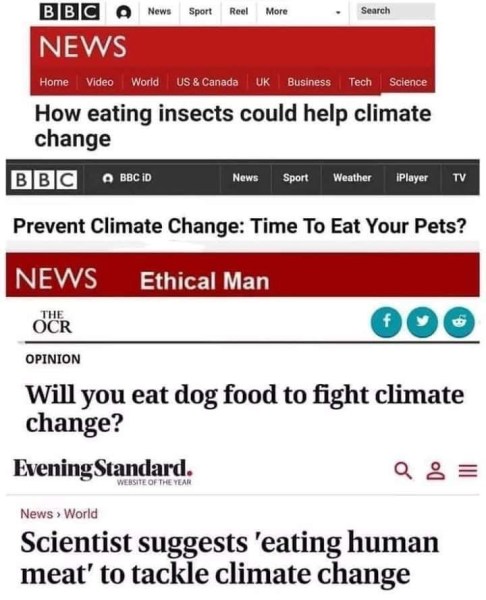
Last week the WEFers held their summer camp in China. More to come, they warned us. More pandemics, more catastrophic global warming, more inflation, hell on wheels, they promise us, Armageddon is coming. Be very afraid.
The following was a particularly lovely event:
“How to Stay Within Planetary Boundaries — Carrot or Stick?” which focused on whether to incentivize or force compliance with “climate goals”. It was hosted by some joker who edits a magazine called Nature Energy, no doubt funded by the WEF and read by exactly nobody. And some very po-faced morons of various colors, paid in the six figures, cited a bunch of falsified statistics ending with these pretty little paragraphs:
We are — broadly speaking — agreed that we need to get on track towards a net-zero, climate-safe and nature-positive future, but we know this will not be easy. And we’re going to need to change behaviours of both individuals but also the way that our industries and corporations and also our governments work and practices.
We’re going to need to do this through a mixture of carrots and hopefully perhaps not so many sticks, in some kind of mix. And there is a very active and live debate as to how we go about this. But we’re likely to see an increasing move towards more stick-like interventions …
These guys, they make me laugh. Seriously? How stupid do they think we are? How hated are they? All over the world, they are loathed and laughed at. Every time one of them is taken out, we laugh and laugh and laugh. Larry Fink from BlackRock? Hiding, Scared. Mocked, publicly humiliated. We need a lot more of that.
[…]
They have to destroy western culture, because we middle-class-unnecessary-eaters are too damned uppity. They have stolen so much that when the tipping point arrives, and it will, they will be hung from the highest tree. “Better to ruin those likely to catch and imprison us, and feed on peasants and serfs, the desperate in the rest of the world.”
Proof?
OK, let’s review the Biden/Trudeau/Macron/Sunak economy shall we? Since the out-in-the-open globalist theft of elections during the past three years — Sunak was installed, Trudeau is the most hated man in Canada, Biden is gaga and Macron is just crazy — this is what the bottom 50% are experiencing. Short form, ground into the dirt.
Ninety percent of the jobs “created” were those gained back after the pandemic. Most jobs are going to the foreign born – they work cheap.
Of the roughly 900 days Joe Biden has been in the White House, real wages have fallen for almost 700 days — about 75% of Biden’s time in office. All total, the collective drop in real wages has been 3% rather than the robust real wage gains workers deserve and expect.
Every single American has lost $36,000 to Biden’s inflation. It has crippled us, especially those working in the real (not digital) economy — Uber drivers, truckers, farmers, manufacturers, ranchers, the bottom 50% — gas prices have gone up 50%. Home heating up 23%, milk 16%, beef 25%, eggs 83%. Home prices 32%, rents 15%, electricity 21%.
Let’s not even talk about interest rates. Ten raises in the last 30 months. Last week the Bank of Canada gave its people $26 million in bonuses. Meanwhile, people are losing their houses.
How much more punishment are we expected to take? This is directly caused by their mad hatter spending during the pandemic — which was fake but for a few months in early 2020 — and their subsequent restriction of the energy supply. Restriction of energy causes prices to skyrocket because producing anything requires energy.
Canada has been one of the biggest freeloaders in NATO for more than 40 years
From the weekend Dispatch from the editors of The Line, some indication that even the American legacy media are tired of Canada’s generations-long peace dividend freeloading at the expense of our allies:

American media doesn’t often notice Canada, and as much as Canadians like to whinge about being ignored, the lack of interest in our affairs from south of the border is usually a good thing. If you’re looking for a rule of thumb here, it’s this: attention from the Americans is almost always negative.
A case in point this week was an editorial published by the Wall Street Journal on Wednesday, headlined “Canada is a military free-rider in NATO”. The subhed was “Ottawa still spends only a pathetic 1.38% of GDP on defense”. The editorial makes a number of points almost all of which will be familiar to readers of the Line, which are all variations of: Canada shirks its NATO commitment to spend two per cent of GDP on defence, while engaging in relentless virtue signalling and moral preening, both domestically and to its allies. It treats national defence as social project, while doing little to nothing in the way of actually projecting the power that is needed to defend the values it purports to advance.
There are some absolutely killer lines in the editorial, beginning with the lede: “Canadian Prime Minister Justin Trudeau was in Lithuania this week for the annual NATO summit, but it’s too bad there wasn’t a junior table where he could sit.” A few paragraphs later: “Last week Ottawa put in its two cents against cluster munitions. But asking its citizens to meet their actual obligations to the cause of freedom is apparently too much to ask.” And then: “Nowadays Ottawa can be counted on to ‘fight’ for human rights, which is to say that it talks a lot about them.”
Again, for anyone paying attention here in Canada, these are not new arguments. But the editorial does add one twist at the end, suggesting that if Canada can’t be bothered keeping its NATO commitments, then perhaps it should be kicked out of the G7 and replaced by a country willing to play a leadership role. They suggest Poland as a possibility.
Reaction in Canada has been surprisingly muted. On our own social media feeds, we noted a lot of rather sad attempts at dismissing the editorial — the paper is a Rupert Murdoch owned rag; this is Trumpist nonsense; Europeans juice their defence spending through useless mandatory service requirements. But curiously, we didn’t see anyone try to pull a Julie Dzerowicz and argue that, despite all evidence to the contrary, Canada is actually punching above its weight in NATO.
Look, some of us here at The Line have been reading harsh editorials on Canada’s defence spending for decades. (We’ve written a few, too!) And we’ve never seen anything remotely this harsh from an American outlet. This is absolutely devastating stuff, and it can’t be simply shrugged off because of the source.
A bit of history: In 1995, the Wall Street Journal published an editorial calling Canada “an honorary member of the Third World” in an editorial that also referred to the Canadian dollar as the “northern peso”. This was in response to Canada’s national debt and tax rates hitting unsustainable levels. We were an economic basket case, and the Americans were starting to notice.
Lots of Canadian commentators dismissed the editorial on the grounds that the WSJ was just pushing the supposedly-discredited Reagan/Thatcher/Mulroney “neoliberal” agenda. But later that year the Chrétien government, with Paul Martin as finance minister, introduced one of the most significant budgets in Canadian history. They slashed federal spending in ways not seen since the end of the Second World War, slashed the public service, gutted the department of defence. But three years later they had balanced the budget, inaugurating an extended period of federal fiscal responsibility that lasted until the election of the Trudeau Liberals in 2015.
The point is not that there’s a cause and effect here — Jean Chrétien and Paul Martin didn’t sit down and go “oh shit, the Journal has weighed in, we have to do something”. It’s that when serious American media get around to noticing stuff about Canada, it is usually because the stuff they are noticing has become such a problem for other countries that our national Emperor’s New Clothes routine is no longer tenable. It is a sign that things have to change, and quickly.
Remember, the Liberal government doesn’t deny that Canada is a NATO laggard and a free rider on defence. Justin Trudeau has admitted as much, both publicly and privately. But up till now, his attitude has been to sort of smirk at the Americans, give his usually smarmy shrug, and say “what are you going to do about it?”
What the Wall Street Journal editorial does is suggest that there could be real consequences for our professed indigence. It is one thing to be left out of AUKUS, which the Liberals continue to falsely characterize as a submarine procurement deal. Getting kicked out of the G7 would something else entirely — it’s the sort of thing the sorts of people who vote Liberal tend to care about.
Canada’s current attitude to collective defence is not sustainable. Our allies have noticed. Either we change, or our allies will change things for us.
QotD: Cavalry combat in Rings of Power versus history
The first thing we see is the cavalry in a great mass riding down into the village with Orodruin clearly behind them; they must be approaching then along the East road. Then we see a 2-horse wide column of cavalry crossing the narrow bridge from the West (at 39:14), then a bunch of orcs gather up into a mass to engage that cavalry force as it gallops up the main road into the village (from 39:16 to 39:26) before getting hit by the vanguard of that column in a really dumb moment we’re going to come back to at 39:30. And now look up at the village above there again and note that it takes one cavalry column at full gallop 16 seconds to go from that bridge to the inn, but the massive wave of cavalry coming over the hill from the other direction has still not managed by this point to actually enter the village proper. They have, apparently, frozen completely solid the moment they were off screen.
So it seems like, while galloping wildly to the rescue of a village they didn’t know was under attack, the Númenóreans also took the time to carefully work their way around the village in order to strike it from two sides at once (somehow filtering through the forest without being noticed, rather than working around the more open terrain to the north side; I cannot communicate clearly enough that cavalry generally avoids moving through forests for a reason), then galloped in at full speed. But the one direction they do not attack from is the North road, which is the only area that is clear and unobstructed (good cavalry ground) and where the slope of the ground is favorable (they’d be charging down hill) with enough space to form up into a proper charge. Instead when we see Galadriel next, she is charging up that hill.
So on the one hand this battle plan doesn’t make any sense, but at the same time I feel I must note just how inferior this is as film-making to the battle scenes in The Lord of the Rings (or even, dare I say it, Game of Thrones). I had to rewatch these scenes, slowly and carefully multiple times to get any sense of where anyone was. By contrast, good battle scenes are careful to make sure the audience understands the geography of the space. Hell, the “battle” scenes in Home Alone are careful to establish the geography of the place (I found the video at that link, by the way, a very approachable introduction to some elements of film study). In The Lord of the Rings we get a lot of big wide shots at high altitude showing us where the armies are in relation to each other […]
Moreover, Peter Jackson’s cavalry doesn’t simply show up. In both of his Big Cavalry Rescues at Helm’s Deep and Minas Tirith he follows the same highly effective pattern of first revealing the presence of the cavalry, then pausing a moment for the cavalry to form up and to give the characters there time for some dialogue and character beats. At Helm’s Deep this is a short exchange between Éomer and Gandalf, while at Minas Tirith it is Théoden’s big defining character moment and speech. From a realism standpoint, it gives the audience time to understand where the cavalry is and how they’ve set up (and a sense that this is organized, planned and prepared).
But this brief delay before “the good stuff” also serves an obviously important emotional narrative aspect that Rings also loses here: it builds anticipation. By the time Théoden is giving his speech outside Minas Tirith, the audience has been waiting for about an hour since the beacons were lit for this very moment of emotional release, waiting for the score to be evened, waiting for the emotional satisfaction of the bad guys getting their come-uppance and so Jackson draws that out just a little bit longer, which builds the anticipation that creates that intense emotional response when the charge at last surges forward. You can even hear the emotions he wants you feel in the music, which starts low and subdued but builds and builds as Théoden sets up his army and gives his speech, booms across the charge itself but then cuts hard to silence in the moment of impact – the moment of greatest suspense (will the charge work?) – before surging back as the charge succeeds, culminating in a big overhead shot showing the good guys winning. It is not historically perfect, but the emotional beats land flawlessly and Rings just fumbles shockingly on both counts.
The resulting melee is also confusing. This village is tiny and while we don’t have a good idea of Adar’s remaining force, it isn’t huge because it seems to all fit in this village which looks to be a fair bit smaller than a regulation soccer pitch. A cavalry charge should be able to run from one side of this road to the other in under 10 seconds (moving at c. 12m/s, a rough horse’s gallop speed); the two leading edges of this charge should be slowing down to meet in the middle in well under five seconds. Consequently the decisive phase of this battle, the one in which orcs are trying to hold the open ground between the buildings (these wide mud streets) should last only seconds, but instead it draws out into a minutes-long melee because, as far as I can tell, the Númenóreans have next to no idea how to fight on horseback.
The thing is, fighting from horseback is quite hard but it is also quite simple. If using stirrups, one’s feet remain in the stirrups pretty much the whole time because the goal here is to retain a firm seat on the horse. Horse archers will sometimes stand up just a little in the stirrups to create a stable firing platform, but only a little bit and at speed an observer may not even notice they are standing at all. But showrunners, it seems, just love putting in all sorts of equestrian tricks; Game of Thrones had to make the Dothraki shoot while standing on the saddle (not a great idea), and so Rings of Power has to do some trick riding. In this case they have Galadriel flip over the side of her horse upside down to slash at an orc while dodging an arrow […]
A close look and you can see that this trick requires a special handhold on her saddle just for the purpose (just like the Game of Thrones standing horse-archers required special trick saddles for that stunt too). And she then cuts an orc’s head off while flipping herself back on to the horse, a sword-stroke that is traveling in the opposite direction of her horse’s movement (it is moving forward, she is swinging backwards), which she cannot brace properly and thus, if it had hit anything but CGI would have been a fairly weak strike; fortunately for Galadriel, CGI orcs are very flimsy so their heads come straight off. The whole thing is a too-clever-by-half effort to look cool, which I also find a bit confusing because Elves don’t seem to me to fight on horseback very often in the Tolkien legendarium; they do it from time to time, but the great elf heroes tend to fight on foot, so it’s not clear to me why Galadriel has to also be the best rider. But that routine is then topped by the baffling idiocy of Valandil here who, despite having a perfectly good sword (though he seems to have lost his spear in the fighting) decides his best plan of attack is to jump off of his horse and tackle two orcs […]
Needless to say a high speed falling dismount is a good way to injure yourself in an actual battle but also that jumping off of your horse is not a good use of you or the horse. Meanwhile the rest of the Númenórean cavalry seem to have mostly come to a stop and are now having stationary fights with orc infantry; some of them get pulled down off of their horses which, yes, is the predictable result of being stupid enough to bring your cavalry to a full stop without of any kind of mutually supporting formation or infantry support. I think many of the problems in this sequence stem from the apparent need to have this seem like a fight that could go either way, when in practice this should have been a short and decisive engagement the moment the cavalry arrived, given that the cavalry is more heavily armored, faster, has the advantage of surprise and presumably outnumbers the orcs given how small the village is. I suppose it might take a bit longer because Adar’s first wave of orcs are hitting their respawn timer so there were adds. Once again the utter inability of the show to keep track of just how many orcs there are ruins any sense of tension but also any hope of the battle making sense; it sure seemed like there were just a few dozen orcs left, which ought to make a battle against 300 armored riders a remarkably short and one-sided affair.
But the moment in this whole fight that broke me completely actually came quite early right after the Númenóreans crossed the bridge. […] I will admit that I burst out laughing when this happened: the horseman ride up in a pair holding on to opposite ends of a chain, which they then use to clothesline about two dozen orcs while steadily fanning out. Once again this is one of those too-clever-by-half Hollywood tactics moments, which defy both physics and logic. The first problem is that I’m not clear on how long this chain is: they need to be holding it tightly or it is just going to snag on the first impact, but they also fan out meaning they need to keep letting out more chain to cover the increasing distance between the two horses. In practice looking at the stills it seems like the chain isn’t under much of any tension at all, which would make it fairly useless as a weapon here – sure a metal chain will have some momentum to it, but not enough to knock multiple ranks of armored troops down.
But of course the broader problem is that if the plan is to merely smash into the orcs with a lot of kinetic force you should just trample them. Putting all of that impact energy in the chain is just going to pull the rider off of their horse since the sole point of contact for that energy is their arms. By contrast, medieval knightly cavalry eventually adopted high-backed saddles, couched lances and lance-rests on their armor all to help keep the knight in his seat through the force of a heavy impact at full speed (cavalry with or without these various devices might need to let their point trail at impact that it wasn’t pulled from their hand but rather the movement of their horse pulled it from their target, a motion pattern easily observed in the modern sport of tent-pegging). But just carrying a chain gives none of these advantages or options: if there’s enough force to knock down a half-dozen orcs, there’s enough force to knock a rider out of his saddle.
Of course in an actual battle this wouldn’t even get this far because the other disadvantage of this chain is that it sacrifice’s the reach of a spear. Now, credit where credit is due, the Númenóreans do seem to have standard issue spears (good!), except for these two guys with the chain (a tactic that only works when advancing two-by-two, which is a terrible way to fight, through a narrow space where cavalry should not be, but nevertheless apparently one the Númenóreans come ready for as standard). No one seems to use their spears on horseback (they shift to swords immediately), but at least they have them. The advantage of a spear or lance of course is that it is a weapon which can project beyond the head of the horse, thus reducing some of the reach advantage an infantryman might have, while concentrating all of the energy of impact at a single point.
But the riders here have to hold this silly chain on their laps, which puts it several feet behind the head of their horse and because it isn’t perfectly taut it lags their motion meaning that it impacts the orcs several feet behind that, which means – as you can see above – the entire horse has to gallop past the target orc before he is hit by the chain. Any any time during that operation that orc could strike at the horse or the rider, spilling them both to the ground and to make the whole thing worse because the riders can’t have a sword or a shield in their hands, they can’t even defend themselves if an orc decides to do this.
Much like the ships, much like the falling tower trap, much like the nonsensical ring forging, it is another instance of the creators attempting to be novel and clever without really understanding the historical practices they are working from. Cavalry tactics, like battle tactics, like ship design, like metalworking, were fields of human endeavor that absorbed the sharpest minds humankind has to offer and persistent experimentation and adaptation for centuries, resulting in highly tested, highly refined patterns of behavior. I will not say that improvement on those practices is impossible, but it would certainly be very hard, the sort of thing which would itself require extensive dedicated study and experimentation. It is not the sort of thing likely to be accomplished in a writer’s room brainstorming session, which is why efforts to “outsmart” the past tend to end up looking silly, rather than clever.
Bret Devereaux, “Collections: The Nitpicks of Power, Part III: That Númenórean Charge”, A Collection of Unmitigated Pedantry, 2023-02-03.
July 16, 2023
Tricksy Tucker Carlson “tricked conservatives into accidentally thinking that they don’t like the former vice-president”
Chris Bray helps dispel the hypnotic trance so many American conservatives have been suffering under:

Tucker Carlson busy hypnotizing innocent conservatives to think they hate poor Mike Pence.
A stupid trend is emerging in the coverage of campaign discourse.
By now you’ve probably seen footage of Tucker Carlson interviewing Mike Pence in Iowa, a discussion that produced a memorable exchange regarding Ukraine. Politico would like you to know that it was a kind of hypnosis routine, a mental hijacking in which Carlson tricked conservatives into accidentally thinking that they don’t like the former vice-president.
The former Fox News host, reports the all-seeing Sally Goldenberg, “primarily used his perch to press candidates on issues of importance to him: namely, the United States’ role in the ongoing war in Ukraine.” As the United States sends cluster munitions to Ukraine and calls up thousands of reservists for “combat-ready” service in Eastern Europe, a journalist is asking political leaders about Ukraine only because it’s a quirky itch his ego needs to scratch — a selfish personal cause, pursued for whatever odd reason. Here’s Goldenberg’s eighth paragraph, and compare it to what you saw with your own eyes:
Carlson — a fierce Trump defender who later soured on the ex-president — challenged, interrupted and contradicted the soft-spoken Pence at nearly every turn. As a result, the devout Christian candidate faced hostility and jeers at a summit that would have once provided him with a friendly audience.
The hostility and jeers were inorganic and manufactured; they didn’t happen because the audience didn’t like Pence or his answers, but as a result of the performative maneuvering of an interviewer who challenged and contradicted him. It’s simply not possible that the audience actually didn’t like Pence or his answer; rather, journalism’s David Blaine pulled a “hey, do you wanna see some magic?” on them, whisking them away into a world of illusion. Tucker Carlson entered a thousand helpless brains and drove a Pence-loving audience away like a bus. The story goes on the say that “establishment Republicans expressed dismay,” accusing Carlson of “pro-Kremlin misinfo.” They don’t have to write these stories any more — they can just cut and paste from all the previous versions.
This is a template for all future campaign coverage: Voters were accidentally hypnotized today into wrongfully [fill in blank] after [select: Tucker Carlson / Donald Trump] challenged and contradicted more responsible leaders.
July 15, 2023
Environmental fanatics want to impose “austerity on steroids”
Brendan O’Neill points out the hypocrisy of the progressives who protest against anything smacking of government austerity — often merely a slowing down in the rate of increase of funding that they condemn as “cuts” — yet fervently desire to impose a form of austerity that would literally lead to hundreds of thousands or even millions of deaths:

There are countless contradictions on what passes for the left these days. We’re against sexism, they cry, and then they’ll while away entire days hounding every uppity broad who dares to question the trans ideology. We’re anti-racist, they say, even as they yell “Uncle Tom” at any person of colour who deviates from their white liberal orthodoxies. Be kind, they tweet, in between their venomous crusades against TERFs, gammon, boomers, deplorables, “semi-fascists”, you name it.
We’re against austerity, they insist, and yet then they agitate for an austerity of apocalyptic proportions. This, surely, is the most stark incongruity of the modern left. They rail against every library closure or reform of welfare payments as an intolerable assault on people’s living standards, and then they take to the streets in their thousands in support of a degrowth agenda that would plunge vast swathes of humankind into penury. They’re far meaner than any right-wing penny-pincher they claim to oppose.
[…]
Environmentalism is austerity on steroids. Consider one of JSO’s key demands: “No new oil or gas”. This would be – there’s no other word for it – psychotic. Not only would such a crazed policy instantly throw hundreds of thousands of people out of work, by decommissioning the rigs and mines where they make their living – it would also make it all but impossible to keep society going. The infantile moralism of modern greens would have us believe that vile oil and gas are only used to propel 4x4s and airplanes packed with the rich and other “bad things”. In truth, every facet of our lives requires energy from oil and gas. The delivery of foodstuffs, house-building, schools, hospitals, life-support machines, heaters to protect the elderly from death in winter – all need energy derived from fossil fuels. Or consider libraries. The left wept when Osborne’s cuts led to library closures, but you try running a library in your post-fossil-fuel dystopia. Without oil, gas, electricity and trees torn down to make books, libraries would cease to exist.
As Alex Epstein argues, to “rapidly eliminate fossil-fuel use” would make the world “an impoverished, dangerous and miserable place for most people”. Fossil fuels provide 80 per cent of the world’s energy. Just three per cent comes from solar and wind power, so beloved of green anti-modernists. And even that measly slice of global energy production is, in Epstein’s words, “totally dependent on fossil fuels, especially natural gas, for 24/7 back-up”. That is, if the wind doesn’t blow and the sun doesn’t shine, we have to crank up the fossil fuels. Ours is a world in which three billion people still use less electricity than your average American fridge. Agitating for less energy production in such a time is callous beyond belief. It would issue a death sentence on the world’s poor. George Osborne is Father Christmas in comparison with these crusaders against the gains and wonders of modernity.
One heartbeat away
Joe Biden is old and his age is clearly a factor in his declining ability to carry out his duties as President. If he dies or is forced to leave office before his term is up, Kamala Harris would succeed him. If that isn’t a scary thought, you haven’t been paying attention:

When it comes to preferences based on identity of one kind or another, it is difficult to know where to start with this insufferable and corrupt woman who may be the next President of the United States of America. First, she is a woman, or at least identifies as one. Second, she is a woman of colour. Third, she is black. Fourth, she is an Indian American woman. And last, but definitely not least, she is a woman of Afro-Caribbean heritage. In other words, she is highly qualified to achieve success in Biden’s America.
The daughter of two college professors, Kamala Harris is poised to become the first female president of the United States for one reason alone: her demographics. She is a very visible poster child for all that is wrong with the system of preferences and favoritism based on identity and immutable characteristics which has replaced the ideals of meritocracy and colour blindness.
Sadly, Vice President Harris is not alone. Those willing to trade their identity for professional advantage are growing in number by the day. Indeed, such individuals are being encouraged and are found aplenty throughout state and federal government, public schools and academia, corporations, and increasingly in law enforcement and the military.
Recently, Harris attended the Essence Festival of Culture, organised by Essence, a magazine aimed at black women. Asked to explain the role of culture in enhancing and securing the achievements of African-Americans, she treated her audience to one of her delectable word salads that have become the hallmark of her vice presidency.“Culture is …” she informs us after a slight pause, “it is a reflection of our moment and our time. Right?” she asks, seeking reassurance from her interlocutors. “And present culture is the way we express how we’re feeling about the moment and we should always find times to express how we feel about the moment. That is a reflection of joy. Because,” she adds, in an inexplicable allusion to Psalm 30, “[joy] comes in the morning,” before bursting into that cackling laughter which can engender suicidal thoughts in vulnerable people, including the current author.
She goes on: “We have to find ways to also express the way we feel about the moment in terms of just having language and a connection to how people are experiencing life. And I think about it in that way too.”
My goodness! Are those the words of a woman who could have access to the nuclear codes in just under two years? I am afraid they are. They are the words of someone whose rise to legislative and executive power has been determined entirely by the immutable characteristics of sex and race and the calculus of political advantage.
Only a nation which has abandoned the meritocratic values that made it great could produce such a paragon of ineffable mediocrity as Kamala Harris. Only a nation which has lost its aspirations to greatness will continue to elevate men and women to positions of high rank on the basis not of talent, ingenuity, and character, but demographic attributes that check the right boxes and ignore merit, privileging cosmetics over competence. If this madness continues (and it will take a lot more than the recent SCOTUS ruling to make it go away) such a policy will eventually spell doom for America, maybe sooner than you think.
July 14, 2023
QotD: Resolving “disagreements” on Wikipedia
And if there isn’t anything going on back there at all, you should probably still take the main article with a grain of salt because you might be reading a bunch of “everybody knows” gibberish without too much thought behind it.
M.K. Freeberg, “Latest Wikipedia Talk Page Mess: Socialism”, Rotten Chestnuts, 2012-12-01.
July 12, 2023
“Folksy” Joe Biden has always been a nasty piece of work
One of the most puzzling things about how Joe Biden has been represented in the legacy media is that — despite mountains of evidence that he’s a hot-tempered bully who has always been eager to belittle and demean other people — he still gets fawning coverage of his supposed kindly personality:

Joe Biden likes to present himself as a folksy type, the kind you’d think of as a kindly old uncle or something. He tells stories about Corn Pop and virtually anything else and the press eats it up.
But it’s a veneer, a mask Biden wears so the public will like him.
We’ve seen it slip a time or two, but Axios has a story that hints that what we’ve seen is just the tip of the iceberg.
In public, President Biden likes to whisper to make a point. In private, he’s prone to yelling.
Behind closed doors, Biden has such a quick-trigger temper that some aides try to avoid meeting alone with him. Some take a colleague, almost as a shield against a solo blast.
The president’s admonitions include: “God dammit, how the f**k don’t you know this?!,” “Don’t f**king bullsh*t me!” and “Get the f**k out of here!” — according to current and former Biden aides who have witnessed and been on the receiving end of such outbursts.
…
“There’s no question that the Biden temper is for real. It may not be as volcanic as Bill Clinton’s, but it’s definitely there,” said Chris Whipple, author of The Fight of His Life: Inside Joe Biden’s White House.
Whipple’s book quotes former White House press secretary Jen Psaki as saying: “I said to [Biden] multiple times, ‘I’ll know we have a really good, trusting relationship when you yell at me the first time.'”
Whipple notes: “Psaki wouldn’t have to wait long.”
Zoom out: Biden’s temper comes in the form of angry interrogations rather than erratic tantrums.
He’ll grill aides on topics until it’s clear they don’t know the answer to a question — a routine that some see as meticulous and others call “stump the chump” or “stump the dummy”.
Being yelled at by the president has become an internal initiation ceremony in this White House, aides say — if Biden doesn’t yell at you, it could be a sign he doesn’t respect you.
Go and read the whole thing, because this is troubling, and not just because I dislike Biden.
While Axios goes out of its way to paint this as just an impassioned politician who demands much of his staff, that’s not what I’m seeing here.
Instead, I’m seeing an abusive man who is taking advantage of his powerful position to bully his subordinates.
I won’t pretend I’ve never lost my temper before. Doing so would be a lie. However, my yelling at someone has never been a sign of respect. It’s been a sign that I lost control.
And if Biden is doing it this often, there’s not much chance the man has any control over much of anything.
Of course, this is a report from Axios. Maybe it’s not really a thing. Maybe I’m just reading too much into it because I can’t stand Biden.
QotD: Media gullibility on military issues
The Media, of course, does not do this. They’d be happy to write up a whole big feature story about how the Russians’ Q-35 matter modulator wasn’t nearly what Vlad Putin, that lying bastard, bragged it up to be. And with the new Lepage gun gluing all those Russian planes together, the brave Ukrainians will be in Moscow for Easter!
Are they lying? Not really. Some very serious-looking persyn in a snazzy uniform with a lot of very colorful ribbons told them that the Q-35 matter modulator isn’t all that, and why would some brave freedom fighter lie to them? And besides — this is crucial — “fact checking” the stats on the Q-35 matter modulator would entail that you’ve never heard of it before …
… which is anathema to our intrepid reporterette’s sense of xzhyrself as a hard-hitting newshound who is very very Smart. After all, she scored a 35,000 on her SATs and graduated from the Assjammer School of Journalism with a 9.98 GPA. She’s got fellowships and awards and whatnot out the yingyang, plus 1.2 million Twitter followers. And it says “war correspondent” right there on her Facebook page. If the Q-35 matter modulator weren’t actually a thing, surely she would know.
Severian, “The Becky Cycle”, Founding Questions, 2023-02-27.
July 11, 2023
Western legacy media is suffering from an overdose of Professionally Correct speech
David Friedman can’t help but notice this phenomenon:
When the question of alcohol and health came up on “Doctor Radio”, a satellite radio program, all of the participants agreed that evidence showed that consuming a moderate level of alcohol, something like one beer a day for a woman, one or two for a man, or the equivalent in other drinks, was good for you, better than no alcohol at all. All of them also agreed that they would not advise their patients to do so.
Why? They mentioned that there were problems with prescribing something that depended on the exact dosage and that a higher level of consumption was likely to lead to auto accidents, but distinguishing one beer a day from three is not a difficult problem even for those who are not doctors. My conjecture was that the real explanation was the reluctance of doctors to appear to be on the wrong side. Everyone knew that alcohol was a bad thing, a source of auto accidents and various medical (and other) problems. By giving a truthful account of the medical evidence the doctors on the program might appear to be pro-alcohol; all good people are anti. Hence they had to qualify their conclusion as a purely theoretical matter, not something that would affect what they told their patients. Think of it as a different version of PC — Professionally Correct speech.
A similar pattern exists for ice cream. Multiple independent studies have found evidence that consuming ice cream reduces the chance of getting diabetes — and found ways of explaining the evidence away. In several cases they have gone so far, in public statements, as to report that yogurt is protective against diabetes, other dairy products are not, when ice cream in their study showed as strong, in some studies a stronger, effect than yogurt.
Yogurt, as everyone knows, is a healthy food. Ice cream, as everyone knows, is bad for you.
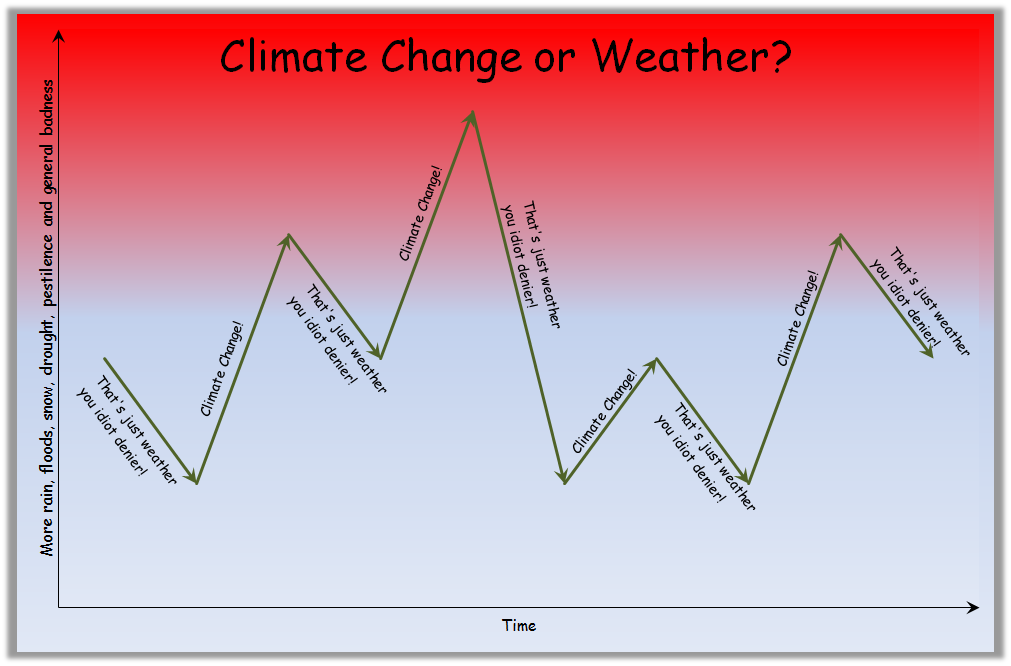
From time to time I see a news story on some piece of scientific research that somewhat weakens the case for taking strong action against global warming. I believe that every time I have seen such a report it was accompanied by a quote from the researchers to the effect that global warming was a serious problem and their work should not be taken as a reason to be less worried about it. They almost certainly believed the first half of that, but their work was a reason to be less worried even if not to stop worrying.
Good people are on the side that believes that warming is happening, is anthropogenic, is a serious problem that needs to be dealt with immediately. Bad people deny one or more of those claims. If that is what all the people who matter to you, such as the fellow members of your profession, believe, and you are so unfortunate as to produce results that strengthen the bad people’s case, it is prudent to make it clear that you are still on the side of the angels. Just as, if you are so unfortunate as to be an honest doctor aware of the evidence in favor of alcohol, it is prudent to make it clear that you have not transferred your allegiance to demon rum.
The obesity crisis … fuelled by iatrogenic public health warnings about certain food groups
Here’s The Armchair General with another example of what he calls COGOs – Crisis of Government Origin:
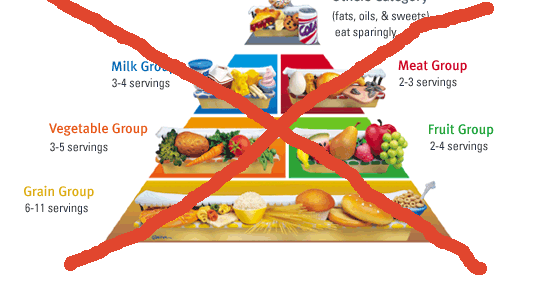
So, after the decades-long crusade against saturated fats, we have a population that has been repeatedly told that fat will kill us. So, many people eschewed fats in favour of salt and sugar. Which, apparently, are also bad for us.
But without saturated fats, remember, people are not going to feel sated. So, what is likely to happen? Well, just what did happen — never feeling full, people feel hungry throughout the day so eat continually through the day: a behaviour known as “snacking” …
Nutritionists believe many people are obese not because they binge on fatty main meals but because they indulge in constant grazing throughout the day without even realising it.
This pattern, dubbed “auto-eating”, involves resorting to snacks and treats at the slightest indication of hunger.
Or, rather, people always feel hungry because they have been told to avoid saturated fats. And they snack on chocolate bars and biscuits and small things that provide a pleasant sugary boost.
Combine this with an increasingly sedentary population — both at home and at work — and other comforts (such as central heating which leads to fewer calories being expended on maintaining body temperature), and…
BOOM! You have an obesity problem.
And now — nearly seventy years after some arrogant doctors used some extremely dodgy studies to enhance their reputations, we now know that what we were told about the harms associated with saturated fats was all absolute bollocks.
And so, once again, we can demonstrate another Crisis of Government Origin (COGO), ably assisted by the arrogant fuckers of the medical profession.
Unfortunately, the government legislation is already in place, and it will take at least three years for the fuck-nuggets in politics to catch up — if they ever do. After all, they are going to have to undo decades of medical advice, government food advice, leaflets, bus adverts, nutritionist training, and social conditioning.
Just another reason why governments should stay the hell out of our private lives. Such up — and fuck off.
July 10, 2023
“De-banking” is the financial world’s version of cancelling someone
At the Free Life blog, Alan Bickley considers the recently reported rash of prominent (and not-so-prominent) critics of the British government being refused service by their banks and further refused permission to open new accounts with any other chartered bank. Being “cancelled” by social media companies is bad, but being “de-banked” in a modern economy is worse than being declared a “non-person” by a totalitarian regime:

“The bank of England. London.”by Demetrio Neri_1959 is licensed under CC BY-NC-SA 2.0


In the past month, we have heard that various rich and well-connected people have had their bank accounts closed, seemingly because of their dissident political opinions. The same has happened to other people who are much poorer and without connections. Twenty years ago, the same happened to the British National Party. There is a simple libertarian response to this.
No one has the right to coerced association with anyone else. If someone comes to me and asks me to provide him with services, I have an absolute right to say yes or no. If I am uncharitable enough to dislike the colour of his face or what he does in bed, so much the worse. I may lose valuable business. But it is my time, and it is my choice. If anyone starts a whine about the horrors of discrimination, he should be ignored. We have an absolute right to discriminate against others for any reason whatever.
This being said, the position becomes less clear when state power of some kind is involved. Banks in this country require a licence from the State to operate. This protects them from open competition. It also gives them access to services and information from the State that are not given to other persons or businesses. If a bank finds itself in serious financial difficulties, it has at least a greater chance than other large businesses of being saved by the State – by a coordination of support by others or by direct financial help. The State has also made it illegal for many transactions to be made in cash. If I try to buy a car with £20,000 in cash, the car dealership is obliged to refuse my business, or to make so many enquiries that accepting my business is too much trouble. In effect, anyone who wants to spend more than a few thousand pounds in cash is obliged by various actual and shadow laws to use a bank account.
So we have privileged corporations and an effective legal obligation for people to do business with them. This entirely changes the libertarian indifference to commercial discrimination. The banks are a privileged oligopoly. The banks compete for custom among a public that is free to choose one bank rather than another, but that is compelled to choose some bank. For this reason, since the relevant laws will not be repealed, it is legitimate to demand another law to offset some of the effects of the others. Banks should be legally obliged to accept the business of any person or group of persons without question. Limitations on what services are provided must be justified on the grounds of previous financial misconduct as reasonably defined. For example, it should be permitted for a bank to refuse an overdraft to someone who is or has recently been bankrupt, or whose spending habits are obviously reckless. Perhaps it should be permitted for a bank to refuse to lend money for purposes it regards as scandalous as well as commercially unviable. Therefore, a representative of the White Persons’ Supremacy Foundation, or the Vladimir Putin Appreciation Society, should be able to walk into any bank and open an account – with no questions asked. If an account is refused, there should be a legal obligation on the bank to provide a full explanation of the refusal. If the refusal is not made on valid commercial grounds, there should be a right of appeal before a tribunal which does not award costs, and this tribunal should have the power to grant punitive damages against any bank found to be discriminating on any grounds but the validly commercial.
The refusal of banking services is only the beginning of a new and sophisticated totalitarianism. What the banks can do can also be done by supermarkets, by Internet service providers, by hotel chains, by airlines and railway companies, and by utility providers. There is indeed a good case for insisting on a law forbidding any organisation that has the privilege of limited liability from any but obviously commercial discrimination.
“… the Western world is failing — culturally and economically — because the government now has a hand in so much of society”
The Armchair General would almost certainly agree with my frequent lament that the more the government tries to do, the less well it does everything:
There is a famous quote by American journalist and satirist H.L. Menken, which has been deployed by many political writers over the years:
The whole aim of practical politics is to keep the populace alarmed (and hence clamorous to be led to safety) by an endless series of hobgoblins, most of them imaginary.
It is an enduring quote because it has the ring of truth1, and it certainly fits with the Machiavellian aspect of politics. This attitude was, without doubt, deployed by governments across the world during Covid (and, to some extent, still is).
Your jaundiced2 General would like to propose a related, alternative and rather more plausible soundbite that, I believe, more adequately describes the Western world in the twenty-first century:
The whole consequence of practical politics is the keep the ignorant populace alarmed (and hence clamorous to be kept in comfort) by an endless series of colossal fuck-ups, labelled as crises, caused entirely by the government.3
Every time that you see the media whipping up a frenzy about a “crisis“, you can be 99% sure that the issue in question has been caused by the state — and that the real solution is to remove the government intervention. And that is never, ever the action actually proposed.
Crises of Government Origin
Your jaundiced General refers to these phenomena as “Crises of Government Origin” (COGO), and will form the back-bone of a series of posts titled with that acronym. Many of the issues are interlinked, and most are absolutely critical if we are ever to confront the economic and social issues facing us today.These include (but are not limited to):
- the energy crisis;
- the Climate Warming / Change / Heating crisis;
- the housing crisis;
- the NHS staffing crisis;
- the police shortage crisis;
- the obesity crisis;
- the education crisis;
- the pandemic crisis;
- the productivity crisis;
- the activist “charity” crisis;
- the drugs crisis (Scottish edition);
- the rape gang crisis;
- the intersectional and gender crisis;
- just about any other “crisis” you can think of.
To be sure, the UK government is not the worst in some of these areas — but, since it is in UK that my comfy leather armchair is situated, it is the rampant stupidity of our own governments that I shall concentrate on. And no, not all of these posts will include reminding people that Grant Schapps is a prick.
I can promise that every one of them will include illustrations demonstrating the mind-gargling incompetence of our governments (of all persuasions) and “Rolls Royce” civil service4.
The law is a blunt instrument, and the government is really inefficient at doing anything at all.
Fundamentally, the Western world is failing — culturally and economically — because the government now has a hand in so much of society. And the UK is in the vanguard of this malaise as Sharon White, at the time Permanent Secretary to the Treasury (and currently fucking things up in typically Rolls Royce civil servant fashion at John Lewis), said (in a rare example of her being right) in 2015 at the Institute for Government:
The UK is “almost the most centralised developed country in the world”.
Indeed it has been observed that, by some measures, the UK is more centralised than Soviet Russia. This is why we are failing.
The Crises Of Government Origin (COGO) series aims to examine some of these failures — large and small. For starters, let’s have a look at Hate Speech laws and why they are so dangerous.
1. The same applies to Menken’s definition of Puritanism: “The haunting fear that someone, somewhere, may be happy”.
2. Caused less by poor mood than incipient liver failure. Now pass the port, would you, old chap. No, to the left, you fool!
3. Yes, yes — I realise that it needs honing, but it will do for now. Feel free to submit more elegant versions in the comments.
4. Snork.
Barbara Kay – “[M]any Canadians [suffer] from highly contagious, patriotism-suppressive Post National Syndrome”
Canadians are deluged with messages that imply — or explicitly demand — that they should be ashamed of Canada and of being Canadians. That there is nothing to celebrate in our history or cultural achievements and instead we should humbly beseech forgiveness for our many, many, many sins. Barbara Kay disagrees:
On Canada Day, near St. Sauveur, Quebec, we were treated to torrential rain, hail, nearby tornado warnings, and continually flickering power. Not a day for fireworks. Just as well, since fireworks are the last thing one craves when one suffers, as many Canadians do, from highly contagious, patriotism-suppressive Post Nationalism Syndrome.
This scourge cannot yet be cured, since it was intentionally cultivated and released into the environment by the current government. Only herd immunity can end it. However, the symptoms of Post Nationalism Syndrome can be alleviated by certain traditional antivirals, like National Postism. Last Saturday’s NP featured several commentaries that buoyed my spirits, in particular Michael Higgins’s misery-loves-company column, “Stop shaming and start celebrating Canada”.
Higgins enumerates recent examples from a tiresome litany of complaints by our elites that “want to turn us into a nation of self-flagellating penitents”. The National Gallery of Canada insinuates that Canada’s iconic artists, the Group of Seven, are linked to white supremacy; a parliamentary motion endorses the residential school system as “genocide”; the attorney general actively considers legal sanctions against “denialism” — dissent from genocide as a proper descriptor (including me); and the erasure of Sir John A. Macdonald’s name from the eponymous Parkway.
In a nearby feature, the false claim that Macdonald was a guilty party in the alleged schools genocide was handily demolished by lawyer Greg Piasetzki, titled, “John A. Macdonald saved more indigenous lives than any other prime minister”. This evidence-based rejoinder to sticky defamatory myths about Macdonald is an excerpt from a new book of essays by 20 writers, The 1867 Project: Why Canada Should be Cherished — Not Cancelled, published by the Aristotle Foundation, and edited by its founder and president, Mark Milke.
Piasetzki’s essay mirrors the 19 others in its forthright challenge of our culture’s reigning anti-western dogmas, which brand Canada as a failed nation. Every author encourages the pride in being Canadian that has not dared to speak its name since Justin Trudeau came to power. I highly recommend it. If enough Canadians read it, we might arrive at herd immunity to Post Nationalism Syndrome.


